
- Google Map Pack Dominance: Why 42% of all local search clicks land in the top three map listings, and how to claim your spot using proven local ranking factors.
- Generative Engine Optimization (GEO): The exact structured data and content strategies required to get recommended by ChatGPT, Gemini, and Google AI Overviews.
- Review Velocity & Sentiment: How to use customer feedback to satisfy both human searchers and machine-learning algorithms.
- Seasonal & Service-Specific Targeting: Structuring your website to capture high-ticket repairs during critical seasonal rushes.
How can my RV repair shop dominate Google Maps and AI search?
To rank your RV repair shop at the top of Google Maps and win recommendations in AI search engines like ChatGPT, you must optimize your Google Business Profile (GBP) using exact categories, implement structured schema markup, and drive consistent, keyword-rich customer reviews. Independent shops and mobile technicians must adapt to dominate local search. Here’s exactly how to do it, step by step. We’re a small business ourselves, and we get it because we’ve lived it. Running a local service business is hard work, and your marketing should work just as hard as you do to keep your bays full.
Traditional search engine optimization faces its sharpest transition in a decade. The rules have changed. With 46% of all Google searches carrying local intent, local visibility remains the core driver of service-oriented businesses. The rise of AI-driven search engines means that simply ranking on page one of organic results is no longer enough. You must optimize your digital footprint so that Google keeps fine-tuning how it finds the best answers and how large language models (LLMs) confidently recommend your shop. This is about ensuring that the small businesses driving America forward aren’t left behind as technology evolves.
The zero-click reality: Why Google Maps and AI define modern RV repair discovery
Understanding the shift to zero-click searches
The numbers are unmistakable enough to demand a strategic rethink. Over 58% of local searches now end without a click to an external website: users find the phone number, the hours, and the service list directly on the search results page. For an RV owner stranded at a campsite outside Flagstaff with a blown slide-out actuator, that effortless answer is exactly what they need. They’re not browsing; they’re triaging.
Google’s Map Pack sits at the center of this behavior. Visibility is everything. The top three local listings capture 42% of all local search clicks, which means the businesses outside that cluster are effectively invisible to the majority of high-intent searchers. This is demonstrated in recent RV Repair case studies, which prove that targeted local visibility directly solves this revenue problem.
The urgency of this dynamic is particularly acute for RV service providers because the searcher’s context is often physical distress: a leaking roof, a dead generator, or a coach that won’t start. These users need immediate, effortless answers: a phone number they can tap, operating hours that confirm you’re open, and enough review data to trust you with a $100,000 vehicle. Your digital storefront must deliver all of that before they ever reach your website.
The rise of generative engine optimization (GEO)
Generative Engine Optimization is the discipline of structuring your content so that AI models, such as ChatGPT, Google Gemini, and Perplexity, can parse, assemble, and cite your business in their generated responses. It’s a distinct shift from traditional keyword targeting, and most independent RV shops haven’t started thinking about it yet.
When someone asks Google, “Where can I get emergency mobile RV slide-out repair in Denver?” the AI Overview at the top of the page doesn’t just list websites. It assembles an answer, pulling from structured business data, review text, and authoritative service pages to recommend specific providers by name. Google’s AI Overviews affect SEO by consolidating web data to present a single, authoritative recommendation. If your data isn’t machine-readable and citation-ready, you won’t be in that answer. A competitor with a cleaner technical architecture will be. Do not let them.
This shift, which moves from a ranked list of blue links to an assembled, direct answer, requires a strategic pivot that goes well beyond traditional on-page SEO. Understanding AI transforming SEO is no longer optional for shops serious about long-term growth; it’s the operating context for every optimization decision you make from here forward.
The local search landscape now favors a zero-click model where users get their answers directly on the search results page. Recent search data reveals that 58% to 60% of all searches now end without a single click to an external website. When an RV owner searches for emergency services, Google’s AI Overviews or the local Map Pack answers their query instantly, displaying phone numbers, reviews, and operating hours directly on the screen. This means your digital storefront must be perfectly optimized to capture attention at the very first glance.
To survive this shift, independent shops and mobile RV technicians must focus on optimizing their websites for AI-driven local search engines. This strategy requires structuring your online data so that AI engines like ChatGPT, Google Gemini, and Claude can easily crawl, understand, and recommend your services. By feeding these engines clear, machine-readable information, you ensure your business is selected as the premier local solution when AI models assemble recommendations for stranded travelers. This is how we level the playing field against massive national dealership networks. Sophisticated marketing belongs to you, too.
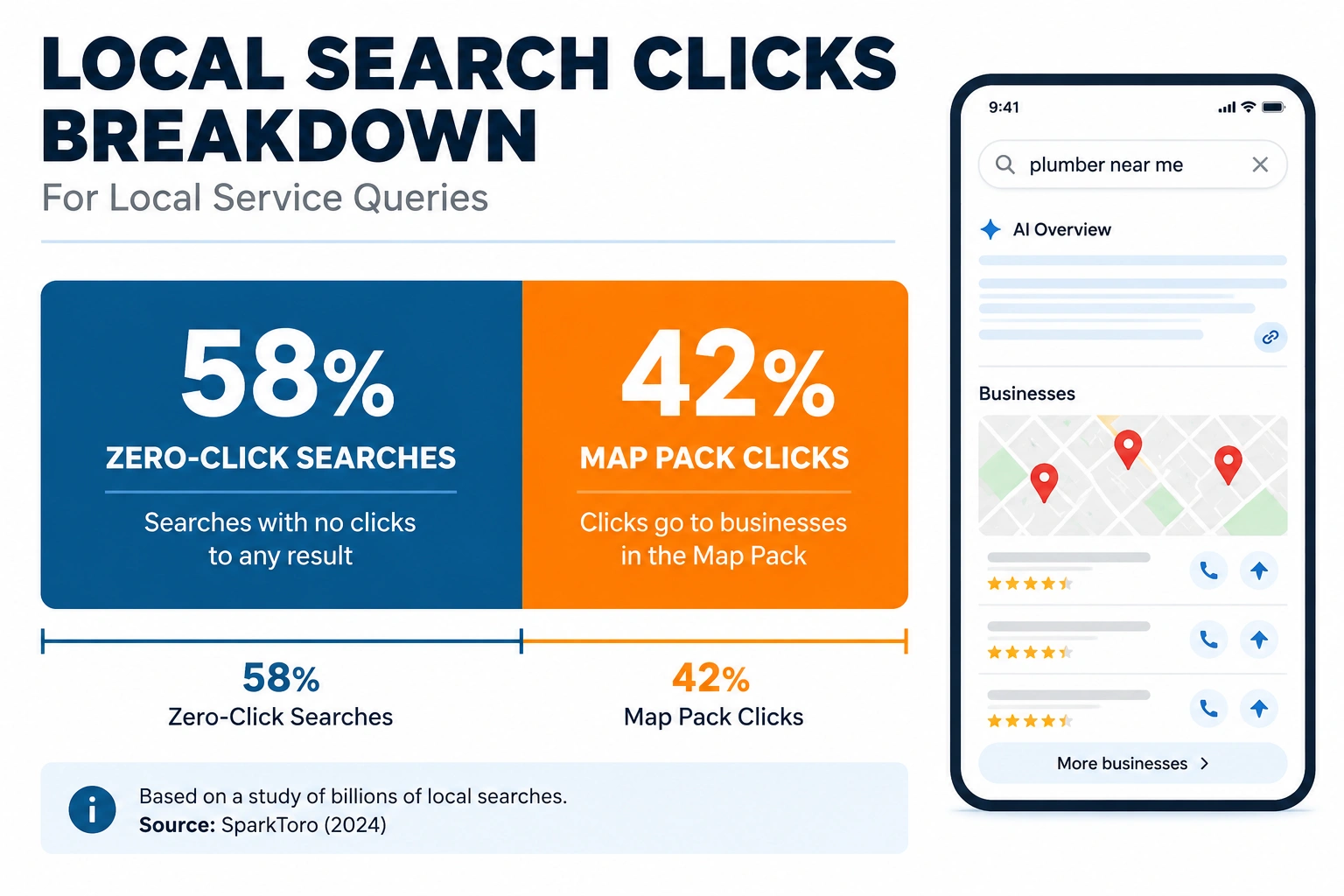
Local service searches are increasingly resolved without a click, while 42% of engagement flows through Google’s Map Pack.
Claiming the Map Pack: The three pillars of local proximity and prominence
Relevance and category alignment
Category selection in your Google Business Profile is not a minor detail. It’s the primary signal Google uses to match your listing to a searcher’s query, and getting it wrong, even slightly, costs you placement in searches that should be yours by default.
Your primary category must be “RV repair shop” according to Google. Not “RV dealer.” Not “trailer repair shop.” Not “auto repair shop.” The algorithm associates that specific category with the highest-volume RV repair queries, including “RV repair near me” at 74,000 monthly searches and “mobile RV repair near me” at 40,500 monthly searches. Secondary categories like “Trailer repair shop” or “RV supply store” are appropriate additions only when those represent genuine, active revenue streams: stacking irrelevant categories weakens your primary relevance signal.
Keyword alignment extends into your services section. Each service listing should use the language your customers typically search, not the internal terminology your technicians use. “Slide-out calibration” is precise and searchable. “Mechanism adjustment” is neither.
Proximity and service area strategy
Proximity is the one ranking factor you can’t directly engineer. Google defaults to the closest provider for most unqualified local queries, which puts shops on the geographic fringe of a metro area at a structural disadvantage. The strategic response isn’t to pretend the constraint doesn’t exist: it’s to maximize the factors you can control. Focus on what you can influence.
For mobile technicians, Service Area Business (SAB) compliance is where this gets operationally specific. Google’s guidelines require hiding your residential address from public view and defining your service territory within a 2-hour driving radius, following the Google Business Profile guidelines for mobile mechanics. Rather than drawing a broad geographic circle, explicitly list individual ZIP codes and municipalities within your service area under the Google Business Profile – Service Areas rules. That granularity signals precise geographic relevance to Google’s proximity algorithms in a way a radius circle simply doesn’t.
NAP consistency, which means keeping your Name, Address, and Phone identical across every local directory listing, functions as supporting evidence for your location data. Think of it as making sure your business name, address, and phone number look the same everywhere online: Google notices when they don’t. Inconsistencies across Yelp, Apple Maps, and industry directories don’t just create confusion for customers; they introduce conflicting signals that weaken Google’s confidence in your proximity data.
Prominence and review velocity
Prominence is Google’s measure of how well-known and trusted a business is, and it’s the factor that can most directly offset a proximity disadvantage. A shop two miles farther from the searcher can outrank the closest competitor if its prominence signals are markedly stronger. And that’s not theoretical. Whitespark and BrightLocal have documented what works best for businesses like yours. This evidence-based approach shows how high prominence can overcome proximity disadvantages, similar to the results shown in several RV case studies.
Review velocity, meaning the frequency and recency of incoming reviews, is one of the clearest prominence signals available to independent shops. An active review profile tells the algorithm that your business is operating, trusted, and generating real customer interactions. Trust must be continuous. Volume matters, but so does recency; a shop with 200 reviews and no new ones in six months reads as inactive compared to a competitor with 80 reviews and a steady weekly cadence.
- Relevance: Aligning your Google Business Profile (GBP) categories precisely with high-intent search terms. Your primary category must be “RV Repair Shop” or “RV Service Center,” with secondary categories covering “Trailer Repair Shop” or “Mechanic.”
- Proximity: Optimizing your service area settings. Instead of drawing a broad radius, explicitly list individual ZIP codes and municipalities to signal precise geographic relevance to Google’s proximity algorithms.
- Prominence: Driving consistent review velocity and profile engagement. Google’s algorithm favors active profiles that regularly upload photos, answer customer questions, and publish weekly updates. Anchoring your prominence strategy in local SEO strategies ensures you’re building on a durable foundation.
Optimizing your Google Business Profile for maximum conversion
Completing the services menu and categories
Most GBP service menus are embarrassingly sparse. A single line item that says “RV Repair” tells Google almost nothing, and it tells a prospective customer even less. Each service listing should function as a micro-landing page: a specific name, a clear description, and enough detail that both the algorithm and the human reading it understand exactly what you do.
High-ticket services deserve individual entries. “RV roof resealing,” “slide-out mechanism repair,” “holding tank plumbing,” and “solar inverter installation” are each distinct search queries with their own monthly volume. Bundling them under a generic heading loses that specificity. Attributes matter here, too. Flags like “Identifies as veteran-owned,” “On-site services,” and “Appointment required” match specific search filters that self-selecting customers frequently select.
High-volume photo cadence and geo-tagging
Profiles with 100+ photos receive 520% more customer actions than those with fewer than 10. That gap is large enough that photo volume alone can significantly shift conversion rates, independent of any other optimization.
What you upload matters as much as how often. Authenticity drives trust. Before-and-after sequences of roof reseals, service trucks staged at job sites, and clean, organized service bays communicate capability in a way that stock imagery never will. Photos taken directly at service locations, rather than edited and uploaded from a desktop, carry embedded geographic metadata that provides organic location signals to Google’s indexing system. This small technical detail has a compounding effect over time, helping your profile show up in search results across your entire service territory and outrank competitors who rely on generic stock photos.
Service area polygons and video verification
Mobile RV technicians face a verification challenge that brick-and-mortar shops don’t. Navigating the Google Business Profile video verification process for mobile RV techs requires you to document your operation in real time: street signs or neighborhood landmarks near your base of operations, professional tools and a branded service vehicle, and proof of business management: typically unlocking the vehicle or displaying business registration documents on camera.
The process is more demanding than it sounds, and Google applies it erratically across regions. Some technicians pass on the first submission. Others face suspensions despite submitting identical documentation. If your profile gets suspended, the correct response is to correct any guideline violations, gather official proof of business registration, and submit a formal appeal through the Google Business Profile appeals tool. Do not create a duplicate listing. That path leads to permanent suspension.
- Complete the Services Menu: Create individual service listings for high-ticket repairs, such as “RV roof resealing,” “slide-out mechanism repair,” “holding tank plumbing,” and “solar inverter installation.”
- Maintain a High-Volume Photo Cadence: Profiles with 100+ photos receive 520% more customer actions than those with fewer than 10. Upload weekly, geo-tagged photos of actual repairs, your service trucks, and certified technicians.
- Configure Service Area Polygons: If you operate a mobile RV repair service, do not list a physical address if customers cannot visit your shop. Instead, define your exact service boundaries using precise geographic polygons to prevent profile suspension. A thorough approach to Google Maps optimization ensures your profile remains bulletproof under Google’s evolving verification standards.
Is your Google Business Profile leaking high-value leads?
Think of your Google Business Profile like your storefront’s digital window display: it’s what people see before they ever walk in or call. Get a detailed, 100% free Local SEO Market Analysis from BizIQ. We will audit your profile, analyze your local competitors, and show you exactly what is blocking your shop from the top 3 spots. Claim Your Free SEO Audit Now →
The review engine: Driving velocity and sentiment to train AI algorithms
Reviews as algorithmic training data
Reviews do more than provide social proof for human buyers; they act as critical training data for search engine algorithms. BrightLocal’s consumer research indicates that 42% of all local search clicks land directly in the top three Map Pack listings, which are heavily influenced by review volume and star ratings. Furthermore, AI search engines scan the actual text of your reviews to understand your business’s specific capabilities and strengths. A steady stream of fresh, detailed reviews is the most accessible fuel source for your local search engine.
Response engagement amplifies this effect. Do not ignore them. Responding to 100% of reviews, both positive and negative, signals active management to Google’s algorithm. It also signals something more fundamental to the humans reading those responses: that someone at your shop is paying attention. BrightLocal’s consumer data shows that 88% of consumers are highly likely to use a business that actively replies to all of its online reviews, establishing a direct link between response engagement and customer acquisition.
Contextual keywords in customer reviews
The written text of your reviews is as important as the star rating. Search engines build entity associations between specific services mentioned in review text and your business listing. When a customer writes, “They did an amazing job with my Winnebago roof leak repair in Denver,” the AI indexes that relationship. Your shop becomes associated with Winnebago repairs, roof leaks, and Denver, all from a single organic review.
This is why training your technicians to ask for specific reviews matters. The ask doesn’t need to be scripted or awkward. Keep it simple. Something as direct as, “If you wouldn’t mind leaving us a Google review, it really helps if you mention what we worked on and where you’re located,” is enough. Over time, a review collection filled with service-specific and location-specific language helps you rank for the exact conversational queries that AI engines are increasingly fielding, queries like “Who is the best Winnebago roof specialist near Denver?”
“According to BrightLocal’s Local Consumer Review Survey, 88% of consumers are highly likely to use a business that actively replies to all of its online reviews, establishing a direct correlation between response engagement and customer acquisition.”
To rank for highly specific queries, your reviews must contain contextual keywords. When a customer leaves a review saying, “They did an amazing job with my Winnebago roof leak repair in Denver,” AI engines index that semantic relationship. This direct association allows the AI to confidently recommend your shop when a user asks, “Who is the best Winnebago roof specialist near Denver?” It’s like giving Google a cheat sheet: you’re literally letting your customers tell search engines exactly what your business does, where, and how well you do it.
Structuring your website for AI crawlers and generative search engines
LocalBusiness schema markup implementation
Schema markup is structured code embedded in your website that translates your business information into a standardized format machines can parse without confusion. Think of it as an AI passport: it tells crawlers your exact NAP data, geo-coordinates, operating hours, services offered, and sameAs links pointing to your Google Business Profile and social accounts, all in a single, machine-readable block.
JSON-LD is the preferred implementation format for both Google and AI crawlers. It is clean and efficient. It sits cleanly in the <head> of your page without clashing with visible content, and Google’s documentation explicitly recommends it over Microdata or RDFa. The properties that matter most for local service businesses are @type: "AutoRepair" nested within LocalBusiness, your precise geographic coordinates, and a hasOfferCatalog block that lists your individual services by name.
Structured data for AI extraction
Google’s AI Overviews operate on a Retrieval-Augmented Generation (RAG) pipeline, meaning the AI pulls real-time data from structured sources to cite in its synthesized responses. Websites that provide direct, unambiguous answers to common questions are frequently cited. Websites that bury their information in dense prose are not. Clarity wins.
FAQ sections and pricing tables are the two most effective content formats for AI extraction. A page for “RV roof repair” that includes a structured FAQ with entries like “How much does RV roof resealing cost? ($800 to $2,500 depending on roof material and linear footage)” gives the AI exactly what it needs to cite your business in a response to a cost-related query. That specificity, including defined price ranges, clear process steps, and named materials, is what separates citation-ready content from content that gets ignored. This is a key part of Answer Engine Optimization and understanding the full AI Overviews and SEO impact on local service businesses.
To help search engines and LLMs read your website efficiently, implement advanced technical markup. LocalBusiness structured data schema acts as an AI passport, translating your physical address, phone number, services, and operating hours into a standardized format that machines can parse instantly. Without this structured code embedded in your website, AI crawlers may overlook your business in favor of competitors with cleaner technical optimization.
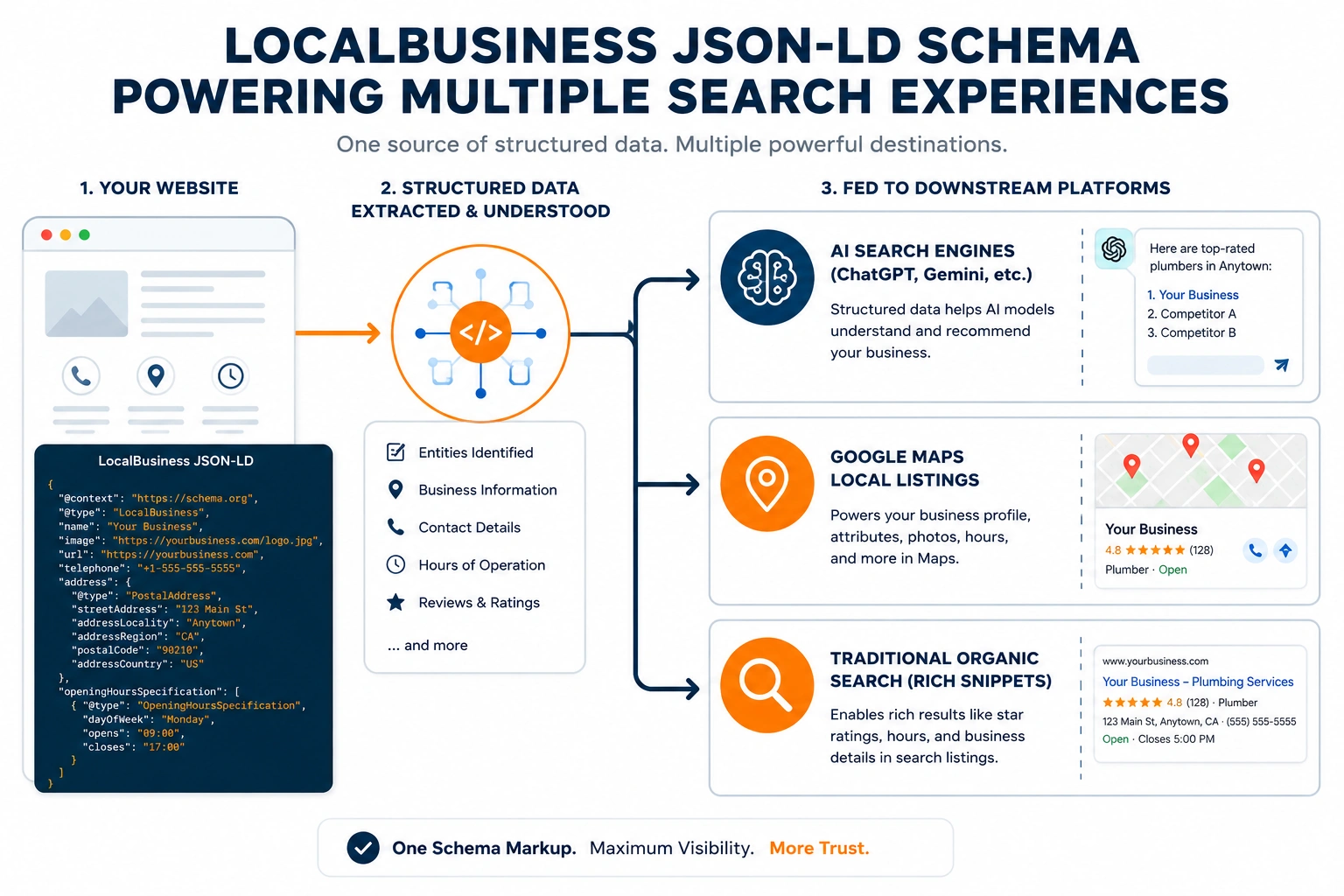
A visual overview of how LocalBusiness schema markup powers AI search visibility, Maps listings, and rich snippets.
Stop letting competitors steal your local market share.
We get it because we’ve lived it. Marketing shouldn’t feel like an expensive black box. Let our team of local search specialists handle your Google Business Profile optimization, schema implementation, and reputation management. We build the compounding digital assets that keep your service bays full year-round.
Explore Our Local SEO Services
Capturing long-tail intent: Building service-specific landing pages
Brand-specific landing pages
When a Tiffin Allegro owner needs slide-out repairs, they will not trust a general auto mechanic. A Tiffin Allegro owner wants a technician who knows Tiffin’s slide-out architecture. They want specialized expertise. An Airstream owner is skeptical of any shop that hasn’t worked on riveted aluminum construction before. This brand specificity creates a search behavior pattern that most competitors haven’t fully utilized: queries like “Tiffin motorhome repair near me” or “Keystone travel trailer service” carry high intent and face relatively low competition compared to generic “RV repair near me” terms.
Dedicated landing pages for major manufacturers like Jayco, Forest River, Airstream, Winnebago, and Thor allow you to capture this targeted search volume while simultaneously building topical authority that signals deep expertise to both human searchers and AI models. These pages also position you well for manufacturer warranty work, where the searcher is specifically looking for an authorized or experienced service provider. This brand-first approach aligns with broader RV Dealership SEO strategies that treat brand specificity as a competitive moat rather than a minor detail.
System-specific repair pages
A customer stranded with a slide-out that will not retract is searching for an immediate solution, not a generic service list. Each major system, including HVAC, roof, slide-out, electrical, and plumbing, deserves its own 1,200+ word guide that addresses both the diagnostic context and the repair process.
The most effective of these pages lead with the failure symptom, not the service name. Symptoms drive searches. “RV slide-out stuck and won’t retract” is how a distressed owner searches. “Slide-Out Mechanism Repair Services” is how a shop describes what it does. Both need to exist on the same page, but the symptom-first framing captures the emergency search intent that drives immediate call conversions. Adding a simple “Should you call a pro?” diagnostic checklist at the bottom of these pages addresses the DIY-vs.-professional conflict that RV owners frequently wrestle with, and it converts fence-sitters into booked appointments.
Seasonal campaign pages
Up to 40% of your annual labor revenue is won or lost during two brief six-week windows. That concentration of revenue in a short period creates both an opportunity and a risk: if your seasonal pages aren’t indexed and ranking before the search volume spikes, you’re handing those bookings to whoever got there first.
The 90-day rule is non-negotiable. Seasonal content must be published and technically optimized at least three months before the temperature shifts that trigger search behavior. A winterization page published in October, when customers are already searching, is too late to rank competitively. Timing is everything. Published in July and refreshed with updated pricing and testimonials in September, it has a genuine chance at the top positions.
- Brand-Specific Service Pages: Create dedicated landing pages for major manufacturers, such as “Jayco RV Repair,” “Forest River Service,” and “Airstream Restoration.” This aligns with broader strategies like RV Dealership SEO to capture brand-specific search volume.
- System-Specific Repair Pages: Build individual pages for complex systems, including “RV Slide-Out Repair,” “Motorhome AC Service,” and “RV Roof Leak Resealing.”
- Seasonal Campaign Pages: Capture high-intent seasonal traffic by publishing pages dedicated to “RV Winterization Services” in October and “Spring De-Winterization” in March.
The seasonal surge: Capitalizing on high-ticket RV repair windows
Seasonality and revenue impact
RV repair operates on a highly seasonal cycle, particularly in cold-climate markets across the United States. Industry data shows that seasonal winterization and spring de-winterization services generate up to 30% to 40% of a shop’s annual labor revenue within compressed six-week windows. The Trailer & RV Repair Services Industry Report verifies these recurring demand spikes, while the RVs Move America Economic Impact Study highlights the scale of the active market. If your website and local profiles are not optimized for these seasonal keywords at least 90 days before the temperature shifts, you will miss the initial wave of bookings. Our passion, drive, and satisfaction come from the positive impacts we make on small business partners. Your success is our success. We help you navigate these seasonal swings without leaving revenue on the table.
The off-season isn’t dead time, either. Shops that use the slower winter months to drive maintenance content, such as battery conditioning, roof inspection reminders, and generator service intervals, build a year-round search presence that keeps them top-of-mind when the spring booking rush begins. It’s a compounding effect: the content you publish in January earns authority that pays returns in April.
Pre-season optimization timeline
The 90-day rule exists because SEO changes take time to spread. Plan ahead. Google needs to crawl your updated content, index it, evaluate its relevance against competing pages, and gradually adjust your ranking position. That process doesn’t happen overnight, and it certainly doesn’t happen in the two weeks before your target season peaks.
Seasonal page refreshes should include updated pricing, new customer testimonials from the previous season, and any service additions or equipment upgrades your shop has made. Using Google Business Profile updates and posts to promote seasonal specials ahead of the rush signals active operation and gives the algorithm fresh engagement data to work with.
Mobile RV techs vs. brick-and-mortar shops: Tailoring your SEO strategy
On-site and roadside SEO for mobile techs
Mobile technicians operate in an entirely different search context than fixed-location shops, as their customers are often traveling and need immediate assistance rather than scheduling a routine service appointment weeks in advance. Their customers are frequently in distress, stranded at a campground, broken down on an interstate shoulder, or parked at an unfamiliar RV park with a system failure they can’t diagnose. The search queries that reach mobile techs are urgent and geographically specific: “emergency mobile RV repair,” “roadside RV service near me,” “mobile RV mechanic open now.”
Optimizing for this intent means more than adding “mobile” to your service titles. Think geographically. Location-cluster pages mapped to major campgrounds, RV parks, and highway routes in your service area create geographic specificity that generic city pages can’t match. A page titled “Mobile RV Repair Near [Campground Name]” captures a highly targeted searcher who is already at that location and needs help immediately. That specificity is a gap most competitors haven’t filled.
Facility-based SEO for brick-and-mortar shops
Fixed-location shops have a different set of assets to highlight. Play to your strengths. Specialized equipment, such as heavy-duty lifts, paint booths, collision bays, and frame straightening systems, justifies the customer’s decision to tow their rig rather than wait for a mobile tech. These physical capabilities should be front and center in your GBP description, your service pages, and your photo library.
Manufacturer certifications carry significant weight for a segment of RV owners who specifically seek authorized service providers. RVDA and RVIA certifications, insurance partnerships, and extended warranty authorization should be documented on your website with enough specificity that both human searchers and AI crawlers can extract and cite them. This trust infrastructure is particularly relevant for shops competing in the same geographic footprint as national dealership service centers. This is directly similar to the certification-first approach that works well for SEO for collision repair specialists.
The rapid growth of mobile RV technician services has changed how local SEO must be executed. Mobile technicians must optimize for near me and on-site search queries, emphasizing rapid response times and roadside assistance capabilities. Conversely, brick-and-mortar shops must showcase their physical facilities, highlighting specialized equipment like heavy-duty collision bays, paint booths, and frame straightening systems, which justifies the customer’s decision to tow their rig rather than wait for a mobile tech.
Frequently asked questions about RV repair SEO
How long does it take to rank an RV repair shop in the Google Map Pack?
Most RV repair businesses see measurable movement in their Map Pack rankings within 60 to 90 days of executing a detailed local SEO strategy. Patience is key. Achieving a consistent top-three position in highly competitive urban areas typically requires four to six months of continuous review acquisition, local citation building, and profile optimization, especially if you are competing with established dealerships that have hundreds of existing reviews.
Do mobile RV technicians need a physical address to rank on Google Maps?
No, mobile RV technicians do not need a physical location to rank. You can register as an SAB. Google allows you to register as a Service Area Business (SAB), which hides your physical residential address while allowing you to define the specific geographic boundaries and cities where you provide on-site services. You must, however, comply with Google’s video verification rules to keep your profile active.
What is the most important ranking factor for AI search engines like ChatGPT?
AI search engines favor structured data schema and high-quality customer sentiment. Data must be clean. To be recommended by AI assistants, your website must feature clean LocalBusiness schema markup, and your Google Business Profile must maintain a steady stream of detailed, keyword-rich reviews that validate your expertise. AI models rely on this “citation-ready” data to create their recommendations.
Should I create separate pages for every RV brand I service?
Yes, creating brand-specific service pages is highly effective. It builds trust. RV owners regularly search for specialists who understand their specific rig, using queries like “Tiffin motorhome repair near me” or “Keystone travel trailer service.” Having specific pages for these brands allows you to capture this highly targeted, low-competition search volume and build deep topical authority, showing both search engines and potential customers that you have specialized knowledge of their specific vehicle’s systems.
How does local SEO compare to Google Ads for generating RV repair leads?
While Google Ads provides instant lead generation, it requires continuous ad spend to maintain visibility. SEO offers lasting value. Local SEO is a compounding digital asset that requires an upfront investment but eventually delivers the lowest cost-per-lead in your marketing mix, maintaining high-ranking visibility long after the initial optimization is complete.
Dominating local search and winning recommendations in the AI era requires a focused, systematic approach to your digital footprint. It takes consistent effort. By optimizing your Google Business Profile, implementing structured schema markup, and driving consistent, keyword-rich customer reviews, you build a highly secure marketing channel that keeps your service bays full and your mobile technicians booked solid through every season. Knowledge belongs to everyone, and we are here to help you put these tools to work for your business, standing beside you, not above you.
Ready to dominate your local market? Don’t let your competitors capture the highest-value RV repair jobs in your area. Partner with BizIQ, a trusted local marketing agency dedicated to helping small businesses drive America forward. Let’s build a strategy that keeps your technicians busy and your business growing. Schedule Your Free Strategy Call Today →