
What This Strategic Guide Covers
- The structural layout of a high-converting landing page for home services.
- How to apply copywriting frameworks (PAS and PPPP) based on customer intent.
- Natural localization strategies to rank in organic search results without keyword stuffing.
- Essential trust signals and safety credentials that turn passive visitors into scheduled jobs.
- Technical optimization tips, including Service schema markup and mobile-first design.
How Should Electricians Structure Localized Service Pages for SEO?
Electricians should create a dedicated page for each service in each city they serve, with unique, locally relevant content that answers customer questions, highlights expertise, and includes clear calls to action. Well-structured localized service pages improve visibility in traditional search engines and AI-powered search while helping attract more qualified local customers.
Your phone should be ringing with service calls. If it’s not, your website might be working against you. If you’ve ever looked at your website analytics and wondered why hundreds of visitors aren’t turning into scheduled service calls, you’re not alone. The problem isn’t your skills in the field: it’s how your digital storefront is built. Traffic without conversion is just a vanity number, and for most electrical contractors running lean operations, vanity numbers don’t pay crews or cover equipment costs. We’ve worked with enough home service businesses to recognize the pattern instantly: a website that was built to exist, not to perform.
The gap between “we have a website” and “our website generates consistent leads” is almost always a structural one. It’s not about spending more on ads or posting more on social media. Those are distractions. It comes down to whether the pages on your site are specifically built to answer the specific questions a homeowner types into Google at 9 PM when a breaker won’t reset.
A generic homepage is a poor substitute for targeted service pages. When a homeowner searches “electrical panel upgrade [city]” or “emergency outlet repair near me,” they are not looking for a company overview; they want confirmation that you do exactly that work, in their area, and that you can be reached right now. A homepage that lists twelve services in bullet form gives them none of that reassurance. It asks them to do the work of figuring out whether you’re relevant, and most of them won’t bother.
This is where local search engine optimisation changes the dynamic. Dedicated, service-specific subpages function as targeted landing pages that match precise search intent. A page titled “Electrical Panel Upgrades in Phoenix, AZ” tells Google, and the homeowner, exactly what you do and where. When that page is structured correctly, it doesn’t just rank; it converts. That distinction matters because building these pages is the foundation of any local marketing strategy that produces real lead generation rather than just empty web traffic. We want an electrician website that consistently gets calls, and that starts with having a page for each service you offer.
The Anatomy of a High-Converting Electrician Service Page
Above-the-Fold Hero Section
The first two seconds on your page determine whether a visitor stays or bounces. Your primary service and target city need to appear in the main header without any vagueness. Something like “Professional Electrical Panel Upgrades in [City]” leaves no room for interpretation. Pair that with an immediate, high-visibility call to action: a prominent click-to-call button or a stripped-down scheduling form with no more than two fields. Don’t make them scroll to find a phone number. Make it easy.
Clean design is not a luxury here because cluttered layouts, slow-loading hero images, and buried contact options all introduce resistance at the exact moment you need zero resistance, driving frustrated homeowners straight back to the search results where your competitors are waiting. User experience at this stage is purely functional: the visitor needs to confirm within moments that they’ve landed in the right place.
The Trust Strip and Immediate Credentials
Directly beneath the hero, before any service description or pricing information, place a horizontal trust strip. This is where you display your state license number, your aggregate star rating from Google or Yelp, and your emergency availability window. Visible. Unambiguous.
One element that most contractors underestimate is explicitly stating that your business is fully licensed, bonded, and carries electrical contractor general liability insurance to protect the homeowner’s property in the rare event that something goes wrong during a complex installation. Homeowners are inviting a stranger into their home to work on systems that can start fires. That anxiety is real, and a single line of credential transparency does more conversion work than three paragraphs of service description. You need to build trust before they pick up the phone, and showing these credentials upfront does exactly that.
Understanding why this layout works requires thinking about the psychological state of the person landing on your page. They are not browsing; they are evaluating. They want to know you are safe, qualified, and genuinely local before they read a single word about your services. Most electrician websites skip this reassurance entirely, which is why the industry average conversion rate sits at a modest 1 to 3%. Well-structured local service pages, built with this psychology in mind, routinely reach 5 to 12% conversion rates. That gap, applied to even modest traffic numbers, represents thousands of dollars in monthly revenue that is currently walking out the door. Think of it this way: a well-structured service page for panel upgrades can easily secure a single $3,000 job. That single call pays for the page entirely.
Writing for search engines and writing for homeowners are not opposing goals, but the friction between them is real enough to cause problems when handled carelessly. Optimizing your website for local search should never produce copy that reads like a keyword list with punctuation. The content needs to address the customer’s primary concern first: the safety risk, the inconvenience, and the cost of inaction. It must then integrate geographic and semantic signals in a way that feels like a natural part of the explanation, not a bolt-on afterthought. When those two goals are aligned, the page earns rankings and conversions simultaneously. When they’re in conflict, you usually get neither.
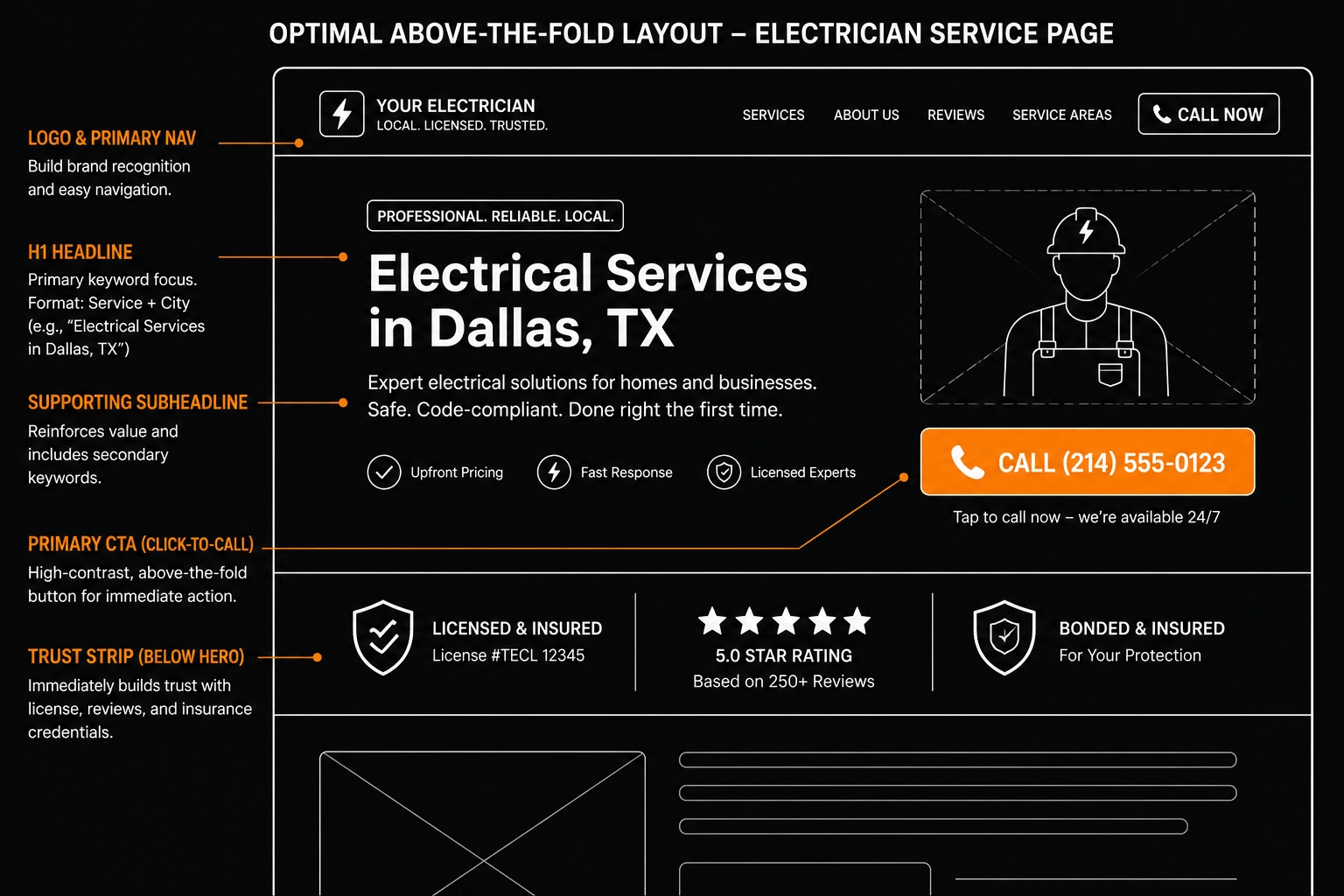
An optimized above-the-fold electrician service page pairs a local H1, prominent call CTA, and immediate trust signals.
Choosing the Right Copywriting Framework for Electrical Services
Not every electrical service page should be written the same way. Intent dictates structure. Matching your copy’s tone and structure to that intent is one of the most impactful decisions you can make because the homeowner searching for emergency help at midnight is in a completely different cognitive state than the one who has been planning a panel upgrade for three months, meaning your approach to writing these pages must adapt to their level of urgency.
The Problem-Agitate-Solve (PAS) Framework for Urgent Services
For high-urgency services, such as sparking outlets, tripped breakers that won’t reset, power outages, or exposed wiring, the PAS framework is the right tool because it matches the frantic mindset of a homeowner in crisis. You identify the immediate safety risk (Problem), explain what happens if it goes unaddressed (Agitate), and position your rapid-response team as the direct solution (Solve). Keep this copy tight. Seconds count. Speed, safety guarantees, and a phone number that appears multiple times on the page are the only things that matter. A homeowner dealing with a potential electrical jeopardy is not reading paragraphs; they’re scanning for a number to call.
The Problem-Promise-Proof-Proposal (PPPP) Framework for Planned Projects
Scheduled, high-ticket services require a different approach entirely. Panel upgrades, whole-home rewiring, EV charger installations: these are decisions a homeowner has been sitting with for weeks. The PPPP framework works here because it replicates their research process. They need details. You acknowledge the capacity or safety limitation they’re already aware of (Problem), outline the long-term safety and efficiency gains of the upgrade (Promise), back that up with localized reviews and code compliance documentation (Proof), and close with a clear, low-friction estimate process (Proposal). This is where you can afford to go deeper, because the reader is actively looking for reasons to trust you with a significant project.
Urgent vs. Planned Copywriting Strategies
- Emergency Services (PAS): Focuses on rapid response, 24/7 availability, and safety; uses prominent click-to-call buttons.
- Planned Upgrades (PPPP): Focuses on energy efficiency, capacity increases, code compliance, and long-term warranties.
- Lead Capture: Emergency pages use single-tap phone calls; planned pages use detailed estimate request forms.
How to Localize Your Service Pages Without Keyword Stuffing
Local relevance is not built by inserting a city name seventeen times into a page. Search engines are discerning enough to recognize that tactic, and they penalize it. Stuffing fails. Genuine geographic signals come from content that could only have been written by someone who actively operates in that market, understands the local housing stock, and knows the specific municipal electrical codes.
Natural Integration of Geographic Signals
Reference local building codes and the specific municipal permit offices your technicians work with. Mention regional conditions that affect electrical systems, such as coastal humidity accelerating corrosion in panel components, high-heat summers driving air conditioning load demands, or winter freeze events that stress older wiring. When you describe a past project, name the neighborhood or suburb where it happened rather than keeping it generic. These details are not just SEO signals; they are proof of local presence that a homeowner from that area will immediately recognize as authentic.
The one practice to avoid entirely is the doorway page: a thin template that swaps out city names while keeping every other sentence identical. Search engines have been penalizing these for years, and the penalty is not subtle. Avoid shortcuts. Every primary service area you target deserves copy that is genuinely specific to that location: its permit requirements, its housing stock, its weather patterns. That’s the work that produces durable rankings.
Geographic Elements to Include in Your Copy
- References to local municipal electrical codes and permit requirements.
- Mentions of regional weather patterns that affect electrical systems (e.g., coastal humidity, winter freezes).
- Names of specific neighborhoods, suburbs, or service zones served by your technicians.
- Embedded service area maps or links to local business profiles.
Want to see how your current service pages stack up against the competition?
We can help you identify missed opportunities in your local market. Let’s look at what’s working and build a strategy to show up when someone searches ‘electrician near me’ for what you offer. digital marketing for electrical businesses
Essential Trust Signals and Safety Credentials to Display
Leveraging Licensing and Industry Authority
A 2024 audit of over 1,200 electrician websites found that 56% hide their license numbers and 42% never mention being licensed and insured at all. That’s not a minor oversight; it’s a conversion killer. Trust is hard-earned. Homeowners who can’t verify your credentials in the first ten seconds of visiting your site will simply move to the next result.
The weight of that credential is worth communicating directly. In Texas, the Texas Department of Licensing and Regulation recorded an overall pass rate of just 26.37% across 15,170 attempts for the FY 2024 electrician licensing exam. Displaying your license number isn’t just an administrative formality; it signals membership in a technically demanding profession where most candidates don’t make it through. That context, stated plainly on your page, reframes your license from a bureaucratic checkbox into a genuine differentiator. And the stakes for homeowners are not abstract: Electrical Safety Foundation International data shows that over 51,000 home electrical fires occur annually in the United States, which means safety credentials function as a primary conversion driver for any homeowner who has thought even briefly about what can go wrong.
Credential transparency has a direct line to revenue. When homeowners see a verified license number, insurance details, and affiliation badges from organizations like the National Electrical Contractors Association (NECA), their skepticism drops measurably. The question shifts from “can I trust this company?” to “when can they come out?” That shift is the difference between a bounce and a booked job, and it costs nothing to implement beyond the decision to make your credentials visible. Customer satisfaction starts before the first service call; it starts the moment someone decides you are worth contacting.
Localized social proof accelerates that trust even further. A review from a homeowner in the same zip code carries more convincing weight than ten generic five-star ratings on a homepage. When a potential customer reads “They upgraded our panel in the Riverside Heights neighborhood last spring and pulled all the permits without any issues,” they are reading confirmation that you operate in their world, follow local code, and deliver on your promises. That specificity is what separates a testimonial that converts from one that gets scrolled past.
“In home services, safety isn’t just a feature: it’s the ultimate trust builder. When you make your licensing, insurance, and local compliance visible, you aren’t just checking a box; you are removing the single biggest barrier to a phone call.”
Implementing Service Schema Markup for Search Engines
Structured Data for Local Visibility
Service schema markup is the technical layer that tells search engine crawlers exactly what your page is about, in a language they parse directly rather than deduce. Without it, Google reads your page and makes educated guesses about your service type, provider details, and geographic coverage. With it, you’re supplying those answers explicitly, and that precision pays off in local pack rankings and Google Maps visibility. It works.
The schema code defines the specific service (e.g., “Electrical Panel Upgrade”), identifies the electrical contractor as the provider with name, URL, and phone number, and specifies the geographic area served. It’s not a ranking guarantee, but it is one of the cleaner signals you can send to a search engine that is trying to match your business to a homeowner’s query. For a detailed walkthrough of the technical implementation, optimizing your website for local search covers the full process in practical terms.
Search engines are fundamentally in the business of accuracy. Their entire promise to users depends on surfacing the most relevant result for any given query, which means they reward businesses that make verification easy. Clean, structured JSON-LD data lets Google confirm your business name, service type, service area, and contact details without having to parse unclear page copy. That confirmation directly improves your organic visibility, not because you’ve gamed an algorithm, but because you’ve made it easier for the algorithm to do its job correctly.
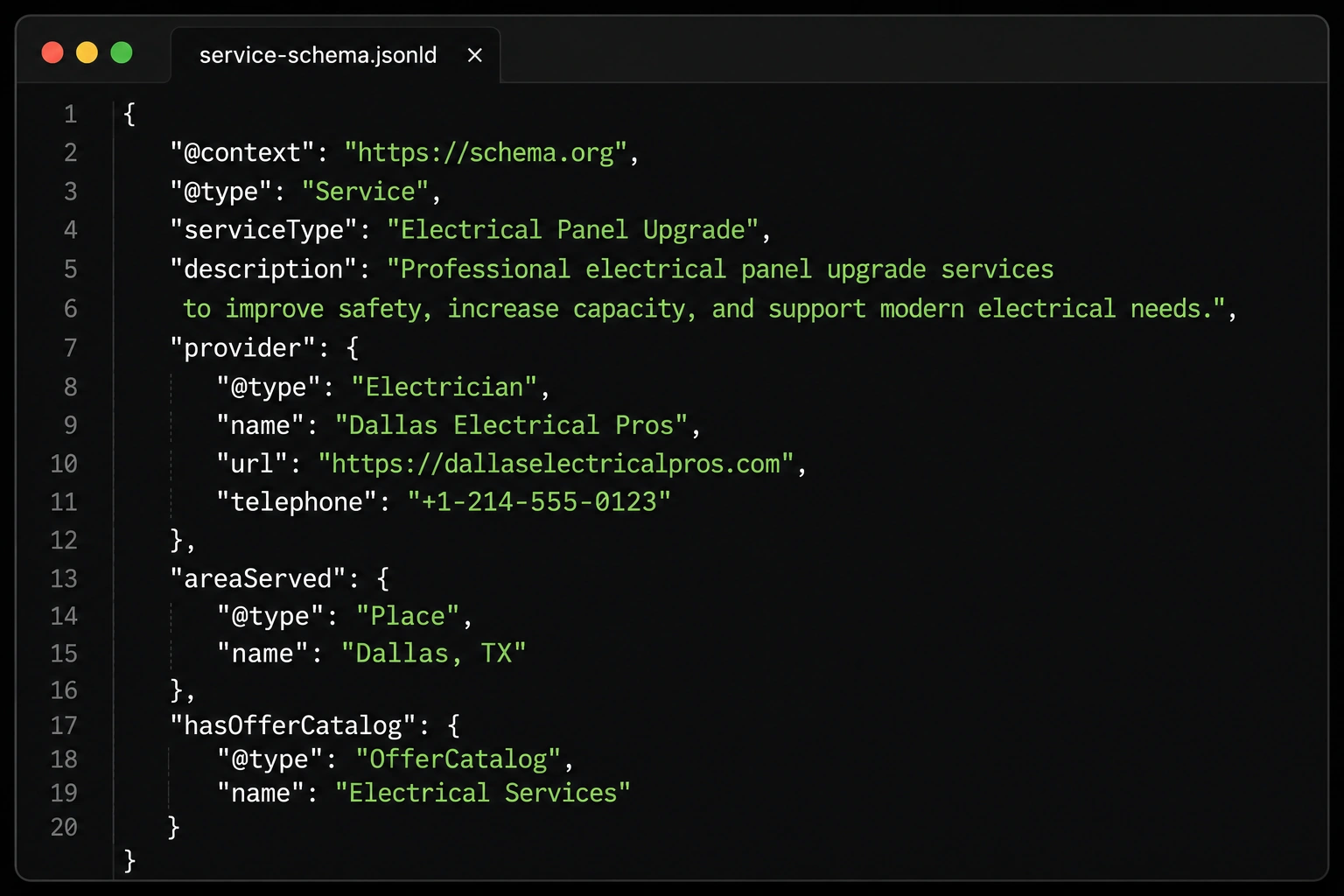
A structured data example showing JSON-LD Service schema for an electrician service page to support SEO and rich results.
You don’t need to become a coding expert to get the benefits. We recommend starting with a professional review of your site’s structure.
Local SEO Website Optimization
Mobile-First Design: The Critical Factor for Emergency Leads
Optimizing for the On-the-Go Searcher
More than 75% of users searching for emergency electrical services do so on a mobile device. That’s not a trend to plan for: it’s the current reality of how homeowners find contractors when something goes wrong. A sticky click-to-call button that remains visible as the user scrolls is not optional on an emergency services page; it’s the primary conversion mechanism. If a homeowner has to hunt for your phone number, they won’t.
Page speed intensifies this. Speed is revenue. A two-second delay on a mobile connection is enough to push an anxious homeowner back to the search results page, where your competitor is one tap away. Every additional second of load time erodes the urgency you spent your above-the-fold copy building. For a detailed breakdown of the design and performance standards that matter most for local service sites, local website optimization is worth reviewing before you make any structural changes to your current layout.
Mobile-First Requirements for Electrician Sites
- Sticky click-to-call phone number at the top or bottom of the screen.
- Large, thumb-friendly buttons and form fields.
- Lightning-fast page load times (under 2.5 seconds on mobile connections).
- Clean, single-column layout that avoids horizontal scrolling.
How to Structure Your Service Area Pages Effectively
Creating Unique Content for Every Target Neighborhood
The doorway page problem deserves a second mention here because it specifically affects service area expansion. When contractors try to scale their local visibility quickly, the impulse is to build fifty city pages from a single template, swapping out the location name and calling it localization. Search engines have been penalizing this approach for years, and the consequences, including ranking drops, manual actions, and wasted development time, are severe enough to set a business back significantly.
Genuine service area pages require genuine local content. Be authentic. That means pulling in permit office names, referencing the housing age and wiring types common in that neighborhood, and featuring reviews from customers who physically live there. A review that mentions a specific street or subdivision does double duty: it signals geographic relevance to Google’s algorithm and provides the kind of neighborhood-specific social proof that converts a local homeowner who recognizes the reference. For contractors working with tighter budgets, affordable local SEO strategies outline how to prioritize which neighborhoods to build out first without overextending your content resources.
Reviews from specific cities do more than build trust with individual visitors. When a review mentions “panel upgrade in Scottsdale” or “emergency rewiring in the Tempe area,” it creates a geographic content signal that reinforces your relevance for those location-specific searches. Google reads reviews as part of the local relevance picture, and a consistent pattern of location-specific feedback across your pages tells the algorithm that you are actively and verifiably working in those communities, not just claiming to serve them.
Frequently Asked Questions About Electrician Service Pages
What is the difference between emergency and scheduled service copy?
Emergency copy is built around speed, safety, and immediate availability. It uses the Problem-Agitate-Solve framework to drive instant phone calls, keeping copy tight and contact options prominent. Scheduled service copy, designed for panel upgrades, EV charger installations, and whole-home rewiring, takes a longer view, using the Problem-Promise-Proof-Proposal framework to address the research-oriented homeowner who wants to understand benefits, compliance, and process before committing to a significant project.
Where should electricians place their license numbers?
Three locations, minimum: the website header, the hero trust strip directly above the fold, and the footer. These are the areas a skeptical homeowner will check instinctively, and having the number absent from any one of them introduces unnecessary doubt at a critical decision point.
How do local reviews improve service page performance?
Local reviews provide social proof that reassures nearby homeowners in a way that generic testimonials cannot. Beyond the human trust factor, reviews that reference specific cities, neighborhoods, or services send geographic and topical relevance signals to search engine algorithms, signals that contribute directly to higher rankings in local searches.
Should every electrical service have its own page?
Yes. A dedicated page for each primary service, such as panel upgrades, EV charger installation, emergency wiring, or outlet repair, allows you to match specific user search queries with highly relevant content. Consolidating multiple services on a single page forces you to weaken your targeting, which weakens both your rankings and your conversion rate on any individual service.
How do you find clients as an electrician?
Consistently attracting new clients comes down to a few compounding strategies: optimizing your online presence to rank for high-intent local searches, running targeted local advertising in your primary service areas, building referral relationships with complementary businesses like general contractors and HVAC companies, implementing a structured customer referral program, and making your scheduling process frictionless enough that a homeowner can book a call in under two minutes.
The most practical place to start is with your highest-revenue service page: panel upgrades, for most residential contractors. Pull it up and run it against the wireframe in this guide: Does the hero section display the service and city clearly? Is there a visible CTA above the fold? Does a trust strip with your license number appear before the first paragraph of copy? If any of those elements are missing or buried, that’s a conversion problem you can fix this week without touching your ad spend. Start small.
From there, work through the copywriting framework that matches your service type, add the geographic signals that make your localization feel genuine rather than templated, and implement schema markup so search engines can read your page accurately. Small, intentional changes to trust signals and page layout consistently produce meaningful improvements in lead volume, not because the changes are dramatic, but because they remove the specific friction points that were causing qualified visitors to leave without calling.
Building high-converting, SEO-optimized service pages takes time and technical expertise. If you’d rather focus on keeping the lights on for your customers, we’re here to help. From custom web design to localized content creation, we build digital marketing strategies that work for businesses like yours. Let’s grow your local presence together. Content Marketing Services | Web Design Services