
- Up to 336% increase in organic clicks and a 50% reduction in average cost-per-lead achieved through structured local optimization.
- Over £100,000 (about $130,000) in added revenue generated in just eight months for an electrical contractor launching their first localized digital campaign.
- 180% monthly organic traffic growth and a 700% increase in daily clicks by aligning website structure with local search signals.
How Can Local SEO Help Electricians Go from Zero Leads to a Fully Booked Schedule?
Local SEO helps electricians generate more qualified leads by improving their visibility in Google, Google Maps, and AI-powered search when nearby customers need electrical services. A strong local SEO strategy includes optimizing your Google Business Profile, creating localized service pages, earning positive reviews, and building a trustworthy online presence that consistently attracts new customers.
Many electrical contractors rely on shared lead platforms that force you to compete on price. It leads to razor-thin margins and inconsistent schedules. Own your leads instead. We know you don’t want to waste money on shared leads that go to five other guys. You can bypass middleman platforms, claim your spot in the Google Maps Local Pack, and build an inbound lead engine that keeps your trucks fully booked by using a clear, data-backed local SEO blueprint.
Sustainable electrical businesses are built on owned lead generation, not rented access to someone else’s platform. Paid ads offer a short-term patch, but they carry a steep cost-per-lead that compounds against your margins every single month. We recommend starting with a dedicated local SEO services for small businesses and a structured electrician website marketing strategy. This builds a compounding digital asset: a system that pulls in local customers searching for your services at a fraction of what traditional advertising demands, and keeps pulling long after the initial work is done.
Claiming your spot in the Google Maps Local Pack
The Google Maps Local Pack is the single most valuable piece of search engine real estate for local service businesses. Think of Google Maps as your digital storefront: the more visible it is, the more people walk through your door. When a homeowner experiences an electrical emergency, they do not scroll past the map. They need help fast. They call one of the top three listings, often within seconds of the search. The Map Pack captures approximately 42% of all local search clicks. It is the primary driver to get more calls from potential customers, while leaving businesses outside the top three in a quiet zone.
Here’s what worked for a business like yours. SD Electric Technologies, operating in Chula Vista, CA, faced low map visibility and inconsistent inbound volume. After partnering with Map Ranking to overhaul their Google Business Profile and execute a local map grid strategy, their Keyword Ranking Score improved by over 300% within 30 days, turning 90% of their local search pins green and placing them at position #1 across more than 30 distinct local zones. That is not an incremental ascent. It is a major shift in local visibility, achieved in a single month.
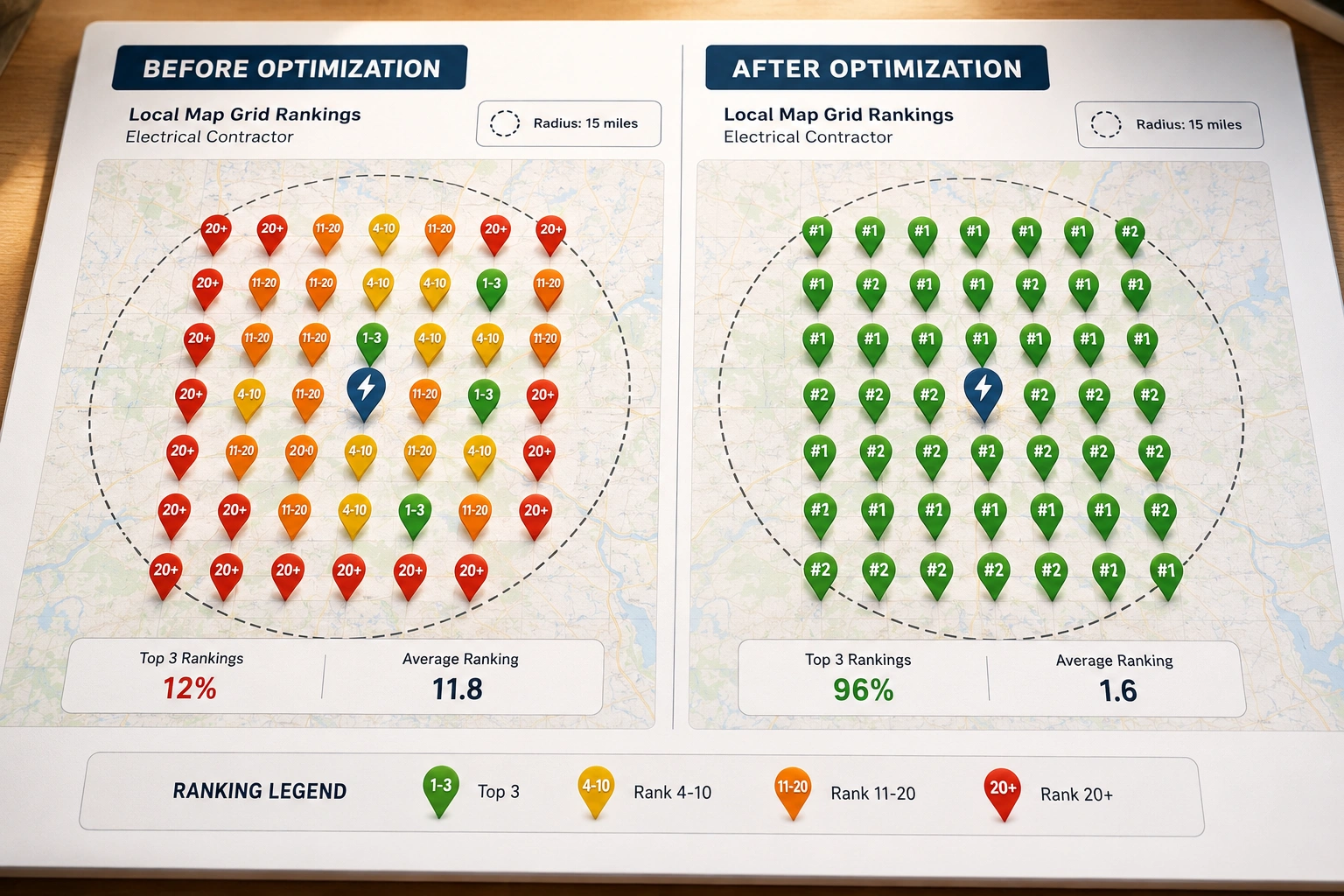
A local map grid comparison showing how improved local SEO increases top-ranking visibility across an electrician’s service area.
Optimizing your Google Business Profile for maximum call volume
- Set your primary category to “Electrician” to align with Google’s core ranking algorithm, then layer in secondary categories like “Electrical Contractor” or “Lighting Contractor” to capture sub-service queries without attenuating your primary relevance signal.
- Define a realistic service area using specific ZIP codes or city names rather than a broad, generic radius: a tight 15-to-20-mile zone consistently outranks an attenuated 50-mile spread because Google’s algorithm rewards proximity precision.
- Maintain absolute NAP consistency (Name, Address, Phone) across your website, GBP, and major directories including Yelp, YellowPages, and Angi. It’s like making sure your business name is spelled the same everywhere: confusion hurts trust, consistency builds it. A single inconsistency across these sources can erode Google’s confidence in your business.
- List high-value secondary services such as EV charger installation, electrical panel upgrades, and emergency electrical repairs to intercept specific, high-ticket search queries that generic profiles miss entirely.
- Publish weekly Google Posts featuring geo-tagged photos of completed local jobs, seasonal safety tips, and targeted promotions. Each post signals active operations to Google’s crawlers and reinforces your relevance within your defined service territory.
Building a high-converting electrician website
- Design for mobile-first responsiveness so that emergency customers can navigate your site and tap your phone number from any device without friction. This is a baseline for digital marketing for electrical businesses, especially since over 60% of local service searches originate on mobile and require high-converting design features.
- Place a single, clear CTA above the fold, such as “Call Now for 24/7 Emergency Service” or “Request a Free Quote”, to capture high-intent visitors before they reconsider or bounce to a competitor’s listing.
- Optimize page load speeds by minifying code, deploying caching layers, and compressing images; every additional second of load time measurably increases bounce rates and suppresses your organic rankings.
- Incorporate concrete trust signals (license numbers, BBB accreditation badges, proof of insurance, and authentic before-and-after project photos) directly on your homepage, where first-impression credibility is either established or lost.
- Simplify your contact forms to the absolute essentials: name, phone number, email, and a brief description of the electrical issue; every additional field you add is a bottleneck that reduces submission rates.
Scaling organic traffic with technical and on-page SEO
Map Pack visibility drives immediate calls. Organic rankings build the kind of authority that sustains a business through algorithm shifts and competitive pressure. For example, look at the results other electricians have seen: a local contractor documented by First Rank scaled from virtually zero organic traffic to over 100 inbound calls per month within six months. They used a four-pillar SEO strategy that balanced technical site health with deep on-page signal alignment. The numbers are compelling, but the mechanism is what really matters: each pillar reinforced the others, creating a compounding effect that no single tactic could replicate alone.
Outranking established competitors in organic search requires more than keyword placement. It takes real depth. A Term Frequency-Inverse Document Frequency (TF-IDF) analysis identifies the contextual vocabulary your content must carry: terms like “circuit breakers,” “rewiring,” “panel upgrades,” and “permitting” that signal genuine subject-matter depth to Google’s crawlers. Pairing that with disciplined local SEO strategies and a structured internal linking architecture (where informational blog content passes authority down to transactional service pages) tells Google not just what your site covers, but which pages carry the weight. That distinction matters enormously in competitive markets where every contractor is targeting the same handful of high-intent queries.
“By shifting our content focus toward high-value services like EV charging and panel upgrades, we didn’t just increase traffic: we grew our year-over-year leads by 80%.”
Adapting to AI search and AI overviews
Search behavior is shifting faster than most contractors realize, and the change isn’t superficial. AI is here. Google’s AI Overviews now occupy a growing share of informational and commercial queries, pulling structured answers directly from authoritative service pages and surfacing them above traditional organic results. For contractors whose pages lack schema markup, clear entity signals, and direct answers to natural-language questions, those AI summary boxes represent lost clicks, handed to competitors whose content is built for the way search really works in 2026. The electricians who treat this as a future concern are already behind.
Structuring content to answer conversational queries, such as “What does an electrical panel upgrade cost in [City]?” or “How long does EV charger installation take?”, is not a stylistic choice anymore. It is a technical requirement for visibility in AI-mediated search. Combining that with properly implemented LocalBusiness, Electrician, and Service schema gives AI crawlers the machine-readable context they need to cite your pages with confidence. For a deeper grounding in how these signals interact, our detailed guide to local SEO covers the technical architecture in detail. The Elevation Marketing case study referenced above is a concrete example of what happens when an electrical contractor’s service pages are built to satisfy both human readers and AI retrieval systems simultaneously: 80% year-over-year lead growth is not an accident.
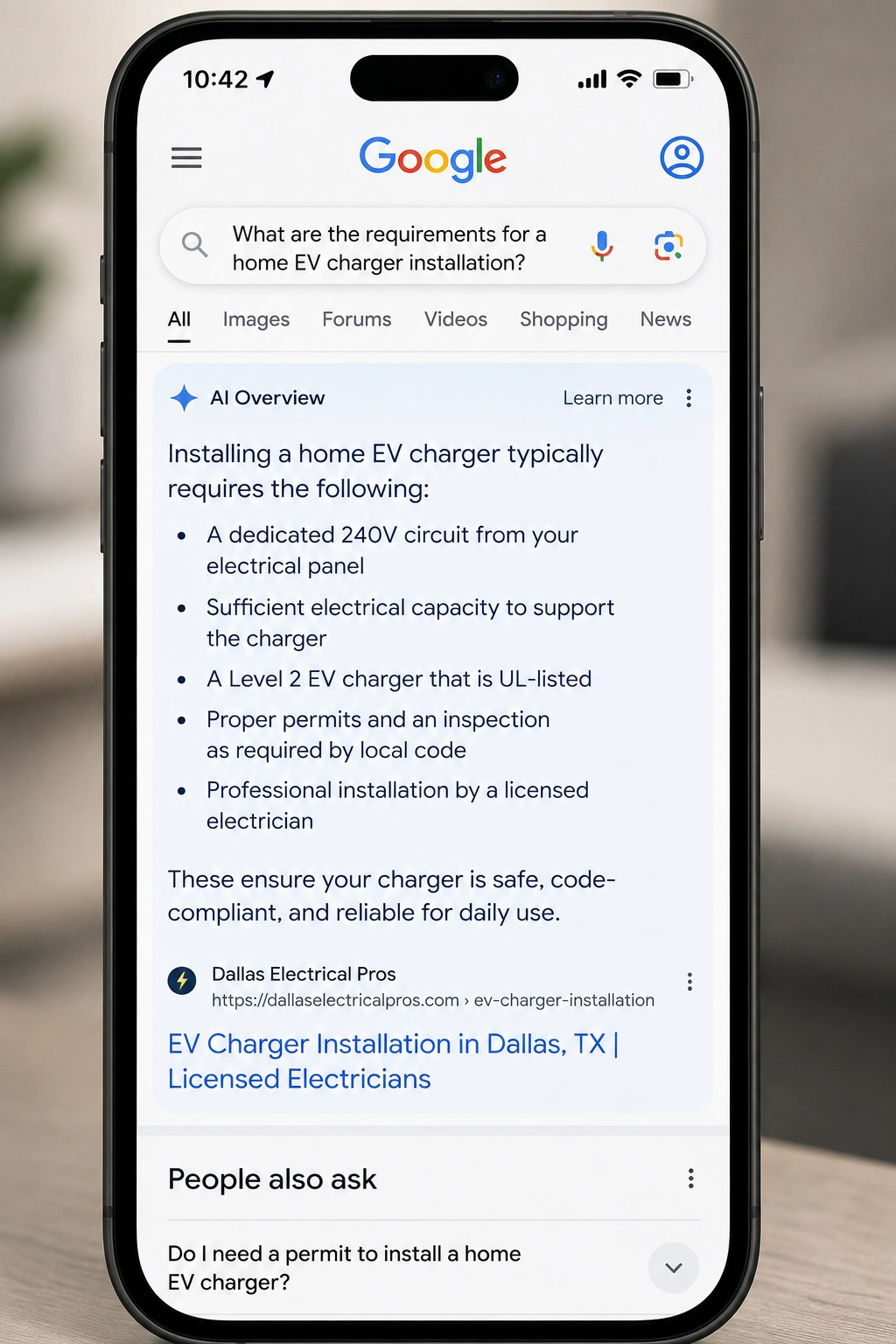
Google AI Overview citing a local electrician’s service page for EV charger installation requirements and best practices.
Establishing local authority with citations and backlinks
- Build high-authority national citations on platforms like Yelp, Hotfrog, Manta, and YellowPages, ensuring your Name, Address, and Phone number are uniform across every directory: not approximately the same, but character-for-character consistent.
- Acquire niche-relevant directory listings through trade associations and local networking groups, which carry geographical specificity that generic national directories cannot replicate and that Google’s local algorithm weights accordingly.
- Execute a targeted local backlink campaign by sponsoring community events, partnering with local charities, or contributing guest content to home improvement publications: each earned link from a geographically relevant domain strengthens your prominence score in ways that directory citations alone cannot.
- Implement LocalBusiness and Service schema markup across your site to give search engines structured, machine-readable data about your physical location, service offerings, and operating hours, which directly supports both Map Pack prominence and AI Overview eligibility.
You should evaluate how Google Home Services for electricians fits into your authority-building strategy, especially if you want to see how paid local placements interact with organic citation signals.
Tracking your local SEO performance and ROI
The financial case for local SEO is not theoretical. Paid search ads for electricians routinely carry a cost-per-lead ranging from $55 to $125+, depending on market density and competition. A well-executed local SEO campaign (one that combines GBP optimization, technical on-page work, and a structured citation profile) consistently drives qualified leads at an average blended cost of $29 to $40. That gap compounds over time. A contractor generating 40 leads per month at $90 CPL through paid ads is spending $3,600 monthly on acquisition alone; the same volume through organic local SEO can cost less than half that, with the underlying asset appreciating rather than expiring the moment the ad budget pauses.
Monitoring that performance requires three mechanisms working in tandem: Google Search Console for organic click and impression data, a dedicated call-tracking solution to isolate SEO-generated calls from offline branding touchpoints, and a blended CPL calculation that accounts for total marketing spend against confirmed booked jobs. Attribution is genuinely messy in trade contracting (a customer who found you on Google Maps may have also seen your truck wrap three times before calling) and pretending otherwise produces misleading ROI figures. The goal is directional clarity, not accounting precision. Focus on the trend.
Frequently asked questions about electrician SEO
How long does it take to see local SEO results for electricians? Most electrical contractors begin to see measurable ranking improvements and lead volume increases within 90 to 120 days of launching a local SEO campaign. Achieving top-three Map Pack rankings in highly competitive metropolitan markets can take six months to a year of consistent optimization and review acquisition. This timeline is not a failure; it is the nature of building durable search authority in dense competitive environments.
What is the most important ranking factor for the Google Map Pack? Google’s local algorithm operates on three pillars: proximity (how close the business is to the searcher), relevance (how precisely the business profile matches the query), and prominence (overall authority driven by reviews, citations, and inbound links). Proximity is largely fixed: you cannot move your service area. Relevance and prominence are where deliberate optimization moves the needle, making category selection and systematic review acquisition the highest-leverage activities for most contractors.
Should electricians display their home address on their Google Business Profile? Electricians operating from a home office and traveling to job sites should configure their GBP as a Service Area Business and suppress the physical address. Google’s guidelines are explicit: businesses without commercial signage and walk-in hours at their listed address must not display that address publicly. Violating this policy risks suspension, which is a far more damaging outcome than simply hiding the address.
How do local citations impact an electrician’s search rankings? Citations (online mentions of a business’s name, address, and phone number across directories like Yelp, YellowPages, and Angi) function as supporting evidence for Google. Each consistent mention reinforces the legitimacy of the business entity and contributes directly to the prominence score that drives Map Pack rankings. Inconsistencies across those sources introduce doubt into Google’s entity resolution process, which suppresses rankings in ways that are often difficult to diagnose without a full citation audit.
Is SEO still relevant for electricians in 2026? Yes, and the contractors asking this question are usually the ones who tried it once, saw slow early results, and concluded it wasn’t working. Local search engine optimization remains one of the most cost-effective channels available for digital marketing for home service companies, particularly as AI-powered search experiences increase the premium placed on structured, authoritative local content. The channel is evolving, not fading. Contractors who build their SEO for electricians foundation now will be positioned to capture AI Overview citations, voice search results, and traditional organic rankings simultaneously: a compounding advantage that paid ads simply cannot replicate.
Transitioning your electrical business from dependence on shared, low-margin lead platforms to owning a consistently full schedule requires a deliberate shift in how you think about marketing. Systematic Google Business Profile optimization, a high-converting mobile website, disciplined citation management, and a content architecture built for both human searchers and AI retrieval systems: these are not separate tactics. They are interlocking components of a single compounding asset. They work together. Each one strengthens the others. We know you don’t have time for this complex setup while running jobs, but starting step-by-step is what actually works. The contractors who move first in their local market tend to hold those positions for years.
Ready to win your local market and keep your trucks fully booked?
Book your free 15-minute Local SEO Strategy Call today and claim your exclusive territory before your competitors do.