You’ve built beautiful homes, but getting found online feels like learning a completely different trade. Your reputation as a builder travels through job sites, referrals, and finished homes that neighbors stop to admire. Word of mouth works. That same reputation needs a digital counterpart, and for most custom home builders, it’s either thin or invisible to search engines. A refined website helps, but without other trusted local businesses and industry associations pointing to it, search engines have no reason to surface it over a national aggregator or a competitor who has been quietly building their digital footprint for years.
A backlink is like another trusted builder vouching for your craftsmanship online. Search engines treat these links as digital recommendations: each one signals that a credible source considers your site worth referencing. Think of your website’s search reputation as your reputation score in the neighborhood. Reputation matters. The more active and respected those local references are, the more credibility they pass to your business. For contractors operating in specific metro markets, local link building from regional organizations carries substantially more weight than generic directory links assembled at scale.
A structured industry involvement campaign delivers four compounding payoffs:
- Improved Local Search Visibility: Higher placement in local map packs and organic results, where buyers with serious budgets are actively searching.
- Increased Earned Authority: A stronger search engine reputation score in the neighborhood that lets you compete against national listing platforms on their own turf.
- Higher Quality Lead Generation: Attracting users who are already researching custom home builders and are prepared to have a real conversation.
- Long-Term Organic Traffic: A durable source of inbound visitors that doesn’t evaporate when an ad budget gets cut.
Why Local Backlinks Matter for Residential Custom Home Builders
The housing market environment matters here. Single-family housing starts fell 25.9% since their April 2022 peak, and the ratio of median existing home prices to median household income climbed to 4.8 on average per year between 2020 and 2024, according to the Deloitte Housing Market Trends Report. Fewer transactions in a constricted market means every qualified prospect carries more weight, and the builders who appear at the top of local search results capture a disproportionate share of those prospects. Standing out in your market has moved from a competitive advantage to a baseline requirement.
Search engines evaluate local relevance through a combination of on-page signals and the quality of external sites linking to you. Think of it like Google sending out inspectors to catalog your work and verify your local reputation. A link from a regional home builders association or a local architecture firm carries geographic specificity that a generic directory listing never can. Your website functions as your digital showroom. The Deloitte Digital Marketing Strategy Guide identifies websites as the most powerful digital channel for first impressions and customer interactions, but that showroom only draws traffic if search engines trust it enough to recommend it. That trust is built through the quality and locality of your earned authority and local visibility, which is why SEO for homebuilders treats local link acquisition as the primary engine driving organic homebuyer leads.
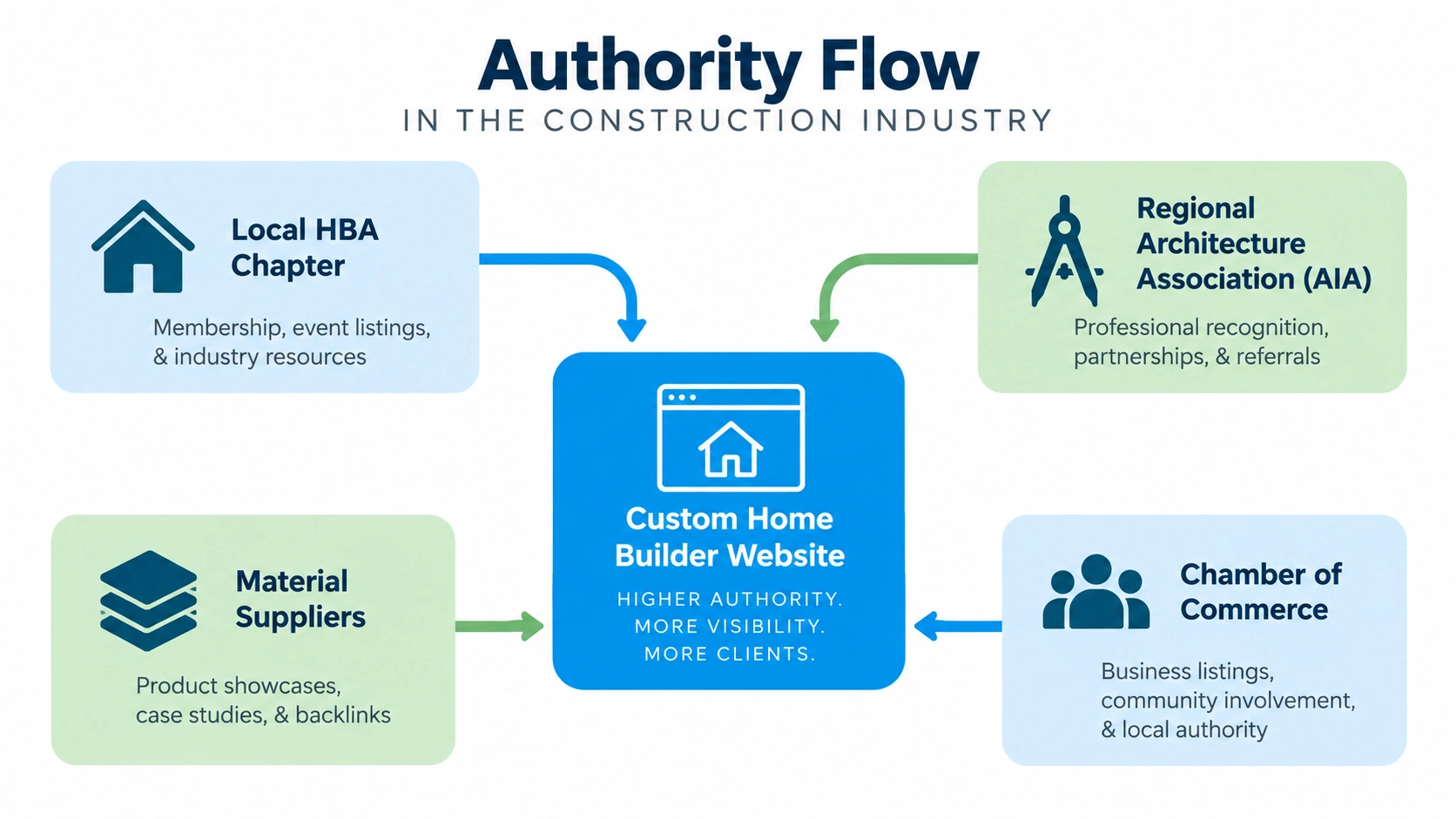
Industry relationships can support a custom home builder’s website authority through associations, suppliers, and local business organizations.
Partnering with Local Home Builders Associations and the NAHB
Industry association memberships are among the most resilient backlink sources available to a residential builder: they’re geographically specific, editorially maintained, and carry the institutional authority that search engines assign to established trade organizations. The NAHB is the second-largest real estate trade association in the United States, per the National Association of Home Builders SEC Filing, which means a link from their directory or a local HBA chapter carries substantial weight. Here is what works to capture that value: Start with these steps.
- Join the NAHB and your local HBA chapter: Membership typically includes a verified directory listing, which provides a clean, geographically relevant link that requires no outreach beyond completing your profile accurately.
- Optimize your HBA directory entry for citation consistency: We recommend keeping your Name, Address, and Phone number exactly matched across your HBA listing and every other directory. Discrepancies create conflicting signals that suppress local map pack rankings. Consistency is key.
- Pursue affiliate membership or sponsorship opportunities with your local American Institute of Architects (AIA) chapter. These chapters maintain directories of partners and sponsors, and a link from an AIA domain carries architectural authority that complements a builder’s profile in ways a generic citation cannot replicate.
Building Industry-Specific Citations and Directory Listings
Citations, which are mentions of your business name, address, and phone number across directories and platforms, serve as validating evidence for search engines. Even when a citation doesn’t include an active hyperlink, it helps verify that your business is a legitimate, established operation at a specific physical location. That verification directly influences local map pack placement, which is where most high-intent buyers encounter local builders for the first time.
- Regional chambers of commerce: Chamber listings pass geographically anchored search equity and are generally well-maintained, making them among the most credible citation sources available to a local contractor.
- Specialized construction directories: Platforms built specifically for contractors and builders carry niche relevance that general business directories don’t. Listing on these reinforces your industry category in search engines’ understanding of your site.
- Maintain identical citation details: Keeping details consistent across every directory is highly recommended. Details matter. A single address variation, like “Suite 103” versus “Ste. 103,” across dozens of listings creates enough uncertainty to suppress rankings for queries where location precision matters most.
Identifying where your citation profile has gaps, or where your citation details have drifted, is the first concrete step toward closing the visibility gap between you and your top local competitors. BizIQ’s homebuilder marketing services include citation building and local SEO management designed specifically for residential construction businesses. A free SEO audit surfaces exactly where your backlink and citation gaps are, so you’re not guessing at priorities. Get your audit today.
Content-Driven Link Building: Creating Assets That Earn Links
Publishing authoritative content gives local businesses, design blogs, and material suppliers a reason to link to you without any outreach required. In-depth project guides, illustrating the decisions behind a custom build from site selection through finish work, attract links from architects and interior designers who reference them in their own writing. Local home design trend reports and regional housing market analyses serve the same function: they become reference material for other local sites, and each link they generate passes authority back to your domain. Integrating secondary keywords within these posts captures search intent from buyers in the research phase, where most custom home purchase decisions begin.
Rich media amplifies this outcome significantly. The Deloitte Digital Marketing Strategy Guide notes that incorporating rich media increases content shareability: high-definition project videos and detailed floor plan infographics give other sites something worth embedding or referencing. To understand the scale of what’s possible: Semrush’s database tracks over 43 trillion backlinks across 808 million domains. In an ecosystem that large, undifferentiated content disappears. Stand out instead. A well-documented custom build walkthrough, anchored to a specific region and construction style, stands out precisely because most builders don’t produce it.
“Because we started as a small business, we understand the hurdles that many small business owners have to face when they begin to market their brand and services online,” says Garrett Cisek, Co-Founder of BizIQ.
The Shift Toward Generative Engine Optimization (GEO)
The debate around AI-driven search and its implications for traditional link building remains highly contested. Some practitioners argue that as large language models synthesize answers directly, the click-through value of a traditional organic ranking diminishes. Others, and there is a strong case to be made here, point out that LLMs still draw from authoritative web databases to verify claims and surface brand recommendations. The underlying infrastructure of trust hasn’t changed; what’s changed is the interface through which users access it. Trust remains essential.
Semrush’s launch of “Semrush One” in late 2025 to track brand visibility across AI-powered platforms like ChatGPT and Perplexity, per the Semrush SEC Filing, is instructive. When a major SEO platform builds a product specifically to measure how often brands appear in LLM responses, it signals that AI citation is becoming a measurable marketing metric, not a vague future concern. For home builders, this means the HBA directory links, AIA citations, and authoritative project content you build today are the same assets that position your brand to be recommended by AI search engines tomorrow.
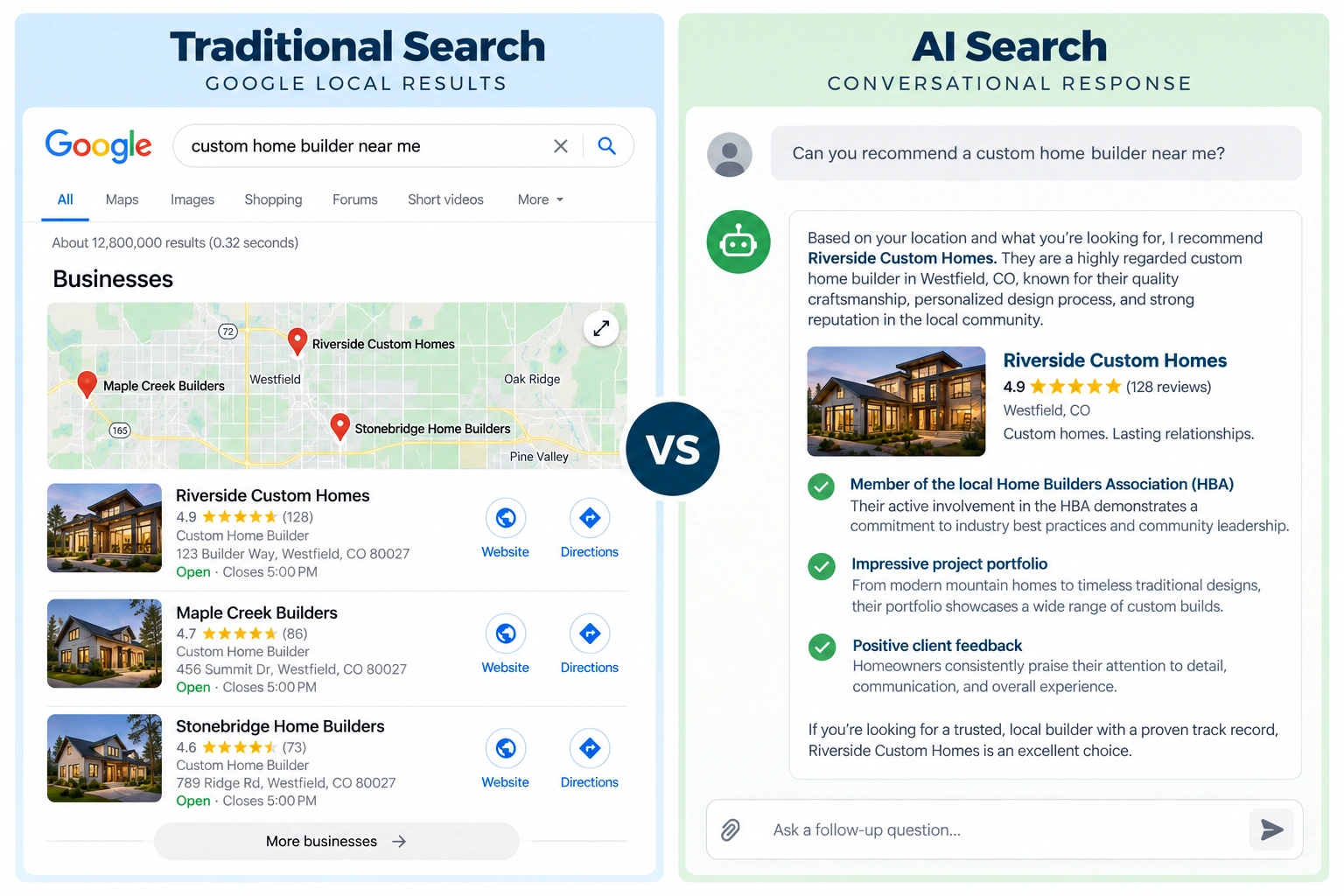
Traditional local search presents builder listings, while AI search can synthesize signals such as reviews, industry memberships, and project portfolios.
BizIQ’s Local Citation Management and Organic SEO services are built to establish the kind of authoritative digital footprint that positions builders for visibility across both traditional search and emerging AI discovery platforms. If your current digital footprint and industry involvement wouldn’t give an AI engine enough evidence to recommend you over a competitor, that’s the gap worth addressing first. Start building trust now.
Overcoming Common Link Building Obstacles for Builders
The objections most builders raise about link building are valid, and they deserve direct answers.
- “I don’t have time for this:” You don’t need to execute a full campaign at once. Securing your local HBA directory listing takes under an hour and delivers one of the highest-authority, most geographically relevant links available to a residential builder. That’s a reasonable starting point.
- “Is link building risky?” Purchasing cheap, bulk links from link farms or over-optimizing anchor text with exact-match keywords are the practices that attract search engine penalties. Relationship-driven outreach to local associations, suppliers, and architecture firms carries no such hazard and produces links that compound in value over time.
- “Do these links translate directly to home sales?” That is the right question to ask. The connection runs through search visibility: stronger links improve rankings for high-intent local queries, which improves Google Maps placement, putting your business in front of buyers who are actively evaluating builders in your market.
Here’s what works to start: pick one local supplier you’ve worked with for years and ask them to feature your latest project on their website with a link to your portfolio.
The Future of Search: Traditional Traffic vs. AI Search
McKinsey research indicates that up to 20% to 50% of traditional search traffic could be at risk as AI-driven search engines absorb more of the query volume that once flowed to organic results, per McKinsey AI Search Insights. That range is wide enough to suggest substantial ambiguity about the pace of disruption, but the direction is clear. Prepare for change. Builders who have invested in local citations, HBA links, and authoritative content will be better positioned regardless of which channel delivers the traffic, because the underlying authority signals translate across both environments.
While the future of search technology evolves, the core principle of local visibility remains unchanged: search engines trust businesses that are highly recommended by their local peers. Peer recommendations matter.
Your Step-by-Step Authority Building Roadmap
A tiered approach keeps the workload manageable and ensures early actions build on each other rather than competing for attention.
Tier 1 covers the immediate priorities: audit your existing local citations for consistency and claim or optimize your Google Business Profile. These actions establish the foundational accuracy that every subsequent effort depends on. Start here first.
Tier 2 runs over the following weeks: join your regional HBA and local AIA chapter, complete your member directory profiles with accurate citation details, and identify any chamber of commerce or regional construction directories where your business is absent. These memberships generate the geographically specific, institutionally authoritative links that move the needle on local search rankings. These links build trust.
Tier 3 is the ongoing layer: publish optimized project portfolios, local design guides, and regional market commentary on a consistent schedule. Over time, these assets earn inbound links from suppliers, architects, and local design publications, compounding the authority built through association memberships and citation consistency. Organic growth from this layer is a long-term, steady process rather than a switch that flips overnight, but the cumulative effect is an earned authority profile that competitors without a content strategy cannot easily replicate.
Frequently Asked Questions About Homebuilder Link Building
How do local home builders associations help with SEO?
Joining a local home builders association (HBA) provides a high-authority, geographically relevant link from their member directory. These links signal local relevance to search engines, which helps improve local visibility.
What is the difference between a backlink and a citation for a homebuilder?
A backlink is an active hyperlink from an external website to the builder’s site, passing search equity. A citation is any online mention of the builder’s Name, Address, and Phone number across a directory or social platform, which may or may not include an active link but helps search engines verify business authenticity.
How can homebuilders implement “SEO for homebuilders” keywords naturally?
Builders can integrate secondary keywords like SEO for homebuilders and homebuilder SEO within educational blog posts, case studies of completed projects, and guides on the homebuilding process, ensuring the language remains natural and reader-focused.
Does joining the American Institute of Architects (AIA) provide SEO benefits?
Yes, local AIA chapters often maintain directories of affiliate members, partners, and sponsors. Securing a link from an authoritative domain like an AIA chapter improves a builder’s overall credibility and local visibility.
How much does link building typically cost?
Link building costs vary widely depending on the quality and authority of the links, ranging from a few hundred dollars per month for basic citation building to several thousand dollars for high-end, bespoke digital PR campaigns.
Building earned authority follows the same logic as building a custom home: the foundation determines everything that comes after it. You wouldn’t skip permits or use substandard materials to cut costs on a build. Your online presence works the same way: the investment protects the quality you’ve already built. Protect your investment. Skipping the structural work, including citations, association memberships, and authoritative content, and expecting strong search visibility is the digital equivalent of framing walls on precarious ground. The builders who invest in that foundation now, while competitors are still relying on word-of-mouth alone, are the ones who will hold the top positions when buyers in their market start searching.
To find out exactly where your earned authority and citation coverage stand right now, contact BizIQ to schedule your free strategy session. Schedule your session today.