
Franchise Google Maps errors are the most common reason a well-known brand loses local 3-pack positions to an independent competitor with a single storefront. You have standardized operations, built a recognizable name, and opened locations across the country, yet the customer searching nearby sees someone else’s listing first.
- Mismatched NAP details erode the trust Google places in every location listing.
- Duplicate Google Business Profiles split reviews and engagement across weaker listings.
- Misplaced map pins distort distance signals and send customers to the wrong spot.
- Bulk upload and API syncing breakdowns leave new locations unpublished and old ones stale.
- Sister-location suppression hides one nearby storefront behind another.
That gap is rarely about demand. When a brand operates dozens or hundreds of storefronts, keeping every Google Business Profile accurate becomes a formidable operational task, and the cause of a vanishing location is almost always technical: how the location is mapped, verified, and governed. The teams at BizIQ see the same handful of faults repeat across franchise networks of every size.
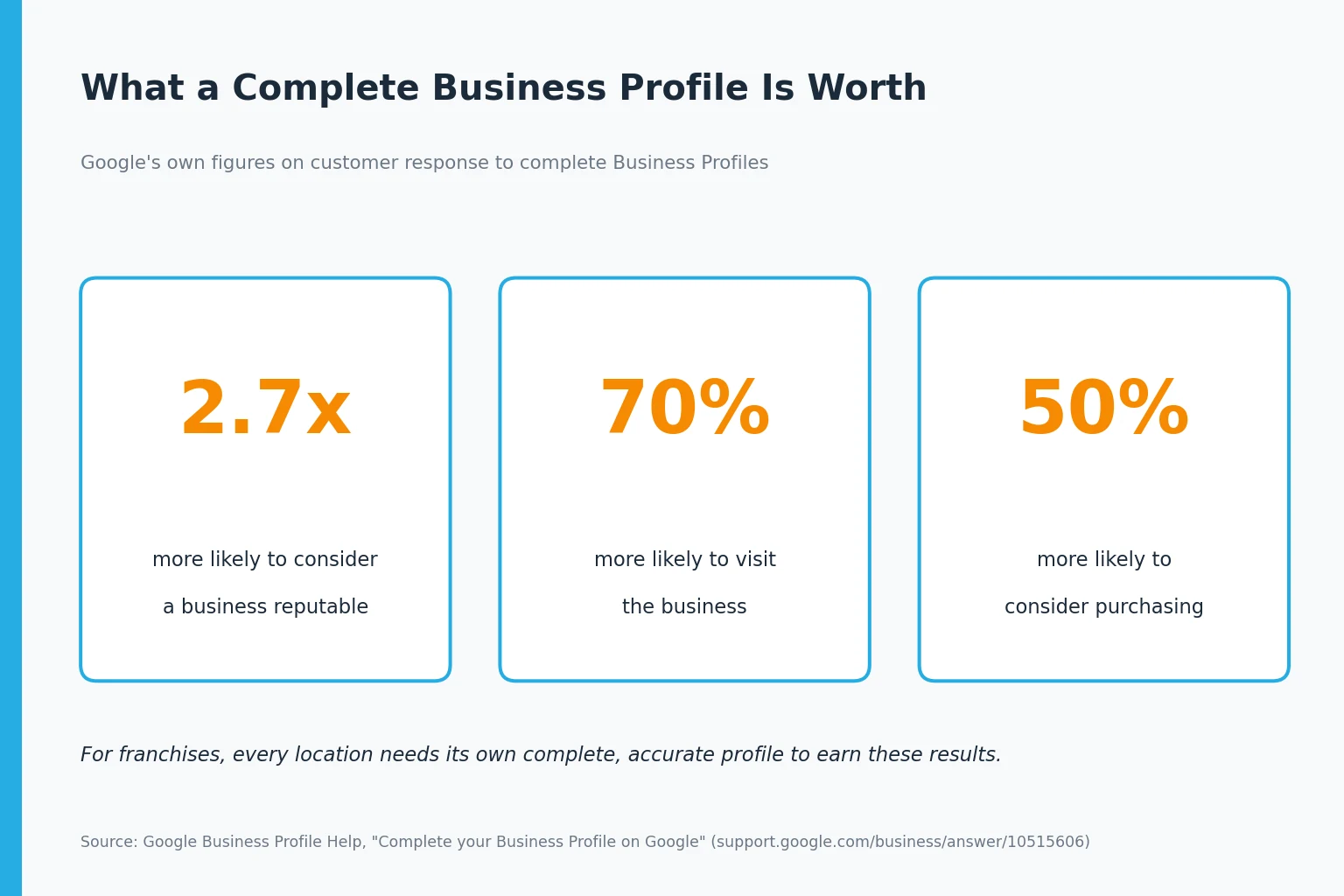
The payoff for getting this right is measurable. Google reports that customers are 70% more likely to visit and 50% more likely to consider purchasing from businesses with a complete Business Profile, and 2.7 times more likely to consider them reputable. Multiply that by every storefront in your system and the cost of a single unresolved error becomes clear.
How the Local 3-Pack Chooses Which Franchise Locations to Show
Google states that local results are based primarily on relevance, distance, and prominence, and that there is no way to request or pay for a better local ranking. Every error in this guide damages at least one of those three signals, which is why fixing them is the most direct route back into the map results.
Industry research shows where the weight sits. In Whitespark’s 2026 survey of local SEO experts, Google Business Profile signals carry the largest share of local pack ranking influence at 32%, ahead of reviews at 20% and website content signals at 15%. Because those signals are controlled at the profile level, a franchise network has to get the profile right at every location, not just at headquarters.
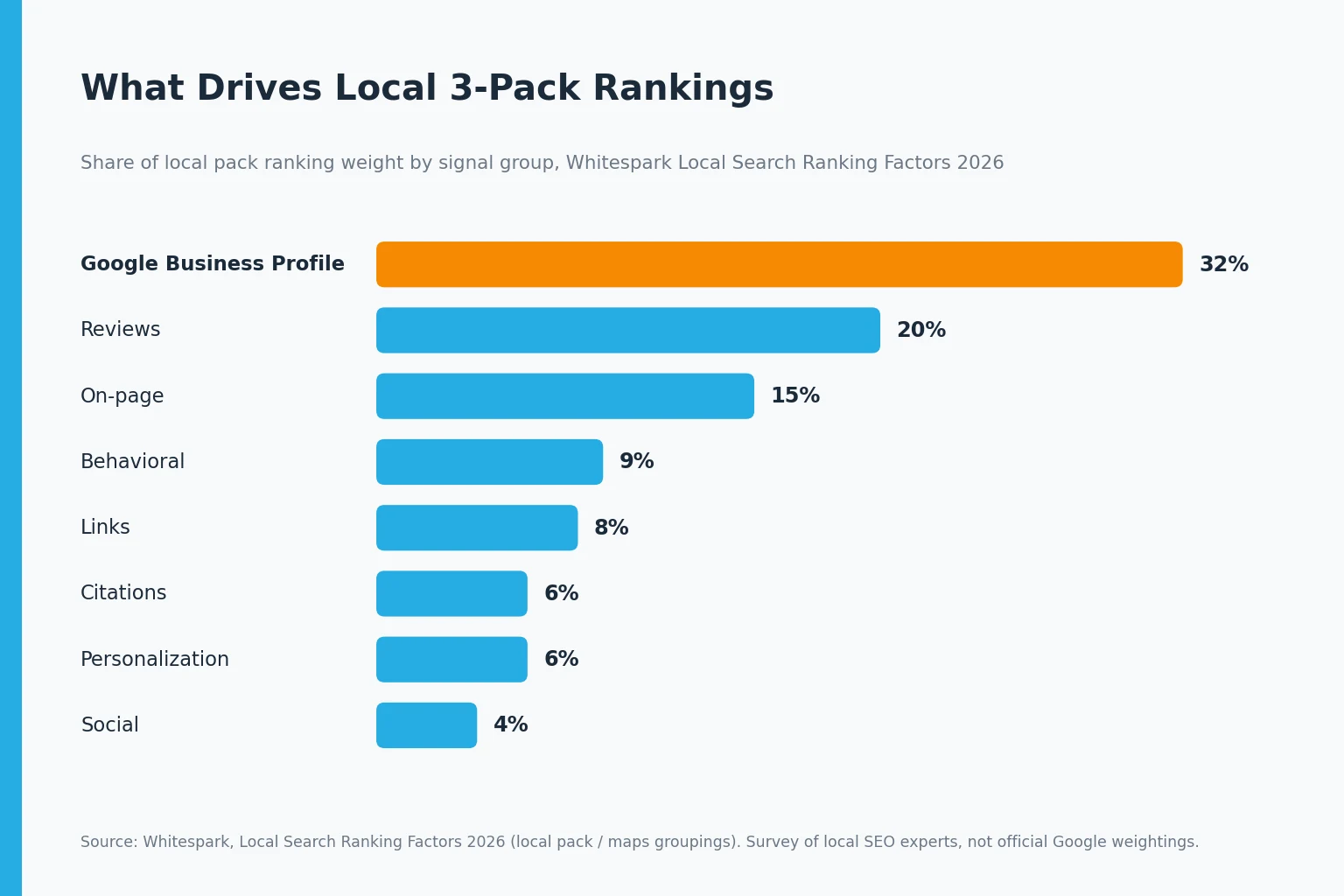
The same survey lists several individual factors that map directly onto the errors below, and it flags two profile conditions that actively hurt rankings.
| Error | Signal it damages | What the 2026 research shows |
|---|---|---|
| Mismatched NAP | Relevance and trust | Website NAP that matches the Business Profile NAP is among the top 15 local pack factors. |
| Duplicate profiles | Prominence | Other profiles in the same category at the same address count as a negative factor. |
| Misplaced pins | Distance | A properly placed map pin ranks among the top 10 local pack factors. |
| Bulk upload failures | Profile completeness | Business Profile signals are the heaviest group at 32% of local pack weight. |
| Sister-location overlap | Distance and relevance | Proximity of the address to the point of search is the second most important individual factor. |
Mismatched NAP Details Across Your Franchise Network
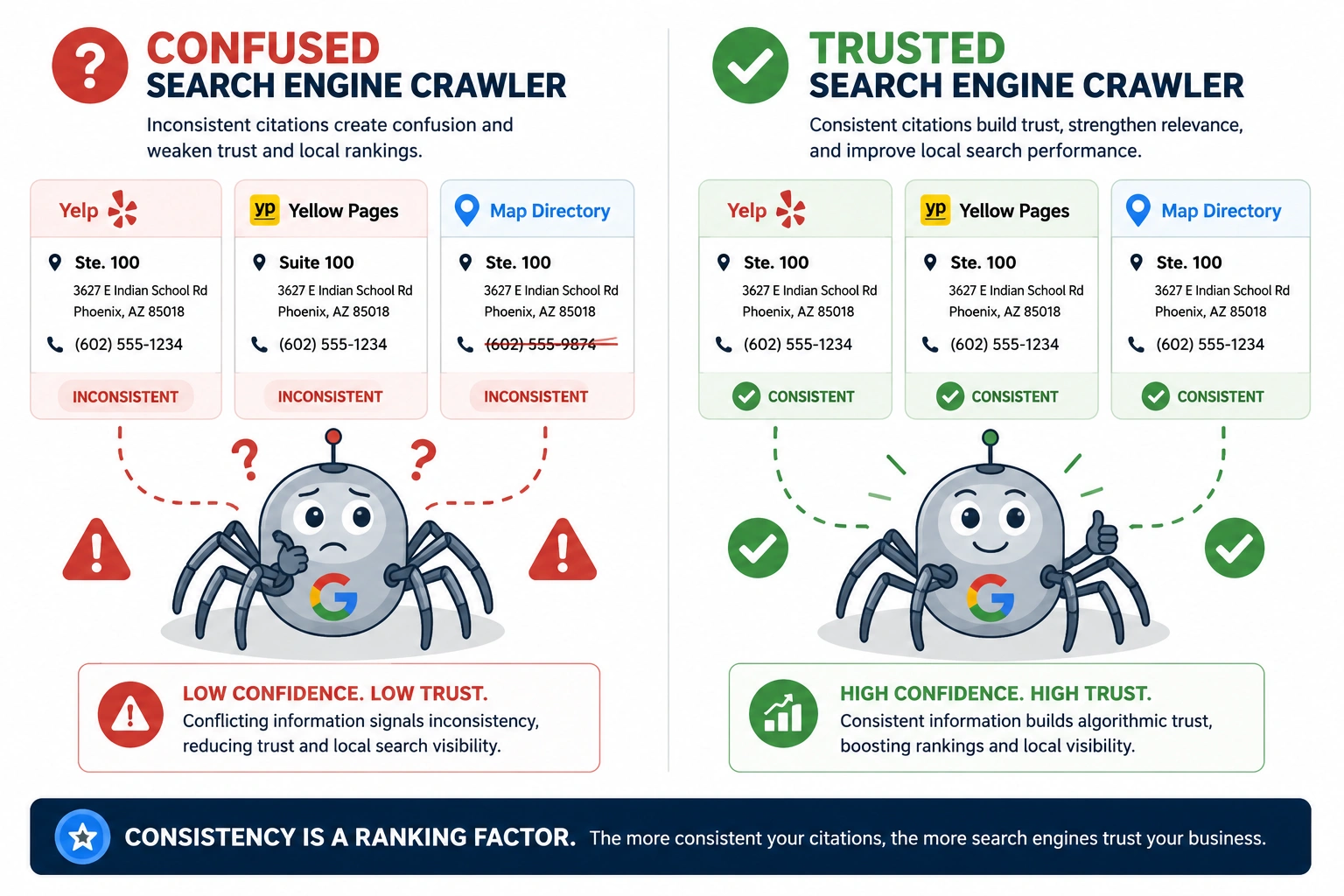
NAP stands for name, address, and phone number, the core identifiers attached to every location across Google, Apple Maps, Bing, and the directories that feed them. Conflicts creep in when a local operator edits a phone number without telling corporate, or when a bulk database push formats an address differently from the version already live on another platform. When Google meets conflicting data, it loses confidence in the listing and favors a competitor whose details agree everywhere.
Real Conflicts Versus Harmless Formatting
Not every difference matters. Google is generally able to reconcile cosmetic variations, so the work is knowing which discrepancies deserve attention.
- Usually harmless: “Street” versus “St.”, or “(123) 456-0000” versus “123-456-0000”.
- Worth fixing: “Suite A” on the website but no suite number on Google Maps.
- Actively damaging: different street names, wrong zip codes, or call-tracking numbers that differ from one directory to the next.
Fixing Franchise Google Maps Errors With a Single Source of Truth
The only architecture that holds at scale is a centralized database with one authoritative record per location, synced outward to every directory through automated tools. Professional local citation management keeps those downstream listings aligned, so a change made once at corporate reaches Google, Apple Maps, Bing, and the major aggregators without manual rework.
Duplicate Google Business Profiles Split Your Local Authority
Duplicates rarely announce themselves. They build up during platform migrations, bulk re-imports, or when a local manager claims what looks like an unclaimed listing without realizing a verified one already exists. By the time corporate notices a ranking drop, the damage has often been compounding for months.
- Signal dilution: a location with 80 reviews spread across two profiles looks like two weak businesses instead of one established one.
- Ranking penalty: Whitespark’s 2026 survey lists other profiles in the same category at the same address as a negative local pack factor.
- Bulk verification setbacks: Google does not count duplicate, suspended, or disabled profiles toward the 10-profile minimum for bulk verification.
- Customer confusion: directions route to the wrong pin and review scores split, so the brand looks inconsistent at street level.
How to Resolve Duplicate Profiles Step by Step
- Export your location group and flag any two listings that share an address or phone number.
- Confirm which profile is verified and holds the strongest review history.
- If you own both, request a merge through Google Business Profile support so reviews and engagement consolidate.
- If a third party holds the duplicate, report it on Google Maps as a duplicate of another place.
- Recheck in a few weeks, because neither route is instant.
Brands that want this handled correctly the first time often rely on a Google Business Profile setup and verification service to merge, claim, and verify without triggering new flags. Reviews that survive a merge are worth protecting, and an ongoing review management program keeps them growing on the single profile that remains.
Misplaced Map Pins Distort Your Proximity Signals
Distance is one of Google’s three named local ranking factors, and the pin is how Google measures it. A pin placed even a block from the real entrance sends customers to the wrong spot and shifts the location relative to the people searching.
- Navigation failures: a misplaced pin can route customers to an empty lot, a neighboring tenant, or a competitor.
- Proximity drift: an incorrect coordinate can place a storefront outside the effective radius of nearby searchers even though it sits close to them.
- Centroid defaulting: complex addresses with suite numbers, units, or mall locations can cause the pin to land near the geographic center of the city.
- Manual correction: latitude and longitude need to be reviewed per location so the pin sits on the physical entrance, and an adjustment may trigger a review before it goes live.
Pin audits are routine work inside local SEO services built for brands with many storefronts, because a map review of every location is the only reliable way to catch drift.

Is your franchise losing local visibility to hidden Google Maps errors?
Don’t let technical faults and misplaced pins hand your customers to competitors. Request a free, enterprise-grade local SEO audit to find and resolve listing issues across every location.
Bulk Upload and API Syncing Breakdowns
Franchises with 10 or more locations typically manage listings through bulk upload spreadsheets or API integrations, and that is the right call at scale. The exposure is that formatting faults rarely produce a loud error. New locations fail to publish, existing ones fall out of sync, and visibility erodes quietly. Google’s own guidance on bulk verification sets the ground rules.
| Google requirement | Why it matters for franchises |
|---|---|
| The spreadsheet must contain 10 or more profiles from the same business. | Smaller groups verify location by location. |
| Duplicate, suspended, or disabled profiles do not count toward the minimum. | Unresolved duplicates can disqualify an otherwise eligible brand. |
| Uploading a spreadsheet does not send a verification request. | A successful import is not the same as a verified location. |
| Locations should appear on the official website and match the upload. | Website and listing data have to agree before verification. |
Store Codes and Upload Limits
Every location should carry a unique, permanent store code from the first upload, because Google uses store codes to differentiate locations that share an address. Common upload errors include invalid characters in the name field, malformed addresses, and incorrect country codes. When the daily upload limit message appears, Google directs businesses to a support form rather than repeated submissions, as outlined in its bulk upload error guidance.
Governance effort grows with every location added, so it helps to understand how multi-location SEO pricing scales before committing to an in-house or outsourced model.
Sister Franchise Suppression and the Possum Effect
Local SEOs use the name “Possum” for the way Google filters near-identical listings so that one business does not fill the local pack. For most businesses that is irrelevant. For franchise systems it is a structural hazard, because neighboring locations share a brand, a primary category, and usually a root domain. Google surfaces the stronger listing in the standard view and shows the weaker one only when the searcher zooms in on the map. Two locations 1.5 miles apart can undercut each other without either operator noticing.
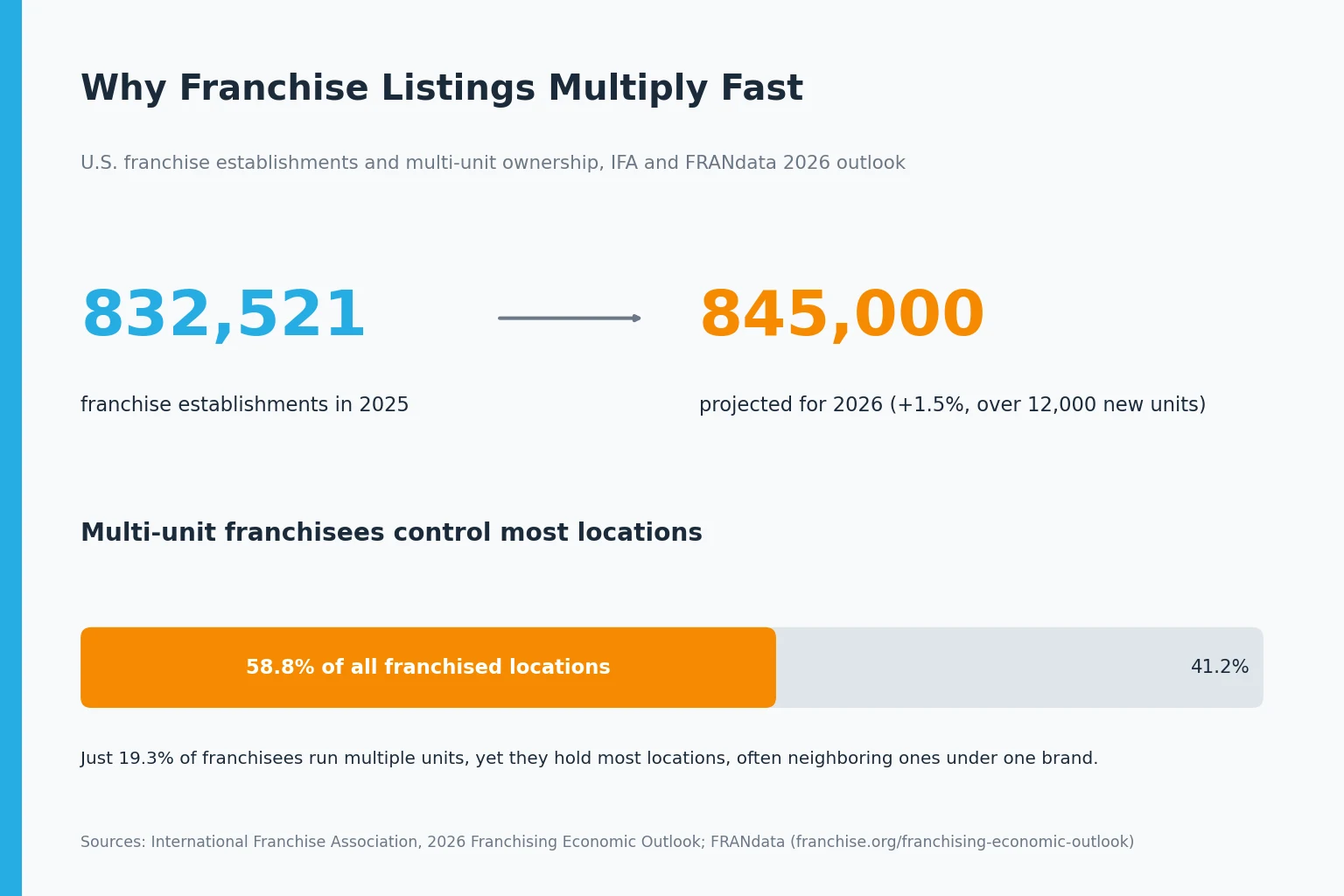
The risk grows with scale. The International Franchise Association projects U.S. franchise establishments will rise from 832,521 to 845,000 in 2026, and FRANdata reports that the 19.3% of franchisees who operate multiple units control 58.8% of all franchised locations.
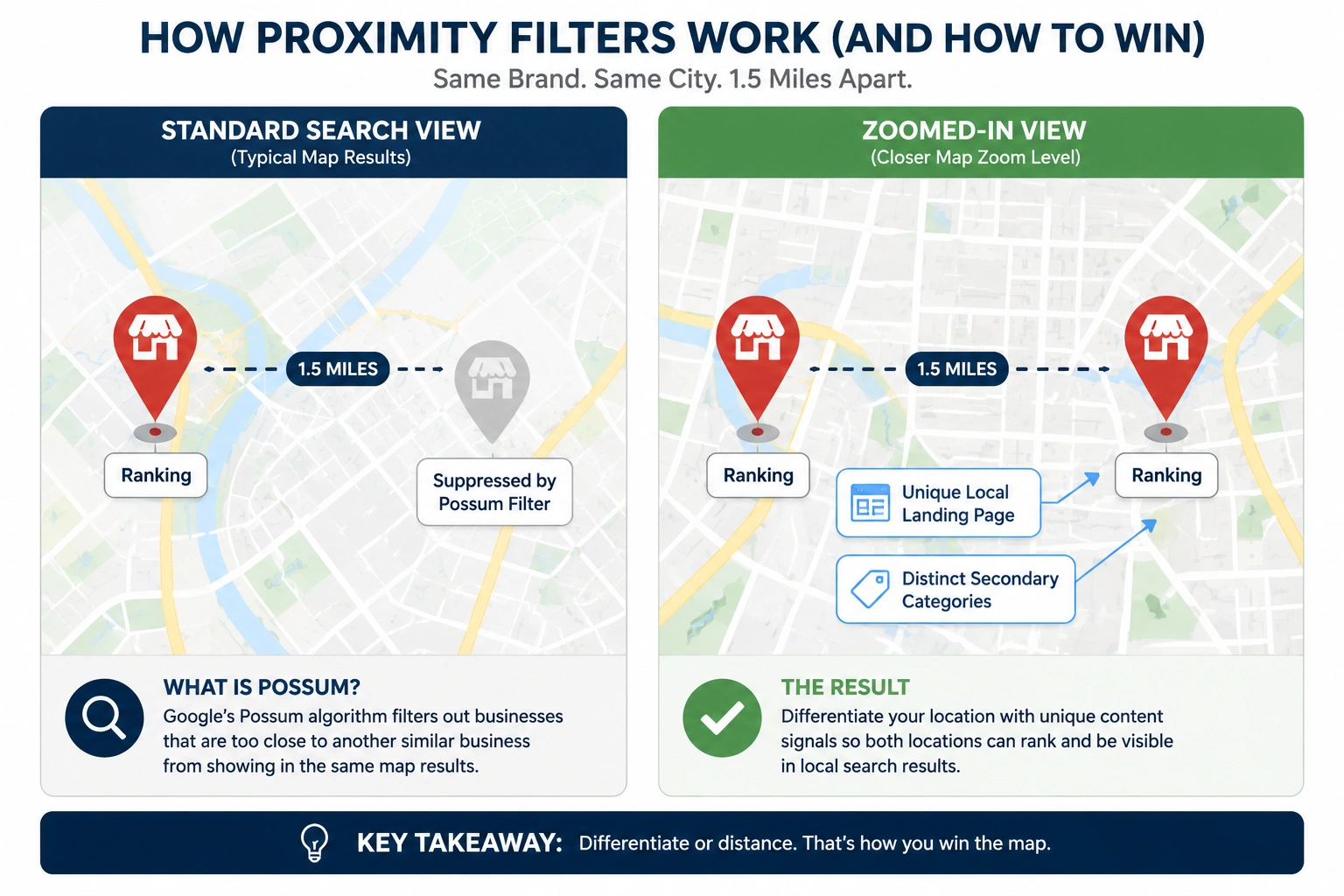
How to Differentiate Nearby Locations
- Unique local content: give each storefront its own optimized location content on your website instead of routing every listing to the corporate root. Strong on-site optimization makes each location read as a distinct business serving a distinct neighborhood.
- Local phone numbers: Google’s guidelines for representing your business ask for a number that connects to the individual location and prefer a local number over a central call center line whenever possible.
- Accurate secondary categories: add categories only where the location genuinely qualifies, since over-claiming creates its own problems.
- Localized engagement: fresh photos, review replies, and updates tied to each neighborhood reinforce that every storefront is its own active entity.
Balancing Corporate Control With Local Engagement
The long-running debate in franchise marketing is how much independence to extend downward without recreating the fragmentation that centralization was meant to prevent. Full lockdown protects data integrity, while local flexibility produces the photos, replies, and updates that engagement signals depend on. The workable answer is a structured hybrid, and it sits at the center of any franchise marketing strategy that scales across territories.
One correction to a common assumption: Google’s owner and manager roles are not a data lock. Managers can edit business information and respond to reviews, while only owners can add or remove users or remove a profile.
- Corporate owns every profile: keep corporate as primary owner so no location can be lost, transferred, or removed by a departing operator.
- Local managers handle engagement: give operators manager access for replies, photos, and updates tied to their storefront.
- Monitor for edits: because managers can change core details, review suggested and pending edits on a schedule and compare every profile against the central record.
- Standardize the website destination: each profile should point to its own optimized local content, not a generic corporate address.
How to Audit Franchise Google Maps Errors Across Every Location
Protecting your local footprint means moving from reactive troubleshooting to proactive governance, and that starts with a structured audit. A thorough free SEO audit is a useful starting point, and the steps below can run alongside it.
- Export the complete location group and compare every listing against the central location database.
- Flag address deviations, phone discrepancies, and missing or duplicated store codes.
- Review every map pin, not only flagship locations, to confirm it sits on the building entrance.
- Queue duplicate profiles for merging or removal before they affect verification status.
- Check verification, suspension, and pending-edit notices for each location.
- Confirm each profile links to its own location content and carries the right local phone number.
Check Primary and Secondary Categories While You Are There
Whitespark’s 2026 survey ranks the primary Business Profile category as the number one local pack factor and lists an incorrect primary category as a negative one. Audit categories at the same time as NAP and pins, and make sure each choice describes what that location actually does.
| Check | Where to look | Suggested cadence |
|---|---|---|
| NAP match | Central record versus Google, Apple Maps, and Bing | Monthly |
| Map pins | Each location in Google Maps | Quarterly |
| Duplicates | Location group and address search | Monthly |
| Categories | Profile editor | Quarterly |
| Upload and sync status | Business Profile Manager statuses | After every bulk change |
When Specialized Franchise SEO Support Pays Off
Managing a local presence across an extensive network does not scale with spreadsheets and good intentions. It takes specialized tooling, fluency with Google’s bulk management systems, and monitoring that catches drift before it becomes a visibility collapse. Dedicated SEO services for franchises bring that infrastructure, along with an understanding of the franchisor and franchisee tension, bulk verification constraints, and proximity filtering described above.
Budget clarity matters as much as capability. Reviewing franchise SEO pricing alongside the scope of each location’s listing work shows what ongoing governance really involves.
Franchise Google Maps Errors FAQs
How do mismatched NAP details affect a franchise’s local search presence?
Conflicting names, addresses, or phone numbers weaken the confidence Google places in a listing. When the same location appears with different details across directories, Google has less certainty about the correct information and may favor a competitor whose data agrees everywhere. Across a franchise network, where locations drift independently, the effect compounds.
Can multiple franchise locations share the same phone number on Google Maps?
Google’s guidelines say to provide a number that connects to the individual business location and to use a local number rather than a central call center line whenever possible. Sharing one corporate number across many profiles makes locations harder to tell apart and can contribute to duplicate-listing flags, so a unique local number per location is the safer standard.
How do I resolve duplicate Google Business Profiles for a franchise location?
Identify the verified primary profile and the duplicate. If you own both, request a merge through Google Business Profile support so reviews and engagement consolidate. If a third party holds the duplicate, report it on Google Maps as a duplicate of another place. Neither route is immediate, so schedule recurring duplicate checks.
How many locations do I need for Google Business Profile bulk verification?
Google requires 10 or more profiles from the same business in the spreadsheet. Duplicate, suspended, or disabled profiles do not count toward that minimum, and uploading the spreadsheet does not by itself send a verification request.
Why is my franchise location not showing up on Google Maps after verification?
Newly verified profiles can take several days to appear. If a listing stays invisible beyond that, check the dashboard for pending verification prompts, address conflicts, or suspension notices that may not have triggered an email. Address conflicts are common when a new location’s address closely resembles an existing listing.
What is the best way to track Google Maps traffic to a franchise website?
Add UTM parameters to the website URL field of each location’s profile, such as ?utm_source=google&utm_medium=maps&utm_campaign=local. Analytics can then separate Maps traffic from general organic traffic, so you can measure visits and conversions at the location level.
How often should a franchise audit its Google Business Profiles?
Treat the audit as a recurring practice instead of a one-time project. Listings drift through user-suggested edits, platform syncs, and operator changes, so a monthly review of NAP and duplicates and a quarterly review of pins and categories is a practical rhythm for most networks.
Maintaining a clean Google Maps presence across a franchise network is not a set-it-and-forget-it task. Listings drift, operators make well-intentioned edits, and bulk uploads introduce faults that nobody catches until visibility slips. The five errors covered here are each fixable on their own, but at franchise scale they rarely appear alone and they compound faster than most corporate teams can track.
Brands that treat Business Profiles as a living operational asset, governed centrally, engaged locally, and audited on a schedule, hold their local 3-pack positions through algorithm updates and competitive pressure. If you want a specialist to review your locations, talk with a franchise SEO specialist about where your network stands today.

Ready to maximize the visibility of every franchise location?
At BizIQ, we help multi-location brands clean up their listings, compete for the local 3-pack, and drive real-world growth. Let us handle the technical heavy lifting so you can focus on running your business.