
Key Takeaways:
- Turn passive organic search traffic into active, high-value phone calls.
- Implement high-converting above-the-fold elements that build immediate trust.
- Optimize visual hierarchies and forms to capture emergency storm damage leads.
- Align your roofing services SEO strategy with conversion-focused design.
We hear it all the time from business owners who invest in seo for roofing company: traffic climbs, rankings improve, but the phone stays quiet. It is incredibly frustrating to watch hard-earned organic visitors land on your roofing company website, look around for a few seconds, and leave. We have helped hundreds of local service businesses resolve these exact challenges, and we know that turning those clicks into actual customers comes down to a few critical design decisions: layout structure, trust signal placement, form architecture, and mobile optimization. These details determine whether visitors pick up the phone or click back to your competitor. Design dictates your revenue.
Showing up on Google is only half the battle for a local roofing company. If your landing page fails to establish immediate trust, clarify your service area, and provide a frictionless path to contact, your organic visitors will simply return to the search results and call whoever ranks below you. The gap between a page that generates calls and one that generates nothing is rarely about the quality of your craftsmanship. It is almost always a design and intent-alignment problem on your website.
Why SEO for roofing companies fails to convert without intent-driven design
The disconnect between traffic and conversions
Search engine optimization and conversion rate optimization solve fundamentally different problems, and confusing them is one of the most expensive mistakes a roofer can make. SEO drives qualified visitors to your page; CRO determines what those visitors do once they arrive. A page can rank in position one for competitive local terms and still convert at a rate that makes the entire investment economically pointless.
The numbers here are genuinely sobering. Average roofing website conversion rates hover between 0.5% and 2%, meaning that for every 200 visitors a well-ranked page attracts, only one or two pick up the phone, leaving you with high marketing costs and empty bays. Optimized, intent-driven roofing landing pages, by contrast, routinely achieve conversion rates of 5% to 8% or higher. That is not a marginal improvement; it is the difference between a marketing approach that pays for itself and one that quietly drains your budget.
The psychological gap between a visitor in research mode and one in emergency mode is also critical to understand. A homeowner casually comparing roofing contractors in January behaves completely differently from one searching at 9 PM during an active storm. Emergency searchers are not evaluating options; they are looking for the fastest credible answer. They want help now. Your page needs to serve both audiences without sacrificing either.
Aligning user intent with landing page optimization
A case study from WebRunner Media illustrates the stakes precisely. Routing search traffic to a dedicated service landing page instead of a general homepage pushed conversion rates from 3.56% to 5.77%, representing a 62% lift, while simultaneously cutting the cost per lead from $196 to $121, according to a case study by WebRunner. The page content did not change dramatically. The routing did.
General homepages scatter attention. Navigation menus, service overviews, company history sections, and blog links all compete for the visitor’s attention, pulling them in six directions when they arrived with one specific need. A service-specific roofing landing page eliminates that competition entirely. Every element on the page, including the headline, the imagery, the form, and the CTA, points toward a single action. For roofing company seo to pay off, the page receiving that traffic must be built around the exact intent that generated the click.
Matching specific search queries to localized landing pages also satisfies transactional search intent at the algorithmic level. Search engines reward pages that answer the precise question a user asked. A page titled “Emergency Roof Repair in Phoenix: Licensed & Insured” will outperform a generic homepage for that query, both in rankings and in the conversion rate of the visitors it attracts.
When a homeowner searches for a “roofing contractor near me” or a “residential roofer near me” after a severe storm, they are not looking to read a 1,000-word essay on the history of asphalt shingles. They want immediate reassurance that a licensed, professional contractor can patch their leak before the next rain. A standard homepage, with its cluttered navigation menus and generic “About Us” sections, forces the user to hunt for contact information, and most won’t bother.
To solve this, we recommend transitioning from a unified website model to an intent-segregated funnel. Dedicated landing pages for distinct services, such as emergency roof repair, commercial roof replacement, and residential inspections, eliminate mental effort by matching the search query to a highly relevant page. That specificity makes the path to calling your business obvious rather than effortful.
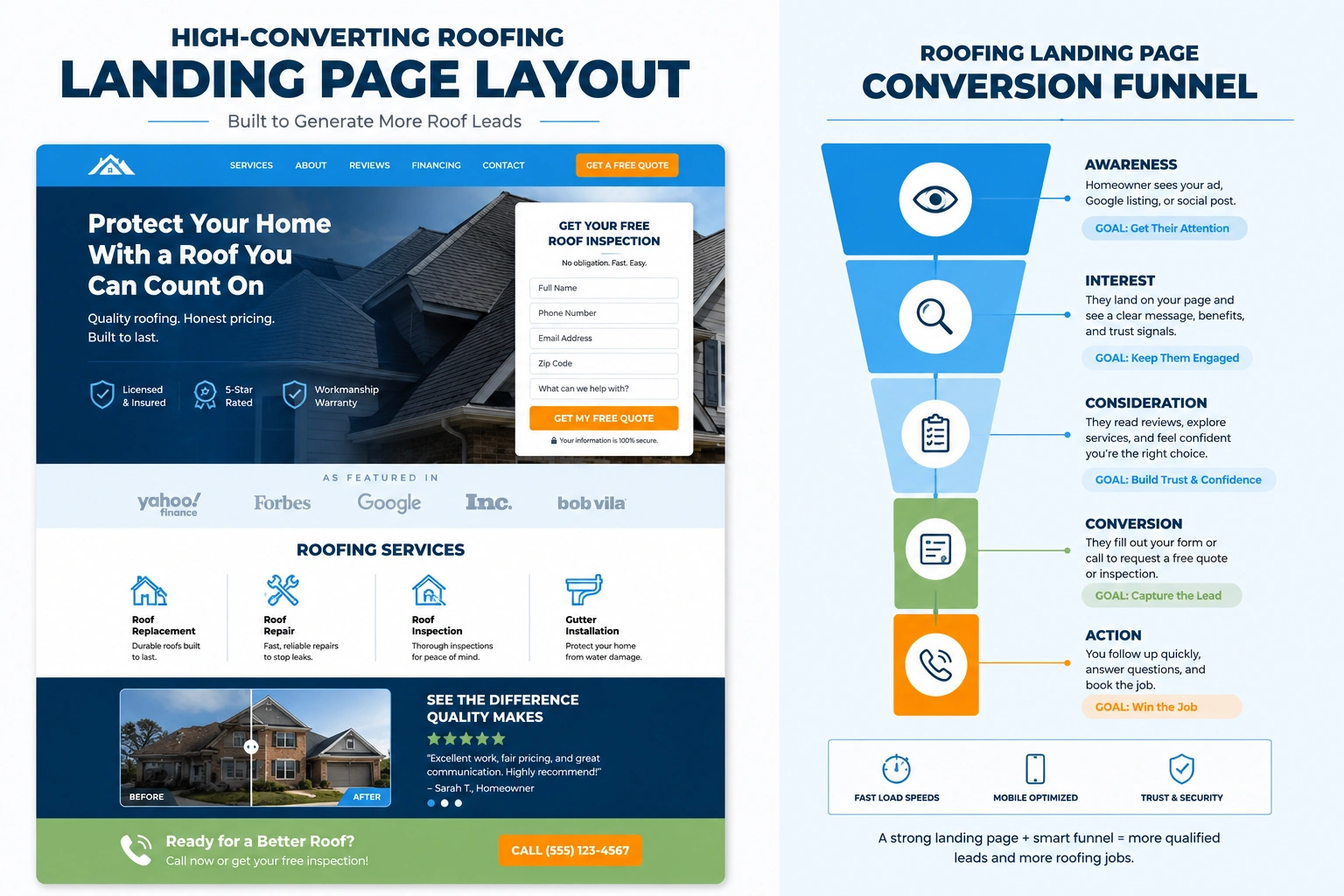
Example of a high-converting roofing landing page paired with a lead generation funnel designed to turn visitors into customers.
Essential above-the-fold elements for immediate trust
The power of the hero section
“Above the fold” refers to everything a visitor sees before scrolling: the first visual impression your page makes in roughly three seconds. For a local roofing business, that real estate is the most critical on the entire site. A visitor who does not find what they need in those first moments will not scroll to find it. They will leave.
A bold, benefit-driven headline does the heaviest lifting here. It should state your primary service and your service area in plain language: “Expert Roof Repair in [City]: 100% Satisfaction Guaranteed” communicates competence, geography, and a commitment to quality without requiring the visitor to interpret anything. Vague headlines like “Your Trusted Roofing Partner” waste the opportunity entirely.
CTA placement in the hero section follows a clear hierarchy. A prominent click-to-call button belongs in the top-right corner of the header, where trained web users instinctively look for contact options, and also centered in the hero section itself, positioned directly below the headline. For guidance on writing CTA copy that compels action rather than just occupying space, BizIQ’s resource on creating compelling ad copy covers the psychological mechanics behind high-performing calls to action in detail.
Integrating immediate trust signals
Trust badges belong immediately below the main headline, not buried in a footer. Put them front and center. GAF Master Elite certification, Owens Corning Preferred Contractor status, and a Better Business Bureau accreditation seal are not decorative; they are real tools for reducing anxiety and proving your team is qualified. A visitor who has never heard of your company needs a fast, visual shortcut to determine whether you are legitimate.
Aggregate review ratings carry similar weight. Displaying “4.9 Stars on Google: 150+ Reviews” above the fold gives visitors social proof before they have read a single word of your copy. Data from ChoiceLocal shows that over 86% of consumers read reviews for local businesses before making a hiring decision, based on market research by ChoiceLocal. Placing that social proof where it is immediately visible rather than requiring visitors to scroll for it removes a significant hesitation point.
Key Above-the-Fold Elements:
- A bold, benefit-driven headline that immediately states your primary service and local service area.
- A prominent click-to-call button positioned in the top-right corner and center of the hero section.
- A set of visible trust badges such as GAF Master Elite certifications, Owens Corning badges, or an aggregate 4.8-star Google rating.
Visual proof and project showcases that reduce friction
Using real imagery over stock photos
Stock photos of smiling models in hard hats holding clipboards do not just fail to build trust; they quickly damage it. Local homeowners have seen those images on dozens of contractor websites. They know they are fake. They register as a signal that the company has something to hide, or at minimum, nothing real to show.
High-resolution before-and-after photos of actual local roof replacements accomplish something no stock image can: they prove capability. A photo of a storm-damaged roof in a recognizable neighborhood, followed by the completed replacement, tells a specific story that a prospective customer can verify and relate to. Add photos of your actual crew in uniform next to branded company trucks, and you have humanized the business in a way that no amount of copywriting can replicate.
BizIQ’s web design portfolio provides real-world examples of how conversion-focused design integrates authentic visual proof into a coherent page structure, which is worth reviewing if you are evaluating layout approaches for your own site.
Proving geographic relevance and local presence
An interactive service area map or a curated list of recently completed local projects does two things simultaneously: it proves to human visitors that you work in their area, and it signals geographic relevance to search engines. Both matter for local search engine optimization for roofers.
Project galleries that reference specific neighborhood names, such as “Recent Replacement in Scottsdale’s McCormick Ranch” rather than “Recent Project,” reinforce local credibility at a detailed level. Visitors from that neighborhood recognize it. Search engines index the location-specific language. This helps you compete with storm chasers by proving you are a permanent part of the community, reducing bounce rates and increasing the probability that a visitor picks up the phone rather than continuing to browse.
Visual Proof Checklist:
- High-resolution before-and-after photos of actual local roof replacements rather than generic stock imagery.
- Real team photos showing your crew in uniform next to branded company trucks to humanize your business.
- An interactive service area map or a list of recently completed local projects to prove geographic relevance.
Ready to grow your local business and turn search traffic into exclusive leads?
Get a free, customized website audit for conversions from BizIQ today to identify your biggest conversion bottlenecks.
Low-friction lead capture and multi-step forms
The psychology of form fields
Long forms are conversion killers. This is not a debatable point; it is documented behavior. Research from Results Digital shows that reducing form fields from six to three can increase overall conversion rates by up to 120%, according to form studies by Results Digital. Every additional field you add asks the visitor to make another micro-decision about whether this interaction is worth their time.
The distinction between low-friction and high-friction conversion paths matters here, and it maps directly to service type. For emergency storm repair or active leak calls, the conversion step should be as frictionless as possible: a ZIP code and a phone number, or better yet, a single click-to-call button. Speed is the entire value proposition for that visitor. They need help fast. For high-ticket retail replacements, such as full roof tear-offs or commercial re-roofing projects, a multi-step form that qualifies the lead by asking about roof age, material type, and project timeline is appropriate. It reduces raw lead volume but dramatically improves lead quality for services where a $15,000 job warrants a more focused sales process.
Multi-step forms for high-ticket services
Multi-step forms work because of how commitment accumulates. Small steps build trust. A visitor who answers “What type of roof do you have?” has already begun investing in the interaction. Each subsequent question deepens that investment, making it progressively easier to reach the final step where contact information is requested. This is the micro-commitment principle applied to lead generation for roofing company workflows, and it consistently outperforms single-page forms for high-ticket service categories.
The structural design of a multi-step form for a commercial roofing landing page or a retail replacement page should follow a simple rule: lead with the easiest, least personal question and save contact details for last. Progress indicators, such as “Step 2 of 3,” reduce abandonment by making the end of the process visible. A roofing landing page template built around this architecture will outperform a standard contact form in both completion rate and lead quality.
When a homeowner is presented with a form asking for their name, email, phone number, address, roof age, and insurance provider all at once, they experience immediate form fatigue. Breaking this into a multi-step experience changes the psychological dynamic entirely. Asking a simple, non-threatening question first, such as “What is your primary roofing material?”, gets the user’s foot in the door. By the time they reach the final step requesting contact details, they have already invested time and attention, and completion rates climb substantially as a result.
Privacy assurances deserve more attention than most roofing sites give them. Homeowners researching high-ticket home services are highly protective of their personal data, particularly in an era when spam calls are common. A single line directly below the submit button: “We respect your privacy. Your information is used solely to provide your quote and is never sold to third parties” addresses that anxiety directly. It costs nothing to include and measurably reduces form abandonment.
“Roofers don’t lose jobs because they’re bad at roofing. They lose them because the competitor who shows up first and builds immediate trust gets the call.”
Maria Harutyunyan, Founder of Roofex SEO
Mobile-first optimization for emergency storm damage traffic
The urgency of mobile page speed
Over 70% of emergency roofing searches originate on mobile devices. Mobile is the standard. That single statistic should reframe how you think about every design decision on your landing page. The visitor is likely standing in their driveway, staring at a damaged roof, typing with one hand. They are not patient.
Page speed is where most roofing sites lose leads without ever knowing it. A one-second delay in load time reduces conversions by up to 7%, as documented in page speed research by Search Engine Journal. If your page takes longer than three seconds to load, conversion rates drop by more than 50%, meaning you have lost the majority of your emergency traffic before a single word of your copy has been read. That is not a theoretical risk; it is a measurable, ongoing cost.
Mobile UX best practices for roofers
A sticky header with a click-to-call button is essential for mobile-optimized roofing landing page design. As the user scrolls through project photos, reviews, and service details, the phone number stays anchored at the top of the screen. The moment they are convinced, the path to calling is immediate, with no scrolling back and no hunting for contact information.
Large, thumb-friendly tap targets matter more than most designers account for. Phones require big buttons. Buttons that are easy to tap on a desktop become frustratingly small on a phone screen. Form inputs should be spaced generously, and dropdown menus should be replaced with large selectable tiles wherever possible. Friction on a mobile form is amplified compared to desktop; a field that’s merely inconvenient on a laptop becomes a genuine barrier on a phone.
Mobile-first optimization is not simply shrinking a desktop layout to fit a smaller screen: it requires re-engineering the entire user experience for a visitor in motion. Compressing high-resolution project images, adopting modern formats like WebP, and eliminating render-blocking JavaScript are the technical foundations. A fast, responsive site not only retains stressed homeowners who would otherwise bounce but also functions as a critical ranking factor for local search engine optimization for roofers, given that Google’s mobile-first indexing directly penalizes slow-loading mobile pages.
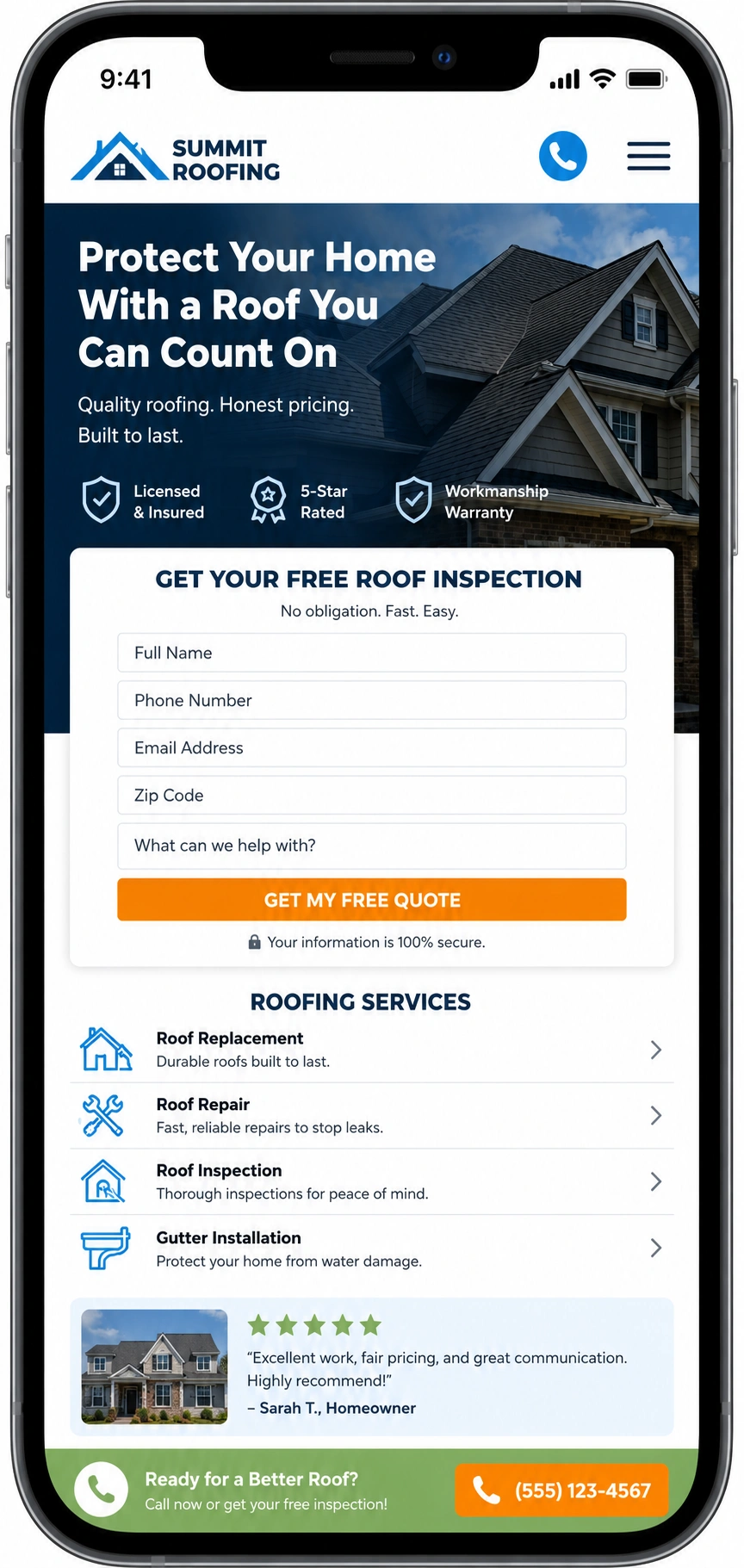
Example of a mobile-optimized roofing landing page designed to maximize conversions with a streamlined layout and prominent CTAs.
Partner with BizIQ for professional guidance on choosing a web design service designed to scale your local home service business.
Local authority signals and service area clarity
Establishing local credibility
Geographic relevance is something you have to demonstrate, not just claim. Show, do not just tell. A local phone number with a recognizable area code shows you are close in a way that an 800 number never can. Visitors, and search engines, treat a local number as a credibility marker; it implies a physical presence in the community rather than a remote call center fielding leads from across the country.
City-level landing pages take this further. A page built specifically for a target city, referencing local landmarks, regional weather patterns, such as hail frequency, hurricane exposure, freeze-thaw cycles, and applicable building codes, signals genuine local expertise rather than a generic service offering copy-pasted across markets. A homeowner in Denver reading about the specific impact of Front Range hail events on asphalt shingles will trust that contractor more than one whose page reads identically to a site in Miami.
Local business schema and NAP consistency
Local business schema markup is the technical layer that communicates your geographic relevance directly to search engines. Implemented correctly, it tells Google your business name, address, phone number, service area, and operating hours in a structured, machine-readable format, clearing up confusion and improving your eligibility for local pack rankings. This is a core component of any serious seo roofing strategy. Do not skip it.
NAP consistency: identical Name, Address, and Phone data across your landing page, Google Business Profile, and directory citations, is equally foundational. Discrepancies between these sources create conflicting signals that suppress local rankings. Embedding a live Google Map of your physical office location or primary service area adds a visual trust layer for human visitors while reinforcing the geographic signals that roofing company seo depends on.
Local Authority Checklist:
- A local phone number with a recognizable area code rather than a generic toll-free number.
- Specific city-level landing pages that mention local landmarks, weather patterns, and building codes.
- Embedded Google Business Profile reviews that display real names, dates, and specific roofing services performed.
Integrating roofing services SEO with conversion design
Balancing search engine optimization and CRO
Search engine optimization and conversion rate optimization are not competing priorities; they are sequential ones. SEO determines who arrives at your page; CRO determines what they do when they get there. They must work together. Treating them as separate workstreams, managed by different people with different metrics, is where most roofing marketing budgets get fragmented, leading to wasted spend and fewer actual jobs on your schedule.
Targeting high-intent keywords, such as roofing services SEO, roofing company seo, and seo roofing, ensures that the traffic your page attracts is already ready to hire. A visitor who searched “emergency roof repair [City] licensed contractor” is not browsing; they are evaluating. Your page’s job is to end that evaluation quickly and in your favor. BizIQ’s guide to the top roofing SEO keywords provides a detailed breakdown of the highest-intent terms worth targeting, organized by service category and search volume.
Natural-language integration and semantic synonyms
Modern search engines evaluate subject expertise, not keyword frequency. Quality matters most. A page that discusses “shingle replacement,” “storm-damaged decking,” “flashing repair,” and “flat roof membrane installation” alongside its primary keyword demonstrates genuine subject-matter depth in a way that exact-match repetition never could. That semantic richness satisfies the algorithm while maintaining copy that reads like it was written by someone who understands roofing, which is exactly the credibility signal your roofing contractor SEO services strategy should be building.
Keyword placement still matters, but the logic has shifted. Integrating your primary and secondary terms into headings, the first paragraph, image alt text, and meta descriptions covers the structural requirements. The body copy should then expand naturally around those terms, using synonyms and related concepts to build topical coverage. Forcing exact-match phrases into sentences where they do not belong produces copy that reads awkwardly to humans and is increasingly penalized by AI-driven search evaluation systems.
In the early days of search engine optimization, ranking a page was as simple as repeating your target keyword dozens of times. Today, search engines favor natural, semantically rich copy over exact-match repetition. Integrating synonyms and related terms organically, such as discussing “shingle replacement” alongside “roof repair,” or “storm restoration” alongside “emergency services,” satisfies search algorithms while maintaining the professional, authoritative tone that builds trust with human readers. The two goals reinforce each other when the copy is written with genuine expertise rather than assembled around a keyword list.
Answering homeowner hesitations before the call
Addressing buying objections directly
Transparent pricing ranges, warranty details, and licensing information are not just nice-to-have additions; they are active conversion drivers. A visitor who can see that your workmanship warranty covers ten years, that you carry $2M in liability insurance, and that your license number is verifiable does not need to call to establish basic credibility. That pre-call trust-building shortens the sales cycle and increases the probability that the call they do make is a booking rather than an inquiry.
Social proof in this context goes beyond star ratings. Details build trust. Testimonials that reference specific services, like “They replaced our entire roof after the April hailstorm and handled the insurance claim directly,” carry far more persuasive weight than generic five-star reviews. Specificity is credibility. A visitor reading that review recognizes their own situation and draws a direct line from that homeowner’s experience to their own potential outcome.
Reducing friction with informational content
An FAQ section structured around genuine homeowner anxieties, not marketing talking points, captures long-tail search queries while simultaneously moving the reader toward a conversion. Questions like “How long does a full roof replacement take?” or “Will my insurance cover storm damage repairs?” address the specific fears that cause visitors to hesitate. Answering them directly on the page removes the need for a preliminary phone call just to gather basic information. Be direct.
Local homeowners are often anxious about hidden fees, poor workmanship, and the complexity of insurance claims, particularly after a storm event when they are already stressed. Addressing these concerns on your landing page by outlining warranty terms, detailing your licensing and insurance coverage, and walking through your step-by-step process removes the mental hurdles that stand between a visitor and a phone call. A roofer who answers the hard questions before being asked signals confidence in their work.
Frequently asked questions about roofing landing page design
What is the ideal conversion rate for a roofing landing page? While the average roofing website converts at 1% to 2%, a highly optimized, dedicated landing page targeting high-intent organic traffic should aim for a conversion rate of 5% to 8% or higher, as demonstrated in multiple local roofing visibility case studies. Top-performing paid search pages can exceed 10% with tightly controlled audience targeting.
Should I use a phone call or a form fill as my primary call to action? For emergency services like storm damage repair, phone calls should be the primary CTA because users require immediate assistance and have no patience for multi-step processes. For retail replacements, a short form fill is an effective secondary option that allows you to qualify the lead before investing time in a site visit.
How do local reviews impact my landing page conversions? Displaying real, local reviews builds immediate trust at a point in the decision process when visitors are still evaluating whether to contact you at all. Over 86% of consumers read reviews for local businesses before hiring, and showcasing a 4.8+ star rating directly on your page reduces the perceived risk of engaging a contractor they have never worked with before.
Do I need separate landing pages for different roofing services? Yes. A single page attempting to serve residential replacement, commercial roofing, storm damage, and minor repair traffic simultaneously will dilute its relevance for each query. Separate, service-specific landing pages allow you to match the exact intent of each search, which improves both organic rankings and on-page conversion rates.
How does page speed affect my roofing lead generation? Page speed is both a ranking factor and a direct conversion variable. A one-second delay in load time reduces conversions by up to 7%, and pages that take longer than three seconds to load lose more than half their potential conversions before the visitor has seen a single element of the page. For emergency traffic, where the visitor’s urgency is highest, a slow page is effectively a closed door.
Optimizing your roofing landing page is the most direct path you have for lowering cost per lead and extracting more value from organic search traffic you are already paying to generate. The contractors who win in competitive local markets are not necessarily the ones with the best rankings; they are the ones whose pages convert that traffic into calls at a rate that makes the entire channel profitable. Implementing clear above-the-fold elements, replacing stock imagery with real project proof, simplifying your forms, and building for mobile-first performance are not incremental improvements; they compound. Each friction point you remove increases the probability that the next visitor becomes a customer rather than a bounce statistic. Friction costs you money. We suggest auditing your current layout against these principles, identifying the two or three highest-impact gaps, and addressing them before investing another dollar in driving more traffic to a page that is not built to close.
Ready to transform your organic traffic into exclusive, high-ticket roofing leads?
Partner with BizIQ for complete digital marketing for roofing companies tailored to your market.