Keyword rankings do not pay your food cost. They do not cover your labor line or your rent. You know your search traffic matters, but can you prove it is driving revenue? Most restaurant owners who invest in search marketing spend months, sometimes years, watching their agency celebrate position improvements while their reservation volume stays flat. The frustration is understandable: you are paying for something you cannot directly connect to a filled table or a completed online order, and that ambiguity makes it nearly impossible to defend the spend or scale it intelligently. Tracking the real ROI of your restaurant SEO is crucial.
The core problem is not that search marketing fails to drive revenue. It is that most restaurants have never built the measurement infrastructure to see the connection. The connection is lost. Organic impressions, click-through rates, and local search actions are all happening; the data exists, but without deliberate tracking configurations, those signals sit in disconnected platforms, invisible to anyone trying to calculate a real return on investment.
In practical business terms, restaurant search engine optimization is the process of making your digital storefront, your website, your Google Business Profile, and your local directory listings, visible and compelling to high-intent local searchers at the exact moment they are deciding where to eat. When someone searches for “Italian restaurant near me” on a Thursday evening, your menu, location, and reviews need to appear prominently enough to earn the click. That click is the beginning of a measurable revenue chain, not the end of a branding exercise. BizIQ’s digital marketing services for restaurants are built around converting that chain from a vague attribution guess into a documented driver of top-line revenue.
Before building that measurement framework, it helps to understand why tracking restaurant SEO ROI has historically been so difficult:
- The Multi-Touch Journey: A guest might view your menu on their phone during a lunch break, read your reviews in Google Maps that evening, and walk in two hours later without ever clicking a “book now” button. No single platform captures that full path by default.
- Fragmented Systems: Reservation widgets, online ordering platforms, and in-store point-of-sale systems rarely share data natively. Each lives in its own reporting silo, and reconciling them requires deliberate integration work.
- The Zero-Click Search Rise: Search engines increasingly surface menus, hours, and review summaries directly on the results page, satisfying a searcher’s intent without sending them to your website at all, which means your traffic numbers can undercount your true search-driven influence.
The Local Search Funnel: Tracking Impressions and Visibility
Think of organic impressions as how many people walked past your restaurant’s window. Thousands of people might walk by on a busy street, glance at your signage, and keep moving. A smaller number will stop and read the menu posted outside. We call that the click-through rate: the percentage of window shoppers who stepped inside. An even smaller group sits down to order. In local search, impressions are the people walking past. Clicks are the ones who stopped. Local actions, like a call, a direction request, or a reservation, are the guests who came inside.
That analogy matters because it reframes what you are measuring. It simplifies the data. Yelp’s local business directory alone hosts more than 308 million ratings and reviews (Yelp SEC Filing), making local directories a primary source of search visibility for dining venues. Your visibility across these platforms is the first variable in your return on investment calculation: you cannot convert traffic you never generated, and you cannot optimize what you are not measuring.
The specific local actions that signal high purchase intent go well beyond a simple website visit. Click-to-call events, driving direction requests, photo views, and menu clicks on your Google Business Profile all represent a searcher who has moved past casual browsing into active consideration. Map-pack visibility, appearing in the top three local results on Google, drives an outsized share of these immediate actions because it intercepts searchers at peak intent. Establishing the right restaurant local SEO strategies ensures your business is positioned to capture those moments consistently, not just occasionally when a competitor’s listing slips.
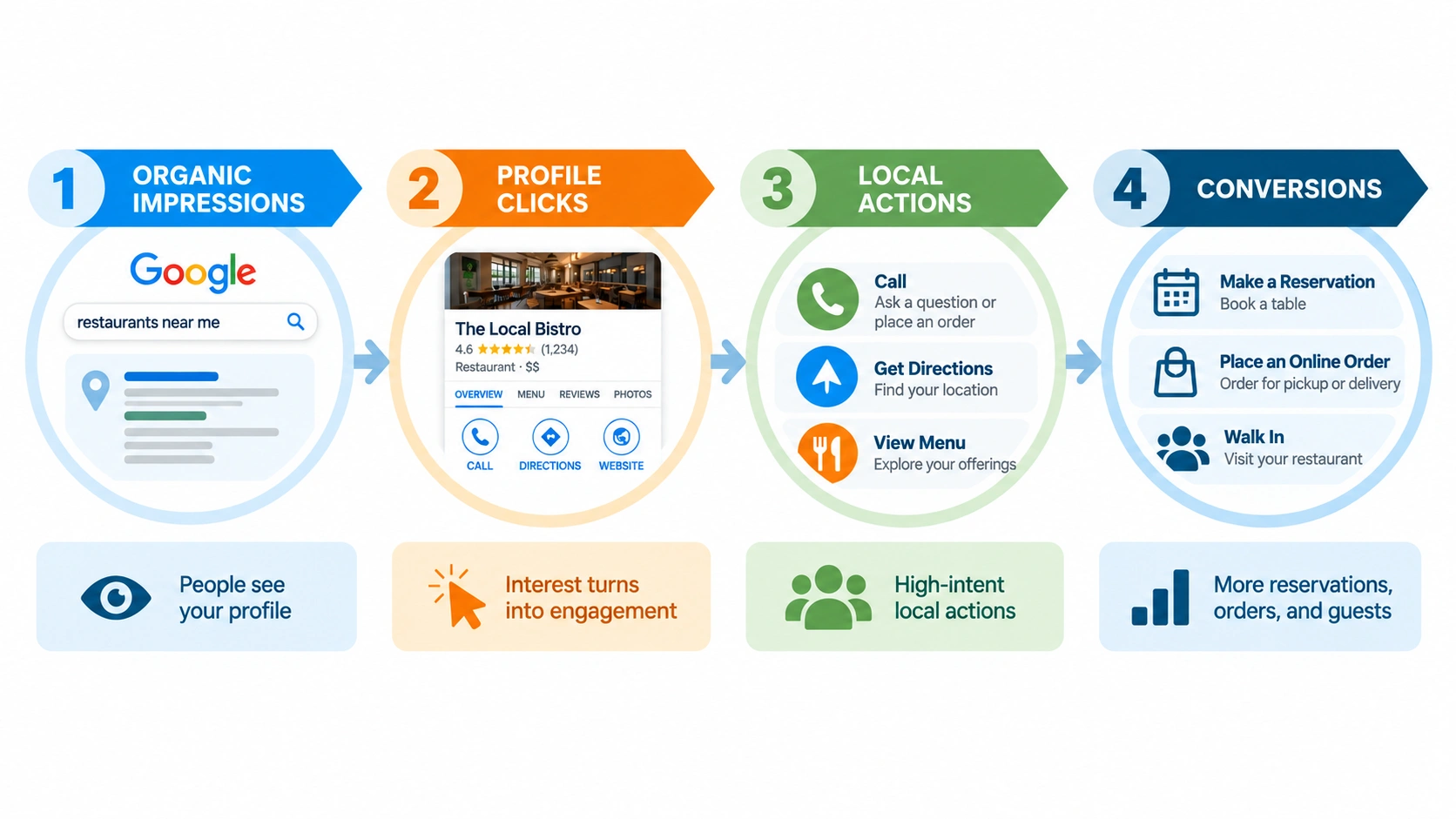
The restaurant local search funnel shows how online visibility can progress from search impressions to calls, directions, reservations, orders, and visits.
Conversion Tracking Setups for Restaurant Websites
Total page views are a comfortable metric to report because they almost always trend upward. They are also nearly useless for proving ROI. They hide the truth. A thousand visitors who browse your homepage and leave without clicking “Order Online” or “Reserve a Table” contribute nothing to your revenue line. What matters is whether your analytics platform is configured to record the specific actions that precede a transaction.
Custom event tracking in your analytics platform allows you to assign a measurable value to every high-intent interaction on your restaurant website, which is the foundation of successful restaurant website SEO. Instead of counting sessions, you count order button clicks, reservation widget completions, and phone number taps: each of which can be assigned a dollar value based on your average check size and historical booking-to-dine conversion rates. This configuration is not technically complex, but it requires deliberate setup. Without it, your search campaign results look like a cost with no corresponding output.
The three primary website conversions that every restaurant must track, and what each one connects to operationally:
- Online Ordering Clicks: Track direct clicks on ordering buttons or third-party integrations. Platforms like Olo focus their restaurant-centric marketing solutions on optimizing Guest Lifetime Value by using direct transaction data, which means the data infrastructure to connect a click to a completed order already exists; it just needs to be piped into your analytics reporting.
- Table Reservations: Integrate reservation widgets so that completed bookings are recorded as conversion events. Systems like OpenTable track real-time online, phone, and walk-in bookings (OpenTable SEC Filing), giving restaurants the ability to tie specific organic search sessions to confirmed covers, provided the tracking is configured to capture the source.
- Click-to-Call and Map Clicks: Mobile users who tap your phone number or address link represent some of your highest-intent visitors. These interactions must be tagged as conversion events in your analytics platform, because a significant portion of your organic search-driven reservations will never touch a booking widget: they will call directly.
Connecting Digital Clicks to Physical Foot Traffic
The hardest attribution problem in restaurant search marketing is the walk-in guest. They leave no digital footprint. Someone searches for your restaurant, views your profile, and drives over, but never clicks a trackable button. That visit is real revenue, and without deliberate attribution tooling, it is invisible to your ROI calculation.
First-party attribution tools help close that gap. Yelp Store Visits, for example, helps track what matters by showing how digital impressions and profile interactions correlate with physical store foot traffic (Yelp SEC Filing). The methodology is estimated rather than exact: it relies on device location signals and panel-based estimates, but it gives operators a reliable directional number to work with. For multi-unit operators, the scale of that impact becomes significant: a Forrester Total Economic Impact study of the localized marketing platform SOCi found that managing localized digital marketing across multiple locations generated $1.1 million in incremental profit over three years and boosted overall conversion rates by 20% (Forrester TEI Study of SOCi).
Beyond platform-native attribution, restaurants have three practical methods for connecting digital search activity to physical visits and offline sales:
- First-Party Platform Attribution: Use built-in store visit metrics from local search engines and directories to track how profile interactions translate into physical visits. These tools are imperfect, but they provide a consistent baseline for trend analysis.
- Localized Promotions and Unique Codes: Create SEO-specific landing pages with mobile-only offers or promo codes that guests must present in-store. When a guest redeems a code tied to an organic search landing page, the attribution is deterministic; no estimation required.
- POS Data Matching: Use secure conversion APIs to match customer email addresses or phone numbers collected through online orders and reservations with in-store transaction records. This method produces the most reliable offline attribution and eliminates the guesswork from your ROI calculation.
Ready to stop guessing and start tracking the real impact of your search marketing?
Let our team of local search experts analyze your digital storefront. You can get a free SEO audit today to identify critical technical issues, benchmark your local visibility, and uncover hidden revenue opportunities. Contact BizIQ at (888) 416-9800 to schedule your consultation.
How to Calculate Your Restaurant SEO ROI
The return on investment formula for restaurant SEO is structurally identical to any other marketing channel: (Net Profit from SEO – Cost of SEO) ÷ Cost of SEO × 100. The challenge is not the math; it is assigning credible dollar values to the inputs. Most restaurant operators know their monthly SEO spend. Fewer have a reliable method for calculating the revenue that spend generated. That must change.
Assigning value to a reservation click requires a few operational inputs: your average party size, your average check per cover, and a conservative estimate of how many reservation clicks result in seated guests (accounting for no-shows and cancellations). If your average party of three spends $65 per person and 70% of reservation clicks convert to completed visits, each reservation click carries an attributable value of roughly $136. Apply that figure across your monthly organic reservation click volume, subtract your SEO investment, and you have a working ROI number: imperfect, but grounded in your real business economics rather than a platform’s vanity metric.
A structured approach to this calculation also prevents budget waste. Without it, marketing spend tends to flow toward channels that are easiest to report rather than channels that perform. General online conversion rates across various industries typically range from 0.7% to 2.3%, but restaurant websites frequently exceed that range by a wide margin because searchers arrive with immediate, local intent. If your website receives 1,000 organic visits in a month and 120 users click “Order Online” or “Book a Table,” your restaurant website conversion rate for those high-value actions is 12%, a figure that makes the ROI math considerably more compelling than the industry baseline suggests.
“Because we started as a small business, we understand the hurdles that many small business owners have to face when they begin to market their brand and services online,” says Garrett Cisek, Co-Founder of BizIQ.
The AI Search Shift: Zero-Click Searches and Answer Engines
The measurement framework described above assumes that organic search drives clicks to your website. That assumption is increasingly worth examining. Over 50% of Google searches now include an AI-generated overview , which often answers a searcher’s query directly on the results page: hours, menu highlights, and cuisine type, without requiring a click to your website. For restaurant operators who have built their ROI models around organic traffic volume, this shift creates a real measurement problem.
The pessimistic read is clear: fewer clicks mean less trackable data, which makes it harder to capture first-party customer information and build direct relationships. If a guest finds your hours through an AI overview and walks in without ever visiting your site, that visit is essentially invisible to your current tracking setup. The optimistic read is more subtle. TechTarget reported seeing a 2x to 3x higher membership conversion rate from answer engine and LLM citations compared to traditional organic search, suggesting that users who do click through from AI-generated results arrive with considerably higher purchase intent than a typical organic visitor. There is a case to be made that a smaller volume of AI-referred clicks could generate more completed transactions than a larger volume of conventional organic clicks, though the data on this for the restaurant vertical specifically is still thin.
What is not debatable is that restaurants need to optimize for both worlds simultaneously, maintaining strong traditional organic signals while also ensuring their structured data, schema markup, and local citations are formatted in ways that AI systems can accurately interpret and surface.
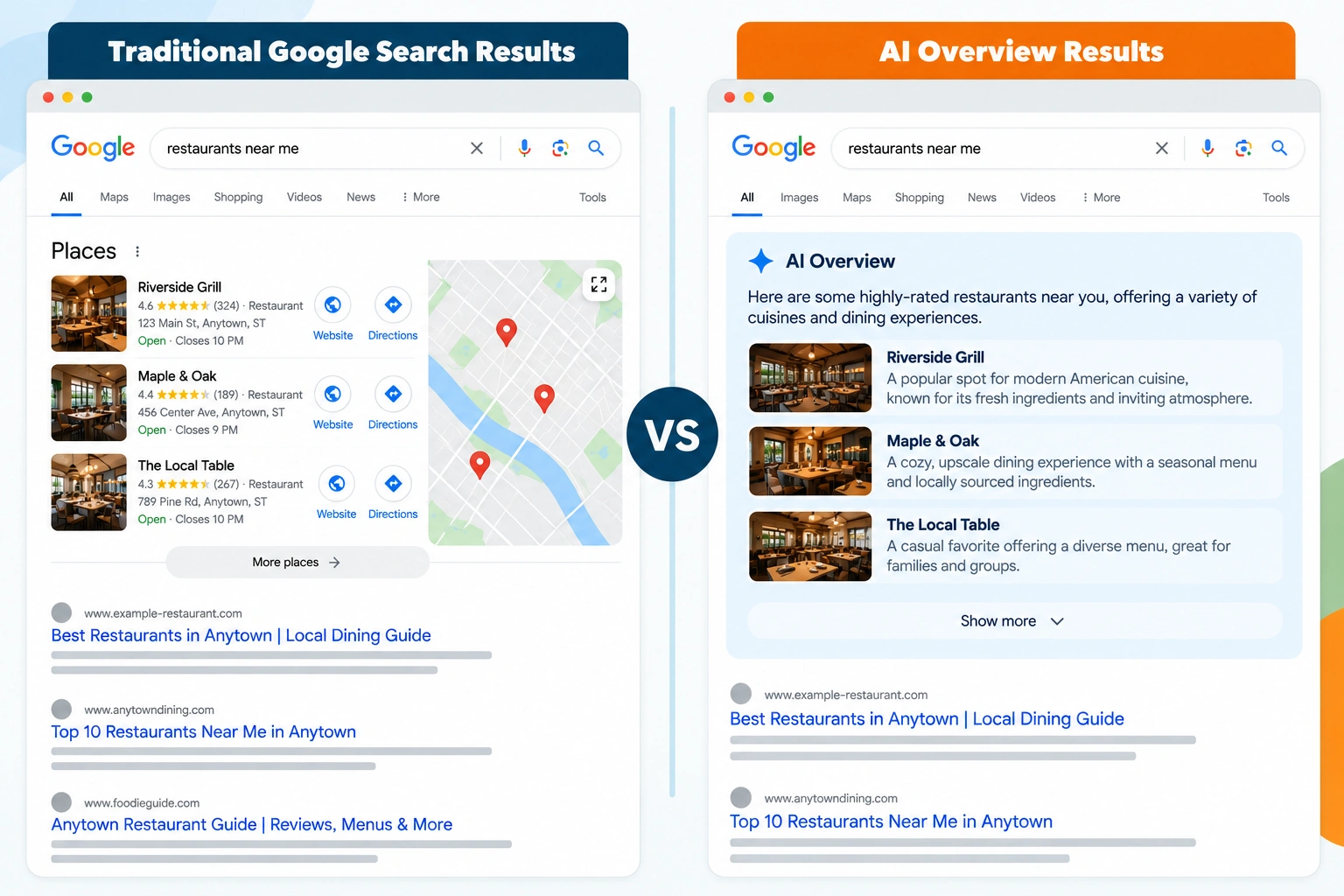
Traditional local search results and an AI Overview demonstrate two ways restaurant information may appear in the search experience.
Don’t let technical tracking hurdles or shifting search algorithms hold your restaurant back.
Our dedicated marketing specialists handle the heavy lifting: from menu schema optimization to local citation cleanup. Contact BizIQ today at (888) 416-9800 to speak with a specialist and map out a customized local search strategy.
Overcoming Data Silos and Privacy Changes
Even restaurants with well-configured analytics platforms run into a structural problem: the data they need to prove the ROI is spread across systems that were never designed to communicate. Marketing measurement is frequently confined to isolated channel-level metrics, leaving valuable customer data trapped in disconnected systems and making integrated insights difficult to achieve. Your reservation platform knows who booked. Your POS knows who spent money. Your analytics platform knows who clicked from organic search. Getting those three systems to agree on a single customer journey requires deliberate integration work that most restaurant operators have not prioritized.
Compounding the silo problem is the ongoing phasing out of third-party browser cookies. Businesses must prepare for cookie deprecation’s impact on paid and organic search by relying more heavily on first-party data and direct server-to-server conversion APIs. The tracking methods that restaurants have relied on for years, such as cross-site cookies that follow a user from a search result to a booking confirmation, are becoming less reliable. Operators who have not built first-party data infrastructure are increasingly flying blind.
Practical steps to work around these limitations:
- Build and Use First-Party Data: Build an email or SMS marketing list directly from your online ordering and reservation systems. Every completed transaction is an opportunity to collect a contact that you own, not one rented from a third-party platform.
- Implement Server-to-Server APIs: Connect your POS and reservation platforms directly to your analytics tools using conversion APIs that bypass browser-level cookie tracking entirely. This creates a deterministic data path from transaction back to search source.
- Utilize a Unified Dashboard: Access your local SEO performance, review metrics, and conversion data in a single reporting environment. The BizIQ Get Noticed package consolidates these reporting streams so that operators can see their full local search performance without toggling between five different platforms.
The Power of Reputation Management in Local SEO
Reviews are the aroma drifting from your kitchen before a guest ever sees a plate. They pull people in, or push them away, before a single click has been tracked. Review velocity, volume, and recency are direct inputs into Google’s local map pack algorithm, which means a restaurant that generates consistent, recent reviews will rank higher than a competitor with an older, larger volume of stale ones. That ranking advantage translates directly into more impressions, more clicks, and more attributable conversions.
The connection between reputation management and conversion rate is equally direct. Trust drives clicks. A guest who clicks through to your website from a local search result has already seen your star rating and review count in the search snippet. A strong review profile reduces the friction between click and booking: the guest arrives on your site with existing trust rather than skepticism. Conversely, a weak or unmanaged review profile can suppress conversion rates even when your search visibility is strong, because the trust signal that should close the gap between interest and action is absent. A unified strategy that treats review generation and technical SEO as interconnected disciplines, rather than separate workstreams, produces compounding results that neither approach achieves independently.
Optimizing Your Digital Storefront for Maximum Conversions
A restaurant website that ranks well but converts poorly is a leaky funnel. You lose potential guests. The most common structural culprit is a PDF menu: slow to load, unindexable by search engines, and nearly impossible to navigate on a mobile screen. Replacing PDF menus with HTML-based, mobile-friendly menu pages gives search engines indexable content to rank and gives guests a smooth browsing experience that keeps them moving toward a reservation or order.
Call-to-action placement matters as much as CTA copy. On mobile screens, which account for the majority of local restaurant searches, primary actions, such as “Order Now,” “Reserve a Table,” or “Call Us,” need to sit within thumb reach, not buried below a full-screen hero image or hidden in a navigation menu. Reducing the number of taps between a search click and a completed action is one of the most effective conversion optimizations available to a restaurant operator, and it costs nothing beyond a basic layout review.
At the profile level, optimizing your Google Business Profile is the single most effective way to capture immediate local search intent before competitors do. A complete, regularly updated profile, complete with current hours, high-quality photos, menu links, and active review responses, outperforms a technically superior website in the local map pack because it gives searchers everything they need to make a decision without leaving the search results page.
Frequently Asked Questions About Restaurant SEO ROI
How do you track phone calls generated from restaurant SEO?
To track phone calls from organic search, restaurants use dynamic number insertion (DNI) technology. This software automatically displays a unique tracking phone number to visitors who arrive on the website via organic search. When a customer calls that number, the system routes the call to the restaurant’s main line while logging the source as organic search in your analytics platform. This creates a clean, auditable record of call volume attributable to your search marketing investment. Every call counts.
What is a typical conversion rate for a restaurant website?
While general online conversion rates across various industries typically range from 0.7% to 2.3% (FTC HomeAdvisor Answer Document), restaurant websites often experience much higher conversion rates. Restaurant searchers typically have immediate, local intent: they are not browsing abstractly; they are deciding where to eat tonight. Clicks on high-value actions such as viewing the menu, clicking “order online,” or initiating a reservation frequently exceed 10% of total organic sessions.
How does local SEO drive physical foot traffic to a restaurant?
Optimizing your restaurant’s local search presence ensures your business appears in map applications and local directories when users search for nearby dining. This visibility directly translates into physical visits. First-party local search platforms offer specialized attribution tools, like Yelp Store Visits, to help businesses track how digital impressions and profile interactions correlate with real physical foot traffic (Yelp SEC Filing). The attribution is probabilistic, but it provides a consistent, trend-trackable signal for operators who need to justify their local search investment.
How do online reviews impact a restaurant’s local search rankings?
Online reviews are a primary ranking factor for local search. Google’s algorithm prioritizes businesses with high review volumes, positive sentiment, and consistent review velocity. A restaurant that generates a steady stream of recent reviews signals to the algorithm that it is an active, trusted business, which improves map pack placement and, by extension, impression volume. To dominate the local map pack, restaurants must actively manage online reviews to build trust with both search engines and prospective guests who are evaluating options before they commit to a visit.
What is the difference between SEO and pay-per-click (PPC) for restaurants?
Pay-per-click advertising delivers immediate visibility by placing paid ads at the top of search results, but it requires ongoing spend for every single click: the moment the budget stops, the visibility stops. Restaurant SEO focuses on building long-term, organic authority in local search results and map packs through content quality, citation consistency, and profile optimization. Over time, organic search delivers a significantly lower customer acquisition cost and a more durable return on investment, because the rankings you build through SEO do not disappear the moment you pause a campaign.
Transitioning your restaurant’s search marketing from a cost center to a verified revenue engine requires moving beyond vanity metrics. Begin by auditing your current website setup this week to ensure that every primary call-to-action, whether it is an online order button, a reservation widget, or a click-to-call link, is configured with custom event tracking in your analytics platform. Next, integrate your offline point-of-sale data with your digital marketing platforms using a secure conversion API to match customer transactions directly back to their organic search touchpoints. The measurement setup described throughout this article is not a one-time project; it is an ongoing discipline that compounds in value as your data set grows and your attribution models become more precise. For a thorough evaluation of your restaurant’s digital visibility and a tailored plan to track your exact search ROI, partner with an experienced team that understands the unique demands of the hospitality industry.
Ready to dominate your local market and track every dollar of your marketing spend?
Contact BizIQ today at (888) 416-9800 to schedule a personalized strategy session with a dedicated marketing specialist. You can also visit our team at 3627 E Indian School Rd Suite 103, Phoenix, AZ during our business hours, Monday through Friday from 7 AM to 4 PM.