
Written by the BizIQ Automotive Strategy Team With over a decade of hands-on experience in local SEO and automotive digital marketing, the BizIQ Automotive Strategy Team works directly with mobile mechanics and independent service providers to build high-visibility online footprints that generate real-world revenue. We don’t theorize about what works: we execute it daily for businesses like yours.
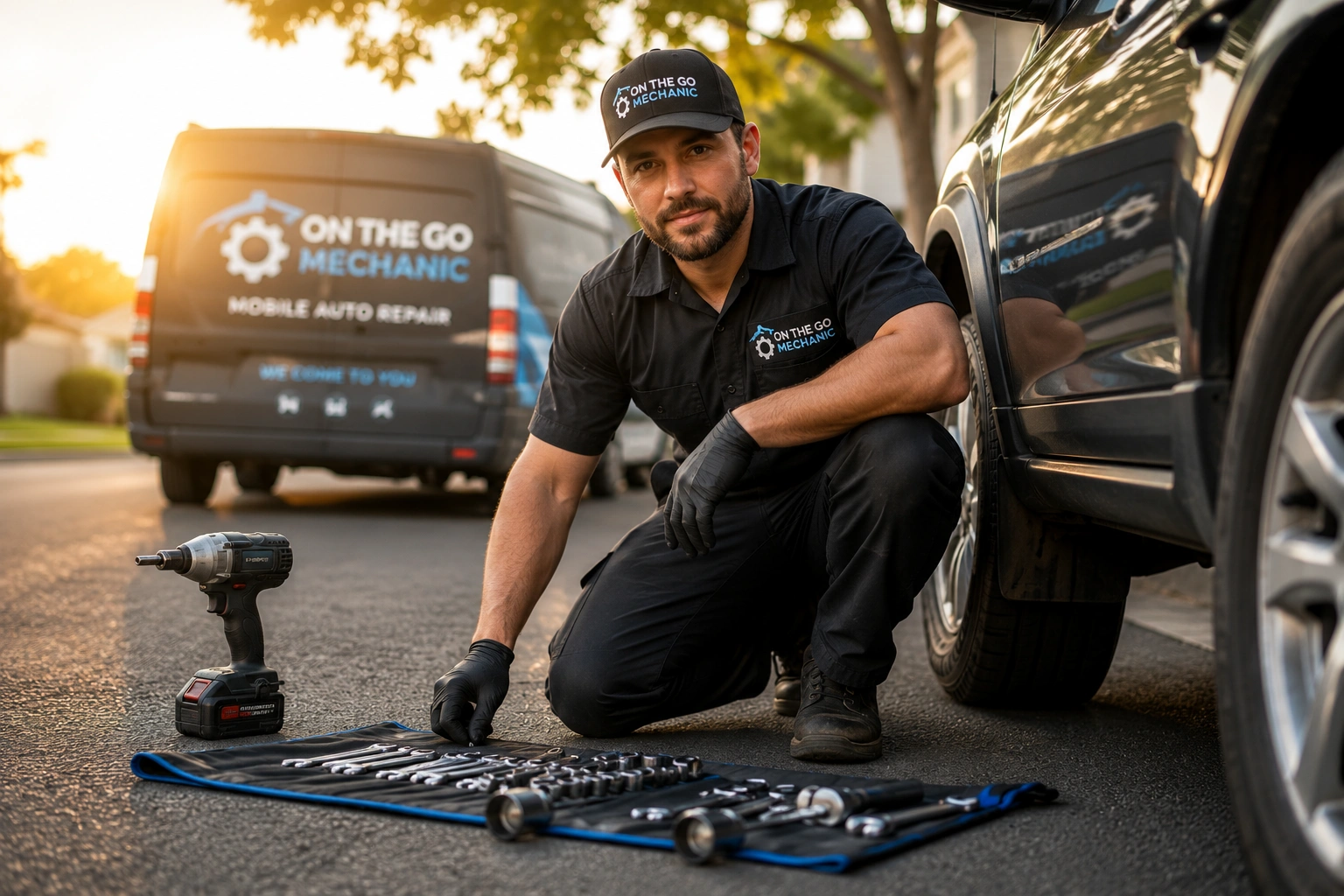
A professional mobile mechanic delivers expert roadside service, bringing trusted auto repair directly to the customer.
- How to dominate local search results even if you do not have a physical storefront.
- Step-by-step optimization tactics for your Google Business Profile to rank higher on Google Maps.
- How to align your website content with symptom-based search intent to capture high-ticket repair jobs.
- Practical strategies for driving authentic reviews and managing your online reputation.
- How to future-proof your business against emerging AI search trends like ChatGPT and Google’s Search Generative Experience (SGE).
How can SEO help a Mobile Mechanic Get More Customers?
Mobile Mechanic SEO helps mobile mechanics appear in Google search results when customers need on-site auto repair services. By optimizing service pages, targeting local, geo-focused keywords, improving Google Business Profile (GBP) visibility, and earning recent customer reviews, mobile mechanics can increase website traffic, generate more calls, and attract qualified leads in their service area.
Your service van is your storefront. The problem is, Google doesn’t know where to put it on the map: unless you tell it exactly how to find you.
Successful mobile mechanic seo requires a specialized approach tailored to proximity, service area optimization, and high-intent local search queries, as traditional SEO playbooks do not work for Service Area Businesses (SABs) operating without a physical storefront. We empathize with the challenge of competing against massive brick-and-mortar dealerships, and this guide is your practical path to leveling the playing field. You can win this fight.
The tactics built for brick-and-mortar shops, such as physical address prominence, in-store photo galleries, and foot-traffic signals, do not translate cleanly to a business that operates out of a vehicle and serves customers wherever their car dies. Competing against dealerships and established repair chains with physical locations isn’t just a budget problem; it’s a structural one. We are a small business too, with the same goals as you, and we believe sophisticated marketing belongs to everyone, including you. That is why we focus on what works in practice: the specific levers that move rankings for service area businesses in competitive local markets.
When a car breaks down on a Tuesday afternoon, the driver isn’t flipping through a phone book. They pull out their phone and search for a “mobile auto mechanic near me” or “roadside assistance.” This is exactly where local seo for mobile mechanics and digital marketing for mobile mechanics become crucial to ensuring your business appears in these critical moments.
When it comes to what is search engine optimization seo, think of Google as constantly updating its neighborhood map. Direct local SEO optimization is how we make sure your mobile service van stays marked on it, right where stranded drivers can see you. Digital marketing for mobile mechanics isn’t about broadcasting to a general audience; it’s about being the most credible, most visible answer at the precise moment someone needs you. Understanding search optimization means understanding that it’s fundamentally about relevance and proximity. For a mobile mechanic, both of those factors are entirely winnable.
Why mobile mechanic SEO is your ultimate lead generation engine
Maximizing organic search results and web traffic
Paid ads deliver traffic the moment you fund them and stop the moment you don’t. Organic search results work differently: they compound. Every optimized page, every earned backlink, and every review that reinforces your authority builds on the last, creating a lead generation channel that grows in efficiency over time rather than resetting to zero when a budget cycle ends.
Over 53% of all website traffic comes from organic search, making it the single largest driver of digital customers across virtually every industry. For mobile repair service lead generation specifically, that number carries extra weight: the searcher who finds you organically was already looking for exactly what you offer. They weren’t interrupted by an ad. They arrived with intent.
The organic search results definition that matters here isn’t the textbook one: it is the practical reality that ranking in positions one through three for “mobile mechanic [city name]” means your phone rings consistently without a cost-per-click attached to every call. Lead generation through organic search isn’t free in the sense that it requires no investment; it’s free in the sense that once the infrastructure is built, the marginal cost of each new lead trends toward zero.
Navigating the shift to mobile search and immediate-need search intent
Mobile mechanic search intent splits into two distinct categories, and mixing them up is a common strategic error. The first is transactional and immediate: a driver stranded on the side of the road, searching on a smartphone, ready to call whoever appears first. The second is research-mode: a car owner planning ahead, comparing services, and reading reviews before a scheduled appointment. Your SEO strategy needs to serve both, but the infrastructure supporting the first category is non-negotiable.
Google’s shift to mobile-first indexing means your website is now evaluated primarily through the lens of how it performs on a smartphone, not a desktop. If your site loads slowly on a 4G connection or buries your phone number three scrolls deep, you’re losing the stranded driver before they ever read a word of your copy. Fast load times and a prominently placed click-to-call button are not UX niceties: they are conversion infrastructure. Speed wins the job. Understanding mobile-first indexing and its implications for your site architecture is one of the most impactful technical decisions you can make as a mobile service business.
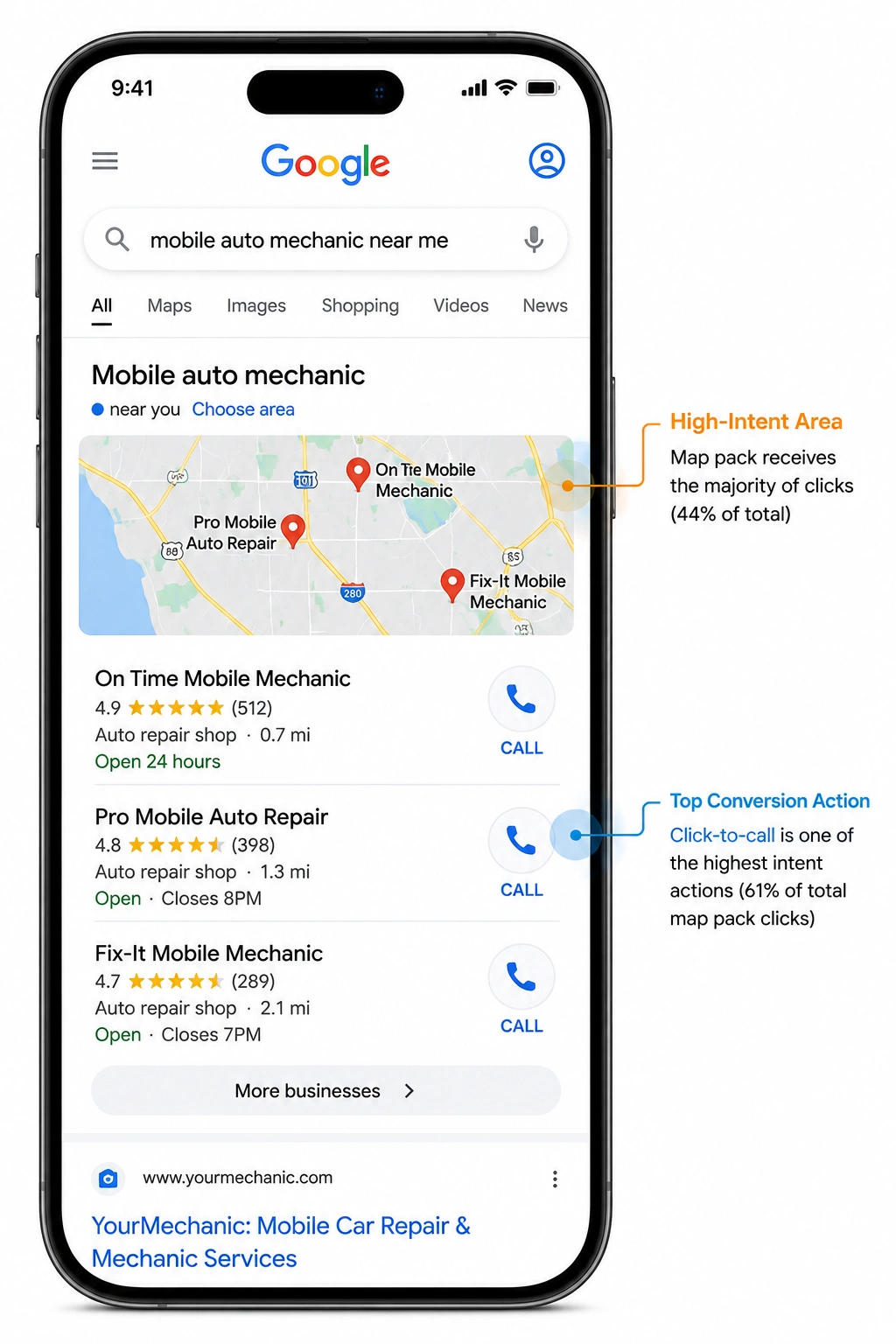
The Google Local 3-Pack places click-to-call buttons and map listings where high-intent mobile customers take action.
Claiming and optimizing your Google Business Profile
Step-by-step optimization for Google Maps and local search ranking
Setting up a Google Business Profile (GBP) for Service Area Businesses (SABs) requires specific steps. Select “No” for having a physical location customers can visit and define your service areas by zip codes or cities. Keep your address private.
Entering a home address as a public-facing storefront violates Google’s guidelines and creates a suspension risk that can take weeks to resolve. Instead, define your service areas by the specific cities, zip codes, or neighborhoods you actively serve. Be precise: claiming a 100-mile radius when you realistically cover a 25-mile zone weakens your relevance signals for the areas where you truly want to rank.
From there, the optimization sequence looks like this:
- Claim and verify your listing using your exact legal business name: the one on your invoices, your insurance, and your marketing materials. Inconsistency here is a citation problem waiting to happen.
- Write a compelling business description integrating
mobile mechanic seoandgoogle business profile for mobile mechanics. Write it for the human reading it, not the algorithm parsing it. - Select the correct primary and relevant subcategories. “Auto Repair Shop” or “Mechanic” are the most common correct choices. Add subcategories for specific services like brake repair, oil changes, or roadside assistance where applicable.
- Add high-quality photos of your service van, tools, and team. Your service van with your business name visible, your tools laid out professionally, and you working on a vehicle: these images signal legitimacy to a customer who has never met you and is deciding in thirty seconds whether to call.
Google Business Profile optimization, including accurate operating hours and regular Google Posts, directly influences your local search ranking for mobile mechanics. Dormant profiles rank below active ones, all else being equal.
On-page SEO and website optimization for mobile auto repair
Key website elements for high-converting mobile mechanic sites
Your website is doing two jobs at the same time: convincing Google you’re the most relevant result for local searches, and convincing the actual human who lands on it to pick up the phone. Most mobile mechanic websites fail at both. This is not because the owner doesn’t care, but because mobile mechanic website optimization requires a different architecture than a standard small business site.
Speed is the floor, not a differentiator. A site that loads in over 2.5 seconds on a mobile connection is already bleeding visitors before a single word is read. For a user who’s standing next to a car that won’t start, a slow site is not an inconvenience: it is a reason to call your competitor instead.
Beyond speed, the structural element that separates high-performing mobile mechanic sites from mediocre ones is dedicated local landing pages. One page titled “Mobile Mechanic Services” does almost nothing for local search ranking. A page titled “Mobile Mechanic Services in Scottsdale, AZ,” written with references to local neighborhoods, regional driving conditions, and specific services available in that area, tells Google exactly where you operate and for whom. Avoid thin, templated versions of these pages; Google’s quality systems are sophisticated enough to identify cookie-cutter location pages, and they rank accordingly.
Schema markup is where many independent operators leave ranking equity on the table. Implementing LocalBusiness and PostalAddress schema gives search engines a structured, machine-readable summary of your service boundaries, operating hours, and contact details: information that’s especially important for SABs that don’t have a physical address anchoring their geographic relevance. This is also the technical foundation that positions you well for AI-driven search features, which we’ll cover later.
Is Your Mobile Mechanic Business Invisible on Google?
Local SEO can feel complex, but here’s what you really need to know to get noticed.
Driving local reviews and reputation management
The impact of reviews on local search ranking for mobile mechanics
Google’s local search algorithm treats reviews as a composite signal: not just the star rating, but the speed at which new reviews arrive, the diversity of reviewers, and the presence of keyword-rich content within the review text itself. A profile with 200 reviews accumulated over three years and no recent activity will often rank below a newer profile with 40 reviews that arrived steadily over the past six months. Recency matters.
The trust dimension runs deeper for mobile mechanics than for almost any other service category. Customers are inviting a stranger to their home, their workplace, or wherever their car is stranded. That’s a different psychological calculus than choosing a restaurant. Trust is everything. Reputation management in this context is crucial, and considering the best reputation management companies can be beneficial to keep your reviews organized. The connection between strong review profiles and conversion rates is direct and measurable; businesses that actively manage their online reputation consistently outperform those that treat reviews as a passive byproduct of good service.
Best practices for asking satisfied customers for Google reviews
Ask for reviews immediately upon job completion. Generate a custom Google review shortcut link and share it on invoices or via text.
A template that works without feeling scripted:
“Hi [Name], thanks for choosing us today! If you’re happy with our service, could you take 30 seconds to leave us a quick review here? [Link]; it makes a real difference for a small business like ours.”
Attracting car repair customers online is partly a function of visibility, but visibility is built on the basis of social proof. A profile with consistent, recent, detailed reviews doesn’t just rank higher: it converts at a higher rate once someone finds it.
“Over 91% of consumers aged 18 to 34 trust online reviews as much as personal recommendations. For a mobile mechanic, a steady stream of 5-star reviews isn’t just a badge of honor: it is a direct signal to Google that your business is active, reliable, and worthy of the top spot in local search results.”
Content marketing and keyword research strategies
How to identify high-intent informational queries and search intent
Most mobile mechanics, when they think about SEO content for mobile auto repair, default to service pages: “brake repair,” “oil change,” “battery replacement.” Those pages matter. But the content strategy that truly builds long-term authority operates at a different layer: the symptom level.
Customers don’t always know what’s wrong with their car. They know what it’s doing. “Why are my brakes squeaking when I stop?” “Car making a clicking noise when turning.” “Check engine light came on after rain.” These are the searches that happen before someone has decided they need a professional, and writing content that answers them precisely and helpfully positions your business as the authority they turn to when they realize the problem is beyond a DIY fix. That’s not a soft benefit; it’s a measurable pipeline. A reader who found your blog post about a clicking noise, read your explanation, and then saw that your service area covers their zip code is a warmer lead than anyone who found you through a generic paid ad.
Performing keyword research and search engine optimization for this type of content means going beyond volume metrics and looking at the full question-and-answer arc: what does the customer search first, what do they search next, and where in that sequence does your content meet them? Tools like Google Search Console’s query report, Google’s “People Also Ask” boxes, and even the autocomplete suggestions for automotive symptom searches will surface more content ideas than any keyword planner spreadsheet.
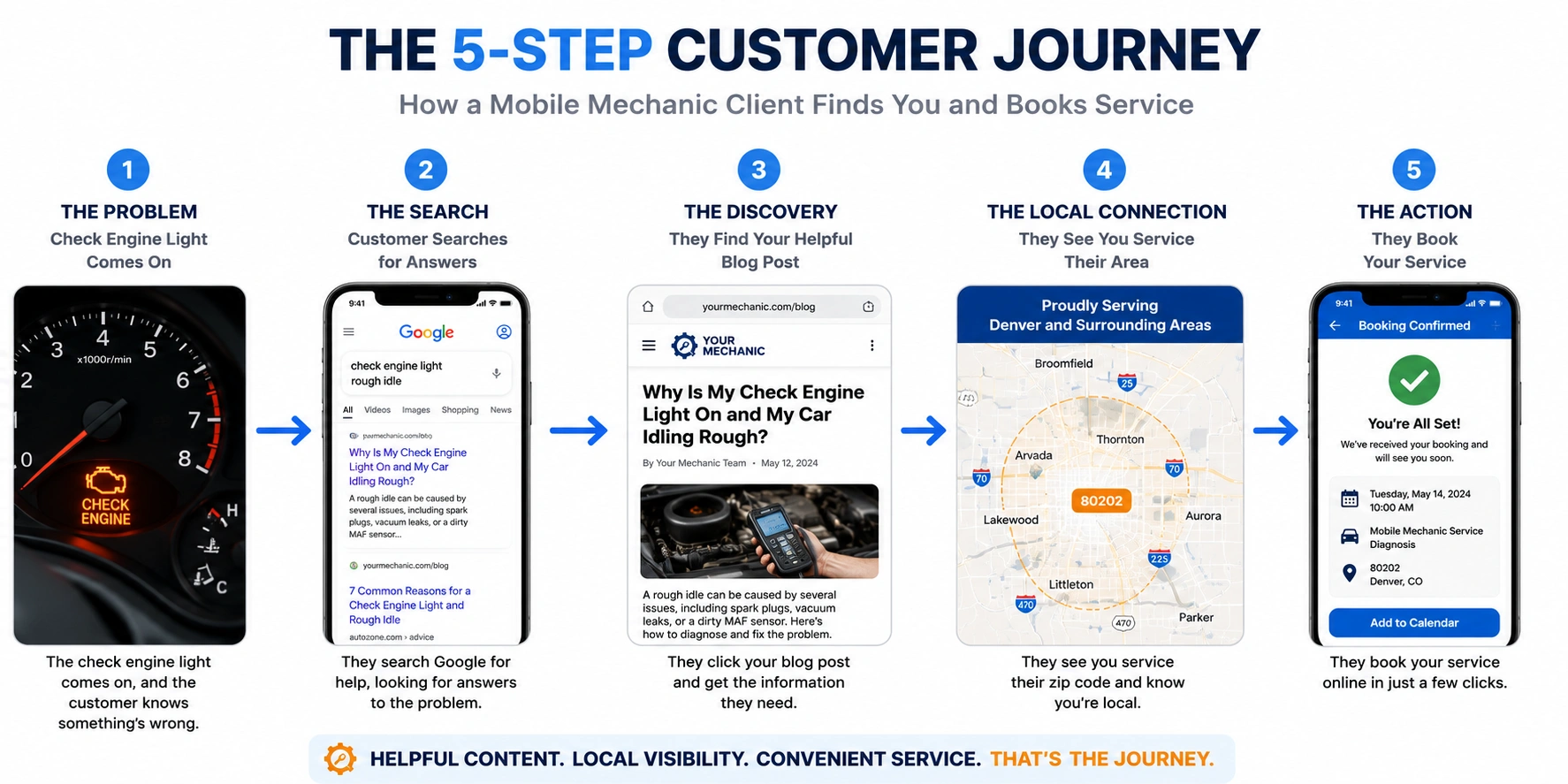
From a check engine light to a confirmed appointment, each search step guides customers toward booking mobile mechanic services.
See How Your Business Ranks Locally in Seconds
Want to know exactly where your mobile mechanic business stands? Use our free Local SEO Audit Tool to scan your online presence, find missing citations, and uncover hidden opportunities to outrank your local competitors
Emerging trends: Answer engine optimization (AEO) and generative engine optimization (GEO)
Optimizing for ChatGPT, Google’s SGE, and voice search queries
SEO is not dead, but the surface area of what counts as “search” has expanded considerably. The FAQ research for this piece flagged it directly: AI Overviews eating clicks, Perplexity pulling direct answers, zero-click searches becoming the norm. That’s not a reason to abandon SEO; it’s a reason to build content that performs across multiple search systems simultaneously. Adapt or get left behind.
Answer Engine Optimization (AEO) and Generative engine optimization (GEO) are the frameworks for doing exactly that. When a user asks ChatGPT “who’s the best mobile mechanic in [city]?” or queries Google’s AI Overviews for “mobile auto repair near me,” those systems are pulling structured, authoritative content from websites that have made it easy for AI crawlers to parse their service details, geographic coverage, and credibility signals. Answer engine optimization tools and generative engine optimization services are increasingly built around the same core principle: structured content, clear Q&A formatting, and structured schema markup give AI systems what they need to surface your business as a direct answer rather than a buried link.
Voice search adds another layer. A driver with grease on their hands isn’t typing: they’re saying “Hey Siri, find a mobile auto mechanic near me.” Voice queries are conversational, longer, and often phrased as complete questions. Content written in natural, spoken-language patterns performs better in voice results than content optimized purely for typed keyword matching.
Three practical adjustments that address all of this at once:
- Write in conversational Q&A structures. H3 questions followed by direct, concise answers aren’t just good for readers: they are the format AI systems are trained to extract and surface.
- Use natural language throughout. Sentence constructions that read like a knowledgeable person explaining something out loud will outperform keyword-dense copy in both voice and AI-mediated search.
- Implement detailed schema markup. LocalBusiness, FAQPage, and HowTo schema give AI crawlers a structured map of your content, including service types, operating areas, pricing context, and business hours, without requiring them to interpret prose.
Tracking your SEO success with Google Search Console
How to set up and use Google Search Console for a basic SEO audit
You cannot improve what you cannot see. Google Search Console is a free tool that gives you direct visibility into how Google is reading, indexing, and ranking your site. For a mobile mechanic running lean on budget, it’s one of the highest-value tools in your digital toolkit.
A basic google search console seo audit for a mobile mechanic site should cover four areas. First, crawl errors: the Coverage report will flag pages Google can’t access or index, which is a silent ranking killer that many site owners never discover. Second, mobile usability: the Mobile Usability report identifies specific pages where Google has detected layout or functionality problems on smartphones: directly relevant given that over 70% of local automotive searches happen on mobile devices. Third, Core Web Vitals: this report surfaces load speed and interactivity issues at the page level, giving you a prioritized list of technical fixes. Fourth, and most directly useful for measuring your optimization progress: the Performance report, where you can filter by queries containing “mobile mechanic” and track impressions, clicks, and average position over time.
Impressions tell you how often your site appears in search results. Clicks tell you how often people act on it. Both metrics matter. The gap between those two numbers, and whether it’s narrowing or widening, tells you whether your titles and meta descriptions are earning the traffic your rankings should be generating.
Moving from metrics to business growth actions
Data without a decision attached to it is just noise. You must act. The Performance report in Search Console becomes useful when you read it to find problems rather than just to see numbers.
High impressions paired with low clicks is a messaging problem: your page is ranking, but the title and meta description aren’t compelling enough to earn the click over competing results. Rewrite them with more specificity: the exact service, the exact city, a concrete differentiator. High clicks paired with low phone calls or form submissions is a conversion problem: visitors are arriving, but something on the page is failing them, whether that’s a buried call-to-action, a slow load time, or content that doesn’t match what they expected to find.
This auto repair case study illustrates precisely how this diagnostic loop: identify the gap, isolate the cause, execute the fix, measure the result, translates into measurable business growth for automotive service businesses operating in competitive local markets. The data doesn’t lie; it just requires someone willing to read it carefully and act on what it says.
Common SEO mistakes mobile mechanics must avoid
Pitfalls to avoid: Keyword stuffing, ignoring mobile optimization, and citation inconsistency
- Keyword Stuffing: Repeating “mobile mechanic near me” excessively looks unnatural and triggers spam filters. Write for humans first. The algorithm will follow.
- Ignoring Mobile Optimization: A slow, non-responsive site will destroy search engine rankings and conversion rates, as over 70% of local automotive searches occur on mobile devices. Google’s mobile-first indexing means the mobile version of your site is the version being evaluated for ranking purposes. If that version is a poor experience, your rankings reflect it.
- Citation Inconsistency: Ensure NAP (Name, Address, Phone Number) consistency across all directories. Mismatched details confuse Google and lower your local search ranking. “Mike’s Mobile Mechanic LLC” and “Mike’s Mobile Mechanic” are different entities to Google’s local algorithm. Audit your citations at least twice a year and correct every discrepancy you find.
Frequently asked questions about mobile mechanic SEO
How do I rank my mobile mechanic business without a physical shop storefront?
Google supports Service Area Businesses. By hiding your home address and specifying your service area on your Google Business Profile, you can rank on Google Maps and local search results. It is fully allowed. Configured correctly, an SAB listing can rank as competitively as, and in some cases above, brick-and-mortar shops in the Local 3-Pack, particularly when the SAB has stronger review signals and more optimized content.
How long does it take to see results from mobile mechanic SEO?
Some early wins arrive quickly. Claiming and correctly configuring your Google Business Profile, correcting citation inconsistencies, and improving your site’s mobile load speed can produce measurable ranking improvements within a few weeks. A complete strategy typically takes 3 to 6 months for consistent, high-volume organic search results. Results vary, but most clients see improvements within this timeframe. Patience pays off. This timeline isn’t a limitation; it’s the nature of building lasting authority rather than renting visibility through paid channels.
What is the difference between local SEO and organic search engine optimization?
Local SEO focuses on ranking within a specific geographic area (e.g., Google Maps), while organic SEO targets ranking for broader, non-geographically specific queries across the web. Both are essential for mobile mechanic business growth. They work together. Local SEO captures the immediate-need, location-specific searches that drive phone calls, while organic SEO builds the content authority that attracts research-mode visitors and supports long-term brand visibility. They help each other.
How much should a mobile mechanic business budget for digital marketing?
Allocate between 5% and 10% of gross revenue to digital marketing. Plan your spend. Focusing on organic local SEO provides a higher long-term return on investment than relying only on paid ads. A business generating $150,000 annually that wants to grow should be comfortable investing $10,000 to $15,000 per year in digital marketing, roughly $800 to $1,200 per month.
How do I handle negative reviews on my Google Business Profile?
Respond promptly, professionally, and politely. Do not ignore them. Acknowledge frustration, offer to move the conversation offline, and demonstrate your commitment to customer satisfaction. A well-handled negative review, visible to potential customers, often builds more trust than an unbroken string of five-star ratings: because it demonstrates that your business responds to problems like a professional operation, not a defensive individual.
Your next steps for mobile mechanic business growth
The path forward from here isn’t complicated, but it does require action rather than continued research. Three actions you can take before the end of the day:
Start right now.
- Claim and audit your Google Business Profile, ensuring it’s configured as a Service Area Business. Confirm your home address is hidden, your service areas are defined with precision, your primary category is correct, and your operating hours are accurate.
- Run a speed test on your website to ensure it’s fully optimized for mobile devices. If your score is below 70, you have a conversion problem that’s compounding every day. Identify the top two or three issues flagged and prioritize fixing them.
- Reach out to three recent satisfied customers and ask them to leave an honest review using your direct Google Maps link. Three new reviews in the next 48 hours will do more for your local ranking velocity than a week of other optimizations.
We are a small business helping small business, and we know we’re in this together. This evidence-based approach is your clear next step. Small business is the backbone of innovation and the heartbeat of America, and we are here to help you keep it moving forward, one service call at a time.
Ready to Fill Your Service Calendar with High-Value Leads?
Local SEO can feel complex, but you don’t have to navigate it alone. Our approach has helped thousands of local businesses grow their online presence and secure consistent, high-intent leads. Let us handle your digital marketing so you can focus on what you do best: keeping your customers’ vehicles safe and on the road.