
Scaling franchise marketing takes a precise balance between centralized corporate control and local market agility. As your brand moves into new regional territories, keeping a consistent message across channels gets harder with every opening. The brands that grow cleanly build digital marketing systems that expand alongside their network of physical locations instead of relying on manual processes that break at volume.
- Control and flexibility: centralized brand standards and localized marketing have to work together at every location.
- Asset and approval systems: digital asset management and automated approvals keep brand consistency high while campaigns launch faster.
- Customizable local tools: templates let franchisees adapt messaging for regional audiences without leaving corporate standards.
- Unified measurement: shared dashboards connect local results to network-wide return on investment.
Many organizations stumble during rapid expansion because they distribute campaigns through outdated, manual processes. Growth calls for a shift from centralized bottlenecks to distributed, technology-enabled frameworks that empower local owners. Corporate teams have to move from acting as a production agency to acting as a strategic facilitator for their franchisees.
Establishing those frameworks early prevents brand dilution and protects long-term equity across diverse markets. When local operators have the right tools, they execute promotions with more confidence, and that alignment turns marketing into a revenue engine for the whole network.
The Scale of the Challenge in Franchise Marketing
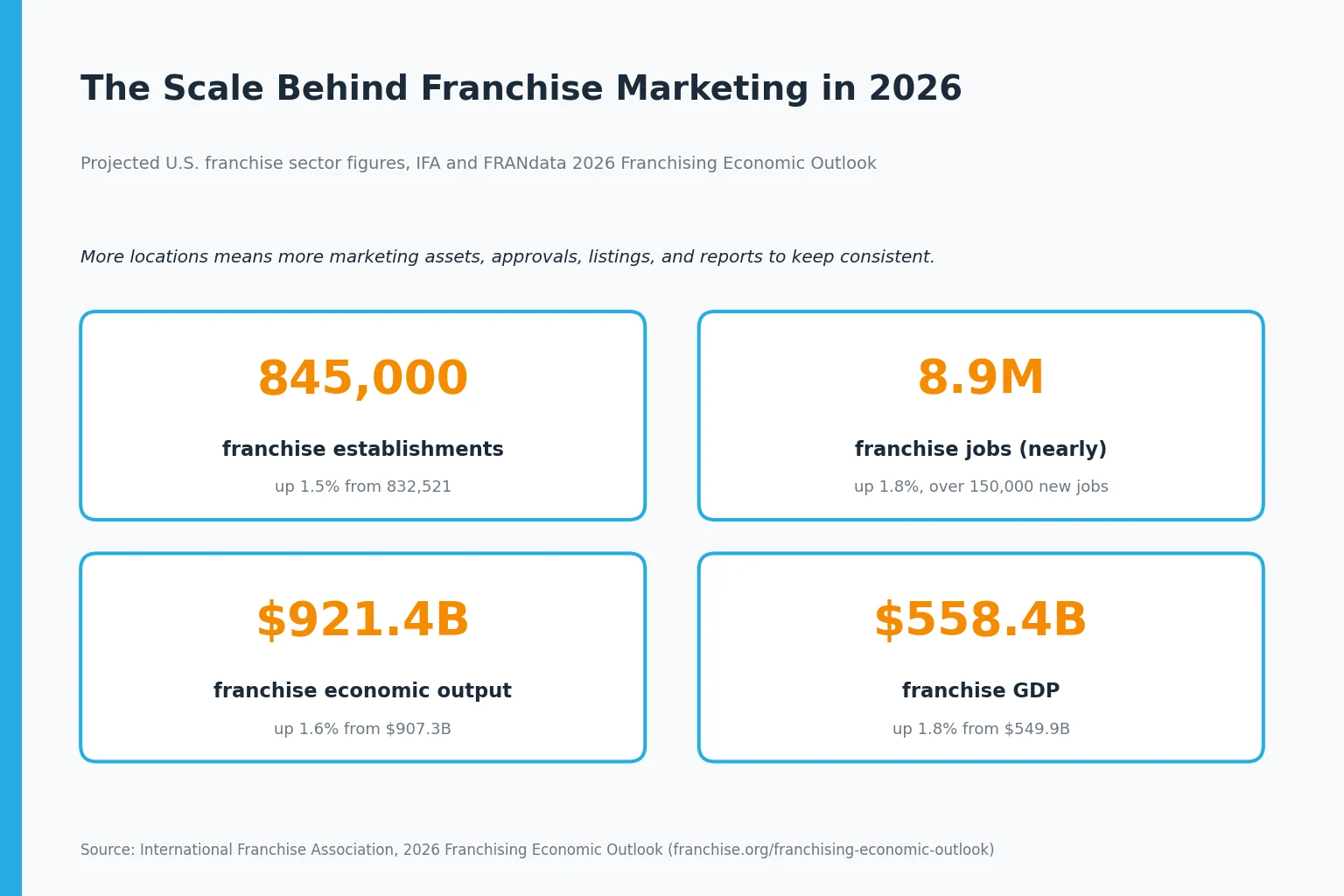
The size of the opportunity explains why the problem is hard. The International Franchise Association projects U.S. franchise establishments will grow from 832,521 to 845,000 in 2026, supporting nearly 8.9 million jobs and $921.4 billion in output. Every one of those locations needs approved materials, accurate listings, and measurable results.
Many franchise networks struggle to protect brand integrity as they add dozens of locations. Corporate teams want strict adherence to style guidelines, while local owners want materials that speak to their communities. That tension often produces fragmented campaigns and diluted brand equity across regions.
The fix is a structured framework that standardizes the core corporate message and gives operators automated tools to execute quickly. Without one, corporate marketing departments spend countless hours reviewing minor design changes for local event flyers, and that manual approval process frustrates operators and delays seasonal campaigns. Efficient growth means removing those administrative hurdles through better technology and clearly defined boundaries.
One boundary matters more than the rest: franchise owners should not hire their own outside advertising agencies without corporate vetting and formal approval. Uncoordinated efforts can create legal compliance issues and damage the reputation the whole network depends on.
Scaling Franchise Marketing Starts With Centralized Digital Assets

Effective growth starts with a technology foundation that stores every approved brand asset in one place. You need a single source of truth for logos, ad copy, and high-resolution campaign imagery. A digital asset management system removes the friction of sending large creative files by email and keeps every location working from the same approved materials.
When franchisees can reach approved assets instantly, they launch local promotions with more speed and accuracy, and that efficiency compounds as you add units. Cloud-based asset libraries also let corporate update materials across the whole network at once. If a logo changes or a product launches, outdated files disappear from local portals immediately, which protects the brand from stale messaging.
The same principle applies to business data. Location names, addresses, hours, and phone numbers have to match everywhere customers look, and local citation management keeps that data synchronized across directories as locations open, move, or close.
- Cloud-based asset management: store all approved corporate marketing materials securely in one library.
- No manual file sharing: faster local deployment and a lighter administrative load for corporate.
- Real-time control: prevent franchisees from using outdated or unapproved imagery.
Empower Local Franchisees Safely via Local Marketing Automation and Support

Corporate teams cannot understand the nuances of every local market. Franchise owners need room to run campaigns inside firm brand guardrails, and customizable templates let them adapt messaging for local events or demographic shifts. That freedom is essential to scaling franchise marketing without sacrificing consistency.
Create Flexible Advertising Templates
Modern design tools can lock the elements that must not change, such as logos and brand colors. Franchisees can then swap text blocks, local addresses, and regional pricing without breaking guidelines. The result is faster local execution with no risk to brand reputation or advertising compliance.
Establish Clear Approval Workflows
Even with locked templates, some campaigns need corporate review before they go live. Automated approval routing for anything outside the pre-approved formats protects the brand while giving franchisees a clear path to launch custom ideas.
Speed makes the process work. A published turnaround target, such as one business day for custom requests, keeps franchisees engaged and discourages them from bypassing the system entirely.
Local Visibility Is Part of the Scale Plan
Marketing assets only work when customers can find the location they are meant for. As a network grows, local search presence needs the same governance as creative: one owner for the data, one standard for the profile, and local contribution inside it. At BizIQ, we help multi-location brands put exactly that structure in place.
An SEO program for franchise networks applies that governance to rankings, listings, and location content.
Each location should have a claimed, verified Google Business Profile with consistent information, and a Google Business Profile setup and verification service helps new openings go live correctly from day one.
Dedicated, locally relevant content on the corporate website then gives each profile a strong destination, and on-site optimization builds that content into templates so quality survives scale.
Reviews are the other half of local trust. A repeatable system for requesting and answering reviews, supported by reputation management, gives every location a steady flow of fresh feedback without relying on each owner’s individual effort.
How to Implement a Scalable Franchise Marketing Strategy Across New Markets
Building a marketing engine for expansion takes a methodical approach to technology adoption and franchisee training. You cannot hand over a dense brand book and expect consistent results across hundreds of locations. A structured rollout makes sure every new franchisee understands the system from day one.
The process starts with an honest look at current capabilities, then fills gaps in tools and workflow. Aligning corporate objectives with the daily reality of busy owners is what makes a playbook repeatable, which shortens onboarding for new franchisees and reduces early mistakes during store launches.
Steps for Scaling Franchise Marketing Across New Territories
- Audit your current marketing assets. Gather logos, brand guidelines, and past campaign materials into one staging area and confirm they meet current standards before uploading. Archive outdated materials immediately so new owners cannot use them by accident.
- Configure local customization rules. Decide exactly which elements local operators may change. Lock core colors and logos, and open text fields for local addresses and promotional pricing.
- Pilot with a small group. Roll the platform out to a few high-performing franchisees first, gather their feedback, and refine the experience.
- Launch network-wide with training. Deploy to every location with required onboarding training so each owner knows how to use the system from the first week.
Track the Right Performance Metrics for Marketing ROI and Franchise Performance
Scaling demands close attention to performance data at both the corporate and local level. You need to know how well brand-level campaigns drive foot traffic and leads to individual locations, because without clear visibility into local return you cannot optimize the broader budget.
Unified dashboards let corporate see aggregate performance across all regions, while localized reports give franchisees clear results for their own campaigns. Track actions that signal real-world intent, such as calls, direction requests, and local form submissions, and add UTM parameters to local links so each channel is attributed correctly.
Accountability for marketing spend is also a compliance topic. The FTC’s Franchise Rule compliance guide explains that franchisors must disclose advertising obligations, including how advertising funds were used, in the franchise disclosure document. Location-level reporting makes those conversations with franchisees far easier.
Clear benchmarks also help you find underperforming locations and offer targeted support, while high performers supply insights you can share across the network. That feedback loop is what makes marketing more efficient as the footprint grows, and it is central to any approach to franchise marketing at scale.
Budget planning completes the picture. Comparing franchise SEO pricing against the scope of your network helps you decide how much of the shared fund belongs in local search.
Scaling Franchise Marketing FAQs
What is the biggest obstacle to scaling franchise marketing?
The primary obstacle is keeping brand consistency while giving local operators enough flexibility to engage their communities. Systems that lock brand elements and open local fields solve both sides of that tension.
How do we stop franchisees from creating unapproved advertising materials?
Make approved marketing easier than going rogue. A centralized digital asset library with brand-locked, customizable templates and a fast approval path gives franchisees what they need, and your franchise agreement and operations manual can define which materials require approval.
Should local franchisees control their own social media accounts?
Often yes, within limits. Corporate should provide a content calendar and approved assets, while local owners follow clear engagement guidelines and add neighborhood updates that corporate cannot write for them.
How much should corporate dictate local marketing spend?
Local advertising requirements are typically set in the franchise agreement and disclosed in the franchise disclosure document, so the amount depends on your system. Many brands set a minimum contribution and let operators choose the specific local channels, which keeps spending accountable without removing local judgment.
What technology helps manage marketing across hundreds of locations?
Most networks combine a digital asset management system, customizable templates with approval routing, listing and profile management, and unified analytics. The right mix depends on network size and how much local flexibility your brand allows.
How do you measure marketing ROI at each location?
Track location-level actions such as calls, direction requests, and form submissions, and attribute them with UTM parameters and call tracking. Combine those with network-wide dashboards so corporate can compare locations and franchisees can see the results of their own spend.
Scaling franchise marketing means moving from rigid corporate control to structured local empowerment. As the brand grows, your systems have to support operators without sacrificing core visual identity, and technology is the bridge between corporate vision and daily local execution.
Centralized digital assets and clear approval workflows create a scalable foundation for expansion. Franchisees who feel supported by the right tools execute better and faster, which drives stronger local revenue and brand presence in every new market. Building those systems early in an expansion phase is far easier than retrofitting them across hundreds of locations, and when you want a partner for the local visibility side, you can talk with a franchise marketing specialist about your network.

Ready to Scale Your Franchise Marketing Strategy?
We help franchise brands streamline multi-location marketing, improve local visibility, and build scalable systems that support long-term growth.