Affordable franchise SEO services give a franchise network one coordinated way to protect brand consistency at the corporate level while delivering a steady stream of local leads to every franchisee. Scaling a network means balancing two goals that often pull in opposite directions: corporate wants every location to look and sound the same, and each franchisee wants their own phone calls, form fills, and foot traffic.
- Unified brand control: keep approval of local content and listing data with corporate.
- Local lead generation: send high-intent local searchers to the right franchisee.
- Affordable co-op pricing: scalable multi-location packages built for franchise budgets.
Think of your franchise like a tree. Corporate is the trunk, the main brand holding everything upright, but every location needs its own roots in the local community to be found by the people who are ready to buy. National brand awareness matters, yet the sale is usually won or lost in a local search, where the customer is comparing the three businesses closest to them.
Many franchise networks struggle with fragmented marketing that produces brand inconsistency and drains ad spend before a single qualified lead arrives. At BizIQ, we build network-wide SEO that satisfies corporate consistency demands while equipping local franchisees with a dependable lead engine. We understand the weight of this challenge because we are small business owners serving small business owners, and we believe every location deserves to be found.
The Cost of Fragmented Franchise Marketing
When each franchisee runs their own search marketing, the network pays for it twice: once in wasted spend and again in brand equity that slowly erodes. The scale of the problem is growing, because the International Franchise Association projects U.S. franchise establishments will reach 845,000 units in 2026, up from 832,521. More locations competing for the same local searches means fragmented execution gets more expensive every year.
Brand Dilution and Inconsistent Messaging
- Decentralized execution: when individual franchisees manage their own SEO, the result is off-brand messaging and inconsistent directory data that weakens the trust corporate has spent years building.
- Duplicate content filtering: copy-paste templates deployed across multiple independent domains scatter search equity, and search engines tend to show only one version of near-identical content, which leaves most locations invisible.
- NAP inconsistency: differences in name, address, and phone data across directories send conflicting signals about which version of a location is correct.
Wasted Local Budgets and Rising Acquisition Costs
- Competing against each other: franchisees who bid on the same local keywords in paid channels can inflate costs for every operator in the network at once.
- No purchasing leverage: fragmented local campaigns lack the buying power and technical depth of a centralized organic strategy, so franchisees spend more and get less.
- Technical debt: broken redirects, orphaned location content, and slow templates build up silently when no one owns the whole site.
The fix is a unified system rather than a collection of independent experiments. A franchise SEO program for multi-location brands consolidates search equity onto one authoritative domain while building localized strength for every branch, so the whole network benefits from each location’s progress.

How Affordable Franchise SEO Services Work for a Network
A network-wide program keeps the expensive, technical work in one place and lets each location contribute what only a local operator can: real neighborhood knowledge. That division of labor is what keeps the cost per location low as the network grows.
Centralized Domain Architecture
- One core domain: hosting every location on a single domain, structured like
brand.com/locations/city-state, pools search equity instead of dispersing it across weak independent sites. - No independent microsites: preventing franchisees from launching their own sites avoids fragmenting domain authority and keeps the network competitive against national brands with consolidated link profiles.
- Technical standardization: uniform schema markup, XML sitemaps, and mobile responsiveness across every location keep any single subfolder from becoming a liability for the whole domain.
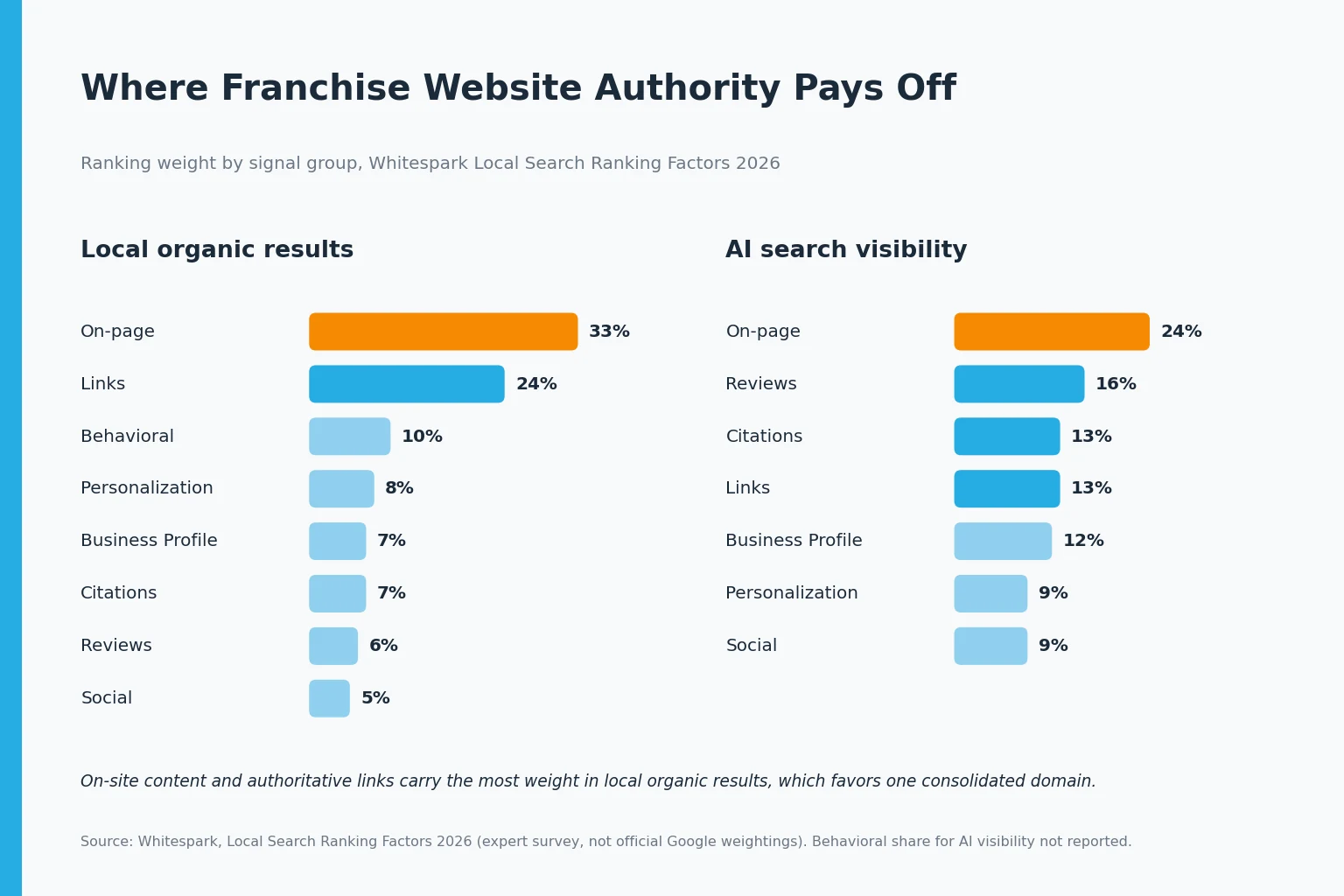
The research supports the consolidated approach. In Whitespark’s 2026 survey of local SEO experts, on-site signals carry 33% of the weight in local organic results and links another 24%, and on-site signals also lead for AI search visibility at 24%. Both are signals that build faster on one strong domain than on dozens of small ones.
Quality location content is where the consolidated domain earns its keep, and strong on-site optimization keeps every location’s content unique, fast, and tied to the right neighborhood.
Hyperlocal Customization
- Dynamic content fields: templates that protect corporate branding at the structural level while letting franchisees add local bios, community news, and neighborhood-specific FAQs.
- Localized keyword targeting: each location targets neighborhood-level terms and local intent queries, instead of generic city terms that put adjacent franchisees in direct competition.
- Entity-based schema markup: structured data that defines the relationship between the corporate entity and each local branch, which matters more as AI-driven search becomes a discovery layer for local businesses.
- Localized content marketing: geo-specific content that gives each location a distinct voice without leaving brand standards.
Centralized Google Business Profile Management
Every location needs an accurate, verified Business Profile, and for networks of 10 or more locations Google offers bulk verification to manage them together.
A specialist Google Business Profile setup and verification service handles the claiming, verification, and ongoing consistency, which eliminates the profile drift that erodes local pack visibility over time.
Affordable Multi-Location Pricing and Co-Op Budgets
Affordable does not have to mean thin. The goal of a co-op model is to spread the cost of shared infrastructure across the network so no single franchisee carries it alone.
What Franchise SEO Costs
Pricing depends on the scope of the network, but these are the starting points for franchise programs.
| Package type | Starting at | Best suited for |
|---|---|---|
| Marketing packages | $399 per month | Franchisees who need a website build plus local SEO support |
| Organic SEO packages | $1,500 per month | Franchise owners and networks that want a more robust organic program |
A full breakdown of what each option includes is available in our franchise SEO pricing overview.
How Co-Op Budget Allocation Works
- Shared infrastructure costs: corporate funds the foundational technical SEO work while franchisees opt into localized packages that raise lead volume in their territory.
- Scale-friendly pricing: standardized models help hold the cost per location down as the network adds units.
- Transparent ROI: reporting at both the network and unit level gives each operator the data to justify their co-op contribution.
Franchisors already structure marketing contributions this way. The FTC’s Franchise Rule compliance guide explains how franchisors must disclose their advertising obligations in the franchise disclosure document, which is why co-op SEO budgets fit naturally alongside existing marketing fund structures.
Because governance effort grows with every location, it also helps to compare multi-location SEO pricing before settling on a model.
Why Affordable Franchise SEO Services Do Not Mean Cutting Corners
Traditional enterprise agencies often anchor their value in retainer size. We work month-to-month with no term contracts, so our incentive is to earn the business every month through measurable performance.
For networks that also want broader support, our local SEO services extend the same transparent approach to each franchisee’s territory.

Ready to Scale Your Network’s Local Visibility?
Stop letting inconsistent local marketing dilute your brand. Get a custom multi-location proposal tailored to your franchise’s footprint and budget.
Local Visibility, Reviews, and Google Maps Results
Visibility in the local 3-pack is what turns a ranking into a phone call. Google states that local results are based primarily on relevance, distance, and prominence, and that review count and score factor into prominence, so each location needs both a clean profile and a steady supply of fresh reviews.
Local 3-Pack Visibility
- Accurate NAP everywhere: clean, consistent name, address, and phone data lets each location compete against single-store rivals whose listings are tidier.
- Active profiles: keyword-informed business descriptions, accurate categories, and a regular rhythm of photos and posts keep each location relevant.
- Citation cleanup: removing duplicate and outdated directory listings clarifies which location data is authoritative, and dedicated local citation management keeps those listings aligned across the network.
Review Generation and Reputation
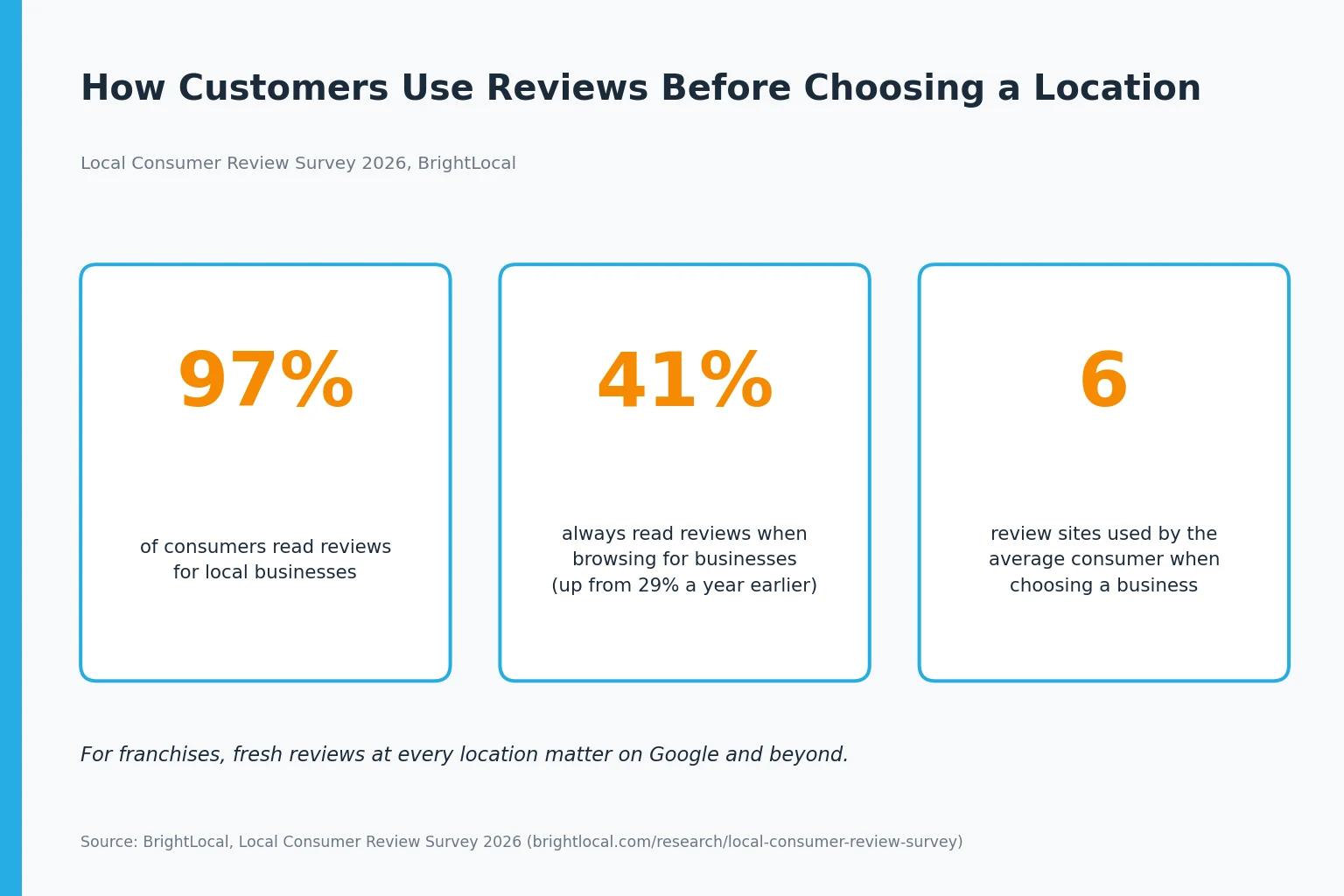
Reviews are a decision tool, not just a ranking signal. BrightLocal’s 2026 Local Consumer Review Survey found that 97% of consumers read reviews for local businesses and that 41% now always read them, up from 29% a year earlier.
- Automated review requests: post-transaction prompts that invite customers to review on Google and industry-specific platforms, without franchisees managing the process by hand.
- Sentiment monitoring: network-wide tracking that surfaces emerging issues to corporate before they grow.
- Response strategy: professional, keyword-aware replies that build trust and reinforce relevance, delivered through a structured reputation management program.
Balancing Corporate Compliance With Local Autonomy
Compliance is the most constant friction point in franchise marketing, and policy alone rarely solves it. The practical answer is a workflow that gives corporate control over what goes live and gives franchisees visibility into what the program is doing for them.
Centralized Approval Dashboard
- Corporate oversight: approval control over local content updates and review responses before they publish removes the compliance exposure of unmanaged franchisee access.
- Brand guideline enforcement: local content follows uniform messaging and legal requirements, with flags that surface errors before they reach the public site.
- Permission levels: access is granted by role, so operators get the visibility they need without the ability to override brand-critical settings.

Tools That Equip Franchisees
- Review response templates: pre-approved frameworks that let franchisees respond authentically while staying within brand voice.
- Local performance reporting: each location sees its own rankings, inbound calls, and lead volume, so the value of the co-op investment is concrete.
- Territory conflict management: keyword targeting is structured so adjacent locations do not compete against each other in search results, a problem that surfaces quickly in dense metro markets.
Each location needs its own identity. A copy-paste job that search engines treat as thin content tends to be filtered out, so unique local content is part of what makes a network-wide program work.
What a Franchise SEO Program Should Cover
Technical and Local Audits
Every program should begin with a baseline. A free SEO audit maps where the network stands today, and the technical work that follows typically covers the items below.
- Crawl error resolution: fixing broken redirects, duplicate location content, and crawl errors across all subfolders, because technical debt suppresses rankings without an obvious signal.
- Site speed: fast loading on mobile and desktop, since slow templates cost conversions at every location at once.
- Listing accuracy: auditing directory data so that every location carries one authoritative set of details.
Strategy That Scales With the Network
The outcome is a lead engine that every franchisee can depend on. A thoughtful franchise marketing strategy lets corporate authority and local relevance operate from the same domain and reinforce each other instead of pulling in opposite directions.
Why Franchise Networks Choose BizIQ
Transparent Pricing and Month-to-Month Agreements
- Clear starting points: published pricing lets networks budget predictably and allocate co-op funds without a buffer for surprise charges.
- Month-to-month: there are no term contracts, so the relationship depends on performance.
- Scalable packages: the program expands as new franchise agreements are signed, without a fresh negotiation for each new location.
A Small Business Peer Partnership
- An extension of your team: we work alongside corporate and franchisees instead of managing a ticket queue.
- Plain-language guidance: complex search concepts explained without agency jargon, so franchisees understand what they are paying for.
- Multi-industry experience: work across home services, automotive, professional services, and local consumer brands informs how we structure each network.
Affordable Franchise SEO Services FAQs
How does franchise SEO differ from standard local SEO?
Franchise SEO manages search visibility for many locations under one brand. It involves optimizing a centralized corporate domain alongside localized location content and individual Google Business Profiles, so national domain authority supports local relevance instead of competing with it. Single-location SEO never has to solve that structural challenge.
How do you ensure corporate brand consistency?
We establish brand guidelines and deploy standardized templates for all local content. Corporate teams keep visibility and approval rights over localized modifications, which maintains compliance across the network without reviewing every update in real time.
Can individual franchisees contribute to their local SEO budget?
Yes. In a co-op model, corporate funds the foundational technical SEO work while franchisees opt into localized content and review management to raise lead volume in their own territory. The structure is flexible enough to fit different franchisee financial profiles within the same network.
How much do affordable franchise SEO services cost?
Marketing packages that include a website build and local SEO support start at $399 per month, and more robust organic SEO packages start at $1,500 per month. Final pricing depends on the number of locations and the scope of work.
How do you handle locations with different service offerings?
We build location-specific service content around the keywords relevant to each franchisee’s market, so a location ranks only for services it provides. That avoids ranking dilution and prevents adjacent locations from competing for identical keyword sets.
How long does it take to see results across the network?
Timelines vary with network size and starting point. Technical fixes and listing cleanups often show up first, while location content and review growth build over several months and keep compounding after that.
Showing up in local search across a franchise network does not require draining your marketing budget. A specialized partner gives you the architecture to protect brand integrity and capture local demand from the same domain, with corporate authority and local relevance reinforcing each other. Fragmented strategies produce fragmented results, while coordinated ones produce a lead engine every franchisee can depend on. When you are ready to build it, talk with a franchise SEO specialist about your network.

Get Your Free Franchise SEO Audit Today
Let our experts analyze your current multi-location search presence and show you exactly where you are losing leads to competitors.