Written by the BizIQ Local SEO Editorial Team. BizIQ is a digital marketing agency committed to helping small and local businesses, including independent auto repair and tire shops, grow their online presence. With over a decade of experience in local search optimization, our team provides practical, evidence-led strategies that turn online searches into offline service bay bookings. We keep marketing simple.
What you’ll learn in this guide:
- The Map Pack Blueprint: Why 32% of your local ranking weight depends on your Google Business Profile (your free business listing).
- Category and Visual Optimization: How selecting the right primary category and uploading specific photos drives conversions.
- Reputation and Citations: Why consistent NAP data and active review management build algorithmic prominence.
- Service-Specific Architecture: How dedicated landing pages and fast mobile load times capture high-intent buyers.
- Realistic Timelines: What to expect in the first 60 to 90 days versus 4 to 6 months of a sustained campaign.
How do Tire Shops Optimize for Local Search and AI Recommendations in 2026?
Tire shops optimize for local and AI search in 2026 by integrating real-time inventory systems that show exact tire brands and sizes in stock. Updating the Google Business Profile (GBP) with transparent pricing and mobile tire-fitting options is also a good idea. AI platforms recommend tire shops feature detailed FAQs on tread warranties, seasonal changes, and same-day emergency puncture repairs.
Most searches end in Google’s Map Pack (the map results that appear at the top of local searches), where three factors decide who shows up: relevance, distance, and prominence. If your shop is not in those top three spots, you are essentially invisible to the driver with a flat tire down the street. In 2026, local search engine optimization is the digital lifeline of your service bays. You cannot ignore it.
Running a tire shop is hard enough without having to decode Google’s constantly shifting algorithms. You have probably heard conflicting advice from digital marketing agencies promising instant rankings. We know how frustrating that is; the marketing industry is full of overpromising and underdelivering. There is no secret formula here. Local SEO is simply about understanding what you can control and organizing those elements step-by-step. By aligning your online presence with Google’s core ranking pillars, you can make sure that when someone in your town searches for new tires, your shop is the one they call.
The 2026 Map Pack blueprint: How Google decides who gets the call
The three core ranking pillars
Google’s local algorithm narrows down hundreds of tire shops to three visible results using three connected signals.
Relevance is how precisely your Google Business Profile (your free business listing) and website content match what the searcher actually typed, or what Google inferred they meant. A profile that lists “tire shop,” “wheel alignment,” and “winter tire installation” as distinct services will outperform a profile that simply says “auto services” every time. If your physical location has clear signage, your Google Business Profile needs equally clear digital signage. Details matter.
Distance is the bluntest of the three. Google weighs physical proximity heavily, and no amount of optimization fully neutralizes a five-mile gap between your shop and the searcher. It is the hardest constraint in the algorithm; you cannot optimize your way out of geography.
Prominence is where your real competitive advantage lives. It is the aggregate of your online authority: citations across directories, volume and recency of reviews, inbound links, and how completely your profile is filled out. Think of reviews as word-of-mouth for the digital age. A shop with 200 recent reviews and consistent name, address, and phone number data across 40 directories will outrank a closer competitor who has not touched their profile in two years.
Whitespark 2026 local search ranking factors
The Whitespark 2026 Local Search Ranking Factors study puts hard numbers on what actually moves the needle in the Map Pack. Google Business Profile signals carry 32% of the total ranking weight: the single largest slice of the algorithm. Reviews account for 20%, which makes reputation management a direct revenue lever, not a soft brand exercise. On-page signals, like local keywords and name, address, and phone number data embedded in your website, represent 15%, and behavioral signals, clicks, calls, direction requests, make up 9%.
Those four categories alone account for 76% of your Map Pack position. Everything else is minor.
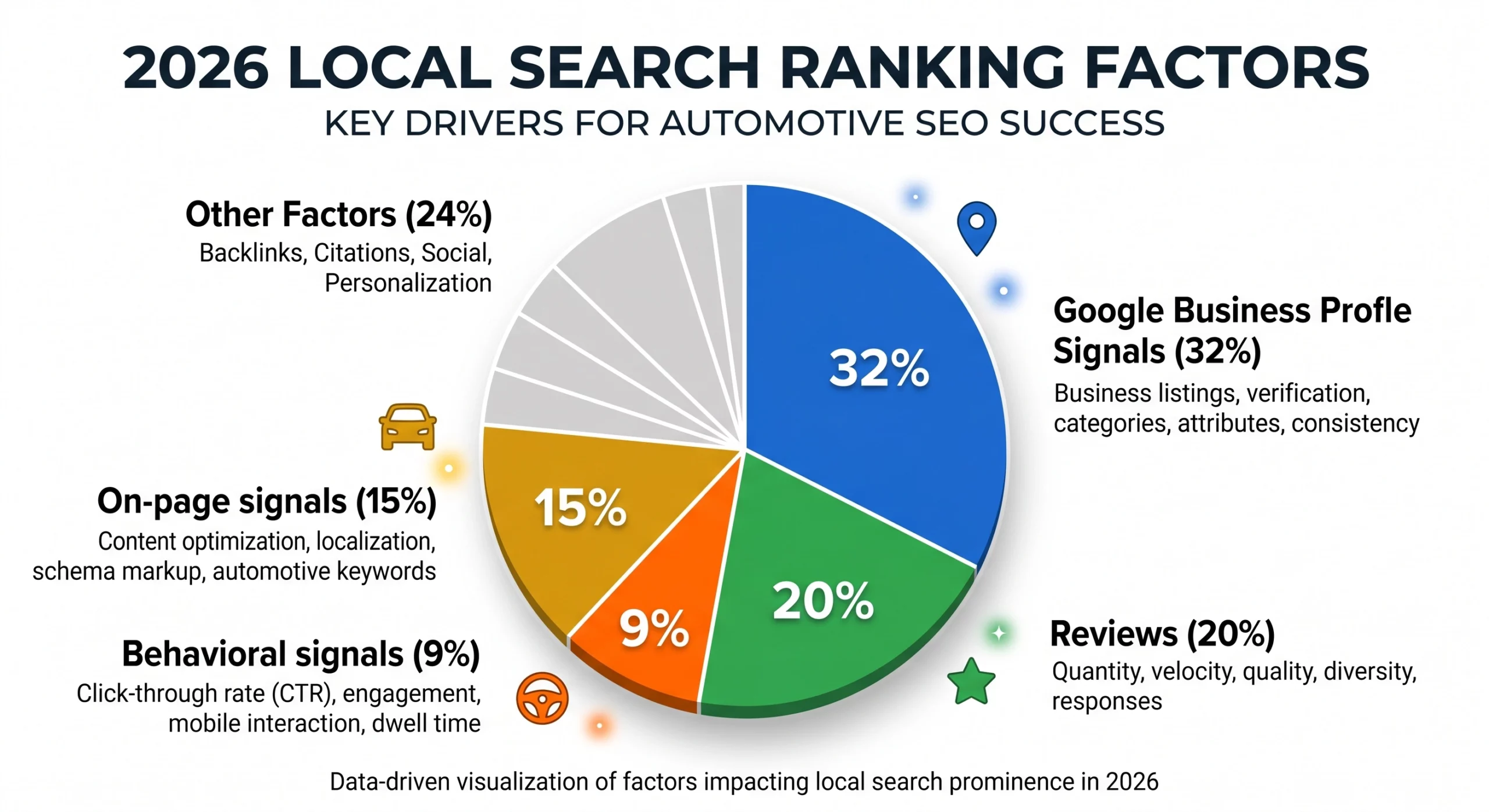
Infographic breakdown of the 2026 local search ranking factors, highlighting key performance drivers for automotive dealership SEO.
Understanding these ranking factors allows you to focus your energy on what you can control. While you cannot control a driver’s physical distance from your shop, you have complete control over your relevance and prominence. By implementing effective local SEO strategies that target the 32% Google Business Profile weight and the 20% review weight, you can outrank competitors who are physically closer but digitally neglected.
This is where many tire dealers fall behind. They assume that simply having a website is enough. Do not make this mistake. But Google’s algorithm does not just look at your homepage; it analyzes your entire digital footprint to determine if you are a legitimate, active business. If your profile is incomplete or your reviews are outdated, Google will bypass your shop in favor of a competitor who actively maintains their local presence.
Optimizing your Google Business Profile (your free business listing) for maximum local relevance
Category selection and naming guidelines
Category selection is where many shops quietly bleed rankings without realizing it. Research on Google Business Profile categories is clear on this point: if tires are your primary revenue driver, your primary category must be “Tire Shop.” Not “Auto Repair Shop.” Not “Automotive Service Center.” Tire Shop.
General auto repair shops that also sell and install tires should flip that structure: use “Auto Repair Shop” as the primary category and add “Tire Shop” as a secondary category. The distinction matters because Google uses your primary category as the dominant relevance signal when matching your profile to search queries.
One trap worth flagging explicitly: do not stuff brand names or service keywords into your business name field. “Joe’s Tire Shop: Michelin Goodyear Bridgestone Wheel Alignment” violates Google’s guidelines and can trigger a profile suspension that takes weeks to resolve. Your business name in your Google Business Profile should match your real-world signage. There are no exceptions to this rule.
For a deeper look at profile completeness beyond categories, here is what we recommend: check out BizIQ’s guide on 10 tips for optimizing your local business to cover the full checklist in practical terms. To understand how this fits into the bigger picture, you can read about Google Business Profile optimization to see how Google evaluates your digital storefront.
Visual content that converts
Google Business Profile photos are not decorative. They are a conversion tool. According to research on Google Business Profile conversion factors, rich, specific imagery signals to both Google and prospective customers that this is an active, professional operation, and that signal translates directly into more profile views and more calls.
Four photo categories carry the most weight for tire shops:
- Before-and-After Photos: Show a worn, bald tire next to a newly installed premium tire to visually demonstrate your work.
- Shop Front and Exterior Photos: Upload photos from multiple street angles to help drivers easily recognize your location when they arrive.
- Advanced Equipment Photos: Showcase your wheel alignment racks, diagnostic tools, and tire lifts to prove your technical capability.
- Approachable Team Photos: Feature your technicians in uniform to humanize your business and make customers feel comfortable before they visit.
Aim for at least five images in each category, and refresh them quarterly. Stale photos, especially if your shop has been renovated or rebranded, send the wrong signal about how current your operation is.
The power of reviews and NAP consistency: Building prominence
Reputation management and review acquisition
Reviews drive 20% of your local algorithm ranking. That is not a soft metric: it is a hard algorithmic input that Google weights on frequency, recency, and variety of platforms. A shop with 15 reviews from three years ago is algorithmically weaker than a competitor with 40 reviews spread across the last six months, even if the older reviews average a higher star rating. Think of reviews as word-of-mouth for the digital age.
The benefits of local reviews for SEO extend beyond rankings. Reviews function as digital word-of-mouth at scale, and Google treats a consistent stream of new, authentic reviews as evidence that a business is actively serving customers. Recency matters more than most shop owners realize. Keep them coming.
Building review volume does not require a complicated system. It requires consistency:
- Ask Every Customer: Train your service advisors to ask for a Google review at the counter when handing back the keys.
- Use QR Codes: Print QR codes on invoices and counter displays that link directly to your Google Business Profile review page.
- Respond Within 48 Hours: Reply to every review, positive or negative, to show Google and prospective customers that you are engaged.
- Audit Your Citations: Regularly check platforms like Yelp, YellowPages, and Apple Maps to ensure your business details match your website exactly. You can read more about building prominence through local citations to understand how directories support your online reputation.
NAP consistency: Your digital signature
Think of your business name, address, and phone number (NAP) like your shop’s signature: it must be the same every time you write it. If you write “Main St” on your website but “Main Street” on Google, search engines see two different businesses. That mismatch erodes the trust signal that consistency is supposed to build. Consistency is key. It is like making sure your name, address, and phone number look exactly the same everywhere: like how customers recognize your phone number, whether it is on a billboard or a business card.
The data from guides on what is NAP? is concrete: maintaining consistent NAP data across major directories makes a business 40% more likely to secure a spot in the Google Map Pack. That is a significant lift from what amounts to a basic data hygiene task. Connecting this to the broader principles of local search marketing makes clear why citation audits belong on a monthly maintenance schedule, not a one-time setup list.
Ready to claim your spot in the Map Pack? Don’t let inconsistent data or an unoptimized profile cost you customers. Let our team handle the heavy lifting with our professional Google Business Profile setup services. We’ll ensure your profile is perfectly optimized to attract local drivers.
Website architecture: Service-specific pages and mobile optimization
Dedicated landing pages vs. cluttered services pages
A single services page that lists tire repair, wheel alignment, oil changes, brake service, and winter tire installation in one block of text cannot rank competitively for any of those queries. Google’s algorithm rewards precision. Each high-intent service deserves its own dedicated page, built around the exact language a local customer would use when searching for it.
That means individual pages for “Tire repair in [City]”, “Wheel alignment in [City]”, and “Winter tire installation in [City]”: each with its own title tag, meta description, header structure, and locally relevant content. BizIQ’s local SEO website optimization tips lay out the technical architecture for these pages in detail, including how to structure internal linking so that your service pages reinforce each other’s authority.
This approach is not just about rankings. It is about matching the mental state of the person searching.
When a driver is stuck on the side of the road with a flat tire, they are not looking for a general services page that lists everything from oil changes to engine rebuilds. They are searching for “tire repair near me” or “emergency tire service.” If you have a dedicated page optimized for that exact service and location, Google is far more likely to display your site. This structure not only improves your search rankings but also provides a friction-free experience for the user.
Mobile speed and user experience
Over 60% of auto service searches happen on mobile devices, often by drivers in genuinely urgent situations. Speed is not a nice-to-have in that context: it is the deciding factor between a call and a bounce. According to local search conversion statistics, sites that load in under 2.5 seconds see 35% longer session times, which means more time for a stressed driver to find your phone number and tap it.
Mobile speed is the engine that drives these conversions. Speed wins. If your website takes five seconds to load on a mobile device, that stressed driver is going to hit the back button and click on your competitor. Google knows this, which is why mobile-first indexing is the standard. Optimizing your images, using browser caching, and minimizing heavy scripts are not just technical chores: they are direct contributors to your shop’s bottom line.
“Your website is your digital service bay. If it’s cluttered, slow, or hard to navigate, customers will drive right past it. In 2026, mobile speed and service-specific clarity are the keys to turning searchers into scheduled appointments.” : Chris Osburn – BizIQ Local SEO Strategist
Showcasing tire brands as Google Business Profile products to capture high-intent searches
Using the Google Business Profile products section
Most independent tire shops ignore the Google Business Profile Products section entirely. That is a significant competitive gap, because the Google Business Profile products and services tab lets you showcase Michelin, Goodyear, Bridgestone, and other major brands directly on your profile: with images, descriptions, and links back to your website: without touching your business name field or running afoul of Google’s naming guidelines.
Each product listing functions as an additional relevance signal. When Google’s algorithm sees that your profile explicitly lists Michelin Defender and Goodyear Assurance tires as products you carry, it becomes easier to match your shop to brand-specific queries. You are not hoping Google figures it out from context. You are telling it directly. Be clear.
Capturing brand-specific search queries
A meaningful group of local tire buyers already knows which brand they want. They are searching “Goodyear tires near me” or “Michelin dealer in [City]”: not just “tire shop.” These are high-intent, high-conversion queries, and the shops that appear for them tend to be the ones that have explicitly signaled brand inventory through their Google Business Profile Products section.
Seasonal inventory updates matter here too. A shop that lists winter tires as products in October and removes them in April is sending Google a current, accurate picture of what is available: which is exactly the kind of active profile management that builds algorithmic trust over time.
Setting up the Products section on your Google Business Profile is one of the easiest ways to stand out from local competitors. Instead of hoping Google figures out which brands you carry, you can show them directly. It works. By uploading popular tire models from Michelin, Goodyear, and Bridgestone with clear photos and descriptions, you capture the high-intent traffic of drivers who already know exactly what brand they want and are simply looking for a local dealer to install them.
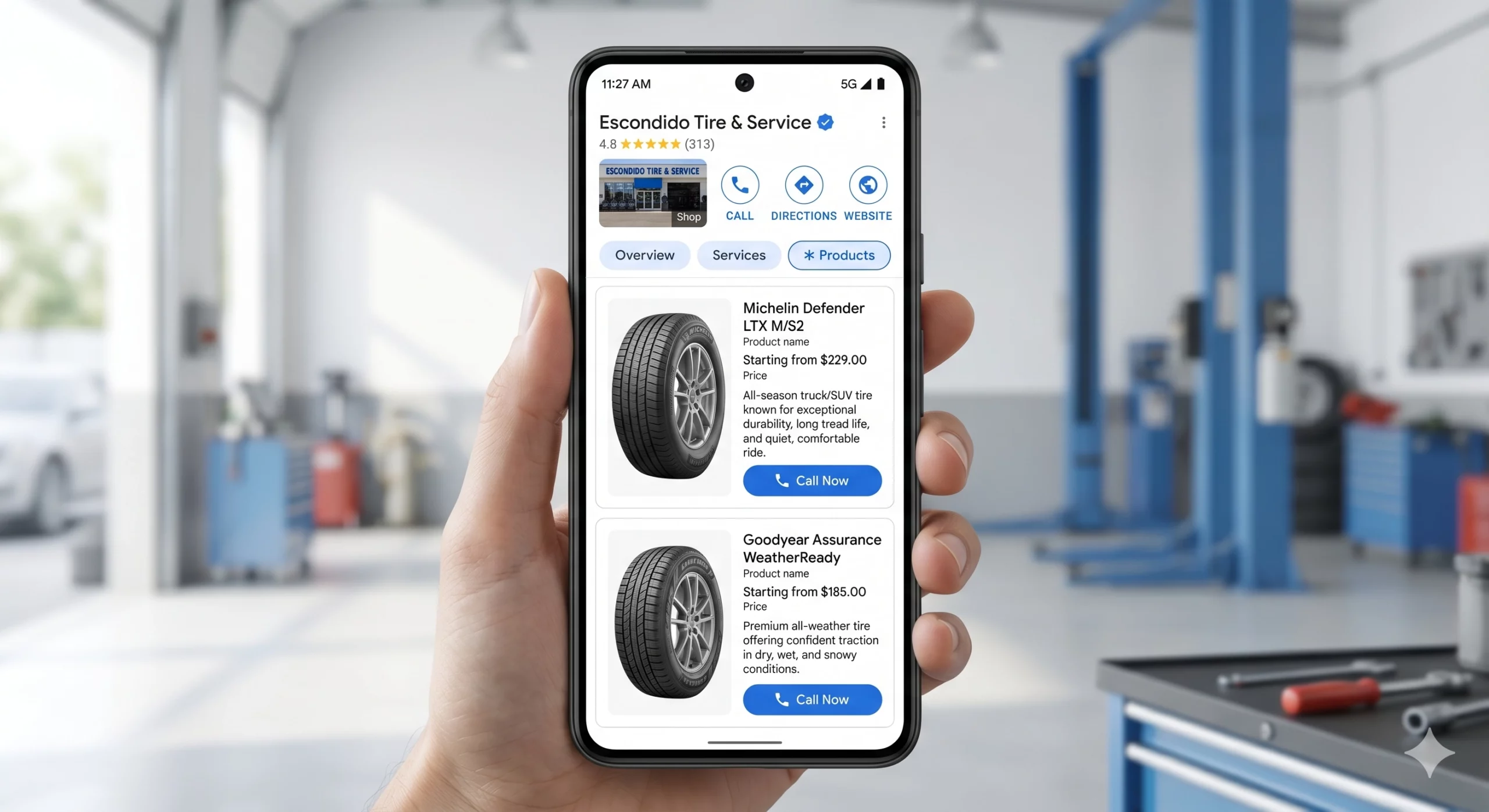
Demonstration of the Google Business Profile Products tab optimization for an automotive repair shop, showcasing specific tire listings.
Want to dominate brand-specific searches in your area? Let us help you showcase your inventory and attract high-value customers. Explore our custom digital marketing services for auto parts businesses and tire dealers to start driving more targeted traffic today.
Local SEO vs. paid search ads: The ultimate tire shop debate
Growing ROI of local SEO
Organic search accounts for 46.5% of website traffic, and local search via Google Maps drives another 22.6%: meaning organic and local search combined control over 69% of all web sessions. Paid search captures roughly 8%. Those numbers alone make a strong case for where the bulk of a tire shop’s marketing budget should go. According to studies on how organic search delivers the best ROI for local businesses, investing in organic visibility yields far better long-term value.
Local SEO is four times more cost-effective than paid search because you do not pay per click. Every piece of authority you build: every citation, every review, every optimized service page: grows over time. A well-optimized Google Business Profile from six months ago is still generating calls today. SEO builds value. That is not how PPC works: the moment you pause a paid campaign, the leads stop.
The growing nature of SEO equity is what makes it the right foundational investment for most independent tire shops, particularly those with constrained marketing budgets who cannot sustain aggressive PPC spend indefinitely.
Paid search (PPC) for emergency transactions
That said, paid search has a specific role that local SEO cannot fully copy. PPC captures only 8% of overall traffic, but it is highly effective for immediate, high-urgency transactions: the driver with a nail in their tire at 7 PM who needs someone right now. A study showing that paid search drives $6 in local sales for every $1 spent online highlights just how transactional those clicks can be.
The most defensible strategy is not an either/or choice. Use both wisely. We recommend using local SEO as your foundational growth engine and deploying PPC selectively for emergency services and seasonal promotions where immediacy outweighs cost-per-click concerns.
Local SEO (Long-Term Equity):
- Traffic Share: Captures over 69% of combined web and map traffic.
- Cost-Efficiency: Four times more cost-effective than PPC with compounding ROI.
- Best For: Sustainable, long-term growth and brand authority in your local market.
Paid Search Ads (Immediate Impact):
- Traffic Share: Captures roughly 8% of web traffic.
- Cost-Efficiency: Higher immediate cost-per-click, but drives rapid conversions.
- Best For: High-urgency emergency services, like flat tires or roadside assistance, and seasonal promotions.
Realistic timelines: When will your tire shop see results?
Map Pack movement (60 to 90 days)
The first 60 to 90 days of a local SEO campaign are about building credibility with Google’s crawlers, not chasing rankings. During this phase, the priority work is resolving NAP inconsistencies across directories, completing and verifying your Google Business Profile, and launching a consistent review acquisition process. Google needs time to re-index your updated information and cross-reference it against the broader web to confirm your business is legitimate and active. According to research on how long it takes to rank in local search, this foundational indexing phase is essential.
Early signals do appear in this window: profile views tick up, you may start appearing for lower-competition local queries, and your Google Business Profile engagement metrics, like calls and direction requests, often improve before your Map Pack position visibly shifts. Patience is not optional here; it is structural to how the algorithm works. Be patient.
Broader organic traffic gains (4 to 6 months)
Steady website traffic increases and broader organic ranking gains take 4 to 6 months of continuous effort. This phase is driven by ongoing content development: adding service-specific landing pages, building local citations, and earning inbound links from local directories and industry sites. The compounding effect of these activities is what separates a shop that ranks consistently from one that briefly appears and fades.
We believe in giving you the straight story. Anyone who promises to rank your tire shop at the top of Google in 30 days is selling you a bill of goods. The local search algorithm is built on trust, and trust takes time to build. Trust takes time. While you will start seeing early Map Pack movement and indexing improvements within 60 to 90 days, the real compounding benefits of your SEO investment will take 4 to 6 months to fully mature. But unlike paid ads, which stop delivering leads the second you stop paying, the organic authority you build during this time is yours to keep.
How local customers find you: The role of voice and AI-driven search in 2026
Preparing for AI-driven search engines (AI Overviews)
Google AI Overviews have fundamentally changed what the top of a search results page looks like. Instead of a list of blue links, users increasingly see a combined answer generated by Google’s AI: and that answer often draws from Google Business Profile data, structured website content, and review text to recommend specific local businesses. If your profile and website are not structured to feed that combination, you are less likely to be cited in it.
The practical implication is that your website content needs to answer questions directly and completely. Be direct. An AI Overview for “how long does a wheel alignment take” will pull from the most clearly written, authoritative source it can find. If your wheel alignment service page includes a concise, accurate answer to that question, your shop has a legitimate shot at appearing in that generated response, and the brand visibility that comes with it.
Optimizing for voice search and conversational queries
Voice queries are deeply different from typed searches. Nobody says “tire shop Sunday hours” to a voice assistant. They ask, “where is the closest tire shop open on Sunday?” That conversational structure means your service pages need to target longer, more natural phrases: not just head keywords.
LocalBusiness schema markup is the technical bridge between your website and AI search engines. When your site includes properly structured schema that explicitly defines your business name, address, phone number, hours, and service offerings, AI models can parse and surface that information without having to infer it from unstructured text. It is a relatively simple implementation that description-wise improves how both voice assistants and AI search interfaces represent your shop.
The way people search is changing rapidly in 2026. Adapt or lose. With the rise of AI-driven search engines and voice assistants, drivers are no longer just typing “tire shop” into a search bar. Instead, they are asking conversational questions like, “where can I get a wheel alignment near me?” or “how long does a wheel alignment take?” To capture this traffic, your website must be structured to answer these direct questions. By combining conversational content with proper LocalBusiness schema, you ensure that AI models and voice assistants recommend your shop first.
Frequently asked questions: Local search for tire retailers
This section answers the questions tire shop owners ask most often about local search: answered directly, without the hedging. Get the facts.
How do “near me” searches work if users don’t type the phrase?
Google figures out local intent automatically using real-time GPS coordinates, IP address, and search history. Location is automatic. A user who types “tire rotation” from their phone while parked near your shop is treated as a local searcher, even without the phrase “near me” appearing anywhere in the query. Google reports that local searches without the explicit “near me” phrase have outgrown those that include it by 150%: which means optimizing for implicit local intent is now more important than optimizing for the phrase itself. Healthy local citations, location pages, and regularly auditing local SEO are how you capture that traffic.
Does local SEO beat paid search ads for tire shops?
For long-term, steady growth: yes. Local SEO is four times more cost-effective than paid search because you do not pay per click, and organic plus local search combined drive over 69% of all web traffic compared to 8% for paid. For immediate, emergency needs: a driver with a flat tire searching at 9 PM: paid ads have a specific advantage in speed and placement. A hybrid strategy captures both: SEO builds the foundation, PPC handles the urgency spikes. Balance is best.
How long does it take to see results from local SEO?
Early Map Pack movement and indexing improvements are usually visible within 60 to 90 days of consistent optimization. Broader organic traffic gains and reliable lead generation take 4 to 6 months of sustained effort. There is no shortcut through that timeline: the algorithm is measuring trust signals that accumulate over time, not overnight. Trust takes time.
Can ChatGPT or AI tools do my tire shop’s SEO?
ChatGPT is truly useful for keyword research, drafting service page content, generating FAQ copy, and brainstorming local content ideas. Those are real, time-saving applications. AI has limits. What AI cannot do is execute the physical components of local SEO: verifying your Google Business Profile listing, managing real-world review responses, auditing citation accuracy across directories, or building relationships with local link sources. Successful local SEO requires a human layer of execution that AI tools currently cannot replace: not because the tools are not capable, but because the tasks involve real-world verification and judgment calls that go beyond text generation.
Is local SEO dead or evolving in 2026?
Evolving. Rapidly. The addition of AI Overviews and conversational search interfaces has changed how local results are displayed and how users interact with them, but the underlying ranking inputs: Google Business Profile completeness, review volume and recency, NAP consistency, and service-specific content, remain the bedrock of local search visibility. Google is actively encouraging users toward AI mode and AI Overviews, which means shops that structure their content to answer direct questions will gain ground on those that do not. The fundamentals have not been replaced; they have been given a new delivery mechanism.
Claim your digital storefront
Small businesses drive America forward, and independent tire shops are a key part of that journey. Keeping your community safe on the road starts with making sure they can find your shop when they need you most. Local SEO is not about tricks or shortcuts; it is about building a digital presence that reflects the quality and reliability of your real-world service. By taking control of what you can optimize today, you set your shop up for years of steady, sustainable growth. Start today.
Take the first step toward dominating your local market today. Download our free Google Business Profile audit checklist below, or partner with our team of experts to build effective local SEO strategies that drive real results. Let’s work together to fill your service bays..