Vetting an SEO partner for an accounting firm is unquestionably difficult, and the difficulty is structural. The SEO industry has a long history of overpromising: agencies pitch page-one rankings, traffic spikes, and lead floods, then deliver dashboards full of numbers that never translate into signed engagements. Managing partners who have been through that cycle once tend to become skeptics, and that skepticism is entirely earned.
We built this guide for that skeptic. It offers clear answers. It is a practical framework for evaluating agencies the same way you would evaluate any significant partner relationship: with documented criteria, specific questions, and clear accountability standards. Measuring the return on investment for marketing communications is essential to determine whether promotional expenditures are genuinely productive, as the Harvard Business Review on Marketing ROI has argued. Firms that treat search presence as a strategic budget line, rather than a discretionary expense, are the ones that build durable pipelines. Knowing how to calculate marketing ROI before you sign a contract is the first step toward holding any partner accountable.
A well-structured campaign rests on three distinct pillars:
- Technical health and architecture: The firm’s website must be crawlable, secure, and fast enough to meet modern search engine standards: a prerequisite before any content or link strategy can take hold.
- Local market dominance: For most accounting practices, the highest-ROI search traffic comes from prospective clients within a defined geographic radius searching for services right now. Local search signals and Google Business Profile optimization are where the real value lives.
- Content authority and compliance: Expert content that addresses specific client questions: tax planning, estate strategy, forensic accounting; this content builds trust with both users and search engines, while staying within the professional and regulatory guardrails the industry requires.
The Core Tension: GAAP Accounting vs. Marketing Assets
There is a genuine financial contradiction at the center of this decision for most managing partners. Under Generally Accepted Accounting Principles, investments in intangibles, such as branding, customer relationships, and digital marketing, must be expensed immediately rather than capitalized as long-term assets, per the Harvard Business Review’s analysis of GAAP and intangibles. That treatment can artificially depress reported short-term profitability even when the economic purpose of those investments is entirely forward-looking. It is worth noting that over 95% of S&P 500 companies now report non-GAAP or pro-forma earnings alongside standard metrics precisely because GAAP accounting fails to capture the asset-like nature of these expenditures.
The practical implication for accounting firms is that an SEO investment will show up as an operating expense on the income statement in the period it is incurred, even though the organic visibility it builds compounds over time. Evaluating a partner without a track record in your industry is like hiring a tax preparer who has never filed a small business return. You need a team that understands how local search presence functions more like a compounding digital asset. A well-optimized service page ranking for “estate tax planning CPA” in your local market continues generating inbound inquiries long after the content work is finished. That is the economic reality that GAAP does not capture, and it is why local SEO for accounting firms functions more like a compounding digital asset than a recurring operational cost.
Performance marketing offers a useful complement to that long-term organic strategy. It delivers fast wins. According to Harvard Business Review’s research on brand building and performance marketing, performance marketing focuses on paying strictly for measurable results, such as clicks, leads, or sales, through search engines and other third-party channels. For accounting firms that need near-term client acquisition while organic rankings mature, combining organic SEO with paid search marketing creates a balanced growth strategy: paid channels drive immediate inquiries while organic authority builds in the background.
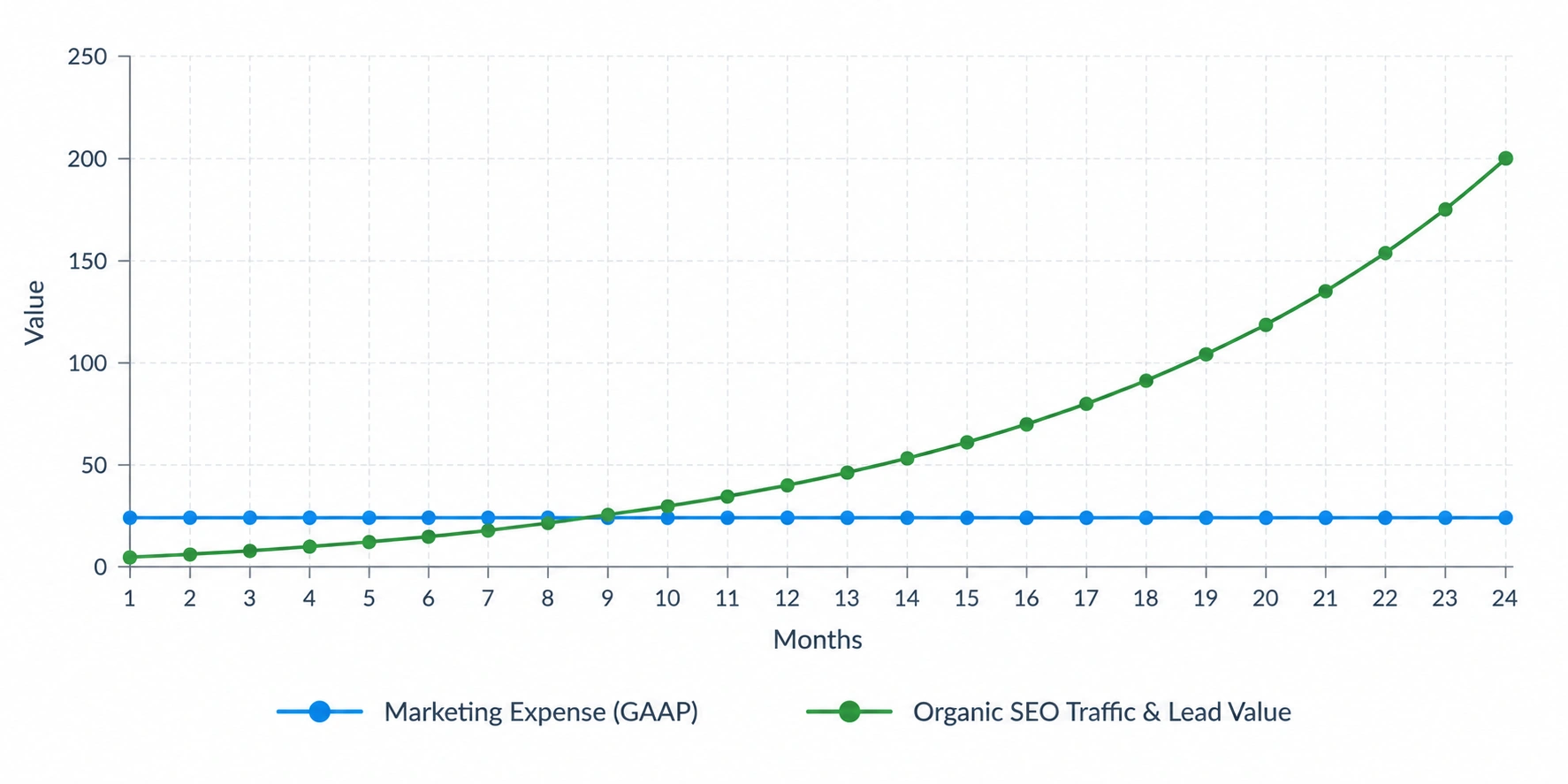
The chart contrasts a flat marketing expense line with the potential for organic SEO traffic and lead value to compound over a 24-month period.
Evaluating Agency Expertise and Specialized Services
Generic SEO agencies fail accounting firms for a foreseeable reason: they do not understand the industry. They do not know that tax season creates a surge in high-intent local searches in February and March. They do not know that content about specific services, such as forensic accounting, business valuation, or IRS representation, carries far more conversion weight than generic “accounting tips” blog posts. And they rarely understand the compliance sensitivities around financial claims in marketing content. This is a risk.
When evaluating an agency’s competence, we recommend shifting the conversation away from traffic projections and toward outcomes that map directly to your practice’s growth:
- Local Map Pack dominance: Consistent appearance in the top three local map results for queries like “CPA near me” or “tax accountant [city]”: these are the positions that capture the highest-intent, ready-to-hire searchers.
- Niche service page visibility: Rankings for specific, high-value service pages rather than just the firm’s homepage. A forensic accounting practice that ranks for “forensic accountant [state]” is generating far more qualified traffic than one that ranks broadly for “accounting firm.”
- Lead quality over volume: Tracked form submissions, phone calls, and consultation requests, not raw session counts. An agency that cannot report on actual lead generation metrics is measuring the wrong things. Reviewing a small business seo case study gives you a concrete benchmark for what real-world local optimization outcomes look like.
We suggest asking any prospective partner to walk you through a specific client result in professional services. If they pivot to traffic charts and keyword rankings without connecting those numbers to client acquisition, that is a clear signal about how they measure success.
Red Flags to Watch For When Vetting Agencies
The market is crowded with providers who compete on price rather than results, and an accounting firm’s unfamiliarity with digital marketing can make it a target for low-quality operators. These warning signs should trigger immediate inspection:
- Guaranteed #1 rankings: Search engine algorithms are proprietary, constantly updated, and influenced by hundreds of variables no external party controls. Any agency guaranteeing a specific organic position is either uninformed or deliberately misleading you.
- Opaque reporting and black-box tactics: If an agency will not tell you exactly which links they are building, where that content is being published, or what technical changes they are making to your site, that opacity is protecting them, not your practice.
- Pricing significantly below market: Retainers that seem too good to be true almost always involve outsourced, low-quality content production or automated link-building tactics that violate search engine guidelines; these can result in manual penalties.
The contrast between short-term agency hype and sustained, professional results is real. Michael Park of Dreamworks Kitchen & Bath put it plainly: “I’ve been working with BizIQ for over 7 years and my experience has been exceptional… I’ve worked with several other SEO compaines and never have I had the sustained results that I’ve gotten with BiZIQ.”
Sustained results require a partner that treats your firm’s digital presence as a long-term asset, not a campaign to be won and handed off. Demand that commitment.
The Impact of AI on Professional Service Search
The search environment accounting firms are optimizing for today is not the one that existed three years ago. Artificial intelligence is profoundly changing how prospective clients research and select professional service providers. According to Harvard Business Review’s research on how AI is changing customer choice, competitive advantage is shifting toward managing AI-shaped digital interactions rather than relying solely on direct customer observation. Prospective clients are increasingly using AI assistants, such as ChatGPT, Gemini, or Perplexity, to research CPA firms, ask complex tax questions, and receive direct recommendations without ever visiting a traditional search results page.
Understanding how AI chooses local businesses to feature in its responses is now a legitimate strategic priority for accounting firms. These systems do not rank websites the way Google’s traditional algorithm does. They operate differently. They pull from structured, authoritative sources: schema-marked business data, well-organized service pages, consistent NAP (name, address, phone) citations across directories, and content that directly answers the questions users are asking. A firm whose digital presence is fragmented, inconsistently cited, or built around thin content is effectively invisible to a growing portion of the market.
The practical implication is that Answer Engine Optimization (AEO) needs to sit alongside traditional SEO in any forward-looking digital strategy. Content must be structured to answer complex, specific queries, such as “what is the difference between a CPA and an enrolled agent” or “do I need a forensic accountant for a business dispute”, in a way that positions the firm as the definitive source of truth on those topics. Firms that fail to adapt to these AI-shaped interactions risk losing visibility precisely when a prospective client is most ready to make a decision.
“As AI and automated agents begin to orchestrate work and influence customer choices, traditional, siloed marketing organizations must redesign their operating models to remain competitive.” : Harvard Business Review, on redesigning marketing for the agentic age
How to Structure the Evaluation and Vetting Process
Treat the partner selection process the same way you would approach a financial audit: with a defined scope, documented criteria, and a structured progression of steps. SEO audits are like financial health checks: we must see the full picture before prescribing any treatment. Emotional decision-making, such as vetting a partner because their pitch deck was polished or their salesperson was personable, is how firms end up locked into 12-month contracts with nothing to show for it.
Start with an independent audit of your own website before you talk to any agency. This is crucial. Identify existing technical bottlenecks (page speed, mobile usability, crawl errors), map your current local visibility gaps, and document where your highest-value service pages currently rank. This baseline gives you a reference point for evaluating every partner’s proposed strategy: if they are not addressing the specific issues you have already identified, that tells you something about the depth of their analysis.
From there, the process follows a logical sequence: research prospective partners’ case studies and client testimonials, with particular attention to professional services experience; schedule discovery calls to evaluate communication style, reporting standards, and how clearly they can explain their methodology without jargon; and request a sample report from a current client engagement to verify that their deliverables match their promises.
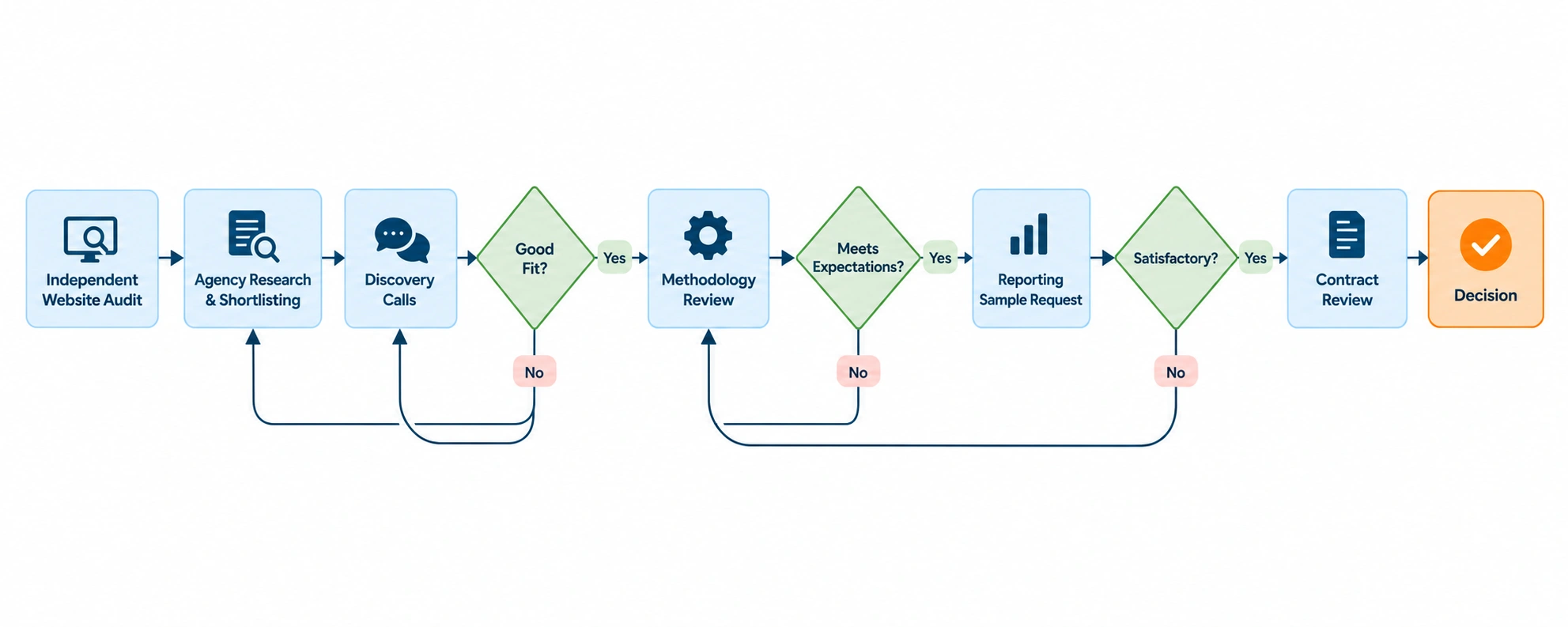
A structured agency vetting process moves from an independent website audit and agency research through methodology, reporting, and contract review.
Key Questions to Ask Before Signing a Contract
The questions you ask during the sales process are the single most reliable indicator of partnership quality. Partners that can answer these clearly and specifically, without deflecting into generalities, are the ones worth engaging. Those that cannot are telling you something important. Pay attention.
- “How do you measure and report on campaign success, and which metrics do you prioritize?” : We recommend looking for a focus on leads, consultation requests, and phone calls, not raw traffic or keyword rankings in isolation.
- “Can you explain your specific link-building methodology and how you ensure compliance with search engine guidelines?” : Avoid any team that references “link networks,” cannot name the types of sites they target, or remains vague about their outreach process.
- “Who will be our primary point of contact, and how often will we receive progress updates?” : Dedicated account management with a defined communication cadence is a baseline expectation, not a premium feature.
- “Do you have experience with accounting or professional services firms specifically, and can you share relevant results?” : Industry experience matters because the keyword environment, content compliance requirements, and seasonal search patterns for accounting are genuinely different from other verticals.
Garrett Cisek, Co-Founder of BizIQ, frames the small business context well: “Because we started as a small business, we understand the hurdles that many small business owners have to face when they begin to market their brand and services online” That kind of institutional empathy, understanding what is truly at stake for a firm that cannot absorb a wasted marketing budget, is worth probing for in any partner conversation.
Understanding SEO Pricing and Retainer Models
Pricing transparency is one of the most enduring pain points in the marketing industry, and the SEO space is no exception. Monthly retainers work like retainers in law firms: you are paying for ongoing availability and accumulated knowledge, not just hours. Monthly retainers for professional services typically range from $1,000 to $10,000 or more, depending on the partner’s depth of expertise, the competitiveness of your local market, and the scope of work involved. A firm in a major metropolitan market competing for high-value keywords like “business tax attorney CPA” will require more intensive ongoing effort than a practice in a smaller market targeting a narrower set of services.
Quality SEO work is labor-intensive. It takes time. It involves ongoing technical maintenance, custom content creation by writers who understand financial topics, manual link outreach, and regular reporting and strategy adjustments. None of that can be sustained at the $200-$300/month price points that some low-cost providers advertise. Those packages almost universally rely on automated content templates and bulk link-building tactics: approaches that violate search engine guidelines and frequently result in penalties that damage the firm’s digital standing far more than doing nothing at all.
While the upfront cost of a professional campaign requires a dedicated budget, the long-term value of a highly visible, authoritative digital presence far outweighs the initial expense. The firms that treat SEO as a multi-year investment rather than a quarterly line item are the ones that build the kind of search authority that generates consistent, compounding returns.
Establishing Accountability and Transparency
A professional partner should provide regular, jargon-free reports that cover three categories: technical updates (what was changed on the site and why), content performance (which pages are gaining visibility and driving engagement), and lead generation metrics (actual inquiries attributable to organic search). If a monthly report requires a glossary to interpret, it is designed to hide rather than inform. Demand clarity instead.
BizIQ backs its work with a concrete commitment: your practice will be listed on the first page of Google’s local maps results or organic search results within 60 days of beginning services, or the team works for free until those results are achieved. That kind of accountability standard is worth asking about explicitly with any partner you are evaluating; not because every firm can or should offer the same guarantee, but because the willingness to stand behind measurable outcomes is a reliable indicator of confidence in their own methodology.
Tim Skinner of Skinner Design Associates describes the difference that professional accountability makes in practice: “I have been working with this organization for a while now. They are highly professional and have helped me immensely. I have worked with other similar groups in the past only to find they can’t deliver as promised. Working with BizIQ has been a pleasurable experience and I recommend them highly.”
The pattern Skinner describes, prior teams that could not deliver as promised, is common enough that it should be a central concern during the vetting process, not an afterthought.
Frequently Asked Questions About Accountant SEO
How much does an SEO partner typically cost?
Monthly retainers for professional SEO services typically range from $1,000 to $10,000 or more, depending on the partner’s expertise, the scope of work, and the competitiveness of your local market. The investment should align with your firm’s growth goals and the size of your target client base. Pricing significantly below this range is a reliable indicator of outsourced or automated work: the kind that produces short-term vanity metrics and long-term search penalties.
Can ChatGPT do an SEO audit?
ChatGPT can assist with certain audit tasks: analyzing existing content for keyword alignment, generating meta tag suggestions, or flagging structural issues on individual pages. What it cannot do is crawl your entire website, identify deep technical server-level problems, analyze your backlink profile, or provide the competitive gap analysis that specialized SEO auditing software delivers. AI tools are useful assistants in the process, but they do not replace the strategic oversight and execution that an experienced SEO professional brings to a full audit.
Why are so many CPAs quitting?
The profession is facing a well-documented retention challenge driven by long hours during busy season, sustained stress, burnout, and wage growth that has not kept pace with inflation for many practitioners. For firm leaders, this trend has a direct marketing implication: as talent acquisition becomes harder, a firm’s digital presence and brand reputation matter not just for client acquisition but for attracting and retaining top-tier professional staff. A modern, credible online presence signals that a firm is well-run and forward-thinking: qualities that matter to candidates evaluating their options.
Is CPA still worth it in 2026?
The CPA designation remains one of the most respected and economically durable credentials in professional services. In an increasingly complex regulatory and financial environment, the demand for certified expertise continues to grow. Firms that pair that professional credibility with strong digital marketing are best positioned to convert that demand into high-value client relationships: the designation opens the door; visibility determines whether prospective clients find you before they find a competitor.
Can you make $500,000 a year as an accountant?
Earning at that level is achievable, typically through a partnership track at a major firm, a CFO or senior executive role, or a highly successful private practice. The private practice path, in particular, depends on building a scalable client acquisition engine that does not rely exclusively on referrals. Local SEO and search visibility are foundational to that engine: they create a consistent inbound pipeline that grows with the firm’s reputation rather than plateauing when the partner’s personal network is exhausted.
Evaluating an SEO partner is a significant business decision that deserves the same thoroughness we would apply to any major partner or professional relationship. The firms that get it right focus on three things: local search presence that captures high-intent prospects in their actual market, transparent reporting that connects activity to real business outcomes, and a partner willing to be held accountable to measurable results. Those criteria filter out the majority of the market quickly. This saves time.
BizIQ specializes in exactly this kind of work for accounting and professional services firms. If you are ready to build a search presence that generates consistent, qualified inbound inquiries, explore digital marketing for accountants and reach out to our team directly. Our team is available Monday through Friday, 7 AM – 4 PM, by phone at (888) 416-9800, or in person at 3627 E Indian School Rd Suite 103.