
What you’ll take away from this piece:
- How to position your healthcare organization for citation within AI Overviews using Generative Engine Optimization (GEO) principles
- Why local SEO remains the most durable patient acquisition channel in a zero-click search environment
- How to operationalize the E-E-A-T framework for clinical content under Google’s YMYL guidelines
- What technical infrastructure, from server-side rendering to HIPAA-compliant analytics, directly determines machine readability in 2026
What is the Ultimate Healthcare SEO Strategy for the AI Era?
The ultimate healthcare SEO strategy for the AI era is to create authoritative, evidence-based content that directly answers patient questions, demonstrates medical expertise, and is supported by a technically optimized website with strong local SEO, structured data, and a trustworthy online reputation. The patient journey no longer starts with a phone book, a referral directory, or even a legacy search result. In 2026, it begins with a voice query to a smart speaker, a conversational prompt to an AI assistant, or a generative summary that resolves the question before the patient ever reaches your website. Understanding AI search and how it reshapes the discovery funnel isn’t optional context anymore: it’s the operating premise for every strategic decision covered in this guide.
We built this blueprint because sophisticated marketing belongs to everyone, not just massive hospital networks with enterprise budgets. At BizIQ, we’re a small business ourselves, with the same goals and aspirations as the clients we serve. We get it because we’ve lived it. We know the stakes. What follows is a direct framework that educates with evidence, leads with outcomes, and does not hype, fear-monger, or oversell. This is about building the kind of clinical authority that search engines, and patients, genuinely reward.
The Evolving Patient Journey
Seventy-seven percent of patients conduct online research before booking an appointment, turning to search engines to evaluate providers, compare treatment options, and read peer reviews long before they call a clinic. That number has held relatively steady for years, but what those patients encounter during that research has changed dramatically. Google now processes over 1 billion health-related queries every day: roughly 7% of its total daily search volume. An increasing share of those queries resolve inside the search interface itself, never generating a click to an external page. Clicks are disappearing.
Healthcare organizations that built their digital strategies around keyword rankings and organic traffic volume are now watching those metrics recede without a clear explanation. The explanation isn’t an algorithmic penalty or technical failure. It’s structural: search has shifted from a navigation tool to an answer engine, and medical content that isn’t architected for that environment gets overlooked entirely. Moving beyond keyword stuffing isn’t a refinement of existing strategy; it’s a prerequisite for remaining visible at all. The organizations gaining ground in 2026 are those that treat clinical authority and technical compliance as the foundation, not the finishing layer.
Navigating the Shift to AI-Driven Search and Answer Engines
The Impact of Zero-Click Searches
AI Overviews now trigger on 89% of healthcare-related search queries, according to BrightEdge, Dec 2025. That figure is worth sitting with for a moment, because it means the overwhelming majority of symptom lookups, drug interaction questions, provider searches, and treatment comparisons now surface a generative summary before any organic result. The downstream effect on traffic is drastic: the presence of an AI Overview reduces organic click-through rates by an average of 61%, based on studies by Seer Interactive, Nov 2025. For the top organic position specifically, CTR drops from 19% to 13.8% when a generative summary occupies the page header.
Zero-click searches have been a known phenomenon for years, but their concentration in healthcare is particularly pronounced because informational intent dominates the category. Patients aren’t searching for a product to purchase; they’re searching for answers to questions that feel urgent. They want clarity now. AI models are purpose-built to satisfy that intent without requiring a page visit. That’s not a problem to fight; it’s a structural reality to engineer around.
Strategies for Generative Engine Optimization
Generative Engine Optimization (GEO) is the practice of structuring content so that AI models select your clinical domain as a primary citation source. It’s the primary strategic hedge against zero-click cannibalization, and the opportunity it presents is larger than most healthcare marketers have recognized. Only 37.9% of URLs cited in AI Overviews rank within the top 10 organic results, according to data from Ahrefs, Dec 2025. This citation-to-ranking gap is significant: it means a well-structured, credentialed content page from a specialized medical domain can earn AI visibility without first winning a competitive organic ranking battle. Structure wins here.
The operational entry point is “answer-first” formatting. Every body page should open with a concise summary block, 80 to 120 words, that directly addresses the primary query, names the relevant entities (condition, treatment, provider type), and cites a verifiable source. This isn’t a meta description repurposed as body copy; it’s a standalone, machine-parseable answer that gives AI models exactly what they need to generate a citation. Pair that with tightly scoped FAQ sections, structured heading hierarchies, and JSON-LD schema, and you’ve built the architecture that generative engines prefer over dense, essay-style clinical content.
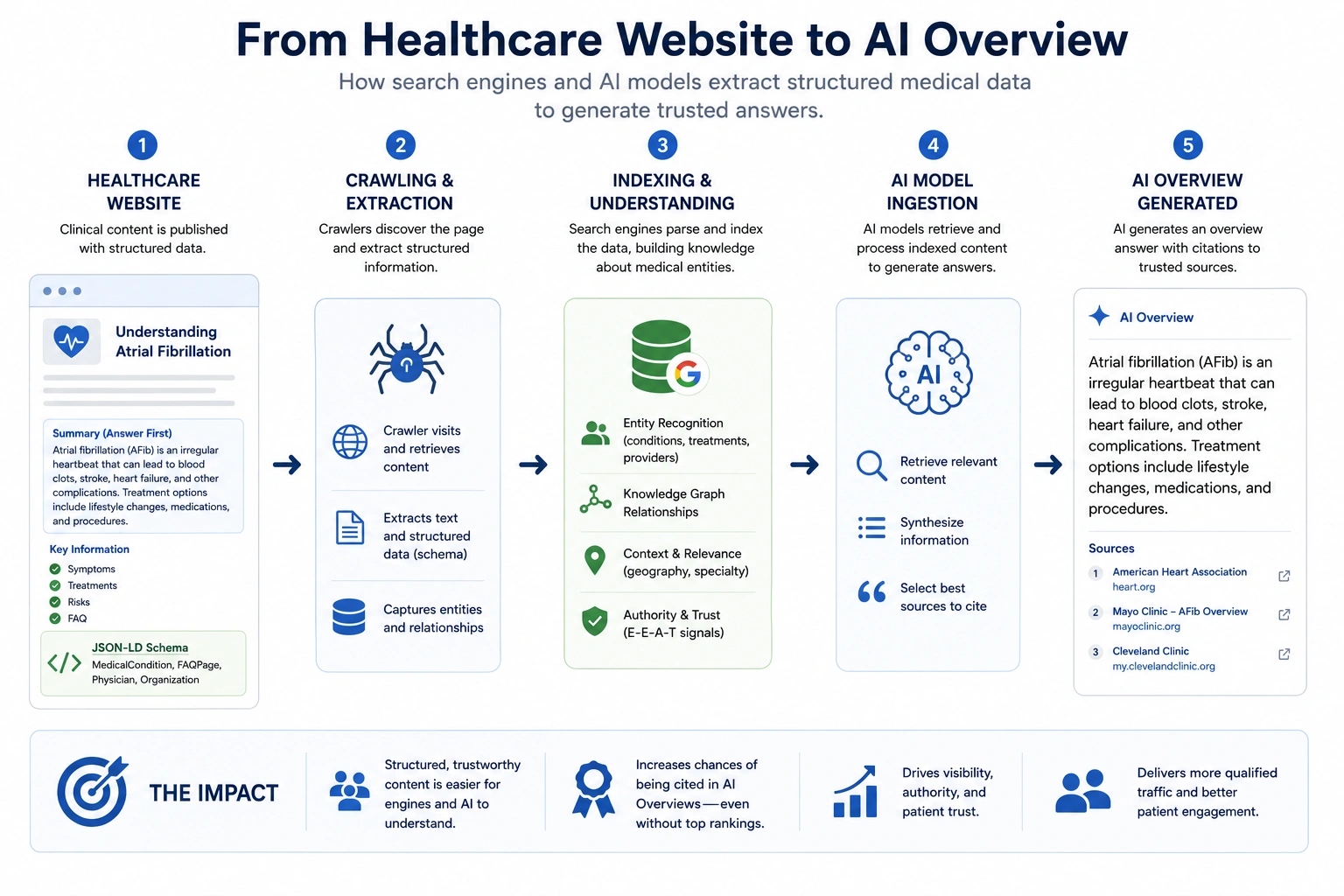
See how structured healthcare content moves from a website through search engines to become a trusted AI Overview citation.
Mastering Local SEO and the Digital Front Door
Local SEO Action Plan
Local search is the one channel that AI Overviews haven’t meaningfully absorbed, and that’s not an accident. Local intent requires physical action: a patient needs to know which clinic is nearby, whether it accepts their insurance, and whether other patients have had a good experience there. A generative summary can’t book the appointment. Action happens locally. That structural shielding makes local SEO the most reliable patient acquisition lever in the current environment, and it deserves proportionate investment. This is why local SEO for healthcare remains your strongest digital asset.
We like to say that local SEO for medical practices is like keeping your storefront window clean and well-lit: it helps the right people find you when they’re looking. It is like being listed in the most trusted neighborhood directory where people find you because they know you’re there, and they trust the listing because it’s consistent, current, and corroborated by other patients. The execution framework breaks down into four interconnected priorities:
- Google Business Profile optimization: Treat your GBP as a live clinical asset, not a set-and-forget directory entry. Accurate service categories, updated hours, photo libraries, and weekly posts all contribute to the signals Google uses to rank local results. Incomplete profiles are consistently outranked by competitors who treat GBP maintenance as a standing operational task.
- Dedicated location landing pages: Each physical location your organization operates should have its own indexed page with unique content, such as provider rosters, local patient reviews, accepted insurance plans, and neighborhood-specific context. Generic multi-location pages with swapped city names don’t satisfy local intent and don’t rank.
- Proactive review generation: Patient reviews aren’t just social proof; they’re a direct local ranking signal. A systematic post-visit review request process, compliant with HIPAA guidelines around what can be referenced in communications, consistently outperforms passive approaches. Ensuring consistency across directories (NAP data across Google, Yelp, Healthgrades, and specialty directories) amplifies the authority of every review you collect.
- Geographic keyword integration: Local keywords in your content should reflect how patients actually search, not how clinicians describe services. “Orthopedic surgeon near downtown Phoenix” performs differently than “orthopedic surgery services.” Map your keyword architecture to the geographic and colloquial language patterns of your patient population, then build content and metadata around those patterns. Reviews from happy customers embedded within location pages reinforce both the trust signal and the geographic relevance.
Establishing Medical Authority Through the E-E-A-T Framework
E-E-A-T Implementation Steps
Google’s Search Quality Rater Guidelines (January 2025) are explicit about the standard applied to medical content: clinical claims require verifiable credentials, first-hand experience, and demonstrable expertise. Healthcare falls squarely within the Your Money or Your Life (YMYL) category, which means the bar for content quality isn’t just higher; it’s categorically different from what applies to a recipe blog or a travel guide. A poorly credentialed medical page doesn’t just rank poorly; it actively signals untrustworthiness to Google’s quality evaluation systems. This is why Google E-E-A-T for medical websites is the core of effective medical seo.
Authority in this context is earned through evidence, not claimed through language. Trust is not assumed. We believe in earned authority through demonstrated results, which is why these four implementation components drive measurable E-E-A-T improvement:
- Credentialed author bylines: Every clinical content page should display the author’s name, credentials (MD, DO, NP, etc.), and specialty. This isn’t decorative; it’s a structured signal that Google’s quality raters and AI models both parse when evaluating content trustworthiness.
- Peer-reviewed citations: Primary sources, clinical guidelines, and peer-reviewed studies should be linked inline, not aggregated in a reference list at the bottom of the page. Inline citation placement signals that the claim and the evidence are directly connected.
- Regular content audits: Medical information has a shelf life. A formal review cycle every 12 to 18 months, with a clearly displayed ‘last reviewed by [credential]’ timestamp, communicates currency to both search engines and patients. Stale clinical content is a liability.
- Detailed clinician bios: Provider profile pages should function as credentialing documents, including board certifications, fellowship training, published research, hospital affiliations, and patient care philosophy. These pages are among the highest-value E-E-A-T assets a healthcare organization can build, and they’re consistently underdeveloped.
“Technical SEO is no longer a back-end development task; it is the very gateway through which search engines and AI models understand, index, and trust your clinical expertise.”
Sarah Jenkins, Senior Healthcare SEO Strategist
Ready to audit your current search visibility?
Your healthcare organization’s digital front door may have gaps you haven’t mapped yet: in local rankings, AI citation coverage, or clinical content authority. Our growth strategists offer a free digital growth consultation to assess exactly where your search presence stands and what it would take to lead your market in 2026.
Claim Your Free Healthcare SEO Consultation → Healthcare SEO
Building Technical Foundations for Machine Readability
Technical Performance & Indexation
Modern healthcare websites carry a technical complexity that most general-purpose SEO frameworks weren’t designed to handle. Dynamic patient portals, JavaScript-heavy appointment booking systems, and multi-location directory architectures all create crawlability challenges that directly hinder organic visibility. Server-side rendering (SSR) addresses the most enduring of these: when search bots encounter complex JavaScript frameworks without SSR, they frequently index incomplete or empty page states. Implementing SSR ensures that the full clinical content of each page is available to crawlers on first contact, and the performance impact is measurable: organizations that have made this transition report an average 27.1% increase in organic traffic as previously invisible pages enter the index. This is a primary focus of professional SEO services for healthcare. Speed dictates trust.
Mobile performance is equally non-negotiable. Seventy-two percent of health-related searches originate on mobile devices, and Google’s mobile-first indexing means that a page’s mobile experience is the version being evaluated for ranking. Core Web Vitals, particularly Largest Contentful Paint and Cumulative Layout Shift, function as proxy trust signals in healthcare contexts, where a slow or visually unstable page erodes patient confidence before a single word of clinical content is read. For organizations managing large-scale, multi-location digital properties, a well-executed SEO Strategy that accounts for both crawl architecture and rendering methodology is the difference between a site that scales and one that fragments.
HIPAA-Compliant Analytics Stack
GA4 is not HIPAA compliant out of the box. Google unequivocally declines to sign a Business Associate Agreement (BAA) for Analytics, which means any healthcare organization routing patient interaction data through a standard GA4 implementation is operating outside HHS and FTC guidelines. Those guidelines prohibit tracking pixels on any page that collects Protected Health Information (PHI): appointment booking forms, patient intake pages, portal login screens, and symptom checkers all qualify. The liability isn’t hypothetical; enforcement actions have already been issued against health systems that deployed standard analytics tags on these page types. Compliance is mandatory.
The compliant path forward branches in two directions. Privacy-first platforms like Piwik PRO and Matomo offer full analytics functionality with BAA availability and data residency controls that GA4 cannot match. Alternatively, server-side Google Tag Manager configurations can strip PHI fields before data transmission, though compliance officers and privacy advocates have noted that this approach still carries residual risk under strict HHS audit standards: the filtering logic must be airtight, documented, and regularly tested. Neither path is frictionless. But the cost of a compliant analytics migration is substantially lower than the cost of an enforcement action, and the measurement fidelity you gain from a properly configured privacy-first stack often exceeds what a poorly governed GA4 instance was delivering anyway.
Implementing Structured Data and Medical Schema
Translating Credentials for AI Models
Structured data is how you speak directly to the machines that index and summarize your content. For healthcare organizations, that conversation needs to be exacting, because the entities involved, including physicians, specialties, locations, and clinical conditions, carry relationships that generic schema types can’t adequately express. This structured translation is vital for SEO for doctors and healthcare providers. Three schema types form the core of any medical implementation:
MedicalWebPage identifies the author and medical reviewer of each clinical content page, establishing the credentialing chain that both Google’s quality systems and AI citation models use to evaluate trustworthiness. Physician schema, applied to individual provider profiles, should include the National Provider Identifier (NPI) number, a verifiable, federally issued credential that functions as an unambiguous identity anchor for AI models parsing provider data. MedicalOrganization schema maps your clinic or hospital locations with the precision that local search algorithms require: address, service area, accepted conditions, and affiliated providers.
These JSON-LD snippets don’t just improve rich snippet eligibility. They build a relational knowledge graph that search engines can navigate, connecting a specific condition to a specific specialist to a specific location, rather than encountering a collection of disconnected articles. Competitors who stop at basic site schema are leaving that graph incomplete. The organizations that invest in deep relational schema, linking clinical outcomes to provider specialties to geographic service areas, are building a structured data architecture that AI models genuinely prefer as a citation source. Data feeds engines.
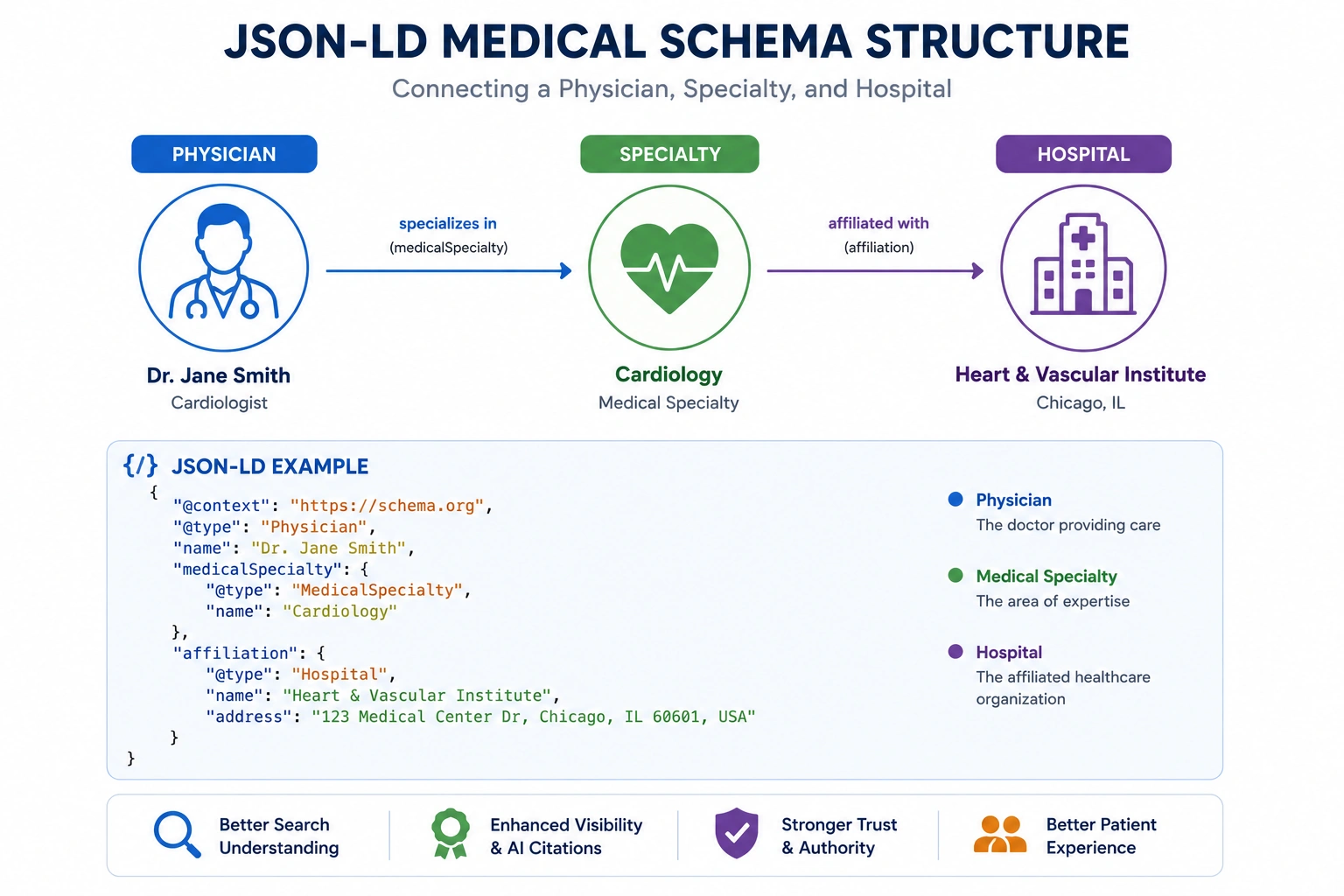
A visual overview of how JSON-LD medical schema links physicians, specialties, and hospitals for better search understanding.
Concerned about crawlability gaps, schema deficiencies, or page speed bottlenecks?
A detailed technical SEO audit surfaces the exact infrastructure issues suppressing your search visibility before they compound. Understanding how to capture AI traffic starts with knowing where your current technical foundation is leaking authority. Our team audits crawl architecture, schema implementation, Core Web Vitals, and analytics compliance in a single engagement.
Designing Patient-Centric Content Hubs
Content Hub Architecture
Topical authority in healthcare isn’t built through volume. It’s built through structural exhaustiveness: the degree to which your content covers a clinical domain from every angle a patient might approach it, organized in a way that search engines can map as a coherent knowledge structure. The hub-and-spoke model operationalizes this: a detailed pillar page anchors each major clinical topic, and a network of detailed subtopic articles links back to it, each one addressing a specific facet of the patient’s informational journey. This is the cornerstone of a sustainable healthcare content marketing strategy. Structure drives authority.
We like to compare this to knowing which of your locations brought in which customers, so you can invest in what truly works. It is about building trust through consistency. Here’s exactly how to do it, step by step, based on what we’ve seen work for businesses like yours:
- Symptom-to-treatment mapping: Organize content around how patients typically experience illness, not how clinicians categorize it. A patient searching “why does my knee hurt when I climb stairs” is at the top of a funnel that ends at an orthopedic consultation. Map the content path between those two points explicitly, with internal links that guide the journey rather than leaving it to chance.
- Layman’s terminology as the primary keyword layer: “Sore throat remedies” outperforms “pharyngitis treatment options” in search volume by orders of magnitude. Clinical precision belongs in the body copy and schema; accessible language belongs in the headings, URLs, and metadata. Both audiences, patients and search engines, are better served by this separation.
- Expectation-setting treatment pages: Patients researching a procedure want to know what the experience will truly be like: recovery time, what to bring, and what questions to ask. Pages that answer these questions reduce pre-appointment anxiety and reduce no-show rates. They also rank for the long-tail queries that high-authority competitors frequently neglect.
- Interactive patient tools: Symptom checkers, insurance eligibility widgets, and appointment readiness quizzes create a user-specific value exchange that static content cannot replicate. These tools generate behavioral engagement signals (time on page, return visits, form completions) that reinforce topical authority in Google’s quality evaluation systems, and they create a natural conversion pathway from informational consumption to scheduled care.
Aligning SEO Metrics with Business Outcomes
From Traffic to Patient Conversions
Raw organic traffic is a lagging indicator in healthcare. What matters is whether that traffic is converting into booked appointments, patient portal registrations, and phone inquiries: the downstream actions that directly generate revenue and clinical volume. Organic search leads close at a rate of 14.6%, compared to 1.7% for outbound marketing channels like direct mail and print, according to studies by HubSpot, 2025. That gap is substantial, and it reflects something structural: a patient who found you through a search query has already self-qualified. They were looking for what you offer. This is the core of a modern patient acquisition strategy 2026. Traffic alone is meaningless.
Capturing that conversion capacity requires more than a well-ranked page. We look at organic SEO like keeping your clinic window clean and well-lit: it helps the right people find you when they’re looking, acting like a digital front desk that never sleeps. Call tracking integrations, HIPAA-compliant form analytics, and session behavior data (from compliant platforms) give you the measurement infrastructure to understand where patients are dropping off between discovery and appointment. What we’ve seen work for businesses like yours is a focus on clear pathways: organizations that have implemented this full-funnel attribution model consistently report a 65% increase in organic conversions, not because their traffic changed, but because they finally understood which pages were closing and which were leaking. Tracking booked appointments and patient portal registrations as primary conversion events, rather than page views or keyword positions, realigns the entire SEO program around the outcomes that clinical leadership genuinely cares about.
Frequently Asked Questions About Healthcare SEO
Navigating the compliance requirements and technical specifications of healthcare search marketing requires more than strategic intent. Understanding these subtleties is imperative for maintaining regulatory standing while driving measurable growth, and the cost of getting them wrong is higher in this industry than in almost any other. Keeping up with healthcare SEO trends 2026 is about balancing visibility with strict patient privacy. Privacy is paramount.
Common Medical Search Queries Answered
How does HIPAA compliance affect healthcare SEO tracking?
Standard analytics implementations, including GA4 without modification, are not allowable on pages that collect Protected Health Information. HHS and FTC guidelines explicitly prohibit tracking pixels on appointment booking forms, patient intake pages, and portal login screens. The compliant alternatives are privacy-first platforms like Piwik PRO or Matomo (both of which offer BAA availability), or a server-side Google Tag Manager configuration that strips PHI fields before any data reaches Google’s servers. The server-side approach carries residual compliance risk if the filtering logic isn’t rigorously maintained and documented, which is why many compliance officers prefer a full platform migration.
Why is E-E-A-T more important for healthcare websites than other industries?
Healthcare content falls under Google’s YMYL designation, ‘Your Money or Your Life,’ which applies to any content that could materially affect a reader’s health, financial stability, or safety. Under the January 2025 Search Quality Rater Guidelines, YMYL content is evaluated against a substantially higher credibility threshold than general informational content. A cooking blog can rank on engagement signals alone. A clinical content page needs verifiable author credentials, cited primary sources, a documented review process, and demonstrable first-hand expertise. The discrepancy exists because the consequences of acting on inaccurate medical information are categorically different from the consequences of following a bad recipe.
How often should clinical content be updated to maintain search rankings?
A formal medical review every 12 to 18 months is the practical standard, though high-traffic pages covering rapidly evolving clinical areas, such as oncology protocols, infectious disease guidance, and pharmaceutical approvals, warrant more frequent review cycles. The review date matters as much as the review itself: displaying a clear ‘last reviewed by [credential, date]’ notation signals currency to both search quality systems and patients. Pages without visible review dates are increasingly treated as potentially stale by Google’s quality evaluation infrastructure, regardless of their actual accuracy.
Can a multi-location health system use the same content for different location pages?
Duplicate location content consistently underperforms in local search, and for a clear reason: Google’s local ranking systems are designed to surface the most relevant result for a specific geographic query, and identical content across locations provides no differentiation signal. Each location page needs genuinely unique content: the provider roster at that location, patient reviews referencing that specific facility, accepted insurance plans that vary by market, transit and parking directions, and any community-specific programs or affiliations. Programmatic page generation that swaps city names into a shared template doesn’t satisfy this requirement and is frequently filtered out of local results entirely.
What is the role of voice search in modern healthcare SEO?
More than 40% of adults now use voice search regularly, and healthcare queries are disproportionately represented in that volume: patients asking smart speakers about symptoms, medication interactions, and nearby urgent care facilities at moments when typing isn’t practical. Voice queries are structurally different from typed queries: they’re longer, more conversational, and almost always locally inflected, such as ‘find an urgent care near me that’s open now’ rather than ‘urgent care Phoenix’. Optimizing for voice means building content around natural language question patterns, ensuring your Google Business Profile is complete and current (voice assistants pull heavily from GBP data for local queries), and structuring FAQ content with the direct, concise answer format that voice interfaces can read aloud without truncation.
The organizations that will lead patient acquisition in 2026 aren’t the ones with the largest marketing budgets: they’re the ones that built a trust-first, AI-ready digital ecosystem before the structural shift in search became impossible to ignore. Every element of this strategy, from GEO citation architecture to HIPAA-compliant analytics to relational medical schema, points toward the same underlying principle: patients and search engines both reward clinical credibility, and the infrastructure that earns one tends to earn the other.
At BizIQ, we are proud of the positive impacts we make on our small business partners. We view this work as small business helping small business shine. Healthcare is not a peripheral industry in the American economy. It is a small business driving America forward: the independent practice owner, the regional health system, the specialty clinic serving a community that depends on it. These organizations are the backbone of innovation and heartbeat of America, and their digital front door deserves the same precision and investment as their clinical operations. The search landscape has changed. The opportunity to lead it hasn’t closed, but the window for building this infrastructure before competitors do is narrowing.
Your 2026 search presence starts with a single conversation.
Our healthcare growth strategists are ready to assess your current digital visibility, identify the gaps between where you rank and where your patients are searching, and build a practical plan that connects clinical authority to measurable patient acquisition. No generic audits. No one-size-fits-all recommendations. Here is what I recommend: let’s look at your current presence together.