Understanding why franchise websites don’t rank starts with a frustrating pattern. You invested in a proven business model and expected a steady stream of local customers. The corporate office handed you a playbook, marketing assets, and a spot on the main corporate website, yet independent local competitors dominate the search results in your territory.
- Duplicate content: syndicated corporate copy leaves most franchise locations with nothing unique for search engines to show.
- Weak local signals: inconsistent listings and neglected Business Profiles limit visibility in map results.
- Restrictive structure: rigid site architecture and locked-down platforms keep locations from competing with agile local businesses.
- Local authority: original location content, consistent citations, and local backlinks help locations earn rankings and traffic.
Franchise websites often struggle for traction despite massive brand recognition behind them. National brands prioritize uniformity and control, and that conflicts directly with the hyper-local relevance search engines reward. Once you understand the specific barriers, you can take targeted steps, or ask corporate to take them, to regain visibility.
Why Franchise Websites Don’t Rank: The Duplicate Content Dilemma
Franchisors want a consistent voice across locations, so they often supply boilerplate text for every franchisee. Search engines then see hundreds of near-identical sets of content with only the city name swapped, which offers little value to a searcher. Independent businesses, by contrast, write original copy about their services, local landmarks, and community involvement.
It helps to understand what Google actually does. Its documentation on canonicalization explains that when multiple URLs have very similar content, Google groups them and picks the one it considers most representative to show in results. It also notes that some duplicate content is normal and is not a violation of its spam policies. In other words, the problem is filtering, not punishment: your location can simply be treated as a duplicate and left out.
Syndicated Copy Destroys Relevance
Search systems judge the richness of content to decide whether it deserves to rank for a local searcher. When your location uses the same service descriptions as a franchisee three states away, you lose geographic relevance, and the system has no reason to prefer yours.
The Canonical Tag Confusion
A canonical tag tells search engines which version of a URL should be treated as the main one. Google describes a canonical preference as a hint, not a rule, but if your location’s tag points to a national URL, that hint can keep the local version out of results entirely. Ask your corporate team to confirm that each location is self-canonical.
Why Franchise Websites Don’t Rank Without Original Local Copy
The remedy is genuinely local content: services offered at your location, neighborhoods served, real staff and customer stories, and community involvement. Request approval for original, localized paragraphs on your location’s content, and support the request with a comparison against three independent local competitors. Strong on-site optimization built into corporate templates makes that content scalable across the network.
Poor Site Architecture and URL Structures

Franchise sites generally take one of three forms: subdomains, subdirectories, or fully independent domains. Many brands place franchisees on subdomains, and Google’s crawl documentation notes that a subdomain such as code.example.com is treated as a separate site with its own crawl budget. That means your local site may get little help from the authority the corporate domain has built.
Subdirectory structures usually perform better because authority is shared across the network. They can still bury local content deep in a convoluted hierarchy. If a visitor or crawler needs several clicks to reach your location, it signals lower importance, and a flatter structure with clear internal links helps authority reach every location. A dedicated SEO program for franchises usually starts by fixing exactly this hierarchy.
One caution: do not buy an exact-match domain to work around corporate rules without checking your franchise agreement. It often violates brand guidelines and can lead to serious consequences.
Restrictive Corporate Platforms and Technical SEO Barriers

Many franchisors run proprietary content management systems to control every location. These platforms often lack basic technical SEO controls, and franchisees usually cannot edit title tags, meta descriptions, or schema markup for their own locations. Without a title that includes your city, you are competing with one hand tied behind your back.
Large corporate platforms also tend to suffer from speed problems. Extra tracking scripts, unoptimized images, and bloated code slow location content down. Google’s ranking systems consider user experience, and it publishes guidance on Core Web Vitals and related experience signals, so heavy templates can hold back every location at once.
Weak Local SEO Signals and Business Profile Neglect
Local search depends on clear, consistent location data across the web. Franchisees often face inconsistent name, address, and phone details across directories, and former operators may have reused one phone number for several locations. When search systems find conflicting details, trust in the location drops and rankings follow.
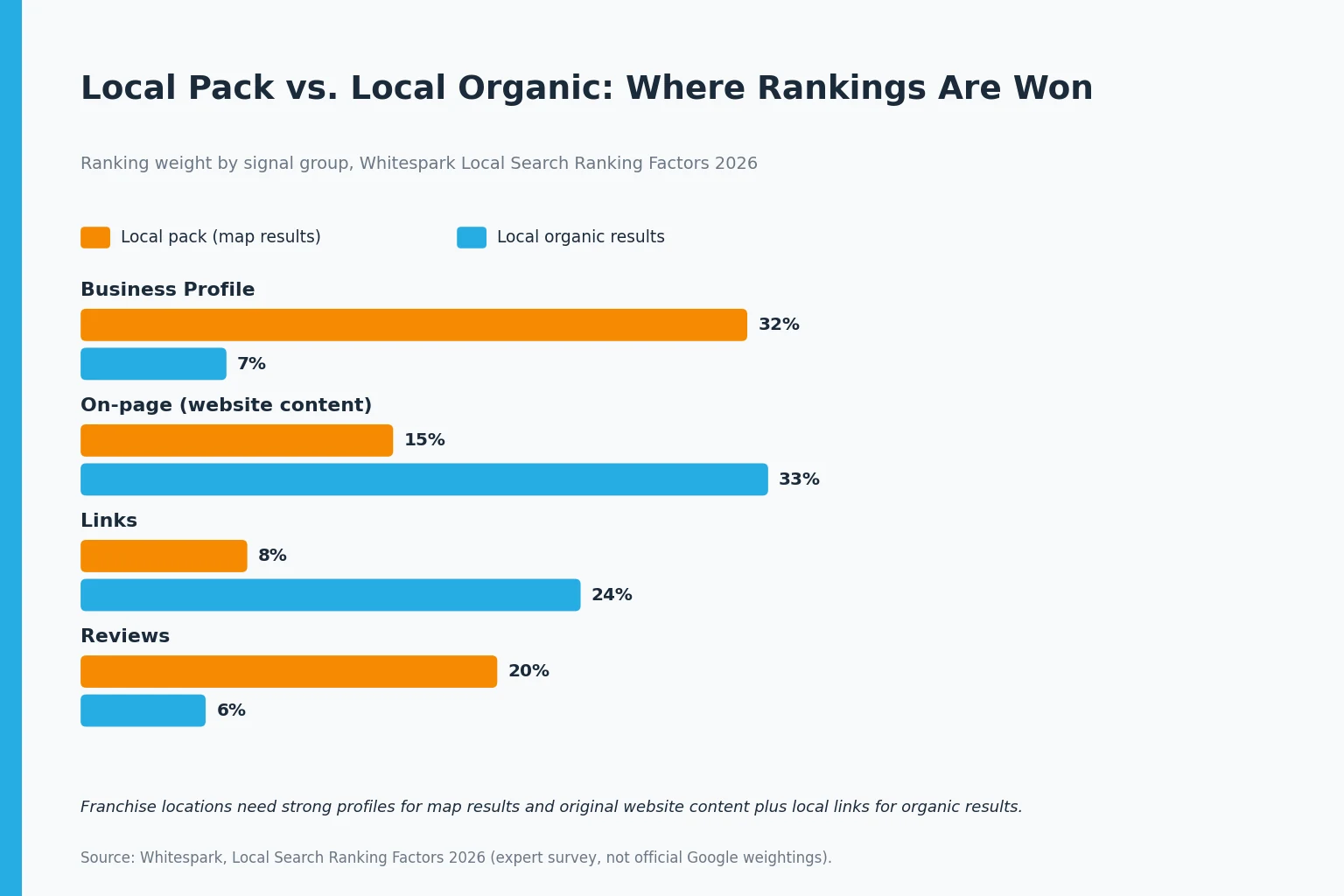
Whitespark’s 2026 survey of local SEO experts shows why this matters. Business Profile signals carry 32% of the weight in local pack rankings, but only 7% in local organic results, where website content leads at 33% and links follow at 24%. A franchise location needs strength on both fronts, which is the focus of ongoing local SEO services.
Many franchisors try to manage hundreds of profiles from one corporate dashboard, which tends to leave profiles with unanswered reviews, dated photos, and no local posts. Corporate should keep ownership while local operators keep access to update their own profile regularly, and a Google Business Profile setup and verification service helps get the foundation right.
Ongoing local citation management then keeps the supporting directory data consistent.
Reviews are the other half of local trust. A steady rhythm of fresh feedback, supported by reputation management, helps your profile compete with independent shops that update their listings daily.
How to Fix Your Franchise SEO Architecture
- Audit your location content. Compare your text against three independent local competitors, and note the landmarks, neighborhoods, and services your corporate copy ignores. A plagiarism checker will show how much of your text appears on other franchise locations.
- Reclaim your local listings. Request manager access to your Google Business Profile and other listings from corporate, so you can answer reviews and post local updates directly.
- Clean up your citation data. Find variations of your business name, address, and phone number, and standardize them across every directory.
- Request template improvements. Ask corporate for editable title tags, a unique local content block, and correct canonical tags, using your audit as evidence.
A free SEO audit is a practical way to document these issues and give both you and corporate a shared starting point.
The Local Backlink Deficit
Links from other reputable sites act as votes of confidence. The corporate website naturally attracts links from national news outlets and industry publications, but those links rarely point to your specific location. Whitespark’s survey puts links at 24% of local organic ranking weight, so a location with no local links of its own starts at a disadvantage.
Independent competitors earn local links naturally by sponsoring a youth sports team or joining the chamber of commerce. Franchisees often skip this because they assume the national name is enough. Pursue local sponsorships, community partnerships, and local press to build authority for your own location, and combine it with the brand-level work in a coordinated franchise marketing strategy that supports every territory.
Why Franchise Websites Don’t Rank FAQs
Why does my corporate franchise listing rank lower than local competitors?
Local competitors publish specific, original content about their own area. Franchise locations often rely on generic, syndicated copy, which search engines tend to group with other near-duplicates and show only once.
Can I build my own separate website outside the franchise network?
That depends on your franchise agreement. Many franchisors prohibit independent websites to protect the brand, and launching one could lead to legal action or termination. Check the agreement and talk to corporate first.
How do I improve my local franchise SEO without breaking corporate rules?
Focus on what you control: your Business Profile, local citations, reviews, and local links. You can also ask corporate to approve a few paragraphs of original, locally relevant text for your location.
Does centralizing Google Business Profiles hurt local SEO?
It can. Centralized management often means slow review responses and few local photo updates. Corporate can keep ownership while local franchisees keep manager access and update their own profile regularly.
Why is my new franchise location not indexed by Google yet?
Common causes are weak internal linking, which leaves the location deep in the site, and canonical tag errors that point Google to another URL. The URL Inspection tool in Google Search Console shows which URL Google chose as canonical.
What can corporate do to help every location rank?
Corporate can give each location unique, editable content, self-referencing canonical tags, editable title tags, clean URL structures, and consistent listings. Then it can support franchisees with local link and review programs.
Franchise search visibility takes a balance between strict corporate guidelines and focused local optimization. National brand recognition alone will not drive local foot traffic and calls, and the structural limits of corporate websites hold locations back against agile independent businesses.
Once you understand the specific technical and content barriers, you can overcome them. Take control of your local digital footprint, build community-level authority, and advocate for genuinely helpful local content. If you want a partner for that work, BizIQ helps franchise brands fix exactly these problems.
To talk through your own situation, talk with a franchise SEO specialist about your location or network.

Improve Your Franchise Search Rankings
We help franchise businesses overcome duplicate content issues, improve local visibility, optimize Business Profiles, and build scalable strategies that drive traffic across every location.