
Written by the BizIQ Organic Strategy Team. We are small business owners and technical marketers who live and breathe local search. We help HVAC contractors fill calendars and complete jobs.
In this guide, you’ll get:
- The Google Maps Blueprint to capture the 65% to 75% of clicks that go directly to the Local 3-Pack, and what disqualifies most contractors from ever appearing there.
- How to target high-intent, emergency keywords that convert into immediate phone calls rather than abandoned contact forms.
- Here’s exactly how to do it: step-by-step instructions to optimize your site speed for mobile users during intense summer heatwaves, when a two-second delay costs you the job.
- The exact review-generation framework that helped Bob’s AC scale organic calls by 800%, and how to train your field techs to execute it before they leave the driveway.
- A clear breakdown of the 27.46x median ROI contractors are generating from HVAC SEO, and what separates the top performers from the average.
What is HVAC SEO and Why is it Important for HVAC Companies?
HVAC SEO is the process of optimizing a heating and cooling company’s website and online presence to rank higher in the search engines and AI. Effective HVAC SEO helps businesses attract local customers, increase website traffic, generate more service calls, and compete with other contractors when homeowners or businesses search for HVAC services online.
Most HVAC SEO advice is broken because it was written for generic businesses. Your trade doesn’t work like an e-commerce store or a SaaS company. When a homeowner’s AC fails at 9:00 PM in July, they aren’t browsing five contractor websites and filling out a contact form: they’re grabbing their phone, typing “AC repair near me,” and calling the first name they trust. That’s the entire purchase cycle. Seventy to eighty percent of all HVAC leads arrive as phone calls, not form submissions, and any SEO strategy that ignores that operational reality is optimizing for the wrong outcome.
The shift happening in local search engine optimization right now is structural, not cosmetic. Google and AI-powered search engines like Gemini are no longer just indexing web pages, they’re piecing together business data from multiple signals simultaneously: your Google Business Profile, your review velocity, your schema markup, your service area pages, your site speed on a 4G connection. When a homeowner asks ChatGPT or Google’s AI Overview “Who is the most reliable AC repair company near me?”, the businesses that surface are the ones whose digital footprint is tightly aligned with their physical service area. Proximity matters, but proximity alone doesn’t win. Structured, consistent, locally-rooted data is what separates the contractor who gets recommended from the one who doesn’t appear at all.
Why HVAC SEO is different: Phone calls vs. form fills
The way most digital marketing frameworks are built, the conversion goal is a form fill: a name, an email, a message in a queue. That model works for industries where the purchase decision takes days or weeks. HVAC doesn’t operate on that timeline.
Immediate phone calls are the lifeblood of this trade. When a furnace goes down in February, the homeowner isn’t comparing three quotes over email. They need heat restored, and they need it today. That urgency collapses the decision window to minutes, which means your SEO strategy has to deliver your phone number to a mobile user who is already in motion, not a landing page they’ll read later.
The numbers confirm what every experienced HVAC operator already knows intuitively. Organic search accounts for 42% of booked customers, 44% of paying customers, and 43% of total revenue opportunity for HVAC businesses, figures that consistently outperform paid advertising on long-term return. More telling is the close rate differential: HVAC SEO leads close at approximately 14.6%, while shared outbound leads from platforms like Angi or HomeAdvisor close at roughly 1.7%. That’s an 8.6x gap in conversion efficiency, and it compounds over time as your organic presence strengthens.
Seasonal demand patterns add another layer of complexity that generic marketing frameworks miss entirely. HVAC search behavior doesn’t spike uniformly, it surges in predictable, climate-driven waves. AC-related queries climb sharply in late spring and peak through July. Heating and furnace repair searches follow the first cold front of autumn. Your content strategy needs to anticipate those surges three months in advance, not react to them after the season has already crested. A blog post about furnace tune-ups published in December is three months too late to capture the organic traffic that was building since September.
Paid advertising operates on a rental model. The moment you stop funding the campaign, the leads stop. There’s no residual value, no compounding return, no asset on your balance sheet. Organic SEO works differently, closer to buying a property than leasing one. Every piece of optimized content, every citation you clean up, every review you earn is equity that builds up. A service area page that ranks well in March will still be generating calls in October without any additional spend. That’s the structural advantage that contractors who have committed to local SEO for HVAC companies understand, and it’s why the gap between them and their PPC-dependent competitors widens every year.
The ROI data on HVAC SEO is striking enough to warrant a direct look. The median return for HVAC and home-service companies investing in search engine optimization sits at 27.46x, meaning that for every dollar allocated, the median contractor recovers nearly $27.50 in revenue. These aren’t outlier numbers from a single market. They reflect what’s possible based on evidence when contractors treat SEO as a revenue infrastructure investment rather than a marketing line item. Top-performing contractors, those with strong local authority, consistent content production, and clean technical foundations, are exceeding 60x ROI on an average monthly spend of approximately $3,604.
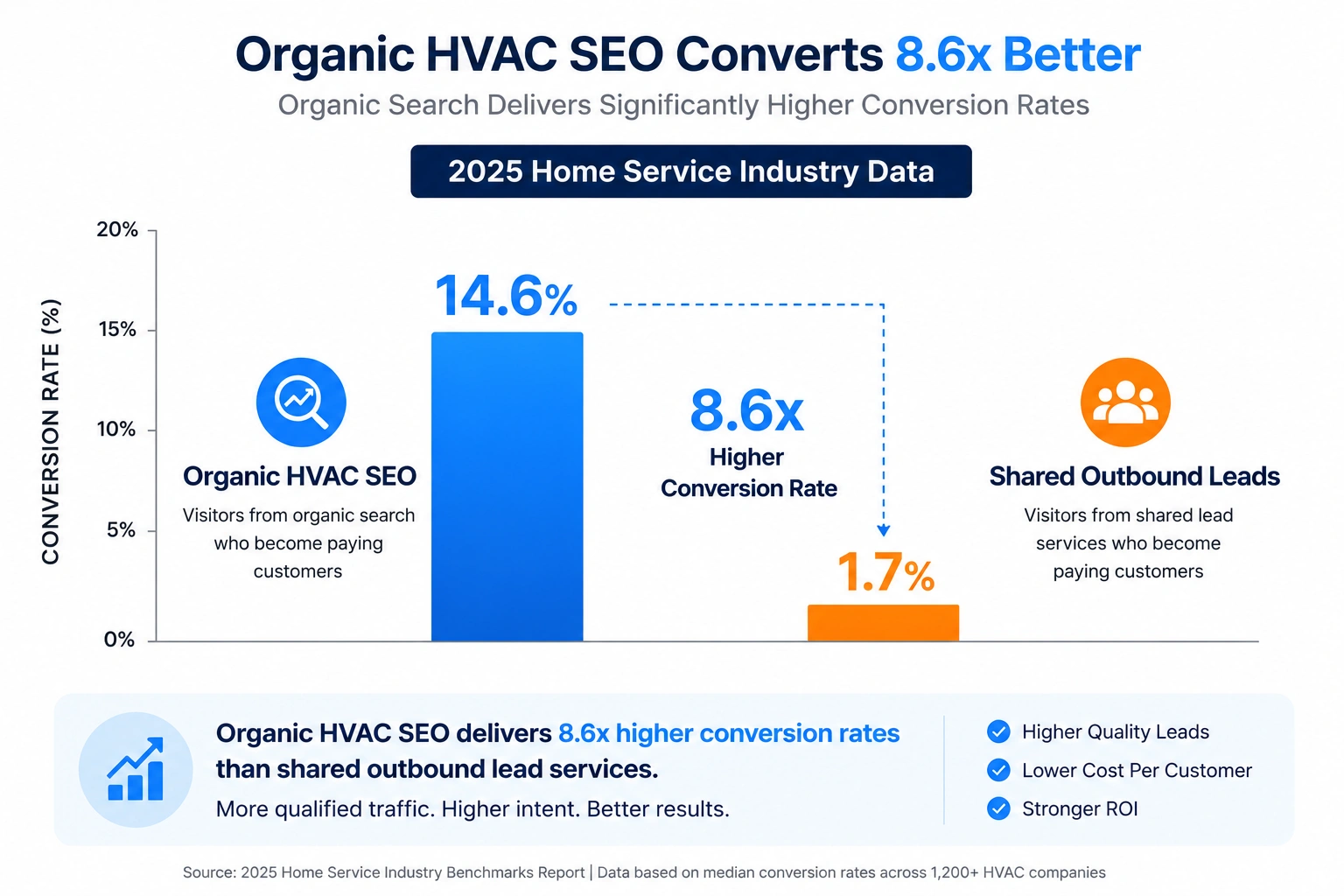
Organic HVAC SEO converts at 14.6%, significantly outperforming shared outbound leads at just 1.7%.
The Google Business Profile blueprint: Dominating the local 3-pack
The Local 3-Pack is not a nice-to-have placement. The top three listings in Google Maps capture 65% to 75% of all clicks for high-intent local HVAC queries. If your business isn’t in that cluster, the vast majority of searchers will never encounter your name, regardless of how well-built your website is or how many years you’ve been in business.
Getting there requires more than a claimed profile. It requires a profile that Google trusts as an accurate, active, and authoritative representation of a real local business.
Primary category selection is the first lever most contractors get wrong. Choosing “Contractor” as your primary category instead of “HVAC Contractor” or “Air Conditioning Contractor” weakens your relevance signal for the queries that matter most. Select the most specific category that describes your core business, then use secondary categories to capture adjacent services. What you don’t do is pad your business name with keywords, such as “ABC Heating & Cooling | Best AC Repair Phoenix,” because Google’s guidelines prohibit it and competitors can flag your listing for suspension.
Visual assets carry more weight than most operators realize. Upload high-resolution, geotagged photographs of your actual service trucks, uniformed technicians, and active job sites, and do it consistently, not once at setup. The “Zero-Stock” mandate from competitor research is worth taking seriously: stock photography signals inauthenticity to both Google’s algorithms and to the homeowners evaluating your profile. A photo of your branded van parked in front of a real job in your service area tells a more credible story than any staged studio image.
Operational accuracy is non-negotiable. If you offer 24/7 emergency service, your hours must reflect that exactly. A homeowner who calls at 11:00 PM and finds a “closed” listing will move to the next result, and may leave a negative review on the way out. Keep your hours current through holidays, seasonal schedule changes, and any operational shifts. It’s a small maintenance task that directly protects your reputation and your ranking.
For a deeper grounding in how local proximity signals interact with your profile data, the broader framework of local SEO strategies is worth working through alongside your GBP optimization.
GBP Weekly Maintenance Checklist:
- Verify your Name, Address, and Phone (NAP) data matches your website and every directory listing exactly. Even minor discrepancies (Suite vs. Ste.) erode citation consistency.
- Post weekly Google Updates featuring completed jobs, community involvement, or seasonal maintenance reminders to signal an active, engaged business.
- Answer customer Q&As directly on your profile using natural, locally-grounded language rather than keyword-stuffed responses.
- Monitor your immediate service area for spam or fake competitor listings and report violations through Google’s Business Redressal Complaint Form.
Technical foundations: Speed and mobile optimization for emergency leads
When a homeowner’s furnace quits at midnight in January, the search-to-call sequence takes roughly 90 seconds. They pull out their phone, type a query, scan the results, and tap a number. That entire window, from search to dial, is where slow websites lose jobs to faster competitors.
61% of all local HVAC searches happen on mobile devices. That figure isn’t surprising given the emergency-driven nature of the category, but its implications for site architecture are significant. A desktop-optimized site with uncompressed images, render-blocking scripts, and no click-to-call functionality is structurally misaligned with how your customers actually find you. Mobile is the standard now.
Page load speed is a direct ranking factor, not a peripheral technical concern. Google’s Core Web Vitals thresholds are clear: if your site takes longer than 2.5 seconds to load on a mobile connection, you’re being pushed down in favor of contractors whose sites load faster. The frustration compounds on the user side, as a slow site during an emergency triggers an immediate back button. That bounce signal reinforces the ranking demotion. Speed isn’t just a technical metric; it’s a conversion variable with a direct line to booked jobs.
Core Web Vitals, specifically Largest Contentful Paint (LCP), Interaction to Next Paint (INP), and Cumulative Layout Shift (CLS), are the measurable targets your developer or SEO partner should be optimizing against. LCP measures how quickly the main content of your page loads. INP tracks how responsive the page is to user interaction. CLS captures whether page elements shift unexpectedly as the page renders, which is particularly disorienting on mobile. All three affect both your ranking and your user’s willingness to stay on the page long enough to call.
For contractors who want to understand how professional technical optimization integrates into a dedicated local search strategy, BizIQ’s HVAC contractor SEO service page outlines exactly how those technical layers are built and maintained.
Technical steps to improve mobile speed and usability:
- Compress all images using WebP format to reduce page weight without sacrificing visual quality, as uncompressed JPEG files are one of the most common culprits behind slow load times on home service sites.
- Implement a Content Delivery Network (CDN) to serve pages from servers geographically close to your local users, reducing latency on emergency searches.
- Enable browser caching for repeat visitors, particularly maintenance agreement clients who return to your site seasonally.
- Upgrade to premium, dedicated hosting built for high-traffic home service sites, since shared hosting plans that work fine for low-traffic blogs will buckle under seasonal demand spikes.
- Ensure every phone number on your site uses click-to-call markup (
tel:) so mobile users can dial directly without copying and pasting a number.
Is your website losing jobs to faster competitors?
We recommend starting with a quick look at your site performance. Get a Free 15-Minute HVAC SEO and Speed Audit.
High-intent keyword strategy: Targeting the “low-hanging fruit”
HVAC keyword research isn’t about finding the highest-volume terms and optimizing your homepage for them. The contractors generating the most consistent inbound call volume are targeting a different layer of the search landscape entirely, focusing on long-tail queries with modest search volume but sharp commercial intent.
“Emergency furnace repair on weekend” gets searched far less often than “furnace repair.” But the person typing that phrase has already decided they need service; they’re searching for availability. Low-hanging fruit keywords like that convert at a dramatically higher rate than broad category terms, and they face far less competition from national aggregators and franchise brands that dominate the generic queries.
Local service area pages are the structural vehicle for capturing this intent at scale. A well-built page for “AC Repair in Scottsdale, AZ” isn’t just a geographic variation of your main services page: it’s a document that speaks directly to the climate conditions, common equipment failures, and neighborhood context of that specific market. That localization is what earns the page its ranking. Generic pages fail. Pair those pages with educational content targeting research-phase queries, like “What is a SEER2 rating?” or “How long does an HVAC system last?”, and you’re building topical authority across the full purchase funnel, not just the bottom of it. For additional ways to market these service pages and amplify their reach, HVAC marketing ideas cover complementary tactics worth layering in.
Duplicate content on service area pages is a more common problem than most contractors realize, and it’s one Google penalizes quietly: not with a manual action, but by simply filtering the redundant pages out of search results. Swapping the city name while keeping the body copy identical across 20 suburb pages doesn’t create 20 ranking opportunities; it creates one page that ranks and 19 that don’t. Each location page needs genuinely distinct content: local landmarks that orient the reader geographically, climate-specific challenges relevant to that zip code, and ideally a review or project reference from a customer in that community. It’s more work per page, but it’s the only approach that holds up under algorithmic scrutiny.
Seasonal keyword timing is a separate discipline from keyword selection, and it’s one most contractors underinvest in. Organic content takes time to index and accumulate ranking authority, typically weeks, and sometimes longer in competitive markets. That means your heating repair content needs to be published and indexed before the first cold snap of autumn, not after it. We recommend building and publishing seasonal content in early spring for cooling season and in late summer for heating season, giving Google time to evaluate and rank those pages before peak demand arrives. The contractors who show up at the top of search results in July started their optimization work in April. Timing is everything.
“Google doesn’t care about a flat services page. They care about topical authority. Cluster your HVAC content: one pillar page supported by deep-dives on smart thermostats, duct cleaning, and seasonal maintenance. That’s how you dominate local search.” –Lorenz Esposito, Local SEO Expert
Review generation & reputation management: The ultimate trust signal
Reviews are not a soft metric. They are a primary ranking input for Google’s Map Pack algorithm, and they are the single most persuasive conversion factor for a homeowner deciding between two contractors with similar ratings. 88% of HVAC customers call or visit a business within 24 hours of a local search after reading positive reviews, a figure that reflects how directly reputation translates into phone volume.
Google evaluates reviews from three angles: velocity (how frequently new reviews arrive), rating (your aggregate score), and content (whether review text includes service-specific and location-specific language). A review that says “Great job fixing our AC in Tempe, highly recommend!” carries more ranking weight than “Good service, 5 stars” because it reinforces the geographic and service relevance signals Google is already evaluating. That’s not something you can manufacture, but you can create the conditions for it by prompting customers to mention the service and their location when you ask for the review.
Automated review workflows are the most reliable way to maintain velocity without relying on your team to remember. Platforms like ServiceTitan and Housecall Pro both support post-job review request automations: a text message or email that fires within an hour of job completion, when the customer’s satisfaction is at its peak. The timing matters more than the copy. A generic request sent three days later performs significantly worse than a personal-feeling message sent while the technician is still in the neighborhood.
Managing negative feedback is where many contractors lose the ground they’ve worked hard to build. 56% of users report changing their opinion of a business based on how it responds to a negative review: not whether the review exists, but how the business handles it publicly. A measured, professional response that acknowledges the customer’s experience and offers a resolution path signals operational maturity to every future reader of that exchange. Ignoring negative reviews or responding defensively does the opposite.
The Wells Service case study is a concrete example of how reputation management and local trust-building compound into measurable small business growth, worth reading if you want a real-world reference point for what this looks like in practice.
Training field technicians to ask for reviews before leaving a customer’s home is the most effective, lowest-cost review generation tactic available to most HVAC operators. The script doesn’t need to be elaborate. Something direct and personal: “If I took good care of you today, I’d really appreciate it if you left a review and mentioned my name,” outperforms any automated follow-up because it carries the weight of a face-to-face interaction. Technicians who understand that their reviews directly affect their own call volume and job security tend to internalize this habit quickly. A brief team training session, a laminated reminder card in each truck, and a monthly leaderboard showing review counts by technician are enough infrastructure to build the habit across a fleet.
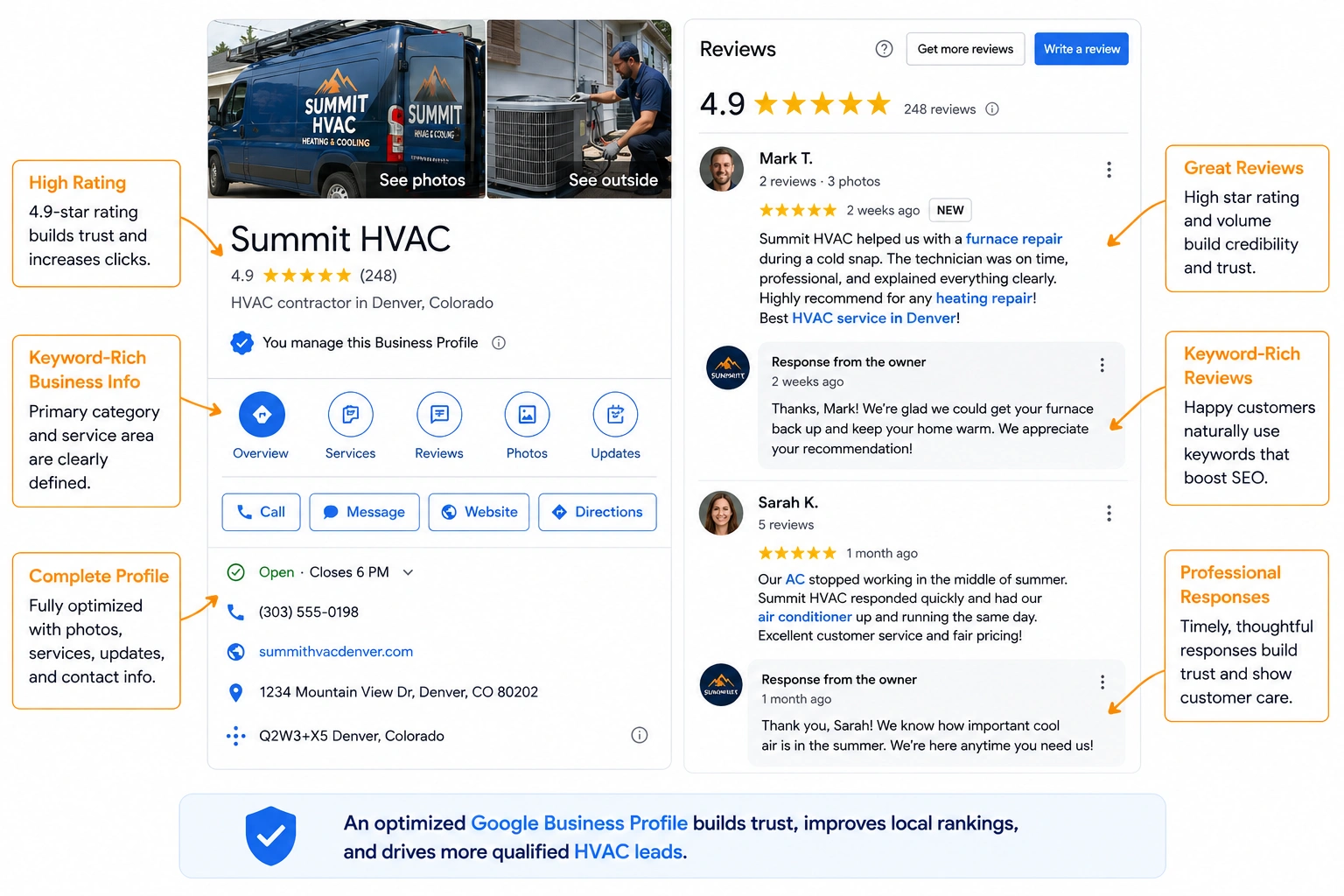
A complete Google Business Profile with strong reviews and owner responses builds trust and improves local SEO performance.
Off-page authority: Local link building and citations
Your website’s authority in Google’s eyes isn’t determined solely by what’s on it. External signals, including who links to you, where your business information appears across the web, and how consistently that information is presented, are equally critical. HVAC companies that build strong local SEO foundations see an average of 188% organic traffic growth, and a significant portion of that lift comes from off-page signals that most contractors haven’t touched.
NAP consistency is the foundation. Your business name, address, and phone number need to match exactly across every directory where your business appears: Yelp, Angi, Houzz, the Better Business Bureau, your local chamber of commerce listing, and every other citation in your profile. Not approximately. Exactly. A discrepancy as minor as “St.” versus “Street” in your address creates a conflicting signal that dilutes the geographic authority you’re trying to build. Audit your citations annually, and whenever you change your address or phone number, update every directory simultaneously.
Community sponsorships are an underused link-building channel for HVAC contractors. Sponsoring a local youth sports league, a neighborhood charity event, or a regional home show typically earns a listing on a .org or .edu domain, the kind of high-trust, locally-rooted backlink that Google weighs heavily as a real-world authority signal. These aren’t transactional links from link farms; they’re the digital equivalent of a community business directory from 1995, and they still work precisely because they reflect genuine local presence.
Strategic partnerships with non-competing trades are another practical avenue. A plumber, an electrician, and a roofer in the same service area are natural referral partners, and a mutual blog feature or resource link exchange between your websites creates backlink equity that benefits all parties. These arrangements take a phone call to set up and cost nothing beyond the time to write a guest post or resource mention. For HVAC contractors looking to connect local link building to a broader growth framework, successful marketing strategies for small businesses covers how these off-page tactics integrate with the full marketing picture.
Local link-building tactics worth executing this quarter:
- Contact your local chamber of commerce for a member directory listing: most chambers offer this as part of membership, and the link carries meaningful local authority.
- Write a guest post for a local real estate blog covering “What home buyers should inspect in an HVAC system before closing,” a topic with genuine utility for their audience and a natural fit for your expertise.
- Submit your business to local “Best of [City]” awards and community business directories; even unsponsored nominations often result in a citation or profile link.
- Pitch a free community workshop on energy-saving tips to local neighborhood associations or library programs, then reach out to local news sites to cover the event.
Tracking the metrics that matter: Calls over clicks
Impressions and clicks are not business outcomes. They’re directional indicators, and treating them as success metrics leads contractors to optimize for visibility rather than revenue. The shift to outcome-based tracking, specifically booked jobs and revenue attribution, is what separates contractors who know their SEO is working from those who are guessing.
A recent marketing plan developed by an SEO company gives a concrete example of what this looks like in practice: contractors using it to track exact lead sources see up to a 28% higher average ticket value, because they can identify which channels are generating high-value jobs and allocate their marketing spend accordingly. That’s not a marginal improvement, it’s the difference between knowing your SEO investment is profitable and hoping it is. Stop guessing.
Call tracking through dynamic number insertion (DNI) is the technical mechanism that makes this possible for organic search. Tools like CallRail assign unique phone numbers to different traffic sources, so when a homeowner finds you through a Google search for “AC repair near me” and calls, that call is logged against the organic keyword that triggered it. Over time, you build a clear picture of which pages and which queries are generating actual phone volume, not just traffic. That data informs everything from content prioritization to service area expansion decisions.
Google Search Console and Google Analytics remain essential instruments for monitoring organic search trends, impressions, and user behavior patterns. Search Console surfaces the queries your site is ranking for and the click-through rates those rankings generate. Analytics shows what users do after they arrive, showing which pages they visit, how long they stay, and whether they convert. Used together, they give you a reasonably complete picture of your organic funnel. For a broader view of how tracking integrates into a complete digital marketing setup, digital marketing essentials is a useful reference.
Setting up conversion goals in Google Analytics 4 specifically for click-to-call interactions and form submissions is a step most HVAC operators skip, and it’s a costly oversight. GA4 tracks events rather than pageviews as its primary unit of measurement, which means you need to configure explicit event triggers for the actions that matter: a tap on your tel: link, a form submission on your contact page, or a click on your “Schedule Service” button. Once those events are tagged as conversions, GA4 can attribute them back to the traffic source, the landing page, and in some cases the specific search query that initiated the session. Knowing that your “Emergency AC Repair in [City]” page generates 60% of your click-to-call conversions tells you exactly where to invest your next optimization effort.
Black-hat tactics to avoid: Protecting your rankings
Google’s tolerance for manipulative SEO has narrowed considerably over the past several algorithm cycles. Tactics that produced short-term ranking gains five years ago now carry a meaningful risk of manual penalties or algorithmic suppression, consequences that can take months of cleanup work to reverse.
Manipulative link buying is the most direct path to a penalty. Purchasing links from link networks, private blog networks (PBNs), or offshore link farms violates Google’s spam policies explicitly. The risk isn’t theoretical: Google’s SpamBrain system has become increasingly effective at identifying unnatural link patterns, and a manual action triggered by a link audit can result in your domain being removed from search results entirely. For an established HVAC business with years of organic equity, that outcome is catastrophic. Do not risk it.
Keyword stuffing in footer text, hidden paragraphs, or image alt tags is a related problem that persists in older HVAC sites built before 2018. Cramming city names and service terms into invisible page elements doesn’t improve rankings; it flags your site as manipulative and can trigger a quality filter that suppresses your pages across the board. If your current site has this pattern, a content audit and cleanup is worth prioritizing before any other optimization work.
Fake Google Business Profile locations, such as using UPS Store addresses, virtual offices, or residential addresses in neighboring cities to fabricate a physical presence, are actively hunted by Google’s local quality team and by competitor contractors who know how to file a Business Redressal complaint. Suspended profiles don’t just lose their Map Pack placement; they lose the review history, photo library, and citation authority that took years to build. The short-term gain of appearing in an adjacent market isn’t worth that exposure. Play by the rules. For building brand awareness and organic reach through legitimate channels, HVAC social media tips covers approaches that compound over time without the downside risk.
Recovering from a Google penalty is a slow, expensive process that most contractors dramatically underestimate before they experience it. A manual action requires submitting a reconsideration request after demonstrably cleaning up the violation, which means auditing and disavowing problematic links, removing manipulative on-page content, and waiting for Google’s review team to evaluate the submission. That process routinely takes three to six months, during which your organic lead volume is suppressed. For a business that generates $500K to $2M annually from organic search, that’s a revenue disruption that no short-term ranking shortcut could justify.
Frequently asked questions about HVAC SEO
What is the difference between on-page and off-page SEO?
On-page SEO covers everything within your own website: the content on your service pages, your page titles and meta descriptions, your schema markup, your site speed, your internal linking structure, and the technical health of your crawlable pages. Off-page SEO covers external trust signals: the backlinks pointing to your site, your Google Business Profile optimization, your citation consistency across directories, and your review profile. Both need to be operating well simultaneously. A technically clean website with no external authority won’t outrank a competitor with strong local backlinks, and a well-cited business with a slow, thin website will hit a ceiling in the Map Pack. Balance is key.
How long does it take to see results from HVAC SEO?
GBP optimizations, such as correcting your categories, uploading photos, and generating fresh reviews, can produce measurable call increases within a few weeks because Google updates local rankings relatively quickly in response to profile signals. Organic keyword rankings for your website pages typically take three to six months to show meaningful upward movement, and that timeline extends in competitive markets where established contractors have years of domain authority. The results vary based on your current presence, your market’s competitive crowding, and how consistently you’re executing. SEO takes time. Consistency is the variable that separates contractors who see compounding gains from those who plateau. Be patient.
Is it worth paying an agency, or should we do SEO in-house?
There’s a reasonable case for both, depending on where your business is. It depends on your size. Under $1M in revenue, a disciplined DIY approach to local SEO, including GBP optimization, citation cleanup, review generation, and basic on-page work, is highly cost-effective and manageable with a few hours per week. Scaling past $5M, the complexity and time investment required to maintain momentum across technical SEO, content production, link building, and analytics typically exceeds what an owner-operator can handle without dedicated internal resources or an experienced external partner. We recommend starting with what matches your current capacity and scaling the investment as your revenue base justifies it. Start small.
How do reviews affect our Google Maps rankings?
Google uses three review-related signals to evaluate Map Pack eligibility: speed (how consistently new reviews are arriving), aggregate rating (your star score), and content quality (whether review text includes service-specific and location-specific language). A steady stream of recent, keyword-rich reviews, like “best AC repair in Fort Worth” or “fast furnace replacement in Scottsdale,” reinforces your geographic and service relevance to Google’s local algorithm. Details matter. Stale review profiles, even with high ratings, signal reduced business activity and can gradually erode your Map Pack position. Keep them coming.
Why is mobile optimization critical for emergency HVAC leads?
When a furnace fails in freezing temperatures, the homeowner isn’t waiting to sit down at a desktop. They need help fast. The search happens immediately, on a phone, and the decision to call happens within seconds of seeing the results. A mobile site that loads slowly, displays broken layouts, or buries the phone number below the fold loses that job before the homeowner has read a single sentence of your content. Mobile optimization for HVAC isn’t a UX luxury: it’s the primary interface between your business and your highest-urgency customers. Speed is money.
SEO is not a campaign you run and evaluate at the end of a quarter. It’s infrastructure, the kind that takes time to build and compounds in value the longer it’s maintained. The contractors dominating your local market aren’t operating with a fundamentally different business model; they’ve simply been more consistent in building their local search presence, and that consistency has created a gap that’s genuinely difficult to close quickly.
By locking in your Google Business Profile, optimizing your site for the mobile users who are searching in urgent moments, targeting the long-tail keywords your competitors are ignoring, and building a review profile that earns trust before a homeowner ever calls, you’re assembling an inbound lead engine that you own outright. No platform can revoke it. No algorithm change erases it overnight. No competitor can buy it away from you.
We understand the skepticism. We’re a small business ourselves, and we’ve seen what happens when contractors invest in marketing that doesn’t deliver. That’s exactly why we build HVAC SEO strategies around what actually works: booked jobs, call volume, and revenue, not the metrics that look good in a monthly report. We believe sophisticated marketing belongs to you too, not just the national franchises with massive budgets. Your business is the backbone of innovation and the heartbeat of America, and you deserve to see the real, positive impacts we make on our small business partners. Taking this path is an empowering next step toward owning your local market, and we’re here to help you build it.
Ready to dominate your local market?
We’re a small business ourselves, and we’d love to help you scale. Book an Intro Call with our HVAC SEO specialists today and let’s build your custom growth plan together.