- Landing pages focus on a single call-to-action, achieving a median conversion rate of 4.6% in the home services sector.
- Standard multi-page layouts build search engine authority, allowing you to rank for multiple local service keywords.
- A hybrid architectural model combines the ranking power of multi-page sites with the high-converting nature of landing pages.
- Google Business Profile integration remains the single most critical factor for local map pack visibility.
If you’ve spent any time researching how to grow your cleaning business online, you’ve probably received conflicting advice. You might be wondering whether a single landing page or a full website navigation system is worth the investment. Most maid service websites focus on looking pretty, but if customers can’t figure out how to book, that beauty doesn’t pay your bills. One agency tells you to build a sleek, single-page site that drives bookings fast. Another insists you need a full multi-page website to rank on Google. Both camps make reasonable arguments, which is exactly why the confusion endures. We get it.
At BizIQ, we’re a small business helping small business. We believe small business is the backbone of innovation and our local neighborhoods. We stand beside you, not above you, sharing what works for businesses like yours. The tension between landing pages and full layouts is real, and we know because we’ve been there ourselves. Dedicated landing pages are precision instruments for converting paid traffic into booked appointments. Multi-page websites, on the other hand, are the structural foundation that lets you compete organically in local search: the kind of visibility that compounds over time without a monthly ad spend attached to it. What most cleaning business owners don’t realize is that choosing between the two is a false dilemma. A hybrid approach, one that uses the authority-building architecture of a full website while engineering each service page to perform like a standalone landing page, is where the real advantage lies.
The core difference between landing pages and multi-page websites
Single-page landing pages for focused campaigns
A landing page is a standalone endpoint built around one conversion objective, designed specifically to capture the immediate interest of a local homeowner who needs their house cleaned today. No navigation menu pulling visitors toward your About page. No footer links inviting them to browse your blog. Just one goal. The entire page exists to move a single type of visitor toward a single action: filling out a booking form, calling your number, or claiming a promotional offer.
In the home services sector, this focus pays off measurably. We take an evidence-based approach to analyzing what works. According to Unbounce data, cleaning service landing page templates in the home services category achieve a median conversion rate of 4.6%, with top-performing pages reaching 8.2%. The results vary, but here’s what most see when they strip away the clutter. That gap between median and top performance isn’t random; it reflects how precisely the page matches the visitor’s intent and how cleanly it removes every competing option.
Landing page optimization is a lot like curb appeal. You can have the most beautiful house on the block, but if the “For Sale” sign is missing, nobody stops. The absence of navigation is a deliberate design choice, not a constraint. When a homeowner clicks a Google Ads link for “deep cleaning service near me,” they’ve already declared their intent. A landing page honors that intent by delivering exactly what was promised, without the detours.
Standard multi-page layouts for organic search authority
A multi-page site operates on a different logic entirely. It is about scale. Homepage, service pages, location pages, a blog, an about section: each page is a distinct piece of real estate that search engines index, evaluate, and rank independently. This structure is what allows a cleaning company to show up for “move-out cleaning Phoenix,” “recurring maid service Scottsdale,” and “commercial office cleaning Tempe” simultaneously.
Standard homepages convert at roughly 2.9% on average, noticeably lower than a focused landing page, but that comparison misses the point. The homepage isn’t primarily a conversion tool. It’s a trust anchor and a navigational hub. Its job is to establish credibility and route visitors to the specific service page that matches their need, where the conversion work happens.
When you optimize your site for local SEO, the multi-page architecture is what gives you the surface area to do it properly. Each page can target a distinct keyword cluster, gather its own backlinks, and build topical authority within your service category.
Think of your website navigation like a physical store layout. If customers have to hunt for the checkout counter, they’ll leave. A landing page is like a focused, one-on-one conversation: one topic, one clear next step. Your homepage is the lobby: welcoming, orienting, but not the place where closing decisions get made.
Search engine crawlers treat page structure as a signal of content depth and relevance. A single-page site, regardless of how well-written it is, offers limited semantic real estate because you cannot target dozens of different suburban neighborhoods with a single set of headers and paragraphs. Google’s indexing algorithms reward structured, interconnected content that maps a business’s full scope of services and geography. A multi-page site provides that map; a single landing page, by design, does not.
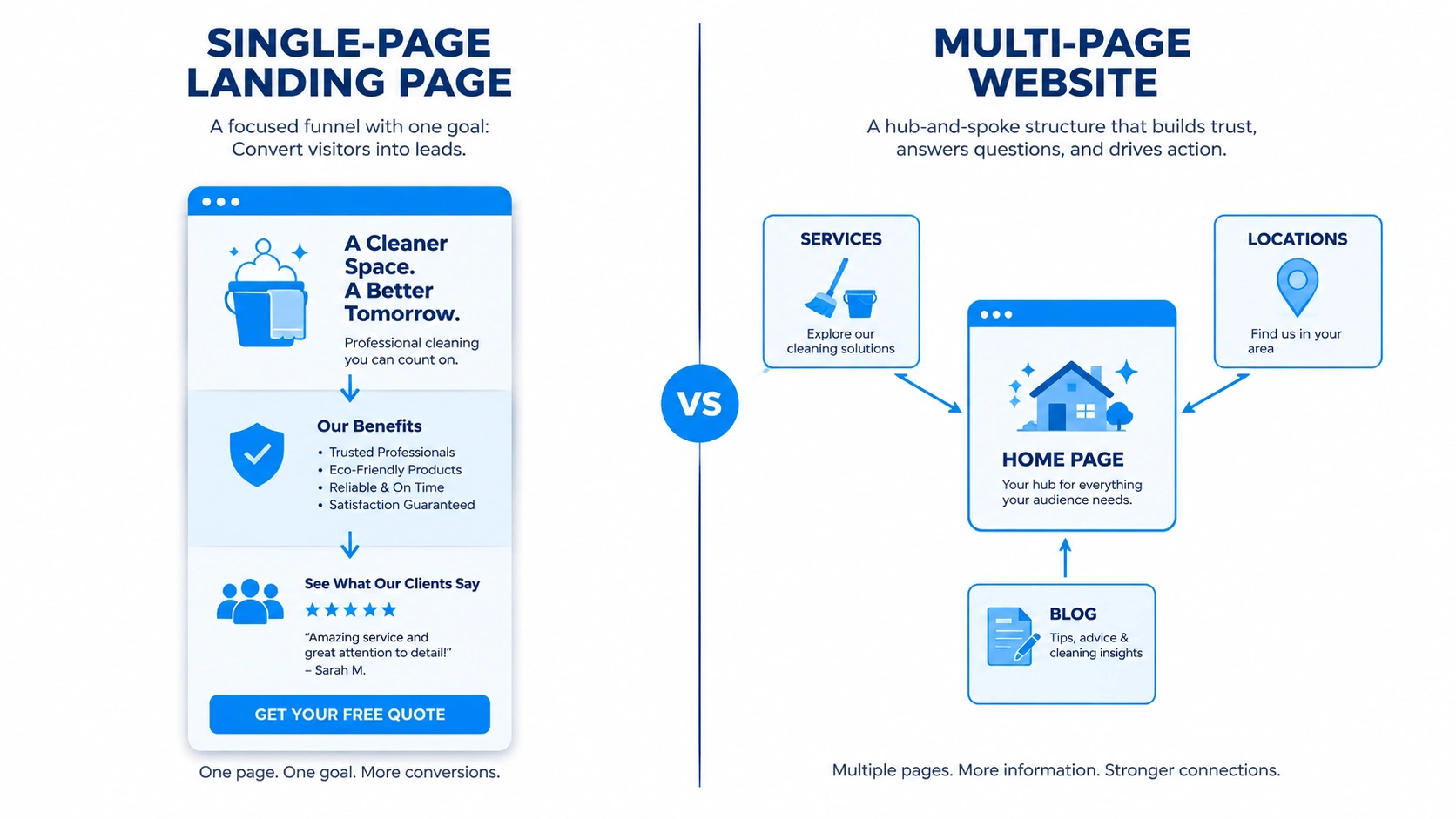
Compare a focused landing page funnel with a multi-page website structure to understand how each supports different marketing goals.
How landing pages maximize booking conversions
Eliminating friction and choice overload
Removing the standard header navigation from a landing page isn’t just a visual preference; it’s a conversion decision grounded in behavioral psychology that directly impacts how quickly a visitor decides to book. Every additional link on a page is an exit ramp. When a homeowner arrives looking to book a cleaning, a navigation menu with six options introduces six opportunities to leave without converting.
The psychology here is well-documented. More choices produce more hesitation, and hesitation in a local service context almost always means the visitor bounces and calls your competitor. A tightly structured cleaning service landing page eliminates that resistance by making the path forward obvious: here’s what we do, here’s why we’re trustworthy, here’s how you book. Nothing else competes for attention.
This matters most for paid traffic, where every click carries a cost. But it also applies to organic visitors who arrive on a service-specific page from a high-intent search. They came looking for a solution. A page that offers one clear action respects that.
Aligning high-intent copy and social proof
The headline on a landing page needs to mirror the language of the search that brought the visitor there. Relevance is everything. Someone who searched “move-out cleaning service” should land on a page that says exactly that, not “Professional Cleaning Solutions for Every Need.” Generic headlines create a cognitive gap between what the visitor expected and what they see, and that gap costs conversions.
Social proof placement is equally exact. Reviews and before-and-after photos positioned directly adjacent to the booking form, not buried below the fold, strengthen the decision at the exact moment the visitor is weighing it. A five-star review from someone in the same neighborhood, placed inches from the “Book Now” button, carries far more persuasive weight than the same review sitting at the bottom of the page where most visitors will never scroll.
- Single Call-to-Action: Keep the user focused on one action, such as a booking form or a phone number.
- High-Intent Copywriting: Align the headline and benefits specifically with the search intent of the visitor.
- Streamlined Booking Forms: Integrate tools that allow users to select dates and calculate pricing on a single screen.
- Tailored Social Proof: Select reviews and photos that match the exact service the user is researching.
Why standard web layouts dominate local SEO rankings
Keyword targeting depth and site architecture
A single landing page can rank for one keyword cluster. That is a major limit. A well-structured multi-page site can rank for dozens, each page targeting a distinct service type, customer intent, or geographic area. “Move-out cleaning,” “deep cleaning,” “recurring maid service,” “post-construction cleanup”: these are separate searches with separate commercial intents, and they each deserve a dedicated page built to capture them.
Search engines crawl structured content more effectively than single-page designs. When your site has a coherent internal linking hierarchy, such as your homepage linking to service category pages, and service pages linking to location variants, crawlers can map your content’s topical scope and assign relevance signals accordingly.
Building location-specific pages for regional reach
Your primary office address secures your Google Business Profile, but it doesn’t automatically extend your organic visibility to every suburb you serve. You need more coverage. A cleaning company based in downtown Phoenix won’t naturally rank for “maid service Chandler” or “house cleaning Gilbert” without dedicated pages for those locations.
Location-specific pages signal geographic relevance to search algorithms in a way that a single homepage simply cannot copy. Each page should include unique content about that service area, including local landmarks, neighborhood-specific details, and testimonials from clients in that zip code, rather than duplicated boilerplate with a swapped city name. That distinction matters: Google’s quality evaluators are trained to identify thin, templated location pages, and they don’t reward them.
- Keyword Targeting Depth: Build dedicated pages for “deep cleaning,” “move-out cleaning,” and “recurring maid services.”
- Internal Linking Structure: Link service pages back to your homepage to pass search authority throughout your domain.
- Content Richness: Provide thorough, high-quality content to help search engines understand your business’s relevance.
- Location-Specific Pages: Create individual pages for surrounding suburbs to rank in multiple geographic areas.
Structuring your cleaning website for the best of both worlds
The hybrid hub-and-spoke model
The hub-and-spoke model treats your homepage as the central authority center and each service or location page as a spoke that both draws from and contributes to that authority. It connects everything. Internal links flow both ways: the homepage passes domain authority down to service pages, and those pages signal topical depth back to the root, creating a network that search engines find highly authoritative. This architecture is not a theoretical framework; it’s the structure that produces measurable ranking gains for local service businesses.
The cleaning service SEO case study for Supreme Clean illustrates what this looks like in practice.
Designing service pages to function like landing pages
The practical implementation of the hybrid model means engineering each service page to behave like a landing page from a conversion standpoint while retaining the SEO infrastructure of a multi-page site. That means stripping out distracting sidebars, placing a prominent booking form above the fold, and positioning trust signals, such as reviews, certifications, and photos, within the first scroll depth.
SEO content, the keyword-rich explanatory copy that helps search engines understand your service, belongs below the fold. Conversion elements belong above it. This isn’t a compromise between two competing goals; it’s a deliberate arrangement that serves both simultaneously. The visitor gets a clean, action-oriented experience. The crawler gets a content-rich page with semantic depth.
When a homeowner lands on your “move-out cleaning” page from an organic search, they should experience the same focused, friction-free layout as a dedicated paid landing page. That alignment between organic traffic and conversion-optimized design is the most direct path to converting visiting homeowners into cleaning clients. It is the architectural principle that separates high-performing cleaning websites from the ones that rank but don’t book.
“According to the LocaliQ 2025 Home Services Benchmark, cleaning, maid, and butler services achieve an outstanding 17.65% average conversion rate when you pair high-intent search traffic with a highly optimized, service-specific destination page.”
Essential on-page SEO elements for maid services
Title tags, meta descriptions, and schema markup
Title tags are not just labels; they are the first signal a search engine uses to determine geographic and topical relevance. They set the stage. A title structured as “Maid Service in [City] | Company Name” communicates both the service type and the location in a format that aligns with how local queries are processed. That specificity matters at the indexing stage, long before a human ever reads the result.
LocalBusiness schema takes this a step further by giving search engines a structured data layer that clearly declares your business name, address, service hours, and service area, ensuring your business is mapped correctly. It’s the difference between Google guessing your location from page content and Google knowing it with certainty. The impact of this kind of structured optimization on a cleaning company’s local search presence is well-documented.
Optimizing content depth and keyword density
Secondary keywords like “house cleaning website design” and “maid service website templates” belong in your content naturally, embedded in context, not forced into sentences where they don’t fit. Write for humans first. Search engines have become advanced enough that keyword stuffing is counterproductive; what they reward is semantic unity, where related terms appear in a context that confirms genuine topical expertise.
The more productive question is whether your content answers the questions homeowners are typing into Google, such as what is included in a deep clean, how far in advance they should book, and how recurring pricing differs from one-time service pricing. Pages that address these questions with specific, useful answers build the kind of topical authority that generic keyword-optimized copy never achieves.
Search engines use title tags and meta descriptions to establish the geographic relevance of your cleaning business before a user even clicks, which is why every character in those fields must be optimized carefully. A title like “Maid Service in [City] | Professional House Cleaning” signals immediate geographic relevance to search algorithms, and that signal is evaluated at the crawl stage, not just at the ranking stage. Getting it right from the start means your pages enter the index with the correct geographic and topical associations already established.
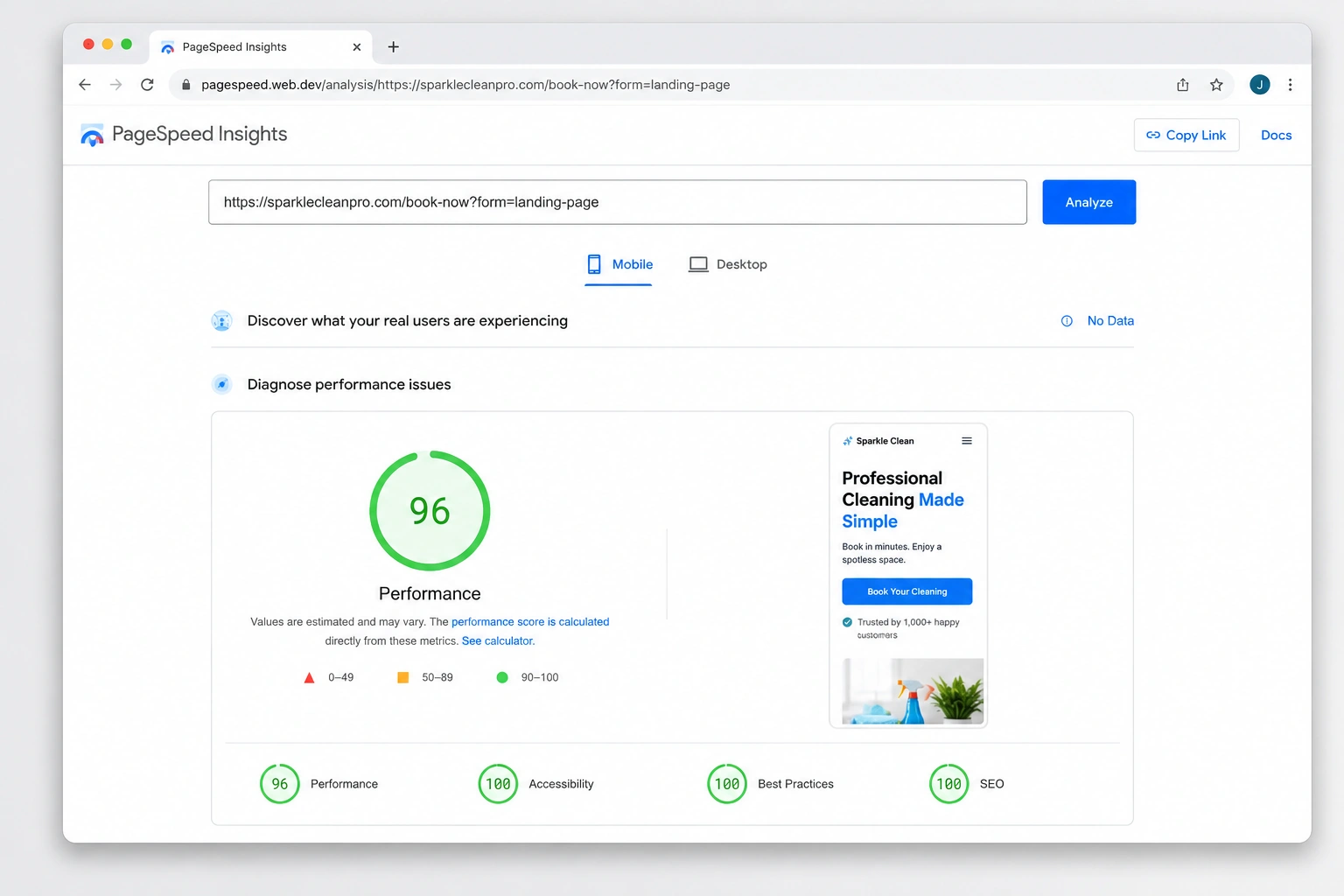
A high Google PageSpeed Insights score demonstrates the speed, accessibility, SEO, and mobile performance of a landing page.
Don’t let slow load times or poor design cost you cleaning clients.
Discover our affordable local SEO solutions and let BizIQ design a high-converting, search-optimized site for your business.
The role of Google Business Profile in local prominence
Optimizing your profile for the local 3-pack
Your Google Business Profile is the single most direct lever for local map pack visibility, and the primary business category selection is where most cleaning companies leave ranking potential on the table. “House Cleaning Service” or “Maid Service” should be your primary category, not “Cleaning Service” or the even more generic “Janitorial Service.” The specificity of that category selection shapes how Google matches your profile to local queries.
The stakes are significant. Ranking in the Google 3-pack drives 126% more traffic and 93% more actions than positions 4 through 10 in local results. That’s not a marginal advantage: it’s the difference between a business that generates consistent inbound leads and one that relies entirely on referrals and repeat clients to stay afloat.
Every directory listing is like a friend recommending you to a neighbor. Service area definition deserves the same accuracy. Explicitly listing the cities, counties, and zip codes your team covers matches your profile with the proximity signals Google uses to match searchers with nearby providers.
Review velocity and customer engagement
Review frequency is a ranking signal, not just a trust signal. Keep them coming. A profile that gathers two or three new reviews per week consistently outperforms a profile with a higher total count but no recent activity. Google’s local ranking algorithm treats review speed as evidence of an active, legitimate business, and that interpretation directly affects map pack placement.
The content of reviews matters too. When customers naturally mention specific services, such as “they did an incredible deep clean before our move,” or neighborhoods, such as “best cleaning service in Tempe,” those keywords reinforce the topical and geographic relevance of your profile. You can’t manufacture this, but you can encourage it by asking customers to describe what they had done and where they’re located when you follow up for a review.
Uploading geotagged photos of your team, marked vehicles, and completed jobs adds another layer of geographic signal. It’s a small operational habit with a compounding effect on profile authority over time.
- Primary Category Selection: Select “House Cleaning Service” or “Maid Service” as your primary business category.
- Review Speed: Actively collect and respond to customer reviews weekly, as review frequency is a major ranking factor.
- Service Area Definition: Explicitly list the cities, counties, and zip codes your team services to align with local proximity algorithms.
- High-Quality Photos: Upload original, geotagged photos of your team, marked vehicles, and completed cleaning jobs to build trust.
Technical SEO and mobile optimization for home services
Site speed and Core Web Vitals
Seventy-six percent of local mobile searches result in a business visit within 24 hours, which means the window between a search and a decision is measured in minutes, not days. A page that takes four seconds to load on a mobile connection doesn’t just frustrate the visitor; it signals a poor user experience to Google’s Core Web Vitals assessment, which feeds directly into rankings.
The technical fixes are well-established: compress images before upload, use browser caching, defer non-critical JavaScript, and use a content delivery network if your hosting plan supports it. None of these are complex interventions. What’s less obvious is that these optimizations need to be applied at the page level, not just site-wide: your booking page and your highest-traffic service pages deserve individual attention because they carry the most conversion weight.
Bounce rate and site speed are correlated in ways that compound. Speed is money. A slow page produces a high bounce rate, which signals low engagement quality to search engines, which lowers rankings, which reduces the quality of traffic that arrives: a deterioration loop that’s much easier to prevent than to reverse.
Thumb-friendly mobile design
Mobile layout for a cleaning service booking page is a different design problem than desktop layout. Mobile requires simplicity. Tap targets need to be large enough to activate without precision. Booking forms need to be short, asking only for name, phone, zip code, and preferred service, because every additional field on mobile increases abandonment. Sticky tap-to-call buttons should remain visible as the user scrolls, because a phone call is often the fastest path to a booked appointment for homeowners who prefer to talk before committing.
The information hierarchy matters too. Service name, price range, and a booking button should be readable without pinching or zooming. If a homeowner has to work to find your contact information on a mobile screen, most of them won’t bother.
Over half of all local searches start on mobile devices, and a slow or poorly structured mobile experience doesn’t just cost individual conversions; it hurts your organic rankings for everyone, including desktop users. The two problems are architecturally linked, which means fixing mobile performance is never just a mobile problem.
Tracking and measuring your local SEO success
Setting up Google Analytics and Search Console
Google Analytics and Search Console are matching instruments. Analytics tells you what users do after they arrive, including which pages they visit, how long they stay, and where they exit. Search Console tells you how they found you, tracking which queries triggered impressions, which ones generated clicks, and which pages are gaining or losing organic visibility over time.
Custom conversion goals are where this setup becomes truly valuable for a cleaning business, allowing you to trace every single phone call back to the exact search term that generated it. Tracking completed booking form submissions and phone number clicks as distinct conversion events lets you calculate the actual revenue contribution of each organic page: not just traffic volume, but booked jobs.
High bounce rates on specific pages are analytical data, not just performance metrics. They show friction. A service page with strong organic traffic but a 75% bounce rate is telling you something specific about the mismatch between what the visitor expected and what they found. That’s a fixable problem, but only if you’re measuring it.
Analyzing local search rankings and map pack visibility
Local keyword rankings aren’t consistent across geography. A cleaning company that ranks #1 for “house cleaning” in their primary city may rank #8 in a suburb ten miles away, and that gap represents real revenue potential that is being left uncaptured. Rank tracking tools that segment performance by zip code give you a precise map of where your visibility is strong and where it needs reinforcement.
Your Google Business Profile’s performance data, including impressions, clicks, direction requests, and phone calls, is a separate signal stream that deserves its own monthly review. Declining impressions on your GBP profile often foreshadow organic ranking drops, making it an early warning indicator rather than just a reporting metric.
Tracking metrics isn’t about vanity numbers. It’s about knowing which pages are booking jobs and which ones are absorbing traffic without producing results, and then making the structural or content changes that close that gap.
Frequently asked questions about cleaning website design
How long does it take to see results from local SEO for a cleaning business?
Typically three to six months of consistent optimization, review collection, and content publishing before you see meaningful ranking movement. The timeline compresses when your Google Business Profile is fully built out and your site already has some domain history. New domains with no existing authority sit at the longer end of that range.
Can I use a single-page website for my cleaning business?
It works as a starting point when budget is the primary constraint, but the ceiling is low. A single-page site can rank for one or two keyword variations at best, which means you’re invisible for every service-specific or location-specific search outside that narrow range. As soon as resources allow, expanding to a multi-page architecture is worth prioritizing.
What is the best booking plugin for a WordPress cleaning website?
The Cleanly Booking Plugin is the most purpose-built option for cleaning services specifically. It handles multi-step booking forms, staff scheduling, and service pricing in a single interface, and it’s built with local SEO integration in mind, which most generic booking plugins aren’t. For cleaning businesses running on WordPress, it’s the most operationally coherent choice.
How many Google reviews do I need to rank in the local map pack?
There’s no fixed limit. The relevant benchmark is your top three local competitors: your profile needs more recent, high-quality reviews than theirs to signal greater prominence to Google. A business with 40 reviews and consistent weekly additions will outperform a competitor with 200 reviews and no activity in six months.
Do I need separate pages for every city I serve?
Yes, and the content on each page needs to be genuinely distinct, not boilerplate with a substituted city name. Dedicated location pages for each major suburb or city you serve are the most reliable mechanism for capturing organic search traffic outside your primary service area. Thin, duplicated location pages get filtered out; detailed ones rank.
Homeowners in your local community are actively searching for reliable cleaning services today: not in the abstract future, but right now, on their phones, during the fifteen minutes between school pickup and dinner. The businesses that capture those searches consistently aren’t the ones with the flashiest websites; they’re the ones that built a site architecture designed to rank and convert simultaneously.
The hybrid model, a multi-page site with service pages engineered to perform like landing pages, is the most direct path to a predictable lead generation system for a cleaning business. It works. Start with your highest-revenue service pages: strip the distractions, add the booking form above the fold, build the location variants for your top five suburbs, and get your Google Business Profile generating reviews weekly. Here’s exactly how to do it, step by step. That sequence, executed with consistency, is what compounds into a dominant local search presence over six to twelve months.
Ready to scale your maid service and dominate local search results?
We can partner with you to build a custom, high-performance web presence that turns local searches into recurring bookings. Contact BizIQ today for a free local SEO consultation.