Key Takeaways:
- f
- Learn how to spot critical contract terms to watch for before signing.
- Discover the real cost of specialized landscaping SEO services.
- Use our objective qualification checklist to protect your budget.
Choosing an SEO partner feels risky. We have all heard the horror stories: promises of “first-page rankings in 30 days” that evaporate the moment the contract is signed, leaving you with a lighter bank account and a silent phone. It is like signing a gym membership with no cancel button. You are committed whether you get results or not. That is a trap. As small business owners ourselves, we know your marketing budget is not play money; it is the lifeblood of your operation.
To safely hire a landscaping SEO company, you need strict qualification criteria. We use a system that favors full data ownership, transparent local deliverables, and contract terms that do not trap you in a 12-month commitment with zero escape routes. We define landscaping SEO as the strategic process of optimizing your online presence: your website, local listings, and content: to rank higher in search results for high-intent local queries. This guide gives you the exact framework to identify a real professional and secure a partnership worth keeping.
The High Stakes of Local Search for Green Businesses
Organic Traffic and Industry Conversion Benchmarks
Landscaping is a regionally bound, seasonally compressed business. When a homeowner needs a retaining wall installed or a lawn maintenance schedule locked in before spring, they search locally and they search with intent. There is no browsing phase. They are ready to call.
That behavioral pattern makes local search visibility less of a marketing preference and more of a revenue dependency. A landscaping company that does not appear in the top results for service-area queries is not losing brand impressions; it is losing booked jobs to whoever does appear.
Organic search traffic to landscaping websites typically converts at a rate of 1% to 3%. That number sounds modest until we account for what it means at scale. Low-quality or misdirected traffic produces almost nothing. On the other hand, targeted local traffic, meaning visitors searching for “hardscape contractor in [your city],” generates a steady stream of qualified inquiries. Specialized landscaping SEO services attract that second category of visitor, filtering out national browsers and pulling in homeowners and property managers within your actual service radius.
The compounding effect matters here. Organic rankings do not disappear when you stop paying per click. SEO is not a light switch; it is more like planting a garden. You won’t see tomatoes overnight, but with consistent care, the harvest comes. A well-optimized service page for a specific city can generate leads continuously for months or years after the initial work is done, which fundamentally changes the economics of customer acquisition.
Cost Per Lead and ROI Comparison
Paid advertising delivers speed. Organic search delivers durability. The cost difference between the two channels is where the strategic argument for landscaping SEO becomes difficult to dismiss.
Mature organic SEO campaigns deliver a cost per lead (CPL) of $8 to $31, according to data from Built Right Digital and Watson Co. Marketing (2026). Compare that to Google Ads (PPC), which ranges from $40 to $120 per lead, and Local Services Ads (LSA), which average $39 to $60 per lead, representing a significant monthly drain on your cash flow. The gap is not marginal; it is the difference between a sustainable acquisition model and one that requires constant budget infusions just to maintain volume.
That CPL disparity does not appear overnight. Organic search campaigns typically require 3 to 6 months before meaningful lead volume materializes, which is why many landscapers default to paid ads in the short term. The smarter play is running both in parallel during the ramp-up period, then scaling back paid spend as organic search matures and takes over the load. We find the long-term economics favor that transition decisively.
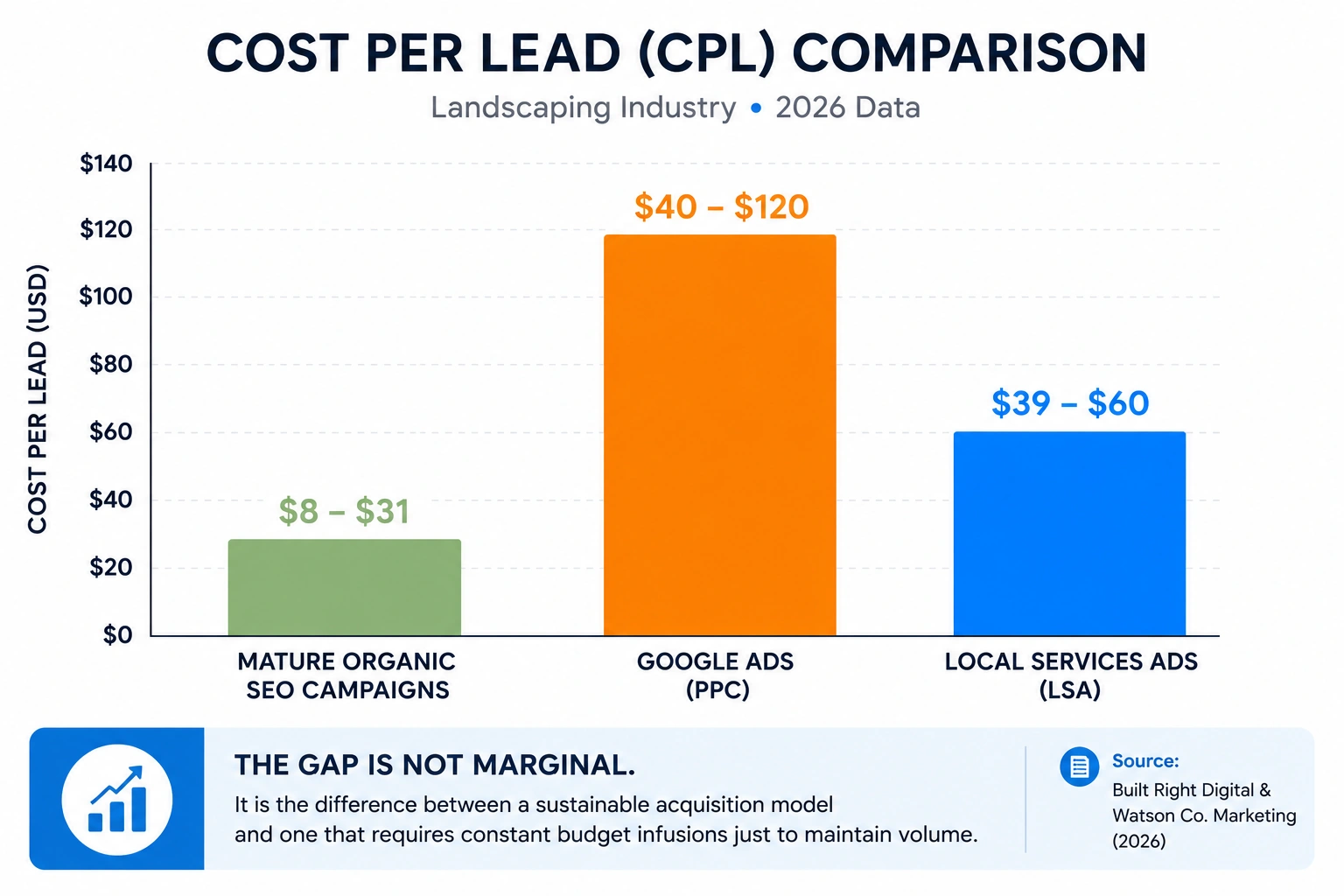
Mature organic SEO delivers a substantially lower cost per lead than Google Ads and Local Services Ads.
Contract Terms to Watch for in Landscaping SEO Agreements
Contract Pitfalls and Asset Hostage Situations
Predatory agencies do not usually announce themselves with bad reviews or obvious warning signs. They present polished decks, confident guarantees, and pricing that seems reasonable, at least until you read the contract. The exploitation happens in the fine print, and it targets business owners who do not have time to parse legal language before a sales call ends.
The most damaging tactic is data ownership manipulation. Some agencies register your Google Analytics, Google Search Console, and Google Business Profile accounts under their own agency credentials rather than yours, effectively locking you out of your own data. A review of over 50 SEO contracts by 10SEOs (2026) found that restricting client access to analytics accounts is the single most common indicator of predatory agency behavior. When you terminate the relationship, you do not just lose the agency; you lose your entire performance history and sometimes the accounts themselves.
Proprietary CMS lock-in is the second mechanism. Certain agencies insist on migrating your website to their custom platform as a condition of service. The pitch sounds like a feature: “we manage everything for you.” The fallout is that your website cannot be transferred if you leave. You would be starting from scratch, losing years of accumulated domain authority and indexed content. No legitimate agency needs to own your infrastructure to do good work. Walk away.
Termination fees complete the trap. Watch for auto-renewal clauses with 90-day notice windows, meaning you must notify the agency three months before your contract anniversary to avoid being automatically locked in for another year. Steep early-termination “kill fees” calculated as a percentage of the remaining contract value are equally common. These clauses are not standard business practice; they are retention mechanisms designed to make leaving financially painful.
Summary of Contract Terms to Watch for:
- Avoid agencies that promise guaranteed first-page rankings within weeks, as this directly contradicts Google’s explicit guidelines and signals either incompetence or dishonesty.
- Walk away from providers who hide behind vague strategies or “secret sauce” methods, which frequently mask black-hat tactics that can trigger manual penalties.
- Be cautious of monthly retainers priced under $500 per month, as quality optimization requires skilled professionals dedicating real hours to your account, not automated scripts running in the background.
Essential Questions to Ask a Landscaping SEO Company
Vetting and Qualifying Potential Partners
Treat the agency consultation like a job interview where you are the hiring manager. Most business owners arrive at these calls in a receptive state, waiting to be sold. Do not do that. Reversing that dynamic, meaning arriving with prepared, pointed questions, immediately separates legitimate providers from those who rely on vague promises and sales pressure to close deals.
Detailed case studies are the most reliable signal of genuine expertise. According to research on B2B buying behavior, 73% of business leaders identify verified case studies as the most effective content for building trust with a potential service provider. An agency that cannot produce documented results from comparable home service or green industry clients, complete with specific metrics rather than just testimonials, has not earned the benefit of the doubt and should be crossed off your list immediately. If you want a structured framework for this evaluation process, BizIQ’s guide on how to choose an effective SEO agency walks through the qualification criteria in detail.
The agency consultation itself is data. How they answer your questions tells us as much as what they answer. Evasiveness on ownership terms, vagueness about deliverables, or resistance to month-to-month arrangements are all diagnostic signals, not negotiating positions.
Vetting Questions Checklist:
- Can you show me verified case studies or references from other home service or green industry companies?
- What specific optimization tasks will your team complete during the first 90 days of our partnership?
- How do you build local links, and do you strictly follow Google’s search quality guidelines?
- Will I retain full ownership of my website, domain, Google Business Profile, and analytics accounts?
- What metrics will be included in our monthly reports, and how do you measure campaign ROI?
Understanding the Real Cost of Landscaping SEO Services
Industry Pricing Benchmarks and Retainer Costs
Budget expectations for professional search optimization are frequently distorted by two extremes: agencies charging $299 per month for standard packages and enterprise firms quoting $10,000 monthly before they have even reviewed your site. Neither figure reflects what a competent, specialized campaign actually costs for a landscaping business operating in a competitive local market.
According to Greenup SEO (2026), the average monthly investment for specialized landscaping SEO services sits at approximately $3,023 per month, with a realistic range of $1,500 to $3,750 for most small-to-mid-size operations. Basic local campaigns for single-location landscapers can start around $1,200 per month, while multi-location or highly competitive metro campaigns can exceed $8,300 monthly.
The risk with cheap SEO is not just poor results; it is active harm. Cheap work backfires. Agencies charging below market rates, such as $500 to $1,000 per month, typically compensate by outsourcing content to low-cost writers with no industry knowledge, using automated link-building schemes that violate Google’s guidelines, or simply doing very little and hoping the client does not notice for a few months. Finding affordable yet high-quality SEO services requires knowing what quality actually looks like at each price tier, not just finding the lowest number that sounds plausible.
Competent agencies employ premium seo keyword research tools to verify local search volumes rather than guessing what your customers search for. These tools, combined with a strong industry reputation, are baked into the overall cost and budget.
The average cost of professional landscaping SEO reflects the labor involved: keyword research, technical audits, content production, citation management, link outreach, and monthly reporting all require skilled practitioners spending real hours on your account. That work does not compress into a $400 monthly retainer without something being cut. Quality costs money.
The Reality of Search Engine Rankings
Only 1.74% of newly published pages rank in the top 10 within their first year. That is a tiny fraction. That figure, drawn from large-scale crawl data, is not a discouragement; it is a reality check. It means that a long-term investment in consistent, high-quality work is the mechanism, not a shortcut or a sprint.
Agencies that frame SEO as a quick-win channel are either misrepresenting the discipline or planning to show you inflated vanity metrics, like impressions or rankings for obscure long-tail terms, while real lead volume stays flat. Do not fall for it. Legitimate providers set a 3 to 6-month timeline for measurable ranking movement and 6 to 12 months for meaningful lead generation, and they document that expectation in writing before you sign anything.
“No one can guarantee a #1 ranking on Google. Beware of SEOs that claim to guarantee rankings, allege a ‘special relationship’ with Google, or advertise a ‘priority submit’ to Google.” (Source: Google Search Central)
What a Legitimate Local SEO Strategy Includes
Core Deliverables for Local Search Visibility
A trustworthy agency starts with a detailed technical and competitive audit, not a generic onboarding checklist. That audit establishes the baseline: current indexation status, crawl errors, page speed performance, existing keyword rankings, competitor gap analysis, and the state of your local citation profile. Without it, any strategy is guesswork dressed up as a plan. Do not accept guesswork.
Google Business Profile optimization is non-negotiable for any landscaping contractor. This means selecting the correct primary and secondary categories, defining accurate service areas, uploading project photos regularly, and managing the Q&A section on a weekly basis. GBP signals are among the most heavily weighted factors in local pack rankings, and most landscaping businesses underutilize the profile significantly.
Local citation building means maintaining consistent Name, Address, and Phone number (NAP) data across directories like Yelp, Angi, Houzz, and the major data aggregators. Inconsistent NAP data does not just confuse customers; it weakens the local authority signals that Google uses to verify your business’s legitimacy and geographic relevance.
Location-specific service pages round out the foundational work. Each target city or service area deserves a unique page with original content, not a template where the city name is swapped in and nothing else changes. Google’s quality evaluators flag those duplicate structures, and they rarely rank competitively.
With 46% of all Google searches carrying local intent, appearing in the local map pack is not a bonus; it is the primary battleground for capturing ready-to-buy customers. For landscaping companies specifically, that map pack placement often determines whether a homeowner calls you or your competitor. BizIQ’s digital marketing services for landscaping businesses cover the full scope of local optimization, from GBP management to citation audits and location page development, built specifically for the home services sector to ensure you dominate your local market.
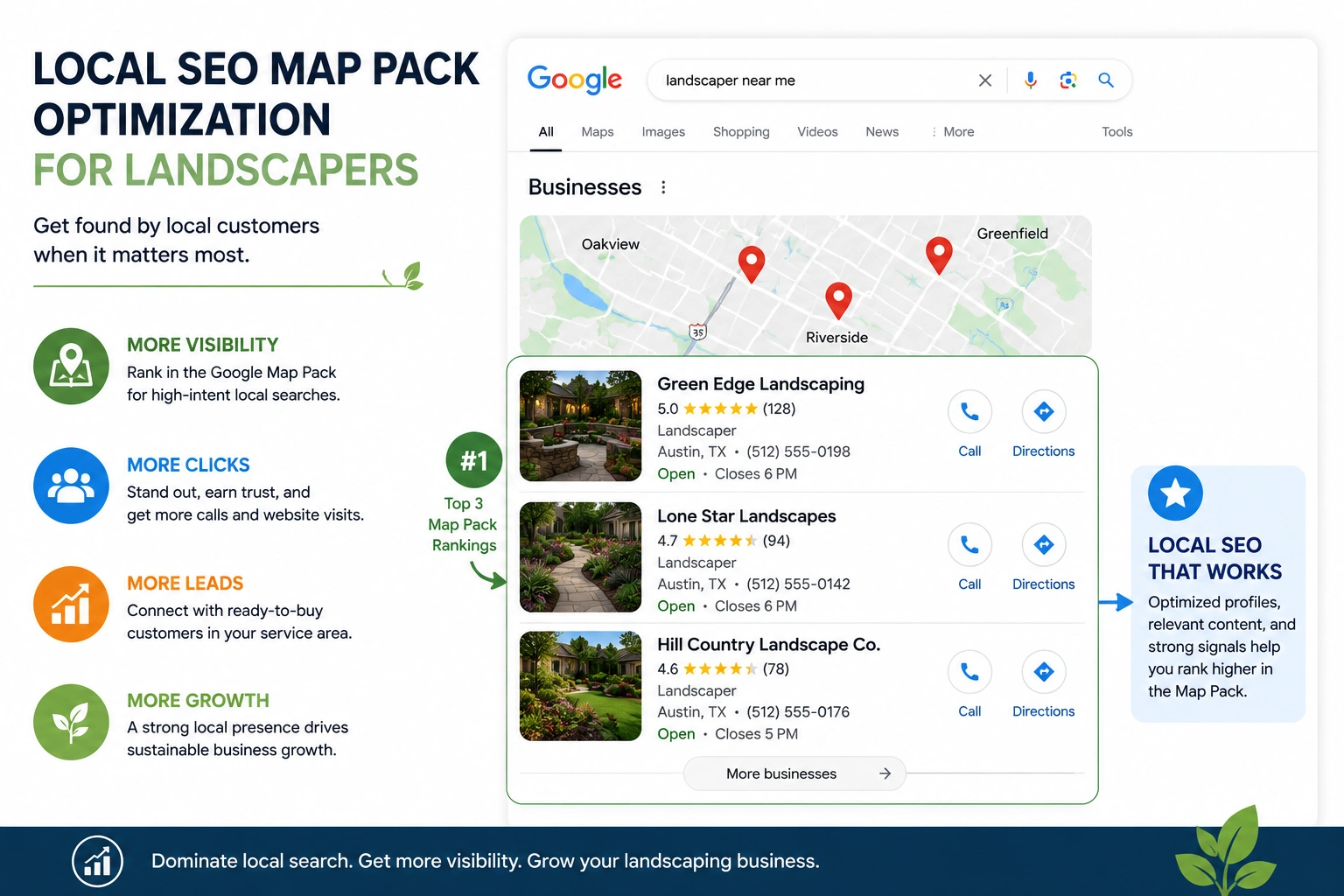
Local SEO helps landscaping companies earn prominent Google Map Pack rankings, increasing visibility, clicks, and qualified leads.
Key Performance Indicators That Matter
Moving Beyond Vanity Metrics
Rankings do not pay invoices. An agency that leads every monthly report with keyword position charts and organic impressions, without connecting those numbers to phone calls and booked estimates, is either measuring the wrong things or hoping you will not notice the gap between traffic and revenue.
Three KPIs reflect campaign health for a landscaping business. Organic lead volume is the count of phone calls and quote form submissions generated directly from search traffic, tracked through call tracking software and form analytics. This is the number that connects SEO activity to your actual pipeline. Conversion rates matter because organic leads close at an average rate of 14.6%, which is substantially higher than paid or outbound channels, meaning organic lead volume is the most reliable predictor of downstream revenue. Website conversion rate is the third lever: if your traffic is growing but your conversion rate is flat or declining, the problem is on-site, and a competent agency should be diagnosing and fixing it, not just reporting the traffic number.
The performance ceiling for well-executed landscaping SEO campaigns is genuinely high. Results speak volumes. SEO Guru Atlanta (2026) documented a 165% organic traffic growth and 4,947 leads over an 8-month campaign for a local contractor. Social Spike (2026) recorded 179 leads in 30 days from a landscaping campaign, generating $75,000 in additional revenue. GrowSmallBiz (2026) reported a 770% increase in phone call clicks alongside a 45.4% lift in organic traffic users. These are not exceptions manufactured for case study purposes; they are the product of disciplined, sustained execution against the right local keyword targets.
Summary of Key Performance Indicators:
- Organic lead volume, tracking the exact number of phone calls and quote forms generated directly from search traffic.
- Lead quality and conversion rates, as organic leads close at an average rate of 14.6%, making organic lead volume the ultimate measure of campaign success.
- Website conversion rate optimization to ensure that your search traffic actually turns into qualified leads and booked jobs.
How to Transition Safely to a New SEO Partner
Protecting Your Search Equity and Asset Control
Switching agencies is common. With the average agency client churn rate sitting at 38% annually, a clean transition plan is not an afterthought; it is a standard operating procedure that every landscaping business should have documented before they need it.
The first priority is administrative access. Before your final billing cycle closes with a departing agency, confirm that full admin-level access has been transferred to your own Google email for Google Analytics, Google Search Console, and your Google Business Profile. Not editor access. Not viewer access. Admin. Anything less leaves the outgoing agency with the ability to modify or delete data after the relationship ends.
Your search equity, meaning the accumulated domain authority, indexed pages, and ranking history your site has built, lives in your domain and your analytics history. An agency that threatens to “unpublish” content or “remove” their work upon termination is describing assets they should never have owned in the first place. If your contract does not explicitly state that all website content, metadata, and structural changes become your permanent property, that clause needs to be added before you sign.
The transition plan itself should include a documentation handoff: a list of all active campaigns, the keyword targets being tracked, any link-building outreach in progress, and the current state of your citation profile. A responsible outgoing agency provides this. One that does not is telling you something important about how they operated the account.
Establishing a Foundation for Long-Term Growth
Realistic Timelines and Lifetime Value of SEO
Local SEO timelines are fairly consistent across reputable agencies: expect 3 to 6 months before significant ranking improvements and lead generation become measurable, with the qualification that heavily competitive markets or websites with serious technical debt may push that window toward the longer end. The initial months are not idle; they are the period when foundational work, including technical fixes, GBP optimization, citation cleanup, and content production, is being executed. The results of that work surface on a delay. Patience is required.
What makes the ramp-up period worth enduring is the compounding nature of organic search. Unlike paid advertising, which stops generating leads the moment the budget stops, SEO builds on itself. A well-optimized service page gains authority incrementally, attracts backlinks passively, and continues ranking without additional spend. Legitimate SEO campaigns deliver a median lifetime ROI of 748%, a figure that reflects the sustained lead generation that continues long after the initial investment is made.
Long-term growth for a landscaping business through organic search is not a single campaign; it is a continuously maintained asset. The best agencies treat it that way, expanding keyword coverage into new service lines, build content clusters around seasonal demand spikes, and refining the technical foundation as Google’s algorithm evolves. For a broader view of how organic search fits into a complete growth strategy, BizIQ’s breakdown of marketing strategies for landscaping businesses covers the full channel mix, including how SEO integrates with reputation management, social proof, and referral systems that green businesses often underutilize.
Realistic timelines matter because they protect you from two failure modes: abandoning a legitimate campaign too early because results have not materialized yet, and staying too long with an underperforming agency because you are waiting for results that were never coming. Knowing the difference requires documented milestones agreed upon before the engagement starts, not reassurances delivered verbally during a renewal conversation. Get it in writing.
Frequently Asked Questions About Landscaping SEO
What is landscaping SEO?
Improving your online presence through landscaping SEO involves optimizing your website and local listings to rank higher in Google search results. This process helps your business attract homeowners or property managers looking for landscaping and lawn care services in your specific service area.
Why do landscaping companies need specialized SEO?
Specialized SEO ensures that your marketing budget targets high-intent local keywords rather than generic national traffic. A specialized agency understands green industry seasonality, service margins, and the specific search terms that affluent homeowners use when looking for high-end design-build projects.
How much do landscaping SEO services cost?
Most professional landscaping SEO services range from $1,500 to $3,750 per month. Basic local packages may start around $1,200, while highly competitive multi-location campaigns can exceed $8,300 monthly, depending on the size of your service area.
How long does it take to see results from landscaping SEO?
You can typically expect to see measurable improvements in organic traffic and local visibility within 3 to 6 months. Because search engine optimization compounds over time, the most significant increases in qualified leads and booked jobs usually occur between 6 and 12 months of consistent work.
What happens if an agency uses black-hat SEO tactics?
If an agency uses prohibited tactics like buying links or keyword stuffing, your website risks receiving a manual penalty from Google. These penalties can cause organic traffic to drop by 50% to 95% within 72 hours, and recovering your search rankings can take 6 to 18 months of intensive cleanup work.
Selecting the right digital marketing partner is one of the most consequential decisions you will make for your landscaping company, not because the stakes are abstract, but because the wrong choice costs you months of lost lead volume, a depleted budget, and sometimes a website you no longer control. By applying these qualification criteria, protecting your marketing budget with the right contract terms, and arriving at your next agency consultation with a prepared vetting checklist, you give yourself the structural advantage that most business owners never build before they sign.
The framework is only useful if you use it before the sales pressure starts. Do not wait. Review your current website performance, document your ownership of every digital asset, and prepare your questions in advance. That preparation is the difference between a partnership that compounds over time and one that costs you a year to escape. Take action today.
Get your free, no-obligation landscaping SEO proposal today and start growing your business with confidence.