
Key Takeaways
- Franchise-cooperative search architecture requires a specialized setup that generalist agencies cannot deliver.
- Crawl budget waste and duplicate content filter out up to 30% of unoptimized franchise location pages from search results entirely.
- A rigorous vetting process protects your cooperative marketing budget and ensures high-intent local lead generation that franchisees can actually trace back to revenue.
Vetting a Franchise SEO Company for a franchise-cooperative network requires moving past standard local checklists. If your corporate site, franchisee pages, and local directories do not align, search engines and AI models will fail to index your locations or surface them to nearby prospects who are ready to buy. We have put together a compliance-grade vetting framework and the exact technical questions to ask when evaluating specialized search marketing vendors who understand the franchise-cooperative business model.
Many franchise brands are contending with flat or declining web traffic across their networks because their SEO providers are still solving a 2018 problem: basic citations and keyword rankings. The real failure points sit deeper in the technical architecture: JavaScript rendering gaps that hide location-finder content from crawlers, indexation loss across thousands of location URLs, and entity fragmentation that causes AI search models to conflate or omit individual storefronts entirely. We recommend finding an agency that treats franchise search as a scalable engineering and data-clarity problem, not a templating exercise. Generic tactics fail.
The structural reality of franchise-cooperative search
Technical site architecture: subdirectories vs. subdomains
The single most influential architectural decision a franchise brand makes is where its location pages live. Hosting all local pages under a unified corporate domain using clean subdirectories, structured as brand.com/locations/city-store, consistently outperforms both separate subdomains and standalone individual websites because search engines treat subdomains as entirely separate entities that must earn their own trust. The reason is mechanical: every backlink, every citation, and every piece of shared brand authority amassed by the main corporate domain flows directly into those subdirectory pages. A location page at brand.com/locations/phoenix-north inherits that domain equity from day one; a page at phoenix-north.brand.com starts from near zero.
The inheritance effect compounds over time. New location pages under a mature corporate domain can begin ranking for local queries within weeks rather than months, because they are not building authority from scratch. Separate subdomains or standalone sites require their own independent link-building campaigns, their own citation profiles, and their own domain age. This is a significant resource drain when you are managing 300 locations simultaneously.
There is a structural risk worth naming clearly, though. Without deliberate architecture mapping, locations within the same metro area will cannibalize each other’s rankings on the search engine results page. Two Phoenix locations competing for the same “HVAC repair Phoenix” query will split impressions, dilute click-through rates, and confuse Google’s understanding of which page to surface. A qualified franchise SEO company resolves this through precise geographic boundary mapping and differentiated keyword targeting at the territory level.
Think of each franchise location as its own digital storefront. It needs its own local visibility in the neighborhoods it serves, but it draws nutrients from the same shared roots. Sever those roots by fragmenting the domain, and you are asking every branch to survive independently. Most won’t.
Local listing management and Google Business Profiles
NAP consistency (Name, Address, and Phone number) is foundational. It is also where franchise networks forfeit local map pack rankings without realizing it. If one franchise location lists ‘St. Louis’ and another lists ‘St Louis’ (no period), Google sees them as two different businesses. That’s the kind of detail that sounds minor but tanks local visibility. Details matter. Baseline audits of franchise-cooperative networks routinely reveal that up to 40% of local listings contain inaccurate NAP data across major directories. A single transposed phone number or outdated suite address, cloned across dozens of citation sources, sends conflicting signals to Google’s local ranking algorithm and suppresses map pack placement directly, which ultimately cuts off the flow of high-intent local phone calls.
The governance challenge around Google Business Profile management is more nuanced than most franchisors anticipate. Corporate needs primary ownership of every profile to protect the brand’s digital assets. Unauthorized edits from third parties, including well-intentioned local managers, can alter service categories, add incorrect attributes, or inadvertently flag a location as permanently closed. At the same time, local franchisees need enough access to upload real-time photos, respond to customer reviews, and update seasonal hours. The operational answer is a tiered access model: corporate retains owner-level control, while local operators receive manager-level permissions scoped to content updates only.
Any agency that cannot articulate a clear Google Business Profile management and access protocol for large networks is not operating at the level your cooperative model requires.
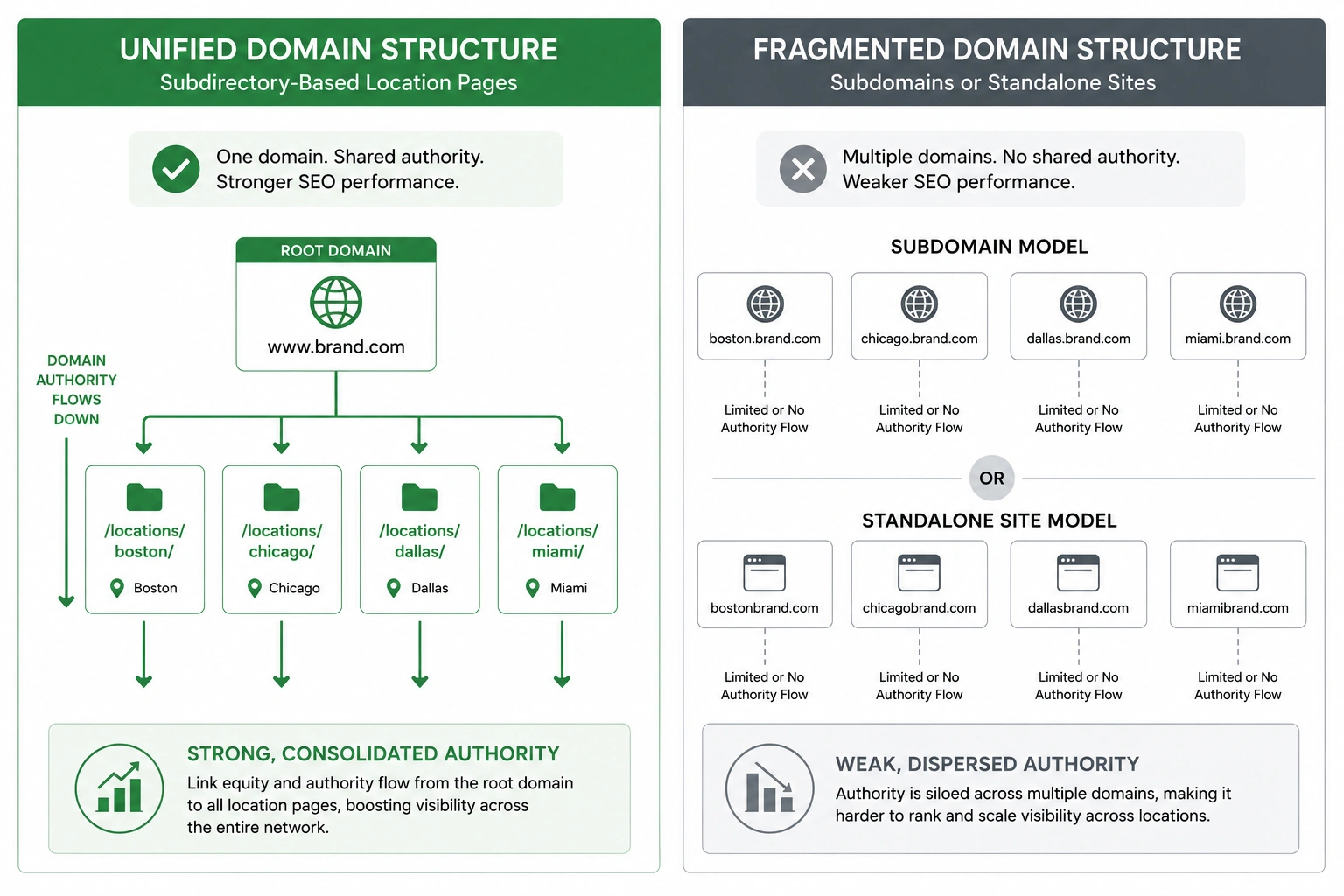
A side-by-side comparison shows how unified website architecture strengthens domain authority while fragmented structures dilute SEO value.
Critical warning signs of generalist search marketing providers
Generalist agencies are not incompetent; they are mismatched. They lack scale. The frameworks they apply to a single-location restaurant or a regional law firm simply do not translate to a franchise-cooperative model operating across hundreds of territories. Knowing what to ask during vendor interviews saves your cooperative marketing funds from being diverted to work that produces activity reports instead of revenue.
Watch for these patterns:
- Guaranteed ranking promises delivered before any technical audit. An agency that quotes guaranteed positions on the search engine results page without first examining your site’s crawl health, indexation coverage, and existing duplicate content issues is selling confidence, not competence. Rankings are an output of technical and content quality, not a deliverable that can be promised in advance.
- Recommending separate subdomains or standalone websites per location. This is the single clearest signal that an agency does not understand franchise search architecture. Fragmented domains fragment authority. Every location page you move off the corporate domain is a page that has to rebuild its ranking potential from zero, and a backlink profile you will never fully consolidate.
- Automated city-name swaps as a content strategy. Deploying identical page templates across hundreds of markets with only the city name changed produces thin, near-duplicate pages that Google actively filters out of search results, treating them as doorway pages. This approach can stifle your entire location directory from meaningful local visibility.
Essential questions for technical and architectural vetting
Vetting for technical competence
The interview stage is where most franchise marketing teams lose leverage: not because they ask the wrong questions, but because they accept vague answers. These questions are designed to surface genuine technical depth, not rehearsed sales positioning.
“How do you pinpoint and prevent crawl budget waste across a network of 100 to 10,000-plus location URLs?”
A specialist will explain how they audit crawl paths, identify low-value URL patterns that consume Googlebot’s attention without contributing to indexation, and implement crawl directives that prioritize your highest-converting location pages. A generalist will pivot to talking about sitemaps. That is insufficient.
“What is your process for managing JavaScript rendering on modern, headless location-finder applications?”
This is a technical discriminator. Many franchise websites use JavaScript-heavy frameworks to power their location finders. If those pages are not rendered server-side or pre-rendered for crawlers, Googlebot may never see the location content at all, meaning your entire location directory could be invisible to search engines despite appearing functional to human visitors. The agency should be able to describe their rendering audit process in specific terms.
“How do you structure LocalBusiness schema and entity signals to ensure AI search models do not merge or omit our individual storefronts?”
Structured data markup is no longer optional for franchise networks. As AI-powered search surfaces increasingly depend on entity graphs to determine which businesses to recommend, fragmented or absent schema means your locations get collapsed into a single entity or excluded from AI-generated answers entirely. A qualified franchise visibility expert will have a documented schema governance process.
Is your franchise network invisible in local visibility?
Get a detailed, engineering-led technical audit of your franchise-cooperative site architecture. Let our specialists identify the rendering gaps and crawl budget leaks holding your locations back.
The financial impact of local visibility optimization
The economics of local visibility vs. paid acquisition
The ROI gap between local visibility and paid advertising is wider than most franchise marketing directors realize when they are under pressure to show immediate results. Local visibility generates a 274% ROI, compared to 81% for paid advertising, a gap that compounds over time because organic rankings, once established, do not disappear the moment a budget cycle ends. Paid acquisition requires continuous spend to maintain visibility; organic local visibility builds an asset.
That disparity is why 72% of franchise systems now designate at least 40% of their cooperative marketing funds to local visibility initiatives. The math is straightforward when you consider that 93% of franchise customers search online before visiting a physical storefront. Organic local visibility is not a supplementary channel; it is the primary driver of offline foot traffic for most franchise categories. It is essential.
Co-op fund transparency and regulatory compliance
Franchise-cooperative marketing funds typically require franchisees to contribute between 1% to 4% of gross sales to a shared advertising fund, as detailed in industry resources like the Franchise Advertising Funds FAQs and the Franchise Marketing Funds FAQ. For a franchise system generating $50 million in systemwide gross sales with a 2% co-op fee, that is a $1 million marketing fund requiring precise reconciliation to demonstrate the organic search portion’s contribution to revenue.
Item 11 of the Franchise Disclosure Document (FDD) is the governing disclosure mechanism here. Rules are strict. Under the FTC Franchise Rule Compliance Guide, franchisors are legally required to disclose the exact percentage of the advertising fund spent on production, media placement, administrative services, and other categories during the prior fiscal year. A search marketing vendor that cannot provide location-level reporting granular enough to satisfy this disclosure requirement is creating a compliance liability, not just an analytics gap.
The regulatory stakes are even higher in some international markets. Australia’s Franchising Code of Conduct, administered by the ACCC, stipulates that specific-purpose marketing funds be held in a separate bank account and subjected to independent annual audits, unless a 75% franchisee vote waives the requirement. Any franchise brand operating across borders needs a search marketing vendor that understands these jurisdictional variations, not one that treats compliance as an afterthought.
“The click question almost doesn’t matter if the business isn’t in the local map pack or AI answers to begin with. Clean, structured location data is the only way to ensure your franchise locations are surfaced when and where customers are actively looking to buy.” Bartosz Góralewicz, Technical SEO Specialist
Eliminating duplicate content and preserving crawl budget
The technical cost of boilerplate location pages
Googlebot operates under real resource constraints. It allocates a bounded crawl budget to each domain, and roughly 20% of that budget gets consumed by duplicate content detection and filtering. For a franchise network with 500 location pages, that is the equivalent of 100 pages worth of crawl capacity spent on content Google has already decided not to index, capacity that could have been directed toward your highest-priority location pages.
The mechanism is simple and punishing. When hundreds of city pages share identical body copy, identical service descriptions, and identical meta structures with only the city name swapped, Google’s systems classify them as near-duplicate doorway pages and stop crawling them. Those pages do not just rank poorly; they often disappear from the index entirely. The franchise brand ends up with a location directory that is technically live but functionally invisible to organic search.
What works is injecting genuinely unique location-specific content and local signals into each page. This means real staff bios with names and tenure, not placeholder headshots. It means community involvement details, such as the local Little League sponsorship or the neighborhood food bank partnership, that cannot be cloned across markets. It means service area specifics that reflect actual territory boundaries, embedded local customer reviews pulled from verified sources, and neighborhood-specific FAQ content that answers the questions real customers in that market are asking. Each of these elements gives Google a reason to treat the page as a distinct, valuable document rather than a duplicate.
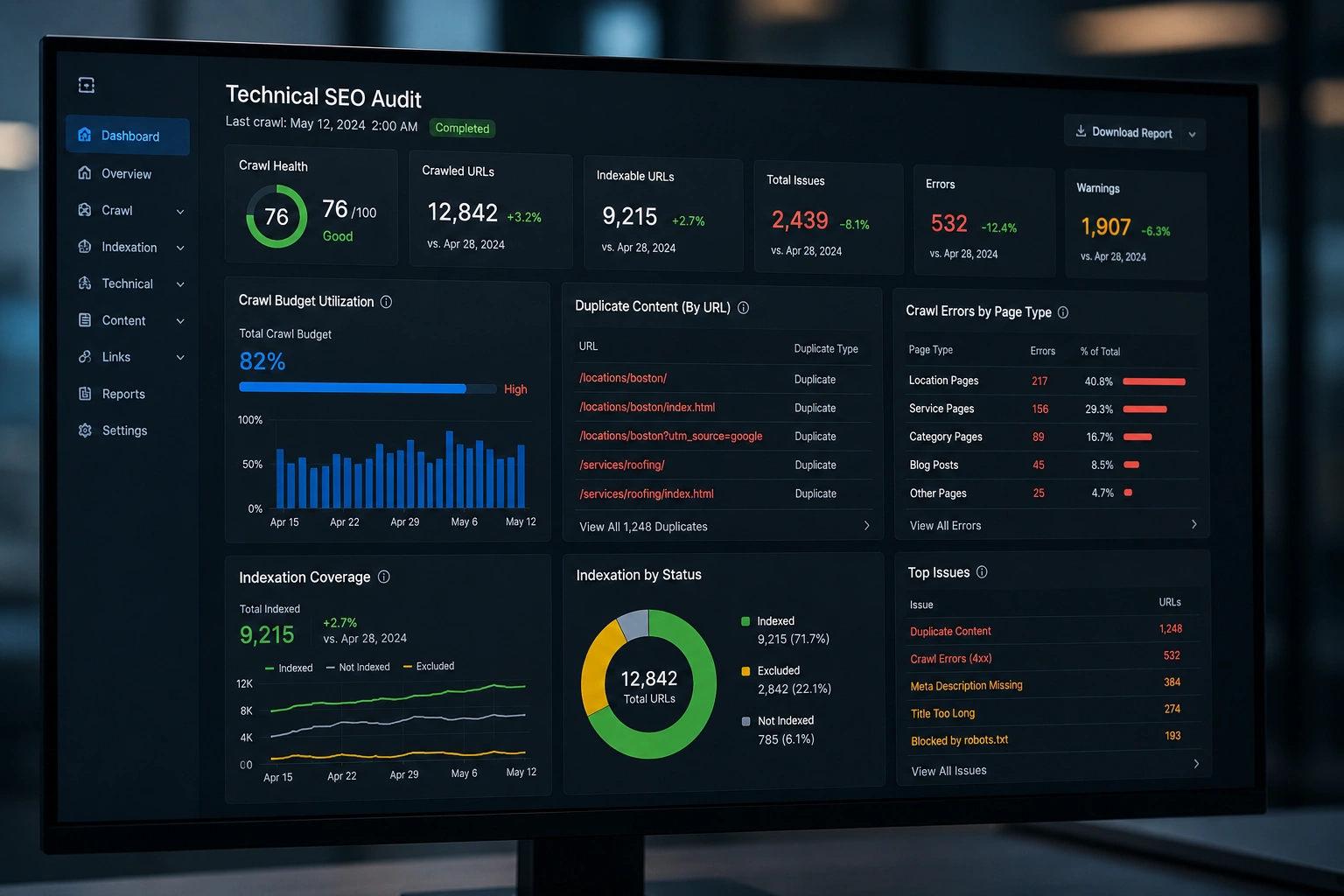
A technical SEO dashboard visualizes crawl health, indexing status, duplicate content, and site errors to support optimization.
The role of Google Business Profile and review velocity
Optimizing local signals for the map pack
Map pack placement is not purely a function of proximity. Recency dictates authority. Review velocity, the rate at which a location gathers new, recent reviews, functions as a primary ranking signal, and recency matters as much as volume. A location with 200 reviews, the most recent of which is eight months old, will often rank below a competitor with 80 reviews and three posted in the last two weeks. Franchise networks that treat review acquisition as a one-time setup task rather than an ongoing operational discipline consistently underperform in local map pack visibility.
The scale of the opportunity is measurable. Google Business Profile actions, direct phone calls, direction requests, and website clicks originating from GBP listings, grew by 41% year over year per location across optimized franchise networks. That growth does not happen passively; it is the result of active profile management that keeps physical addresses, operating hours, and service offerings aligned across all search directories, and that maintains a consistent cadence of fresh review content.
Scaling review acquisition across hundreds of locations without violating platform guidelines requires a systematic approach. Automated review request sequences triggered by completed service transactions, combined with location-level response protocols that ensure every review receives a timely reply, are the operational backbone of what works at franchise scale. BizIQ’s reputation management services are built specifically for this kind of coordinated, multi-location execution, managing the citation infrastructure and review velocity that map pack rankings depend on.
Establishing content governance and franchisee guardrails
Balancing corporate control with local operator autonomy
The tension between centralized brand control and local operator flexibility is not new to franchise operations; it predates digital marketing entirely. In the context of search engine optimization, though, the stakes are unbalanced. As processed in industry analyses of brand consistency across franchise locations, a single local franchisee hiring an unapproved agency that builds low-quality backlinks to their specific location page can trigger a manual action from Google that de-indexes the entire corporate subdirectory for that region. One operator’s shortcut becomes a network-wide penalty.
That asymmetry is why the centralized camp, those who argue for strict corporate control over all search activity, has a structurally sound argument. Inconsistent messaging, keyword stuffing on local pages, and purchased review schemes are not just brand problems; they are technical liabilities that spread across a shared domain. Risks are high. The counterargument from the decentralized camp, which champions local ownership and autonomy, is equally valid: corporate-only campaigns lack the neighborhood-level specificity that local map pack algorithms reward. A corporate copywriter in Phoenix cannot replicate the market knowledge a franchisee in Boise has about regional terminology, local competitors, and community events.
The operational resolution is a hybrid governance model. Corporate maintains ownership of the core website architecture, technical templates, schema markup standards, and backlink acquisition strategy. Local operators contribute unique proof: photos of their actual team, responses to customer reviews, local event announcements, and neighborhood-specific service details. The guardrails are structural, meaning local operators work within approved content modules, rather than purely restrictive. This model preserves brand compliance while capturing the local relevance signals that drive map pack performance.
Measuring real revenue attribution instead of proxy metrics
Connecting organic clicks to store-level conversions
Keyword rankings and impression counts are not business outcomes. They are vanity metrics. They are leading indicators, useful for diagnosing directional trends, but inadequate for justifying cooperative marketing funds expenditure to a room full of franchisees who want to know how many calls came in last month and what those calls were worth. An agency that leads its reporting with keyword position dashboards and organic traffic graphs without connecting those numbers to store-level conversions is measuring its own activity, not your revenue.
What the reporting infrastructure needs is call tracking and lead validation systems that connect organic search clicks directly to closed sales and local contact form submissions. This means unique tracking numbers per location, call recording and qualification protocols that separate genuine customer inquiries from spam and misdials, and attribution logic that identifies which organic search queries initiated the customer journey. Without this layer, calculating the true cost per acquisition across franchise territories is guesswork, and guesswork does not survive a franchisee budget review.
The more precise challenge is filtering high-quality leads from noise. A franchise network receiving 2,000 inbound calls per month across 100 locations may find, after validation, that 30% are spam, wrong numbers, or existing customer service calls that should not be counted as new lead generation. Stripping those out changes the cost-per-acquisition calculation materially. Agencies that do not build this validation step into their reporting are inflating your apparent lead volume and understating your actual acquisition cost.
Frequently asked questions about franchise search marketing
How does franchise SEO differ from standard local visibility?
Standard local visibility focuses on optimizing a single business location within a specific geographic area. Franchise search optimization requires managing a complex network of hundreds or thousands of locations simultaneously, balancing national shared brand authority on a single corporate domain with hyper-local visibility for individual storefronts, all while preventing internal keyword competition between locations in overlapping markets.
How much does franchise SEO typically cost?
Franchise search marketing retainers generally range from $1,500 to $2,500 per month for entry-level local optimization, scaling to $5,000 to $10,000 or more per month for enterprise-level technical and architectural management. The total investment depends on your location count, the volume of existing technical debt, and the level of custom content required per market. Networks with significant duplicate content issues or fragmented domain structures should budget for an initial rectification phase before ongoing optimization begins.
Should franchise locations have separate websites or live on one domain?
Franchise locations should always live on a single, unified corporate domain using a subfolder structure, for example, brand.com/locations/city. This consolidates all backlink equity and domain authority, allowing new location pages to rank faster by inheriting the strength of the main brand domain. Separate websites or subdomains fragment that authority, requiring each location to build its own ranking foundation independently, which is both slower and more expensive to maintain at scale.
How do we prevent duplicate content issues across hundreds of location pages?
Every location page must contain genuinely unique local elements to avoid duplicate content filtering. This includes integrating real-time local customer reviews, uploading unique photos of the local team and storefront, detailing location-specific service variations, embedding local maps, and answering neighborhood-specific FAQs that reflect the actual questions customers in that market are asking. Boilerplate templates with only the city name changed will be filtered out of search results over time.
How long does it take to see measurable leads from a franchise search campaign?
Initial technical cleanups and local profile optimizations can drive incremental call volume within 30 to 90 days. A strategic franchise-cooperative search campaign typically requires 4 to 9 months to achieve significant organic ranking shifts and sustainable, network-wide lead generation. Networks with substantial technical debt, such as fragmented domains, widespread duplicate content, or unverified GBP listings, should expect the rectification phase to extend the timeline before growth acceleration begins.
Choosing the right search marketing vendor is the difference between exhausting your cooperative marketing funds on empty performance reports and building a scalable lead-generation infrastructure that supports every local owner in the network. By focusing on technical site architecture, unique local content, rigorous lead validation, and co-op fund transparency, we can identify an agency that delivers measurable, long-term ROI rather than activity metrics dressed up as results. We recommend taking the next step in securing your network’s digital footprint by auditing your current site structure and preparing a technically focused RFP. Take action today. If you want to see what a specialized, peer-to-peer approach looks like in practice, explore our expert franchise SEO services or reach out to our team to discuss your network’s specific architecture and growth objectives.