What you need to know:
- Why on-page SEO is the highest-ROI channel for indie beauty brands in 2026
- The step-by-step framework for writing search-optimized product descriptions
- How to write descriptive image alt-text that ranks in Google Images
- Technical essentials: Product schema markup and variant canonicalization
We know that standing out in the indie beauty space feels formidable when you’re competing with brands that have massive marketing budgets. Sephora doesn’t win Google because their products are better formulated: they win because they’ve spent years building their Beauty SEO, domain authority, and content infrastructure. The gap is real, but it’s not insurmountable. Precision wins. What levels the field is precision: knowing exactly which signals Google needs to understand your product pages and delivering them more deliberately than a brand managing 10,000 SKUs ever could.
As skincare creators and founders of indie cosmetics brands, you don’t need enterprise-level budgets to build local visibility and national reach. You need what works to rank on Google search and images.
Executing cosmetics product page optimization requires a strategic blend of sensory copywriting, ingredient-focused keyword integration, descriptive image alt-text, and structured schema markup. Each of those layers compounds on the others. Miss one, and you’re leaving ranking potential on the table.
The scale of what’s at stake makes this worth getting right. Industry forecasts project global beauty e-commerce sales will reach $286.5 billion by 2026, and in the first half of 2024, 41% of all beauty and personal care sales took place online. That volume of purchasing activity flows through search engines first: product discovery, comparison, and intent confirmation, long before it ever reaches a checkout page. Optimizing your product descriptions once means they work for you continuously; it’s not recurring spend, it’s building a durable asset.
The foundation of beauty SEO
Broad search terms are an unproductive route for indie brands. Massive retailers dominate traditional broad searches like “lipstick” or “face cream” with decades of backlink equity and content depth that no small brand can replicate in a reasonable timeframe. The productive territory is elsewhere.
Think of keywords like signposts: put the right signposts in the right places, and Google knows exactly what you’re offering. A shopper typing “non-comedogenic foundation for acne-prone skin” has already done their research. They know what they need. Your product page either matches their query precisely or it doesn’t appear at all. That specificity is where indie brands can genuinely compete, and it’s the core mechanic behind every effective set of on-page SEO tactics for small e-commerce businesses.
Keyword diversification is the structural move that makes this work at scale. Rather than targeting a single term per product, map your makeup website keywords across three distinct axes: skin concern (e.g., “moisturizer for dehydrated skin”), active ingredient (e.g., “niacinamide face cream”), and lifestyle or value alignment (e.g., “vegan lip gloss”). Each axis captures a different searcher at a different stage of their decision process. Someone searching by ingredient already trusts the active; someone searching by concern is still evaluating options. Your page needs to speak to both.
The data reinforces this. 73% of beauty searches now include ingredient- or benefit-specific qualifiers. That figure reflects a fundamental shift in how shoppers approach cosmetics research: they’re not browsing, they’re filtering. Structuring your keyword architecture around that behavior, rather than around what you want to say about your product, is what separates pages that rank from pages that sit idle.
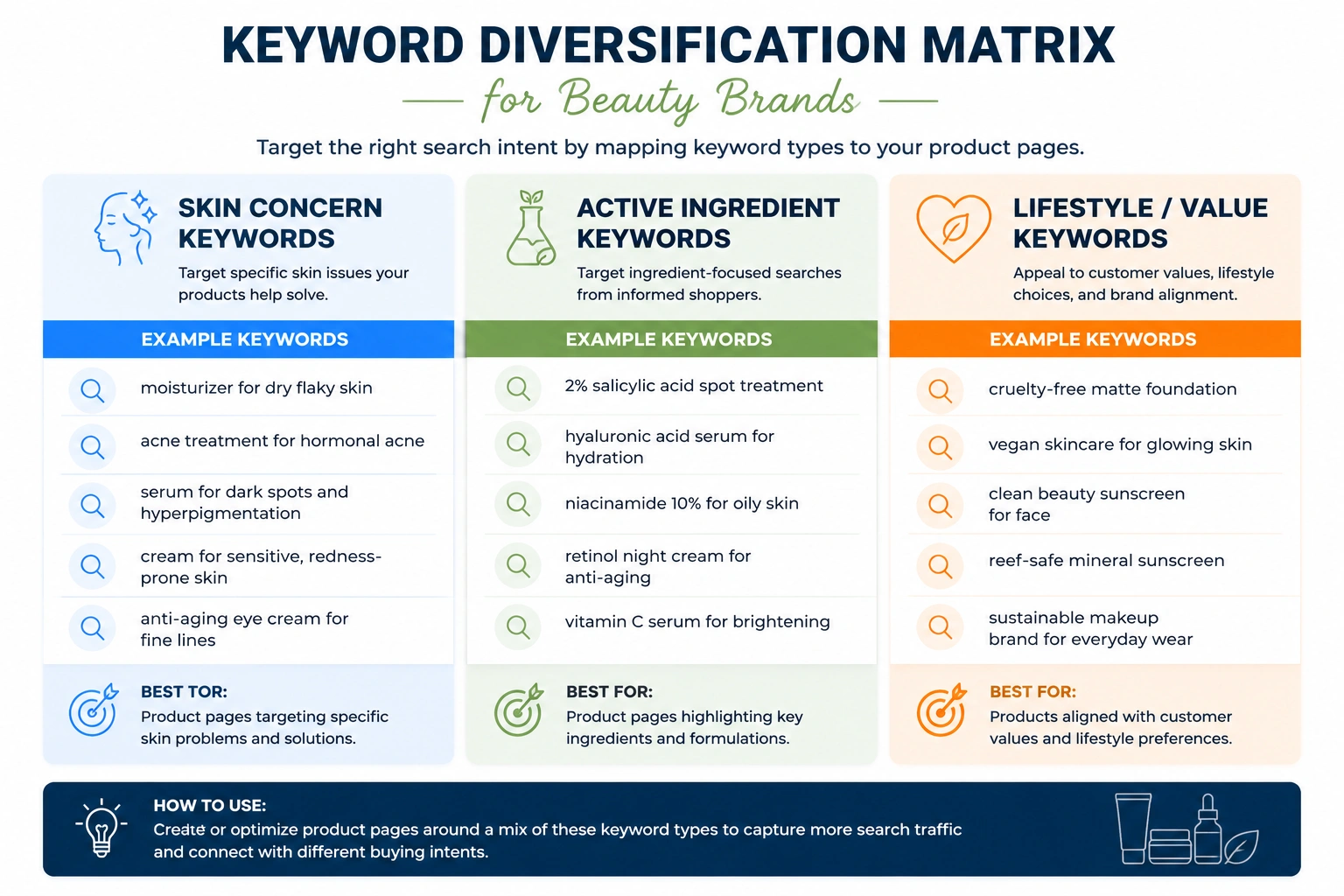
A visual guide to organizing beauty SEO keywords by skin concerns, active ingredients, and lifestyle values for product pages.
Writing product descriptions that sell and rank
The tension between brand voice and search requirements is real, and there’s no tidy solution that works for every brand. A minimalist aesthetic that uses three lines of poetic copy may feel on-brand, but it gives Google almost nothing to work with. A 600-word keyword-dense block reads like a spec sheet and drives shoppers away. The productive middle ground requires deliberate architecture: not a compromise, but a structure that serves both audiences simultaneously. Balance is key.
We build high-performing cosmetics product descriptions in four layers:
- The Hook (Sensory Copywriting): Describe the texture, scent, and immediate payoff with specificity, not “smooth formula” but “a buttery, lightweight lip tint that melts onto lips with a subtle vanilla warmth.” This is the copy that converts; it also signals to Google what category and experience the product delivers.
- The Active Ingredients: List key actives with their concentrations and their function: “Formulated with 2% Hyaluronic Acid to draw moisture into the skin and organic Jojoba Oil to seal it in.” Ingredient-led copy captures the 73% of searchers who query by active.
- The Skin Concerns Addressed: State explicitly who this product is for, such as: “Ideal for dry, sensitive skin prone to flaking and tightness.” This aligns the page with long-tail queries that carry genuine purchase intent.
- The Usage Instructions: Step-by-step application guidance captures tutorial-based queries (“how to apply cream blush” or “how to layer serums”) and adds word count that deepens topical relevance without padding.
We recommend targeting a functional range of 300 to 600 words for skincare product page SEO and cosmetics descriptions. Below 300, you’re likely producing thin content that Google deprioritizes. Above 600, you risk burying the conversion-critical elements (price, add-to-cart, social proof) under a wall of text that mobile shoppers won’t scroll through. The range isn’t arbitrary; it reflects the balance between topical depth for crawlers and scan ability for humans.
Duplicate content is the silent killer of cosmetics product page SEO, and it’s more pervasive than most indie founders realize. Copying a supplier’s ingredient description, reusing boilerplate across product variants, or pulling copy from a manufacturer’s data sheet creates content that exists verbatim on dozens of other URLs. Google doesn’t penalize this in a dramatic, manual-action sense; it simply deprioritizes pages that don’t offer unique informational value. Writing SEO-friendly product descriptions from scratch for every SKU is the only reliable fix, and it’s worth the investment because those pages compound in authority over time.
Optimizing image alt-text for Google Images
Shoppers discover beauty products visually before they research them via written search. A shopper who sees a swatch of a cool-toned berry lip color in Google Images and clicks through already wants the shade: they’re arriving at your product page with intent that a text search result rarely delivers at the same temperature. Google Images is a primary discovery engine for cosmetics, and most indie brands are leaving that channel almost entirely unworked.
The mechanics are straightforward. Google cannot interpret the visual content of an image without metadata: it reads the alt attribute, the filename, and the surrounding page context to understand what an image depicts. That’s the lever.
Here’s what effective alt-text optimization looks like in practice:
- Describe what is visible: Focus on product type, shade, finish, and packaging, like “Matte red lipstick tube in shade Ruby Noir by [Brand Name].” This is what the image actually shows.
- Keep it under 125 characters: The 125-character ceiling isn’t arbitrary; it’s the threshold at which screen readers truncate alt-text, per Harvard Accessibility Guidelines . Staying within it serves both accessibility compliance and indexing completeness.
- Avoid keyword stuffing: Alt-text that reads “best red lipstick cheap affordable matte long-lasting” tells Google nothing useful and signals manipulation. Keywords belong only when they accurately describe the image.
- Skip generic prefixes: “Image of” and “picture of” are redundant; search engines and screen readers already know the element is an image. Start with the subject.
Writing descriptive image alt text for beauty products is highly effective when you use this formula: [product type] + [brand or line] + [shade/color] + [finish/feature]. Applied to a real example, the contrast is stark. A lazy alt-text reads red lipstick or, worse, IMG_0432.jpg. An optimized version reads: Matte cool-toned red liquid lipstick swatch on medium skin tone, Ruby Noir by [Brand Name]. The second version tells Google the product category, the finish, the shade temperature, the application format, and the skin tone context, which are all signals that surface the image in relevant visual search queries.
Alt-text is like giving blind customers a detailed description of what they’re “seeing”: it helps search engines understand your images, and it ensures every shopper can access your products regardless of how they browse. Google’s own image SEO guidelines reinforce this dual function: accessibility and discoverability are not competing priorities here, they’re the same action.
Implementing product schema markup
Structured data is how your product’s price, availability, and star ratings reach the search result page before a shopper ever clicks your link. Without it, Google has to infer those details from your page content, and it frequently gets them wrong, omits them, or simply doesn’t surface them at all.
The click-through consequences are significant. The top three organic search results capture over 54% of all clicks, and rich snippets (the star ratings, price ranges, and in-stock indicators that appear directly in the SERP) measurably lift CTR above what a plain blue link achieves. That lift is one of the cheapest gains available in organic search; the implementation cost is a one-time technical task, and the benefit persists indefinitely. Solid schema markup implementation is the clearest example of a technical SEO task with an outsized and durable return.
For cosmetics product pages, utilizing the JSON-LD format is the cleanest implementation path. Use JSON-LD. Implementing beauty product schema markup with this template works well:
{
  "@context": "https://schema.org/",
  "@type": "Product",
  "name": "Hydrating Niacinamide Serum for Sensitive Skin",
  "image": [
    "https://www.yourbrand.com/images/niacinamide-serum-bottle.jpg"
  ],
  "description": "A lightweight, fast-absorbing serum formulated with 10% Niacinamide and Hyaluronic Acid to minimize pores and deeply hydrate sensitive skin.",
  "sku": "NIA-SRM-30ML",
  "brand": {
    "@type": "Brand",
    "name": "Your Brand Name"
  },
  "offers": {
    "@type": "Offer",
    "url": "https://www.yourbrand.com/products/niacinamide-serum",
    "priceCurrency": "USD",
    "price": "38.00",
    "availability": "https://schema.org/InStock",
    "itemCondition": "https://schema.org/NewCondition"
  },
  "aggregateRating": {
    "@type": "AggregateRating",
    "ratingValue": "4.8",
    "reviewCount": "124"
  }
}
Every field in that template serves a function. The aggregateRating block is what generates star ratings in search results: omit it, and you lose the most visually compelling SERP element available to product pages. The offers block feeds price and availability directly into Google’s product panels. The description field reinforces the page’s topical relevance signal. Google’s official product structured data documentation details the full property set and validation requirements; running your implementation through Google’s Rich Results Test before publishing catches errors that would otherwise silently prevent rich snippets from appearing.
For brands managing a large SKU catalog, rich results optimization across every product page is worth systematizing: templated schema that pulls dynamic values from your product database is far more scalable than hand-coding each page.
“Structured data is how rating stars, price, and availability reach the search result. It won’t fix a weak page, but on a good page, it is one of the cheapest click-through gains available.” (SEO Best Practices)
Solving the variant duplication problem
Shade variants are where cosmetics product page SEO gets structurally convoluted. It confuses search crawlers. A foundation line with 40 shades, each on its own URL with near-identical copy, doesn’t give Google 40 indexable assets; it gives Google 40 near-duplicate pages competing against each other for the same queries, diluting the ranking authority that should be concentrated on a single, authoritative product page.
Canonical tags are the fix. Think of them as forwarding addresses for search engines: each variant URL tells Google “the authoritative version of this content lives here,” pointing to the parent product page. The crawl budget that would have been distributed across 40 thin pages now flows to one, and the backlinks, engagement signals, and keyword relevance that accumulate over time consolidate rather than fragment. This is the mechanical foundation of how SEO and ecommerce integration operates at the product catalog level: not as a marketing concept, but as a technical architecture decision.
On Shopify, canonical tags for product variants are partially handled automatically, but the default behavior doesn’t always match what’s optimal for your specific catalog structure. Shopify’s native variant system typically applies a canonical pointing to the parent product URL, but if you’ve created separate product listings for each shade (a common workaround for inventory management), those pages won’t have automatic canonicalization. You’ll need to set canonical tags manually in your theme’s product.liquid file or through a dedicated SEO app.
Using user-generated content for organic reach
Customer reviews do something your product copy can’t: they introduce keyword variations you wouldn’t think to write yourself. A shopper who reviews your concealer and writes “perfect for covering hyperpigmentation on NC40 skin without creasing” has just added three long-tail keyword phrases to your product page, phrases that reflect exactly how other shoppers with similar concerns are searching. That’s not incidental; it’s a structural advantage. It builds trust.
The mechanics of UGC-driven SEO work on three levels:
- Integrate reviews on-page: Pull customer reviews and photos directly onto the product detail page. Fresh, crawlable text signals to Google that the page is actively updated, and the natural language in reviews captures long-tail query variations that no keyword research tool surfaces reliably.
- Mark up reviews with schema: Your review app should automatically encode reviews with structured data. If it doesn’t, that’s a configuration gap worth fixing: star ratings in SERPs are generated from review schema, not from the visual display of stars on your page.
- Encourage descriptive reviews: Ask customers to mention their skin type, shade match, and specific concern in their review. A prompt as simple as “Tell us your skin type and how you use it” in your post-purchase email sequence shifts review quality dramatically.
The traffic impact of this approach is well-established. E-commerce sites see an average of 240% organic traffic growth when they shift from generic category targeting to structured, long-tail product page optimization supported by UGC. That figure reflects the cumulative effect of dozens of pages each capturing a handful of highly specific queries: not one page ranking for one big term, but a catalog of pages each owning a precise slice of search demand.
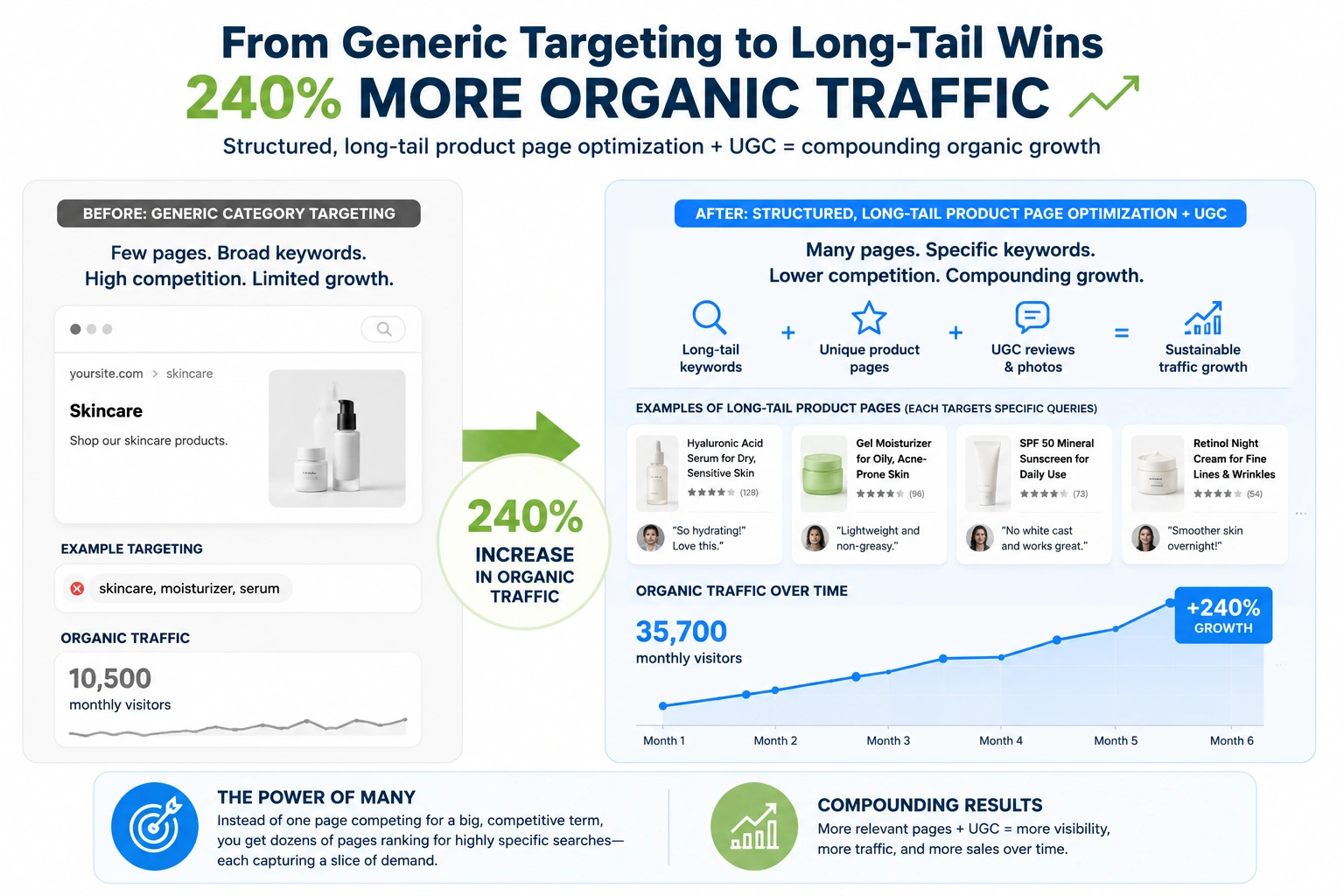
Compare generic category targeting with long-tail product page optimization to see how structured SEO and UGC boost organic traffic.
Measuring your on-page SEO success
Google Search Console is the instrument panel for this work. It reveals search behavior. Organic impressions tell you how often your pages appear in search results; CTR tells you whether your title tags and meta descriptions are compelling enough to earn the click; average position tells you where you’re ranking and how much room exists to improve. These three metrics, tracked weekly for non-branded keywords, give you a clear picture of whether your optimization work is moving the needle.
The compounding nature of SEO makes patience a practical requirement, not a hollow phrase. Most beauty brands see initial ranking shifts within 30 to 60 days of implementing structural changes: new descriptions, corrected alt-text, and schema markup. Meaningful organic traffic growth typically takes 3 to 6 months as Google accumulates engagement signals and topical authority builds across the catalog. Tracking these metrics helps you see that compounding in real time, which matters when you’re deciding where to allocate optimization effort next.
One metric that’s underused by most indie founders is the organic conversion rate by landing page. In Google Analytics, segmenting conversions by organic traffic source and landing page reveals which product pages are attracting qualified visitors and which are pulling in traffic that doesn’t convert: a signal that the keyword targeting may be misaligned with purchase intent. A page ranking for “what is niacinamide” will attract informational searchers; a page ranking for “niacinamide serum for oily skin buy” will attract buyers. The distinction matters more than raw traffic volume.
Common pitfalls in cosmetics SEO
Manufacturer-provided descriptions are the most prevalent self-inflicted wound in indie beauty SEO. When you copy the ingredient list and product summary from your supplier’s data sheet, that text exists verbatim on every other brand that sources from the same manufacturer. Google sees it as non-unique content and deprioritizes your page accordingly: not as a penalty, but as a relevance signal that your page offers nothing distinctive. Write original copy.
Image compression is the second most common gap, and it’s directly tied to revenue. Shoppers complete 57% of e-commerce sales on mobile devices, and mobile shoppers abandon pages that load slowly: Google’s Core Web Vitals data consistently shows that pages loading above 3 seconds see dramatically higher bounce rates. Uncompressed product photography is the primary culprit on beauty sites, where high-resolution swatches and texture shots can run several megabytes per image. Tools like Squoosh or TinyPNG reduce file size without visible quality loss; on Shopify, apps like Crush.pics automate this at the catalog level.
A subtler pitfall is targeting the same primary keyword on both your category page and your individual product pages. Category pages should own broader terms (“organic skincare,” “matte lip color”); product pages should own the specific, transactional variants (“organic vitamin C brightening serum,” “matte berry liquid lipstick”). When both pages target the same term, they compete against each other: a phenomenon called keyword cannibalization, and neither ranks as well as it would with a clean, non-overlapping target.
Mobile optimization extends beyond page speed. Product page layouts that require horizontal scrolling to view shade swatches, ingredient lists formatted as dense paragraphs rather than scannable bullet points, and CTAs positioned below the fold on smaller screens all degrade the user experience signals that Google’s ranking algorithm increasingly weighs. Audit your product pages on a physical mobile device, not just a browser emulator. The gap between the two is often revealing.
Frequently asked questions
How long does it take to see SEO results for a beauty brand?
Most beauty brands see initial ranking improvements within 30 to 60 days of implementing on-page changes, but significant organic traffic growth typically takes 3 to 6 months as topical authority accrues across the catalog.
Should I create separate product pages for different shade variants?
No. Canonicalize shade variants to a single parent product page to prevent duplicate content fragmentation and consolidate search authority. Separate variant pages dilute ranking signals rather than multiplying them.
What is the ideal character length for image alt-text?
Keep alt-text under 125 characters. That threshold aligns with screen reader processing limits per Harvard Accessibility Guidelines and ensures search engines index the full image context without truncation.
How does product schema markup help my cosmetics store?
Schema markup enables rich snippets in search results: price, availability, and star ratings displayed directly on the SERP before a shopper clicks. Those visual elements lift CTR above what a plain organic listing achieves, and the implementation is a one-time technical task with indefinite benefit.
Can I use the same keywords on my category and product pages?
Avoid it. Category pages should target broader terms (“organic skincare,” “vegan makeup”); product pages should own specific, transactional variants (“organic vitamin C face serum,” “vegan matte liquid lipstick”). Overlapping targets create keyword cannibalization, where both pages underperform because they’re competing against each other in the same index.
Implementing these on-page SEO strategies builds search authority systematically: not through a single optimization sprint, but through the compounding effect of dozens of well-structured product pages each capturing precise, high-intent queries. We know that managing a growing e-commerce business is a full-time job, and the technical layer of SEO (schema markup, canonical tags, crawl budget management) can feel like a separate discipline entirely. That’s a fair assessment; it is a separate discipline, and it takes time to execute correctly across a full catalog. But it pays off.
What we’ve seen working with 200+ small businesses is that the brands that gain durable organic traction aren’t the ones who do everything at once; they’re the ones who prioritize the highest-leverage changes first: unique product descriptions, structured alt-text, and schema implementation. Those three moves, done well, create a foundation that every subsequent optimization effort builds on.
Partner with Us to Scale Your Beauty Brand’s Organic Revenue.
Let’s work together to optimize your cosmetics store and drive sustainable growth. Explore our beauty industry SEO services today.