- Typical Monthly Investment: $1,500 to $3,500 for mid-sized markets.
- Realistic Lead Timeline: 4 to 6 months for consistent organic calls.
- Primary Performance KPI: Investment per exclusive lead ($25 to $100 upon maturity).
- Map Pack Clicks: Google Map Pack captures 42% to 44% of local search clicks.
If you are a roofing contractor researching search engine optimization, you probably have two questions: how much will it take to invest, and how long until I see results? Both deserve straight answers. We keep it simple. We believe in providing clear facts from the field: no marketing hype, no unrealistic promises, just real data.
Many roofing business owners treat marketing as a recurring expense rather than a long-term investment. When we optimize your digital footprint step by step, we build compounding equity that continues to generate exclusive phone calls from homeowners in your target neighborhoods long after your initial rankings stabilize. Understanding the core economics of search visibility helps you make data-driven decisions that align with your actual growth targets, not an agency’s arbitrary quarterly projections.
Understanding the real investment of roofing SEO
Roofing is one of the most fiercely contested home service verticals, and the economics explain why. Competition is fierce. A single residential roof replacement averages $8,000 to $20,000; commercial projects routinely exceed six figures. Because the per-job revenue is that substantial, established contractors invest aggressively to hold their ground in local search engine optimization. According to pricing benchmarks documented in the Ahrefs SEO Pricing Guide, a professional digital marketing agency typically charges between $1,500 and $3,500 per month for a mid-level campaign targeting 5 to 15 suburban markets. Reviewing small business SEO costs in a broader context helps frame this as a scalable asset rather than a recurring bill.
In major large city areas like Houston, Phoenix, or Chicago, expect to invest between $3,500 and $7,500 or more per month to compete against entrenched players with years of accumulated domain authority and review volume. Conversely, a single-location contractor in a low-density market can often gain traction starting around $750 to $1,500 per month. Be highly skeptical of packages priced under $500 per month. Cheap SEO fails. These cheap setups almost always rely on automated citation spam and bulk link schemes that erode domain authority. They can even trigger a manual action penalty, which removes your site from search results entirely, not just drops it a few positions.
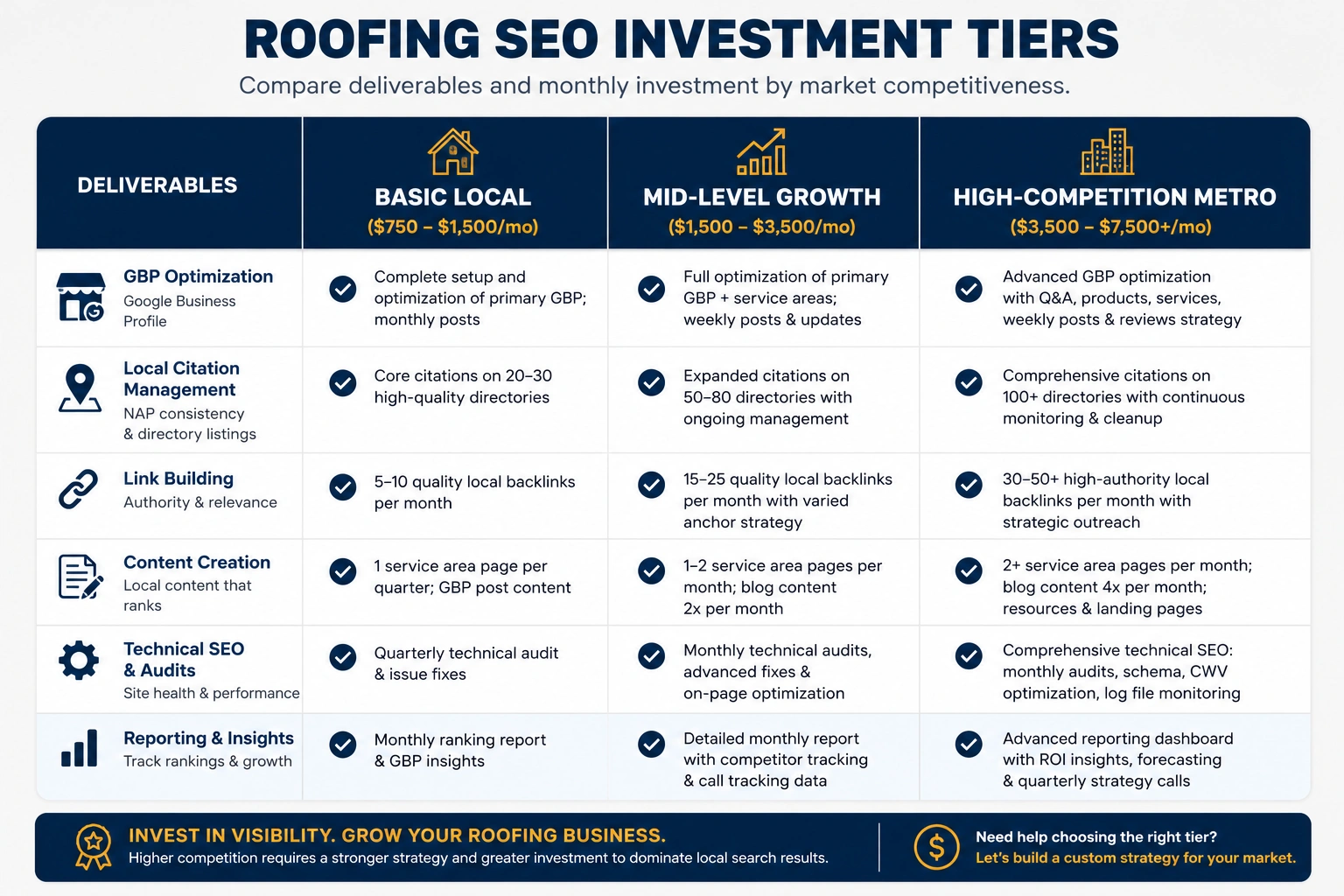
Compare roofing SEO investment tiers to understand the services, deliverables, and monthly budgets for different market sizes.
Comparing organic SEO with paid advertising
1. Investment Per Lead (IPL) Benchmarks
- Mature organic search campaigns deliver exclusive leads, not just website traffic, at $25 to $100 per lead after 12 months of consistent investment.
- Google Ads averages $150 to $350 or more per lead in competitive roofing markets due to aggressive bidding from both local contractors and national lead aggregators.
- Organic visibility provides a structural buffer against rising ad auction prices, a buffer that compounds in value the longer the campaign runs.
2. Lead Sole Ownership and Control
- Organic search leads belong entirely to your business. You own the leads. There are no referral fees and no shared pipelines.
- Shared lead networks sell the same homeowner inquiry to 3 to 5 competing roofers simultaneously, at $50 to $200 per lead, which collapses your margin before the estimate is even scheduled.
- Owning your lead pipeline eliminates the race to the bottom pricing dynamic that shared networks structurally incentivize.
3. Asset Compounding vs. Renting Traffic
- Paid ads function like a water tap: the moment you stop paying, your lead flow drops to zero. Ads stop working instantly.
- SEO builds long-term marketing equity that continues driving calls from nearby homeowners month after month, even during periods when your ad budget is tight.
- Authoritative sites increasingly capture traffic from AI-assisted search features like Google AI Overviews, extending the reach of well-established organic content beyond traditional search result pages.
Key variables that determine your roofing SEO investment
1. Market Population and Competitor Density
- Ranking in a major metro requires substantially more content production, link acquisition, and technical optimization than securing visibility in a rural county seat. The gap is not marginal: it can be the difference between a $1,200 monthly retainer and a $6,000 monthly investment.
- Competitor density directly dictates the volume of authoritative backlinks and local citations needed to establish prominence. In markets where three or four well-funded contractors have been investing in SEO for five or more years, a new entrant faces a meaningful authority deficit that takes time and consistent effort to close.
- Multi-location campaigns require separate, geographically distinct strategies for each physical office, not a single campaign stretched thin across service areas.
2. Current Domain Authority and Technical Health
- A brand-new website requires extensive foundational work: technical architecture, schema implementation, and citation scaffolding, before any ranking movement is realistic. An established site with existing backlink equity can often see early traction within 60 to 90 days.
- Resolving historical Google penalties or severe crawl errors adds upfront cleanup work that extends the timeline before growth-oriented tasks can begin.
- Clean site architecture accelerates how quickly Google indexes new service pages, which matters considerably when you are launching localized landing pages for adjacent suburban markets.
3. Service Scope and Geographic Targets
- Optimizing for multiple service lines, such as residential asphalt shingles, commercial flat roofing, metal roofing, or gutters, multiplies content requirements. Each service line needs its own keyword-mapped page architecture to capture high-intent searches at the category level.
- Targeting several adjacent cities requires unique, substantively differentiated landing pages. Thin location pages with swapped city names are a well-documented liability; Google’s quality systems identify and suppress them with regularity.
- Broad service offerings without a coherent keyword mapping strategy produce diluted authority across too many topics. This is a prioritization failure that looks like a budget problem from the outside.
Ready to build permanent digital equity?
Stop renting your leads from third-party platforms and start building permanent digital equity with a clear strategy. Own your presence. Our team focuses on high-performance local search strategies that turn local customers searching for roofing services into booked inspections. We can help. Explore our tailored digital marketing for roofing companies to receive a customized market analysis and competitive breakdown for your service area.
The realistic timeline for organic growth and leads
Think of SEO like building a roof. You cannot rush the foundation: it needs to be solid before the shingles go on. The results come, but they build over time. Be patient. On average, roofing companies should expect 3 to 6 months of sustained optimization before noticing a material increase in organic lead volume, with the most noticeable gains typically arriving between months 6 and 12. Understanding the realistic SEO timeline before you sign an agreement is the single most important way to set realistic expectations for your business.
Month 1 is almost entirely about what’s actually involved in the setup: technical website audits, directory cleanups, local schema markup, and initial Google Business Profile optimization. Months 2 and 3 bring early signals: minor Map Pack movement, ranking improvements for lower-competition long-tail queries, and the first trickle of organic calls. By months 4 through 6, the compounding effect of content creation and link building begins to manifest as a steady, measurable stream of inbound calls and form submissions from homeowners actively searching for roof replacements and storm damage inspections. The contractors who treat that early period as proof of failure rather than proof of process are the ones who restart the clock every six months. They never reach the point where organic search replaces paid lead sources. Do not quit.
“SEO is not a quick-fix marketing channel; it is a long-term business infrastructure investment. The contractors who commit to a consistent strategy for 12 to 24 months are the ones who ultimately build lasting value and drastically reduce their overall customer acquisition investments.”
Key performance indicators that matter for your business
Vanity metrics are a distraction. Track what counts. Raw impression counts tell you nothing about whether a homeowner picked up the phone. A reputable digital marketing agency will provide monthly reports that tie search performance directly to revenue-generating actions: not rankings for keywords that nobody searches, and not session duration on pages that do not convert. The metrics worth tracking are Google Business Profile call volume, organic form submissions, local search visibility across your full service geography, and website conversion rate. That last figure deserves attention: an unoptimized or template-built roofing site typically converts at 0.5% to 2%, while a properly structured site with strong social proof and prominent trust signals converts at 2% to 5%. The difference between those two ranges, applied to the same volume of organic visitors, can represent several additional booked jobs per month. Integrating the top roofing SEO keywords into your content strategy is the foundation for driving those high-intent actions in the first place.
One underused measurement approach worth adopting is geo-grid tracking. Traditional rank trackers report your position from a single static point, usually the center of a zip code, which gives a misleading picture of how visible you are across a dispersed service area. Tools like Local Falcon and BrightLocal map your rankings across a visual grid of coordinates. This shows exactly where you hold strong positions and where competitors are capturing calls you should be winning. It is a more granular and operationally honest view of local search performance. This is key.
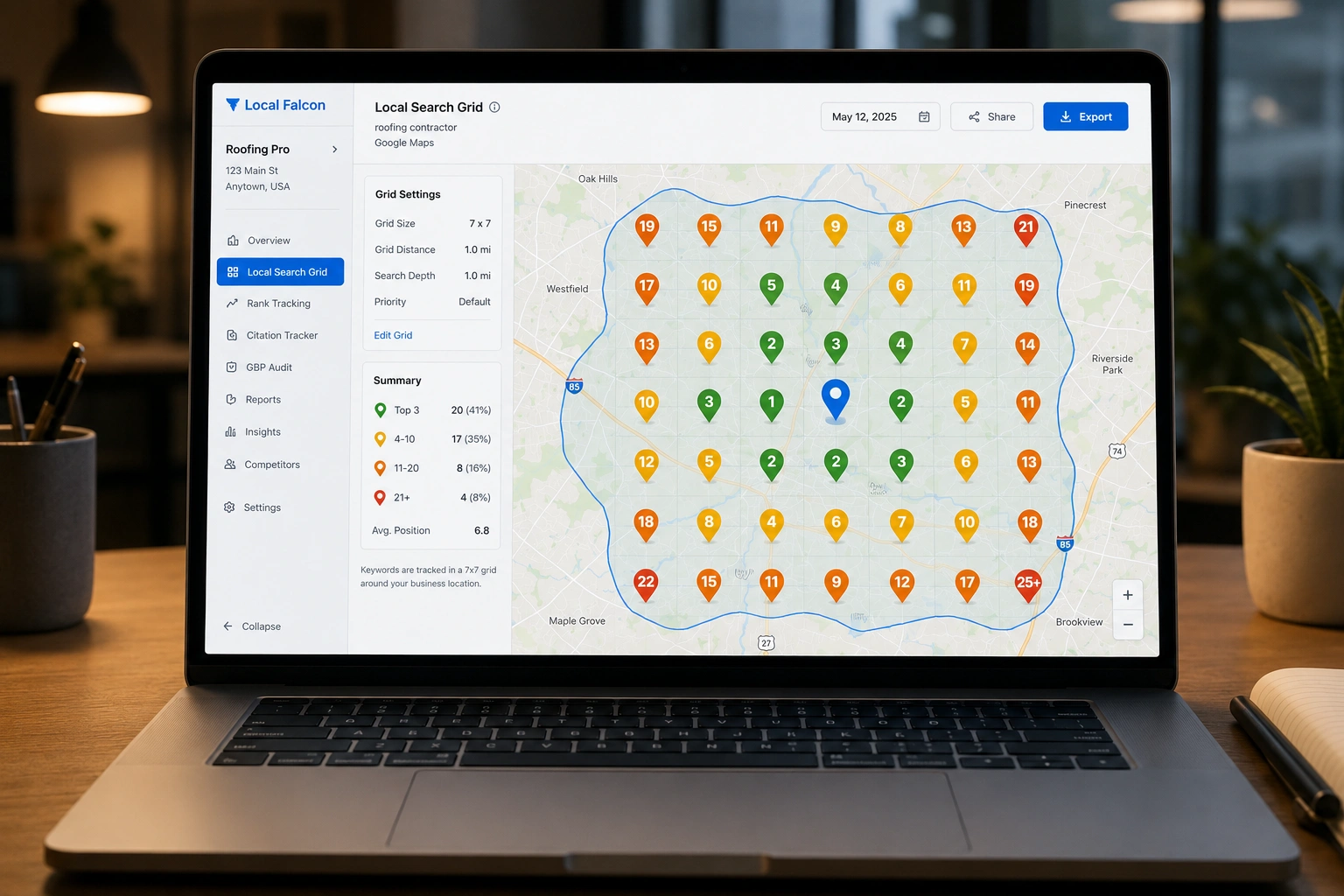
A geo-grid ranking map visualizes local search performance across a service area, helping businesses identify SEO strengths and gaps.
Get a transparent investment estimate for your service area
Wondering what it will take to outrank the top competitors in your specific zip codes? We can assess your local search landscape and provide a clear proposal tailored to your business goals. We make it easy. Read our guide on SEO service costs and discover how we can help you secure more high-ticket roof replacements. Start today.
Essential components of a high-performing campaign
1. Google Business Profile (GBP) Management
- Your Google Business Profile is like your shop’s storefront sign. If the address is wrong or the hours are missing, local customers searching for roofing services will walk right past. Keep it accurate.
- The Google Map Pack captures 42% to 44% of all local search clicks, according to aggregated local search behavior data: this means your profile is often the highest-leverage asset in your entire online presence.
- Maintaining a steady review velocity signals active operations to search engines and builds the social proof that converts a profile view into a phone call.
- Selecting “Roofing Contractor” as the primary category remains the single most impactful setup decision for Map Pack visibility, more so than many on-page factors that agencies spend disproportionate time on.
2. Localized Content Clusters and Service Pages
- Every helpful answer you publish online is like a positive referral from a satisfied customer: it compounds over time.
- Dedicated service area pages and detailed project case studies, structured around specific scenarios like “Asphalt Shingle Replacement after Hail Damage in [Neighborhood],” build the topical authority that broad service pages cannot achieve on their own.
- Developing genuinely useful resources around roofing marketing ideas captures homeowners in both the research phase and the emergency-response mode. These are two audiences with very different content needs. Help them decide.
- Thin or duplicate location pages, where the only variation is a swapped city name, are a documented liability. Google’s quality systems identify and suppress them, and they can drag down the authority of legitimately strong pages on the same domain.
3. Technical SEO and Schema Markup
- Implementing structured data and local schema helps search engines accurately parse your service areas, business category, and review aggregates. This information feeds directly into how your listing renders in rich results.
- Core Web Vitals and mobile page load speeds have a measurable effect on conversion rates, not just rankings. A roofing site that takes four seconds to load on a mobile connection loses a significant share of the homeowners who would have called.
- Secure HTTPS protocols and clean URL structures are foundational. They are not differentiators anymore: they are table stakes.
4. High-Authority Link Building
- Earning relevant, natural backlinks from local business directories, chamber of commerce listings, and regional home improvement publications builds the domain authority that sustains first-page rankings under algorithm updates.
- Placements on industry association sites and trade publications carry disproportionate authority weight relative to the effort required to secure them, making them a highly efficient acquisition target for roofing-specific link building.
- Automated link spam remains the most common way contractors unknowingly damage their own campaigns. If an agency cannot explain exactly where your links are coming from and why those sources are relevant, that is a problem worth pressing on.
Red flags to avoid when hiring a roofing SEO partner
The digital marketing industry has a low barrier to entry, and the roofing space attracts more than its share of underpowered providers making outsized claims. If an agency guarantees a top ranking within 30 days, or offers cheap packages for $199 per month, the math simply does not support the promise. No one controls Google’s proprietary algorithm. The agencies making those claims are typically reselling templated work at a margin, not building anything durable. Cheap packages at that price point almost universally rely on automated link spam, which can result in a manual action penalty that removes your website from search results entirely. The recovery process from a manual penalty is time-consuming, expensive, and never guaranteed. Always ask for verified, roofing-specific case studies. Ask for proof. A generalist agency that has never worked with a contractor operating in a storm-damage market will not understand the seasonal search patterns, the urgency-driven conversion behavior, or the high average job values that shape what a successful campaign actually looks like in this trade.
Frequently asked questions about roofing SEO
We provide direct, transparent answers to the questions roofing contractors ask most frequently when researching investments, timelines, and campaign strategy. Get clear answers.
Common contractor queries answered
How much should a roofing company budget for SEO per month?
Most mid-sized roofing companies should budget $1,500 to $3,500 per month for an all-inclusive campaign. That range covers ongoing content creation, local citation management, Google Business Profile optimization, link building, and monthly reporting. If you operate in a highly competitive metropolitan market, or if you are running a multi-location operation targeting several distinct service areas simultaneously, a budget of $3,500 to $7,500 or more per month is typically required to compete effectively against established local brands and national lead aggregators who have been investing in this channel for years.
Why is roofing SEO more expensive than SEO for other local industries?
Roofing keywords carry exceptionally high commercial intent. Average residential replacements run upward of $10,000, and commercial projects can reach six figures: this means every contractor in your market has a strong financial incentive to rank. That concentrated competition drives up the volume of content, backlinks, and technical optimization required to hold a first-page position. You are not just competing against other local roofers; you are competing against national aggregators with massive domain authority who are also bidding for the same organic real estate.
How do you calculate the ROI of a roofing SEO campaign?
Track your monthly investment against the number of exclusive organic leads generated and your sales close rate. Here is what we recommend and why: a $2,500 monthly investment that generates 20 organic leads, closed at a 25% rate (5 jobs) at an average job value of $10,000, produces $50,000 in attributed monthly revenue, representing a 20:1 return on investment. That math improves as the campaign matures and your cost per lead drops from the $100 to $125 range typical in months 6 through 12 down toward the $25 to $50 range that well-established organic campaigns achieve. The calculation is not complicated; the discipline is in tracking organic leads separately from paid leads so the attribution is clean. We have helped hundreds of small businesses track these numbers to see what is possible based on evidence.
Should I stop my Google Ads campaign once my SEO starts working?
Maintaining both channels is the more defensible strategy. While SEO builds long-term, low-investment-per-lead organic equity, Google Ads provides immediate lead flow and fills the pipeline during the early months when organic rankings are still developing. Running both also lets you occupy multiple positions on the search engine results page simultaneously: paid listings at the top, organic results and Map Pack below. This compresses the visible real estate available to competitors. Most contractors who shut off paid ads the moment organic kicks in find themselves exposed during algorithm fluctuations or seasonal demand spikes.
What is the difference between traditional local SEO and complete SEO?
Traditional local SEO focuses primarily on Google Business Profile management, local citation consistency, and basic on-page adjustments. It is a necessary foundation, but it has a ceiling. A complete roofing SEO strategy encompasses your entire digital ecosystem: advanced technical site architecture, multi-city landing page creation built around genuinely differentiated local content, natural link acquisition, conversion rate optimization, and geo-grid tracking to measure visibility across your full service territory rather than a single zip code centroid. The distinction matters because contractors who invest only in the foundational layer often plateau at Map Pack visibility for their immediate address area while competitors with broader campaigns capture calls from the surrounding suburbs.
Investing in high-quality search engine optimization is the most reliable path to building a sustainable, predictable stream of exclusive local leads for a small business like yours. The contractors who treat it as a long-term infrastructure investment, rather than a monthly bill to be minimized, are the ones who ultimately stop buying shared leads entirely and start fielding more calls than their crews can schedule. Partnering with an agency that understands the seasonal patterns, high job values, and localized search behavior specific to this trade is what separates a campaign that compounds from one that flatlines. We focus on transparent reporting tied directly to revenue, setting realistic expectations grounded in what the data shows rather than what sounds good in a sales pitch.
Take the first step toward local market growth
Do not let competitors capture the high-value roof replacement jobs in your service area. Act now. Our team is ready to build a tailored, high-converting search strategy for your business. Let’s begin. Read our guide on finding an affordable SEO company and discover how we can help you scale your organic lead volume without sacrificing quality or transparency.