
A construction team reviews digital blueprints as a steel high-rise takes shape, highlighting planning, coordination, and commercial development.
- Initial Traction (Months 1 to 3): Laying the digital foundation through technical audits, search console setup, and keyword mapping.
- Organic Movement (Months 4 to 6): Early ranking improvements for local and mid-competition commercial search terms.
- Consistent Lead Generation (Months 6 to 12): Compounding inbound visibility, qualified RFP opportunities, and measurable ROI.
- Average Cost Benchmarks: Regional campaigns range from $1,500 to $3,000 per month; national general contractors range from $3,000 to $7,500+ per month.
If you run a commercial construction firm, you are likely highly doubtful of digital marketing. You have probably received dozens of cold emails promising “instant first-page rankings” or “guaranteed leads overnight.” In an industry where a single project contract can be worth millions of dollars, we know that nothing of lasting value is built in a day. Just like pouring a concrete foundation, search engine optimization requires precise engineering, specialized tools, and, most importantly, time to cure before it can support a heavy structural load.
When hiring a commercial construction SEO agency, understanding what works for commercial construction, what it should cost, and how long until I see results is not just about managing expectations: it is about protecting your marketing capital. Commercial search engine optimization is fundamentally different from residential contractor marketing. The stakes are much higher. You are not targeting local homeowners looking for a quick roof repair; you are targeting B2B decision-makers: developers, corporate real estate directors, architects, and institutional project managers navigating complex, multi-million-dollar procurement cycles. Evaluating these campaigns requires clear timelines, transparent cost structures, and rigorous vetting questions.
Month-by-Month Commercial Construction SEO Timeline:
Days 1 to 30 (Phase 1: Building the Digital Foundation)
The first 30 days are analytical and structural. Clean data is the priority. A professional agency secures administrative access to Google Analytics 4 (GA4) and Google Search Console to establish clean, uncontaminated data tracking from day one: because any reporting built on a broken data foundation is fiction. From there, the team executes a detailed technical website audit to surface crawl errors, broken internal links, mobile responsiveness failures, and page speed bottlenecks that are silently suppressing your rankings.
Simultaneously, deep construction industry keyword research maps out the high-intent B2B search terms your target buyers use. This is where the residential-versus-commercial distinction becomes operationally critical: a procurement officer searching for a “cold storage design-build contractor” uses entirely different language than a homeowner searching for a “roofer near me,” and a generalist agency will almost certainly conflate the two. Baseline organic search visibility is documented, competitor backlink profiles are analyzed, and a structured 30/60/90-day onboarding roadmap is delivered, giving you a concrete schedule of technical optimization milestones rather than vague promises.
Days 31 to 60 (Phase 2: On-Page and Local Optimization)
Phase two is where the technical debt gets paid down. Critical site speed bottlenecks and metadata shortcomings identified in the initial audit are resolved, and existing service pages are optimized for primary commercial keywords including commercial construction SEO and B2B construction SEO services. This is not cosmetic work: metadata precision and page-level keyword alignment directly determine how search engines categorize and surface your pages for relevant commercial queries.
Local citation cleanup runs in parallel. Accuracy here is vital. Google Maps profiles are audited and optimized to capture regional developer searches, NAP (Name, Address, Phone) consistency is enforced across all web directories, and target keywords are mapped to specific landing pages based on documented user intent. For regional subcontractors, such as commercial electrical, HVAC, and masonry firms, this local alignment phase is often the single most effective activity in the entire campaign.
Days 61 to 90 (Phase 3: Content Expansion and Authority Building)
The third phase shifts from correction to construction. A targeted content marketing strategy launches, focusing on the complex pre-construction planning, safety compliance, and project delivery topics that B2B buyers research during their procurement process. High-quality link-building campaigns initiate, pursuing authoritative backlinks from construction industry publications, trade associations, and regional business chambers, not the automated, bulk-link schemes that characterize low-quality agencies.
Project portfolio pages receive conversion rate optimization (CRO) attention, because a developer who lands on a poorly structured case study page will leave without inquiring regardless of how well the page ranks. Structured schema markup is implemented to help search engines parse your firm’s commercial capabilities accurately. The first detailed quarterly progress report is delivered, comparing current rankings and organic visibility against the Month 1 baselines established during onboarding.
During the first 90 days of an SEO campaign, a professional builders SEO specialist focuses heavily on technical health and strategic alignment rather than immediate lead volume. Search engines must crawl, index, and build trust in your newly optimized website architecture before rewarding you with prominent rankings. This phase is the pre-construction and excavation phase of a physical build: invisible to the public, but structurally non-negotiable.
As the campaign transitions into months 4 through 6, you will begin to see early organic traction. Early organic traction emerges as ranking improvements for local and mid-competition commercial terms begin to materialize. By months 6 to 12, that visibility compounds, translating into a steady stream of qualified project inquiries and RFPs.
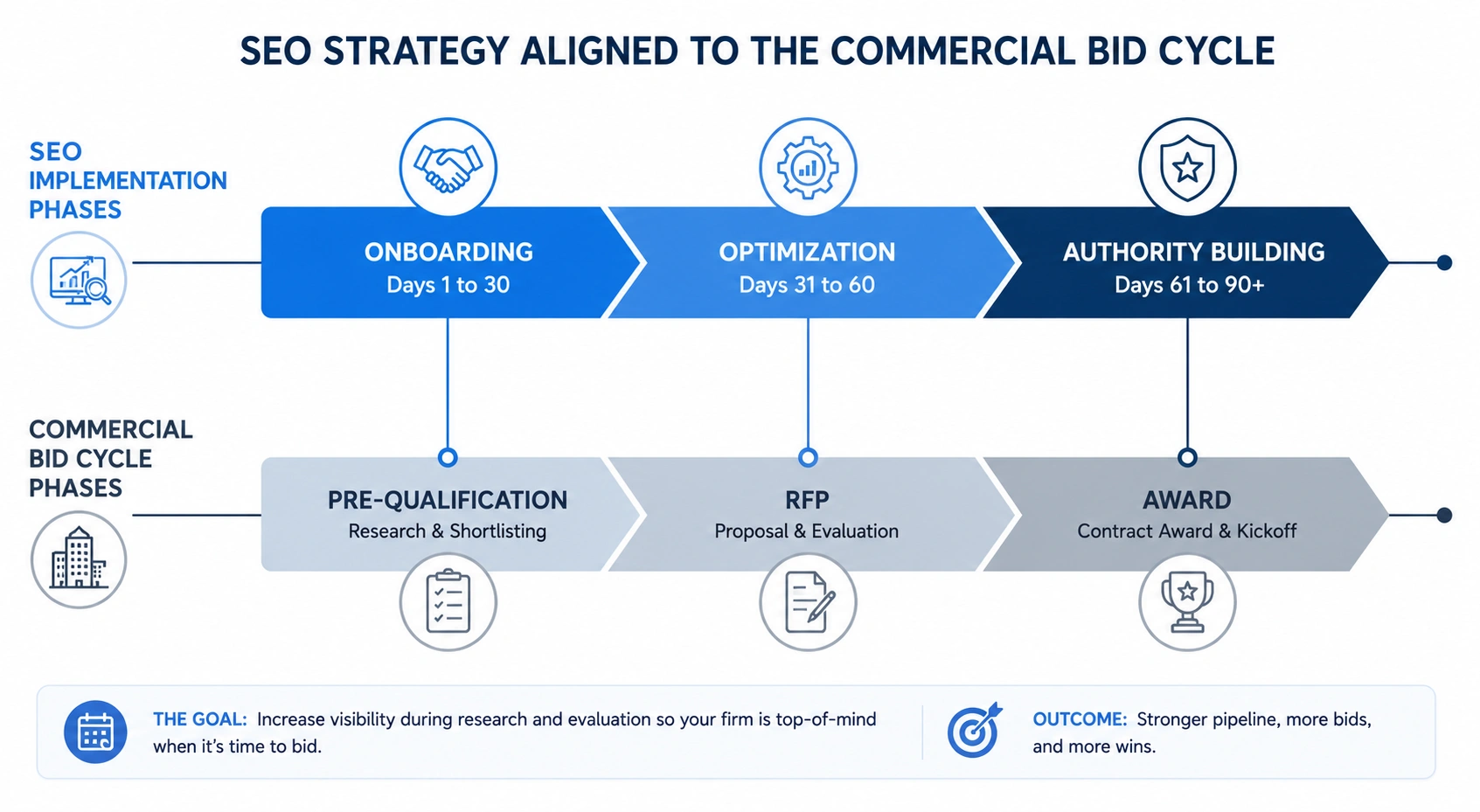
A side-by-side timeline shows how SEO implementation aligns with key stages of the commercial bid process, from pre-qualification through contract award.
Counting the Cost: SEO Pricing Packages for Commercial Contractors
Regional and Local SEO Campaigns
For regional or local campaigns targeting specific metropolitan areas, expect to invest $1,500 to $3,000 per month. This is a standard baseline. The focus is heavily weighted toward local SEO for commercial contractors: Google Maps optimization, localized content creation, regional link building, and ongoing citation management. The return profile here is efficient: you are capturing developers who are already searching for a regional partner, which means the intent is high and the competition is often more manageable than national terms. A commercial electrical firm dominating the map pack in a mid-sized metro can generate a significant share of local subcontract bids relative to its investment. Read our detailed guide on how to find an affordable SEO company without sacrificing quality to help you evaluate proposals.
National and Enterprise Campaigns
Large general contractors, design-build firms, and industrial engineering companies operating across multi-state territories should expect to invest $3,000 to $7,500+ per month. At this level, the work is fundamentally different in scope: deep, authoritative content strategy addressing complex project management, safety compliance, and national pre-construction planning; aggressive competitor analysis SEO to identify the keyword gaps and backlink opportunities that separate your firm from established national players; and a sustained brand-positioning effort designed to secure placement on prestigious B2B bid lists. This is not a campaign that runs on autopilot: it requires active strategic management. It demands constant attention.
Project-Based and Technical SEO Audits
One-time technical interventions, such as website migrations, structural audits for new brand launches, or recovery from a sudden organic traffic collapse, typically range from $2,500 to $10,000 as a flat fee. These engagements are diagnostic and corrective, not growth-oriented. They fix existing errors. They resolve deep crawl architecture issues and establish a clean technical foundation. They do not include ongoing content creation or link building, which means they function as a starting point rather than a self-sustaining pipeline. Most firms that commission a technical audit transition into a monthly retainer once the structural issues are resolved.
- Monthly Retainer Model: The industry standard for ongoing optimization, content creation, and link building, ensuring your site remains competitive as algorithms and competitors evolve.
- Cost Drivers: Pricing is determined by geographic scope, keyword competition, and the depth of technical optimization required, not by random tier packages.
- Danger of Cheap SEO: Packages priced under $1,000 per month often rely on automated software, outsourced low-quality content, or spammy backlinks that can trigger search engine penalties and damage your domain’s long-term credibility.
- Investment Alignment: Your SEO budget should align with your average project contract value; a single closed commercial bid can easily offset years of SEO investment.
Why Commercial Construction SEO Differs from Residential and Local SEO
B2B Search Intent vs. B2C Consumer Searches
Residential SEO targets high-volume, transactional keywords like “emergency roof repair near me” where a homeowner makes a decision within minutes based on proximity and price. Commercial SEO operates in a different register entirely. The buyer is a professional procurement officer or corporate real estate director, and the search query looks more like “cold storage design-build contractor” or “LEED-certified commercial general contractor multi-state.” Volume is low. Intent is precise. And the decision timeline is measured in months, not minutes.
Specialized commercial construction SEO services build trust and technical credibility rather than offering discounts or urgency triggers. Content must address the topics that B2B buyers examine during due diligence: EMR safety ratings, bonding capacity, pre-construction capabilities, and project delivery methodology. Success is measured by the quality of project inquiries, whether they are coming from qualified developers with real RFPs, not by raw traffic volume. A site drawing 500 qualified commercial visitors per month outperforms one drawing 5,000 residential homeowners every time. Partner with a specialized agency that offers targeted construction company SEO services tailored to your specific business goals.
The Role of Local Map Pack Visibility for Regional Subcontractors
National general contractors and regional subcontractors have meaningfully different optimization priorities, and confusing the two is a common strategic error. While national firms benefit most from deep thought-leadership content and domain authority, regional specialty trades, such as commercial concrete, structural steel, and commercial HVAC, derive outsized value from local map-pack visibility.
Developers assembling bid lists for regional projects frequently search for local specialty trades to satisfy local hiring requirements or reduce logistics complexity. A query like “commercial masonry contractor [City]” is low-volume but carries enormous procurement intent. These searches are highly valuable. Optimizing your Google Business Profile with commercial project photography, verified client testimonials, and accurate service categories is not a cosmetic exercise: it is a direct lever on your regional bid pipeline. Consistent NAP data across all web directories reinforces local search engine trust, functioning as a digital signpost that confirms your firm’s physical presence and operational legitimacy.
- Longer Sales Cycles: Commercial construction sales cycles can last 6 to 18 months, requiring SEO content that nurtures leads from initial research through to final RFP submission, not just content that captures a single transactional moment.
- Multi-Stakeholder Decision Making: Commercial content must address the informational needs of project managers, CFOs, and architects simultaneously, because all three may interact with your digital presence before a contract is awarded.
- Portfolio-Centric Optimization: High-quality project case studies with technical specifications, such as scope, square footage, delivery method, and safety record, are critical for converting B2B search traffic into qualified inquiries.
- Low-Volume, High-Value Keywords: Targeting highly specific, low-competition commercial terms is more profitable than chasing broad, high-volume terms that attract unqualified residential traffic or job seekers.
Is your website positioned to win high-value commercial bids?
Don’t let your competitors dominate the search results. Partner with a specialized commercial construction SEO agency that understands the B2B bidding process.
Measuring SEO Success in the Commercial Sector
Key Performance Indicators (KPIs) That Matter
Vanity metrics are a distraction. Focus on real business outcomes. Organic impressions and session counts tell you almost nothing about pipeline health unless they are connected to the specific pages and keywords that attract commercial buyers. The KPIs that matter are: organic search rankings for high-intent commercial keywords (not broad industry terms), organic traffic growth on service pages and project portfolio pages specifically, and, most critically, the conversion rate from organic visits to qualified RFP inquiries or direct phone calls.
Google Search Console is the most reliable instrument for tracking organic impressions and click-through rates on high-priority service pages, and any agency that isn’t surfacing this data in monthly reports is either not monitoring it or not optimizing for it. Backlink profile growth is a secondary but meaningful indicator: specifically obtaining high-authority links from construction industry publications, regional business associations, and trade organizations, not the volume of low-quality directory submissions.
Financial Benchmarks and ROI of Organic SEO
The financial case for organic SEO in commercial construction is not ambiguous. The numbers speak for themselves. Organic SEO leads in the construction sector average $31 to $35 per lead, while paid search (PPC) leads range from $109 to $165.67 per lead: a cost differential that compounds dramatically at scale. Organic search traffic in the commercial construction sector achieves an average 35% to 38% conversion rate from initial site visit to qualified project inquiry, according to a 2026 report. This is a remarkably high conversion rate for any B2B channel and reflects the precision of intent-matched commercial keyword targeting.
To accurately measure the success of your digital marketing, we must move beyond vanity metrics like raw traffic volume. A sudden spike in website visitors is meaningless if those visitors are homeowners seeking residential repairs or candidates browsing your careers page. A specialized contractor search marketing expert will configure advanced tracking in Google Analytics 4 to isolate commercial search intent, filtering by keyword type, landing page, and conversion event, so that your reporting reflects actual pipeline activity rather than inflated session counts.
Furthermore, because the sales cycle for commercial construction projects is exceptionally long, often lasting from 6 to 18 months, the financial impact of your SEO campaign will have a delayed but compounding effect. An organic lead captured in Month 6 may not produce a signed contract until Month 12 or Month 18. Evaluating your ROI timeline requires a time-based frame that matches your industry’s procurement reality, not a 30-day performance window borrowed from e-commerce.
“In the commercial construction sector, SEO is not an expense; it is a capital investment. Unlike paid ads that stop delivering leads the moment you stop paying, organic search optimization builds a permanent digital asset that continues to generate high-value RFPs for years to come.” – Commercial Construction Marketing Association
Real-World Proof: Case Studies in Commercial Construction SEO
Fuel Online Texas Commercial Construction Campaign
A Texas-based commercial construction SEO campaign executed by Fuel Online targeted high-value regional general contracting keywords. The campaign achieved a 116% increase in project inquiries and a 226% boost in overall organic search visibility within 12 months. These results are substantial. The strategy centered on three pillars: technical site health correction, local citation optimization, and high-intent commercial content creation targeting developers searching for regional partners. The results confirmed that a structured, geographically focused SEO strategy has a direct and measurable impact on regional bid opportunities, not just on traffic dashboards.
ZAG FIRST Full-Funnel B2B Lead Generation
A full-funnel SEO and B2B lead generation campaign for a commercial builder focused on high-intent keyword clusters and transitioned the firm from zero inbound leads to 4 to 6 qualified commercial leads per month within 6 months. Executed by ZAG FIRST, the campaign secured 103 first-page keyword rankings for highly specialized commercial construction terms. The critical strategic decision was targeting low-volume, high-intent keyword clusters aligned with the specific informational needs of commercial project managers, not the broad, high-competition terms that generalist agencies default to. The outcome confirmed the low-volume, high-intent approach in a way that traffic-volume metrics alone never could. Quality beats quantity.
Brandignity Technical and On-Page Campaign for Egan
A technical and on-page SEO campaign for Egan, a commercial construction and HVAC firm, executed by Brandignity focused on resolving deep site architecture issues. The campaign delivered a 12% ranking increase within the first 30 days of optimization. This rapid improvement occurred because Egan’s site had significant unresolved technical crawl errors that were actively suppressing its rankings; fixing them produced an immediate trust signal to search engines. It is a clean demonstration of why technical SEO is the non-negotiable foundation, and why firms that skip the audit phase and jump straight to content creation are building on unstable ground. A solid base is essential.
These real-world examples demonstrate that when you hire a specialized commercial construction SEO agency, the results are measurable and directly tied to business growth. Whether you are a regional subcontractor looking to dominate local map packs or a national general contractor seeking multi-million-dollar bids, a structured SEO campaign delivers a compounding return on investment that paid advertising simply cannot duplicate over time.
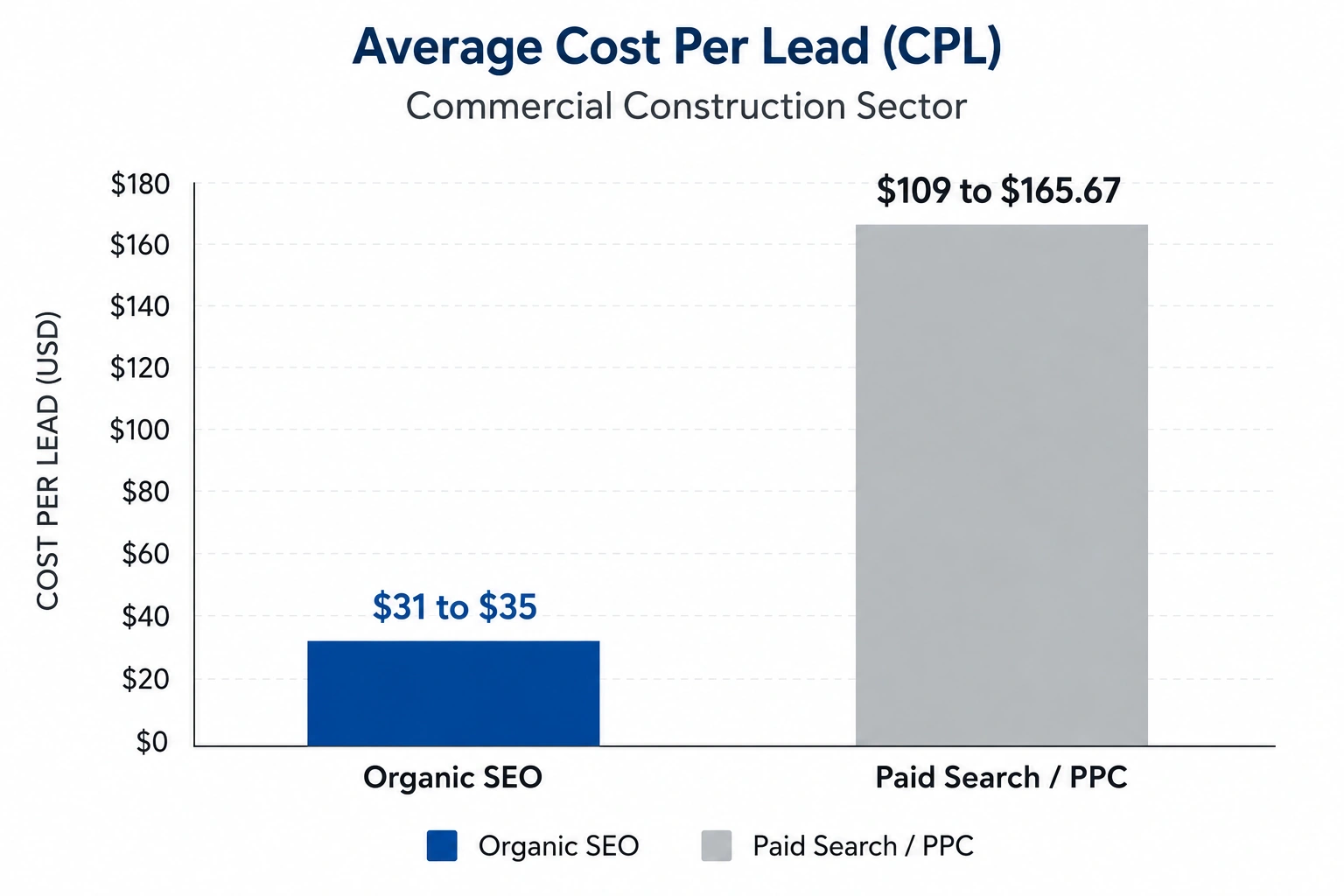
A simple bar chart compares the average cost per lead for organic SEO and paid search, highlighting the lower acquisition cost of SEO.
Want to see how we helped a real construction firm scale their organic lead flow? Read our detailed construction case study to see how we design and execute high-impact SEO strategies that deliver measurable business growth. Explore the Holloway Construction Case Study Now.
Red Flags to Avoid When Hiring an SEO Agency
Guaranteed First-Page Rankings and Instant Results
No agency can guarantee a specific ranking position. Search engine algorithms are proprietary, continuously updated, and deliberately opaque: Google has made this explicit in its own documentation. Any agency promising first-page placement within days or weeks is either describing black-hat tactics that will eventually trigger a manual penalty or simply misrepresenting how organic search works. A professional agency will commit to a realistic timeline, such as 3 to 6 months for initial traction and 6 to 12 months for pipeline-impacting results, and will measure progress through transparent, documented metrics rather than ranking screenshots taken at convenient moments. A legitimate agency will never promise overnight rankings.
Avoid agencies that refuse to explain their optimization methodology or deflect questions about their link-building sources with references to “proprietary processes.” Legitimate SEO work is explainable. If an agency cannot walk you through their technical audit findings, their content strategy rationale, or the specific publications they are targeting for backlinks, that lack of clarity is informative. Identifying these warning signs early protects your marketing budget.
Lack of Transparency and Outsourced Work
Many generalist agencies outsource content creation and link building to low-cost providers who have no familiarity with commercial construction, and the content they produce reflects that. A blog post written by someone who cannot distinguish between a design-build delivery method and a construction management at-risk contract will not build topical authority with commercial buyers or search engines.
Demand transparency on three specific points: who is writing your content, who is performing your technical audits, and where your backlinks are originating. You should also confirm, in writing, before signing, that you retain full ownership of your website assets, Google Analytics data, and all published content if you end the engagement. Agencies that resist this provision are signaling that they plan to use your assets as bargaining chips. This is unacceptable.
- Vague Reporting: Avoid agencies that report only on impressions or traffic spikes without connecting those numbers to keyword ranking progress or lead conversions.
- No Industry Experience: A generalist agency that cannot distinguish residential from commercial bidding intent will spend your budget attracting the wrong audience.
- Lack of Content Strategy: If a proposal does not include original, high-quality content creation, the agency cannot build the topical authority required to rank for competitive commercial keywords.
- Spammy Link Building: Promises of hundreds of backlinks delivered quickly are a reliable indicator of low-quality link schemes that will damage your domain’s long-term credibility.
Key Questions to Ask a Prospective Builders SEO Specialist
Vetting for Industry Expertise and Commercial Intent
These questions are designed to separate specialized B2B marketers from agencies that have simply added “construction” to their service page. These are the critical questions to ask before you hire any agency: Do not skip this step.
- What specific experience do you have marketing B2B commercial construction or industrial engineering firms? Ask for case studies with documented outcomes, not testimonials.
- How do you differentiate between residential search intent and commercial developer search intent in your keyword targeting? A qualified specialist will explain the distinction fluently and give you concrete examples of the commercial keyword clusters they would target for your firm.
- Who owns our website assets, analytics data, and content if we choose to terminate the contract? The answer should be clear: you do, always.
- How do you approach content creation for complex construction topics? Ensure they employ B2B writers with demonstrable knowledge of pre-construction processes, safety compliance frameworks, and project delivery methodologies.
- What is your strategy for building high-quality, industry-relevant backlinks? They should describe a deliberate outreach process targeting construction publications, local business chambers, and trade associations, not a software-automated submission queue.
Aligning Expectations on Deliverables and Communication
Operational clarity matters as much as strategic capability. Demand clear answers. Before signing, establish:
- What specific deliverables will we receive during the first 30, 60, and 90 days? A professional agency will reference a structured onboarding roadmap with documented milestones.
- How often will we receive reports, and what metrics will be highlighted? Look for reports that connect organic traffic to keyword rankings and lead conversion events, not just session counts.
- Who will be our primary point of contact, and how often will we have strategy calls? You need a dedicated account manager, not a rotating support queue.
- How do you stay current on Google’s algorithm updates, and how do you adjust strategy accordingly? Continuous adaptation is not optional in SEO: it is the work.
- What is your pricing model, and are there hidden fees or long-term contract lock-ins? Transparent pricing that aligns with your business goals is a baseline expectation, not a premium feature.
Asking these targeted questions during the vetting process is the most reliable way to protect your marketing investment. A thorough builders SEO specialist FAQ session should leave you with a clear picture of the agency’s technical capability, industry knowledge, and operational transparency. Hesitation or avoidance in response to these questions is diagnostic information.
Frequently Asked Questions on Commercial Construction SEO
How much does SEO cost for a construction company?
Understanding seo for construction company cost starts with geographic scope and competitive concentration. Prices vary widely. For regional or local campaigns targeting specific metropolitan areas, expect to invest $1,500 to $3,000 per month. National or enterprise campaigns targeting multi-state territories or highly competitive industrial niches typically run $3,000 to $7,500+ per month. One-time technical projects, such as website migrations, structural audits, or post-penalty recovery, range from $2,500 to $10,000 as a flat fee.
Cost is driven by three primary variables: the geographic breadth of the campaign, the competitive intensity of your target keyword set, and the depth of content creation and link-building services required. A specialty subcontractor targeting a single metro will have a materially different cost profile than a national design-build firm competing for enterprise-level industrial contracts. For a detailed framework on evaluating proposals, our guide on how to find an affordable SEO company without sacrificing quality walks through the specific criteria that separate legitimate value from false economy.
How long until I see results from commercial construction SEO?
Initial organic search visibility and ranking improvements for lower-competition terms typically emerge within 3 to 6 months. Meaningful pipeline impact, such as a consistent flow of qualified commercial leads and RFPs, materializes between 6 and 12 months. High-competition metropolitan markets or national campaigns targeting dominant competitors may require 9 to 18 months to achieve first-page positioning on the most valuable terms.
SEO is a compounding asset. It requires patience. The technical and content work executed in the first 90 days continues generating organic traffic and authority for years: it does not expire when you stop paying for a given month’s deliverables the way a PPC campaign does. Align your timeline expectations with realistic business cycles rather than expecting overnight results.
Is SEO worth it for commercial contractors compared to PPC?
The cost differential is significant. SEO is highly efficient. Organic SEO leads in the construction sector average $31 to $35 per lead; paid search leads range from $109 to $165.67 per lead. That gap widens further when you account for the 35% to 38% conversion rate that organic commercial traffic achieves from initial site visit to qualified project inquiry: a conversion rate that reflects the precision of intent-matched keyword targeting rather than broad ad audience targeting.
PPC delivers immediate visibility and has a legitimate role in short-term lead generation, particularly during the first 6 months before organic rankings mature. A balanced strategy uses paid search to fill the pipeline while organic authority builds. Over a 2-to-3-year period, however, the compounding nature of organic SEO makes it the lower-cost, higher-return channel by a substantial margin.
How do I know if my SEO company is working?
Your agency should provide a structured 30/60/90-day onboarding roadmap at the start of the engagement and deliver regular monthly reports that connect organic activity to business outcomes. Specifically, you should see: steady growth in organic search impressions and clicks for target commercial keywords in Google Search Console, measurable increases in organic traffic to service pages and project portfolio pages, and, most critically, a documented count of RFP inquiries and phone calls generated through organic search.
Agencies that report only on traffic volume without connecting it to keyword rankings or lead conversions are either not tracking the right metrics or not producing the right results. Demand full accountability. For a detailed breakdown of what performance-based reporting should look like, our guide on what to look for in the best SEO company covers the reporting standards and accountability structures that separate serious partners from order-takers.
What is included in a standard commercial construction SEO package?
A full-scale campaign from a qualified agency covers five functional areas. Each area is critical. Technical optimization addresses site speed, mobile responsiveness, crawl error resolution, and schema markup implementation. On-page optimization covers keyword mapping, metadata precision, and existing service page refinement. High-quality content creation produces authoritative blog posts, project case studies, and landing pages written for B2B buyers, not homeowners. Authority building pursues high-quality backlinks from industry-relevant publications, local business directories, and trade associations. Local SEO management maintains your Google Business Profile, citation consistency, and regional map-pack positioning.
At BizIQ, these services are integrated into a structured campaign architecture designed specifically for construction firms, with dedicated account management and transparent monthly reporting. Explore our targeted construction company SEO services to see how each component is scoped and executed for your specific business goals.
Choosing the right digital marketing partner is one of the most critical decisions you will make for your commercial construction firm’s growth. By understanding the realistic timelines, cost structures, and vetting criteria outlined in this guide, you can avoid the common pitfall of hiring a generalist agency and instead engage a specialist who understands the procurement cycles, buyer psychology, and technical complexity of your industry.
At BizIQ, we deliver transparent, evidence-based SEO strategies aligned to your business goals. We treat your digital presence with the same precision and engineering discipline that you bring to your physical job sites: no inflated promises, no opaque processes, and no shortcuts that create liability down the road. We build a solid digital foundation and execute the structured work required to generate measurable, compounding results for your commercial construction firm.
Ready to build a predictable pipeline of commercial construction leads?
Don’t leave your online visibility to chance. Partner with a trusted SEO marketing company that specializes in the construction industry. Schedule your free, no-obligation commercial SEO audit and timeline consultation with BizIQ today.