
What this guide covers:
- Local Pack Dominance: How to secure a top-3 spot on Google Maps and drive immediate phone calls.
- Service-Page Architecture: Why a single “Services” page is killing your search rankings and how to fix it.
- Symptom-Based Search Content: Capturing high-intent drivers before they even know which part is broken.
- Connecting SEO to Shop Revenue: How to turn search engine optimization and digital marketing into a higher Average Repair Order (ARO).
How do Auto Repair Shops use SEO to Keep Their Service Bays Full?
Auto repair shops fill their bays by dominating hyper-local emergency and maintenance search intent by users. Success requires optimizing your Google Business Profile for specific vehicle repair keywords, earning steady local reviews, and providing immediate, direct answers about service pricing and diagnostics that AI search engines can seamlessly surface and cite.
When a driver hears a grinding noise from their brakes or watches their check engine light flicker on, their first move is almost always the same: they grab their phone and search. That search is the exact moment your shop either wins a customer or loses one to a competitor down the street. Visibility is everything. With over 235,000 auto repair shops across the U.S. competing for visibility, where you rank on Google directly governs how many phones ring in your service bays each week. At BizIQ, we’re a small business ourselves, and we know that every single car count matters. We believe that sophisticated marketing belongs to you, not just the massive national chains with unlimited budgets. We operate by standing beside, not above or behind, our clients. Here is what works and why to get your shop found online.
Unlike social media posts or billboard ads, search traffic is high-intent traffic. A driver searching for “brake repair near me” isn’t window shopping; they have a broken car, a real deadline, and immediate booking intent. To capture this demand, your shop must be visible where these decisions are made: Google’s Local Pack and organic search results. By implementing a targeted strategy for auto repair shop marketing, you can position your shop as the immediate, trusted solution to an active automotive emergency. This visibility helps you connect with drivers when they need your expertise most.
Why Auto Repair SEO is Different (and More Profitable)
Auto repair search is driven by urgency, trust concerns, and service specificity in a way that most other local industries simply aren’t. Car owners don’t browse: they need help now, and they carry a historically deep skepticism about getting overcharged. Speed wins. Capturing that intent requires addressing both the search query and the trust gap at the same time. Google’s own research shows that 76% of people who conduct a local search on their smartphone visit a related business within 24 hours. That conversion speed is unmatched by other marketing channels, which makes local search engine optimization the most productive driver of new customer acquisition for shops operating in competitive metro markets.
Think of local SEO like your shop’s main highway billboard: if it’s blank, hard to read, or pointing the wrong way, drivers in a hurry will cruise right past your exit. The numbers get more compelling when you look at what happens after the click. According to Search Engine Land‘s 2025 Google Ads benchmarks, the automotive repair, service, and parts industry achieved a 14.67% conversion rate: the highest-performing local service category measured. That figure reflects the problem-aware, urgency-driven nature of the audience. When someone searches for a mechanic, they are rarely in the consideration phase; they need a resolution. To intercept that demand effectively, your digital presence must be engineered for mobile-first indexing, because between 65% and 80% of emergency mechanic searches originate on mobile devices. A slow-loading site or a layout that collapses on a phone screen isn’t just a minor technical issue. It is a direct transfer of repair orders to whoever ranks below you.
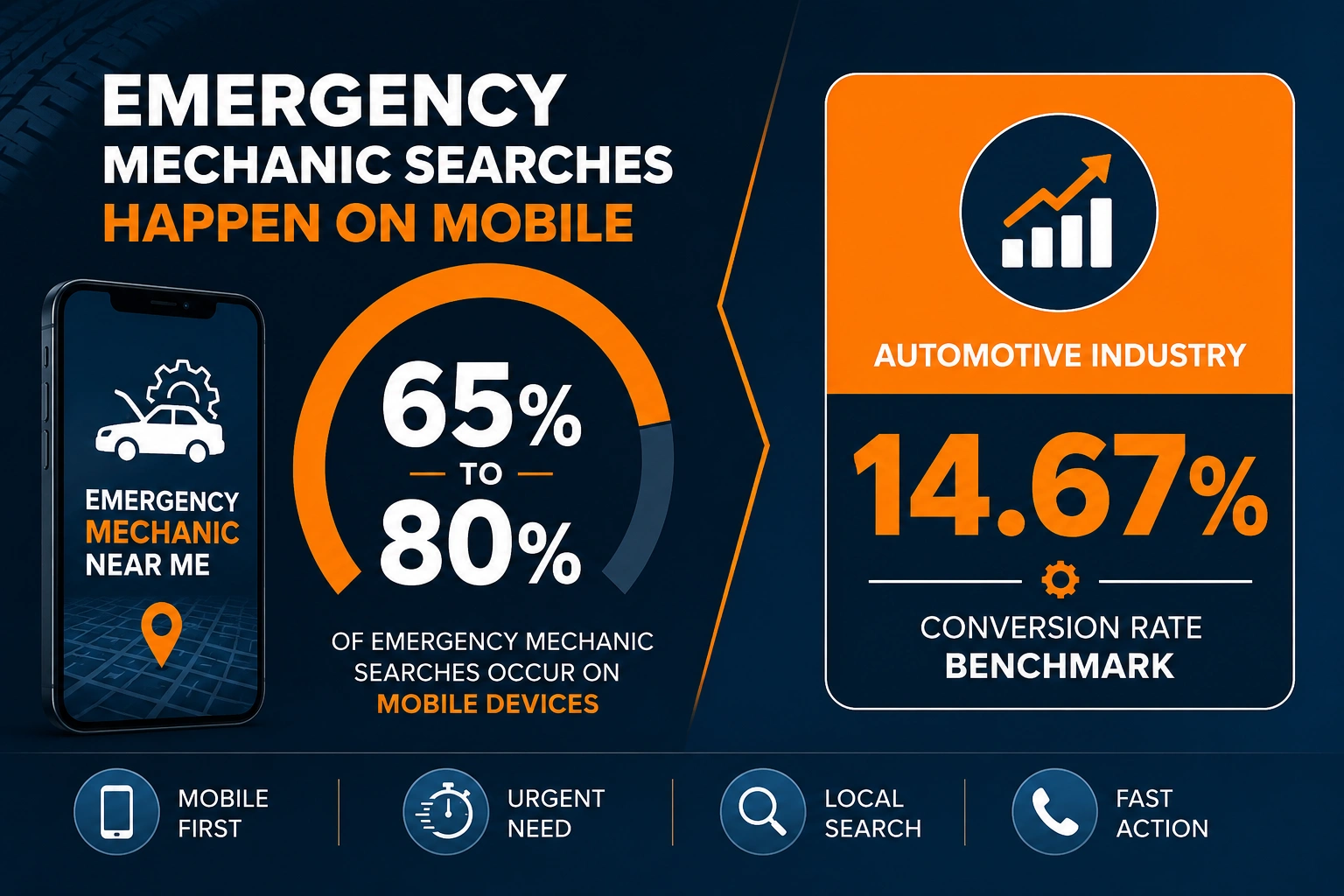
Emergency auto repair customers rely on mobile search, with 65%–80% of searches occurring on smartphones and a 14.67% industry conversion benchmark.
The 3-Step Local Pack Dominance Strategy
Ranking in Google’s Local Pack: the map-based cluster of three results that appears above organic listings, is the fastest path to inbound phone calls. The three actions below are sequenced by impact.
- Claim and Verify Your Google Business Profile (GBP)
Your GBP is the single most weighted signal in the Local Pack algorithm. Verification through Google’s process gives you editorial control over your listing data. Set your primary category to “Auto Repair Shop” to align with the highest-volume searches in your market, then layer in secondary categories: “Brake Service,” “Oil Change Service,” and “Transmission Repair” to capture narrower, high-intent queries that your competitors often leave uncontested. Every field in your profile is a signal; leave none blank. Details matter. Your business description should read naturally while incorporating the services and geography that matter most to your shop. Google Business Profile for auto mechanics is not a set-it-and-forget-it asset; it is a living document that Google rewards for completeness and recency. - Build a Systematic Review Generation Process
BrightLocal reports that 77% of consumers regularly read online reviews before choosing a local business. That figure has held steady for years, which tells you something about how deeply ingrained review-checking has become in the pre-purchase decision. The operational lever most shops underuse is timing: send an automated SMS or email review request within one hour of invoice close, while the positive service experience is still fresh. Shops with 60 or more reviews convert Google Maps impressions to direction requests at roughly double the rate of shops sitting below 25 reviews. That gap isn’t about star rating. It is about volume signaling trust at scale. Each new review is like a customer standing in your parking lot, telling everyone walking by that your mechanics know their stuff. Mechanic shop reputation management is not a passive activity; it requires a deliberate, repeatable workflow baked into your service advisor’s closing routine. - Maintain Weekly Profile Activity
Google interprets profile inactivity as a signal that a business may be inactive or disengaged. Publishing weekly GBP posts: seasonal maintenance reminders, new service announcements, and team photos from the shop floor: communicates active customer care to both the algorithm and the prospective customer scanning your listing at 7 PM on a Tuesday. AC recharge promotions in April, battery check reminders in October: these posts cost almost nothing to produce, and they keep your profile’s activity score elevated relative to competitors who post once a quarter.
Building a Service-Page Architecture That Converts
A single “Services” page is one of the most common structural mistakes we see on auto repair websites. Google needs a clear-cut, focused signal to rank a page for a specific query. When you list brake repair, transmission service, AC diagnostics, and engine work on a single page, you are diluting the relevance signal for all of them simultaneously. None of them rank with the authority they would if each had its own dedicated page. Think of your website like your physical service bays: you wouldn’t try to align an alignment rack, a tire changer, and a brake lathe all in a single tight corner. Each service needs its own dedicated space to operate cleanly.
- Create Dedicated Pages for Core Services
Build individual, substantive pages for every high-margin service your shop performs. Brake Repair, Transmission Service, Engine Diagnostics, AC Repair, and Oil Change each deserve its own URL, its own H1, its own body content, and its own call to action. This architecture is a foundational pillar of optimizing your local business for search engines, and it’s the structural change that most consistently produces measurable ranking improvements within 60 to 90 days of implementation. Thin pages won’t hold. Each page needs enough depth: service explanation, process transparency, trust signals, and local context: to satisfy both the search engine and the skeptical car owner reading it at midnight. This is an evidence-based method to earn search visibility. - Optimize URLs and Headers for Local Intent
City name and neighborhood terms belong in your H1 headers, title tags, meta descriptions, and body copy; but they need to read like a human wrote them, not like a keyword list got pasted into a sentence. Clean, localized URLs like yourshop.com/brake-repair-phoenix reinforce geographic relevance at the structural level. Keyword research for car repair shops at the page level means identifying the exact phrasing your local market uses, such as “transmission shop near me” versus “transmission repair [city],” and matching your page architecture to that phrasing rather than to what sounds most professional. - Place CTAs and Trust Signals Above the Fold
Mobile users should be able to tap-to-call or book an appointment without scrolling. That’s not a preference. It is a conversion requirement given how the majority of your inbound traffic arrives. ASE certifications, warranty information, and financing options displayed prominently above the fold address the consumer trust gap before the visitor even reads your service description. Auto repair lead generation lives or dies on the friction between a visitor’s intent and your site’s ability to convert that intent into a phone call or booking in under 10 seconds.
The Power of Symptom-Based Search Content
Car owners rarely search for technical terms like “catalytic converter replacement.” They focus on symptoms. They search for what they’re experiencing: “rotten egg smell from car,” “car shaking when braking,” “squealing noise when turning.” The gap between what a technician calls a problem and what a driver calls it is wide, and that gap is where a significant volume of uncontested search traffic lives. By aligning your automotive repair content marketing strategies with these symptom-based queries, you reach customers at the very beginning of their research phase: before they’ve committed to a shop, before they’ve called anyone, and before price becomes the primary decision variable.
When you build blog posts that diagnose common symptoms and link them directly to your core service pages, you create a navigational path from “What is this sound?” to “Here is the local shop that can fix it.” This approach compounds over time in a way that promotional content simply doesn’t. Real-world data from shops that have transitioned away from discount-driven content toward authority-based, symptom-focused writing shows a measurable shift in customer quality: fewer one-time oil change chasers, more customers who approve multi-point repair recommendations because they already trust your shop’s diagnostic credibility before they walk through the door. That shift protects your margins and builds a healthier long-term customer pipeline. It is worth acknowledging that tracking this shift requires deliberate post-visit retention monitoring, because aggregate traffic numbers alone won’t tell you whether your new content is attracting the right customers.
“Car owners don’t search for technical solutions; they search for their car’s symptoms. Meet them at the symptom, and you’ll win the repair.” —BizIQ Automotive Marketing Team
Technical SEO Foundations Most Shops Get Wrong
Page speed and mobile responsiveness are direct ranking factors, not aspirational best practices. Speed is critical. Given that the majority of emergency mechanic searches happen on mobile devices, a slow-loading site is a revenue leak with a measurable dollar value attached to it. The most widespread culprit is uncompressed imagery: high-resolution photos of your shop, your team, and your equipment uploaded directly from a camera roll without optimization. Compressing those images and ensuring your site passes Google’s Core Web Vitals thresholds can produce immediate improvements in mobile load time, keeping frustrated drivers on your page instead of bouncing back to the search engine results page and clicking on the shop ranked below you.
Beyond image compression, two technical issues consistently surface in our auto repair website optimization audits: missing or misconfigured AutoRepair schema markup and broken NAP (Name, Address, Phone) consistency across directories. Schema markup, specifically the AutoRepair type from Schema.org, feeds structured data directly into Google’s knowledge graph, increasing your eligibility for rich snippets and voice search results. NAP inconsistency, on the other hand, erodes the trust signals that local search algorithms use to verify your business’s legitimacy. A shop listed as “Joe’s Auto” on Google, “Joe’s Auto Repair” on Yelp, and “Joe’s Automotive LLC” on the BBB is sending fragmented signals that suppress Local Pack rankings even when every other optimization is executed correctly. These aren’t glamorous fixes. They are the unglamorous infrastructure that everything else depends on.
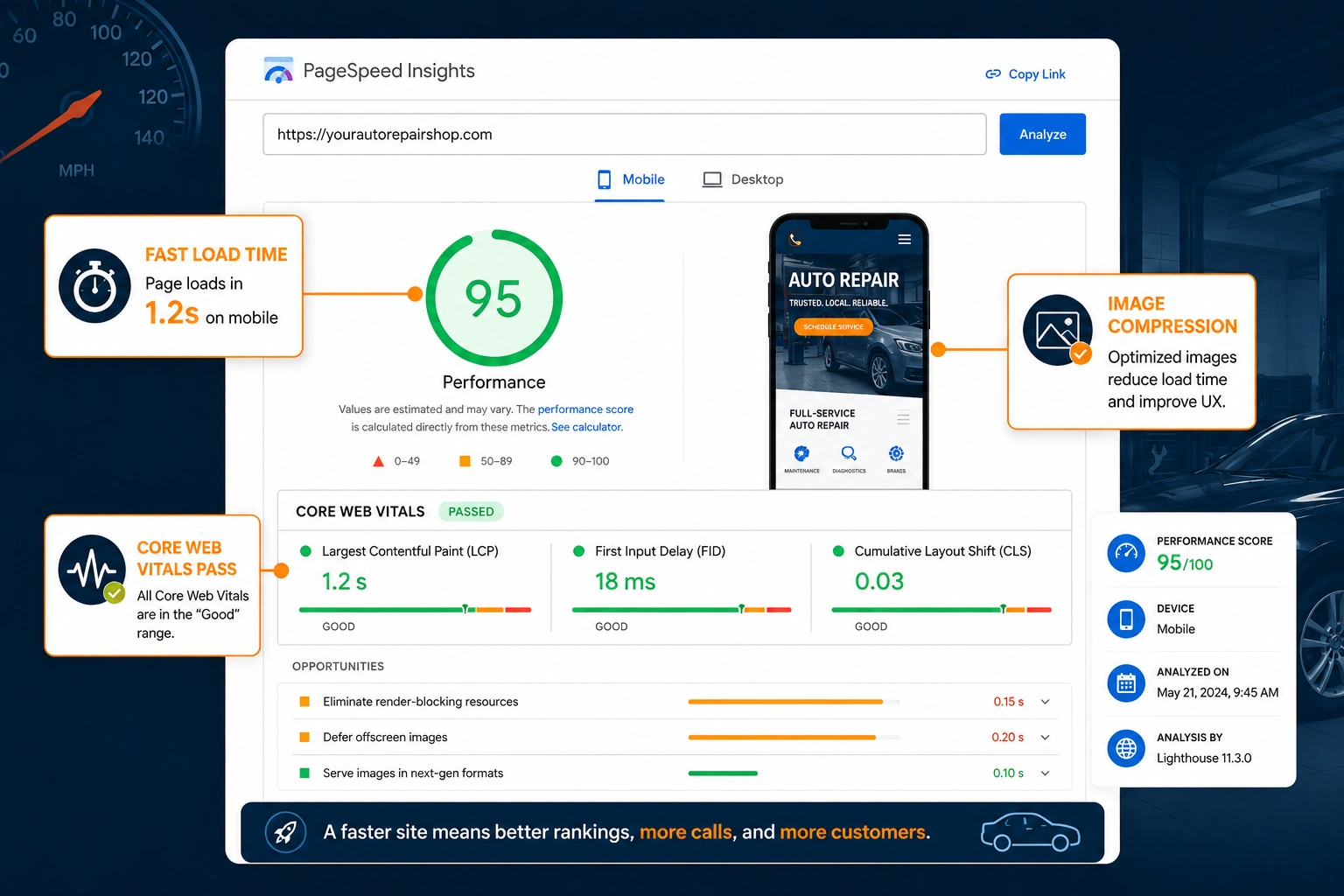
A 95/100 mobile PageSpeed score demonstrates strong site performance, Core Web Vitals compliance, and optimized user experience.
Is your website holding you back from ranking?
Get Your Free Auto Repair SEO Audit to identify hidden technical errors, check your mobile speed, and see exactly where your shop stands in local search rankings.
Connecting SEO to Your Average Repair Order (ARO)
Getting a driver through your digital front door is one problem. Getting them to approve the full scope of recommended repairs is a separate and equally important one. The shops that understand this treat SEO and in-shop conversion strategy as a single system rather than two unrelated departments.
- Implement Digital Vehicle Inspections (DVIs)
Technicians perform inspections on tablets, attaching photos and videos of worn components directly to the repair estimate. Visual proof builds trust. When your SEO-driven landing pages explain this process upfront: describing how your shop uses DVIs to give customers complete visual transparency into what needs repair and why: you pre-sell the trust that converts a cautious customer into an approved ticket. The customer who arrives already knowing you use photo documentation is far less likely to decline a recommendation they can see with their own eyes. - Boost ARO with Visual Proof
The ARO data here is worth sitting with. According to industry benchmarks from the PartsTech 2025 State of General Auto Repair Shops Report and the Tekmetric dataset, shops using DVIs average an ARO of $741, compared to $612 for shops without them. This is a 21% increase driven almost entirely by transparency, not upselling pressure. SEO brings the customer through the door; DVIs secure the ticket value once they’re there. These two levers compound each other: higher car counts from search visibility multiplied by a higher per-ticket average produce a revenue outcome that neither strategy achieves independently. - Present Good/Better/Best Estimates
Tiered repair options, consisting of a basic fix, a recommended repair, and a complete long-term solution, reduce price resistance by giving customers a sense of agency rather than a binary yes-or-no decision. This structure aligns naturally with the trust-building work your content marketing is already doing. A customer who found your shop through a symptom-based blog post, read about your DVI process on your service page, and arrived already confident in your expertise is far more receptive to a tiered estimate than a cold walk-in who knows nothing about your shop. Automotive repair marketing and in-shop conversion strategy are not separate disciplines; they are sequential stages of the same customer journey.
Measuring What Matters: SEO KPIs for Shop Owners
Ranking position alone is a vanity metric. A shop ranking fourth for “brake repair” with 40 monthly Google Business Profile call clicks is generating measurable revenue, while a shop ranking second with only five clicks has a conversion problem that no amount of additional optimization will solve until the conversion issue is diagnosed and fixed. The metrics that directly connect to car count are GBP call clicks, direction requests, and organic landing page conversions tracked in Google Analytics, not keyword position reports that look impressive in a monthly PDF but don’t tell you whether your phone rang. We focus on these metrics because of the positive impacts we make on our small business partners.
Google Search Console is equally underused by most shop owners. It provides clarity. It reveals the exact queries driving impressions and clicks to your site, which means you can identify symptom-based searches you’re appearing for but not yet ranking well enough to capture consistently. That data should directly inform your next round of content production. To see how these metrics translate to real-world shop growth, our auto repair case study for Half Price Auto Repair documents how targeted local optimization produced direct, measurable improvements in car count and revenue, not just traffic numbers. Organic search results don’t lie about intent: the customers who arrive through them are already looking for exactly what you offer.
Frequently Asked Questions (FAQs)
Understanding the subtleties of search engine optimization can feel disorienting when you’re also running a shop, managing technicians, and tracking parts inventory. Time is limited. These answers address the specific operational challenges of managing local search visibility alongside daily shop operations.
Common Auto Repair SEO Questions Answered
Does SEO work for small, independent auto repair shops or only big chains?
Yes. Independent shops carry a structural advantage in local SEO that most owners don’t fully appreciate. Google’s Local Pack prioritizes proximity, relevance, and review velocity over corporate budget size. A well-optimized independent shop with a consistent stream of fresh reviews will regularly outrank a national chain in its immediate neighborhood, because the algorithm is designed to surface the most locally relevant result, not the most heavily funded one. Small businesses are the backbone of innovation and the heartbeat of America, driving America forward. Local search algorithms, whatever Google’s broader intentions, functionally reflect that by keeping the competitive playing field more level than most shop owners assume.
How long does auto repair SEO take to show results?
Technical website fixes and Google Business Profile optimizations can yield measurable visibility improvements and increased inbound calls within 30 to 90 days. A thorough local SEO strategy: dedicated service pages, content production, citation building, and link acquisition: typically takes 4 to 6 months to generate a consistent, compounding stream of organic traffic and service bookings. The compounding part matters. Unlike paid ads that stop the moment you stop funding them, organic search equity builds over time and continues delivering returns without a proportional increase in spend.
Should I put keywords in my Google Business Profile name?
Only if those keywords are part of your legal, registered business name. Adding terms like “best mechanic” or “brake repair” to your GBP name can produce a short-term ranking lift, but it violates Google’s guidelines and puts your profile at genuine risk of a hard suspension: a penalty that wipes out your entire local search presence, often without immediate recourse. We’ve seen shops lose months of ranking equity overnight because of this shortcut. Building long-term authority through legitimate on-page optimization, structured schema markup, and authentic local link building is slower, but it doesn’t carry the existential risk of a profile suspension.
Do auto repair shops need separate pages for each service?
Yes. Google needs a focused, unambiguous relevance signal to rank a page for a specific search. A single “Services” page listing ten different repairs sends a weak signal for all of them, which is why shops with that architecture rarely rank competitively for high-intent terms like “transmission repair [city].” Creating dedicated service pages is one of the best practices for mechanic website SEO that produces the most consistent, measurable ranking improvements. It is the fix that most shops can begin implementing without waiting on a full site redesign.
How do I get more Google reviews for my mechanic shop?
Ask immediately after service delivery. Send an automated text message or email with a direct link to your Google review form as soon as the customer pays their invoice. The window of maximum willingness is narrow: it closes fast as the customer moves on with their day. Automation is the mechanism that makes this consistent rather than dependent on a service advisor remembering to ask during a busy afternoon. Training your advisors to mention the review request in person and explaining why it matters to your shop specifically also increases response rates meaningfully. Customers who feel a personal connection to a small business are more likely to take 90 seconds to leave a review than customers who feel like they just transacted with a faceless operation.
Dominating your local market requires a consistent, structured approach to both local and technical SEO, and there’s no clean shortcut that replaces the foundational work. By optimizing your Google Business Profile, building dedicated service pages, generating reviews systematically, and aligning your content with how drivers search, you can turn search engine visibility into a predictable stream of high-value repair orders. If you’re evaluating specialized partners for this work, it’s worth exploring options like top SEO companies for collision repair specialists and general automotive repair to find a team that understands the industry’s specific conversion dynamics, not just generic local SEO tactics.
Ready to fill your bays and scale your shop’s revenue?
Partner with a team that treats your business like our own. Explore our affordable SEO services or contact us today to build an automotive industry digital marketing strategy tailored to your shop’s unique goals..