Should Painting Contractors Do Their Own SEO or Hire an SEO Agency?
The right choice depends on the allotted time, budget, and growth goals. DIY SEO can work for painting contractors who have the time to learn about and manage their website, but hiring an experienced SEO agency typically delivers faster, more sustainable results through expert strategy, technical optimization, content creation, local SEO and AI search optimization. The best long-term approach is the one that consistently increases your online visibility, qualified leads, and booked painting jobs.
Every painting contractor eventually hits the same wall. While word-of-mouth referrals might carry your painting business through the busy spring and summer months, the phone often goes quiet when winter arrives, and you are left wondering how to fill your schedule. You know you need to show up on Google. The core question is: should you handle SEO yourself or hire help?
If you have been researching SEO for painting contractors DIY vs agency, you have already waded through a swamp of aggressive sales pitches and vague promises. This breakdown skips the fluff. The honest tradeoff is that neither path is universally correct. It comes down to three concrete factors: your available time, your local market’s competitiveness, and your current marketing budget.
Think of it like painting itself. For minor touch-ups around your own office, you grab a brush. A multi-story commercial repaint with specialized equipment and tight deadlines? Pulling yourself off the tools to handle that solo does not just risk the finish: it pulls you away from running the business that pays for everything else. SEO operates on the same logic.
What DIY SEO Realistically Delivers (And Where It Stops)
You do not need a computer science background to improve your presence in local search. The basics are straightforward. For painting contractors operating in small towns or mid-sized suburban markets, a few focused hours per week can produce genuine, measurable visibility, all without spending a dollar on an agency.
Local search for home service businesses is predominantly driven by the Google Map Pack: the three-business cluster that appears at the top of local search results alongside a map. That box captures nearly half of all local search clicks, and the tools to compete for it are entirely free. You can win this space. That is not a minor detail: it means a well-executed DIY effort can directly compete with businesses spending thousands per month on professional campaigns, at least in markets where the competition is not deeply entrenched.
The DIY Scope of Work
If you take the DIY route, your weekly and monthly workload revolves around real-time, operational tasks that require your direct involvement anyway. This is What DIY Realistically Gets You when you focus on the basics:
- Claim and verify your Google Business Profile (GBP). Your business name, address, and phone number must be exact and consistent with what appears on your website. Any discrepancy diminishes credibility with Google’s local algorithm.
- Set your primary category to Painting Contractor. Secondary categories like Drywall Contractor or Pressure Washing Service are fine additions, but your primary category needs to reflect your core trade without ambiguity.
- Upload project photos every week. Fresh, high-quality before-and-after images signal active business operations to Google. This is not a one-time task: it is a weekly habit.
- Build a review request system. Reviews are the single most influential variable in Map Pack rankings. Sending a review request via text or email within 24 hours of job completion, while the experience is still fresh for the homeowner, is the most reliable way to accumulate them consistently.
What DIY Realistically Gets You
In a low-to-moderate competition market, for example, a suburban area where fewer than 15 competitors have surpassed 100 reviews, a well-maintained GBP and a steady review cadence can land you in the top three Map Pack positions. That is not a minor achievement. For many painting contractors, that position alone generates enough inbound leads to keep two or three crews booked.
The ceiling, however, is real. GBP optimization and review accumulation will not build the domain authority needed to rank your website for competitive keywords across multiple service areas.
Where Agencies Add Value: The Technical and Scalable Work
As your business expands into new service areas or moves into a denser metro market, the work required to maintain and grow your search presence transitions from operational to technical. This is where agencies add real value. It requires specialized skills. They focus on the infrastructure work that most contractors do not have the time or background to implement correctly: not just managing your GBP, which is best handled in-house, but scaling your digital presence. This is where growth happens.
The Agency Scope of Work
A professional local SEO campaign involves deep optimizations that happen in the backend of your website. These are invisible to visitors but critical to how search engines evaluate and rank your pages:
- Implementing Schema Markup. Specifically LocalBusiness and Service schema: structured code that tells search engine crawlers exactly what services you offer, which geographic areas you cover, and where your business is physically located. Without it, crawlers are making educated guesses.
- Optimizing Core Web Vitals. Google’s page experience signals are a ranking factor, and mobile load speed is the one that bites painting contractor websites most often. An agency works to get your mobile pages loading in under 2.5 seconds: a threshold that most template-built contractor sites fail to meet out of the box.
- Building a Localized Backlink Portfolio. A link from your local Chambers of Commerce, neighborhood associations, or industry-specific directories carries more weight for local rankings than a generic directory listing. Agencies build these relationships methodically, which is time-consuming work that does not fit neatly into a contractor’s schedule.
- Deploying Programmatic Location Pages. Ranking across five suburbs requires five distinct, high-quality service-area pages, not five versions of the same page with the city name swapped out. Agencies build these with content depth to avoid duplicate content penalties while capturing geographic search intent and building authority.
Real-World Proof: The Power of Professional SEO
Valley Creek Painters in the Twin Cities, MN offers a concrete demonstration of what consistent professional execution produces. In late 2024, they had zero monthly organic traffic, ranked for only 8 keywords, and held a Domain Authority of 5, essentially invisible to search engines. They were virtually invisible. After implementing a structured local technical SEO strategy that included monthly optimized blog content, schema markup, and dedicated service pages, their organic traffic climbed to over 1,500 monthly organic visitors by March 2026. Their local search traffic share expanded from 10% to 48% of the total competitive traffic share in their market.
A separate case study from Lockedown SEO tracked a residential painter in a major US city who started with zero organic leads and complete reliance on paid ads and lead aggregators. Three months into a local SEO engagement focused on content depth, website restructuring, and GBP optimization, the contractor reached Page 1 rankings and generated tens of thousands of dollars in profit from organic search within the first six months. Neither of these outcomes happened overnight, and neither happened through GBP management alone. Results take time.
The Contractor SEO Self-Assessment Checklist
Before you make any decision, run your business through this framework. It will not give you a perfect answer, but it will tell you which direction the evidence points.
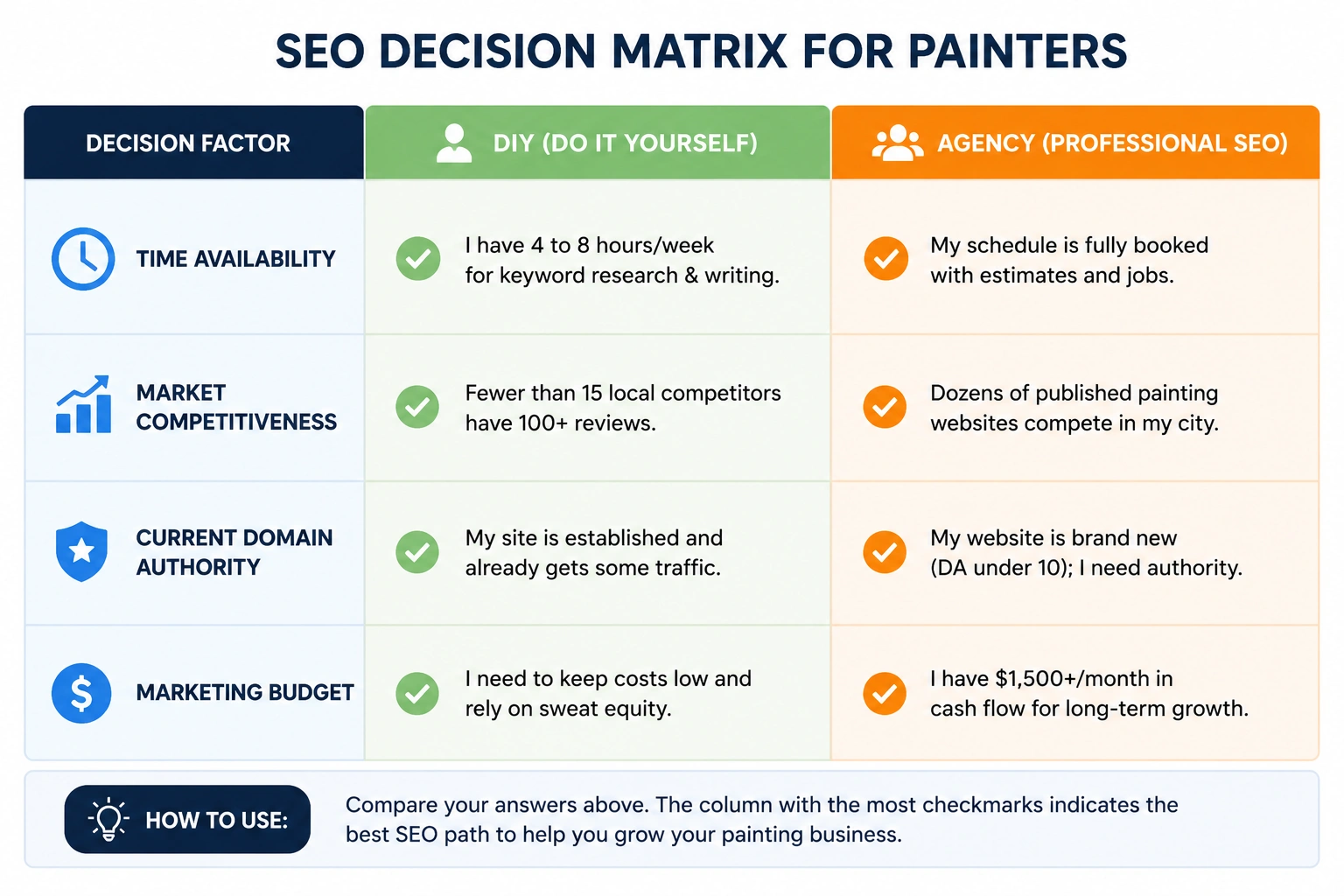
Decision matrix helping painting contractors choose between DIY SEO and hiring an agency based on key business factors.
TIME AVAILABILITY: Evaluate whether you realistically have 4 to 8 hours per week to dedicate to keyword research, content writing, and citation building. If yes, I have 4 to 8 hours/week for keyword research & writing. (DIY). If you are already running crews, writing estimates, managing subcontractors, and handling customer service at 60 hours a week, then My schedule is fully booked with estimates and jobs. (Agency). Pretending that bandwidth exists will result in a half-maintained web presence that underperforms both options. Be honest with yourself.
MARKET COMPETITIVENESS: Open an incognito browser tab and search “painter [your city].” Count how many competitors appear with more than 100 reviews and professionally built websites. If you find Fewer than 15 local competitors have 100+ reviews. (DIY), you can compete on your own. If Dozens of polished painting websites compete in my city. (Agency), you are in a high-competition market. That level of Market Competitiveness requires technical SEO and systematic link building to break through.
CURRENT DOMAIN AUTHORITY: A brand-new website with a DA under 10 is starting from scratch in terms of search credibility. If My site is established and already gets some traffic. (DIY), you have a head start. If My website is brand new (DA under 10); I need authority. (Agency), expect a time-to-results gap of 12 to 18 months to rank organically without professional support. An agency can compress that window through targeted content strategy and building authority: not eliminate the wait, but shorten it. This is the reality of Current Domain Authority.
MARKETING BUDGET: The math here is basic. Do you have at least $1,500 per month in unallocated cash flow that you can commit to a 6-to-12-month campaign without depending on it to generate immediate survival-level leads? If I have $1,500+/month in cash flow for long-term growth. (Agency), hiring help is a justifiable investment. If I need to keep costs low and rely on sweat equity. (DIY), free local tools and sweat equity are the appropriate starting point. This is not because agencies are not valuable, but because the timing is not right yet. This is the tradeoff of your Marketing Budget.
The Financial Math: Calculating Your Opportunity Cost
The instinct to DIY is usually framed as saving money. But is it? It is worth stress-testing that assumption with actual numbers.
Eight hours per week managing your website, writing blog posts, and troubleshooting technical SEO issues adds up to 32 hours per month. If your effective hourly rate, whether measured by what you charge for labor or what you would earn bidding and closing a new job, is $100 per hour, those 32 hours represent $3,200 per month in lost earning capacity. If those same hours could have been spent winning a $10,000 exterior repaint, the DIY approach is not saving you money: it is costing you the difference.
The other side of this equation is lead quality. It matters immensely. High-intent organic search leads for home service contractors convert at an average rate of 16% from lead to sale. This figure reflects the intent behind someone who searched for a painter, found your site, and called you directly. Social media marketing, by comparison, delivers roughly a 4% conversion rate. The gap is not insignificant: it is the difference between a channel that fills your schedule and one that generates occasional inquiries.
Lead Generation Cost Comparison (2025-2026)
When you look at cost per lead across channels, the long-term economics of organic search are hard to question:
| Marketing Channel | Average Cost Per Lead (CPL) | Conversion Rate (Lead-to-Sale) | Real-World Context |
|---|---|---|---|
| Organic SEO | $15 to $60 | 14% to 16% | Compounds over time; lowest long-term cost. |
| Google Local Services Ads (LSAs) | $20 to $40 | 10% to 15% | Highly cost-effective; strong for immediate leads. |
| Google Standard PPC Ads | $70 to $150 | 5% to 10% | Fast results, but expensive in competitive markets. |
| Shared Lead Platforms | $25 to $80 | Under 10% | Leads are sold to multiple painters simultaneously. |
Paid ads and platforms can generate work quickly. That speed costs money. But they stop the moment you stop paying, and shared platform leads arrive pre-competed: the same homeowner has already received quotes from two or three other painters before you pick up the phone. Organic search delivers leads that found you specifically, and once your rankings are established, those leads do not carry a per-click price tag. They are yours.
The Hybrid Path: The Best of Both Worlds
The choice is not either-or. Many of the most consistently booked painting contractors operate on a hybrid model that divides responsibilities, allocating technical work to digital specialists while keeping customer-facing tasks in-house where they can be executed with genuine local authenticity.
There are things an agency simply cannot do for you. They cannot photograph your freshly completed projects. They cannot text a satisfied homeowner from the job site while the experience is still fresh. They cannot update your GBP with accurate holiday hours or post a timely photo of a standout commercial project. These tasks require your physical presence and direct client relationships, and they are also the tasks that carry the most authenticity signal for local search.
What an agency handles in this model: technical site speed optimization, schema markup deployment, backlink acquisition, and the construction of authoritative, localized service pages. What you handle: real-time review collection, weekly project photography, and keeping your GBP current. Neither side is doing the other’s job, and the result is a local presence that is both technically sound and genuinely human.
Pairing this long-term organic effort with Google Local Services Ads (LSAs) for immediate lead generation is a practical bridge strategy. LSAs average $20 to $40 per lead and deliver high-intent contacts while your organic authority is still maturing. You are not choosing between short-term and long-term: you are running both tracks simultaneously.
The “Renting vs. Owning” Debate in SEO
As you evaluate agency options, you will encounter two fundamentally different business models: and the distinction matters more than most contractors realize before they have signed a contract.
Some agencies structure their engagements as long-term monthly retainer agreements ranging from $1,500 to $3,000 per month. Ongoing optimization is genuinely necessary in competitive markets, so the retainer model is not inherently problematic. The problem arises when an agency builds your website on a closed-source platform they control. Cancel the retainer, and you may lose your rankings, your website, or both. That is not a partnership: it is a dependency.
The alternative model, a one-time build at a flat fee of around $1,500, hands you a professionally designed, technically optimized website that you own outright. You handle the ongoing updates yourself. The tradeoff is that you are responsible for keeping the content fresh and the technical elements maintained, which requires either time or a willingness to learn.
Complete ownership is the non-negotiable principle here. Whatever path you choose, you must retain 100% control of your domain, your website files, your Google Business Profile, and your Google Analytics accounts. If an agency builds your digital presence on a domain they register, you do not own your own business’s online identity. That is a risk no contractor should accept, regardless of how compelling the pitch sounds. Before committing to any agency, make sure you understand exactly how to choose an affordable SEO agency that operates with full transparency on asset ownership, ensuring that you retain complete administrative access to all accounts from day one.
It is also worth noting that if you are currently using a template-based website builder, the technical limitations of those platforms can compromise even a well-executed SEO strategy. The structural constraints of DIY website builders (such as slow load times, limited schema support, and restricted URL structures) create a ceiling on what any optimization effort can achieve.
Frequently Asked Questions
How much does SEO cost for a painting contractor?
A professional local SEO agreement typically runs between $1,500 and $3,000 per month in 2026 for a standard single-to-multi-town campaign. This varies by market. For smaller operations, some agencies offer a one-time optimized website build at a flat fee of around $1,500, which establishes a solid technical foundation without locking you into ongoing monthly fees. It saves money.
How long does it take to see leads from local SEO?
Google Business Profile optimization can produce noticeable Map Pack visibility improvements within 3 to 6 months. It is a process. Building domain-level organic authority, the kind that ranks your website for competitive service keywords in a major metro area, typically requires 12 to 18 months of consistent effort. There is no shortcut to that timeline, and any agency claiming otherwise is worth questioning carefully. Be patient.
Can I do SEO myself without any technical background?
Yes, for the basic layer. Managing your GBP, uploading weekly job photos, and collecting customer reviews within 24 hours of project completion are impactful tasks that require zero coding knowledge. Where technical background becomes relevant is at the website level: if your site has structural issues or loads slowly on mobile, you will want professional development rather than a template fix. The limitations of DIY website builders tend to surface precisely at the point where your SEO efforts start gaining momentum. That is when you scale.
What are the red flags of a bad contractor SEO agency?
Three behaviors should end the conversation immediately: guaranteed first-page rankings (no one can guarantee this), refusal to grant you full ownership of your domain and GBP, and pricing under $500 per month (which almost always signals automated tactics that risk a Google penalty rather than sustainable optimization). Walk away immediately. A reputable agency will explain what they are doing and why, not just send a monthly report with green arrows. Demand transparency.
How do I move from DIY SEO to an agency?
Audit your ownership before you hand anything over. Protect your assets. Confirm that your domain is registered in your name, your GBP is verified under your Google account, and your Google Analytics property belongs to your business email. When you bring an agency in, give them access, not ownership. Keep control. Provide your past search data and existing assets so they are building on what you have established, not starting over on infrastructure they control.
Here Is What We Recommend
The decision between DIY and hiring help is not a permanent commitment. Your needs change. It is a reflection of where your business stands today, and the right answer will change as your market position, revenue, and available time evolve.
If you are a new business with more hours than budget, start with the DIY path. Nail your Google Business Profile, build a consistent review cadence, and write clear service pages that describe what you do and where you do it. Our guide on SEO local search strategies covers the foundational mechanics in detail if you want a structured starting point.
If you are an established business trying to lead a competitive metro market, the situation shifts. Your time is worth more than the hours it takes to learn technical SEO from scratch, and the gap between a well-executed professional campaign and a self-managed one widens significantly in dense markets. That is where small business digital marketing services that handle the technical complexity (schema, backlinks, location pages, and Core Web Vitals) start paying for themselves in booked jobs rather than just rankings.
For a parallel look at how this plays out in a comparable trade, our guide on SEO for plumbers documents how the same technical optimization principles drive real phone calls in a market with nearly identical competitive dynamics to residential painting.
We specialize in digital marketing for painting companies and work with contractors at every stage: from first-time GBP setup to aggressive multi-location campaigns. If you want a clear-eyed read on your local market, your current website’s technical health, and the most direct path to steady organic leads, reach out. We will give you an honest assessment, not a sales pitch. Let’s talk.