
What you’ll learn in this post:
- Why a single services page keeps your business invisible to high-intent local searchers.
- How to build a dual-axis content matrix matching every pest type to every service city.
- The technical secrets to writing unique local content that avoids Google’s duplicate content filters.
- How to structure your internal linking to build massive topical authority in your market.
Why Does a Pest Control Website Need a Page for Every Pest and Every City?
A pest control website should have a dedicated page for every pest it treats and every city it serves because customers search for specific pest problems in specific locations. Creating optimized pages for each pest and service area helps search engines and AI-powered search platforms better understand your expertise, improves local search visibility, and increases the likelihood of attracting qualified leads looking for pest control services in their area.
A single, generic services page is the single most expensive structural misstep a pest control company can make. It collapses distinct search intents into one URL, and in doing so, renders your business invisible to customers who are actively searching for a specific pest solution in a specific city. Capturing high-intent organic traffic requires a different structural approach entirely: a dual-axis content matrix, which is a disciplined grid of dedicated pages for every pest type crossed against every service location, built without triggering Google’s duplicate content filters.
When a homeowner discovers a bed bug infestation in their master bedroom, they are not searching for general pest control. They are searching for bed bug heat treatment in [City Name]. They need immediate help. If your website lists bed bugs alongside ants, spiders, and termites on a single broad services page, Google will almost always surface a competitor who has a dedicated, tightly optimized page for that exact pest and location. Failing to map your services to the precise way people search is not a minor oversight: it is a systematic transfer of high-value leads to your competitors, one query at a time.
The cost of collapsing search intent into one page
Keyword dilution and search engine confusion
Listing termites, mosquitoes, and rodents on a single page does not make that page more useful in Google’s eyes. It makes it less relevant for every individual query. Search engines assign relevance scores at the page level, and a page that attempts to serve five different pest intents simultaneously will rarely rank at the top for any of them. The algorithm is not rewarding breadth; it is rewarding precision.
Consider a market like Nashville. A homeowner searching “termite treatment Nashville” and a homeowner searching “mosquito spraying Nashville” represent two completely different search intents, two different emotional states, and two different service transactions. Combining both on one page forces Google to make a judgment call about which intent the page primarily serves. It will usually guess wrong, or more precisely, it will decide the page is not authoritative enough for either query to justify a top-three placement.
The financial risk here is not abstract. Paid search in the pest control vertical carries a median cost per click of approximately $10.00, with a median cost per lead running around $60.00. Every organic ranking position you forfeit to a competitor because your page architecture is too diffuse is a lead you are now paying $60 to recover through paid channels, assuming you recover it at all. According to industry-wide local SEO statistics, organic search remains the primary driver of high-intent home service leads. Furthermore, historical local SEO statistics show that businesses relying solely on paid ads face escalating customer acquisition costs year over year.
The financial impact of invisible service pages
Operators who rely on paid advertising to compensate for being invisible to search are not running a marketing strategy. They are running a funding program for their competitors’ SEO decisions. Every dollar spent on Google Ads to capture a query your website should already be ranking for organically is a dollar that compounds no long-term equity, forcing you to pay repeatedly for the same customer instead of building a permanent digital asset.
Matching customer urgency with specific solutions
Homeowners searching for pest control are trying to solve an immediate, specific problem. An anxious homeowner who has just found termite damage in their crawl space is not browsing: they are executing a task with urgency. They need a provider who treats termites, who operates in their city, and who can demonstrate local credibility within the first ten seconds of landing on a page. A generic services page fails all three criteria simultaneously. A dedicated page for “Termite Treatment in [City],” complete with local context, local reviews, and a clear service description, meets the homeowner exactly where their intent lives.
Every dedicated page is a permanent local asset. Once it ranks, it keeps generating leads month after month, without ongoing ad spend. That is not a cost; that is ownership. Ownership beats renting.
Over time, a well-structured page matrix dramatically lowers customer acquisition costs. Organic traffic does not charge you per click. A page that ranks in position two for “rodent control services near me” in a mid-sized metro is generating leads at a marginal cost that approaches zero after the initial content investment.
Infographic showing how collapsing search intent onto a single page dilutes keyword signals and reduces organic rankings compared to a dedicated page structure
The dual-axis strategy: mapping pests against locations
Defining the horizontal and vertical axes
The dual-axis matrix is a structural framework, not a content philosophy. It works by treating your service offering and your service territory as two independent variables, then systematically building a landing page at every meaningful intersection of those variables.
Imagine having a separate storefront for each pest problem in each town you serve: each one optimized for the customers walking through that door. This is exactly what the matrix does. Instead of a single page trying to rank for everything, you create a dedicated page for each pest type in each location. This is the matrix.
The vertical axis is your pest taxonomy: termites, bed bugs, ants, rodents, mosquitoes, stinging insects, cockroaches, and any other organism you treat commercially. Each of these represents a distinct service line with its own treatment methodology, its own customer psychology, and its own cluster of search queries. They should never share a URL.
The horizontal axis is your service territory: every major city, suburb, and named neighborhood within your realistic service radius. This does not mean every city you could theoretically serve, but rather every city where you can dispatch a technician same-day or next-day and where there is demonstrable search volume for your services.
The intersection of these two axes is where the real work happens. A URL like /locations/phoenix/termite-control/ is not just a page: it is a precise answer to a precise question from a high-intent buyer. This works because each town has its own search behavior. For instance, termite problems and bed bug problems are different searches entirely, requiring different answers. The matrix works because it matches what people actually search for. That structural alignment with local search engine optimization principles is what separates a website that generates leads from one that merely describes services.
The core components of a dual-axis matrix:
- The Vertical Axis (Pest Types): Create individual, detailed pages for every pest you treat, including termites, bed bugs, ants, rodents, mosquitoes, and stinging insects.
- The Horizontal Axis (Service Cities): Build dedicated location pages for every major city, suburb, and neighborhood within your physical service radius.
- The Intersection (The Matrix): Generate targeted landing pages for high-value combinations, such as “Termite Treatment in [City A]” and “Rodent Control in [City B],” to capture unique content that serves a specific search intent at the exact moment of need.
Why Google flags cookie-cutter location pages
The danger of scaled content abuse
The dual-axis matrix only works if the pages within it are genuinely distinct. This is where most operators stumble: not in the concept, but in the execution. Building 200 city pages by swapping a single variable in an otherwise identical template is not a content strategy. It is a doorway page network, and Google’s systems have become increasingly precise at identifying it.
Google’s Helpful Content Update, combined with its AI Overview infrastructure, actively evaluates whether a page was created to serve a user or to manipulate a ranking. A page that reads “Welcome to [Company Name]’s pest control services in [City]. We offer termite control, bed bug treatment, and rodent removal in [City]. Call us today,” with only the city name changed across 150 URLs, will be invisible to search. Copying the same description across 50 pages is like handing out the same business card in every neighborhood: it doesn’t tell anyone why you’re the right choice here. It will either be filtered from search results entirely or trigger a sitewide quality assessment that suppresses your entire domain.
The term “duplicate content penalty” is widely misunderstood. Google does not issue a manual penalty for duplicate content on local service pages. Google’s official stance on demystifying duplicate content makes it clear that there is no automatic penalty, but rather a system of filtering. What it does instead is apply duplicate content filtering: it identifies the most authoritative version of near-identical pages and surfaces only that version, effectively hiding the rest from search results.
Industry research on duplicate content in local SEO shows that filtering quietly decimates a site’s reach, leaving your pages invisible to search. The result is identical. To recover, you must rebuild page-level authority using standard duplicate content fixes that focus on consolidation and unique writing.
When considering When is duplicate content acceptable for local SEO? Google explains that while some overlap is natural, complete duplication across geographic pages is a critical mistake. Understanding the truth about duplicate content is essential for scaling your site without triggering these filters. To avoid these issues entirely, Google’s documentation on reunifying duplicate content on your site highlights the technical steps for combining authority when pages overlap too heavily. By following Google’s SEO Starter Guide, you can build a site structure that naturally avoids these pitfalls.
Google’s own blog post on demystifying duplicate content explains how search engines select a single representative URL when multiple pages match. Instead of risking your pages getting filtered, focus on reunifying duplicate content into strong, distinct pages. If you already have overlapping pages, implement duplicate content resolutions immediately. Knowing what is acceptable for local SEO will help you write pages that remain visible to customers who are actively searching.
Signals of verifiable local authenticity that prevent filtering:
- Scaled Content Abuse: Google’s Helpful Content Update and AI Overview systems actively flag websites that use automated templates to swap out only the city name while keeping 95% of the text identical.
- De-indexing and Demotions: Search engines will identify these templated pages as thin content and either de-index them entirely or apply a sitewide quality assessment to your entire domain.
- Verifiable Local Authenticity: To rank, every location page must contain unique, locally grounded signals: neighborhood-specific landmarks, local staff bios, and genuine customer reviews sourced from that specific zip code.
Join the free Pest Control Millionaires Facebook Group to connect with over 4,000 active pest control operators sharing the exact website structures and local SEO strategies that are driving millions in recurring revenue right now.
How to write unique local content without duplication
Injecting local pest context and environmental factors
The most reliable way to produce genuinely distinct location pages at scale is to start with the biology and climate of each market, not with a template. Pest behavior is not uniform across geographies, and the operators who understand this write pages that read like they were authored by someone who actually works in that city. Local details build trust.
Duplicate content hurts when it’s the same content repeated. The matrix strategy works when each page answers a different question: someone searching ‘termite treatment Austin’ wants different information than someone searching ‘bed bug treatment Austin.’ You’re not copying; you’re applying your expertise to distinct local needs.
Subterranean termites thrive in Houston’s humidity and clay-heavy soils, building mud tubes through foundation slabs in ways that are structurally distinct from the drywood termite infestations common in Phoenix’s arid, low-moisture environment. A homeowner in Houston searching for termite treatment has a different problem than a homeowner in Phoenix: different species, different treatment protocols, different seasonal timing. Writing to those specific realities is not just good SEO; it is accurate service communication.
Each service-location page should carry a minimum of 600-800 words of unique local content. That is not a word count target to hit mechanically: it is the practical threshold at which you can meaningfully discuss local pest pressures, reference geographic landmarks and crossroads that anchor the page’s relevance, and embed local social proof. A review from a customer in a specific ZIP code, displayed on the page serving that ZIP code’s queries, is one of the most overlooked local authenticity signals in the industry.
Structuring technical schema for local crawlers
Schema markup is the layer that makes your content machine-readable at the level of intent, not just text. Schema removes ambiguity. For pest control location pages, the relevant schema types are PestControl (a subtype of LocalBusiness) combined with the areaServed property, which explicitly defines the geographic boundaries your page is claiming to serve.
Implementing areaServed with specific city names, ZIP codes, or GeoShape coordinates gives search crawlers a clear declaration of geographic scope, ensuring your business shows up in local map packs and organic searches for those exact neighborhoods. Without it, the crawler is inferring your service area from text alone: a less reliable signal that becomes increasingly important to formalize as AI-driven search systems parse structured data more aggressively than prose. This is not a complex implementation, but it is one that a surprising number of pest control websites skip entirely, leaving a meaningful relevance signal on the table.
“The single biggest mistake local service companies make is treating every suburb as if it has the exact same pest problems. A homeowner in an older, historic neighborhood cares about rodent entry points in stone foundations, while a homeowner in a new subdivision cares about clay-soil termite prevention. Write to those specific realities, and your pages will rank.” – Dan Leibrandt, Founder of Pest Control SEO
The mobile-first reality of emergency pest searches
Capturing urgent, on-the-go decision makers
Pest control is one of the few home service categories where the discovery-to-decision cycle can compress into minutes. A homeowner who finds a wasp nest above their front door on a Saturday afternoon is not conducting deliberate research: they are executing an emergency search on a mobile device and calling the first credible result they find.
The data behind this behavior is clear. Eighty-eight percent of consumers running a local mobile search call or visit a business within 24 hours. Mobile devices now drive between 60% and 70% of local pest-related searches. Those two figures together describe a user who is already in decision mode before they even land on your page. Our goal at that point is not to persuade: it is to remove every possible friction between their intent and our phone number. We need not just more pages, better pages.
Page speed is not a technical nicety in this context; it is a conversion variable. Speed is everything. A page that loads in four seconds on a 4G connection will lose a measurable percentage of panicked searchers to a competitor whose page loads in 1.8 seconds. Click-to-call buttons need to be above the fold, large enough to tap without precision, and connected directly to a staffed line, not a voicemail box. The conversion rate optimization for emergency pest searches is less about persuasion architecture and more about eliminating the gap between “I found you” and “I called you.”
There is also a ranking dimension here that operators frequently overlook. Google’s mobile-first indexing means the mobile version of your page is the version being evaluated for ranking purposes. A page that is technically well-structured on desktop but renders poorly on mobile, slow load times, collapsed content, broken forms, is being assessed at its worst version, not its best.
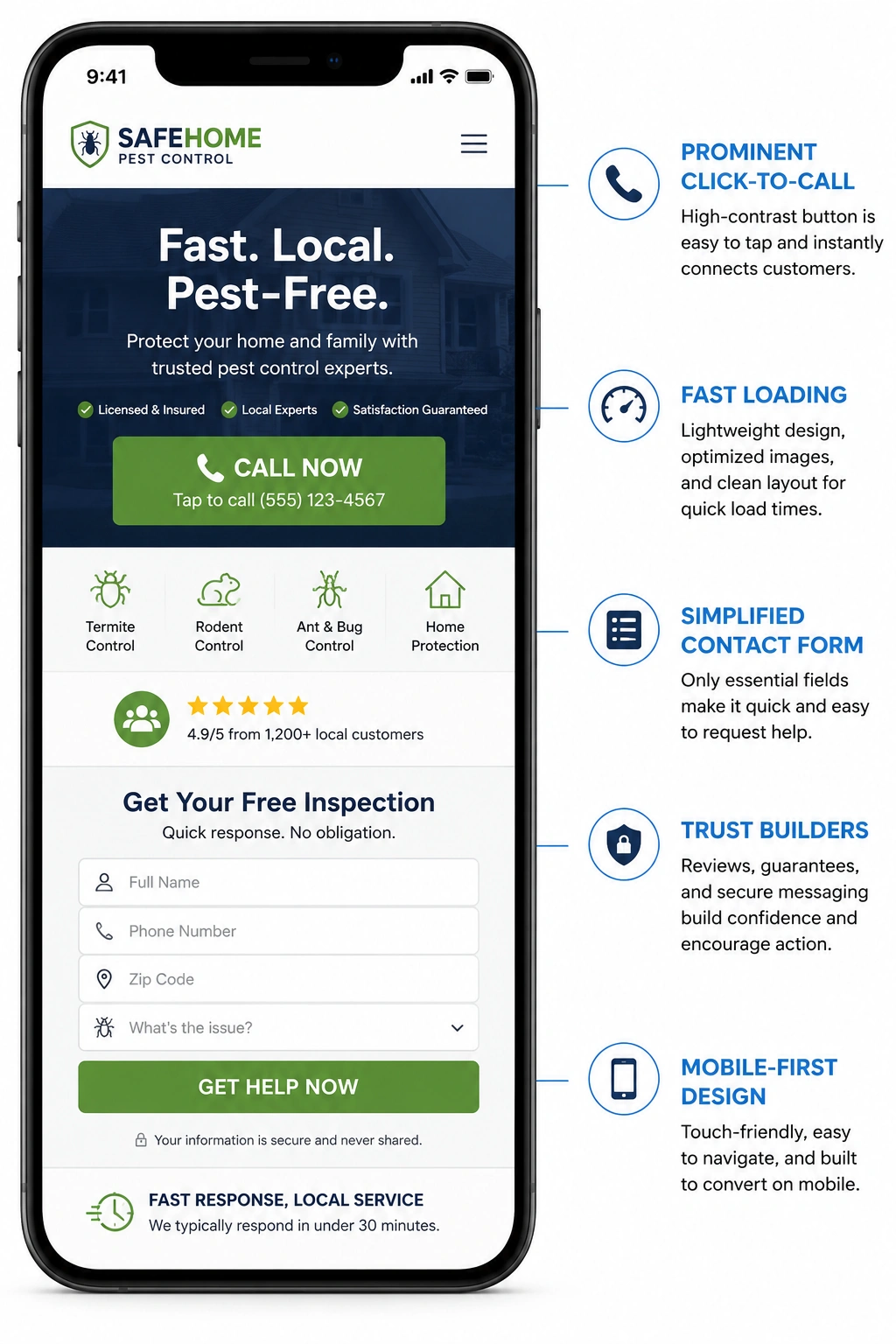
Mockup of a mobile-first pest control landing page featuring a prominent call button, streamlined form, and fast-loading design.
Need a website built for speed and conversions?
Explore our professional web design services to see how we build high-converting, mobile-first sites for local home service providers.
Building topical authority through strict silo structures
The mechanics of hub-and-spoke internal linking
A well-built content matrix generates topical authority only if the internal linking architecture reinforces the thematic relationships between pages. Silos keep authority concentrated. Without deliberate silo structure, link equity scatters across unrelated topics, diluting the relevance signals that tell Google your site is the definitive resource for termite control in Phoenix, or rodent exclusion in Denver.
The hub-and-spoke model is the structural solution. Your homepage links directly to core service hub pages (e.g., /termite-control/) and to your primary location pages (e.g., /locations/phoenix/). Those hub pages then link to their corresponding city-specific service intersections (e.g., /locations/phoenix/termite-control/). This creates a clear topical hierarchy that passes link equity downward without dilution, and it signals to crawlers that your site has organized, intentional depth on each subject, not a flat collection of loosely related pages.
Supporting blog content, articles like “How to Identify Termite Damage” or “Signs of a Rodent Infestation in Your Attic,” belongs inside its respective topic cluster and links only upward to its parent hub page and laterally to other posts within the same cluster. Cross-linking a termite blog post to a rodent control service page might seem like a reasonable internal link, but it bleeds relevance signal across topic boundaries and weakens the cluster’s coherence. A local content strategy that ignores silo discipline will produce pages that rank inconsistently, even when the individual page has 600-800 words of unique local content.
Internal linking rules for maintaining strict cluster isolation:
- Homepage Links: Link the homepage directly to your core service hub pages (e.g.,
/termite-control/) and main location pages (e.g.,/locations/phoenix/). - Hub-to-Spoke Links: Link each core service hub page to its corresponding city-specific service pages (e.g.,
/locations/phoenix/termite-control/). - Strict Cluster Isolation: Keep supporting blog posts (e.g., “How to Identify Termite Damage”) strictly within their topic silo. These posts must link only to their parent service hub page and other posts within the same cluster, avoiding cross-linking to unrelated silos (like rodent control) to prevent link equity dilution.
Overcoming the implementation hurdle: where to start
Prioritizing your highest-value intersections
The matrix concept can feel overwhelming when you are staring at a service area that spans twelve cities and eight pest categories. That is 96 potential pages before you have written a single word. Start smaller and more deliberately than that.
You don’t need to write 50 pages from scratch. You need a template that adapts your core expertise to each location-pest combination. Once the structure is in place, each new page takes less than an hour. You can implement this yourself or work with a partner to scale the work.
Identify your top five service areas by revenue and your top five most profitable pest services: typically termite treatment, bed bug extermination, rodent exclusion, mosquito control, and general pest prevention plans. That gives you 25 intersections to build first. Map them in a spreadsheet with rows for pest types, columns for cities, and cells for the target URL and current status so that you can easily track which pages exist, which need to be rewritten, and which need to be built from scratch. The audit alone will surface gaps you did not know existed.
Prioritize high-margin services first. Termite treatment and bed bug extermination carry the highest average job values in the residential pest control market, which means the organic traffic capturing those queries has an outsized revenue impact per lead. Build those pages with the most investment: the most localized content, the most granular schema, the most carefully sourced local reviews. The mosquito spraying pages can follow with a slightly leaner treatment once the high-value intersections are established.
New pages typically take three to six months to rank in organic search results, depending on your domain’s existing authority and the competitive density of your local market. That timeline is not a reason to delay: it is a reason to start immediately. A page built today that ranks in month five is generating leads in month six. A page you defer to next quarter starts that clock three months later.
Common pitfalls in multi-location SEO content strategy
Avoiding doorway page flags and low-effort AI content
Auto-generating location pages for cities where you have no physical presence and cannot realistically dispatch a technician is a risk that compounds over time. Keep your presence real. In the short term, a few thin city pages might not trigger any visible consequence. But as you scale to 50, 100, or 200 pages using the same structural template, the pattern becomes legible to Google’s quality systems. The doorway page designation is not applied page-by-page: it is applied as a site-level assessment once the pattern is established.
AI drafting tools are genuinely useful for this work; dismissing them entirely is overcorrecting. The practical model is to use AI to generate a structural draft and first-pass content for each page, then route every page through a human editor who is responsible for injecting the hyper-local details that the AI cannot fabricate accurately: the specific neighborhood names, the local pest pressures tied to that city’s soil composition or climate, the real customer reviews from that ZIP code. Google’s helpful content systems are not evaluating whether AI touched the content: they are evaluating whether the content demonstrates real-world experience and local expertise. That distinction is what the human editorial layer must deliver.
Neighborhood-level pages carry a different risk than city-level pages. Building a page for “Termite Control in Midtown Atlanta” makes sense if Midtown has distinct search volume and a pest profile that differs meaningfully from the broader Atlanta market. Building it because you want to occupy more URL real estate does not. The threshold question is always: does this page serve a user who has a genuinely distinct need, or does it exist to capture a keyword variation? Google’s systems are increasingly capable of distinguishing between those two motivations.
Frequently asked questions about pest control SEO
How many city pages should a pest control website have?
Build pages only for cities where you have a verified service area and can realistically provide same-day or next-day service. Creating hundreds of pages for cities you cannot actually serve risks being classified as a doorway page network, which can suppress your entire domain’s visibility, not just the thin pages themselves. Start with your core five to ten service cities, build those pages with genuine depth and local specificity, and expand the matrix as your operational footprint grows.
Can I use AI to write the unique content for my city pages?
AI can generate a serviceable structural draft, but it cannot supply the hyper-local details that make a location page genuinely distinct: the specific neighborhoods, the local pest species pressures, the climate-driven treatment nuances, the real customer testimonials from that ZIP code. Google’s helpful content system is not filtering for AI authorship: it is filtering for the absence of real-world experience and local expertise. A human editor who knows the market must own the final layer of every page.
How long does it take for a new city-pest page to rank?
Three to six months is the realistic window for a new page to establish organic rankings, though that range widens considerably based on your domain’s existing authority and how competitive your local market is. You can compress the timeline by building high-quality local backlinks pointing to the new page and by linking to it directly from your homepage or a high-authority hub page. Internal link equity from established pages accelerates indexing and initial ranking signals.
Should I create separate pages for neighborhoods or just cities?
Start with major cities and build those pages with enough depth to rank competitively. Neighborhood-level pages are worth building only when two conditions are met: the neighborhood has demonstrable search volume for your services, and it has a distinct pest profile or demographic that justifies genuinely different content. In a dense, highly competitive metro like Chicago or Los Angeles, neighborhood pages can be a meaningful differentiator. In a mid-sized market, they are often premature, and thin neighborhood pages in a low-volume area will dilute your domain’s quality signals without generating meaningful traffic.
Will Google penalize my site if my city pages have similar structures?
No, Google does not issue manual penalties for duplicate content on local service pages. The mechanism at work is duplicate content filtering: Google identifies near-identical pages, selects the most authoritative version, and suppresses the rest from search results. The practical consequence is the same as a penalty (your pages are invisible to search), but the recovery path is different. You are not appealing a manual action; you are rebuilding each page’s uniqueness and authority until it clears the filtering threshold. Maintaining a minimum of 600-800 words of genuinely unique content per page is the most reliable way to stay above that threshold.
Your next move is concrete: open a spreadsheet, list your top five service areas across the top row and your top five most profitable pest services down the left column, and audit your current website against those 25 intersections. Note which pages exist, which need to be rewritten with genuine local depth, and which need to be built from scratch. Prioritize the high-margin combinations, termite treatment and bed bug extermination, and build those pages first with full localization: 600-800 words of unique local content, local reviews, PestControl schema with areaServed defined, and clean hub-to-spoke internal links. The matrix will not complete itself overnight, and the ranking timeline demands that you start before you feel fully ready. Do not wait. A website built on this architecture does not describe your services: it intercepts the exact searches your highest-value customers are running at the exact moment they are ready to call.
You can implement this yourself or work with a partner to build a high-performing website that reaches your local service areas. Contact BizIQ today for our professional local SEO services and start capturing high-intent leads in every city you serve. Also, consider joining the Pest Control Millionaires Facebook Group to connect with over 4,000 active pest control operators sharing practical growth strategies.