
A custom home builder reviews architectural plans as a timber-framed residence takes shape.
You know your craft inside out. Getting found online, though? That is a different kind of build entirely.
Referrals have carried most residential construction businesses for years, and they still matter. But a referral pipeline is inherently variable. It depends on timing, relationships, and luck. A search-driven pipeline operates on a different logic: someone in your market types a specific phrase into Google, your website surfaces, and they contact you. That shift from reactive to proactive lead generation is what a well-executed contractor SEO strategy makes possible. Search engines continuously refine their algorithms to surface the most relevant, high-quality content for each query, which means the builders who invest in targeted, expert-driven content earn compounding visibility over time.
This blueprint delivers 15 high-intent home builder SEO keywords organized into three buyer categories: custom home building, remodeling, and subdivision development. This organization helps you map your content and service pages to the exact phrases your future clients are already searching.
What this blueprint covers:
- Intent-based categorization: Keywords grouped into transactional, commercial, and informational buckets to reach buyers at every stage of their decision
- Local optimization priority: Why geographic visibility outperforms broad national targeting for residential builders
- Human-centric content: Why authentic, expertise-driven pages consistently outrank automated text in search results
The Mechanics of Search Intent for Residential Construction
Not every search query signals the same level of intent maturity. Informational searches, like “steps to build a custom home,” come from buyers in the early research phase. Commercial searches, such as “best custom home builders near me,” indicate someone is actively comparing options. Transactional searches, like “home remodeling contractors near me,” represent a buyer who is ready to make contact. Aligning your pages to these distinct intent profiles means you are present at every stage of the decision cycle, not just when someone is already prepared to sign a contract.
Because construction is geographically bound, local SEO for builders carries more weight than almost any other ranking factor. A buyer searching for a custom home builder in their city is not going to hire a firm three states away. Targeting city-specific and neighborhood-level terms, and backing them with a fully optimized Google Business Profile, is what connects your business to the buyers who can become clients.
There is also a content quality dimension worth addressing directly. Quality matters. With 41% of workers now using AI to automate tasks (source: Deloitte Human Capital Trends 2026), the volume of machine-generated web content has surged. Yet 86% of the top-ranking pages on Google are human-written. For home builders, this is an advantage. Your real project experience, your knowledge of local permitting, and your understanding of what clients worry about during a build represent a level of specificity that generic AI content cannot replicate. It is also what search engines are increasingly designed to reward. Separately, 95% of executives report concern about the accuracy of digital data, a concern that mirrors why search algorithms apply strict quality filters to surface authoritative content over shallow, synthetic alternatives.
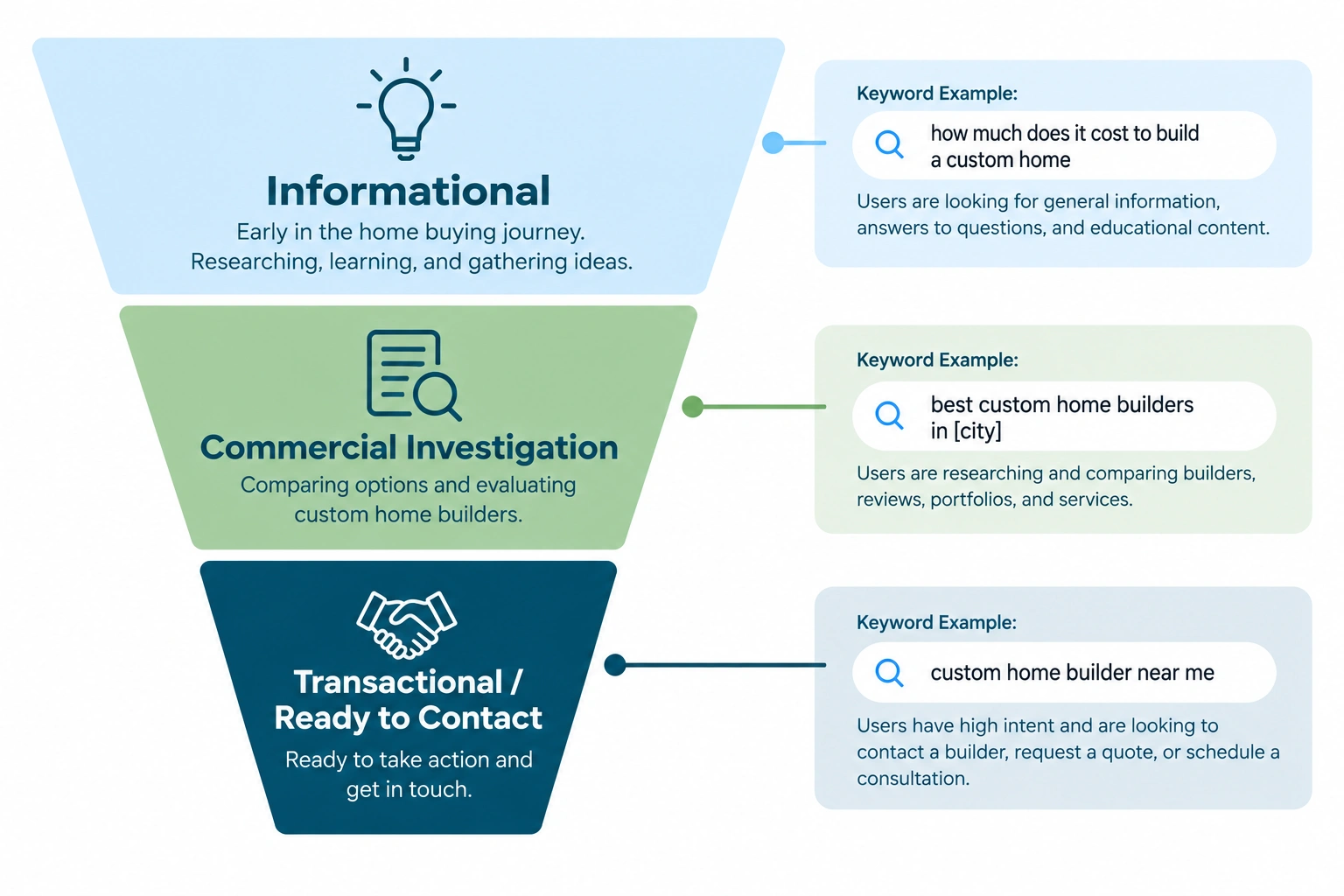
The custom home buyer search funnel shows how keyword intent progresses from early research to builder comparisons and ready-to-contact searches.
High-Intent Custom Home Building Keywords
These five terms engage buyers who are either actively planning a custom build or deep in the research process. Each one represents a different stage of the buyer journey, which means a single builder can capture multiple touchpoints with the right content architecture.
- “custom home builders near me” : Transactional intent. This is the highest-urgency phrase in the custom home category. A buyer typing this query is ready to reach out; your Google Business Profile and local landing pages need to be optimized to surface here.
- “how to choose a custom home builder” : Informational intent. This term attracts high-value prospects who are still evaluating their options. A well-written guide on this topic positions your firm as a reliable resource before the comparison phase even begins.
- “custom home building cost per square foot” : Informational/Commercial intent. Budget-phase buyers use this phrase to anchor their expectations. Content that answers this question honestly, using regional context and realistic variables, builds credibility with exactly the clients worth pursuing.
- “luxury custom home designs” : Commercial intent. This targets affluent buyers seeking architectural inspiration and premium craftsmanship. Portfolio pages and project galleries optimized for this term attract clients with higher budgets and longer project timelines.
- “steps to build a custom home” : Informational intent. This is a process-oriented query that lets you demonstrate construction expertise and timeline transparency. Buyers who find this content early associate your brand with authority before they ever contact a competitor.
Implementing these terms effectively requires more than dropping them into a page title. Aligning your website structure, service pages, and blog content to these high-value phrases is where homebuilder marketing services deliver the greatest impact, mapping each keyword to the right page type and ensuring your technical foundation supports the content you publish.
Commercial Keywords for Home Remodeling Clients
Remodeling clients search distinctly compared to custom home buyers. They are often working with an existing structure, a defined budget range, and a specific scope, which makes their queries more targeted and their intent more immediate.
- “home remodeling contractors near me”: Transactional intent. This is one of the highest-conversion phrases in the remodeling category. Homeowners using this term have already decided to hire; they are selecting who.
- “whole house remodel cost”: Informational/Commercial intent. Large-scale renovation leads start here. Content that walks through realistic cost ranges, scope variables, and financing considerations captures buyers who are serious about a major project.
- “kitchen and bath remodeling company”: Transactional intent. Kitchen and bath projects represent some of the highest-margin work in residential remodeling. Dedicated service pages optimized for this phrase connect you directly with homeowners ready to invest.
- “historic home renovation specialists”: Commercial intent. This is a niche phrase, but a highly valuable one. Buyers searching for historic preservation expertise are looking for a specific skill set, and there is far less competition for this term than for generic remodeling keywords.
- “home addition builders”: Transactional intent. Homeowners expanding their living space need structural expertise, not just cosmetic contractors. This phrase filters for buyers with larger project scopes and budgets.
Targeting these terms drives high-margin projects directly into your pipeline. Kitchen and bath remodeling alone commands premium pricing, and buyers searching for it are already past the “should I do this” stage; they are in the “who should I hire” stage.
Ready to put these keywords to work?
We focus on building long-term local search visibility that helps you attract custom home buyers and remodeling clients in your market. Explore our construction company SEO services to see how this approach applies to your market.
Search Terms Targeting Subdivision Leads
Subdivision buyers navigate a different timeline and different priorities than custom home clients. They are often comparing communities, evaluating amenities, and researching lifestyle fit, not just floor plans. Capturing them requires content that meets them at the community-research level, not just the transaction level.
- “new construction homes in [City]” : Transactional intent. These are city-specific inventory searches from buyers who are ready to move. Localized landing pages for each active market are essential here.
- “new home subdivisions near me” : Transactional intent. This query directs local buyers to active community developments. Proximity and availability are the primary purchase drivers here.
- “master planned communities in [City]” : Commercial intent. This term attracts families and retirees researching neighborhood amenities, school districts, and lifestyle options. Content detailing community features and nearby infrastructure performs well for this term.
- “new build community floor plans” : Informational/Commercial intent. Buyers comparing layout options within active subdivisions use this phrase. Dedicated floor plan pages with filterable options and clear square footage data serve this intent directly.
- “pros and cons of living in a subdivision” : Informational intent. This is an early-stage research query from buyers who have not yet committed to a community purchase. Content that answers this question honestly, acknowledging trade-offs alongside benefits, builds trust with buyers who will remember where they got straight answers.
Localized, long-tail strategies consistently outperform broad national campaigns for community-level targeting, a pattern well-documented in small business SEO case studies that track geographic search performance over time.
Subdivision buyers differ from custom home clients in one important way: they are often choosing between communities rather than designing from scratch. By capturing them with “pros and cons of living in a subdivision,” you enter their decision process before they have committed to any specific development, which means your community has the first opportunity to shape their expectations.
“Because we started as a small business, we understand the hurdles that many small business owners have to face when they begin to market their brand and services online,” Garrett Cisek, Co-Founder of BizIQ.
Integrating Secondary Keywords Into Your Builder Website
The 15 primary keywords above are your lead-generation anchors. Secondary terms, including “seo for homebuilders,” “search engine optimization for home builders,” and “keywords for residential construction companies,” serve a different function: they signal topical authority to search crawlers and help your educational content rank for the broader category, not just individual queries.
Three integration methodologies make the most difference. They are straightforward. Feature secondary keywords in H2 or H3 subheadings on educational resources and industry guides, where crawlers weight them as structural signals. Use the terms naturally within the first 100 words of your articles, keeping them natural rather than forced, to establish topical relevance early in the page. Anchor internal links with these exact phrases to distribute page authority across your service pages, rather than concentrating it on a single homepage.
What most homebuilders find is that secondary keyword integration is less about placement mechanics and more about writing content that genuinely covers the topic. When a page on search engine optimization for home builders addresses the full scope of the subject, covering local signals, content strategy, technical health, and link building, the secondary terms appear naturally because the topic demands them.
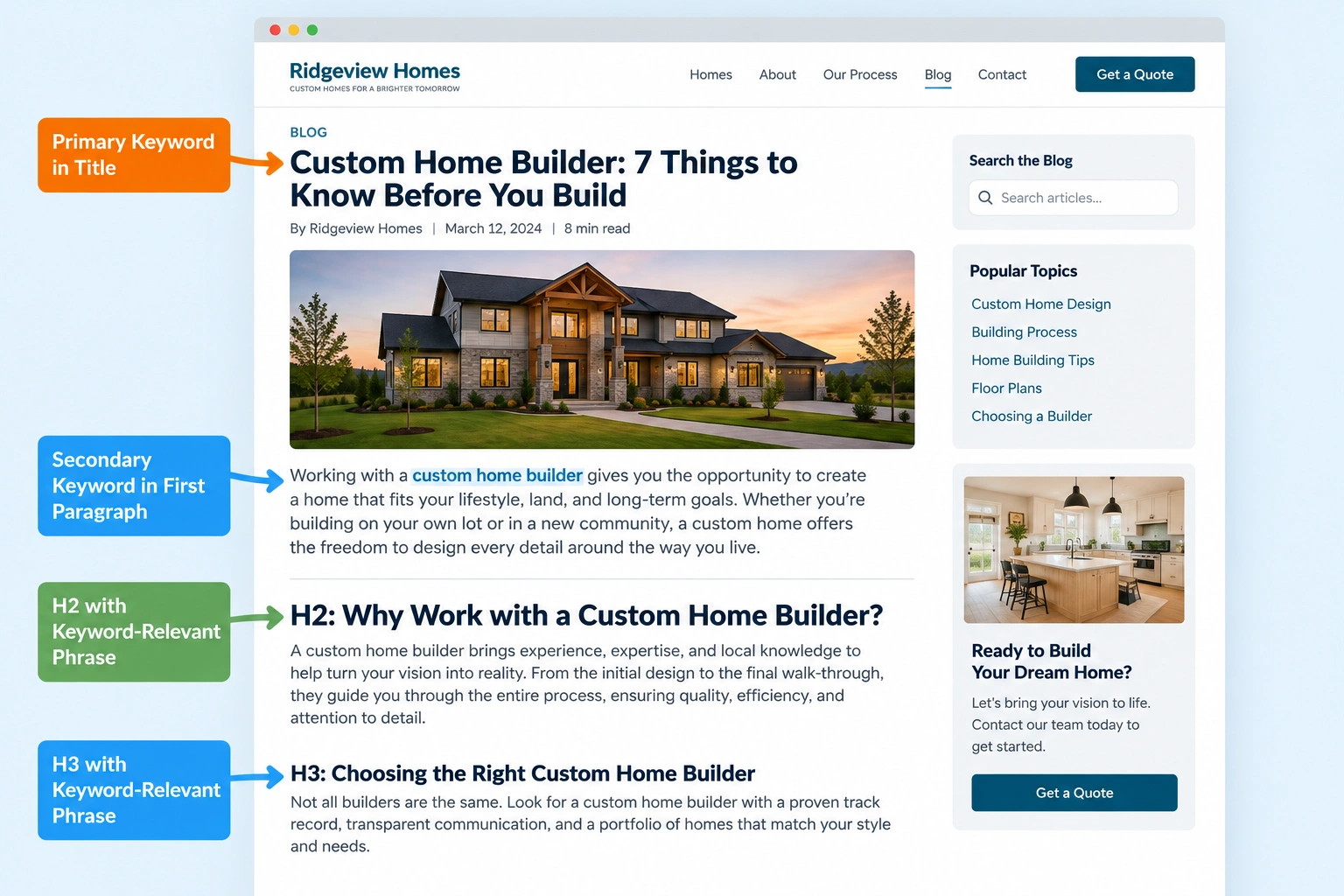
An optimized home builder blog demonstrates natural keyword placement across the page title, opening paragraph, and structured subheadings.
Want a tailored analysis of your current keyword footprint?
We build campaigns specific to your geography and service mix with no generic packages. Explore our local SEO services to see how we approach geographic optimization for residential builders.
Local Search Dominance and Google Business Profile Optimization
For residential builders, the Google Business Profile (GBP) functions as a digital storefront; it is often the first impression a prospective client gets before they ever visit your website. Treating it as a secondary priority is a substantial overlooked advantage.
- Google Business Profile (GBP): Fill out every available section, including services, service areas, project categories, and business description. Upload high-quality photos of completed projects. Keep hours current. A complete, active profile signals credibility to both Google and the buyers reviewing it.
- NAP Consistency: Your Name, Address, and Phone Number must match exactly across every directory, citation, and listing where your business appears. For reference, BizIQ maintains its listing at 3627 E Indian School Rd Suite 103, with a consistent phone number of (888) 416-9800 across all platforms. The same discipline applies to your business.
- Review Acquisition: Actively request reviews from satisfied clients after project completion. The compounding effect of consistent, genuine reviews on your GBP ranking is well-established. Michael Park of Dreamworks Kitchen & Bath describes his experience with BizIQ this way: “I’ve been working with BizIQ for over 7 years and my experience has been exceptional… I’ve worked with several other SEO compaines and never have I had the sustained results that I’ve gotten with BiZIQ.” That kind of sustained relationship is what review-driven trust looks like in practice.
- Local Citations: Get listed in established local and industry-specific directories to reinforce your geographical relevance. Consistency across citations amplifies the local signals your GBP already sends.
Overcoming Common Obstacles in Home Builder Search Optimization
Two objections come up frequently when builders consider investing in organic search.
The first is timing: “SEO takes too long, and I need leads now.” We hear this often. This is a fair concern, and it is not entirely wrong; organic rankings do take time to build. What the objection misses is the compounding nature of the asset. A well-optimized page that ranks for “custom home builders near me” in your market generates leads every month without an ongoing cost-per-click. Paid ads stop the moment you stop paying; organic visibility accumulates. The builders who started investing in search two years ago are now harvesting leads their competitors are still paying to acquire.
The second objection is competitive: “My market is too crowded; I can’t compete with national builders.” National builders typically target broad, high-volume terms, such as “home builders” and “new construction homes,” where they have domain authority advantages. Local builders win by going specific. A page targeting “custom home builders in [Your City]” or “historic home renovation specialists in [Your Neighborhood]” faces a fraction of the competition and converts at a higher rate because the geographic match is exact. Long-tail, service-specific, and hyper-localized keywords are where local builders bypass national competition entirely, not by outspending it.
Measuring the ROI of Your Organic Search Strategy
Organic search performance is quantifiable, but the right metrics matter. Focus on leads. Organic traffic volume tells you whether your pages are attracting visitors. Keyword rankings for high-intent terms tell you whether you are visible to the buyers most likely to convert. Form submissions, email inquiries, and direct phone calls tell you whether that visibility is translating into qualified leads, and tracking these conversions over time is what ultimately justifies your marketing investment.
One important caveat: search engine algorithm volatility can rapidly alter rankings and disrupt organic traffic flows. A single algorithm update can shift positions for dozens of pages simultaneously. Tracking long-term trends, both month-over-month and quarter-over-quarter, gives a far more accurate picture of momentum than daily rank checks. Builders who panic at short-term fluctuations and abandon their strategy often do so just before their rankings stabilize and compound.
Frequently Asked Questions About Home Builder Search Engine Optimization
How do I choose between hiring a specialist or doing SEO myself?
Doing it yourself is possible if you have the operational capacity, but most homebuilders find that managing a construction business leaves little room for the technical side of optimization. Crawl health, schema markup, link acquisition, and content production all require consistent attention. Partnering with an agency that provides construction company SEO services ensures your campaign is managed by people who do this full-time, while you stay focused on the work that builds your business.
What is the 80/20 rule in SEO for residential builders?
The 80/20 rule, or the Pareto Principle, suggests that roughly 80% of your website’s traffic and leads will come from 20% of your content or keywords. For home builders, this means concentrating effort on the 15 high-intent terms in this blueprint rather than attempting to rank for hundreds of generic phrases. Depth on a focused set of keywords consistently outperforms shallow coverage across a broad one.
How do catchy taglines or slogans impact SEO rankings?
Taglines like “Quality You Can Trust” or “Your Vision, Our Foundation” do not directly influence search rankings. What they do affect is user behavior after the click: time on site, bounce rate, and conversion rate. A professional, memorable brand message increases the likelihood that a visitor stays and engages, which sends positive behavioral signals to search engines. The SEO value is indirect but real.
How does generative AI search affect organic click-through rates for builders?
Generative AI search engines increasingly answer simple informational queries directly on the results page, which can reduce clicks to informational content. High-intent transactional queries, such as “custom home builders near me” or “kitchen and bath remodeling company,” are different. Buyers using those phrases need to review portfolios, read testimonials, and make contact. That process still requires clicking through to a website, which makes transactional keywords more valuable relative to informational ones as AI search evolves.
Can I target multiple cities with the same home builder keywords?
Yes, but duplicate content will work against you. The right approach is to create unique, localized landing pages for each target city or neighborhood, tailoring the content to local project examples, regional permitting considerations, and architectural trends specific to that area. A page that reads like it was written for Phoenix should not look identical to one written for Scottsdale, even if the services are the same.
Building a reliable digital presence follows the same logic as a well-executed construction project: the foundation determines everything that comes after. By focusing on high-intent keywords, optimizing your local search footprint, and producing content that reflects genuine expertise, you shift from waiting on referrals to generating leads from buyers who are actively searching for what you build. We are a small business too, and we understand the dedication it takes to grow. Let’s build your online authority together.
Ready to take the next step? Partner with BizIQ to implement a tailored local SEO strategy that drives real leads. Our local marketing approach focuses on building sustainable visibility for your business, helping you rank for the terms that matter most to your bottom line. Contact BizIQ today to schedule your personalized contractor SEO consultation.