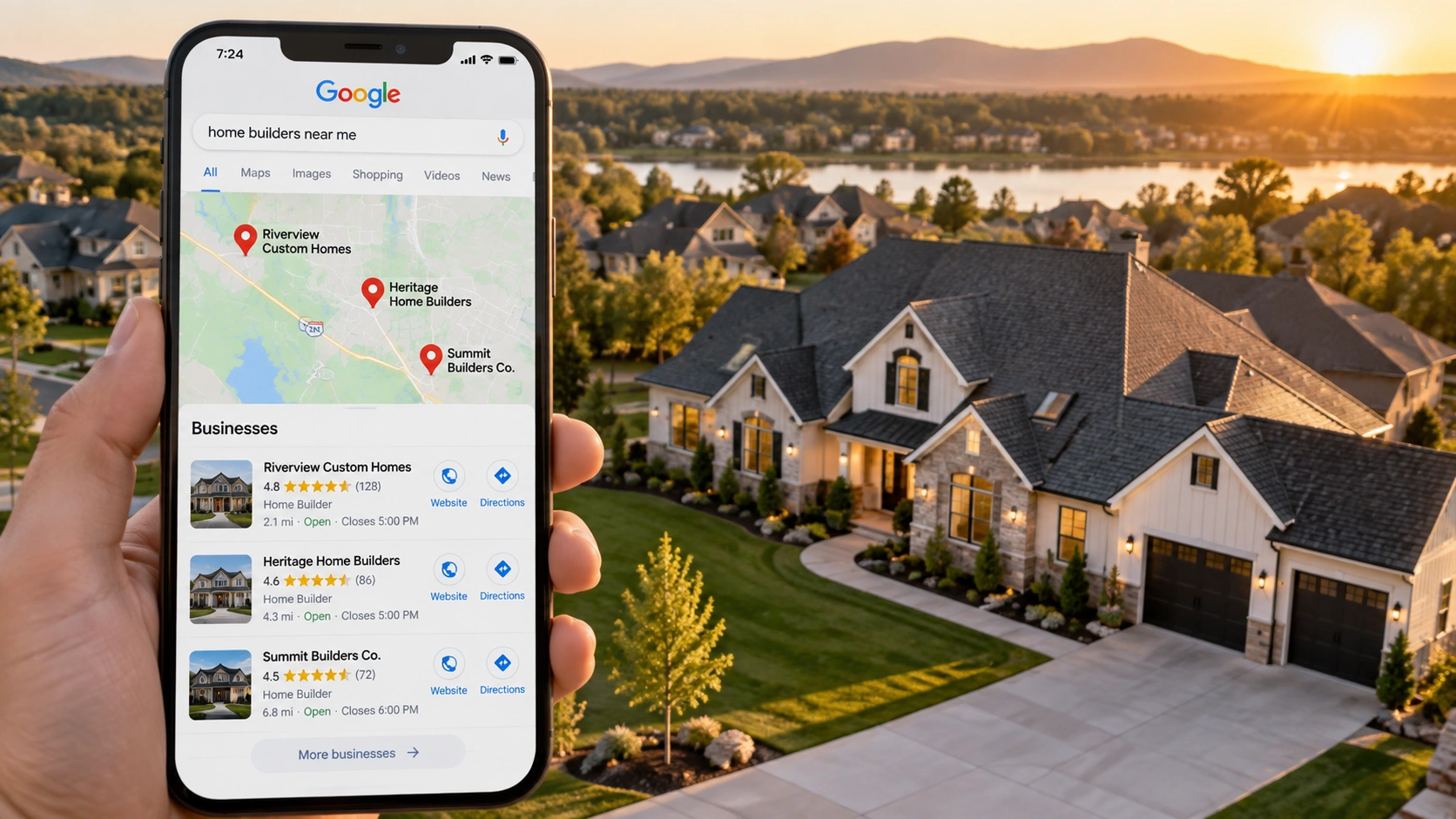
A local search for home builders connects prospective homeowners with custom construction companies serving their area.
Custom home builders lose regional leads every day not because their work is inferior, but because their online presence is invisible. When a prospective buyer types “custom home builder near me” into Google, three listings take up the screen before any website result appears. If your business is not among them, the buyer moves on, and they rarely circle back. Which is why effective Local SEO for Home Builders is so important.
Winning that map pack real estate requires a clear, step by step approach. Local search is a specialized ecosystem where Google prioritizes proximity, relevance, and prominence simultaneously. Mastering local SEO for home builders means setting up your digital presence to score well on all three, not just one. Think of it like a regional home show: if you are not set up in the right hall, the most qualified buyers will walk right past you regardless of the quality of your work. A well-executed local search marketing strategy puts your booth in front of the right audience.
We focus on three main areas that determine your map pack position:
- Complete Google Business Profile optimization to establish a clear foundation that Google can confidently surface in local results.
- Consistent local citation building across major directories to reinforce your business’s legitimacy and geographic relevance.
- Active online reputation and review management to build the search engine trust and buyer confidence that convert visibility into consultations.
Demystifying the Local Map Pack Algorithm
Google’s local algorithm is not a mystery, but it does require deliberate attention. Three primary ranking factors determine which three businesses appear in the map pack for any given search: relevance, distance, and prominence. Understanding how each one operates, and where they interact, is the starting point for any serious homebuilder SEO strategy.
Relevance and Local Search Intent
Relevance is Google’s assessment of how well your business profile and website content match what a searcher actually wants. For home builders, this means your Google Business Profile and website need to speak the same language as high-intent queries like “custom home builders [city]” or “luxury home builders near me.” Generic category labels and thin business descriptions leave Google guessing. Detailed service descriptions, specifying architectural styles, building capabilities, lot types you work with, and the communities you serve, give the algorithm concrete signals to match against specific queries.
Content alignment matters here more than keyword density. A profile that clearly communicates how you help clients “build a house in [region]” will consistently outperform a profile that simply says “home builder” with no further context.
Distance and Proximity Challenges
Distance is the factor builders find most frustrating, and for good reason. Google calculates proximity based on either the searcher’s physical location or the geographic terms embedded in their query. A builder whose office sits in one suburb may struggle to rank in an adjacent affluent community five miles away, even if that community represents their primary market.
Service-area business (SAB) settings in your Google Business Profile help address this directly. Rather than displaying a single address, SAB configuration allows you to define the specific counties, cities, or zip codes where you actively build. This signals geographic relevance to Google’s algorithm for those target communities, even without a physical office in each one. The catch is that SAB settings alone are not enough; they need to be reinforced by localized website content and geo-targeted project portfolios to carry real weight.
Your Google Business Profile is the cornerstone of local visibility for any builder operating in this environment. Think of it like a model home’s portfolio: it is how potential buyers see your best work and verify your active business operations before they ever meet you. A fully optimized profile tells Google’s algorithm everything it needs to know about who you are, where you build, and what you specialize in. Google Business Profile optimization is not a one-time setup task; it is an ongoing maintenance discipline that directly affects your map pack position.
Proximity and prominence interact in a way that gives well-optimized builders a genuine competitive edge. A highly prominent builder with strong review signals and a complete profile can win local visibility over a closer competitor whose Google Business Profile is sparse and unmanaged. Distance is a factor, but it is not a ceiling. Prominence, built through reviews, citations, backlinks, and profile completeness, can compensate for geographic disadvantage in ways that pure proximity never can.
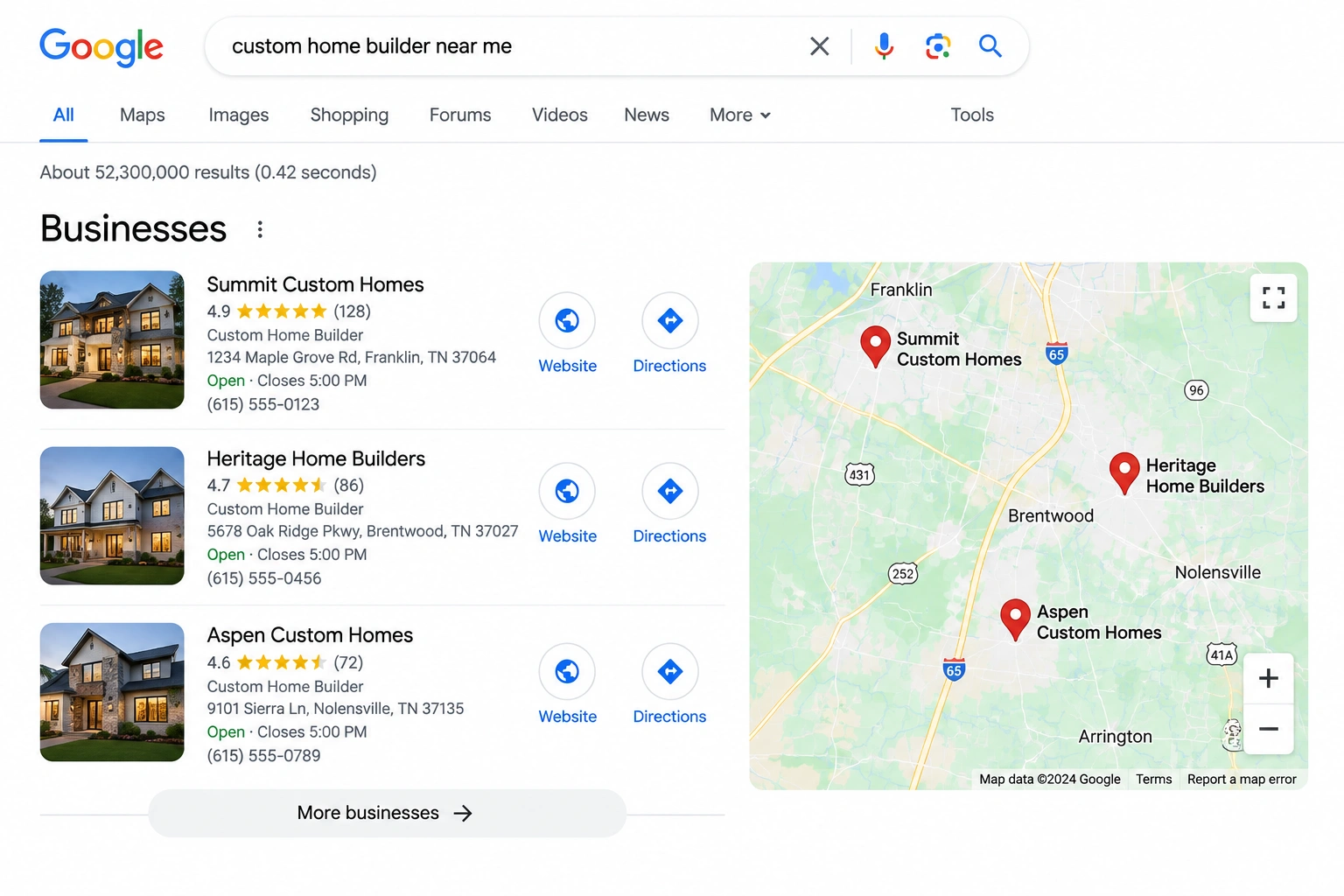
A Google Local Map Pack displays three custom home builders, illustrating how local search connects prospective clients with nearby construction companies.
Complete Google Business Profile Optimization for Custom Builders
A Google Business Profile that is 60% complete is not 60% effective; it is functionally incomplete in Google’s eyes. The algorithm rewards thoroughness, and for custom home builders competing in regional markets, every unfilled field is an opportunity handed to a competitor. We recommend starting with the most critical profile fields to signal your capabilities to Google’s algorithm, then building outward from there.
Selecting Primary and Secondary Categories
Your primary category is the single most important classification signal in your entire Google Business Profile. Selecting “Custom Home Builder” or “Home Builder” as the primary category is non-negotiable; this is the field Google weights most heavily when matching your profile to relevant searches. Deviating from this, even with a category that feels more specific, risks misaligning your profile with the queries that matter most.
Secondary categories extend your reach without diluting your primary signal. “General Contractor” and “Real Estate Developer” are both legitimate additions that capture adjacent search intent from buyers who phrase their queries differently. What you want to avoid is category stuffing, which means loading your profile with loosely related categories in an attempt to appear in more searches. Google treats this as a relevance dilution signal, and in some cases it triggers profile suspensions that can take weeks to resolve.
Defining Precise Service Areas
Service area configuration is where many builders leave significant ranking potential on the table. Listing the specific counties, cities, or zip codes where you actively build gives Google a defined geographic scope to work with. Vague or overly broad service areas, such as “the entire state” or “nationwide,” provide no useful signal and can actually suppress your local relevance for the specific communities where you do your best work.
For service-area businesses without a traditional retail storefront, the SAB configuration also determines whether your address is displayed publicly. Most custom home builders operate this way, and hiding the physical address while defining precise service areas is both appropriate and algorithmically sound. The critical alignment point is that your Google Business Profile service areas should mirror the localized landing pages on your website. When both sources confirm the same geographic scope, Google’s confidence in your relevance for those areas increases meaningfully.
To complete your profile optimization, work through these step-by-step tasks:
- Write a detailed business description that naturally integrates terms like “search engine optimization for home builders” while highlighting your unique building process, architectural specialties, and regional experience; keep it informative, not promotional.
- Upload high-resolution photos of completed custom homes, active construction sites, and floor plans; visual content signals active business operations to Google’s algorithm and gives prospective buyers a reason to engage with your profile before they ever contact you.
- Keep business hours, phone numbers, and holiday schedules meticulously updated. Inconsistencies between your Google Business Profile and your website are a trust signal problem, not just a cosmetic one.
Local Citation Consistency and NAP Management
A citation is any online mention of your business’s Name, Address, and Phone number (NAP). Think of your business name, address, and phone number like your company’s signature: it should look exactly the same everywhere it appears. The principle behind citation building is clear: when Google finds your business information consistently represented across dozens of authoritative directories, it treats that consistency as a trust signal. Inconsistencies, such as an old suite number here or a slightly different business name there, introduce doubt into that signal and suppress your local rankings.
Think of citation consistency like showing up to every client meeting in your best suit. It signals professionalism, makes you easier to find, and tells people you take your business seriously. Getting listed on the same directories where homebuyers search is like putting your sign on the same street where buyers are already driving. One sloppy entry in a major directory can undercut months of careful profile work.
Auditing Existing Citations
Before building new citations, audit what already exists. Most established builders have accumulated a scattered trail of directory listings, some accurate, some outdated, and some duplicated, from years of organic web activity. Identifying and correcting these discrepancies is foundational work that cannot be skipped.
Duplicate listings are a particular problem. When Google finds two listings for the same business with slightly different NAP data, it cannot confidently determine which one is authoritative. The result is often a suppression of both listings in local results. Reclaiming and updating outdated profiles on major platforms, especially Google Maps, Bing Places, and Apple Maps, should be the first priority in any citation audit.
Automated vs. Manual Citation Building
The debate between automated citation tools and manual submission is genuinely unresolved, and the right answer depends on your resources and risk tolerance. Automated platforms allow builders to scale their homebuilder SEO efforts, pushing consistent NAP data to dozens of directories simultaneously and monitoring for drift over time. The tradeoff is that automated tools occasionally introduce formatting inconsistencies or submit to lower-quality directories that add noise rather than authority.
Manual citation building offers precision, allowing you to control exactly what gets submitted and where, but it is time-intensive in a way that most builders cannot sustain alongside an active construction schedule. A hybrid approach, using automation for broad distribution and manual verification for the highest-authority platforms, tends to produce the most reliable results. Platforms like Houzz and HomeAdvisor warrant manual attention given their direct relevance to the homebuilding audience.
For a real-world example of how citation management works across a similar trade category, the local citation playbook for landscapers illustrates the same NAP discipline applied to another service-area business. The core mechanics translate directly to residential construction. Your citation footprint should cover:
- Major search engines and mapping services, including Google Maps, Apple Maps, and Bing Places, where NAP accuracy has the most direct impact on local rankings.
- Industry-specific platforms and directories such as Houzz, HomeAdvisor, and Yelp, where homebuyers actively research and compare builders before making contact.
- Local business directories and community platforms including Nextdoor and local Chambers of Commerce, which carry geographic authority that general directories cannot replicate.
Ready to improve your visibility in the regional map pack?
BizIQ backs its local SEO work with a 60-Day First-Page Local Ranking Guarantee: your business will appear on the first page of Google’s local maps results or organic search results within 60 days of beginning services, or we work for free until you are ranked. Learn more about the BizIQ local marketing guarantee and what it means for your building business.
Reputation Management and Active Review Acquisition
Online reviews function as both a ranking signal and a sales tool simultaneously. Google’s local algorithm weighs review quantity, review velocity, and review diversity as direct inputs into prominence scoring. A builder with 12 detailed, recent reviews will consistently outrank a competitor with 3 reviews from two years ago, even if that competitor has a more complete profile in every other respect.
Review Acquisition Strategy
The most effective review acquisition strategy is also the simplest: ask. Satisfied clients who have just moved into their new custom home are at peak enthusiasm, and a direct, personal request at that moment converts at a far higher rate than a generic follow-up email sent weeks later. Timing matters as much as the ask itself.
What you ask for matters too. Encouraging clients to mention specific details, such as the building process, the architectural style, and the community, produces reviews that reinforce your relevance for those exact queries. A review that says “they built our custom craftsman home in [City]” carries more algorithmic weight than a review that says “great company, highly recommend.” Responding to every review, positive and negative, demonstrates active engagement and signals to Google that your profile is maintained by an attentive business owner.
Online Reputation Management Software
Specialized reputation management software addresses the operational challenge of monitoring reviews across multiple platforms simultaneously. These tools track rankings, monitor citations, and consolidate review requests into a streamlined workflow that increases review velocity without requiring manual follow-up on every completed project.
For builders managing multiple active communities, the ability to audit local search visibility across different geographic areas from a single dashboard is genuinely useful. The alternative, which involves manually checking Google, Houzz, HomeAdvisor, and Yelp separately for each service area, is the kind of administrative burden that causes review management to fall off the priority list entirely.
Modern homebuyers use Google to vet word-of-mouth recommendations. If a referred buyer searches your name and finds an unoptimized, review-starved profile, they will often jump to a competitor in the map pack, not because your work is inferior, but because the competitor’s digital presence looks more trustworthy. The referral you earned through years of quality work can be lost at the final verification step.
Active review management builds long-term prominence and authority in a way that other optimization tactics cannot replicate. When search engines see consistent, positive, and detailed reviews mentioning specific services, such as “custom home build,” “kitchen remodel,” or “luxury spec home,” it reinforces your relevance for those exact queries. The cumulative effect compounds over time, making your profile progressively harder for competitors to displace.
“I have been working with this organization for a while now. They are highly professional and have helped me immensely. I have worked with other similar groups in the past only to find they can’t deliver as promised. Working with BizIQ has been a pleasurable experience and I recommend them highly.” – Tim Skinner, Skinner Design Associates
Advanced Local SEO Architecture: Multi-Community and Service Area Strategies
Custom home builders rarely operate in a single city. A builder based in one suburb may have active projects across three or four distinct communities, each with its own search behavior and competitive landscape. Managing multi-community local SEO requires a deliberate website architecture, not just a single homepage with a list of cities in the footer.
Multi-Community Landing Pages
Dedicated landing pages for each target community give Google a specific, authoritative source to associate with local searches in that area. These pages should go beyond a generic “we build in [City]” statement. Effective community landing pages incorporate localized content: regional trade relationships, local building regulations, community-specific project portfolios, and references to local landmarks or neighborhoods that signal genuine geographic familiarity.
Linking your Google Business Profile directly to these dedicated regional landing pages creates a reinforcing signal loop. When your Google Business Profile lists a community as a service area and your website has a substantive page dedicated to that community, Google’s confidence in your relevance for those locations increases on both fronts. The two assets work together in a way that neither can achieve independently.
Service Area Business Settings
For builders without a physical retail storefront in every community they serve, SAB configuration in the Google Business Profile is the primary mechanism for claiming geographic relevance. The configuration itself is simple: you define your service areas by city, county, or zip code, but the strategic question of which areas to include requires thought. Listing every county in your state dilutes your signal; listing only your home base leaves revenue on the table. The right scope is the geographic footprint where you can credibly claim active project history.
Balancing proximity signals with localized website content is an ongoing calibration. A new community landing page with thin content will not immediately move rankings, but as that page accumulates project portfolio content, localized references, and inbound links from regional sources, it builds the prominence signal that eventually pushes your profile into the map pack for that area.
Builders have access to visual assets that most service businesses can only envy, such as completed homes, active construction sites, and architectural details, and most of them underutilize those assets from an SEO standpoint. Optimizing image file names and alt text with local keywords (“craftsman-home-[city]-exterior.jpg”) and uploading those images directly to your Google Business Profile signals active, local project completion to Google’s algorithm. Each optimized photo is a small but cumulative relevance signal for the community where it was taken.
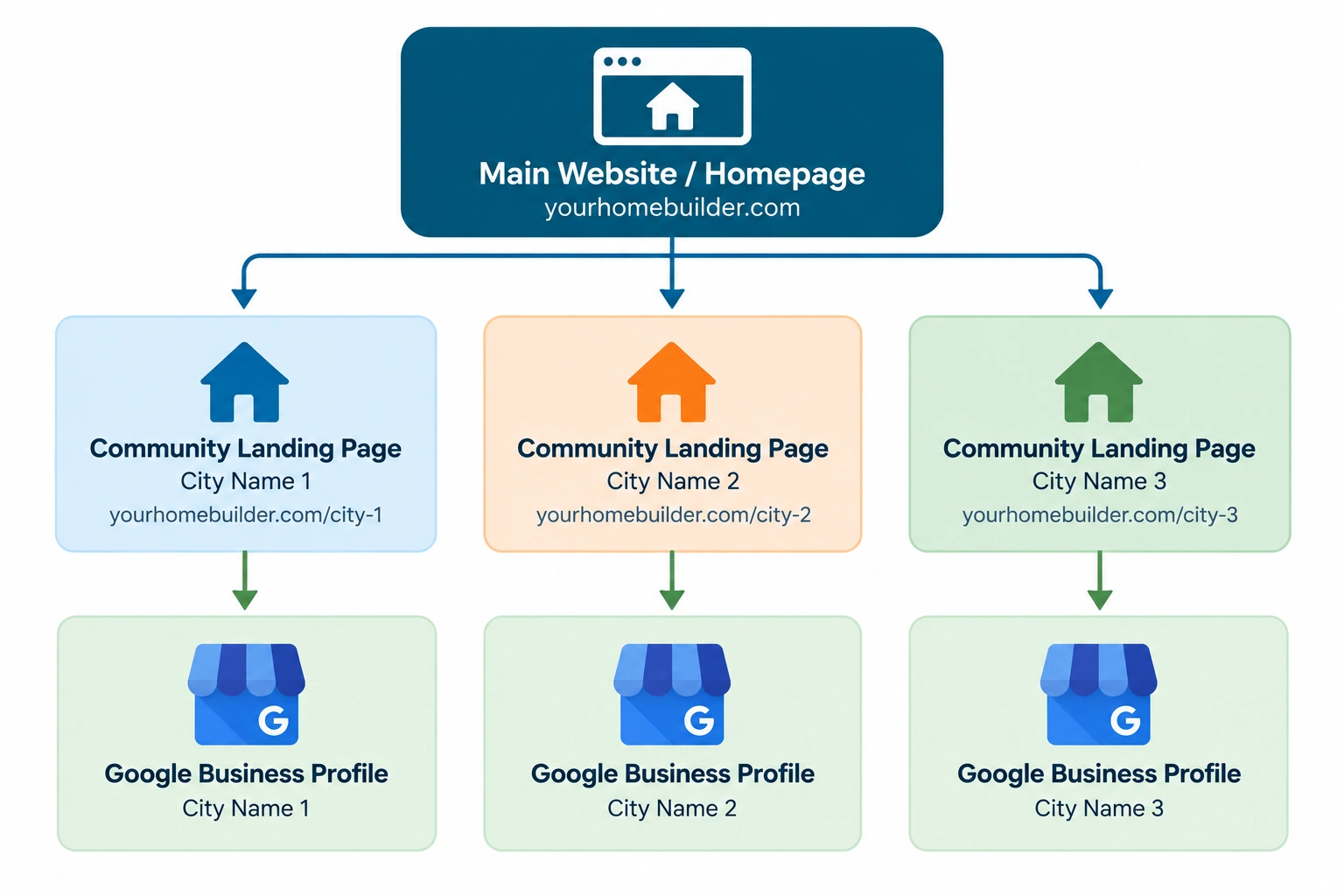
A simple multi-community website structure connects the main home builder website with dedicated city landing pages and local Google Business Profiles.
Not sure where your local presence stands? A detailed local SEO audit will show you exactly where your NAP data is inconsistent and which directory gaps are blocking your map pack entry. Explore BizIQ’s approach to local SEO for small businesses to see how the audit process works and what it uncovers.
Future-Proofing Local Visibility: Generative Engine Optimization and Multimodal AI
The local search environment is shifting in ways that will affect home builders over the next two to three years, and the builders who adapt early will hold a structural advantage over those who wait. Two developments in particular warrant attention: the rise of generative AI in search, and the growing role of visual and multimodal search in local discovery.
Generative Engine Optimization
Traditional search engine optimization is transitioning into generative engine optimization (GEO), where search engines use generative AI to answer queries directly rather than directing users to external websites. For home builders, this means that a prospective buyer asking “who are the best custom home builders in [Region]?” may receive a direct AI-generated answer, and whether your business appears in that answer depends on how well your digital footprint signals authority and trustworthiness to the AI models generating it.
Optimizing for GEO is not a separate discipline from traditional local SEO; it is an extension of it. Businesses with complete, consistent, well-reviewed profiles and authoritative local content are the ones AI models draw on when generating local recommendations. The foundational work of profile optimization, citation consistency, and review management serves both traditional and AI-driven search simultaneously.
Multimodal AI and Visual Search
Visual search is becoming a meaningful discovery channel for high-consideration purchases, and custom home building sits squarely in that category. Gartner projects that multimodal AI solutions will grow to 40% of generative AI solutions by 2027, up from just 1% in 2023, a trajectory that makes structured visual content a clear advantage rather than a nice-to-have. Builders who invest in high-quality, structured visual content, such as 3D home tours, video walkthroughs, and optimized image metadata, are positioning themselves for a search environment where visual assets carry direct algorithmic weight.
Search engines are already more sophisticated in interpreting visual content alongside text than they were even two years ago. A portfolio of well-captioned, properly structured project images is no longer just a sales tool; it is a machine-readable signal about what you build, where you build it, and for whom.
To position your business for this shift, prioritize these steps:
- Standardize high-fidelity, responsive media delivery across your website to maintain site speed while showcasing your portfolio; a slow-loading luxury portfolio page defeats its own purpose.
- Implement structured schema markup on project pages and community landing pages to bridge the gap between your visual assets and search engine comprehension; schema gives the algorithm explicit context that image files alone cannot provide.
- Regularly upload optimized project walkthrough videos directly to your Google Business Profile, where they contribute to both visual search relevance and overall profile engagement signals.
Overcoming Local SEO Limitations and Tracking Challenges
Local SEO is not a closed system with predictable inputs and outputs. Several structural limitations affect how builders can measure and respond to their local search performance, and acknowledging them honestly is more useful than pretending the process is fully controllable.
Proprietary Algorithm Updates
Google’s local search algorithm is proprietary and updated frequently, often without public announcement. The practical implication is that a ranking position you hold today can shift without any change on your end, and diagnosing the cause requires tools and expertise that most builders do not have in-house. To illustrate the scale of investment required to track these shifts: Semrush invested $41.2 million in research and development in 2022 specifically to refine its tools and monitor search engine changes. That figure reflects what it costs just to stay current with algorithmic movement at a professional level.
The appropriate response to this reality is building a resilient local SEO strategy focused on foundational quality rather than tactical optimization for any specific algorithm state. Businesses that chase algorithm updates tend to oscillate; businesses that maintain complete profiles, consistent citations, and strong review signals tend to hold their positions through updates because they are doing what the algorithm was designed to reward in the first place.
Data Latency in Local Reporting
Many local SEO tools rely on third-party data aggregators, which introduces latency between when a change is made and when it appears in reporting dashboards. For builders tracking rankings across multiple service areas and zip codes, this means that a citation correction made today may not reflect in your visibility metrics for days or weeks.
There is also a genuine research gap regarding the precise correlation between citation consistency and actual lead conversion rates for high-ticket services like custom home building. Citations improve local search visibility in measurable ways, but the path from a corrected directory listing to a signed construction contract involves enough human variables that clean attribution is difficult. The most reliable tracking approach combines keyword ranking data with direct user action metrics, such as phone calls, direction requests, and website visits originating from your Google Business Profile, to build a more complete picture of what your local presence is actually generating.
Despite these limitations, the case for investing in a strong local search foundation is not weakened by the measurement challenges. Consistency and operational discipline in managing your local presence will outperform short-term optimization tactics over any meaningful time horizon. The builders who treat local SEO as infrastructure, meaning something you maintain continuously rather than deploy in bursts, are the ones who hold map pack positions when competitors cycle in and out.
The questions below address the adjacent topics that come up most often when builders start planning their local marketing strategy: pricing, timelines, the DIY question, and how AI fits into the picture going forward.
Frequently Asked Questions About Homebuilder SEO
Local search marketing raises practical questions that go beyond the technical mechanics of profile optimization and citation building. Pricing structures, realistic timelines, the role of AI, and whether professional management is worth the investment are all legitimate concerns for builders evaluating where to put their marketing resources. These answers are meant to give you a grounded starting point, not a sales pitch.
How much should I pay for local SEO?
Pricing for local SEO varies based on the scope of services, market competitiveness, and whether you are managing a single location or a multi-community presence. Most businesses working with a professional local SEO agency can expect to invest anywhere from $500 to $2,500 per month. For custom home builders competing in affluent regional markets, the higher end of that range typically reflects the additional work required for multi-community landing pages, reputation management across multiple platforms, and ongoing citation monitoring.
Is SEO still worth it in 2026?
Yes, and the reasoning is clear. Organic search remains a primary driver of high-intent traffic, the kind of traffic that comes from buyers who are actively looking for what you offer, not passively scrolling past an ad. The mechanics have shifted toward user experience, domain authority, and adaptation to AI-integrated results, but the underlying dynamic has not changed: buyers search, Google surfaces trusted businesses, and the builders with the strongest local presence capture the most qualified leads.
What is the 80/20 rule in SEO?
The 80/20 rule in SEO reflects the observation that roughly 80% of your organic traffic and results tend to come from just 20% of your content or keywords. For home builders, this usually means a small number of high-intent queries, such as “custom home builders [city]” and “luxury home builder near me,” drive the majority of qualified inbound traffic. Identifying those queries and ensuring your Google Business Profile and website are fully optimized for them is a more efficient use of resources than trying to rank for every possible variation.
Can I do local SEO myself?
You can, and for builders with limited budgets, starting with the basics yourself is a reasonable approach. Optimizing your Google Business Profile, claiming and correcting your major directory listings, encouraging reviews from satisfied clients, and ensuring your website uses local keywords in the right places are all tasks that do not require professional expertise. The honest caveat is that consistent execution across all of these channels, while managing an active construction business, is where most builders run into trouble. The work is not technically complex, but it is time-intensive and easy to deprioritize when a project demands attention.
Is SEO dead now with AI?
No. The distribution mechanism is changing, as AI-generated answers capture a growing share of search queries, but the underlying principle that search engines surface trustworthy, relevant, and authoritative businesses has not changed. If anything, the rise of AI in search raises the stakes for local SEO fundamentals, because AI models draw on the same signals, such as profile completeness, citation consistency, review quality, and content authority, that traditional local search has always rewarded. Businesses that maintain strong local SEO foundations are better positioned in AI-driven search environments, not worse.
The path forward from here is concrete. Start by auditing your current Google Business Profile: check that your primary category is correct, your service areas reflect where you actually build, and your business description speaks to the specific queries your buyers use. Then work through your major directory listings to identify and correct NAP inconsistencies. These two steps alone will move the needle on your local search visibility, and they are the foundation everything else builds on.
If you want a faster route to map pack visibility with professional management of your citations, reviews, and profile optimization, contact BizIQ to discuss what a structured local SEO engagement looks like for your building business.
Partner with BizIQ to build your local search presence the right way. BizIQ manages local visibility, citation building, and reputation management for residential construction businesses across North America, backed by a 60-Day First-Page Local Ranking Guarantee. If you are not on the first page of Google’s local maps or organic results within 60 days of starting services, we work for free until you are.
Phone: (888) 416-9800 Address: 3627 E Indian School Rd Suite 103