- How AI answer engines are rewriting the rules of beauty product discovery: and what that means for your bookings and sales
- The exact content signals that trigger citations in ChatGPT, Perplexity, and Google AI Overviews
- Why ingredient transparency is now a measurable ranking factor, not just a branding choice
- A practical, 90-day playbook to scale your organic presence and local search rankings
- How local salons and spas can dominate the Google Map Pack through schema markup and review management
How are AI Search Engines Changing How Consumers Find Local Beauty Brands, and How Can My Business Stay Visible?
Beauty shoppers no longer rely solely on a list of blue links to find their next skincare staple or local aesthetician. They are asking conversational questions directly to AI platforms like ChatGPT, Perplexity, and Gemini, and they expect immediate, highly tailored answers. As a small business ourselves, we understand how disorienting this shift feels when you are already managing appointments, staff, and inventory. Sophisticated marketing belongs to you, not just the enterprise brands with seven-figure ad budgets, and here is what you need to know: the rules of search have changed, but the opportunity is larger than it has ever been. Our approach to digital marketing for small business is built on the same principle we apply here: an evidence-based approach that puts practical, executable strategy in your hands, with us standing beside you, not above or behind.
To capture high-intent traffic in 2026, beauty brands must operate a dual-threat strategy that satisfies both Google’s traditional ranking algorithms and the retrieval mechanisms of generative AI engines. This means optimizing your digital footprint so that AI models select, trust, and cite your content as the authoritative source, while simultaneously maintaining a fast, technically sound website that converts the human visitors who do arrive. These two objectives are not in competition; they reinforce each other at every layer of your digital presence. They must align. Generative Engine Optimization (GEO) is the emerging discipline that bridges them, and for beauty businesses, it is quickly becoming as essential as having a Google Business Profile.
The Shift from Search Engines to Answer Engines
The mechanics of how people find beauty products and services have shifted more dramatically in the past two years than in the previous decade. Search is different now. Understanding the architecture of that shift is the starting point to doing anything useful about it. For a closer look at the forces driving this change, our piece on AI transforming SEO covers the broader landscape in detail.
Zero-Click Searches and the Rise of AI Overviews
When Google deploys an AI Overview at the top of a search results page, it synthesizes information from multiple sources and delivers a direct answer before the user ever sees a single organic link. For informational queries, the kind that dominate beauty research like “best moisturizer for combination skin” or “how often should I get a chemical peel,” this has produced a 61% drop in organic click-through rates. That number deserves a moment of honest reckoning: more than half of the traffic that once flowed to informational content is now resolved on the search page itself.
The offset to that statistic is equally significant. Citations drive traffic. Brands that are cited within an AI Overview receive 35% more organic clicks than competitors who are absent from the summary entirely. The search results page has effectively split into two tiers: those who exist inside the AI-generated answer, and those who exist below it. For beauty businesses, securing that citation real estate is no longer a nice-to-have optimization; it is the primary competitive battleground.
Zero-click search is the broader phenomenon at work here. Users increasingly receive complete answers without visiting any website, which means your content must be valuable enough to feed the AI engine, even when it does not generate a direct visit. The brands that understand this are investing in content that earns citations, not just rankings.
Conversational Search Behavior in the Beauty Sector
The Spate “AI Search in Beauty” report offers a precise window into how this behavioral shift is playing out at the category level. ChatGPT now accounts for 4.3% of beauty-specific searches, with foundation queries reaching approximately 343,900 monthly searches and lipstick queries reaching around 134,800. Those numbers will grow. More telling than the volume is the nature of the queries themselves.
Users are treating AI platforms as personal beauty advisors. They are not typing “foundation”; they are asking “what drugstore foundation works for dry, acne-prone skin over 40” or “non-comedogenic moisturizers that layer well under SPF.” These are not keyword searches; they are consultations. The implication for your content strategy is direct: a product page that reads like a catalog entry will not be cited. A page that reads like a knowledgeable answer to a specific concern will.
AI engines do not return a list of websites in response to these queries. They synthesize a single, direct response drawn from sources they have assessed as authoritative, structured, and factually dense. That synthesis process is where your optimization work either pays off or disappears entirely.
A 61% drop in organic CTR for informational queries sounds like a crisis. It works as a filter. The traffic that does click through from an AI citation carries a 23% higher engagement rate and a measurably higher conversion intent than the undifferentiated traffic that once came from a standard blue-link ranking. These visitors are not casually browsing; they are deep in research mode, often one decision away from booking an appointment or completing a purchase. Optimizing for answer engines is not a concession to a diminished search landscape; it is a deliberate shift toward capturing fewer, better-qualified visitors who are far more likely to become clients.
Entity-based search is the technical framework that makes this possible. Search engines and large language models use natural language processing to connect your brand to specific concepts: “clean beauty,” “vegan peptides,” “local lash extensions,” “barrier-repair ceramides.” Your brand does not just rank for keywords; it becomes associated with a network of related entities that AI models recognize and trust. Building that entity-based authority requires on-page clarity, structured schema data, and off-site corroboration from sources the AI already treats as credible. It is a slower build than keyword optimization, but the competitive moat it creates is substantially harder to erode.
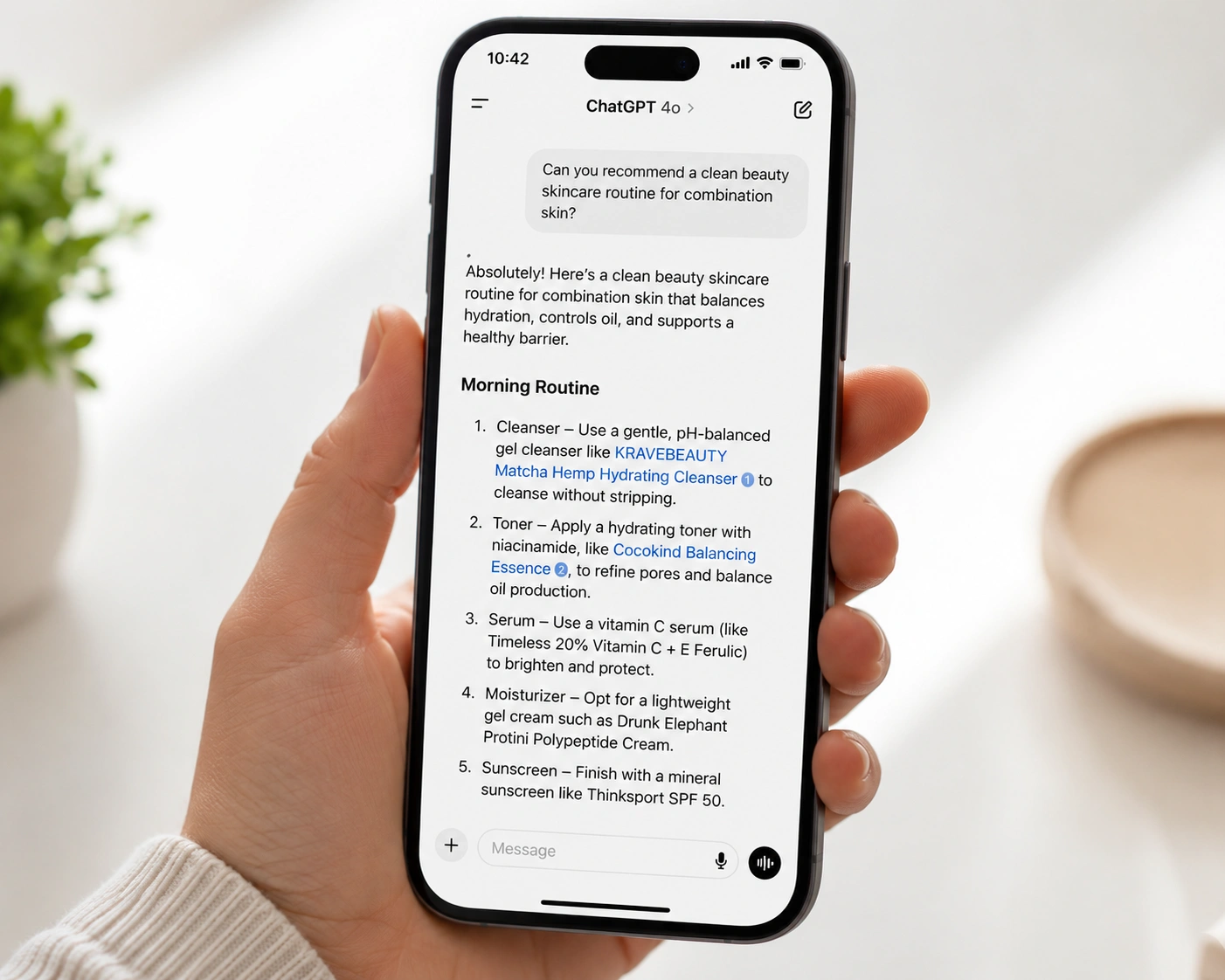
A conversational AI response recommends a skincare routine while citing trusted beauty brands and authoritative online sources.
Generative Engine Optimization for Beauty Brands
GEO is the practice of structuring your content and digital presence so that AI-driven answer engines can parse, trust, and cite your brand in their generated responses. For beauty businesses, the technical tactics are specific and, once understood, entirely executable without an enterprise-level budget. It requires clear structure. A solid foundation in optimizing for search engines provides the groundwork that GEO builds on.
Factual Specificity and What the Princeton GEO Study Found
The Princeton University GEO Study, published at KDD ’24, is the most rigorous quantitative analysis of what drives AI citation visibility to date. Its central finding: adding statistics to content yields a 41% lift in citation frequency across generative AI search results. That is not a marginal improvement; it is a structural advantage that compounds across every page you optimize.
The mechanism is direct. Large language models prioritize factual density over promotional copy because their function is to answer questions accurately, not to amplify marketing claims. A product description that reads “our miracle serum transforms your skin overnight” provides no retrievable signal. A description that reads “formulated with 5% niacinamide and 0.1% retinol, clinically tested to reduce visible pore size by 22% over eight weeks” gives an AI model something it can readily use. The shift from aspirational language to clinical precision is not just a stylistic preference; it is a measurable ranking factor.
Content architecture matter here as well. Placing a concise, 40-to-60-word direct answer block immediately beneath each major H2 heading creates a predictable extraction target for AI crawlers. These blocks should read like the first paragraph of a Wikipedia entry: declarative, specific, and free of hedging. The rest of the section can carry nuance and depth, but that opening block is what gets cited.
The Power of External Citations and Backlinks
The same Princeton study found that citing external authoritative sources within your content boosts your own citation visibility by approximately 40%. This is a counterintuitive but logical finding: AI models assess trustworthiness partly by observing whether a source engages with the broader knowledge ecosystem or operates in isolation. A skincare brand that cites peer-reviewed dermatological research, links to clinical studies, and references established industry publications reads as more credible than one that exists in a self-referential bubble.
Building a strong backlink profile from industry publications, digital beauty magazines, and professional association websites reinforces this signal from the outside in. When authoritative external sources reference your brand, AI models encounter your name repeatedly across trusted contexts, which accelerates the process of entity recognition. Backlinks have always mattered for traditional SEO; in the GEO context, they serve a second, equally important function as supporting evidence of your brand’s real-world authority. Authority must be earned.
Implementing GEO on your beauty website starts with four concrete actions:
- Audit your highest-traffic informational pages and replace vague marketing claims with precise, data-backed statements that include percentages, timeframes, and clinical references.
- Place a concise, 40-to-60-word direct answer block immediately beneath each major heading to give AI crawlers a reliable extraction target.
- Cite peer-reviewed clinical studies or dermatological research when discussing ingredient benefits, linking out to the source rather than just referencing it in passing.
- Integrate external citations to reputable industry sources to strengthen your content’s authoritative signal and encourage reciprocal recognition from AI models.
Ingredient Transparency as the Ultimate AI Signal
For skincare and cosmetic brands specifically, ingredient transparency has emerged as a measurable ranking variable, not a brand positioning choice. The data on this is precise enough to act on directly. Details matter.
The Correlation Between Ingredient Details and AI Visibility
The Yotpo CommerceGPT study analyzed 127 beauty brands and found a 0.78 correlation between high ingredient transparency and AI search visibility. That is a strong statistical relationship. To put it in practical terms: brands that publish detailed molecular and percentage breakdowns of their active ingredients are consistently more visible in AI-generated search summaries than brands that do not, independent of their marketing spend or domain authority.
Paula’s Choice illustrates the ceiling of this approach. The brand scored 101.6 in the Yotpo study’s AI visibility index, driven almost entirely by its practice of publishing exact ingredient concentrations, pH levels, and clinical effectiveness data for every product. AI engines encounter Paula’s Choice content and find it immediately usable: structured, specific, and directly responsive to the kinds of ingredient questions users ask. That is not a coincidence; it is the result of a deliberate content architecture decision that smaller brands can replicate.
The underlying mechanism is semantic. AI engines rely on structured signals to understand what a product does, for whom, and under what conditions. “Advanced hydrating formula” tells an LLM nothing useful. “2% pure hyaluronic acid with a molecular weight of 50 kDa, formulated at pH 5.5 for optimal skin barrier absorption” tells it exactly what it needs to generate a confident recommendation for a user asking about dry skin solutions.
Transitioning from Promotional Copy to Clinical Clarity
Rewriting product descriptions for clinical clarity does not mean stripping them of personality. It means leading with usefulness. A product page should answer three questions before it does anything else: what is in this, what does it do at a molecular level, and who is it for. The emotional and brand narrative can follow, but the functional information must come first, because that is what AI models extract.
Mapping ingredients to specific consumer concerns is the most direct path to AI citation. “Salicylic acid for acne-prone skin,” “ceramides for compromised skin barriers,” “tranexamic acid for hyperpigmentation”: these pairings are the semantic anchors that allow AI models to retrieve your product in response to a specific user query. For an integrated approach to structuring this kind of content across concerns, ingredients, and lifestyle categories, establishing clear structural frameworks is essential.
This level of specificity also builds trust with the human reader. A consumer who understands exactly what they are applying to their skin and why is a more confident buyer and a more loyal one. Clinical clarity is not just an AI optimization tactic; it is a conversion optimization tactic. It builds trust.
Key ingredient details every beauty brand must publish on product pages:
- Exact concentration percentages of active ingredients (e.g., 2% pure hyaluronic acid, 10% vitamin C as L-ascorbic acid)
- The formulation’s pH range and why it matters for efficacy (e.g., optimized at pH 5.5 for skin barrier support)
- Sourcing and purity certifications (e.g., USDA organic, cruelty-free, vegan peptides, non-comedogenic tested)
- Clear guidance on ingredient layering and contraindications (e.g., do not combine retinol with high-concentration vitamin C in the same application)
Expert Validation and Entity Trust
Google’s E-E-A-T framework: Experience, Expertise, Authoritativeness, and Trustworthiness: applies across all content categories, but its weight is not uniform. Beauty content sits in a category where the stakes are higher. Trust is paramount.
Satisfying YMYL Standards for Skincare and Cosmetics
Because skincare routines, chemical exfoliants, and aesthetic procedures can directly affect consumer health, Google classifies this content under “Your Money or Your Life” (YMYL) thresholds. The practical consequence is that beauty content is evaluated with the same algorithmic examination applied to medical and financial content. A blog post about retinol layering written without professional verification is not just a missed optimization opportunity; it is a liability that can trigger algorithmic suppression.
Google’s Search Quality Rater Guidelines make the standard explicit: content that could impact a user’s health, safety, or financial well-being requires demonstrated expertise and clear authorship credentials. For beauty brands, this means that content involving chemical ingredients, active concentrations, or treatment protocols must be written or reviewed by someone whose qualifications are verifiable. Generic author bios with no external credentials do not satisfy this threshold.
The risk of ignoring YMYL compliance is not hypothetical. The rules are strict. Content that lacks professional backing, makes unsubstantiated health claims, or presents promotional copy as clinical guidance is a candidate for ranking suppression during core algorithm updates. The beauty industry has seen this play out repeatedly, with brands that built large content libraries on aspirational copy watching their organic traffic erode after Google’s Helpful Content and core updates.
Using Professional Reviews and Dermatologist Backing
The Yotpo study found that dermatologist recommendations and expert validation correlate with AI visibility at r=0.71, nearly as strong as the ingredient transparency correlation. CeraVe is the most cited example of this strategy executed at scale: the brand’s consistent dermatologist-backed positioning has generated $30.1 million in earned media value, driven almost entirely by the credibility that professional support provides across both traditional and AI search.
The practical version of this for smaller brands does not require a national dermatologist partnership. Partnering with a single licensed esthetician or cosmetic chemist to audit, verify, and co-author your content produces a measurable E-E-A-T lift. It builds real authority. The key is making that partnership visible and machine-readable: not just a name in a byline, but a structured, verifiable credential that both human readers and search engines can confirm.
To build this entity trust at the page level, we recommend launching a formal “Expert Review” protocol. Every article involving chemical ingredients, treatment protocols, or skin concerns should carry a “Reviewed By” badge that includes the reviewer’s full credentials, a link to their professional bio or licensing body, and a timestamp showing when the content was last verified. This is not a decorative addition; it is a direct signal to Google’s Quality Raters and to AI retrieval models that the content has been assessed by someone with accountable expertise.
That expert validation must also be encoded in machine-readable form. Implementing Organization and Person schema allows you to explicitly link your authors and reviewers to their external professional profiles, published research, and licensing credentials. When a search engine or LLM encounters your content, it does not just read the text: it follows the structured data to verify the real-world existence and authority of the people behind it. A blog post with a verified dermatologist reviewer, properly marked up in JSON-LD, carries a fundamentally different trust signal than an identical post with an anonymous author.
“The brands that win the AI search race are not those with the biggest ad budgets, but those that provide the most transparent, expert-backed, and structured data for engines to digest.”, Nikki Lindgren, Founder of Pennock
Optimizing Site Performance for Mobile-First Buyers
Content and authority signals only matter if your website is technically capable of delivering them. Speed is critical. For beauty businesses, this is where significant ground is lost: not through strategic failures, but through unoptimized visual assets and built-up technical debt.
Core Web Vitals Benchmarks for Beauty Websites
Raygun’s 2026 data shows that only 31% of e-commerce websites pass all three Core Web Vitals metrics. The primary cause is heavy visual media: high-resolution product photography, video tutorials, and interactive tools that are uploaded without compression or dimension constraints. For beauty websites, where visual quality is directly tied to brand perception, the temptation to prioritize aesthetics over performance is understandable. It is also costly. Slow sites lose sales.
Google evaluates page experience using real-user Chrome data from the CrUX dataset, which means your rankings reflect how your site really performs on real devices across real network conditions, not how it performs in a controlled lab test. The three metrics that determine your score are specific:
- Largest Contentful Paint (LCP): The time it takes for the largest visible element on the page to load. Google’s threshold is under 2.5 seconds. A hero image that has not been compressed will fail this benchmark on most mobile connections.
- Interaction to Next Paint (INP): The responsiveness of the page to user input. The threshold is under 200 milliseconds. Legacy third-party scripts, such as chat widgets, tracking pixels, and social embeds, are the most common source of INP failures.
- Cumulative Layout Shift (CLS): The visual stability of the page as it loads. The threshold is under 0.1. Images and banners without hardcoded dimensions shift the layout as they load, producing a disorienting experience and a failing CLS score.
Visual Asset Optimization Without Losing Aesthetic Appeal
The good news is that the performance gap between a visually compelling beauty website and a technically optimized one is smaller than most brands assume. Converting all images to WebP or AVIF formats reduces file size by 25 to 50% compared to JPEG or PNG with no noticeable quality loss at standard screen resolutions. No homepage image should exceed 150 kB. Speed keeps users engaged. Product gallery images can be served at lower resolutions initially and loaded at full quality only when a user interacts with them.
Hardcoding width and height dimensions for every image, banner, and video element eliminates layout shift at the source. It is a one-time implementation task with a permanent CLS benefit. Auditing and removing unused third-party JavaScript is slightly more involved but equally impactful; every unnecessary script that loads on page initialization adds latency to your INP score, and many beauty websites carry three to five legacy scripts that serve no active function.
No amount of content optimization will compensate for a site that takes too long to load. Capital One Shopping data shows that 57% of e-commerce sales are completed on mobile devices, which makes mobile responsiveness and page speed non-negotiable constraints, not aspirational targets. If a potential client has to wait more than three seconds for your salon’s booking page or product gallery to render, they will navigate back to the search results, and your competitor’s faster site will capture that booking. In the beauty space, where visual experience is central to the brand relationship, speed and aesthetics must function as a unified design requirement, not competing priorities.
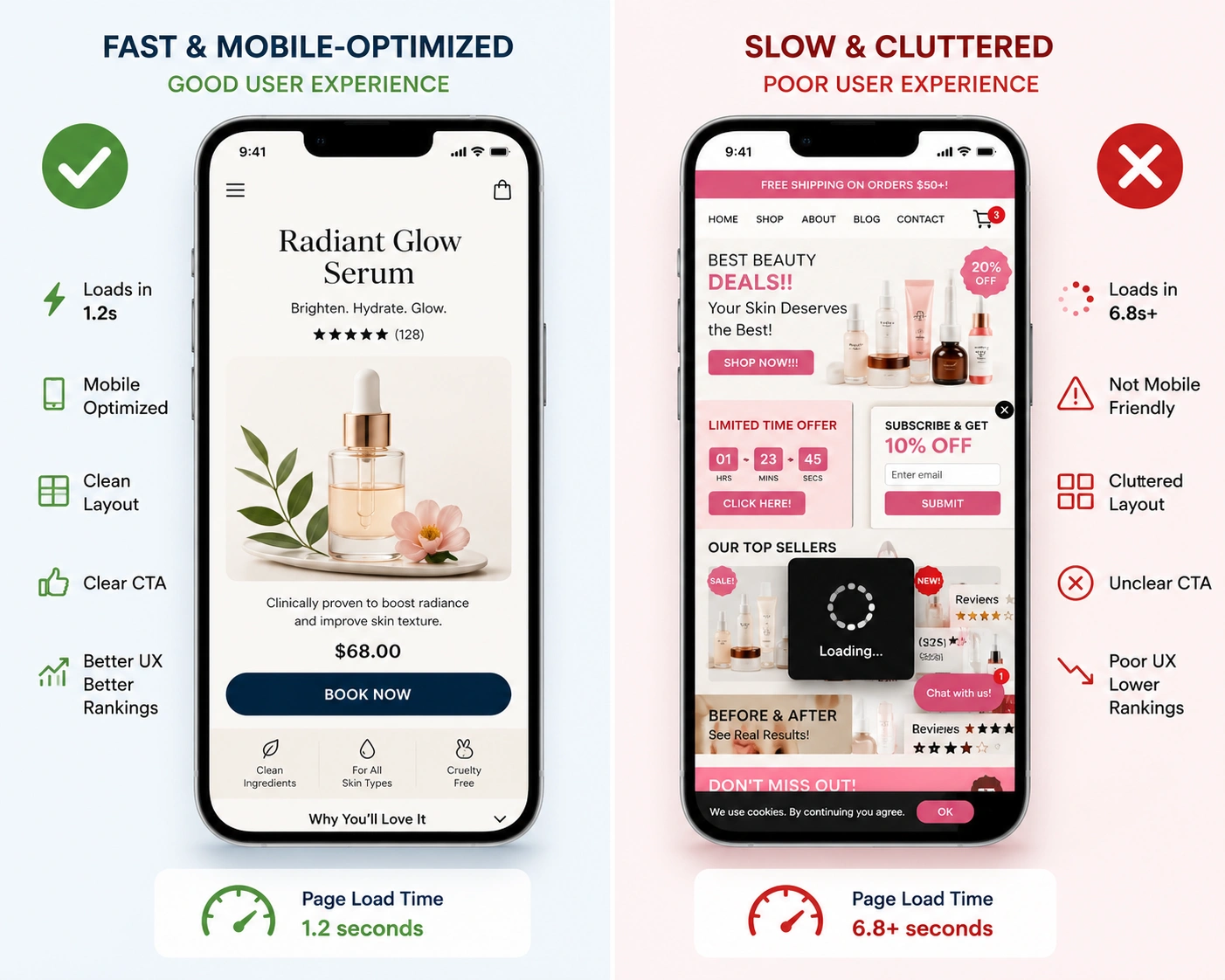
A side-by-side comparison shows how fast, mobile-friendly pages create a better user experience than slow, cluttered designs.
We recommend exploring our analysis of Google AI Overviews to understand how technical performance directly impacts your visibility in generative search results, and what to do about it.
A Ninety-Day Playbook for Beauty Brands
The strategies covered so far are not independent tactics; they form a sequence. Timing is everything. The following three-phase plan organizes them into a practical timeline that builds each layer of optimization on the one before it.
Phase One: Baseline Assessment and Audit (Days 1–30)
Before optimizing anything, it is essential to know where you currently stand across both traditional and AI search. Start with data. Run a fixed set of buyer-intent prompts across ChatGPT, Perplexity, and Gemini: queries that reflect how your ideal client really searches, not how you wish they would. Document every instance where your brand appears, where competitors appear instead, and where no brand is cited at all. That gap analysis is your prioritization map.
Simultaneously, run a Core Web Vitals audit using Google Search Console and PageSpeed Insights. Identify every page with an LCP above 2.5 seconds, flag all render-blocking JavaScript, and catalog every image that has not been converted to WebP or AVIF. This technical inventory takes time to compile correctly, but it prevents you from spending Phase Two optimizing content on pages that will never rank because of performance failures.
Map your existing content to search intent: Informational, Commercial, and Transactional. Most beauty websites have a significant mismatch: either too much promotional content masquerading as informational, or informational content that has been placed on commercial pages and is diluting conversion signals. Identifying these mismatches in Phase One makes the rewriting work in Phase Two far more targeted.
Phase Two: On-Page and Schema Implementation (Days 31–60)
With a clear baseline established, Phase Two is where the structural work happens. Rewrite your highest-traffic informational pages to lead with direct answer blocks: 40 to 60 words of factual, clinical language beneath each H2 heading. Replace vague marketing claims with specific ingredient statistics, clinical study references, and precise efficacy data. These rewrites do not need to sacrifice brand voice; they need to front-load the factual content that AI models extract.
Implement custom JSON-LD schema across your site. For product-focused pages, deploy Product schema with complete ingredient and offer data. For local service businesses, implement BeautySalon schema with full NAP details, service listings, and price range. For any page with a question-and-answer structure, add FAQPage schema. These are not optional enhancements; they are the machine-readable layer that allows search engines and LLMs to understand your business without confusion, translating your content into a structured format that AI models can instantly verify and cite.
Launch your Expert Review protocol during this phase. Identify the licensed professionals (estheticians, dermatologists, and cosmetic chemists) who will audit and verify your content. Establish a review workflow, create the “Reviewed By” badge template, and begin applying it to your highest-priority pages first. The goal by the end of Phase Two is to have your top twenty pages fully optimized with direct answer blocks, complete schema, and verified expert attribution.
Phase Three: Off-Site Authority and Corroboration (Days 61–90)
On-site optimization creates the foundation; off-site corroboration is what makes AI models confident enough to cite you. Phase Three focuses on building the external signal network that validates your on-site authority claims.
Prioritize acquiring third-party reviews on Google Maps and Yelp. Reviews build trust. These platforms are among the most frequently referenced sources in AI-generated local recommendations, and a consistent volume of recent, verified reviews is one of the clearest trust signals available to a local beauty business. Implement an automated post-appointment review request sequence, sending a text or email within two hours of a completed service, to build review velocity without manual effort.
Secure PR mentions, expert quotes, and backlinks from industry blogs and digital beauty publications. Even three to five high-quality placements in relevant publications during this phase will begin feeding your brand name into the LLM training data ecosystem. Track referral traffic from AI domains (chatgpt.com, perplexity.ai) in Google Analytics 4, and monitor branded search lift in Google Search Console. These proxy metrics are currently the most reliable indicators of growing AI share of voice.
Primary deliverables at the end of the 90-day cycle:
- A complete baseline audit documenting your brand’s current visibility across traditional search and major AI engines
- Fully optimized high-intent pages featuring direct answer blocks, clinical ingredient data, and verified expert review badges
- Custom JSON-LD schema implemented across all product, service, and FAQ pages
- An active off-site citation and review acquisition campaign generating consistent external validation
Local SEO and Google Business Profile Optimization for Salons
For brick-and-mortar beauty businesses like salons, spas, aesthetic clinics, and nail studios, the local Map Pack is the primary search real estate that drives booked appointments. Everything discussed so far applies, but local search has its own set of technical requirements that operate in tandem. Local visibility is key. Our detailed analysis of local SEO strategies covers the broader framework; here we focus on what is specific to the beauty industry.
NAP Consistency and Localized Service Specificity
Your Name, Address, and Phone number must be identical across every platform where your business appears: your website, Google Business Profile, Yelp, Facebook, Apple Maps, and any local directory that lists you. Think of it like using the same name on every business card you hand out: the moment one version differs, the signal becomes ambiguous and your local authority dilutes. A salon listed as “Estelle Beauty” on Google but “Estelle Beauty Salon & Spa” on Yelp is creating a citation conflict that suppresses local rankings, even if every other optimization is in place.
Service specificity on your Google Business Profile is equally important, and it is where most salons leave significant visibility on the table. Broad categories like “Hair Salon” or “Spa” are not sufficient. Be precise. Every service you perform should be listed explicitly, such as “Russian Volume Lash Extensions,” “Salicylic Acid Chemical Peel,” “Hydrafacial MD,” and “Keratin Smoothing Treatment,” and each should be tagged with your target city or neighborhood. These detailed service entries are what surface your business when a user searches for a specific treatment rather than a general category, and they are the primary driver of long-tail local query visibility.
Automated Review Management and Schema Markup
Review velocity and recency are among the most heavily weighted signals in Google’s local ranking algorithm. Reviews drive rankings. A salon with 200 reviews accumulated over three years will typically underperform a competitor with 80 reviews from the past six months, because recency signals active business engagement. Implementing an automated post-appointment review request, specifically a text message sent within two hours of a completed service with a direct link to your Google Business Profile review form, is the most reliable way to build consistent review velocity without relying on manual follow-up.
Responding to every review within 48 hours matters beyond the courtesy it represents. Google’s algorithm interprets owner responses as an engagement signal, and businesses that respond consistently to both positive and critical reviews rank measurably higher in local results than those that do not. The response does not need to be elaborate; a brief, genuine acknowledgment is sufficient.
At the schema level, implementing BeautySalon JSON-LD directly in your website’s HTML header provides search engines and LLMs with a structured, unambiguous map of your business:
{
  "@context": "https://schema.org",
  "@type": "BeautySalon",
  "@id": "https://yourbeautysalon.com/#salon",
  "name": "Estelle Beauty Salon",
  "description": "Premium beauty salon in downtown New York offering facials, lash extensions, and advanced skin treatments.",
  "url": "https://yourbeautysalon.com",
  "telephone": "+1-555-123-4567",
  "address": {
    "@type": "PostalAddress",
    "streetAddress": "123 Main Street",
    "addressLocality": "New York",
    "postalCode": "10001",
    "addressCountry": "US"
  },
  "priceRange": "$$$"
}
When a local shopper searches for “best facial near me,” Google’s local algorithm relies on structured data and proximity signals to populate the Map Pack. BeautySalon schema provides a direct, machine-readable map of your business: your exact location, operating hours, price range, and service offerings: that search engines can parse without guessing. When that technical foundation is paired with a highly active, review-rich Google Business Profile, the combination creates a compounding local authority signal that consistently outperforms competitors who rely on profile completeness alone. The schema does not replace the profile; it amplifies it.
The Future of Beauty Product Discovery
Voice Search and Conversational Queries
Smart speakers and mobile voice assistants have made voice search optimization for beauty salons a practical priority rather than a theoretical one. Voice search is growing. Voice queries are structurally different from typed searches: they are longer, more conversational, and almost always phrased as complete questions. “Where can I get a hydrafacial near me open on Sundays?” is a voice query. “Hydrafacial Sunday” is a typed query. Both are looking for the same thing, but they require different content structures to capture.
Targeting these long-tail conversational phrases means building FAQ-style content that mirrors how people naturally speak. A page that answers “Do you offer hydrafacial treatments on weekends?” with a direct, structured response, complete with FAQPage schema, is positioned to appear in both voice search results and AI-generated local recommendations. The overlap between voice search optimization and GEO is substantial: both reward direct, factual, conversationally structured answers.
Bridging the Social-to-Site Gap
There is a meaningful and largely untapped opportunity in connecting social media trend data directly to on-site content. When an ingredient goes viral on TikTok or Instagram, like snail mucin, bakuchiol, or tranexamic acid, search volume for that ingredient spikes within days. Trends move fast. Brands that have existing, well-optimized on-site content about that ingredient capture that surge. Brands that do not are watching traffic flow to competitors who were already there.
Creating a “Trending” pillar page that tracks viral beauty ingredients and concerns based on social data, and linking it directly to your existing long-form technical guides, allows you to capitalize on peak search volatility without building new content from scratch. The page acts as a dynamic index; the existing guides provide the depth that earns both rankings and AI citations. This multi-channel approach, where social trend data feeds organic search content, builds the kind of deep topical authority that search engines and AI models reward with sustained visibility, not just temporary traffic spikes.
The landscape of beauty search is shifting rapidly, but the core principle has not changed: delivering genuine, expert-backed value to your audience is what earns visibility, whether the audience is a human searcher or an AI retrieval model. We believe that small business is the backbone of innovation, and sophisticated marketing belongs to you, whether you run a single-chair salon or a growing DTC skincare brand. The affordable SEO strategies we’ve developed for small businesses are built on the same evidence-based approach that drives results for brands operating at any scale, because we’re a small business ourselves. By implementing these advanced SEO and GEO strategies now, you position your beauty business as a reliable authority that both search engines and AI models confidently recommend to the clients who are actively looking for exactly what you offer.
Common Beauty SEO and AI Search Queries
Structuring an FAQ section with FAQPage schema serves two functions at once. Every step counts. It allows Google to display your answers directly in search results as rich snippets, capturing visibility without requiring a click. It also addresses the adjacent questions your readers are carrying into this page: questions that, if left unanswered, send them elsewhere to find the information. Keep answers direct, specific, and free of promotional language; AI engines extract these blocks verbatim.
What is Generative Engine Optimization (GEO)?
Generative Engine Optimization (GEO) is the practice of optimizing your website content and digital footprint so that AI-driven answer engines, like ChatGPT, Perplexity, and Google AI Overviews, can easily parse, trust, and cite your brand in their generated responses. It operates alongside traditional SEO rather than replacing it, addressing the retrieval and citation mechanisms that determine which brands appear inside AI-generated answers.
How does GEO differ from traditional SEO?
Traditional SEO focuses on ranking in the top ten blue links on a search engine results page by optimizing for keyword relevance, backlink authority, and technical performance. GEO focuses on getting your brand cited inside the single synthesized paragraph that AI engines present directly to users. Traditional SEO targets keyword rankings; GEO targets structured data density, factual specificity, and entity trust: the signals that determine whether an AI model considers your content credible enough to cite.
Why is ingredient transparency important for AI search?
AI engines rely on factual, structured data to answer complex user queries with confidence. Disclosing exact ingredient percentages, molecular details, and pH ranges provides the precise semantic signals that large language models need to match your products to specific skin concerns. The Yotpo CommerceGPT study found a 0.78 correlation between high ingredient transparency and AI search visibility: a strong enough relationship to treat clinical specificity as a direct ranking input, not just a branding preference.
Can small beauty brands compete with legacy brands in AI search?
Yes, and the competitive dynamics favor smaller brands in this context. AI engines prioritize factual specificity, expert validation, and structured data over broad marketing budgets and domain age. A smaller brand with highly optimized, transparent, expert-reviewed content can outperform a legacy giant whose product pages rely on generic promotional copy. The barrier to entry in AI search is content quality and structural precision, not ad spend.
How do I measure my brand’s AI search visibility?
Run a fixed set of buyer-intent prompts across ChatGPT, Perplexity, and Gemini on a monthly basis, documenting where your brand appears and where competitors appear instead. In Google Analytics 4, monitor referral traffic from AI domains, including chatgpt.com, perplexity.ai, and gemini.google.com, to track actual visits generated by AI citations. In Google Search Console, watch for branded search lift: an increase in direct searches for your brand name is one of the clearest indicators that AI-driven awareness is translating into active interest.
Navigating the intersection of traditional search and generative AI requires a technically grounded, consistently executed approach, and there is no clean, one-size answer for every beauty business. The right sequence depends on where your current gaps are largest: technical performance, content structure, expert validation, or local citation authority. As a small business ourselves, we understand the challenges of finding your footing in a search landscape that changes faster than any single team can track alone. We are standing beside you, not above or behind, ready to help you claim your digital space and showing the positive impacts we make on our small business partners. The empowering next step is a simple one: take stock of where you are today, and start with the layer that will move the needle fastest for your specific business.
Ready to dominate the future of search?
We recommend exploring our focused analysis of Answer Engine Optimization to learn how to position your beauty brand at the forefront of the conversational search revolution and build the kind of AI citation authority that compounds over time.