
You run a full kitchen, a trained team, and a dining room that earns genuine loyalty from the people who find you. Yet when a hungry local types “best tacos near me” into Google, your restaurant sits buried beneath three layers of DoorDash listings, a Yelp aggregator page, and a sponsored result from a delivery platform that charges you 30% per order just to exist in the results. That gap between the quality of your operation and your visibility in search is not an accident: it is the foreseeable consequence of ignoring the one signal that Google’s local algorithm weights most heavily: customer reviews. Restaurant SEO & Reviews are thus crucial to the success of restaurants and cafes.
Think of your Google Business Profile like your restaurant’s storefront on the busiest street in town. Reviews are the crowd standing outside, telling everyone passing by that the food is worth the wait. This guide covers how review velocity, sentiment, and response consistency feed Google’s local ranking signals, what the competitive landscape truly looks like for independent operators, and how to build a review generation system that compounds in value over time without consuming your already-stretched bandwidth.
For independent cafes and eateries, local search visibility is not a marketing luxury; it is a commercial prerequisite. Research into small food and beverage retail businesses confirms that while operators in this segment understand the importance of a strong web presence, many struggle to convert that understanding into actual website traffic, largely because technical implementation remains a persistent barrier (Alaska Planning Study, NIST). The gap between knowing SEO matters and executing it consistently is where most independent restaurants lose ground. What closes that gap is not a six-figure agency retainer: it is a disciplined local SEO strategy for small businesses that converts the dine-in traffic you already have into resilient digital authority.
Before focusing on reviews specifically, it helps to map the full terrain of local search for restaurants. The core components that determine whether you appear in the Google Map Pack are interconnected, and reviews sit at the center of all of them:
- Claiming and optimizing your profiles: Everything starts with optimizing your Google Business Profile: accurate hours, correct contact information, high-quality photos, and a complete business category selection. An incomplete profile is essentially invisible. It costs you customers.
- Directory consistency: Your Name, Address, and Phone (NAP) data must match precisely across Google Maps, Yelp, Tripadvisor, and every other directory where your business appears. Even minor discrepancies, such as a suite number missing here or an old phone number there, erode Google’s confidence in your listing.
- Review generation and management: Actively prompting customers for feedback builds the review velocity and freshness that Google’s algorithm reads as a signal of a currently active, popular business.
- HTML menu integration: Replacing PDF menus with crawlable, text-based HTML menus allows search engines to index individual dishes, capturing the long-tail search intent that drives high-conversion traffic.
The Digital Battleground: Overcoming Third-Party Platform Dominance
Independent restaurants are not losing the local search war because their food is worse. They are losing it because the platforms competing against them operate at a scale that distorts the playing field. According to findings presented at the FTC and DOJ Listening Forum on Technology Mergers and Acquisitions, dominant third-party delivery platforms exploit their immense scale to control search engine rankings in ways that individual operators simply cannot match. These platforms purchase AdWords and keywords tied directly to independent restaurant names, effectively positioning themselves as the digital storefront for a business they do not own. By spending billions on SEO and paid search, they can suppress a small restaurant’s own website in organic results, forcing operators to either pay high commission fees or accept diminished online discoverability, according to the same FTC and DOJ forum report.
Paid search is a losing battle. But maps are different. The Google Map Pack operates by different rules, and that is where independent operators hold a structural advantage they rarely exploit. Scale drives traffic in organic search, but local map rankings weight authentic, place-specific signals, the kind that a vicinity eatery accumulates naturally and that a corporate delivery aggregator cannot manufacture. A highly active Google Business Profile with a strong, recent review record can surface above paid delivery platform ads in the Map Pack, routing customers directly to your website and your reservation system rather than through a commission-extracting intermediary. Every review your customers leave is, in effect, a vote that no delivery platform can buy.
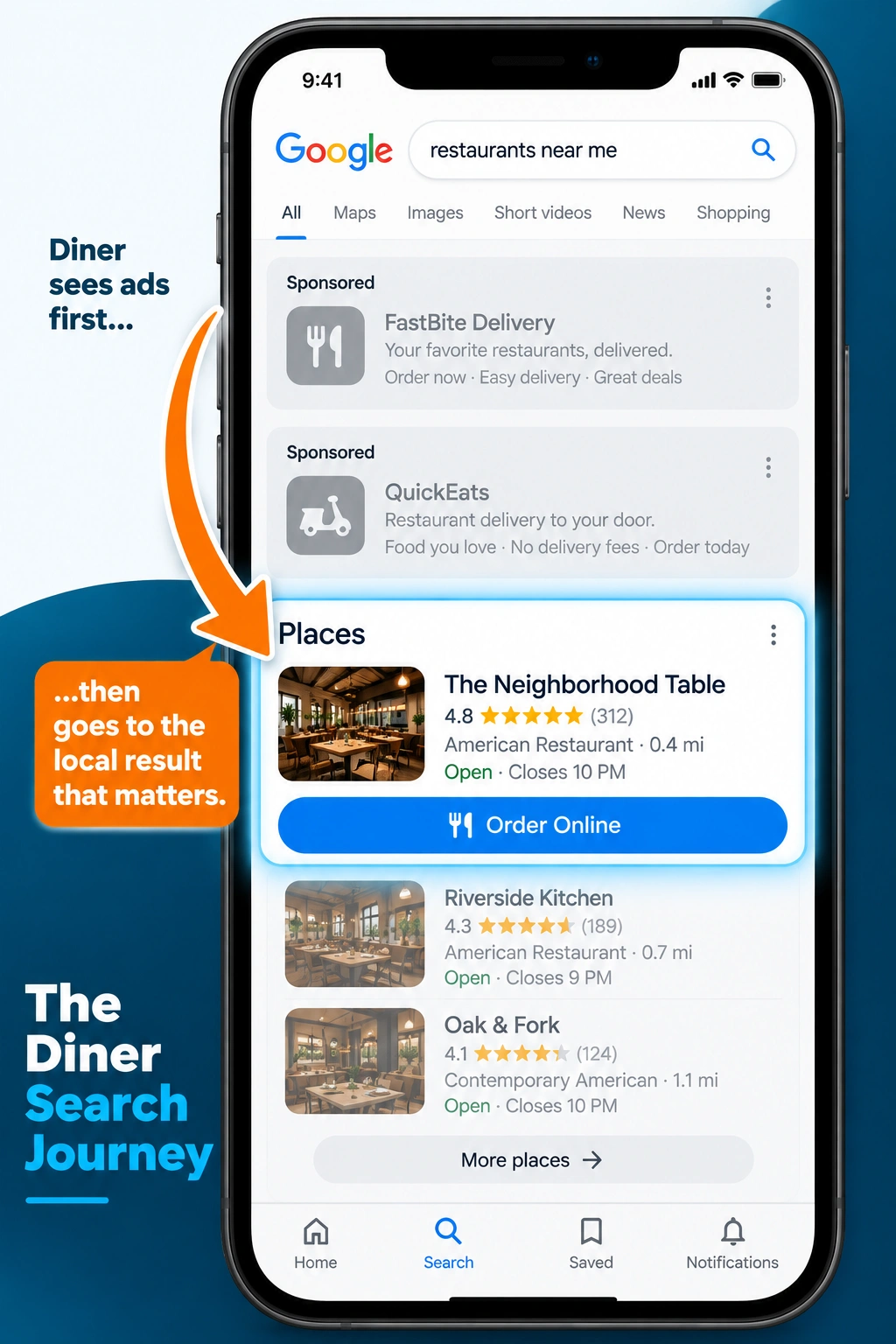
The diner search journey illustrates how customers may move past sponsored ads to engage with a prominent local restaurant listing.
How Google Reviews Directly Impact Your Local Map Rankings
Google does not treat all reviews equally, and understanding the specific signals it reads from your review profile changes how you approach the whole process. These are the four levers that matter most: They drive your map rankings.
- Review velocity: How frequently new reviews arrive matters as much as how many you have in total. A restaurant that earned 200 reviews two years ago and has gone quiet since then sends a weaker freshness signal than one earning 10 reviews a month consistently. Google interprets uninterrupted influx as evidence of a currently active, patronized business.
- Volume and sentiment: Total review count and average star rating remain bedrock. Higher volumes of positive feedback correlate directly with stronger local search visibility, not because Google mechanically rewards stars, but because volume and sentiment together indicate genuine consumer engagement with your location.
- Keyword richness in review text: When customers naturally mention specific dishes, neighborhoods, or service types in their reviews, such as “best gluten-free pizza in Phoenix” or “great patio brunch spot in Midtown,” Google reads those phrases as organic confirmation of what your business offers and where. This is long-tail SEO you cannot buy; your customers write it for you. It works.
- Owner response engagement: Responding to reviews signals to Google that your listing is actively managed, which reinforces the impact of online reviews on SEO as a ranking factor. The impact of online reviews on SEO extends beyond star ratings: engagement patterns, including response rates and response recency, feed directly into local authority signals.
The Art of the Response: Turning Feedback into Search Authority
Most restaurant owners understand they should respond to reviews. Fewer understand that how they respond creates compounding SEO value. Responses matter. These practices make the difference:
- Speed matters: Responding within 24-48 hours signals high engagement to both Google and prospective diners scanning your profile before booking. A week-old unanswered review reads as indifference, regardless of the star rating. Do not wait.
- Incorporate keywords naturally: When thanking a guest, weave in a dish name or service descriptor, like “We’re so glad you loved our hand-tossed wood-fired pizza,” rather than a generic “Thanks for visiting.” That phrasing reinforces the keyword associations Google is already building from your review corpus.
- Handle negatives with operational transparency: Ignoring a 1-star review does not make it disappear. Addressing it professionally, by acknowledging the issue, offering to resolve it offline, and keeping the response brief, demonstrates to every future diner reading that thread that your operation takes quality seriously. A few well-handled negative reviews build more trust than an implausibly flawless record.
- Avoid the perfect-score trap: A 5.0 average with 12 reviews and zero negative feedback can register as inauthentic to both consumers and search algorithms. Authentic review profiles with natural variation and visible owner engagement outperform sterile, curated ones over time.
Keeping up with reviews across Google, Yelp, and Tripadvisor simultaneously is one of those tasks that sounds manageable until you are in the middle of a dinner rush. BizIQ’s local brand management and reputation services handle the monitoring, response workflows, and citation consistency so your profile stays active without pulling you away from the floor. Call us at (888) 416-9800, Monday through Friday, 7 AM – 4 PM, to talk through what a managed reputation program looks like for your operation.
Beyond Organic: Using Targeted Local Advertising
Organic review authority builds slowly and compounds over time, but paid local advertising can accelerate the top of that funnel while your organic presence matures. Ads buy time. Research on programmatic advertising targeting mechanisms identifies several strategies particularly relevant to food and beverage operators: geotargeting reaches consumers in defined geographic radii around your location, contextual targeting places your ads alongside relevant dining content, and behavioral targeting engages users based on past browsing patterns, all documented in the FTC PrivacyCon study on online advertising targeting factors. Among these, retargeting, which shows ads to users who have already visited your website, commands significantly higher advertiser bid values in programmatic auctions, a finding from the same FTC PrivacyCon advertising research that reflects how highly the industry values converting already-interested consumers.
Paid ads and organic local SEO are not competing strategies: they work consecutively. They feed each other. A geotargeted ad brings a nearby diner to your website; your Google Business Profile with 180 recent reviews and a 4.7 average is what convinces them to make a reservation rather than clicking back to a delivery platform. Combining local ad spend with a review-rich organic profile creates a self-sustaining cycle: ads drive traffic, traffic generates visits, visits generate reviews, and reviews improve organic rankings that reduce your long-term dependence on paid spend.
“Because we started as a small business, we understand the hurdles that many small business owners have to face when they begin to market their brand and services online.” – Garrett Cisek, Co-Founder of BizIQ
Practical Workflows: Building an Automated Review Generation Machine
The most common reason restaurant owners have thin review profiles is not indifference: it is that asking for reviews feels awkward and manual in the middle of a busy service. The fix is removing the human friction from the process entirely by embedding review prompts into touchpoints that already exist in your operation. Make it automatic.
QR codes printed on physical menus or placed on table tents route diners directly to your Google review page with a single scan: no searching, no navigating. Digital receipts from your POS system can include a review link automatically. Reservation platforms like OpenTable and Resy support post-visit email sequences that can carry a review request without any manual follow-up from your team. The goal is turning review generation into an operational protocol for front-of-house staff: train servers to mention the QR code when presenting the bill, the same way they mention dessert specials. When the ask is normalized and unimpeded, review velocity follows. The reviews will come.
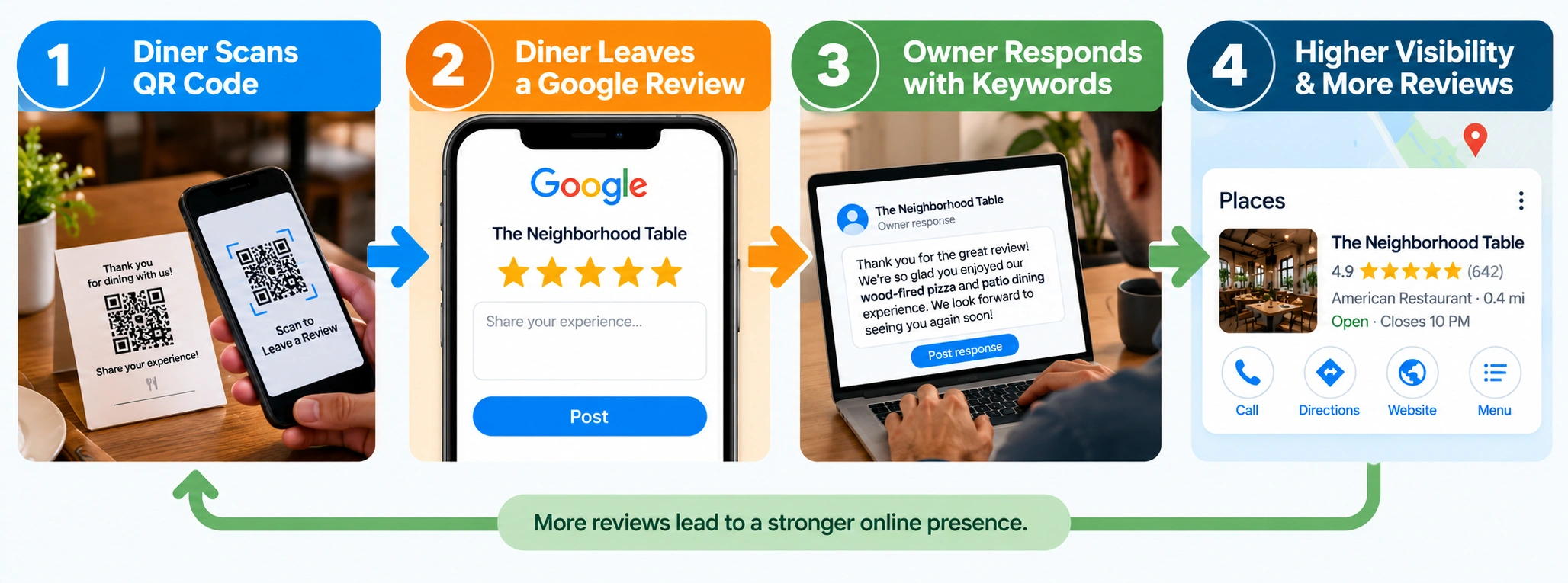
A simple review workflow shows how QR codes, customer reviews, and thoughtful owner responses can support a restaurant’s local presence.
Want to see exactly where your restaurant’s review profile and local citations stand against nearby competitors? BizIQ offers a free local SEO and review profile audit: our team will analyze your Google Business Profile, citation consistency across major directories, and review velocity to surface your most immediate growth opportunities. Reach out at (888) 416-9800, Monday through Friday, 7 AM – 4 PM.
The Technical Foundation: Why Your Menu Structure Matters for SEO
A well-managed review profile sitting on top of a technically broken website is like a great storefront on a street with no parking. The menu structure issue is the most widespread technical error in restaurant SEO, and it is entirely fixable: Do not ignore it.
- The crawlability problem: Search engines cannot reliably extract text from PDF or image-based menus. Every dish name, ingredient descriptor, and cuisine category locked inside a PDF is imperceptible to Google’s crawler, which means you are relinquishing the dish-level keyword associations that drive high-intent local searches.
- Mobile responsiveness: PDF menus force mobile users to pinch, zoom, and scroll sideways. That friction translates directly into bounce rate, and high bounce rate on a mobile session signals to Google that your page failed to satisfy the user’s intent.
- Capturing dish-level search intent: A structured HTML menu allows Google to index individual items. When someone searches “best gluten-free lasagna near me,” a restaurant whose menu includes that phrase in crawlable HTML has a genuine shot at that result. A restaurant with a PDF menu does not. They miss out.
- Page speed impact: Large PDF files increase page load time, and page load speed is a confirmed ranking factor. Every second of additional load time compounds the damage across mobile sessions, which now represent the majority of local dining searches.
Overcoming the Fear of Negative Feedback
Every operator dreads the occasional 1-star review, and that anxiety is understandable, but a perfect 5.0 rating can indeed work against you. Nobody is perfect. Consumers have grown discerning enough to recognize that no restaurant serving real food to real people in real time maintains a flawless record, and a suspiciously pristine profile often reads as either fake or lightly reviewed. Search algorithms share a version of that skepticism; a natural distribution of ratings, including a small percentage of lower scores, is a marker of an authentic, active business.
The practical framework for handling negative reviews is simple: acknowledge the specific issue without becoming adversarial, keep your response to two or three sentences, and invite the reviewer to continue the conversation offline where you can truly resolve it. What you are doing in that public response is not really talking to the unhappy customer; you are talking to the hundreds of prospective diners who will read that exchange before deciding whether to book. A professionally handled complaint demonstrates operational maturity in a way that a wall of five-star reviews simply cannot. It builds trust.
The Long-Term ROI of Consistent Local SEO Marketing
Third-party delivery commissions are a perpetual overhead that extracts value every time a transaction occurs, with no residual benefit to your own digital presence. Every order placed through a delivery platform strengthens that platform’s data and search authority, not yours. You lose equity. Organic search equity works in the opposite direction: every review earned, every response posted, and every citation corrected is a permanent addition to your local authority that continues generating discoverability without an ongoing per-transaction fee.
A restaurant that builds a consistent review generation workflow and maintains an optimized Google Business Profile is, in effect, constructing a customer acquisition asset that compounds over time. The 50th review you earn matters less than the 200th, and the 200th matters less than the 500th, not because of any single threshold, but because the cumulative signal tells Google, and every diner who encounters your profile, that this is an established, actively patronized business worth surfacing. You do not need a dedicated marketing department to get there. Start small. You need a structured, repeatable approach to local visibility and the discipline to execute it consistently.
Frequently Asked Questions About Restaurant SEO and Reviews
How do I do SEO for my restaurant?
Focus on local SEO by claiming and optimizing your Google Business Profile, targeting location-specific keywords such as “sushi in downtown Phoenix,” ensuring your Name, Address, and Phone (NAP) details are identical across all directories, and consistently generating and responding to customer reviews. These four actions, executed consistently, form the core of effective restaurant search engine optimization.
What is the 30/30/30 rule for restaurants?
The 30/30/30 rule is a financial guideline suggesting that a balanced restaurant budget should allocate roughly 30% of revenue to food and beverage costs, 30% to labor costs, and 30% to operating and overhead expenses, leaving approximately 10% as net profit. It is a budgeting touchstone, not a regulatory standard, and actual ratios vary significantly by concept and market.
Is SEO still worth it in 2026?
Yes, though the mechanics have shifted. Modern search engines prioritize helpful, authentic, human-verified content and strong local brand signals, including active customer reviews, consistent citations, and genuine user engagement, over the keyword-density tactics that defined early SEO. For restaurants specifically, local SEO for restaurants has become more valuable, not less, as search intent around dining has grown more specific and location-dependent.
Can ChatGPT do SEO?
ChatGPT can assist with isolated SEO tasks, such as generating keyword ideas, drafting meta descriptions, or outlining content structures, but it cannot replace human strategy, local market judgment, or the real-world review management that drives map rankings. A language model has no mechanism for generating authentic customer reviews, managing your Google Business Profile, or building the citation consistency that local search algorithms require.
Is SEO dead now with AI?
No. Search engines are actively shifting their ranking criteria toward authentic, real-world business signals that AI cannot fabricate: active customer reviews, verified local citations, and direct user engagement with your listing. If anything, that shift advantages independent restaurants that invest in genuine community relationships over operators who relied on technical keyword manipulation.
Your customer reviews are the most cost-effective ranking asset you control. They work around the clock, they compound in authority over time, and they signal to Google exactly what delivery platforms cannot manufacture: that real people in your neighborhood chose your restaurant, had a good experience, and took the time to say so publicly. Start today by responding to your three most recent reviews and auditing your Google Business Profile for accuracy: those two actions alone will move the needle faster than most technical SEO changes. When you are ready to build a systematic, scalable approach to local visibility, BizIQ’s team is equipped to handle the technical execution while you stay focused on the kitchen.
Ready to win the local Map Pack and drive more direct diners to your tables?
Partner with BizIQ to implement a professional, results-driven digital marketing services for restaurants strategy. Call us today at (888) 416-9800 or visit our office at 3627 E Indian School Rd Suite 103 to get started.