
A split-scene comparison contrasts managing restaurant local SEO alone with a coordinated team using data to guide digital marketing strategy.
Every restaurant owner eventually faces the same question: manage digital marketing internally, or hand it to a professional team that does nothing else? Restaurant SEO is crucial. It sounds like a budget decision, but it’s really an operational one: about where your time goes, what skills your team actually has, and whether the local search landscape is working for you or against you.
The stakes are not abstract. Approximately 46% of all online searches carry local intent, meaning consumers are actively looking for dining options nearby rather than browsing broadly. Of those local searches, around 81% target unbranded terms: people searching “best tacos near me” or “Italian restaurant open now,” not your restaurant’s name specifically (SEC Form F-1 unbranded search data). That means the overwhelming majority of potential customers who could walk through your door tonight are searching in a way that only finds you if your local search presence is deliberately built and maintained.
The visibility gap compounds this further. More than 90% of all websites receive zero organic traffic, and another 5% receive fewer than 10 visits per month. Ranking on page one isn’t a vanity goal; it’s a functional requirement, given that more than 95% of consumers will enter a new search query rather than scroll to page two (SEC Form F-1 page-two behavior data). If you’re not on page one for the searches that matter to your market, you are effectively not in the conversation.
This guide works through the actual costs, execution realities, and performance differences between managing restaurant SEO in-house and partnering with a professional agency. For a broader foundation on how local search works, the local SEO guide from BizIQ covers the mechanics in depth.
The Economics of Restaurant Marketing: In-House Salaries vs. Agency Retainers
The compensation metrics immediately recontextualize this choice for most operators. A Senior Marketing Specialist commands a base salary of $64,000 to $87,000 annually. A Marketing Manager runs $86,000 to $118,000 (Gartner Marketing Manager salary benchmark). A Marketing Director, the level of expertise needed to own a complete local search strategy, costs $120,000 to $167,000 per year. None of those figures include benefits, payroll taxes, recruitment costs, onboarding time, or the paid software tools required to execute campaigns competently.
Contrast that with a professional restaurant SEO company. Local SEO agency retainers typically range from $1,000 to several thousand dollars per month, roughly $12,000 to $36,000 annually, while specialized freelancers start around $500 per month, or $6,000 to $12,000 annually (SEC Form F-1 agency pricing data). The math is not subtle.
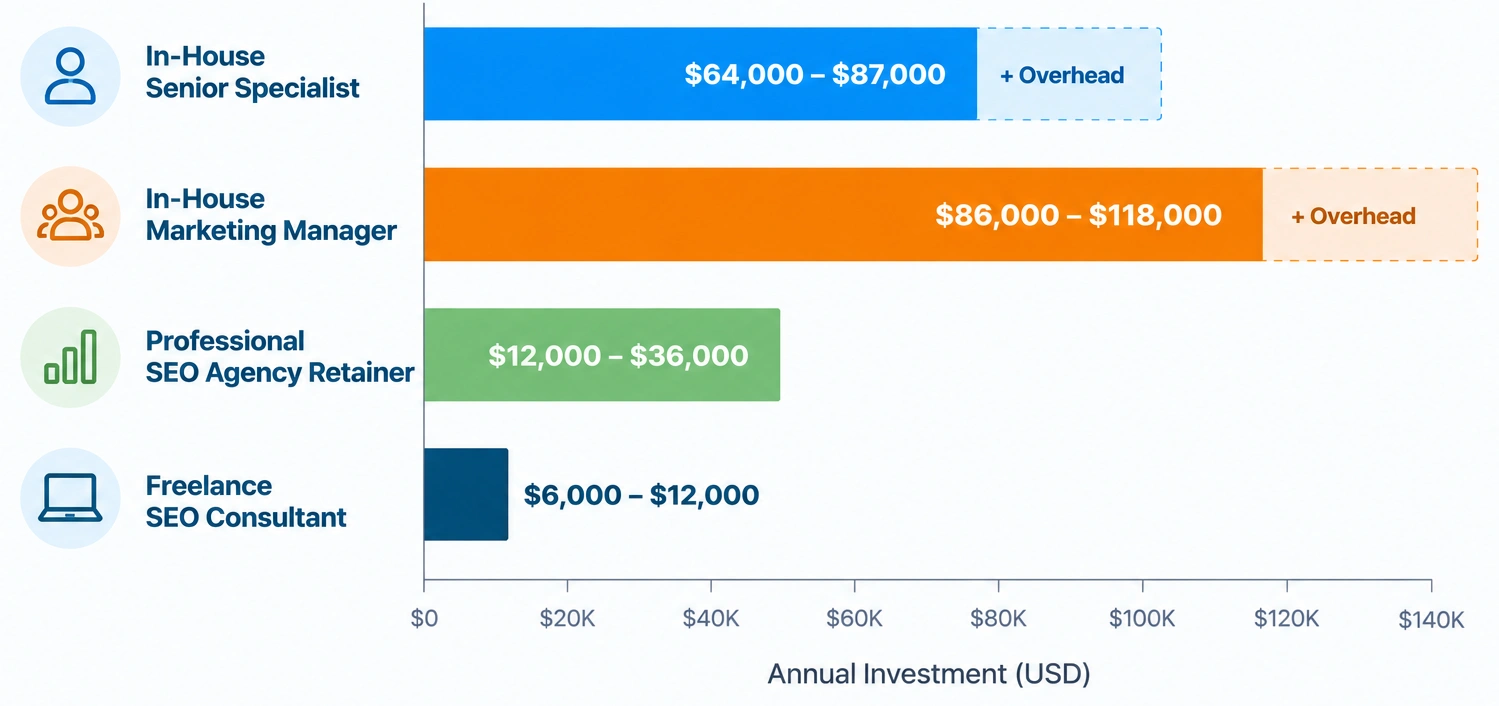
Annual marketing investment ranges vary significantly between hiring in-house professionals and working with SEO agencies or freelance consultants.
The chart above makes the cost differential visible in a way that is hard to argue with. Hiring an agency is structurally similar to hiring a head chef rather than staffing a full kitchen from scratch: you can build the team yourself, but a seasoned professional strengthens the entire operation without the overhead of full-time employment. The hidden costs of in-house hiring, including benefits, turnover, training, and tool subscriptions, routinely push the real annual investment well above the base salary figures.
For restaurant operators who want to understand what a full-service approach looks like before committing, BizIQ’s digital marketing services for restaurants page outlines the scope of what a professional partner delivers.
The Execution Gap: Generalist Staff vs. Specialized SEO Teams
Salary is only part of the problem. The deeper issue is execution capacity. Most restaurants do not have a dedicated marketing hire; they have a manager or coordinator who handles social media, email blasts, printed menus, and whatever else needs doing that week. Asking that person to also own local SEO is asking them to become a different professional without the time or training to do it.
Effective search engine optimization is not a single skill. It requires content marketers, web developers, user experience professionals, and performance marketers working in coordination to implement technical fixes and maintain momentum. When those disciplines are not aligned, or when one person is trying to cover all of them, execution gaps appear quickly. Citations go stale. Schema markup never gets implemented. Google Business Profile updates fall behind.
The skill-building problem is structural, not just a matter of effort. In-house teams at emerging companies are 94% less likely to enhance search skills rapidly compared to specialized agencies (Forrester on in-house SEO skill development). That gap widens over time as search algorithms evolve and the technical requirements of local search grow more complex. Meanwhile, specialized local search platforms and agencies consistently demonstrate measurable visibility improvements within 30 days of deployment, a timeline that in-house generalist teams rarely match.
There’s also the question of accountability. When SEO is a side responsibility, it’s the first thing that gets deprioritized when a busy Friday service runs long or a key staff member calls out. A professional partner doesn’t have that problem.
Core Pillars of a Winning Restaurant Search Strategy
Understanding what a complete local search strategy requires helps clarify why execution depth matters so much. The fundamentals are straightforward in theory, yet each demands meticulous, technical execution. Details matter.
- Google Business Profile (GBP) optimization: Consistent Name, Address, and Phone (NAP) data across all online directories is a primary local ranking signal. Inconsistencies, even minor formatting differences, erode search engine trust.
- Schema markup and structured data: Implementing local business schema and “speakable” code allows voice assistants, such as Siri, Alexa, and Google Assistant, to read your menu items and hours aloud to users. This is increasingly important as voice-based local queries grow.
- Review management: Actively soliciting and responding to customer reviews builds both search authority and consumer trust. This must be done in strict compliance with the FTC’s Consumer Reviews and Testimonials Rule, which took effect on October 21, 2024, and prohibits fake or incentivized reviews (FTC Consumer Reviews and Testimonials Rule).
- Local citation synchronization: Maintaining accurate listings across directories, review platforms, and data aggregators, making sure your restaurant shows up correctly on Google Maps, Yelp, and the other places people search for food, ensures that AI models and search engines can consistently identify and recommend your restaurant.
- Content and keyword targeting: Creating location-specific content that targets the unbranded search queries your potential customers are using, using the same words your customers type when looking for a place like yours, not just your restaurant’s name.
For a detailed breakdown of how these elements work together in practice, BizIQ’s coverage of restaurant local SEO strategies goes deep on the Map Pack, organic results, and AI-driven search simultaneously.
Want to know exactly where your restaurant stands in local search?
Request a free SEO audit from BizIQ. The audit identifies your specific visibility gaps, including inconsistent citations, missing schema, and underoptimized GBP elements, and delivers a clear path for closing them. No generic recommendations; it’s built around your restaurant’s actual search footprint.
The Shift to Answer Engine Optimization (AEO) and AI Search
Traditional SEO assumed a relatively stable model: optimize your website, build authority, rank on Google. That model is still relevant, but it is no longer sufficient on its own. The search landscape is shifting in a way that changes where restaurant recommendations actually originate.
A 2025 survey of 12,000 consumers found that 58% reported using generative AI tools for product and service recommendations, up from just 25% in 2023 (Harvard Business Review on Gen AI search behavior). ChatGPT, Perplexity, and Google’s Gemini are now part of how people decide where to eat. The complication is that a restaurant’s own website typically comprises only 5% to 10% of the sources AI search engines reference when generating recommendations (McKinsey on AI search source distribution). Your website matters, but it’s one input among many.
This is pushing the industry toward what is being called Answer Engine Optimization (AEO): optimizing your restaurant’s digital footprint across directories, review platforms, and structured databases so AI models can find, interpret, and recommend you accurately (Forrester on the AEO transition). It is not a replacement for traditional SEO; it is an extension of it. SEO is like building a reputation: it compounds over time, but neglect catches up with you, and the AI search layer amplifies both the benefits of a strong presence and the costs of a weak one.
There’s no clean playbook yet for AEO. The honest answer is that the field is still developing, and anyone claiming certainty about how AI recommendation engines will evolve over the next 18 months is speculating. What is clear is that the restaurants with consistent, accurate, and widely distributed digital footprints are better positioned regardless of which search surface dominates.
“Why is SEO important for your small business in Phoenix?
SEO levels the playing field by boosting your website’s search ranking, allowing you to compete with larger competitors even on a limited budget. It provides a cost-effective strategy for reaching more customers and building brand awareness through keyword optimization, attracting visitors interested in your offerings.”, Tyson Copeland, Local SEO Manager Based in Phoenix, AZ
Managing Restaurant Reviews Under the New FTC Guidelines
Review management has always been operationally important for restaurants. It is now legally consequential as well. The FTC’s Consumer Reviews and Testimonials Rule, which took effect on October 21, 2024, prohibits businesses from creating fake reviews, purchasing positive reviews, or suppressing negative feedback. The rule applies broadly; it covers not just outright fabrication but also incentivized reviews that are not properly disclosed.
Regulatory scrutiny has intensified. The FTC has already warned 10 companies about possible violations of the new rule, signaling that civil penalties are a real operational risk, not a theoretical one. For restaurants that have historically offered discounts or freebies in exchange for reviews, a common practice, this represents a meaningful compliance shift.
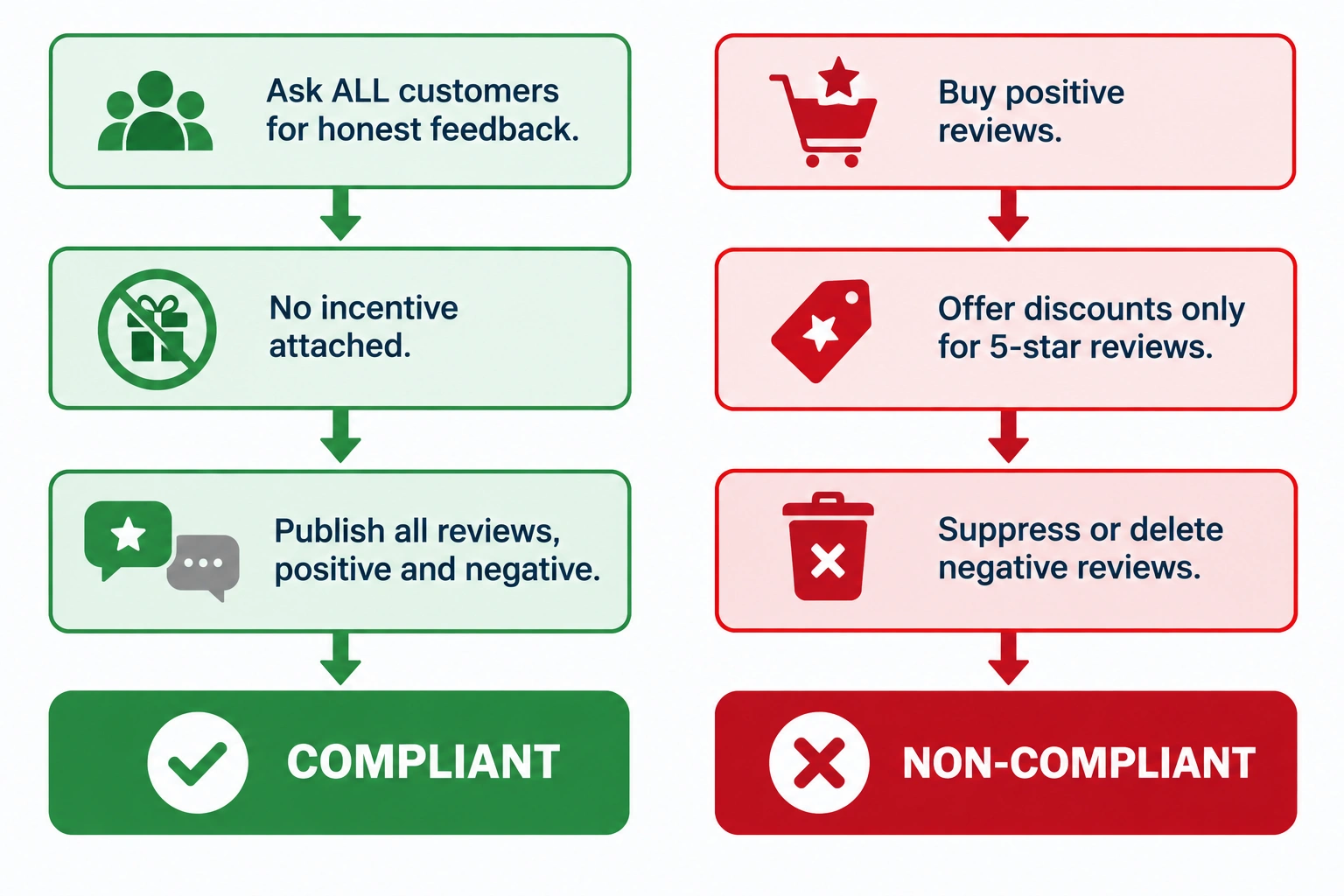
A side-by-side flowchart contrasts compliant review collection practices with prohibited tactics involving purchased or manipulated reviews.
The flowchart above captures the practical compliance boundary. Asking every customer for an honest review, without attaching any reward to the outcome, is the standard. Anything that selectively incentivizes positive feedback or discourages negative feedback crosses the line. Professional agencies that manage review programs are typically current on these requirements; in-house teams managing reviews ad hoc may not be.
Ready to build a compliant, high-performing local marketing strategy tailored to your restaurant?
Contact BizIQ to schedule a personalized consultation with a local marketing expert. The conversation focuses on your restaurant’s specific market, competitive landscape, and growth objectives, not a generic pitch deck. BizIQ builds customized, data-driven strategies rather than one-size-fits-all packages, and every client gets a dedicated account manager who handles the technical execution so you can stay focused on the dining room.
Step-by-Step Checklist for Optimizing Your Google Business Profile
Your Google Business Profile is the single most visible local search asset your restaurant controls directly. Achieving accuracy and maintaining currency is foundational to all subsequent efforts.
- Claim and verify your listing: If your GBP hasn’t been claimed and verified, none of the other optimizations matter. This is the starting point.
- Audit NAP consistency: Your Name, Address, and Phone number must be identical across every online directory, not just Google. Search engines treat inconsistencies as signals of unreliability.
- Upload geo-tagged visual content: High-quality, regularly updated photos of your dishes, interior, and menu, geo-tagged to your location, improve both engagement and local relevance signals.
- Monitor and respond to reviews: Actively solicit feedback from every customer and respond to reviews promptly, maintaining full compliance with the FTC’s October 2024 rule. Engagement signals matter to local ranking algorithms.
- Keep hours and attributes current: Outdated holiday hours or missing attributes (outdoor seating, delivery available, parking) create friction for potential customers and weaken your profile’s completeness score.
For a deeper look at the technical side of profile optimization, BizIQ’s resource on Google Business Profile optimization covers the ranking mechanics and common errors that undermine otherwise solid profiles.
Measuring ROI: Direct Orders vs. High-Commission Delivery Apps
The financial case for being found online without paying for ads sharpens considerably when you factor in the margin impact of customer acquisition channels. Data and analytics programs across top restaurant operations yield a 5% to 10% increase in revenue and a 10% to 15% reduction in store-level operating costs by optimizing online ordering and customer acquisition (SEC Form S-1/A restaurant analytics data). Those represent substantial margins in an industry characterized by notoriously thin profitability.
The attribution picture is genuinely complicated, though. Many customers search online and then walk in and pay in person: no reservation click, no online order, no trackable conversion event. The exact contribution of being found online without paying for ads to in-venue dining is difficult to isolate, and anyone claiming precise attribution figures for local SEO to table covers is probably overstating their measurement capability.
What is measurable is the cost structure of alternative acquisition channels. Third-party delivery platforms charge commissions on every order that cut directly into already-tight margins. Every direct order, driven by a customer who found you through being found online without paying for ads, clicked your website, and ordered without a platform intermediary, is a higher-margin transaction. Building local search visibility is not just about getting found; it is about reducing dependence on channels that extract a share of every sale.
That margin logic is what makes the agency retainer math work even for operators who are skeptical of digital marketing spend. The question is not whether SEO costs money. Margins matter. It’s whether the cost of not investing in it, in lost direct orders, in platform dependency, in invisibility to the 81% of local searchers who never type your restaurant’s name, is higher.
How to Decide: Is In-House or Professional SEO Right for You?
The pragmatic framework here transcends ideology: it centers on arithmetic and operational capacity.
Start with time. Estimate the hours your current staff spends each month on manual directory updates, review monitoring, GBP maintenance, and content creation. Assign an hourly cost to that time based on what those employees earn. Then compare that figure against a professional agency’s monthly retainer. For most restaurant operators, the math resolves faster than expected.
Then consider skill depth. If your team includes someone with genuine technical SEO experience, not just social media familiarity, but actual knowledge of schema markup, citation management, and local link building, in-house execution is at least plausible. If that expertise does not exist on your payroll, you are not choosing between in-house and agency; you are choosing between agency and underperformance.
There’s also the question of what happens when things go wrong. Algorithm updates, GBP suspensions, citation conflicts: these require immediate, informed responses. A professional partner has seen these problems before and has processes for resolving them. An in-house generalist is figuring it out in real time, often while managing everything else a restaurant demands.
For operators who have been burned by agencies that promised quick rankings and delivered nothing, the concern is legitimate. The distinction worth making is between agencies that report on vanity keyword rankings and agencies that report on business outcomes: calls, map direction requests, direct website visits, and reservation volume. The latter is what a well-structured local search partnership looks like.
Frequently Asked Questions About Restaurant SEO
How long does it take to see results from restaurant SEO?
While traditional SEO timelines run 6 to 12 months for meaningful organic ranking improvements, specialized local search services can demonstrate significant ranking gains within 30 days by automating schema deployment and local citation synchronization. The distinction matters: broad domain authority takes time to build, but local visibility signals, including GBP optimization, citation consistency, and structured data, can move faster when executed correctly. BizIQ’s local SEO services are built around that local-first approach.
What is the impact of voice search on restaurants?
Voice search queries are inherently local and immediate: “find a pizza place near me” spoken into a phone while driving is a high-intent moment. Deployed landing pages that implement automated schema and speakable code ensure that voice assistants can accurately interpret and read your restaurant’s details, including hours, location, and menu highlights, directly to users. Without that structured data layer, voice assistants either skip your restaurant or pull inaccurate information from stale sources.
How does the FTC review rule affect restaurant marketing?
The FTC’s Consumer Reviews and Testimonials Rule prohibits writing fake reviews, purchasing positive reviews, or suppressing negative ones. Violations can result in severe civil penalties; the FTC has already moved to enforce the rule, warning 10 companies about possible violations. For restaurants, this means any review solicitation program needs to ask all customers for honest feedback without attaching incentives to the outcome.
Is SEO dead now with AI?
No, it is evolving. AI changes how users search and how content gets surfaced, but the underlying requirement for accurate, authoritative, and relevant information has not changed. What is shifting is the range of surfaces that need to be optimized: not just Google’s blue links, but AI-generated recommendations, voice results, and structured database queries. Restaurants that maintain strong local SEO fundamentals are better positioned across all of those surfaces, not just traditional search results pages.
Can ChatGPT do SEO?
ChatGPT can assist with specific SEO tasks, such as keyword research, content drafting, meta description generation, and structured data formatting, but it requires human oversight to ensure strategic alignment, factual accuracy, and brand consistency. It is a capable tool for accelerating certain workflows, not a replacement for the judgment and ongoing monitoring that effective local search management requires.
Auditing your current local search footprint is the most concrete first step available to you right now. Calculate the hours your staff spends on manual directory updates and review monitoring each month, assign a real cost to that time, and compare it against what a professional agency retainer actually costs. For most restaurant operators, that exercise alone clarifies the decision. If you want to eliminate execution gaps and capture the unbranded local search volume that represents the majority of your potential customers, a professional local SEO audit gives you the specific plan to do it: not a generic checklist, but a diagnosis of your restaurant’s actual visibility gaps and a prioritized plan for closing them.
Partner with BizIQ for Local Restaurant Growth
Explore BizIQ’s local SEO services for small businesses to see how the approach works, or call (888) 416-9800 to talk through your restaurant’s specific situation with someone who understands what local search actually requires.
BizIQ specializes in the local search mechanics that drive restaurant growth, including citation management, GBP optimization, schema deployment, review strategy, and the emerging demands of AI-driven search. Every client works with a dedicated account manager who handles the technical execution entirely, so you can focus on the dining room rather than the dashboard. As Co-Founder Garrett Cisek put it: “Because we started as a small business, we understand the hurdles that many small business owners have to face when they begin to market their brand and services online.”