Google’s algorithm doesn’t treat your restaurant the same as a national chain. Here is what determines whether a hungry customer finds you when they search nearby. The frustration is real, and it is compounded by the fact that every third-party delivery marketplace is quietly extracting a significant cut of each order you work hard to fulfill.
To make your restaurant visible to people already looking for you, you need to understand how search engines match a diner’s query to nearby options. Effective restaurant search engine optimization is critical.
Search engines match a diner’s query to the most geographically and contextually appropriate options available. Understanding that matching process is the foundation of every effective restaurant local SEO strategies decision you will make. According to SEC filings analyzing local search behavior, map pack results generate around 42% of local organic traffic, which means the three-business cluster that appears at the top of a Google search is capturing nearly half of all clicks before a diner ever scrolls to the traditional results below.
Think of Google like a food critic who is constantly updating their guide. If your restaurant keeps changing its address, phone number, or hours across different directories, that critic cannot keep up and will eventually stop recommending you. Consistency is not a technical nicety; it is the baseline requirement for trust. Trust drives rankings.
The three pillars that search engines use to evaluate local restaurants are worth understanding clearly:
- Proximity: How close your restaurant is to the searcher’s physical location or the geographic area they specified in their query.
- Relevance: How well your business profile, website content, and menu descriptions match what the diner is searching for, which includes the specific dishes, dietary preferences, and dining context they have in mind.
- Prominence: How well-known and trusted your restaurant appears across the broader web, measured through reviews from happy customers, links from other reputable sites, and consistent directory listings that reinforce your identity.
Demystifying the Google Local Pack for Restaurants
Your Google Business Profile is the single most important digital asset for capturing immediate, high-intent foot traffic. Optimizing this profile is like making sure your restaurant has a clear, well-lit sign on the busiest street in town. When someone searches “tacos near me” or “best brunch in [neighborhood],” the businesses that appear in the map pack are almost always those with fully built-out, actively maintained Google Business Profiles. Google Business Profile optimization is not a one-time setup task; it is an ongoing operational habit that directly influences how your restaurant shows up in search.
The basic requirement is keeping your business name, address, and phone number consistent across every directory where your restaurant appears. When Google cross-references your profile against Yelp, TripAdvisor, your website, and a dozen other sources and finds matching information everywhere, that consistency functions as a trust signal. Discrepancies, even minor ones like “St.” versus “Street” in an address, introduce ambiguity that algorithms penalize. Claiming and verifying your listing through Google’s official process is the first concrete step, because an unverified profile has limited visibility regardless of how complete it is.
Daily operational habits feed directly into search algorithms in ways most owners do not realize. Uploading high-quality photos of your kitchen and dishes, updating your hours for holidays and special events, and posting weekly updates about specials or new menu items all signal to search engines that your business is active and engaged. An abandoned profile, one that was set up two years ago and never touched, reads as a low-confidence listing. Activity matters. It is also worth noting that traditional search engines restrict map pack visibility primarily to businesses with a verified physical location, typically targeting a five-mile radius around the searcher, according to the same SEC filing on local search behavior. That geographic boundary makes the quality of your profile within that radius significantly more important.
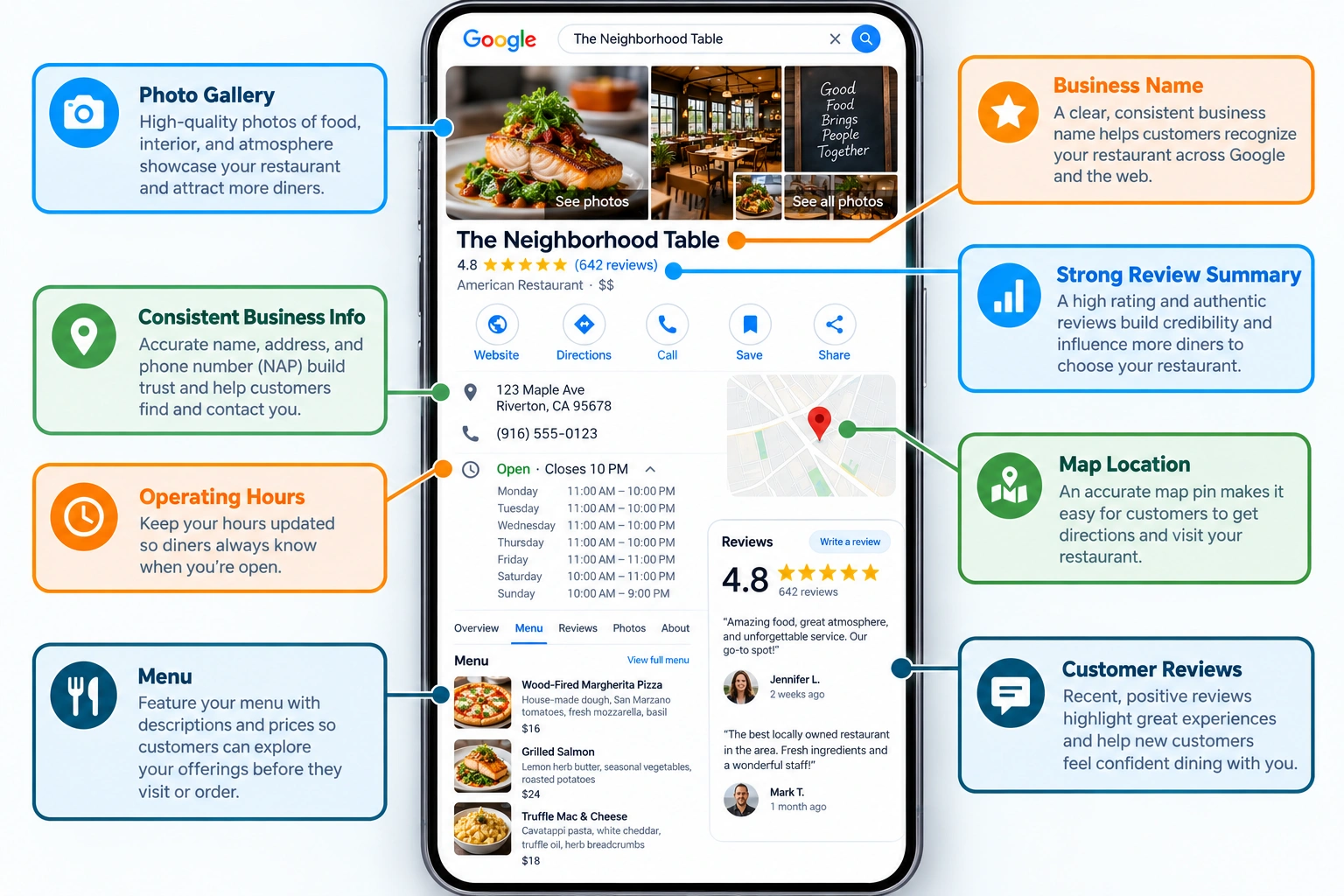
An optimized restaurant Google Business Profile combines accurate information, strong reviews, photos, hours, and menu details in one local listing.
The Shift to AI Search and the Zero-Click Environment
The way diners find restaurants is changing faster than most owners appreciate. Generative AI and large language models have introduced a search experience where a user asks a conversational question and receives a direct recommendation, without ever visiting a traditional search engine results page. This zero-click environment has significant implications for how your restaurant needs to be represented online.
- AI search adoption has surged. According to Harvard Business Review’s 2025 analysis of AI search behavior, 58% of consumers surveyed in 2025 reported using AI search tools, up from just 25% in 2023. That is not a gradual trend; it is a fundamental shift in how people discover local businesses.
- Your website is a small fraction of the picture. Research from McKinsey’s analysis of AI search referral sources found that a brand’s own website accounts for only 5% to 10% of the sources AI search engines draw on when generating recommendations. The rest comes from third-party directories, review platforms, and social media.
- Consistency across the entire web becomes non-negotiable. Because AI models scrape dozens of external sources simultaneously, a discrepancy between your Google Business Profile and your Yelp listing, or between your Yelp listing and your Facebook page, can produce conflicting information in an AI-generated recommendation. The diner may receive an outdated phone number or incorrect hours, and that weakens trust before they ever walk through your door.
- Zero-click does not mean zero opportunity. Restaurants that appear in AI-generated recommendations are typically those with the most coherent, well-documented digital presence. The businesses that show up are not necessarily the most famous; they are the most consistently described across the sources AI models trust.
Transitioning to Entity-Based SEO for Restaurants
Traditional keyword optimization, such as stuffing your website with phrases like “best pizza restaurant” and hoping for the best, has been losing effectiveness for years. What search engines actually want to understand is not just which words appear on your page, but what your restaurant is as a defined entity in the world.
Entity-based SEO means optimizing your restaurant as a singular, coherent reference point with clearly associated attributes. Rather than chasing individual keyword variations, you are building a complete picture that search engines and AI models can confidently cite, according to SEC filings on local search algorithm development. The attributes that define your restaurant entity include:
- Cuisine category and subcategory (e.g., “wood-fired Neapolitan pizza” rather than just “Italian restaurant”)
- Physical address and verified location data tied consistently to your Google Business Profile and all major directories
- Reviews from happy customers across high-authority platforms, which serve as third-party validation of your entity’s quality and relevance
- Signature menu items described in structured, crawlable text that search engines can associate with your restaurant’s identity
Structured data and schema markup are the technical tools that make this work. By adding restaurant schema to your website, you give search crawlers explicit, machine-readable instructions about the relationships between your business, your location, your menu, and your neighborhood. It is the difference between a search engine guessing what you are and knowing exactly what you are. Clarity wins.
Get a Free Local Visibility Audit
If you are not sure how your restaurant currently shows up in search, or how your profile compares to competitors within your immediate neighborhood, we can help you find out. Our free local visibility audit analyzes your Google Business Profile, checks your directory consistency across the web, and benchmarks your search presence against nearby competitors. There is no obligation, and the findings give you a clear, honest picture of where you stand today. Reach out to us at (888) 416-9800 to request your audit.
The Critical Role of Reviews and Compliance
Review volume, average rating, and the recency of new reviews are among the most direct prominence signals that search algorithms measure. A restaurant with 400 reviews and a 4.6-star average will consistently outperform an equally proximate competitor with 40 reviews and a 4.8-star average, because the volume and frequency of reviews communicate ongoing relevance. Platforms like Yelp, which hosts over 300 million cumulative reviews according to Yelp’s SEC Form 10-K filing, function as massive trust repositories that search engines crawl to verify a restaurant’s quality and relevance.
Think of it this way: a recommendation from a trusted local food blogger carries more weight than a random mention on an obscure website. Search engines evaluate reviews through a similar lens: the authority of the platform, the specificity of the review content, and the consistency of the sentiment all factor into how prominently your restaurant shows up in search. To optimize for AI search engines and the growing range of platforms that aggregate local business data, your review presence needs to extend beyond Google alone, covering Yelp, TripAdvisor, and any niche dining platforms relevant to your cuisine category.
The compliance dimension of review acquisition is something every owner needs to understand clearly. Rules are strict. The Federal Trade Commission’s endorsement and testimonial guidelines are explicit: paying for reviews, incentivizing reviews without clear disclosure, or offering free meals in exchange for positive feedback without disclosing that arrangement violates consumer protection law. Beyond the legal risk, deceptive review practices tend to produce a review profile that looks inauthentic, and both search algorithms and savvy diners are increasingly good at detecting it. The only viable approach is organic, compliant review generation: making it easy for genuinely satisfied customers to leave feedback through well-placed prompts, follow-up messages, and table signage.
“Why is SEO important for your small business in Phoenix? SEO levels the playing field by boosting your website’s search ranking, allowing you to compete with larger competitors even on a limited budget. It provides a cost-effective strategy for reaching more customers and building brand awareness through keyword optimization, attracting visitors interested in your offerings.” : Tyson Copeland, Local SEO Manager Based in Phoenix, AZ
Why Your Restaurant Needs a Dedicated Website
A common objection we hear from independent restaurant owners is that a Facebook page and a Yelp listing cover the bases; why invest in a dedicated website? The answer comes down to how search engines and AI assistants retrieve and interpret information. Both systems rely on structured, crawlable HTML text to understand what a business offers at a detailed level. Social media profiles and third-party directory listings provide some of that context, but they do not give you control over the depth or structure of the information.
When a diner searches for “gluten-free pasta near me” or “restaurants with outdoor seating and happy hour,” search engines crawl your dedicated domain looking for specific, machine-readable text that answers those queries. If your menu exists only as a flat PDF or as an image file, search crawlers and AI assistants cannot read it. PDFs block search engines. You are invisible for every dish-level and feature-level search that could be driving customers to your door. A dedicated website with an HTML menu, one where each dish, its description, and its dietary attributes are written in structured text, gives you coverage for the long tail of specific searches that your competitors with PDF menus are missing entirely.
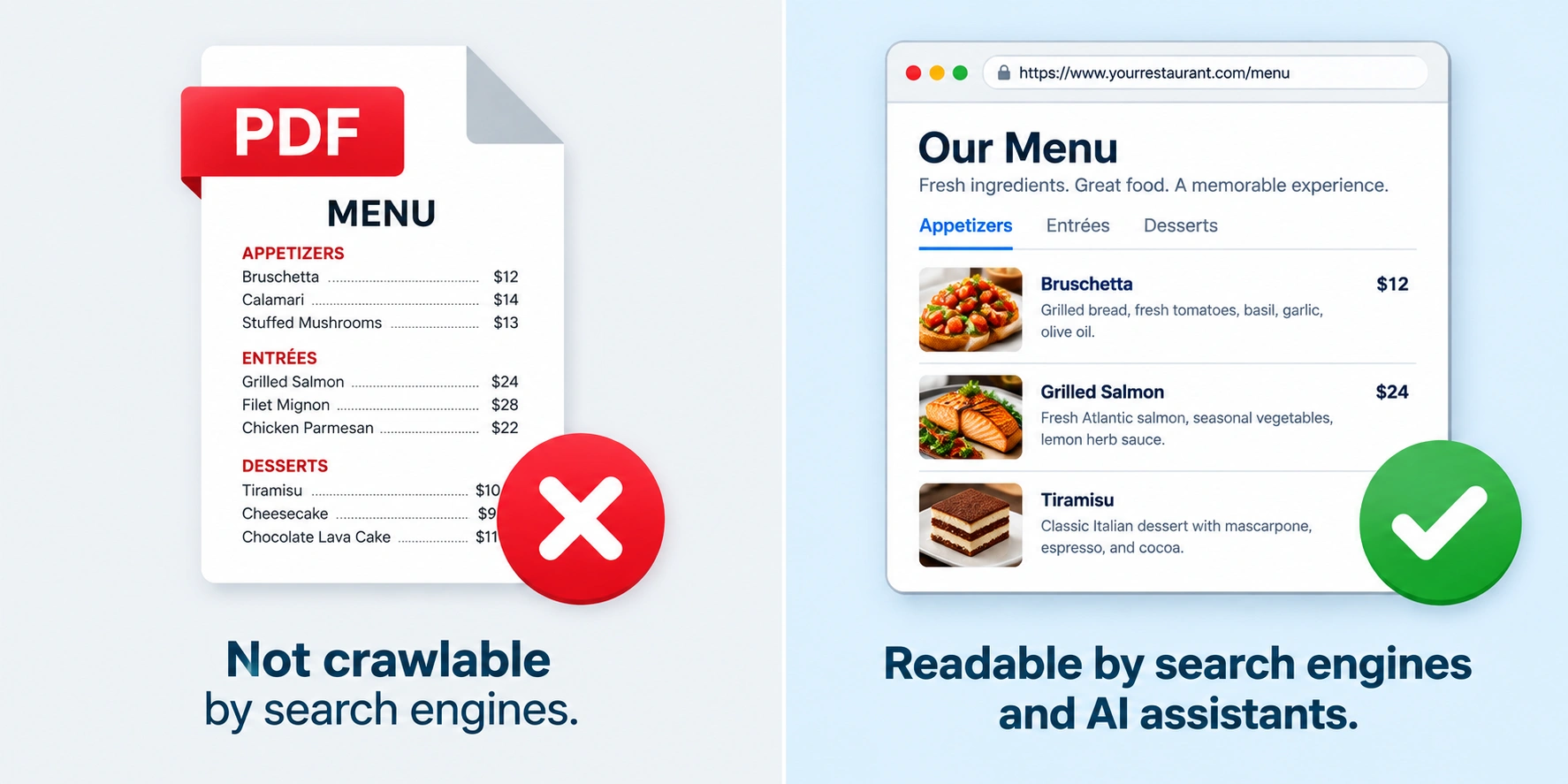
A side-by-side comparison shows why structured HTML menus provide greater search accessibility than relying on PDF menus alone.
Commission-Free Ordering, Built Into Your Website
We design professional, mobile-responsive websites specifically built for restaurants, with structured HTML menus that search engines can read and index at the dish level. More importantly, we integrate a commission-free online ordering system directly into your site, so when a diner finds you through search and places an order, that revenue stays with you rather than flowing to a third-party marketplace. No per-order fees, no platform reliance. If you are ready to turn your website into a direct revenue channel, call us at (888) 416-9800 or visit us at 3627 E Indian School Rd Suite 103 to learn more.
Foundational On-Page SEO Practices for Restaurants
Getting your website to work as a genuine discovery tool requires attention to a handful of basic practices. None of these are exotic; they are the baseline that separates a website that generates traffic from one that simply exists.
- Keyword mapping with local intent: Pair cuisine-specific terms with neighborhood or city modifiers throughout your page content. “Best sushi in [Neighborhood]” targets a far more specific and convertible search than “sushi restaurant.” Map distinct keyword themes to distinct pages: your lunch menu page, your private dining page, and your catering page should each target their own relevant search queries rather than competing with each other.
- Schema markup for restaurants: Implement local business schema and restaurant-specific schema on your website. This structured data tells search crawlers explicitly what your business is, where it is located, what it serves, and when it is open, reducing the deciphering work the algorithm has to do and improving the accuracy of how your restaurant shows up in search.
- Mobile responsiveness: The majority of local restaurant searches happen on mobile devices, often within minutes of dining decisions. Ensure your pages load fast enough to prevent mobile users from bouncing before they see your menu, and that your site functions flawlessly across screen sizes. A site that requires pinching and zooming to read a menu is a site that loses customers. Speed and layout matter.
- Structured HTML menus: As covered above, your menu should be written in crawlable text, not embedded as a PDF or image. Each dish name, description, and dietary tag is a potential search query that your website can answer.
The Financial Impact of Direct SEO-Driven Ordering
Third-party delivery marketplaces solve a real problem: they put your restaurant in front of diners who might not otherwise find you. But that visibility comes at a cost that increases with every order. The steep commission fees charged by major delivery marketplaces are not a one-time expense; they are a recurring drain on every transaction that flows through those platforms, and for restaurants already operating on tight margins, that drain is material.
A fully optimized local search presence changes the math. When a diner finds your restaurant through Google Maps, clicks through to your website, and places an order directly through your own ordering system, you capture the full revenue of that transaction. No platform fee, no commission, no dependency on a third-party algorithm deciding whether to feature you this week. You keep the profits. Over time, the compounding effect of shifting even a portion of your order volume from third-party platforms to direct channels has a significant impact on your bottom line, protecting the profit margin that your food quality, your staff, and your operational discipline have earned.
Frequently Asked Questions About Restaurant SEO
Local search is not a static system you configure once and forget. It changes daily. Algorithms update, competitors improve their profiles, and the platforms that influence your visibility, from Google to Yelp to emerging AI assistants, evolve continuously. The questions below are designed to help you make informed decisions about your digital presence, whether you are just getting started or reassessing a strategy that has plateaued.
Common Restaurant Search Queries Answered
How do I get my restaurant to show up on Google?
Start with your Google Business Profile: claim it, verify it, and fill out every available field: hours, cuisine category, menu items, photos, and a description that reflects how your restaurant speaks to customers. From there, focus on keeping your business name, address, and phone number consistent across every directory where your restaurant appears, including Yelp, TripAdvisor, Apple Maps, and any local city guides. Inconsistencies across those sources create conflicting signals that erode search trust. Encouraging reviews from happy customers is equally important, not just for the star rating, but because review volume and recency are active ranking signals. Understanding the benefits of local reviews for search engine trust is one of the most practical things you can do early in this process.
What is the 30/30/30 rule for restaurants?
The 30/30/30 rule is a financial health standard suggesting that food costs, labor costs, and overhead plus profit should each account for roughly 30% of total revenue. It is a useful framework for identifying where margin pressure originates. The connection to digital marketing is direct: every order that flows through a third-party delivery platform at a high commission rate compresses the profit portion of that equation. When organic search drives diners to place orders directly through your own website, you protect that 30% profit allocation rather than surrendering a portion of it to platform fees.
Is SEO still worth it in 2026?
Yes, though the nature of what “SEO” means has shifted considerably. Organic search visibility remains one of the most cost-efficient ways to reach diners who are actively looking for what you serve. What has changed is the environment: AI search tools, zero-click results, and entity-based algorithms mean that the old approach of targeting a handful of keywords and building a few backlinks is no longer sufficient on its own. The restaurants that will benefit most from search in 2026 and beyond are those that have built a coherent, well-documented digital presence across multiple platforms, a presence that both traditional search engines and AI assistants can confidently cite when a nearby diner asks for a recommendation.
What is the 60/40 restaurant rule?
The 60/40 rule is a prime cost standard: your combined cost of goods sold and labor costs should not exceed 60% of total sales, leaving 40% to cover overhead and generate profit. It is a tighter, more operationally focused version of the 30/30/30 framework. From a digital marketing perspective, the commission fees charged by major delivery platforms directly inflate your effective cost of goods sold on those transactions, pushing prime costs above the 60% threshold. Eliminating or reducing that dependency through direct, search-driven ordering is one of the more straightforward levers for keeping prime costs in check without changing a single ingredient or scheduling a single fewer shift.
How do I learn SEO as a beginner?
Google’s own SEO Starter Guide is a genuinely useful starting point; it is free, regularly updated, and written for non-specialists. Moz’s Beginner’s Guide to SEO and HubSpot Academy’s free courses cover keyword research, on-page optimization, and technical fundamentals in accessible depth. If you are thinking, “I’m not tech-savvy,” there is a practical ceiling to what a restaurant owner can realistically implement while running a full operation. Partnering with a managed service provider like BizIQ means the technical heavy lifting, such as schema markup, directory management, website optimization, and ongoing performance monitoring, is handled by specialists, while you stay focused on the kitchen and the dining room.
Getting found online is ultimately about protecting what you have built: the food, the team, the regulars who keep coming back, and the community presence that no algorithm can replicate. Search engines and AI assistants are simply the modern version of word-of-mouth: the systems that carry your reputation to people who have not discovered you yet. Building a resilient, multi-channel digital presence is not a distraction from running your restaurant; it is the infrastructure that ensures the work you put into your food and service actually reaches the people looking for it.
The most useful next step is an honest audit of where your restaurant currently stands, not a vague sense that you “should probably do something about SEO,” but a concrete look at your Google Business Profile, your directory consistency, and how you compare to the restaurants showing up above you in local search results.
Start With a Free SEO Audit
We offer a free SEO audit that analyzes your current online visibility, identifies gaps in your directory listings, and benchmarks your search presence against nearby competitors. If you are ready for a fully managed solution, one that covers your website, local search optimization, and a commission-free online ordering system, the BizIQ Complete Solution is designed to handle all of it. You focus on the food. We handle the rest.