Strong local backlinks for franchises come from genuine relationships, useful local resources, and coverage that customers have a reason to trust. A national franchise website may have broad recognition, but each individual location still needs to demonstrate its relevance to the neighborhood it serves. The right links can introduce a franchise to new customers, send qualified referral traffic, and contribute to how search engines understand its local prominence.
There is no guaranteed number of backlinks that puts a location at the top of Google Maps. Quality, context, the usefulness of the linked destination, and other local search factors matter far more than collecting links for their own sake.
Key Takeaways
- Start with accurate location information and genuinely useful local content.
- Prioritize editorial links from relevant organizations and publications over mass directory submissions.
- Never assume that paying a sponsor or swapping links produces ranking credit.
- Measure referral visits, inquiries, and location-level search performance, not just backlink counts.
Why Local Backlinks for Franchises Matter
Google explains that local rankings are primarily based on relevance, distance, and prominence. Prominence reflects how well known a business is, and Google’s examples include links and reviews among the signals it considers. That gives franchises a concrete reason to build awareness beyond national advertising, but it does not establish that any particular link will change a specific Maps position.
Compare two locations within the same network. One appears only on the brand’s corporate website. The other is mentioned by its chamber of commerce, a neighborhood nonprofit, and a local publication covering a community project. Those mentions create opportunities for discovery and may reinforce the location’s local identity. The second location still needs accurate business details, relevant services, and a competitive customer experience.
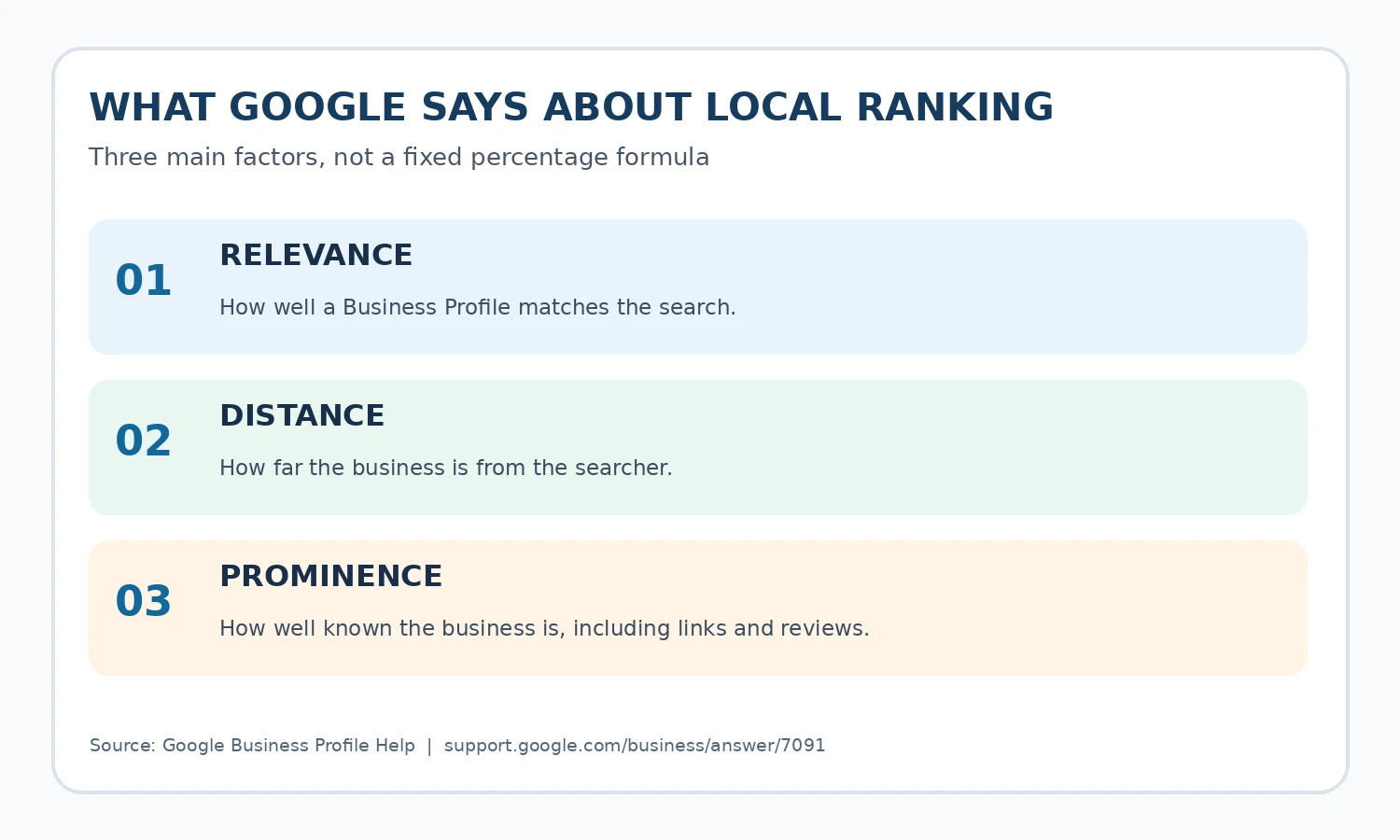
official Google Business Profile local ranking guidance
for details. The infographic does not assign invented percentages to these factors.
How Local Backlinks for Franchises Differ From National Links
A national mention may promote the franchise brand without helping customers discover a particular branch. Location-specific coverage can point customers toward the actual store, staff, events, and service area. The key distinction is the intended audience and the destination, not simply whether the linking website has a city in its name.
For a broader program covering branch visibility, content, and technical foundations, explore franchise marketing support. Local link earning is one piece of that wider work.
Build a Reliable Foundation Before Outreach
Give Each Eligible Location Accurate Business Information
Check every eligible Google Business Profile for the correct business name, address or service-area configuration, phone number, category, hours, website destination, and services. Do not create duplicate profiles for the same business just to target more keywords. If local teams manage their own listings, use a shared approval process so corporate and franchisees do not overwrite one another.
Accurate directory information helps people find the correct location and reduces confusion. A Google Business Profile setup service can support consistent setup and maintenance across a growing network.
Prepare a Useful Destination for Every Earned Link
Whenever possible, link to the exact location involved in the story, not a generic corporate entry point. A strong location destination should give visitors the information they expected to find: real contact details, opening hours, local photographs, appropriate services, directions where relevant, and clear next steps.
A branch-specific destination is particularly valuable when the linking organization is covering a local workshop, community initiative, or partnership. The reader arrives with context and should not need to search again to identify the participating franchise.
Keep those destinations distinctive. Changing only a city name across hundreds of near-identical locations adds little value. A coherent local SEO service strategy should connect relevant local information with real customer needs.
Seven Practical Ways to Earn Quality Local Links
1. Contribute Expertise to Local News
Journalists look for informed sources when covering consumer questions, seasonal trends, neighborhood development, and business issues. A home services franchise might explain winter maintenance needs; a restaurant operator could discuss sourcing or hiring challenges. Offer accurate, attributed information rather than a prewritten advertisement. An editorial citation may include a link, but coverage is worthwhile even when it does not.
2. Join Relevant Community Organizations
A chamber of commerce or professional association can generate introductions, business referrals, and an authentic listing. Review the organization’s actual activity, member audience, and directory quality. Membership alone does not make a directory link powerful. Confirm that a local chapter or member profile genuinely serves the franchise location’s community.
3. Collaborate With Nearby Organizations
Consider a family entertainment location working with a neighborhood school on a fundraising night or a fitness franchise offering a free workshop with a local wellness nonprofit. Document the event clearly: date, participating organizations, photos with permission, and how residents benefited. When partners independently cover the initiative, natural citations can follow.
4. Create Locally Useful Resources
Helpful resources earn references because they solve a problem. Examples include an accessible event checklist, a regional maintenance calendar based on credible weather guidance, or a downloadable safety checklist reviewed by a qualified specialist. Avoid generic city guides that offer nothing original. The resource should stand on its own even without any search benefit.
5. Support Community Events Without Buying Ranking Credit
Legitimate sponsorship can raise awareness and support worthwhile causes. However, sponsorship is not a way to purchase ranking credit. Google’s spam policies require paid or sponsored links to be qualified appropriately, for example with rel="sponsored" or rel="nofollow". Make that expectation clear before agreeing to a placement.
Review Google’s link spam policies before building a program around sponsorships, link exchanges, or guest contributions. Editorial relevance beats shortcuts.
6. Offer Interviews, Demonstrations, and Community Classes
Franchise employees often possess practical knowledge that local audiences value. A hardware outlet could host a tool safety class, while a pet care franchise could teach basic seasonal pet preparation. Publish accurate event details and invite established local organizations to share them only when the event truly fits their audience.
7. Reclaim Legitimate Unlinked Brand Mentions
When a real local publication mentions a specific branch but does not include a website link, politely offer its correct URL for readers who want hours, services, or directions. The publisher may decline. Keep the request focused on helping the audience rather than demanding keyword-rich anchor text.
Backlinks Versus Local Citations
A backlink is a clickable hyperlink from another website. A citation is a mention of a business’s identifying information, commonly its name, address, and phone number. A citation may include a link, but not every citation does. Neither category automatically proves that a location is trustworthy.
| Opportunity | Primary Benefit | What to Check |
|---|---|---|
| Local news coverage | Audience trust and relevant referral traffic | Editorial independence and factual accuracy |
| Chamber directory | Business discovery and accurate contact details | Active community membership and current listing |
| Industry directory | Qualified customer discovery | Real consumer usage and accurate categories |
| Event partnership | Community engagement | Authentic participation and disclosure of sponsorship |
| Mass link directory | Often little practical customer value | Avoid thin listings and bulk submissions |
For multi-location systems, centralized local citation management can help maintain consistent details while individual operators pursue community relationships.
A Scalable Workflow for Multi-Location Franchise Teams
Corporate marketing needs visibility without stripping local operators of their community knowledge. A workable approach separates brand policy from local opportunity discovery. Corporate can provide approved descriptions, media contacts, brand guidelines, and compliance checks. Franchise teams can recommend neighborhood partners, local events, and experts with firsthand knowledge.
Start With a Small Location Pilot
- Select several representative locations. Include a mix of established and newer branches rather than only strong performers.
- Audit existing coverage. Note relevant links, local citations, broken destination URLs, and community relationships.
- Identify five to ten meaningful prospects per location. Prioritize actual fit over arbitrary authority scores.
- Make a useful contribution. Offer a story, source, class, partnership, or valuable reference.
- Record outcomes. Track published mentions, earned links, referral visits, and resulting inquiries.
- Improve the process. Expand only the outreach types producing credible audience value.
Set Approval Rules Without Creating a Bottleneck
Give each manager a simple opportunity form with the organization, contact person, intended contribution, likely audience, and whether money or goods change hands. Reserve corporate review for legal claims, regulated industries, press statements, and sponsored placements. Routine chamber memberships and eligible community calendars should not require a weeks-long approval cycle.
Example Responsibility Split
| Task | Corporate Team | Local Operator |
|---|---|---|
| Brand and compliance policy | Owns standards | Follows standards |
| Community relationships | Provides templates | Leads outreach |
| Location details and photography | Provides platform and review | Checks local accuracy |
| Reporting and measurement | Maintains dashboard | Reviews inquiries and results |
Measure the Business Impact, Not Just the Link Count
An impressive backlink count can conceal poor outcomes. Review new referring websites for topical fit, local relevance, credible audience reach, and legitimate editorial context. Then compare those findings with real customer behavior.
- Referral sessions: Use Google Analytics 4 to identify visits arriving from a partner or local publication.
- Engaged visitors and conversions: Measure completed contact forms, calls where properly tracked, bookings, or other meaningful actions.
- Organic search performance: Use Google Search Console to review queries and clicks associated with the relevant location destination.
- Business Profile interactions: Review available calls, direction requests, and website interactions without treating them as direct backlink attribution.
- Link quality: Check whether earned links remain live, point to an appropriate destination, and comply with Google’s guidelines.
Consult Google Analytics traffic acquisition reporting to understand where visits originated. Correlation is not causation: movement in rankings after outreach does not prove that any single link caused it.
Common Mistakes Franchise Networks Should Avoid
- Buying bulk link packages: High volumes of unrelated links can add risk without providing useful traffic.
- Overusing exact-match anchors: Let independent publishers choose natural references rather than imposing repetitive keyword text.
- Excessive reciprocal linking: Partnerships should exist for customers and communities, not as a required link trading scheme.
- Sending every local link to the brand’s top-level URL: Direct readers toward the specific branch or resource when that best matches their intent.
- Confusing citations with backlinks: Keep separate records for accurate mentions and actual clickable references.
- Reporting guarantees: No agency can promise that a fixed number of links will secure a particular local ranking.
A structured SEO audit can reveal technical and visibility issues that would otherwise limit the benefit of strong community outreach.
How to Budget Without Paying for Link Schemes
Budget for useful activities rather than promising a price per followed backlink. Legitimate expenses may include staff time, community participation, original photography, event logistics, qualified expert review, and measurement. Separate public relations and sponsorship costs from editorial link earning. A paid sponsorship should be evaluated for its real audience benefit, not sold as a guaranteed ranking boost.
Location count alone should not determine the budget. A network of forty branches in similar markets may need different support from a smaller system spread across highly competitive urban areas. Review service scope, number of participating locations, reporting requirements, and available local resources before comparing franchise SEO pricing options.
Frequently Asked Questions
What are local backlinks for franchises?
They are links from other websites, often local publishers, organizations, or partners, to a franchise brand or specific location. The strongest opportunities are relevant, legitimate, and useful to customers.
Do backlinks guarantee better Google Maps rankings?
No. Google says local results depend mainly on relevance, distance, and prominence. Links can contribute to prominence, but Google does not offer guaranteed placements or a fixed backlink target.
Should every franchise location earn its own links?
Where feasible, location-specific coverage is valuable because it connects a real branch with its community. National brand coverage also has a role, but local efforts should point to the most helpful destination.
Are chamber of commerce links worth pursuing?
They can be worthwhile when membership has real business or community value. Review the organization and its directory rather than joining solely for a hyperlink.
Can sponsorships generate SEO value?
Sponsorships can build brand awareness and send visitors. Paid placements should use appropriate link attributes such as rel=”sponsored” or rel=”nofollow” rather than being sold as followed links for rankings.
How long does local link building take?
Timelines vary by market and outreach approach. Track publishing dates, referral visits, inquiries, and organic visibility over several months instead of promising ranking changes by a particular deadline.
Make Every Local Relationship Count
A sustainable franchise link strategy begins with the communities the business already serves. Relevant news coverage, worthwhile partnerships, accurate listings, and useful local resources can create reasons for other organizations to mention each branch. The goal is stronger awareness and qualified customer discovery, supported by a responsible search strategy.
BizIQ combines practical local marketing experience with services for organizations managing multiple locations. Learn more about BizIQ’s digital marketing team and how local visibility fits into broader business growth.

Keep Franchise Listings Accurate
Build a stronger foundation for customer discovery with consistent location information and clearer local profiles.

Plan for Multiple Locations
Compare available franchise SEO options and align the scope with your network’s goals.

Discuss Your Franchise Growth Goals
Find out which local visibility opportunities deserve attention first.