According to the FTC consumer alert on online impersonation, 68% of pest control leads originate from local search results, which means the majority of your potential customers are finding, or not finding, you before they ever pick up the phone. That is why effective SEO for Pest Control is so crucial. If your business isn’t showing up conspicuously in those results, you’re not just losing visibility; you’re handing revenue to competitors who figured out local search before you did.
Most pest control operators already know the pain of shared lead platforms: you pay a premium per lead, compete against three other companies for the same homeowner’s attention, and still have no guarantee of the job. Organic local search flips that equation. A well-optimized presence generates inbound calls from people who searched specifically for your services, in your area, right now. And with AI-powered search engines increasingly shaping how homeowners discover service providers, the window to build that presence, before your competitors do, is narrowing.
Local search results, traditional SEO, and the newer discipline of Generative Engine Optimization are not separate strategies requiring separate budgets. They share the same bedrock: clean, consistent, structured local business data. Clean data wins. Get that foundation right, and you’re positioned to win both the Google Maps pack and the AI-generated recommendations that are fast becoming a primary discovery channel. Our SEO Beginners Guide covers the broader mechanics of how this works across service industries: pest control leads come from the same underlying system, just with more urgency behind the search intent.
A successful pest control search engine optimization strategy rests on three interconnected pillars:
- Local Map Pack Visibility: Ensuring your business appears in the top three map results when homeowners search for emergency services like “exterminator pest control services near me” or “pest control service for rats.”
- Organic Search Authority: Ranking your website’s service pages for high-intent terms such as “termite pest control service,” “bed bug pest control,” or “cockroach pest control”, queries where the person searching has already decided they need professional help.
- AI Citations and Mentions: Ensuring conversational AI models recommend your brand when users ask for the best pest control service professional in their area, pulling from the same structured data that powers your traditional rankings.
Mastering the Google Business Profile for Maximum Map Visibility
Your Google Business Profile is the single most critical asset for local visibility, and it functions less like a social media page and more like a digital storefront on the busiest street in your market. If the hours are wrong, the address is inconsistent, or the phone number doesn’t match what’s listed on your website, customers encounter impediments, and Google’s algorithm notices the same inconsistencies. The U.S. Small Business Administration local search data guidelines recognize NAP consistency (Name, Address, Phone Number) across all platforms as a fundamental requirement for local search success, not a nice-to-have. A fully optimized profile drives the majority of phone calls and website clicks for local service businesses, and for pest control companies specifically, where most searches carry urgent intent, that visibility gap between a complete profile and an incomplete one translates directly to missed calls.
For Google Business Profile optimization to actually move the needle, the details matter more than most operators expect. Selecting “Pest Control Service” as your primary category designation, rather than a generic “Home Services” label, tells Google’s algorithm precisely what your business does and which searches it should surface you for. From there, adding relevant secondary categories like “exterminator pest control services” or “residential pest control service” expands your footprint across related queries. Equally important are geo-tagged photos of your actual technicians working in the field: treating a crawl space, inspecting a commercial property, or finishing a termite treatment. These images do two things simultaneously: they signal to Google that your business is active and locally rooted, and they give prospective customers the kind of visual proof that stock imagery never provides. Pest control services are inherently trust-dependent purchases; a homeowner letting a technician into their house wants to see who’s showing up.
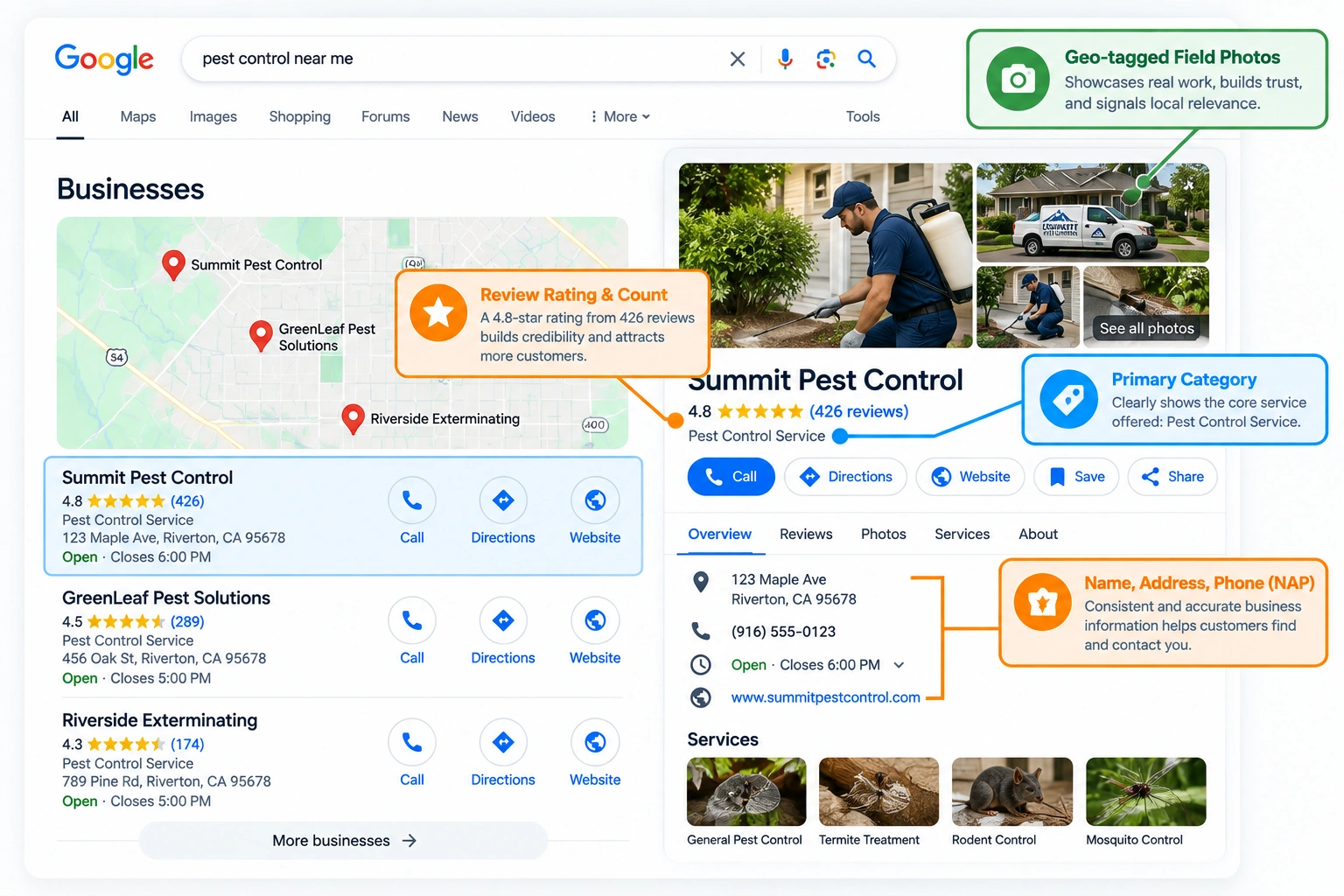
An optimized pest control Google Business Profile highlights the local search elements that help customers find, evaluate, and contact a business.
Building Authentic Review Velocity Under FTC Guidelines
Customer reviews function as both a ranking signal and a trust mechanism; for pest control companies, the two are inseparable. Reviews are vital. Google’s algorithm parses review text for specific service terms: a review mentioning “cockroach pest control” or “pest control service for rats” carries semantic weight that a generic five-star rating without text does not. Understanding the impact of online reviews on SEO is essential before building any review garnering strategy, because the rules governing how you collect those reviews changed significantly in late 2024.
- Organic Review Velocity: Prompt real customers for feedback immediately after completing a service. A steady, consistent stream of reviews, even a handful per week, signals an active, credible business far more effectively than a burst of reviews followed by months of silence.
- FTC Compliance: The FTC’s Rule on the Use of Consumer Reviews and Testimonials, which went into effect October 21, 2024, prohibits deceptive practices including buying fake reviews, suppressing negative feedback, and fabricating endorsements. Violations carry real penalties, and the rule applies to businesses of every size.
- No Review Gating: Pre-screening customers and sending review links only to satisfied clients is explicitly prohibited. Every customer must have an equal opportunity to leave feedback, regardless of whether the job went smoothly or not.
- Operational Integration: Specialized software can automate review requests immediately following service delivery, turning a manual follow-up task into a consistent, scalable process that generates active search signals without requiring your technicians to remember to ask.
Navigating the Shift to Generative Engine Optimization and AI Citations
Search behavior is shifting in a way that most pest control operators haven’t fully accounted for yet. Platforms like ChatGPT, Google Gemini, and Perplexity are increasingly the first stop for homeowners researching pest problems, and those platforms don’t return a list of ten blue links. They amalgamate information from multiple directories, local blogs, and government databases to recommend specific service providers, according to the SBA guide on emerging AI search technologies, GEO or Generative Engine Optimization is the discipline of making your business the one those AI models recommend.
- Information Synthesis: AI search engines don’t rely on simple keyword matching. They cross-reference hundreds of sources to verify a business’s legitimacy and relevance before surfacing a recommendation, per the SBA guide on emerging AI search technologies. A business that appears consistently across authoritative directories, local citations, and its own well-structured website carries far more weight in that verification process.
- Data Consistency: Inconsistent business details across the web cause AI models to lose confidence in a listing. When your phone number on Yelp doesn’t match your website, or your service area description varies between directories, the model’s confidence threshold drops, and it recommends a competitor whose data is cleaner.
- Structured Data Implementation: Implementing schema markup for small business on your website makes your content machine-readable for AI crawlers, providing explicit signals about your services, location, and operating hours rather than leaving the model to infer them from unstructured text, as noted by the U.S. Small Business Administration local search data guidelines.
- Cached Database Reliance: Some AI search engines draw from cached database snapshots rather than live web data, per the U.S. Small Business Administration local search data guidelines. If your company recently changed its service area, updated its hours, or moved locations, that change may not propagate to AI recommendations for weeks or months without proactive citation management.
Get Your Free Local SEO & Citation Audit
Your NAP consistency and AI search readiness determine whether homeowners find you or your competitors. BizIQ’s free local SEO and citation audit assesses exactly where your data stands across the directories and platforms that matter most, including the sources AI models rely on when generating recommendations.
We back our work with a 60-Day Local Marketing Guarantee: first-page Google rankings (maps or organic) for at least two keyword phrases within 60 days, or your next month of service is free.
Explore our pest control seo services to see how we build and protect your local search presence from the ground up.
Protecting Your Pest Control Brand from Online Impersonation
Brand impersonation is a genuine operational risk in the pest control space, not a theoretical one. Dishonest companies regularly use paid search ads to impersonate reputable local brands or redirect inbound calls to unauthorized lead centers, as documented in the FTC consumer alert on online impersonation. A homeowner searching for your business by name may click a paid ad that looks like your listing, speak to someone who has nothing to do with your company, and never reach you at all. The revenue loss is real; the reputational damage from a bad experience with an impersonator is harder to quantify and harder to recover from. Building a dominant organic presence and securing verified AI citations is the most durable defense against this kind of interference: organic rankings and AI recommendations can’t be purchased by a competitor the way a paid ad slot can.
When your business ranks prominently in organic results, the local map pack, and AI search engines cite you by name as the recommended provider in your area, you establish an undeniable source-of-truth that a deceptive paid ad simply can’t replicate. A homeowner who sees your business listed organically, confirmed in the map pack, and recommended by an AI assistant has three independent signals pointing to the same conclusion. That convergence is what a local SEO foundation protects: not just rankings, but the integrity of your brand in the moments that matter most. A digital shield built from consistent citations and structured data is far more resilient than any single ad campaign.
“Because we started as a small business, we understand the hurdles that many small business owners have to face when they begin to market their brand and services online.” : Garrett Cisek, Co-Founder of BizIQ
The Role of Entity SEO and Content Silos in Pest Control Marketing
Search engines have moved well past simple keyword matching. Keywords are not enough. Modern algorithms build a knowledge graph of your business by mapping interdependencies between concepts: connecting your service types (termite pest control, bed bug pest control, residential pest control service) to geographic locations, to customer intent signals, to the specific pest categories your content addresses. This process is called entity-mapping, and it’s why two pest control websites with identical keyword density can rank very differently: one has built semantic authority across a coherent network of related topics, and the other has a collection of pages that don’t reinforce each other.
Content silos are the structural answer to this problem. Think of it like organizing a tool shed: a well-organized shed has a section for power tools, a section for hand tools, and a section for safety equipment, with everything in its designated place. When you need a specific tool, you know exactly where to look. A pest control website built on content silos works the same way: a parent page for “Pest Control Services” branches into dedicated sub-pages for termite pest control service, cockroach pest control, pest control service for ants, and pest control and bed bugs, each of which links to location-specific pages that address the problem in a particular service area. Google’s crawlers follow that architecture and build a coherent picture of what your business covers and where it operates, which is precisely the kind of structured signal that earns both organic rankings and AI citations.
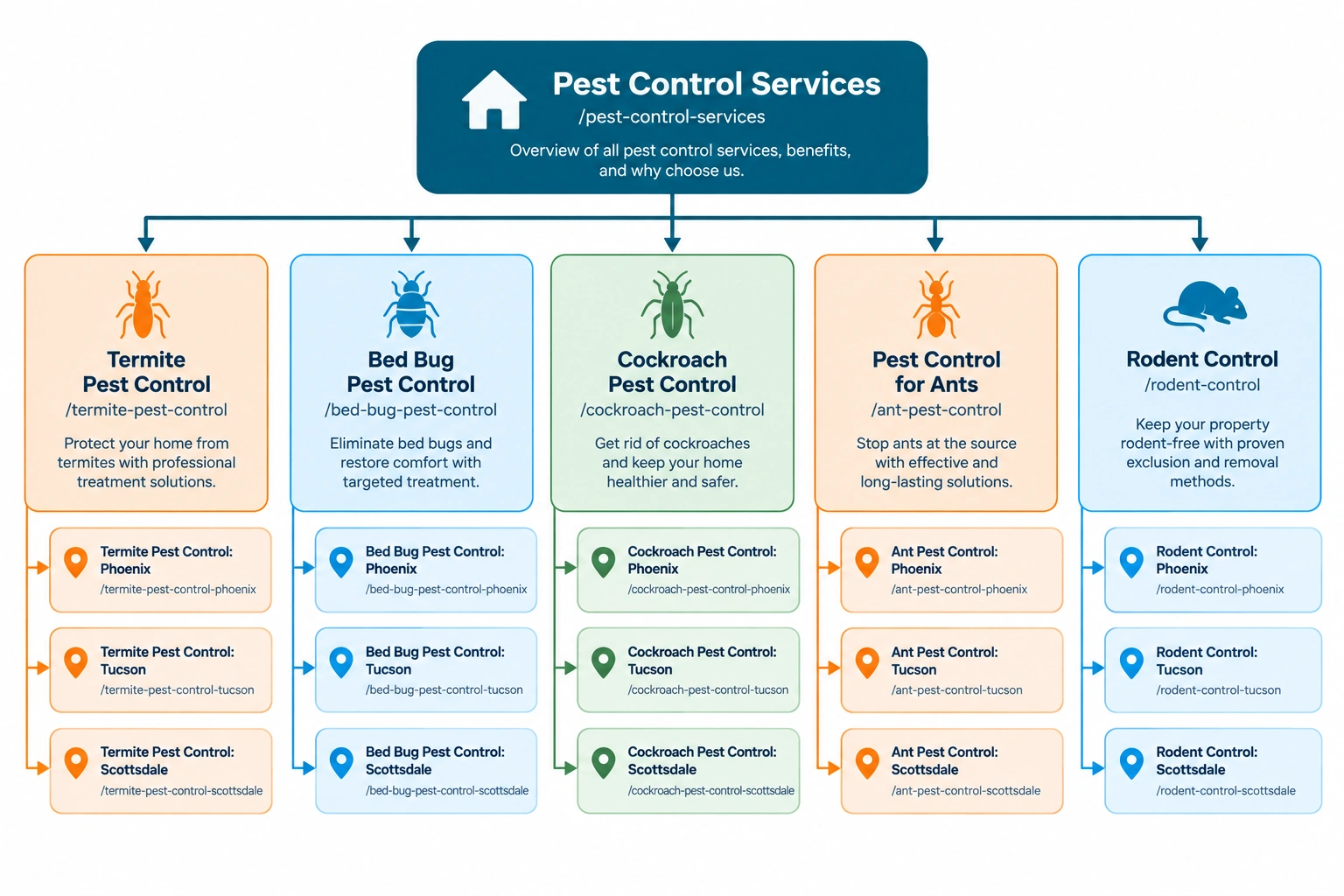
A depth-first SEO content silo organizes pest control services into dedicated service pages with supporting location-specific pages.
Talk to a BizIQ Local Marketing Specialist
We’re a small business that has spent years helping other small businesses compete in local search, and we believe sophisticated digital marketing belongs to every pest control operator, not just the national franchises with dedicated marketing departments.
If you want to discuss building a customized local search strategy for your company, our team is available Monday through Friday, 7 AM – 4 PM. Call us at (888) 416-9800 and speak directly with a specialist who understands the pest control market.
Technical On-Site SEO and Structured Data for Exterminators
The technical layer of your website determines whether search engines and AI crawlers can accurately read, categorize, and trust what you’ve built. Even strong content underperforms when the underlying architecture is unclear. Speed and structure matter. These are the core technical priorities for a pest control website competing in local search:
- Schema Markup: Implementing structured data, particularly LocalBusiness schema, provides search engines and AI models with explicit, machine-readable information about your services, service areas, and operating hours, reducing the interpretive work the algorithm has to do and increasing the likelihood of accurate citations, per the SBA guide on emerging AI search technologies. Note that the specific Schema.org markup types best suited for pest control service pages remain an evolving area of practice; LocalBusiness schema is the established foundation, and additional service-specific types should be evaluated as the standard develops.
- Mobile Optimization: Most emergency pest searches happen on a phone, often late at night or early in the morning when someone has just discovered a problem. A site that loads slowly or renders poorly on mobile loses those calls before the visitor ever reads a word.
- Site Architecture: A clear taxonomy, with descriptive, entity-focused anchor text connecting parent pages to service sub-pages and location pages, helps crawlers map the relationships between your content and assign topical authority accordingly.
- Local Landing Pages: Each service area your company covers warrants a dedicated page with unique, locally relevant content. Duplicate text across location pages signals thin content to search algorithms and provides no meaningful signal to AI models trying to verify your geographic footprint.
[MISSING: downloadable asset]
Overcoming the Limitations of Modern AI Search Tracking
One of the more frustrating realities of investing in Generative Engine Optimization is that you can’t always measure it cleanly. Major AI developers do not disclose the exact formulas used to determine which local businesses appear in generative summaries, per the SBA guide on emerging AI search technologies, meaning there’s no equivalent of a Google Search Console report for AI citations. Algorithmic transparency in this space is essentially nonexistent at the practitioner level, and that’s unlikely to change in the near term.
The measurement problem compounds this. Standard digital marketing platforms lack robust attribution metrics for tracking leads that originate specifically from AI conversational citations. A homeowner who asks Perplexity for a pest control recommendation, then searches your business name directly, then calls you: that lead shows up in your analytics as a direct or branded search, not as an AI-assisted conversion. The actual return on investment for GEO efforts is therefore difficult to isolate with the tools most pest control operators have access to today. That doesn’t mean the investment isn’t working; it means the industry hasn’t yet built the measurement infrastructure to prove it cleanly. The practical response is to treat citation consistency and structured data as foundational hygiene: work that pays dividends across traditional search, AI search, and brand protection simultaneously, regardless of which channel gets the attribution credit.
Frequently Asked Questions About Pest Control SEO
Navigating the evolving landscape of local search and AI citations raises real questions for operators who are running routes, managing technicians, and trying to grow at the same time. The following frequently asked questions address the most common points of confusion around search engine optimization in the pest control industry.
Answers to Common Pest Control Marketing Queries
How do AI search engines find local pest control companies?
AI search engines crawl authoritative directories, local business listings, and structured website data to identify highly recommended service providers in a specific geographic area, according to the U.S. Small Business Administration local search data guidelines. Businesses with consistent NAP data and well-structured websites are significantly more likely to surface in those results.
What is the impact of the FTC review rule on local SEO?
The FTC’s 2024 rule penalizes businesses that engage in deceptive review practices, meaning pest control companies must rely strictly on authentic, organic customer feedback to build their online reputation, per the FTC’s Rule on the Use of Consumer Reviews and Testimonials. Review gating, purchased reviews, and suppressed negative feedback all carry enforcement risk under the current rule.
Why is schema markup important for AI search?
Schema markup provides search engines and large language models with clear, structured information about a business’s services, location, and operating hours, increasing the likelihood of being cited in generative search results, as outlined by the SBA guide on emerging AI search technologies. Without it, AI models are left inferring your business details from unstructured text: a process that introduces errors and reduces citation confidence.
How can a pest control company protect its brand from online impersonators?
Building a strong foundation of local SEO and securing verified citations across major platforms establishes a trusted digital presence that distinguishes a legitimate business from deceptive paid ads, according to the FTC consumer alert on online impersonation. When your organic rankings, map pack presence, and AI citations all point to the same verified business, the impersonation tactic loses most of its effectiveness.
Is SEO still worth it for pest control companies in 2026?
Yes: organic search remains a primary driver of high-intent traffic, and local map pack rankings still generate the majority of immediate phone calls for emergency pest services. AI search changes the discovery pathway for some users, particularly those in the research phase, but it doesn’t replace the need for strong organic and map visibility. The companies that invest in both traditional local SEO and GEO now will hold a compounding advantage over competitors who wait.
Staying competitive in local search requires treating your digital presence as an active operational asset, not a one-time setup. Optimizing your Google Business Profile, building authentic review velocity within federal guidelines, implementing structured schema markup, and maintaining consistent citation data across directories: these aren’t separate projects. They’re the same project, executed across different surfaces. As AI search engines become a more significant discovery channel for homeowners dealing with termite damage, bed bug infestations, or rodent problems, the businesses that have already built a clean, consistent, authoritative local presence will be the ones those models recommend.
BizIQ works specifically with small businesses navigating these shifts, because we’ve operated as one ourselves. If you’re ready to assess where your current presence stands and build a strategy that covers both traditional local search and AI citations, our team is available Monday through Friday, 7 AM – 4 PM.
Call (888) 416-9800 to schedule your free local SEO and citation analysis, backed by our 60-Day Local Marketing Guarantee: first-page Google rankings for at least two keyword phrases within 60 days, or your next month of service is free.