The BizIQ Organic Search Team wrote this. We are a small business, so we understand the local shop owner’s perspective. We face the same challenges and help them navigate local search engine optimization.
- Understand the High-Ticket Difference: Why collision repair SEO requires a completely different strategy than general mechanical repair.
- Dominate the Local 3-Pack: Step-by-step instructions to optimize your Google Business Profile and capture urgent, mobile searches.
- Target $4,800+ Repair Orders: How to identify and rank for high-intent keywords like Paintless Dent Repair (PDR) and ADAS calibrations.
- Beat Insurance Steering: How to use educational content to inform consumers and bypass direct repair program (DRP) limitations.
How do Auto Body Shops use Local SEO to Win High-Margin Collision Leads in 2026?
Auto body shops can win high-margin collision leads by dominating hyper-local search intent when accidents occur. Success will require optimizing your Google Business Profile (GBP) for emergency proximity keywords, rapidly collecting customer reviews, and publishing direct answers about insurance claims, thus allowing your shop to capture high-intent vehicle owners before competitors or insurers get a chance to intervene.
Your shop does quality work. You know that. The problem is that the driver who just got rear-ended three blocks away doesn’t know it yet. The first result they tap on their phone is going to get the call. Local SEO can feel like a moving target, but the fundamentals are more stable than most agencies want you to believe. We’re a small business helping small businesses, and we share your same goals and aspirations: we understand that every dollar you put into marketing has to pull its weight. To help you drive high-margin collision leads without depending solely on insurance steering, you need a clear, localized search strategy built around how collision customers behave. Here is exactly how to do it, step by step.
The U.S. auto body shop industry is projected to reach $76.9 billion in 2026 across 105,000 businesses (IBISWorld 2026). With repairable claim volumes fluctuating and insurance relationships growing more complicated, winning shops are turning to organic search to capture local market share and reduce their dependence on insurer-controlled pipelines. We define auto body shop SEO as the strategic process of improving a collision repair center’s online visibility to attract vehicle owners who have recently experienced accidents, hail damage, or cosmetic vehicle damage. Unlike general automotive repair, collision repair is an urgent, high-ticket, and insurance-driven purchase: this means your digital marketing strategy must focus heavily on local search visibility and immediate trust-building.
Why collision SEO is different from general auto repair
High-ticket urgency vs. routine maintenance
General mechanical repair shops optimize for frequency. Oil changes, brake pads, tire rotations: these are planned, budgeted, and comparison-shopped. Collision repair doesn’t work that way. Nobody schedules an accident. When it comes to automotive industry digital marketing, collision repair requires a completely different approach than general mechanical repair, because the search behavior is driven by stress and immediacy rather than convenience and price.
A driver who just got sideswiped isn’t browsing. They’re searching from the shoulder of a road, or from a parking lot, or from the tow truck. They need to know you exist, that you handle their insurance, and that you can take the car today. Your entire digital presence, from your Google Business Profile to your site’s load speed, needs to be calibrated for that moment.
Navigating the insurance claim window and DRPs
Insurance steering is one of the most underestimated competitive pressures independent shops face. Adjusters routinely funnel claimants toward Direct Repair Program shops, sometimes implying, without explicitly stating, that using a non-preferred shop will complicate the claim. Most vehicle owners don’t know they have a choice.
In most U.S. states, they do. New York Insurance Law Section 2610(b) explicitly prohibits insurers from requiring repairs at specific shops, and similar consumer protection provisions exist across the country. In fact, many drivers are unaware of insurance company body shop requirements and their legal right to choose. Publishing educational content that explains these rights, clearly and without legal jargon, positions your shop as an advocate for the driver rather than a vendor competing for an insurer’s approval. That framing converts. It also captures a category of search queries your DRP-affiliated competitors are structurally unable to target.
While general repair shops optimize their websites for routine $150 oil changes and $500 brake jobs, collision centers deal with a much higher average total cost of repair (TCOR) of $4,818, according to CCC Intelligent Solutions 2026 data. That price difference changes search behavior entirely. Stressed drivers aren’t browsing for coupons; they’re looking for immediate trust, insurance compatibility, and towing options. Your search engine optimization strategy must reflect that urgency: positioning your shop as a reliable partner during one of the more stressful events a vehicle owner will experience.
Another layer of complexity: the decision window is compressed. A driver who calls three shops and gets voicemail twice will book with whoever answers. That means your GBP listing, your click-to-call button, and your site’s mobile performance all function as conversion assets, not just discovery tools. Ranking is only half the equation; what happens in the first five seconds after the click determines whether you get the estimate appointment.
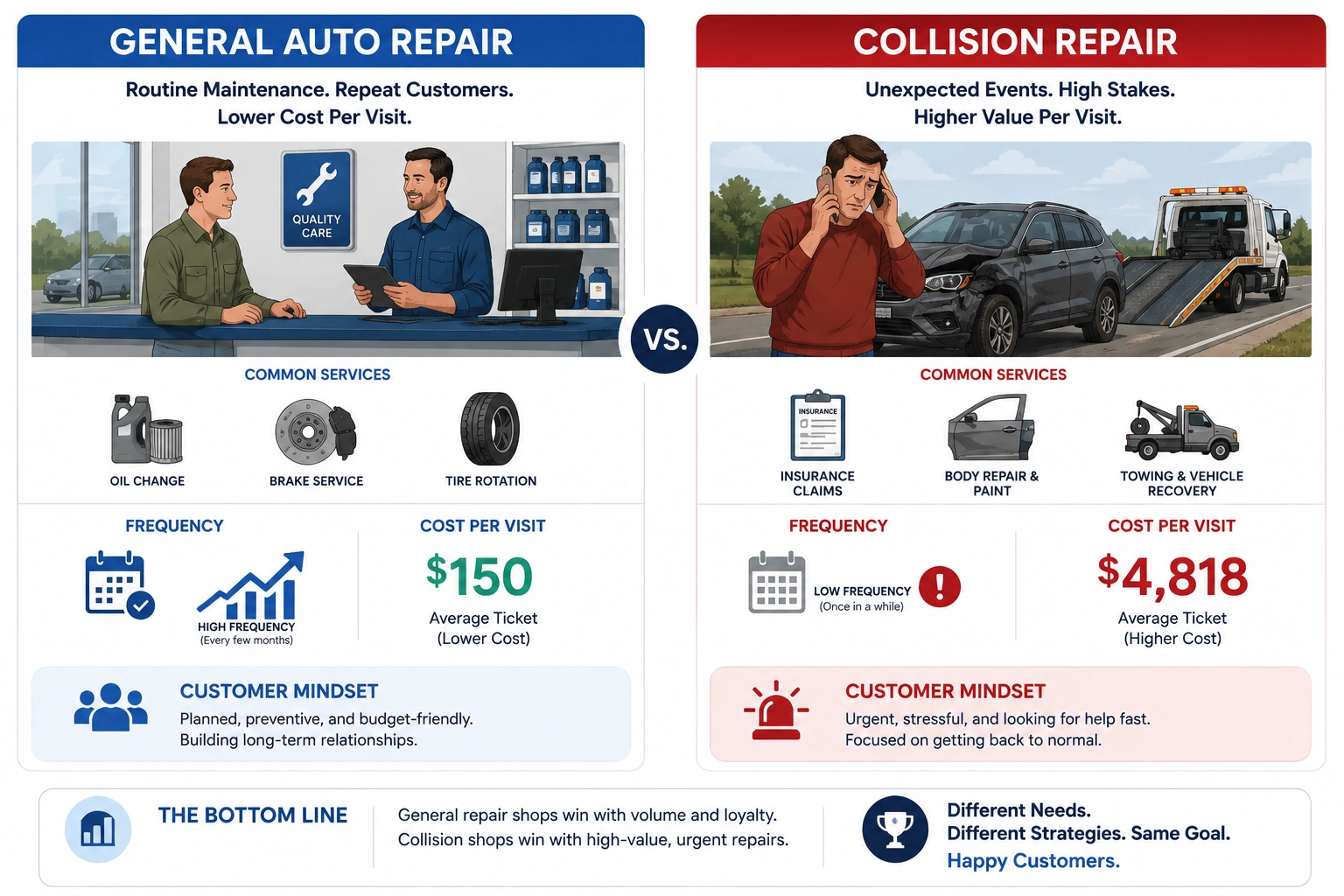
General auto repair is routine and lower cost, while collision repair is urgent, infrequent, and significantly more expensive.
Dominating the Google Map Pack: The 3-step blueprint
Google Business Profile (GBP) category and service optimization
Your Google Business Profile is the single most leveraged asset in local map pack rankings. Category selection is where most shops leave visibility on the table. It is a common mistake. Setting “Auto Body Shop” as your primary category signals your core capability to Google’s algorithm. From there, secondary categories like “Collision Repair Service,” “Auto Dent Removal Service,” “Auto Painting,” and “Car Repair and Maintenance” extend your reach into adjacent searches without diluting your primary signal.
The Services section deserves more attention than most shops give it. Details matter here. Populate it with specific, high-intent offerings: frame straightening, paintless dent repair (PDR), bumper repair, ADAS calibration, and insurance estimate assistance. These aren’t just labels: they are keyword anchors that help Google match your profile to the right queries.
Local citation consistency and directory building
Citation consistency is straightforward in principle and surprisingly easy to get wrong in practice. Accuracy is vital. Your business name, address, and phone number need to match exactly across every platform: not approximately, but exactly. Think of it the way you’d think about your storefront sign and your business cards: if they say different things, customers notice, and so does Google.
Core directories (Yelp, Facebook Business, Bing Places, Apple Maps, and the BBB) are the baseline. Start there first. The real differentiation comes from niche automotive citations like Carwise, AutoBody Alliance, RepairPal, AAA Approved Auto Repair, and the Carfax Service Shop Directory. You can find many of these on lists of top automotive citation sites, which carry industry-specific authority signals that generic directories can’t replicate.
Uploading high-resolution visuals and geo-targeted photos
Google wants to recommend businesses it trusts. One of the clearest trust signals is an active, visually rich profile. Do not neglect this. Regularly posting high-resolution photos of your clean facility, your frame-straightening equipment, and your certified technicians does two things simultaneously: it builds immediate credibility with vehicle owners scanning your profile, and it signals freshness and activity to Google’s local algorithm. A profile that hasn’t been updated in four months reads as dormant; this is true even if the shop is busy.
- Claim and Verify Your Profile: Ensure your Name, Address, and Phone number (NAP) are 100% consistent across the web. Think of this like making sure your business shows up the same way everywhere: like using the same name on your business cards and your storefront sign.
- Select Precise Categories: Set “Auto Body Shop” as your primary category to signal your core capability to Google. Add secondary categories like “Collision Repair Service,” “Auto Dent Removal Service,” and “Auto Painting” to capture adjacent searches.
- Upload High-Resolution Visuals: Regularly post photos of your clean facility, advanced frame-straightening equipment, and certified technicians. Google wants to recommend businesses it trusts. Trust is built the same way it is with customers: showing up consistently and doing what you say you’ll do.
High-impact keywords for $4,800+ repair orders
Targeting transactional and localized collision keywords
Volume alone is a misleading metric for collision repair keyword strategy. “Auto body shop near me” commands an estimated 18,600 monthly U.S. searches, and “collision repair near me” pulls around 12,400; however, the real value isn’t in those broad terms. It’s in the specificity beneath them.
Targeting terms like “Tesla certified collision center [City]” or “aluminum frame repair [City]” attracts customers with specialized, high-ticket needs who are less price-sensitive and far more likely to commit. These searchers have already filtered themselves. They know what they need, and they’re looking for a shop that can prove it can deliver. Weaving city-specific modifiers into your H-tags, meta descriptions, and body text is how you capture that geographically relevant intent without building an entirely separate site for each individual service area in your region.
Service-page architecture and keyword mapping
Single-page websites are a structural disadvantage in this market. They limit your reach. Each core service (Collision Repair, Paintless Dent Repair, Frame Straightening, Auto Painting, and Color Matching) deserves its own dedicated, search-optimized page with local geographic modifiers built into the URL, title tag, H1, and body copy. A page titled “Bumper Repair in [City Name]” can rank for that specific query in a way that a generic “Services” page never will.
Keyword mapping at this level also helps search engine crawlers understand your shop’s full range of capabilities. Instead of inferring that you do frame work because it’s mentioned in a paragraph on your homepage, Google can crawl a dedicated page with structured content, relevant terminology, and internal links, assigning it appropriate authority for that specific query.
- Target Transactional Keywords: Focus on high-intent terms like collision repair near me (12,400 monthly searches) and auto body shop near me (18,600 monthly searches) to capture drivers immediately after an accident.
- Target Vehicle-Specific and Long-Tail Keywords: Optimize for specific, high-ticket terms like “Tesla certified collision center [City]” or “aluminum frame repair [City]” to attract customers with specialized needs who are less price-sensitive.
- Target Insurance-Related Queries: Create landing pages addressing questions like “Can my insurance force me to use their body shop?” to capture and convert research-stage searchers before they commit to an insurer-steered competitor.
Free Local SEO Audit: Want to see how your shop ranks against local competitors in Google Maps? We’ve helped hundreds of auto body shops increase their local visibility. Get Your Free SEO Audit Now
Optimizing for modern vehicle complexity: ADAS & diagnostics
Dedicated pages for ADAS calibration
The technical complexity of modern collision repair has outpaced the content strategies of most shop websites. This is a mistake. Vehicles manufactured in the last five years carry sensor arrays, cameras, and driver-assistance systems that require precise recalibration after even minor structural work; the volume of repairs requiring that calibration is climbing fast.
A dedicated page for “ADAS Calibration” accomplishes more than just ranking for that keyword. It signals to Google’s algorithm that your shop is equipped to handle advanced safety systems, and it signals to the vehicle owner, who may not fully understand what ADAS means, that their car will be restored to its original safety specifications. Including specific terminology around the equipment you use (targets, alignment racks, OEM scan tools) builds semantic relevance that generic service descriptions can’t match.
Pre- and post-repair diagnostic scanning pages
Diagnostic scanning has moved from optional to standard. It is essential now. The data reflects how thoroughly it’s embedded in the repair process now, and shops that don’t surface this capability in their content are leaving a significant portion of search intent unaddressed. Explaining the scanning process in plain language (what it checks, why it matters for safety, and what happens if it’s skipped) reassures customers and differentiates shops that treat scanning as a genuine safety step from those that treat it as a line item.
Modern collision repair is no longer just about pulling metal and spraying paint. As vehicles become rolling computers, the technical complexity of repairs has escalated sharply. According to CCC Intelligent Solutions’ 2026 Crash Course, the share of Direct Repair Program estimates requiring at least one calibration reached 35.6% in Q3 2025 (up from 26.9% in 2024), and diagnostic scans appeared on 87.7% of all estimates. For shops that have already invested in the equipment and training, this is a content gap waiting to be closed.
To rank for these high-value modern repairs, we recommend starting with dedicated service pages for “ADAS Calibration” and “Pre- and Post-Repair Diagnostic Scanning.” Map those pages to the specific queries your target customers are using: not just the technical terminology, but the plain-language versions too. A driver searching “does my car need recalibration after a collision?” and a fleet manager searching “post-repair ADAS scan [City]” are both reachable with the right page structure.
“Complexity compounds. As vehicles become rolling computers, the shops that optimize their content for advanced diagnostics and calibrations will capture the highest-margin repair orders in 2026.”
–CCC Intelligent Solutions 2026 Crash Course
Visual social proof: Before-and-after case studies
Showcasing structural and cosmetic transformations
Text-only testimonials have a credibility ceiling. A five-star review that says “great work, highly recommend” tells a stressed driver almost nothing about whether your shop can handle their specific structural damage, sensor calibration, or complex paint matching. Process-driven case studies (Before, During, and After) close that gap in a way that written content alone cannot.
The documentation process doesn’t require professional photography equipment. Keep it simple. Consistent lighting, a clean background, and a systematic approach to capturing each repair stage are enough. Pair the visuals with a brief, search-optimized description of the repair process: what the damage was, what techniques were used, and what the outcome was. That combination serves both the human reader and the search engine crawler.
Linking visuals to local search intent
Mapping case studies to specific vehicle models and repair types creates a layer of long-tail relevance that broad service pages can’t replicate. A case study titled “Toyota RAV4 Rear Bumper Repair in [City]” can rank for that exact query; the driver who owns a RAV4 and just damaged their rear bumper in that city will find it far more persuasive than a generic gallery page.
Visual proof reduces friction at the decision point. When a driver sees a quarter-panel repair on a vehicle identical to theirs, executed cleanly and documented thoroughly, the question shifts from “can this shop handle it?” to “when can I bring it in?” That’s the conversion moment SEO is designed to create.
Stressed drivers need visual reassurance that their vehicle can be restored to pre-accident condition. Implementing process-driven case studies that document the full arc of a repair, mapped to specific search intent, is one of the most underutilized content strategies in collision marketing. When a driver sees a beautifully executed repair on a vehicle just like theirs, the friction of choosing your shop drops considerably. This approach is backed by real-world evidence: looking at successful auto body shop SEO case studies and auto repair shop SEO case studies, localized visual content consistently drives higher engagement. While some agencies offer generic auto body shop SEO services, the real gap in the market is this kind of authentic, localized proof. Most competitors are still relying on text-heavy explanations. The gap is real, and it’s exploitable.
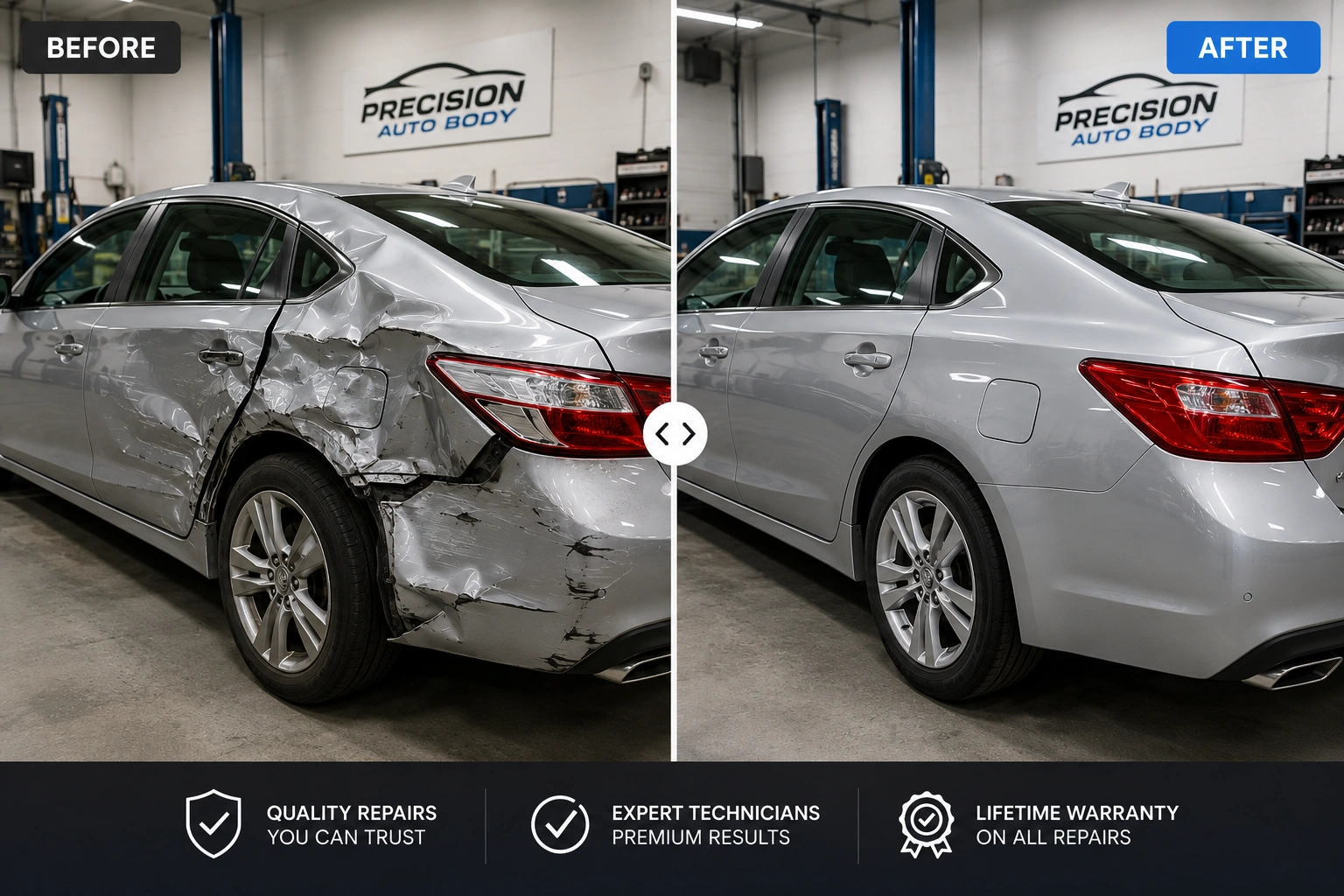
See the transformation: severe collision damage repaired with expert bodywork and seamless paint matching.
Looking to partner with a professional?
Learn what to look for in the best SEO company for collision repair to drive high-margin leads.
Technical SEO essentials for collision websites
Mobile responsiveness and speed optimization
Most collision-related searches happen on a phone. That’s not a trend: it’s the baseline. Mobile devices drive between 65% and 80% of organic sessions for local auto repair and collision domains, according to auto body shop mobile search data, and many of those searches are happening at or near the scene of an accident. A site that loads slowly or renders poorly on mobile isn’t just a bad user experience; it’s a lead that walked out the door before you knew they arrived.
The page speed threshold matters more than most shop owners realize. A load time increase from one second to three seconds raises the probability of a mobile user bouncing by 32% (as detailed in this guide on website speed optimization). At five seconds, that probability climbs to 90%. Compressing high-resolution before-and-after images, which are essential for trust-building but heavy on file size, is the single most impactful technical fix most collision sites can make immediately.
Structured schema markup implementation
Schema markup is a set of structured data signals that tell Google’s crawler exactly what your business is, where it’s located, and what it does: in a format the algorithm reads natively rather than infers from prose. Think of it as a direct translation layer between your website and Google’s understanding of your business.
For collision centers, the critical distinction is using the specific AutoBodyShop JSON-LD schema subtype rather than the generic LocalBusiness type. The specificity matters. Here’s a copy-pasteable template to get you started:
Schema Example for Painting Contractors
<script type="application/ld+json">

{

  "@context": "https://schema.org",

  "@type": "AutoBodyShop",

  "@id": "https://example.com/#autobodyshop",

  "name": "Precision Collision Center",

  "image": "https://example.com/images/shop-front.jpg",

  "url": "https://example.com/",

  "telephone": "+1-555-555-0199",

  "priceRange": "$$",

  "address": {

    "@type": "PostalAddress",

    "streetAddress": "456 Repair Way",

    "addressLocality": "Dallas",

    "addressRegion": "TX",

    "postalCode": "75201",

    "addressCountry": "US"

  },

  "geo": {

    "@type": "GeoCoordinates",

    "latitude": 32.7767,

    "longitude": -96.7970

  },

  "openingHoursSpecification": [

    {

      "@type": "OpeningHoursSpecification",

      "dayOfWeek": [

        "Monday",

        "Tuesday",

        "Wednesday",

        "Thursday",

        "Friday"

      ],

      "opens": "08:00",

      "closes": "17:30"

    }

  ]

}

</script>
Replace the placeholder values with your actual business data and place this in the <head> of your homepage and relevant service pages.
- Mobile Responsiveness: Mobile devices drive 65% to 80% of organic sessions for local auto repair and collision domains (AuthoritySpecialist, 2026). Your site must be optimized for immediate mobile use, as many searches happen at the scene of an accident.
- Page Speed Optimization: A page load time increase from 1 to 3 seconds increases the probability of a mobile user bouncing by 32% (Google/Scube Marketing). Compress high-resolution before-and-after images to ensure your site loads in under 2 seconds.
- AutoBodyShop Schema Markup: Implement structured JSON-LD data using the specific AutoBodyShop subtype (rather than generic LocalBusiness) to provide search engines with clean, structured entity data, including your physical address, geo-coordinates, and business hours.
Building local authority and backlinks
Sponsoring local community events and teams
Backlinks from local sources carry a different quality signal than links from generic directories. When a youth sports league, a school fundraiser, or a community charity event lists your shop as a sponsor on their website, Google reads that as a vote of physical community relevance: not just digital authority. These links are often easier to earn than editorial links from industry publications, and they compound over time as your community footprint grows.
The outreach is simple. Identify local organizations that publish sponsor pages, reach out to their coordinators, and confirm that your sponsorship includes a linked mention on their site. Many will already have a sponsor page; you’re simply asking to be added to it. Most will say yes.
Securing niche automotive and hyper-local citations
A diverse backlink profile, one that combines local community links with niche automotive citations and regional business association listings, is structurally harder for large multi-shop operators (MSOs) to replicate at scale. National chains can outspend independent shops on paid advertising. But they lack local roots. They can’t easily replicate the authentic local link profile of a shop that has been embedded in its community for a decade.
If your map pack presence is struggling, you might be dealing with common errors: check out this resource on automotive local SEO issues to diagnose why your rankings might be slipping.
Local chambers of commerce, regional business associations, and industry-specific platforms like RepairPal and AAA Approved Auto Repair each contribute a distinct authority signal. Together, they build the kind of domain authority that supports long-term map pack rankings: not just short-term visibility spikes.
Google ranks local businesses higher when they have strong community ties. Building local backlinks is the digital equivalent of word-of-mouth recommendations from sources Google already trusts. We recommend starting by sponsoring local youth sports teams, partnering with local towing companies for reciprocal links, and securing listings in regional business directories and your local Chamber of Commerce. These local links signal physical community relevance to Google’s algorithm, and they help independent shops compete with MSOs that have larger marketing budgets but shallower local roots.
Frequently asked questions about collision SEO
Answering common owner and marketer concerns
SEO timelines, budget thresholds, and realistic expectations are the questions we hear most often from collision center owners who are considering a local search investment for the first time in a highly competitive market. The answers aren’t always clean-cut, but they’re more predictable than most agencies let on. Honesty is better.
We’ve compiled the most common questions collision center owners ask about search engine optimization. Our goal is to provide clear, honest answers based on what works and what has worked for businesses like yours.
FAQ section
How long does it take to see results from auto body SEO?
Typically, a new SEO campaign takes 3 to 6 months to show measurable increases in organic traffic and phone calls. Technical fixes and Google Business Profile optimizations can yield quick wins within weeks: category corrections, NAP consistency, and photo uploads often move the needle faster than expected. Earning high-quality local backlinks and building domain authority is a slower process that requires consistent effort. Results vary based on your market’s competitiveness, but most clients see meaningful movement within that 3-to-6-month window.
Do I need a separate page for every service?
Yes. Dedicated pages for “Paintless Dent Repair,” “Bumper Repair,” and “Frame Straightening” allow you to target specific, high-intent keywords and convert searchers looking for those exact solutions. A single Services page can’t rank competitively for all of those queries simultaneously. Separate pages also help search engine crawlers understand your shop’s specialized capabilities, which strengthens your overall topical authority in the collision repair space.
How do Google reviews affect my local rankings?
Reviews are a primary ranking factor for the Google Map Pack. Shops with a high volume of 5-star reviews and active owner responses rank significantly higher and convert local traffic at a 12% to 18% rate (AuthoritySpecialist, 2026). The volume of reviews matters, but so does recency and response rate. A shop with 200 reviews and no owner responses will underperform against a shop with 80 reviews and consistent, professional replies.
Should I focus on organic SEO or Google Ads?
A balanced strategy is defensible, but local SEO delivers the stronger long-term ROI. Google Ads stop generating leads the moment you stop funding them. They are temporary. Organic SEO builds a compounding asset that drives free traffic for years. Localized organic search traffic for auto body shops achieves a 12% to 18% conversion rate for phone calls and form inquiries, compared to a 5.35% average conversion rate for paid search ads in the body repair and paint sector. That gap is significant enough to shape how you allocate your marketing budget.
How do I optimize my site for insurance-related searches?
Create content that explains the insurance claim process, how Direct Repair Programs work, and the driver’s legal right to choose their own repair facility. Pages targeting queries like “Can my insurance force me to use their body shop?” capture research-stage searchers before they commit to an insurer-steered competitor. This content positions your shop as an advocate for the consumer. That framing builds trust in a way that promotional content never can.
Dominating your local market in 2026 requires more than keyword stuffing and a Google Business Profile that hasn’t been touched since 2022. It takes real effort. By aligning your website architecture, your content strategy, and your technical infrastructure with the high-stress, high-ticket nature of collision repair, and by optimizing explicitly for modern vehicle complexities like ADAS calibration and diagnostic scanning, your shop can secure durable positions in Google’s Map Pack and drive consistent, high-margin revenue from organic search. Join those driving our nation forward by taking control of your online presence today. Taking these steps ensures your shop is visible when local drivers need your services most.
Ready to partner with a team that understands your business?
Explore our guide to the top SEO for collision repair specialists or schedule a free, personalized strategy session with our team today.