In this guide:
- How Google’s three local visibility factors (relevance, distance, and prominence) work for independent lots
- Step-by-step Google Business Profile optimization built specifically for used car dealers
- Why a steady stream of customer reviews outperforms one-time content pushes every time
- A free starter checklist for auditing your current local visibility
How can Used Car Dealers Optimize their Site for Local SEO and AI Search Engines?
Used car dealers can dominate local SEO and AI by sync-feeding their live vehicle inventory to the Google Business Profile (GBP). By dedicating specific pages to popular models, clear financing options, and vehicle history reports, it provides the detailed information needed by search and AI. AI engines prioritize dealers that showcase transparent pricing, host virtual car walkthroughs, and consistently secure positive, detailed customer reviews.
Every week, thousands of buyers in your city type “used cars near me” or “used car dealerships near me” into Google. Most of them never scroll past the first three map results. If your lot isn’t in that cluster, those shoppers are walking onto a competitor’s lot, not yours. You lose the sale. The frustrating part is that showing up in local search isn’t reserved for franchise dealers with six-figure ad budgets. Independent operators who understand how Google evaluates local businesses can compete directly, often showing up ahead of larger competitors in the neighborhoods that matter most. Let’s look at exactly how that works, without any corporate jargon.
Dealer SEO, or search engine optimization for car dealerships, is the process of making your lot visible to buyers who are already searching for what you sell. Unlike a paid ad that disappears the moment your budget runs dry, organic local search visibility compounds over time. Think of it as the difference between owning a piece of real estate and renting a billboard. Ownership wins. Third-party lead aggregators like AutoTrader and CarGurus charge per lead, per month, indefinitely. Your organic search presence, once built, keeps generating calls and directions without an ongoing per-click invoice. Exploring the right digital marketing strategies for your lot means understanding which channels you own versus which ones you are perpetually leasing. For most independent lots, the math on local visibility versus aggregator fees becomes clear quickly.
The three pillars of local search: Relevance, distance, and prominence
Google’s official local visibility documentation identifies three factors that determine which lots appear in local map results: relevance, distance, and prominence. These aren’t marketing abstractions, they are the levers Google pulls when a buyer searches for a vehicle near them. They dictate your visibility.
Distance: Navigating the proximity paradox
Distance is the factor you can’t change. Google calculates how far your physical lot sits from the searcher’s device location, or from the geographic center of the city they named in their query. A dealer on the outskirts of town faces a structural disadvantage for searches originating from the city center, and no amount of optimization fully erases that gap.
Where it gets complicated is the debate around hyper-targeted city-specific landing pages. Opinions are split. Some practitioners advocate creating individual pages for every surrounding suburb, like “used cars in [Suburb Name]”, to capture nearby searches. The risk is real: if those pages don’t contain genuinely useful, locally distinct content, Google’s helpful content system can flag them as thin doorway pages, which actively damages your overall site authority. There’s a case to be made for neighborhood pages done well, but a case against them done cheaply.
Relevance: Aligning your profile with local intent
Relevance measures how closely your Google Business Profile and website match what a buyer is searching for. Primary category selection carries significant weight here: choosing “Used car dealer” over the broader “Car dealer” sends a precise signal about your inventory type. Be specific. Beyond categories, the keywords embedded in your vehicle descriptions, service pages, and on-site content all feed Google’s understanding of what you sell and to whom.
Structured data markup, specifically AutoDealer and Vehicle schema, goes a step further by translating your active inventory into a machine-readable format. Search engines can then surface specific vehicles directly in results, rather than just your lot’s name. This drives high-intent clicks.
Prominence: Building authority that Google trusts
Prominence is Google’s approximation of how well-known your lot is, both online and off. It draws from web links pointing to your site, directory citations, mentions in local publications, and, critically, your Google review profile. A lot with 200 steady reviews and consistent community backlinks will show up ahead of a competitor with a cleaner website but no off-site authority. Prominence rewards lots that are genuinely embedded in their local market, not just optimized on paper.
Distance is the one variable outside your control. A lot on Route 9 at the edge of town cannot relocate to Main Street. That is a fact. What you can do is build such strong relevance and prominence signals that Google compensates, showing your lot for searches where your geographic proximity is close enough and your profile authority is clearly superior.
Dealers who focus exclusively on their website while ignoring their Google Business Profile, citation profile, and review velocity are optimizing only one of three visibility levers. That is a mistake. The ones who close that gap are the ones who start showing up in the local map pack for searches they previously couldn’t touch.
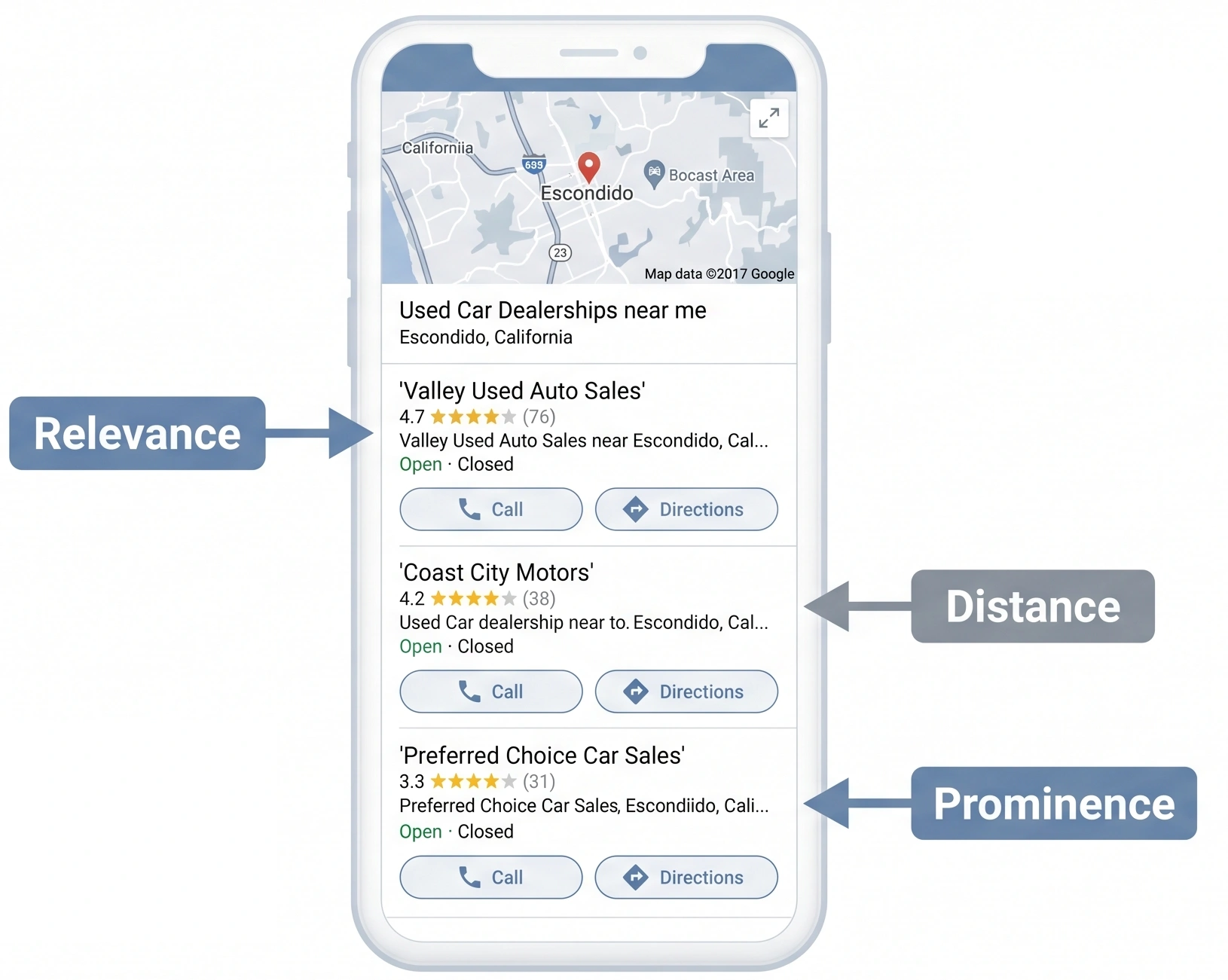
Google Maps local search listings on a mobile screen, illustrating how relevance, distance, and prominence impact local business SEO.
Relevance: How Google matches your lot to local shoppers
Optimizing for local search starts with a clear signal to Google about exactly what kind of business you are. Clarity is key. For a used-only independent lot, that signal begins with your Google Business Profile category selection and extends through every vehicle listing on your website.
Selecting the right Google Business Profile categories
“Used car dealer” must be your primary category, not “Car dealer,” and not “Auto dealer.” The distinction matters because Google’s algorithm uses primary category as a primary relevance filter for pre-owned vehicle searches. Industry surveys place Google Business Profile signals at nearly a third of overall local pack visibility weight, and category selection is the most direct input into that signal.
Secondary categories are legitimate only when they reflect genuine, staffed business functions. If you have an active service bay, “Car service” is appropriate. If you carry parts inventory, “Auto parts store” has a defensible case. Keep it honest. What you cannot do, and what Google explicitly prohibits, is add brand-specific categories like “Honda dealer” or “Toyota dealer” for a used-only lot. You are not a franchised representative, and your inventory changes too frequently for those categories to be accurate. Violations here can trigger profile suspension.
Optimizing vehicle detail pages (VDPs)
Every vehicle on your lot needs its own crawlable page on your website. Not a filtered search result. Not a shared inventory feed page. An individual URL with a unique title, unique description, and structured Vehicle schema markup embedded in the code. This is what allows Google, and increasingly, AI-powered search surfaces, to index specific cars and surface them for long-tail queries like “2019 Honda Civic under $15,000 near me.”
The descriptions themselves matter more than most dealers realize. Generic manufacturer boilerplate, the same copy that appears on 400 other dealer sites, contributes nothing to your relevance score. A natural, specific description that mentions the vehicle’s condition, notable features, and your lot’s location signals both relevance and original content to search crawlers.
Actionable relevance checklist:
- Primary Category: Set “Used car dealer” as your Google Business Profile primary category: this is the single most effective category change you can make.
- Secondary Categories: Add “Car dealer” for broader search capture; add “Car service” only if you operate an active, staffed service bay.
- Avoid Brand Categories: Do not list brand-specific categories (like “Ford dealer”). This violates Google’s guidelines for used-only lots and risks suspension.
- Vehicle Detail Pages: Write unique, natural vehicle descriptions for every car in active inventory: copy-pasted OEM text actively dilutes your relevance signals.
Prominence: Building authority that Google trusts
Prominence is where independent dealers can genuinely outmaneuver larger competitors, if they are willing to play the long game. It takes time. Our complete local visibility guide covers this in depth, but the short version is this: prominence is earned through consistent off-site signals, not manufactured overnight.
Systematic review acquisition
Reviews are not a one-time campaign. They are an ongoing operational process. Training your sales staff to request a Google review at the point of sale, when the buyer’s satisfaction is highest, and the interaction is freshest, is the most reliable acquisition method available. The ask should be direct and frictionless: a QR code on the paperwork, a text message with a direct review link sent within an hour of purchase.
What you want to avoid is the bulk blast. Sending 50 review requests to a dormant list in a single afternoon looks exactly like what it is to Google’s spam filters: an artificial spike. Recent research shows a significant increase in review posting blocks for profiles exhibiting clustered acquisition patterns. The reviews get filtered, the effort is wasted, and in some cases the profile takes a visibility hit.
Local community link building
Backlinks from local, geographically relevant sources carry disproportionate weight for local search prominence. Sponsoring a high school athletic program, a youth soccer league, or a community fundraiser typically earns a link from the school or organization’s website, which is a domain Google recognizes as locally rooted and editorially independent. That’s a meaningfully different signal than a link from a generic automotive directory. Local links win.
Joining your local Chamber of Commerce serves a dual purpose: it provides an authoritative citation (consistent NAP data on a trusted local domain) and often includes a backlink from the Chamber’s member directory. These aren’t glamorous tactics, but they are the kind of community-embedded signals that Google’s prominence calculation is designed to reward. They work.
Prominence-building tactics, prioritized:
- Review Velocity: Aim for 8+ new reviews per month through consistent, post-sale requests: a steady cadence outperforms historical volume for map visibility stability.
- Local Sponsorships: Sponsor high schools, youth sports leagues, or community events to earn geographically relevant backlinks from trusted local domains.
- Chamber of Commerce: Membership provides an authoritative local citation and backlink that reinforces NAP consistency across the web.
Is your lot showing up where local buyers are looking?
Get a free, personalized Local Visibility Audit from BizIQ.
Optimizing your Google Business Profile (GBP)
Your Google Business Profile is the most visible piece of digital real estate your lot controls in local search. It drives calls, direction requests, and website clicks for buyers who are already in decision mode. Do not ignore it. Google’s Business Profile guidelines are specific about what constitutes a legitimate, suspension-proof profile, and the rules are worth knowing before you start.
Claiming and verifying your profile
Verification requires a physical, staffed storefront with permanent signage. PO Boxes, virtual offices, and UPS Store addresses are grounds for automatic suspension. If your lot operates from a real address with a sign visible from the street, you are in good shape. This is critical. The verification process itself, typically a video walkthrough or postcard, is Google’s way of confirming that a real business operates at the listed location.
One point that trips up independent dealers more than almost anything else: your business name on Google must match your real-world signage and legal registration exactly. “Springfield Auto Sales” is your name. “Springfield Auto Sales: Best Used Cars & Financing Near You” is a keyword-stuffed violation that Google’s quality reviewers flag regularly. Profile suspensions from name violations are common, and reinstatement requires submitting dealer licenses, utility bills, and video documentation of your physical lot.
Managing multiple departments
Google officially permits separate Google Business Profile listings for Sales and Service departments, provided each has distinct signage, a separate entrance, and unique categories. For large franchise lots with dedicated service centers, this can make sense. For a single-lot independent operation, it almost never does. Keep it simple.
The practical risks outweigh the theoretical benefits. Two profiles for the same physical address invite duplicate listing flags. Reviews split between two profiles dilute the authority of both. And if a buyer leaves a service review on your sales profile, which happens constantly, you’ve created a category mismatch that confuses Google’s relevance signals. One authoritative, fully optimized profile is the right call for most independent lots.
“Your Google Business Profile is your digital showroom. If your hours are wrong or your categories are incomplete, you are locking the front door to local buyers.”
Why steady reviews beat one-time blog pushes
The power of review velocity
Google’s local algorithm weighs recency heavily. A profile that received 80 reviews two years ago and has gone quiet since then shows up lower than a competitor with 40 reviews and a consistent monthly cadence, all else being equal. The signal Google is reading is business activity: an active, well-reviewed lot is more likely to be a reliable result for a current searcher than a historically popular one that may have changed.
Effective local visibility strategies consistently point to review velocity as one of the most actionable levers available to small operators. It costs nothing but a trained sales process and a direct review link. Start asking today.
Handling negative reviews professionally
Negative reviews happen. A professional, measured response, acknowledging the concern, offering an offline resolution path, and keeping the tone constructive, demonstrates customer service quality to every future buyer who reads the exchange. Defensive or argumentative responses do more damage than the original review. A steady inflow of positive reviews naturally reduces the proportional weight of occasional negative feedback over time; the goal isn’t a perfect score, it’s a credible one.
Profiles maintaining 8+ reviews per month show up measurably higher and hold more stable map positions than competitors with sporadic acquisition patterns, according to industry tracking data. Google has simultaneously increased review posting blocks for clustered patterns. Spikes look suspicious. Sterling Sky’s research on review filter surges documents how bulk requests trigger automated suppression, often without any notification to the lot owner. The practical implication: build review acquisition into your daily sales process, not your quarterly marketing calendar.
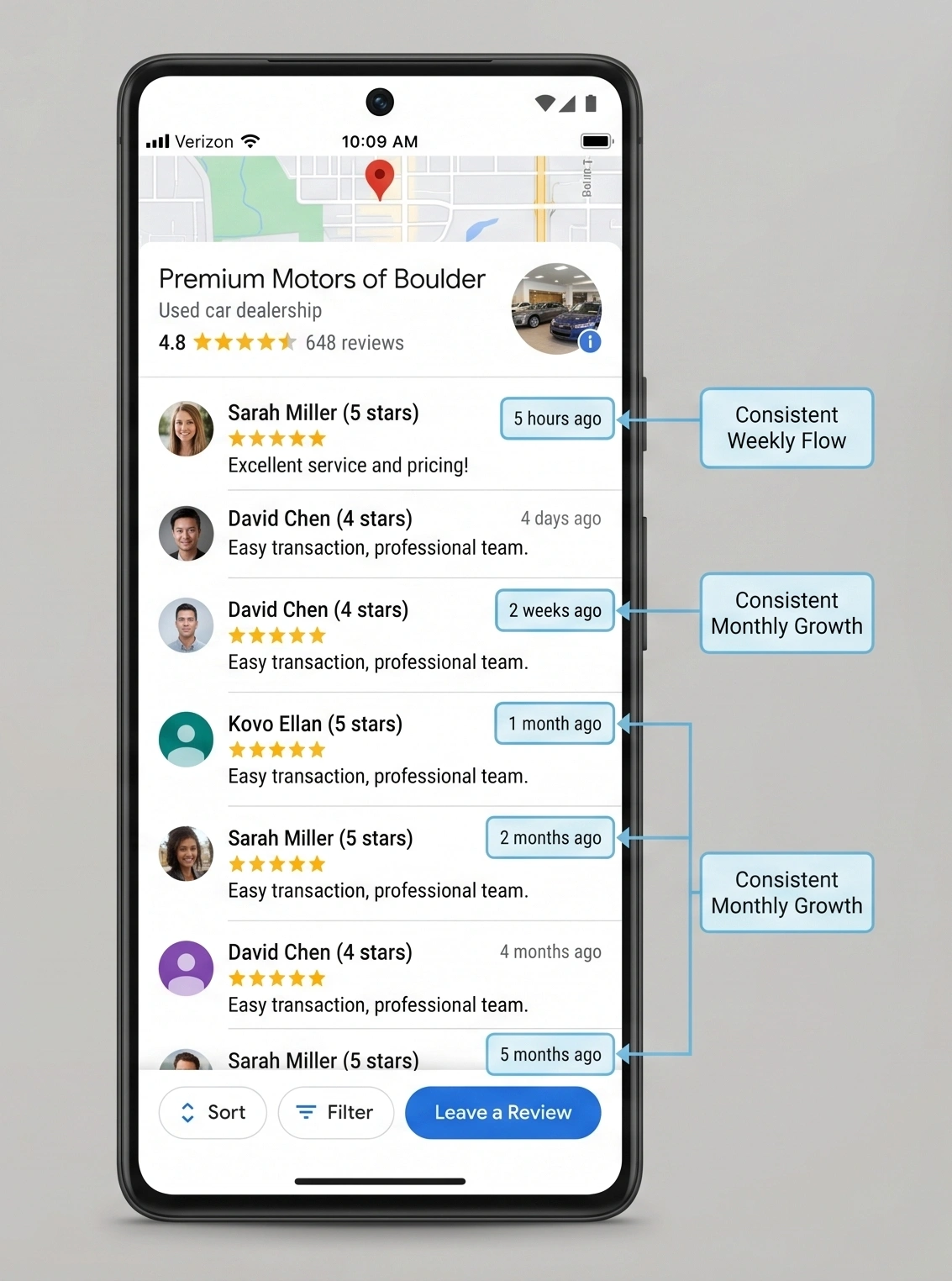
Smartphone screenshot of a car dealership’s online reviews with callouts pointing to consistent review growth over several months.
Stop guessing where your lot stands.
Contact us today to inspect your Google Business Profile, NAP consistency, and review health.
The shift to AI and zero-click searches in 2026
Preparing for AI search engines (SGE and Gemini)
AI-driven search surfaces don’t browse your website the way a human does. They parse structured data. They need clean code. When a buyer asks Google’s Gemini-powered search “What used trucks under $20,000 are available near me?”, the engine pulls from machine-readable inventory data, not from your homepage copy. Lots without AutoDealer and Vehicle schema markup on their local website optimization infrastructure are effectively invisible to these query types, regardless of how well their traditional local visibility is performing.
Optimizing for conversational queries
The content that performs in AI search is specific, locally grounded, and directly answers real buyer questions. Be direct. A page that explains your financing process in plain language, covering what credit scores you work with, how long approvals take, and whether you work with first-time buyers, is far more useful to an AI search engine than a generic “About Us” paragraph. As noted in Advice Local’s analysis of AI search trends, AI engines rely heavily on structured data and conversational relevance.
The same logic applies to warranty terms, trade-in processes, and vehicle condition disclosures. Answer them clearly. These are the questions buyers are asking; answering them directly on your site is the most durable content investment available. Participating in local online communities, such as neighborhood Facebook groups, city subreddits, and local forums, builds the kind of organic brand mentions and positive sentiment that AI models increasingly scrape when constructing local recommendations.
Forward-looking steps for AI search readiness:
- Implement Schema Markup: Add
AutoDealerandVehiclestructured data to your website so AI engines can read active inventory, pricing, and hours in machine-readable format. - Answer-First Content: Write locally relevant pages that answer real buyer questions directly, including financing terms, warranty coverage, and trade-in processes, rather than generic lot copy.
- Avoid Boilerplate: Replace manufacturer-supplied vehicle descriptions with unique, specific details that differentiate each listing.
- Participate in Local Communities: Build genuine brand mentions in local online spaces where AI models scrape community sentiment and local business data.
DIY vs. hiring professional help
The DIY route: What you can do
Two focused hours per week is enough to manage your Google Business Profile, respond to reviews, and maintain basic citation consistency across the major local directories. It is manageable. Local visibility software platforms, which are tools that track your map visibility, flag citation inconsistencies, and monitor review velocity, run between $29 and $99 per month. Building out foundational directory listings manually is feasible but time-consuming; outsourcing individual citations to a specialized builder costs roughly $2.00 to $3.20 per listing.
The DIY route works best for genuinely consistent dealers. Consistency is key. Sporadic effort, like a burst of activity followed by weeks of neglect, produces worse results than a modest but steady routine.
When to hire a professional agency
The honest threshold is this: when the opportunity cost of your time exceeds the cost of delegation. Time is money. A general manager spending 10 hours per month on local visibility tasks is a general manager not closing deals, managing staff, or sourcing inventory. Fully managed auto dealer SEO services from a specialized agency typically run between $799 and $1,299 per month per location. At that price point, you are buying not just execution but expertise: technical site audits, structured data implementation, digital PR for backlink acquisition, and the kind of rapid iteration that comes from working across dozens of lot accounts simultaneously.
The cost comparison worth running is not “SEO agency fee vs. zero.” It’s “SEO agency fee vs. what I’m currently paying AutoTrader or CarGurus per month.” For most independent lots, that math resolves clearly. Delegation pays off. DIY tools cost $29 to $99 a month and require consistent personal time. Professional management runs $799 to $1,299 a month and frees you to focus on the floor. Neither option is wrong: the right one depends on your bandwidth, your current lead costs, and how aggressively you want to grow your organic footprint.
Why your car dealership needs local visibility
Capturing high-intent local shoppers
Roughly 97% of car buyers begin comparing lots online before they ever set foot on a lot. They start online. That research phase, which includes searches for “used SUV near me”, Google Maps comparisons, and review scanning, is where your lot either enters the consideration set or gets eliminated from it. Third-party aggregators capture a portion of that traffic, but at a recurring cost per lead that compounds indefinitely. Local visibility website optimization builds an owned channel that generates the same high-intent traffic without the per-lead invoice.
Your Google Business Profile is the single strongest driver of calls, direction requests, and walk-ins for lots at the moment buyers are ready to act. The 2024 Cox Automotive Car Buyer Journey Study found that buyers who completed key research steps online, including comparing inventory and reading reviews, saved an average of 40 minutes at the physical lot during used-vehicle purchases. That efficiency matters to buyers, and it starts with the information your Google Business Profile and website surface before they arrive. Respect their time. A fully optimized profile with accurate hours, current inventory signals, and a steady review cadence is the difference between a buyer calling your lot and a buyer calling the one getting found ahead of you.
Frequently asked questions (FAQs)
Independent dealers ask a consistent set of questions when they start thinking seriously about local search visibility. The answers below reflect what the data and real-world experience support, not what sounds reassuring. Here is the truth.
How long does it take to see results from local visibility?
Quick wins, including profile verification, category corrections, and review link generation, show up within one to two weeks. Early movement in local map impressions and website clicks typically appears within one to three months of consistent effort. Meaningful traction on high-intent keywords, the kind that translates to measurable increases in calls and walk-ins, generally takes three to six months. There’s no clean shortcut here; the timeline reflects how long it takes Google to accumulate enough consistent signals to trust a profile. Be patient.
How much does dealer visibility cost?
The DIY route costs nothing beyond your time, plus $29 to $99 per month for local visibility tracking software if you want to monitor your search presence and citation health. Outsourcing individual directory citations runs roughly $2.00 to $3.20 per listing. Fully managed professional local visibility services from a specialized agency typically range from $799 to $1,299 per month per location, a figure that looks different when measured against what most independent lots spend monthly on third-party lead aggregators.
Do I need a separate website page for every car in my inventory?
Yes. Individual Vehicle Detail Pages are not optional if you want to show up for specific, long-tail searches like “used Honda Civic near me” or “2020 Ford F-150 under $25,000 [City]”. These pages also provide the structured Vehicle schema data that AI-powered search engines use to surface specific inventory in conversational results. A shared inventory feed page with filtered URLs does not accomplish the same thing. It fails.
What is the most important category for a used car lot on Google Business Profile?
“Used car dealer” must be your primary category. This is the most direct relevance signal available for pre-owned vehicle searches, and industry local visibility factors data places Google Business Profile category selection as a top-weighted input. Broader terms like “Car dealer” can serve as secondary categories. Brand-specific categories, such as “Honda dealer” or “Toyota dealer”, are prohibited for used-only lots under Google’s current guidelines.
Can local sponsorships really help my website get found?
They can, and for independent dealers with limited link-building budgets, they are one of the most cost-efficient options available. Sponsoring a local high school athletic program or youth sports league typically earns a backlink from the school or organization’s website, which is a domain Google recognizes as locally rooted and independently editorial. That geographic specificity is exactly what the prominence algorithm is designed to reward. It is not a fast tactic, but it builds the kind of durable local authority that aggregator spending never will.
Local visibility is not a campaign. It is an infrastructure investment, one that accumulates authority, review signals, and organic visibility over months and years rather than billing cycles. A lot that builds a fully optimized Google Business Profile, maintains a consistent review cadence, earns community backlinks, and keeps its Vehicle Detail Pages current is constructing an asset that generates leads long after the initial work is done. Paid ads stop the moment the budget does. Organic local presence compounds. For independent used car dealers operating without franchise marketing support, that distinction is worth taking seriously.
Ready to stop renting leads and start owning your local search presence?
Schedule a free local visibility consultation with BizIQ’s automotive experts. Let’s build an asset that drives buyers to your lot month after month.