Written by the BizIQ Search Strategy Team. We are here to help. We’re a small business ourselves, standing beside you, not above or behind, to show you what really works and why.
Key takeaways of this guide:
- The Diagnostic Truth: Understand why Google doesn’t have an official “SEO score” and why third-party scores are still vital diagnostic proxies.
- The Metric Breakdown: Learn the difference between an overall SEO Score, Domain Authority (DA), and Site Health, and why conflating them leads to wasted effort.
- Step-by-Step Optimization: A clear path to check your score for free and improve it to capture high-intent local customers.
- The 2026 AI Shift: How SEO scores are evolving to account for AI Overviews and search everywhere optimization, and what that means for your business right now.
An SEO score measures how well your website aligns with search engine ranking factors. It is crucial for small businesses because a higher score improves online visibility, builds trust, and ensures AI engines can find your content, helping you attract local customers without relying on expensive paid advertising.
If you have ever run your website through a free analysis tool, you have probably been greeted by a bold, colorful number, perhaps a 75 out of 100, telling you how healthy your website is. It is easy to feel a sudden flash of worry when that number is low, especially if you have been burned by marketing agencies in the past that promised the moon but left you with empty pockets. We’re a small business ourselves. We get it. We know exactly how frustrating it is to deal with confusing jargon and mysterious metrics. Google does not use a single, official “SEO score” to rank your website. Those third-party scores are, however, highly useful diagnostic proxies. They reveal exactly what is holding your website back from reaching the people who need your services.
Think of an SEO score like a physical checkup for your car. The diagnostic machine at the mechanic’s shop does not make your car run faster on its own, but it does pinpoint the exact engine issues, worn-out belts, and low fluids that are keeping your vehicle from performing its best. In the digital world, an SEO score is a proprietary, third-party metric generated by software tools to estimate how effectively your web page or website is optimized for search engine crawlers and algorithms. By understanding this metric, you shift from guessing why your site isn’t ranking to executing evidence-based fixes that improve your visibility on the search engine results page (SERP). More importantly, it puts you in front of customers who are actively searching for what you offer.
Demystifying the Numbers: SEO Score vs. Domain Authority vs. Site Health
Many small business owners make the mistake of chasing a single number, without realizing that different tools measure completely different aspects of their digital footprint. A business might carry a strong technical score but still fail to rank because it lacks domain strength or content relevance. These are not interchangeable metrics. They track different things. To build a lasting online presence, here’s what we recommend and why: you must understand the three distinct pillars of search engine optimization metrics and how they interact to influence your organic search results.
The classic correlation vs. causation trap in digital marketing often leads business owners to believe that raising a third-party score will automatically prompt Google to rank them higher. The EPI Study on DA Reliability analyzed the reliability of Domain Authority scores across major platforms (Moz, Semrush, and Ahrefs) and found a high correlation with actual search visibility, but explicitly warned against treating those scores as causal factors. In other words, a high score correlates with strong rankings because both outcomes stem from quality content and a strong backlink profile, not because the score itself carries any algorithmic weight in Google’s eyes. Chasing the number without addressing the underlying signals is like polishing the outside of a car with a broken engine.
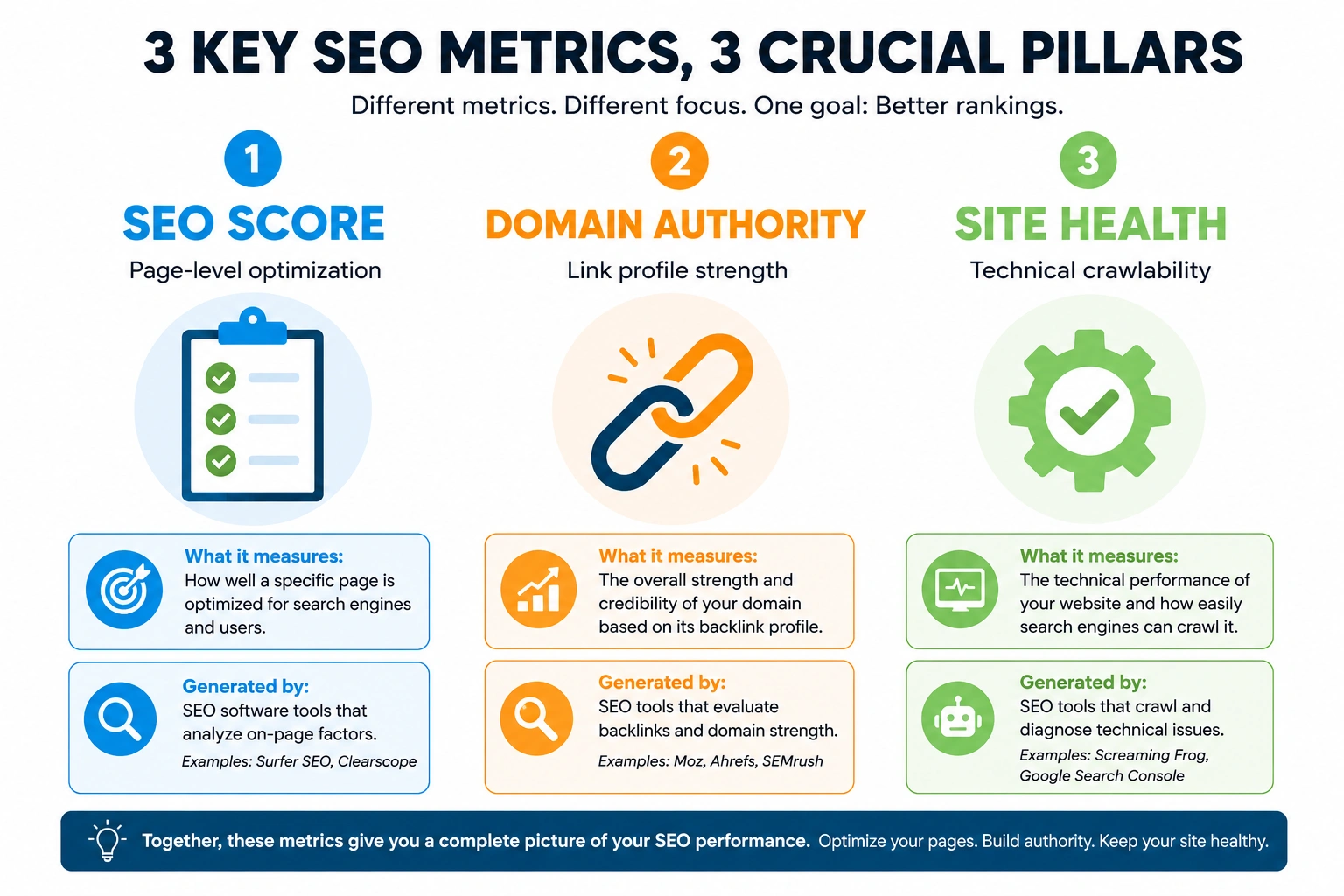
Side-by-side comparison of SEO Score, Domain Authority, and Site Health, highlighting what each metric measures and the tools that generate them.
The Three Pillars of SEO Metrics Explained
1. Technical Site Health (The Foundation)
- What it measures: Crawlability, broken links, missing meta descriptions, duplicate content, and security protocols (HTTPS).
- Ideal Benchmark: A score of 85% or higher is considered excellent for local businesses.
- Why it matters: If search engine crawlers encounter broken links or sluggish load times, they will abandon your site, burning through your crawl budget on pages that never get indexed. No index, no ranking.
2. Domain Authority / Domain Rating (The Competitive Strength)
- What it measures: A logarithmic 0 to 100 score predicting a domain’s competitive ranking strength based on its backlink profile.
- Ideal Benchmark: A score of 20 to 40 is highly competitive for local small businesses, while national brands routinely exceed 60.
- Why it matters: It estimates how difficult it will be to rank for competitive keywords in your industry. A local HVAC company does not need a Domain Authority of 60 to dominate its city. It needs a score that outpaces its immediate local competitors.
3. On-Page SEO Grade (The Content Relevance)
- What it measures: How well an individual web page is optimized for a specific target keyword, including title tags, H2 headings, and image alt text.
- Ideal Benchmark: An “A” grade or a score above 80/100 on page-level audits.
- Why it matters: It ensures that search engines can cleanly parse the topic of your page and match it with high-intent user queries. A page that is technically sound but topically unclear will consistently underperform against a well-structured competitor page that clearly answers the searcher’s query and provides immediate, practical value.
Why Your SEO Score Matters for Business Growth
- Capturing the Lion’s Share of Clicks
- The CTR Reality: Search position is not a vanity metric; it is a revenue lever. Moving from position 2 to position 1 on Google produces a 74.5% increase in clicks, and a single-position upward move increases click-through rate by an average of 32.3% (Ahrefs, 2026). That differential multiplies across every keyword your business ranks for.
- Organic Conversion Rates: Organic search traffic achieves an average conversion rate of 1.7% to 3.75% across industries. High-intent local service verticals perform even stronger: legal reaching 7.5% and HVAC reaching 3.3% (QuickSEO, 2026). When you improve your SEO score and climb those rankings, you are not just attracting more visitors; you are attracting visitors who are already in buying mode.
- Protecting Your Marketing Budget
- PPC vs. Organic Durability: Paid ads stop delivering leads the moment you stop paying. They are temporary. Optimizing your website’s SEO score builds compounding equity: the kind that keeps generating traffic at 2 a.m. without an active ad spend.
- Real-World Small Business ROI: A 12-month SEO campaign for a local business produced a 304% increase in organic traffic (from 1,510 to 6,115 monthly users) and a 338% increase in organic revenue (Autorank AI, 2026). Those are not outlier numbers for a well-executed local SEO strategy; they represent what happens when technical fixes, content alignment, and authority building work in concert.
- Preparing for the 2026 AI Search Transition
- AI Overviews Expansion: According to Digital Applied AI SEO Statistics, Google AI Overviews now appear in 25.11% of search queries, up from 6.49% in early 2025 (Digital Applied, 2026). That is a fourfold expansion in roughly twelve months, and it fundamentally changes which websites get surfaced at the top of the results page.
- Search Everywhere Optimization: Being cited as a trusted source by large language models like Perplexity, Gemini, and ChatGPT requires the same flawless technical foundation and credibility signals that a high SEO score reflects. The businesses that invest in their site’s technical health today are positioning themselves for AI-driven visibility tomorrow.
The Core Web Vitals: Google’s Real Technical Signals
While third-party tools use synthetic algorithms to grade your site, Google relies on real-user field data to evaluate page experience. These metrics, known as Core Web Vitals, are the genuine technical signals that directly influence your search rankings. Chasing a perfect synthetic 100/100 score on a generic online tool misses the point. It wastes time. Small businesses should focus on passing Google’s Core Web Vitals assessment, which measures how actual people experience your website’s speed and stability under real-world network conditions.
Google’s Core Web Vitals center on three user-centric performance benchmarks: Largest Contentful Paint (LCP), which measures loading performance; Interaction to Next Paint (INP), which measures visual responsiveness to user input; and Cumulative Layout Shift (CLS), which tracks visual stability as the page renders. According to the Google PageSpeed Insights V5 About documentation, optimization should prioritize these real-world user experiences rather than arbitrary synthetic grades. A site can score 95/100 on a synthetic tool and still fail its Core Web Vitals assessment because the synthetic test runs under ideal laboratory conditions, not on a real user’s phone with an unstable 4G connection.
Think of Core Web Vitals like the layout and service speed of a physical retail store. If a customer walks in and the lights take ten seconds to turn on (LCP), or if the shelves physically shift and cause them to drop their items (CLS), they will walk out and never return, regardless of how good your product is. This is precisely why small business owners should care about SEO: the technical signals that search engines reward are the same signals that make your website genuinely easier to use. Better user experience and better rankings are not competing goals. They are the same goal.
“Google does not use third-party proprietary scores to rank websites. However, the technical fixes required to raise those scores, like fixing broken links, improving page speed, and resolving crawl errors, directly help search engines discover, index, and rank your content.” —BizIQ Search Strategy Team
Who Should Fix What? The Role-Responsibility Matrix
One of the most ongoing friction points for small business owners is determining who is really responsible for resolving the issues flagged in an SEO audit. A long list of technical errors can feel paralyzing, particularly when you are unsure whether a fix requires a developer or whether your content manager can handle it in an afternoon. Wrongly assigning these tasks wastes both budget and momentum. It slows progress. A developer billing hourly to update a meta description, or a content writer attempting to modify server response headers, are both expensive mistakes in opposite directions.
To help you take action without wasting time or budget, the fixes uncovered in a typical site audit fall into two clear categories. Content-led fixes, such as meta tags, internal links, image alt text, heading structure, and keyword alignment, require no code and can be executed by anyone with access to your CMS. Developer-led fixes, including Core Web Vitals optimization, schema markup implementation, server response time reduction, and script minification, require direct access to your codebase or hosting environment. Knowing which bucket a problem falls into before you assign it is the difference between a fix that takes two hours and one that takes two weeks.
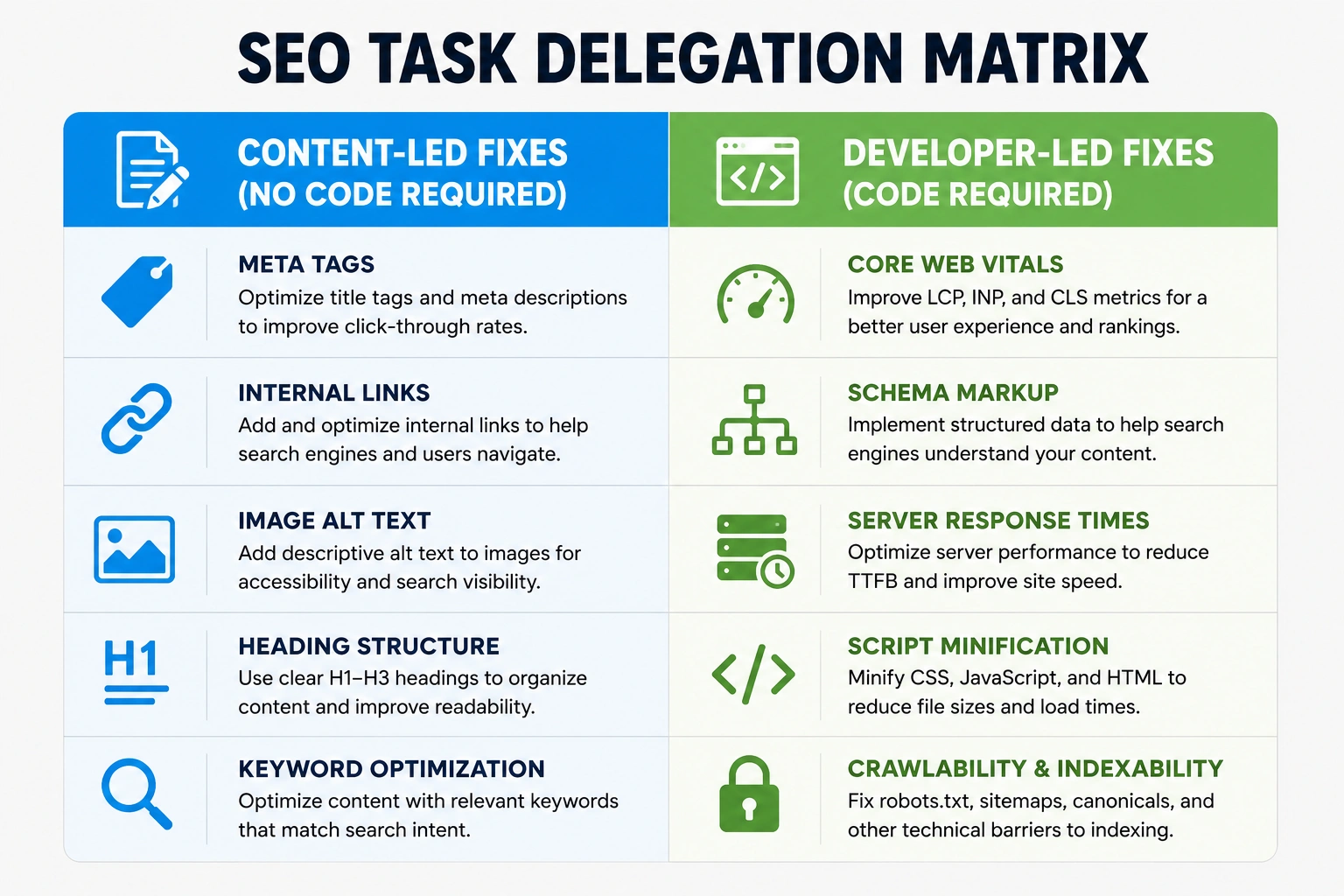
A quick-reference matrix showing which SEO improvements can be handled by content teams versus developers.
Your 30-Day Plan to Improve Your SEO Score
- Days 1 to 7: Run a Free Technical Audit
- Use free tools like Ahrefs Webmaster Tools to run a detailed technical site audit across your entire domain.
- Identify and catalog all critical crawl errors, broken links (404 errors), and missing or duplicate meta tags. Prioritize errors flagged as “critical” over warnings.
- Aim to find the top 10% of technical errors causing 90% of your crawl budget waste: these are almost always broken internal links, redirect chains, and missing canonical tags.
- Days 8 to 14: Optimize for Real-User Speed
- Analyze your site using Google PageSpeed Insights to check your Core Web Vitals scores under real-user field data conditions, not just the lab score.
- Compress large images using next-generation formats (WebP), use browser caching, and eliminate render-blocking JavaScript resources that delay your LCP.
- Focus on passing the real-user field data benchmarks (LCP under 2.5 seconds, INP under 200 milliseconds, CLS under 0.1) rather than chasing a synthetic 100/100 score that does not reflect actual user experience.
- Days 15 to 21: Align Content with Search Intent
- Review your top-performing pages in Google Search Console to identify the precise queries driving impressions, then cross-reference those against your current title tags and H2 headings.
- Ensure your page copy directly and specifically answers those customer questions: not in a general, category-level way, but with the granularity that matches the intent behind each query.
- Integrate strategic internal links to help both users and search crawlers navigate your site’s content hierarchy, distributing authority to pages that need a ranking lift.
- Days 22 to 30: Build Local Authority and Trust
- Claim and fully populate your Google Business Profile with accurate hours, service categories, high-quality photos, and a keyword-informed business description.
- Secure consistent local citations, including Name, Address, Phone number (NAP), across trusted directories like Yelp, Angi, and industry-specific platforms relevant to your vertical.
- Actively request reviews from satisfied customers. Review velocity and recency are measurable signals in both traditional local search rankings and the emerging AI-driven local result packs that are reshaping how customers discover businesses in their area.
Tracking Your SEO Success Over Time
Improving your website’s SEO score is not a one-time event. It is ongoing work. Search engine algorithms shift, competitors refresh their content, and your own website will naturally build up technical debt as you add new pages, update service offerings, or migrate hosting environments. A score that reads 87% today can slip to 71% within sixty days if a site update introduces broken internal links or removes canonical tags from a template. To prevent those silent drops from eroding your traffic, establish a monthly monitoring routine, rather than a quarterly one, that lets you annotate score fluctuations against specific deployments or known algorithm updates.
Tracking also sharpens your ability to measure the success of your small business SEO strategy with precision. When you know that a specific technical fix, such as compressing your homepage hero image, coincided with a 0.4-second LCP improvement and a 12% uptick in organic sessions the following month, you build an evidence base that guides every future investment decision. That kind of attribution clarity is what separates businesses that grow through SEO from those that simply spend on it. There is also a case to be made that consistent monitoring is more valuable than periodic thorough audits, because it catches regressions before they compound into ranking losses that take months to recover.
Frequently Asked Questions About SEO Scores
Navigating the world of search engine optimization can feel like learning a new language mid-conversation. We can translate. To help you make sense of it all, we have gathered direct, honest answers to the questions we hear most often from business owners at every stage of their digital marketing journey.
Answers to Your Top SEO Questions
Q: Is a high SEO score required to rank on Google?
A: No. Google does not consult third-party proprietary scores when determining search rankings. What matters is the underlying technical health and content quality that those scores attempt to measure. The fixes required to raise your score, such as resolving broken links, improving page speed, and eliminating crawl errors, are the same fixes that help Google discover, index, and understand your site. A high score is a reliable indicator that your website’s foundation is solid and ready to compete, not a ranking lever in its own right.
Q: How can I check my website’s SEO score for free?
A: A combination of three free tools covers the full diagnostic picture. Use Ahrefs Webmaster Tools to run a thorough technical site audit and surface crawl errors across your entire domain. Use Google Search Console to monitor your indexing status, search performance, and any manual actions or coverage issues. Use PageSpeed Insights to test your Core Web Vitals and understand how real users are experiencing your site’s loading speed and stability. Together, these three tools give you a more complete picture than any single paid platform’s composite score.
Q: What is a “good” SEO score for a small business?
A: For technical Site Health, 85% or higher is the benchmark that indicates your site is free of critical crawl-blocking errors. For Domain Authority, a score of 20 to 40 is both common and genuinely competitive for local small businesses. National brands exceed 60 because of their massive, decades-old backlink profiles, but a local plumber or law firm does not need that scale to dominate its city’s search results. The more useful question is not “what is a good score in the abstract?” but “does my score outpace my direct local competitors?” That comparison is what really determines ranking outcomes in your market.
Q: Why did my SEO score go up but my traffic went down?
A: This disconnect usually surfaces when technical fixes and content strategy are not coordinated. You may have resolved a batch of crawl errors (which legitimately raised your technical Site Health score) while simultaneously losing rankings because a competitor published more detailed content for your primary keywords, or because a Google algorithm update adjusted content relevance signals in your vertical. A rising score and falling traffic is not a contradiction; it is a signal that the technical foundation is improving but the content layer needs attention. Fixing one without the other is a partial solution. Both must work together.
Q: Can I do SEO by myself, or do I need to hire an agency?
A: Many foundational tasks are genuinely within reach for a motivated business owner, such as writing helpful service pages, optimizing your Google Business Profile, updating meta tags, and building internal links between related content. Where the complexity compounds is in technical fixing (Core Web Vitals, schema markup, crawl budget management), sustained link acquisition, and keeping pace with algorithm changes that can shift ranking dynamics in a matter of weeks. Many business owners find that handling the content layer themselves while partnering with an agency for the technical and authority-building work is the most cost-effective division of effort. If you want to explore what that looks like without a long-term commitment, learning how to measure SEO success with an affordable budget is a practical starting point.
Understanding and actively improving your website’s SEO score is one of the most reliable investments a small business can make in its own discoverability. After all, small businesses are driving America forward, and sophisticated marketing belongs to you too. The businesses that treat their technical site health as a living, monitored asset, rather than a one-time project, are the ones that compound organic visibility over time while their competitors cycle through paid ad budgets with nothing to show for it. By focusing on real-user speed, resolving critical technical errors, and aligning your content with the specific queries your customers are really typing, you build a sustainable pipeline of organic leads that does not evaporate the moment a campaign ends. We’re a small business ourselves, and we focus on the positive impacts we make on our partners. BizIQ is here to stand beside you, not above or behind, as a knowledgeable peer at every step of that process. We won’t hand you a confusing report and disappear.
Here’s what to do next. Read our guide on how to perform a website audit to enhance SEO and maximize your conversions, or explore our affordable SEO strategies to learn how we can help your business grow steadily and sustainably.