
The question of franchise SEO vs local SEO usually comes up too late. Most franchise operators do not ask whether they need a different strategy until they are deep into a scaling problem: organic traffic has plateaued across new locations, and a single-location competitor three blocks away outranks every franchisee in the metro. That gap is not a content problem or a budget problem. It is a structural one, and it comes down to four differences.
- Architectural complexity: one domain structure has to serve every location.
- Content scalability: unique local content has to be produced systematically, not by hand.
- Brand governance: corporate standards and local participation have to coexist.
- Data syndication: listing accuracy has to stay synchronized across hundreds of directories.
Running SEO for one storefront is like learning to cook one recipe well. You know the ingredients, the heat, and the timing, and you can adjust in real time, focus on a handful of search terms, and manage every citation by hand. Running it for a franchise network is closer to operating a restaurant chain where every location must deliver the same quality. You are managing dozens or hundreds of locations at once, each with its own local competition, all reinforcing one brand without trampling each other. You need a system, not just a recipe.
The stakes grow with the industry itself. The International Franchise Association projects U.S. franchise establishments will reach 845,000 units in 2026, which means more locations competing for the same local searches every year. Franchise networks have to balance national brand authority with hyper-local relevance, while avoiding duplicate content, internal keyword cannibalization, and inconsistent business data across the web.

Franchise SEO vs Local SEO: The Four Structural Differences
Local SEO for a single business concentrates authority on one website and a handful of services. Franchise SEO is a system-design challenge, because the same activities have to work across a whole network without creating conflicts. The table below summarizes where the two disciplines diverge.
| Factor | Single-location local SEO | Franchise SEO |
|---|---|---|
| Architecture | One site, one service area, a few service sections | One corporate domain with a structured, scalable set of location content |
| Content | Depth and quality for one market | Distinct local content produced at scale without duplication |
| Governance | One owner makes every decision | Corporate standards plus local contribution |
| Data | One name, address, and phone number to maintain | Hundreds of records that must stay synchronized |
How Franchise SEO vs Local SEO Work Differs Day to Day
The practical difference shows up in the failure modes. Templated location content that swaps only the city name gets filtered as near-duplicate. Sister locations targeting the same metro keywords cannibalize each other. A single franchisee who edits their own Google Business Profile with a wrong address creates a conflict that weakens trust signals for the brand. None of these problems matter much for one storefront, but across 50 or 500 locations each one is a constant operational risk. A single business can lean on local SEO services built around one profile and one site, while a franchise needs that same discipline multiplied and governed.
Architectural Foundations: Subfolders vs. Standalone Domains
When a brand operates 200 locations, the question of where location content lives, and how it shares authority, shapes how quickly new markets can compete. This is the first place franchise SEO departs from the single-location playbook, and a dedicated SEO program for franchises starts here.
Subdirectories on One Corporate Domain
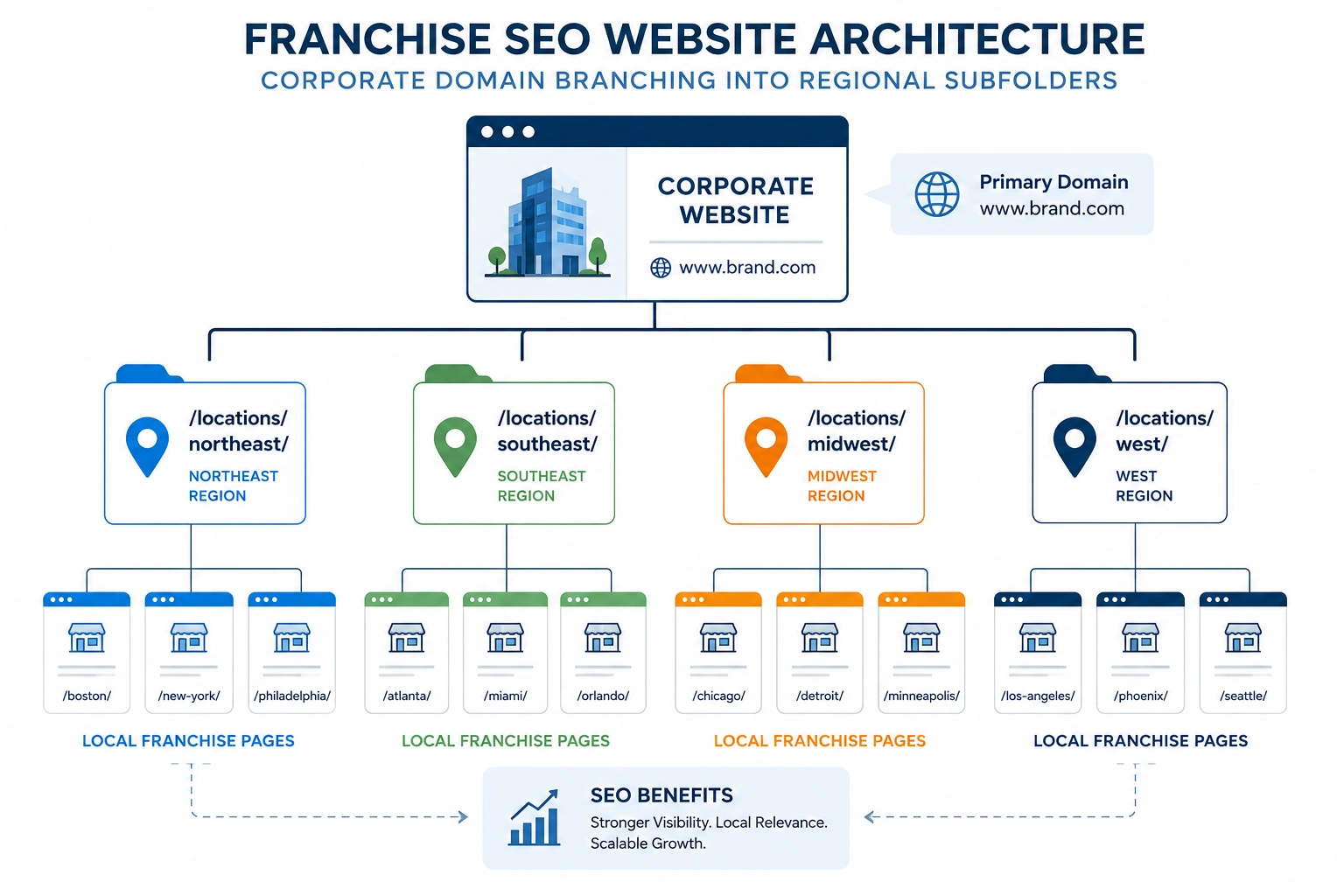
A practical starting point is a hierarchical subdirectory structure such as brand.com/locations/austin/, brand.com/locations/dallas/, and brand.com/locations/chicago/. Every location sits inside the root domain, so the authority the corporate site has earned supports the location content beneath it, and every local mention a franchisee earns strengthens the same domain. Templates, sitemaps, and technical standards also live in one place, which makes governance far simpler.
Subdomains and Microsites
Subdomains such as austin.brand.com look like a reasonable alternative, and some systems use them for perceived local control. The trade-off is consolidation. Google’s crawl documentation notes that a subdomain like code.example.com is treated as a separate site with its own crawl budget, and separate sites have to build trust on their own. Standalone microsites go further, turning each franchise unit into a brand-new website that must earn its own links and citations while the corporate domain gains nothing from the work.
The case for subdirectories rests on consolidation and operational simplicity, not on a guaranteed ranking boost. For a network adding locations every quarter, that simplicity is the difference between a program that scales and one that collapses under its own maintenance.
Content Scaling: Hyperlocal Customization vs. Single-Site Focus
A single-location operator can afford to focus closely: one service area, one set of local keywords, one voice. Content strategy at that scale is about quality and depth, not about manufacturing differentiation across hundreds of nearly identical pieces.
Franchise content is a different challenge. The network needs hundreds of location listings that are consistent enough to reflect one brand and distinct enough that search engines do not treat them as duplicates. That is a content engineering problem, and the solution is not to write more but to write differently, systematically, at scale. Strong on-site optimization builds those requirements into templates so quality survives scale.
The hyperlocal playbook for franchise location content comes down to four elements.
- Substantive local copy: every location needs original content about its service area, nearby landmarks, and community involvement, with enough depth to stand on its own instead of a lightly edited template.
- Non-overlapping keyword targets: neighborhood and city-specific terms keep sister locations from competing against each other.
- Real local photos: images of the actual team, storefront, and branded vehicles replace generic stock photography.
- Supporting local topics: content about regional climate, local codes, or community events builds topical authority around each market.
Brand Governance: Centralized Control vs. Local Autonomy
Managing search across a franchise network means balancing corporate standards with local execution. If you are thinking that you do not have a big marketing team, consider how enterprise brands solve it: they do not choose one extreme, they define who controls what. The debate between centralized control and local autonomy has real costs on both sides, and the right balance depends on network size, franchisee sophistication, and the maturity of the brand’s digital infrastructure.
Fully centralized models produce technically compliant but often generic content. Corporate-controlled copy tends to lack the authentic local signals, such as genuine community references and real customer stories, that separate high-performing content from templated content. Fully decentralized models produce the opposite problem: citation conflicts, inconsistent name, address, and phone data, duplicate listings, and off-brand messaging.
The hybrid framework most large networks converge on divides responsibility cleanly.
- Corporate owns the foundation: the content management system, schema templates, core technical SEO, and ownership of every Business Profile.
- Franchisees contribute local proof: review replies, real photos, and regular local updates through approved modules.
- Policies keep everything aligned: clear rules for tone of voice, logo use, and local content creation, so a coordinated franchise marketing strategy stays consistent across every territory.
- Unified reporting: dashboards that track local visibility, lead volume, and review activity across the entire network.
A note on access: Google’s owner and manager roles let corporate keep ownership while operators manage day-to-day activity, but managers can still edit business information. Scheduled monitoring of changes is what protects the data, not the role alone.
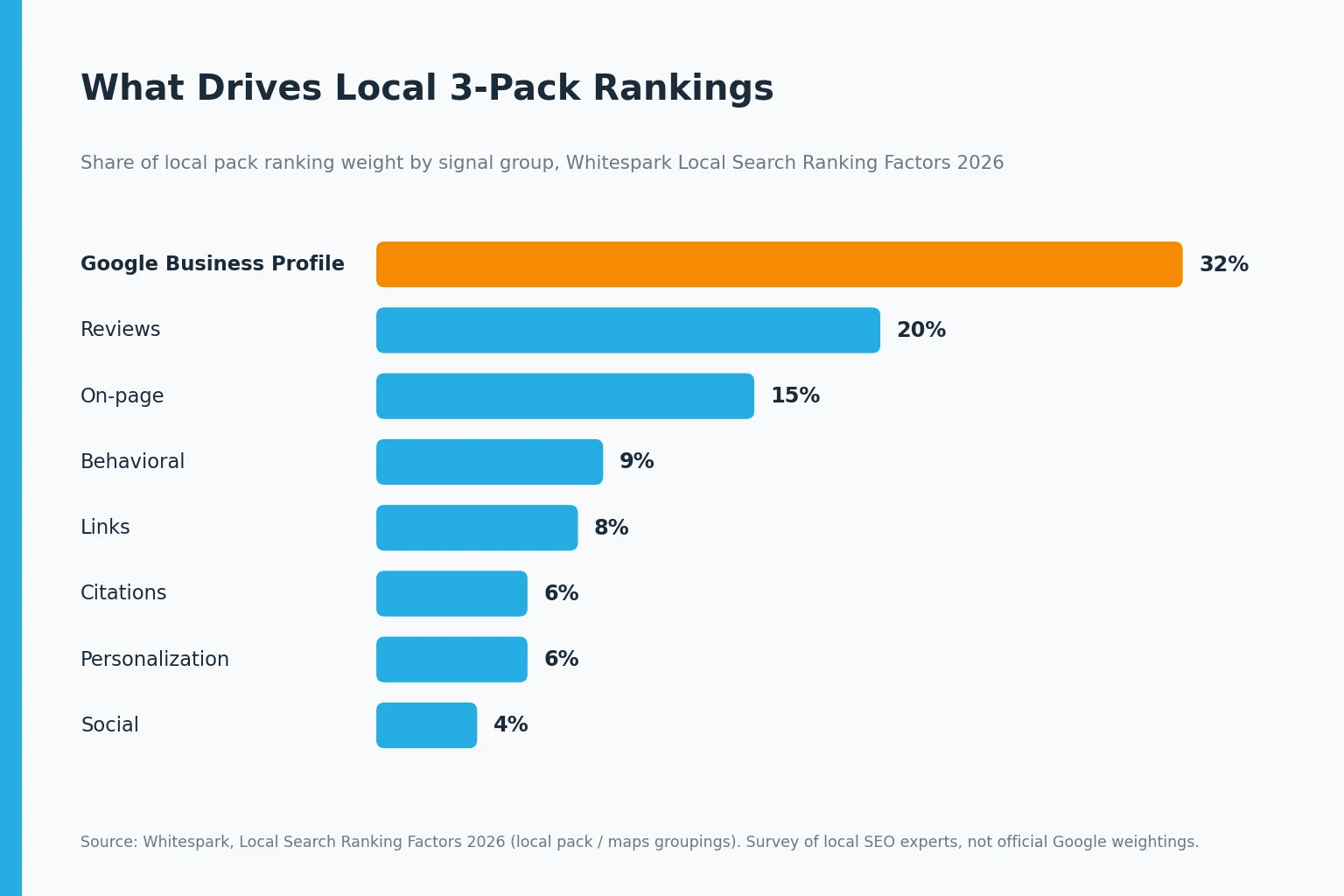
Profile quality matters because Business Profile signals carry the most weight in local pack rankings. In Whitespark’s 2026 survey of local SEO experts, they account for 32% of local pack ranking influence, ahead of reviews at 20%.
For networks that want expert help with claiming, verifying, and governing every profile, a Google Business Profile setup and verification service removes much of the risk.

Is your network competing against itself?
Internal keyword competition and duplicate location content can quietly hold back an entire franchise network. Schedule a free audit and let our search specialists review your site architecture.
Citation Management: API Syndication vs. Manual Directory Submissions
Manual citation management works at single-location scale. One business, one address, one phone number: you can submit to the major directories, verify the listings, and check back quarterly. The overhead is manageable and the error rate stays low because the data set is small.
At 200 locations the system breaks. Coordinating data aggregators, industry directories, mapping services, and navigation platforms means keeping thousands of individual citations perfectly synchronized, and any one of them can drift. Data drift, the gradual corruption of business listings through incorrect third-party data or automated updates, erodes both search engine trust and consumer confidence.
Enterprise networks need centralized data management, with the corporate location database feeding directories through API-driven platforms so a single update propagates everywhere. Ongoing local citation management turns that principle into a routine, so accuracy is maintained instead of repaired after the fact.
Where Customers Look Now: Search, Maps, and AI Recommendations
Franchise SEO also has to account for how customers discover local businesses today, and that has shifted quickly. In BrightLocal’s 2026 Local Consumer Review Survey, use of ChatGPT and other generative AI tools for local recommendations rose from 6% to 45% in a year, while Google’s share dipped from 83% to 71% and Apple Maps nearly doubled from 14% to 27%.
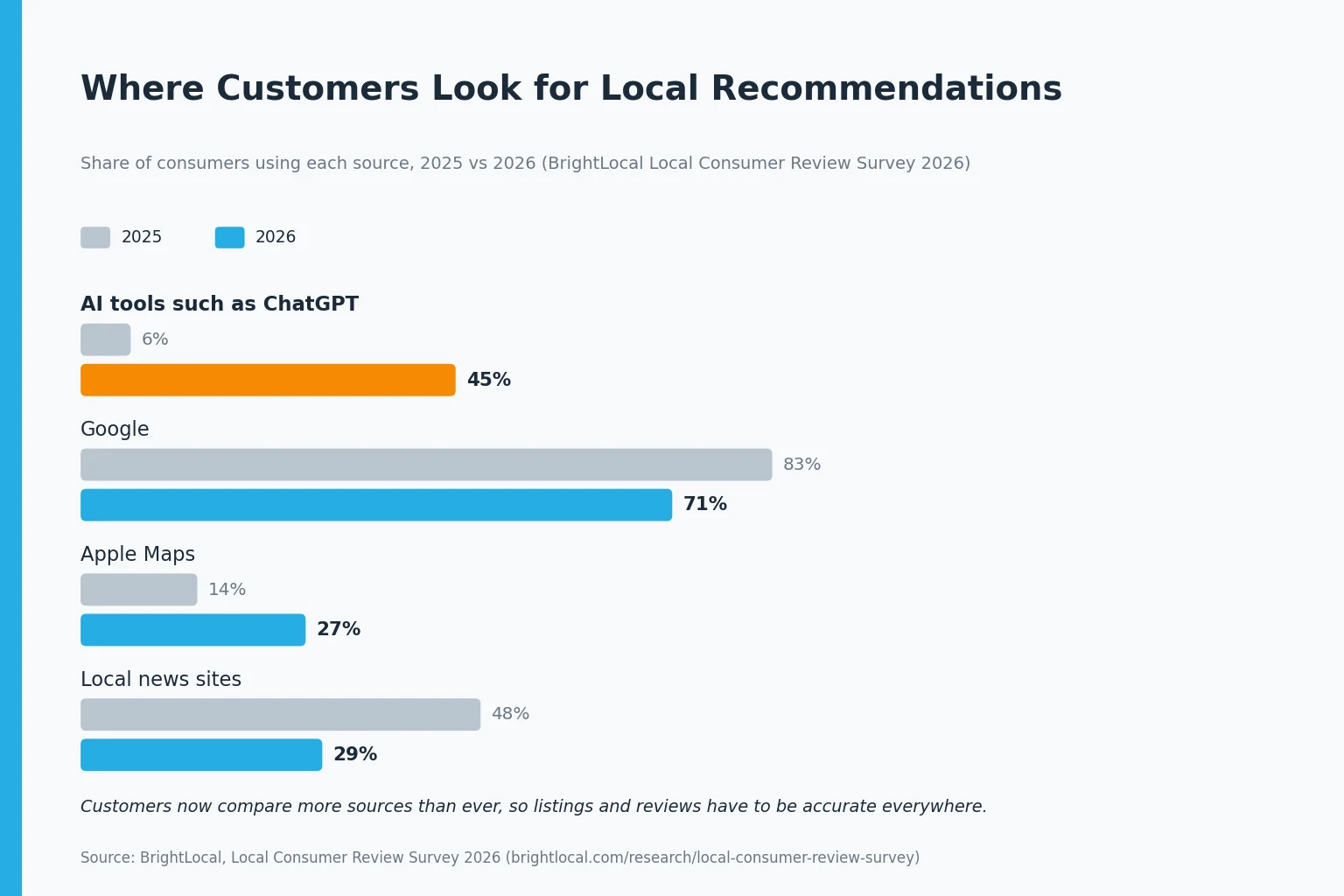
For a franchise network, that makes consistency a visibility issue and not only a tidiness issue. AI tools and map apps draw on listings, reviews, and website content, so conflicting location data can lead to the wrong details being repeated at scale.
Preparing a Franchise Network for AI-Driven Discovery
- Clean structured data: LocalBusiness schema on every location helps machines tell storefronts apart and connect each one to the parent brand.
- Conversational, specific answers: content that directly answers real local questions is easier for people and AI tools to use.
- Visible expertise: detailed FAQs, local case examples, and transparent pricing demonstrate experience and trustworthiness.
- A steady flow of reviews: recent, genuine reviews reinforce reputation across every platform, which a managed reputation management program can sustain at network scale.
Budgeting for this work is a real consideration, and our franchise SEO pricing overview shows what network-level programs include.
Avoiding the Cannibalization Trap
Keyword cannibalization in a franchise network is an internal conflict, and it is more common than most marketing directors realize. It happens when several locations in the same network target identical or near-identical queries, such as “plumber near me in Dallas,” “Dallas plumbing services,” and “emergency plumber Dallas,” across overlapping service areas. When several URLs from one site compete for the same intent, signals split among them, and none may build enough strength to break into the local map pack.
Search systems do not give a corporate brand special treatment for competing with itself. In practice, three Dallas-area locations targeting the same broad city keyword can collectively sit lower than any one of them would if it owned a distinct, non-overlapping territory.
The fix is to set clear geographic boundaries in website content and in each Business Profile at the same time. Each location should target neighborhood-level terms, specific service-area zip codes, and long-tail queries tied to local landmarks, so no two locations in the same metro compete for the same intent.
A Two-Layer Content Model for Corporate and Local Visibility
The most reliable content model for franchise networks uses two layers. Corporate service content targets high-volume national keywords and broad brand queries, capturing customers who are still researching. Individual location content targets geographically specific, high-intent terms, capturing customers who are ready to act.
The model also creates a natural internal linking structure. Corporate service content links to the relevant locations, and each location links back to the corporate service content and to supporting local content in its area. That two-way structure reinforces topical authority at every level, which both traditional search systems and AI answer tools tend to reward.
Franchise SEO vs Local SEO FAQs
What is the difference between franchise SEO and local SEO?
Franchise SEO manages search visibility for a network of locations at both the national and local level. Local SEO typically focuses on one physical location or independent business in a specific geographic area. The franchise version adds challenges that single-location SEO never faces, including shared domain architecture, duplicate content control, brand governance, and listing synchronization.
Should each franchise location have its own website?
For most networks, no. Separate microsites or domains multiply the work and keep authority from consolidating. Hosting every location under one corporate domain in a subfolder structure makes governance simpler and lets new locations benefit from the authority the brand has already earned. Google treats a subdomain as a separate site, so subdomains face the same consolidation problem.
How do you prevent duplicate content across franchise locations?
Avoid templates where only the city name changes. Each location needs original, localized content, including specific neighborhood details, local customer feedback, a clear service area definition, and real photos of the local team. Templates should protect brand structure while leaving room for authentic local information.
Why is NAP consistency important for franchises?
NAP (name, address, and phone number) consistency is a core trust signal. Conflicting details across directories confuse search systems and customers, and in a franchise network those conflicts multiply with every location and every listing source. Centralized data management keeps every record aligned.
How does Google Business Profile affect franchise SEO?
Business Profile signals are the largest single group of local pack ranking factors in Whitespark’s 2026 survey, at 32%. Each physical storefront needs its own accurate, verified profile, with a steady flow of reviews and regular local updates, governed so that corporate keeps ownership while local operators contribute.
Does franchise SEO matter for AI search tools?
Yes. BrightLocal’s 2026 survey found that use of AI tools for local recommendations grew from 6% to 45% in a year. Those tools rely on listings, reviews, and website content, so accurate structured data, consistent location details, and genuine reviews help each location be represented correctly.
Succeeding as a franchise network means moving from isolated local tactics to a scalable, enterprise-grade system. A unified subfolder structure, strict name, address, and phone consistency, and a two-layer content model let you put national brand authority behind hyper-local results. Start by reviewing your current URL structure and Business Profile ownership to find the conflicts that are costing you visibility, and if you want a second set of eyes, talk with a franchise SEO specialist about your network.

Build a growth playbook for your whole network
Tell us about your network and we will build a customized proposal for every location, built around your territories and budget.