Written by the BizIQ SEO Strategy Team. As a small business ourselves, we understand the hurdles of local visibility. We know the grind. We have helped over 26,000 small businesses across America build sustainable organic lead engines, proving that small business is the backbone of innovation and local commerce is driving our nation forward.
- Claim and verify your Google Business Profile to secure your local digital storefront.
- Build a high-velocity review system to capture the 20% ranking weight of customer feedback.
- Create dedicated service area pages to rank in high-ticket suburbs without a physical address.
- Implement LocalBusiness schema markup to feed structured data directly to search crawlers.
How do Plumbers use Local SEO to fill their Dispatch Boards in 2026?
Plumbers fill dispatch boards by optimizing for immediate, high-intent emergency searches. Success requires maximizing Google Local Services Ads, optimizing your Google Business Profile (GBP) for near-me proximity, and publishing direct, snippet-friendly answers about urgent plumbing crises, ensuring your business captures desperate homeowners right when a pipe bursts.
When a homeowner faces a burst pipe or a failing water heater, they do not browse social media or flip through mailers; they search Google for an instant solution. If your plumbing business does not appear in the Google Local 3-Pack during these high-urgency moments, you are actively handing high-margin jobs to your competitors. That is a costly mistake. Local SEO doesn’t have to feel like a mystery. Here’s exactly how to do it, step by step, focusing on what works and why for small businesses like yours, rather than a sprawling checklist of marginal optimizations. We share the same goals and aspirations: keeping your dispatch board full and your trucks rolling.
In 2026, local SEO is no longer a passive marketing channel. It is the single highest-ROI asset a plumbing company can own. While paid lead platforms charge up to $150 per shared lead, organic local search delivers exclusive, high-intent inquiries directly to your dispatch board. By aligning your digital presence with Google’s core local ranking factors, you can build a predictable, compounding lead engine that keeps your trucks rolling 24/7.
Why Local SEO is the Highest-ROI Marketing Engine for Plumbers
Traditional advertising channels interrupt homeowners. Local SEO intercepts them at the precise moment of need. Local plumbing leads convert at a rate of 12% to 16%, a figure that makes most display ad benchmarks look embarrassing by comparison. That conversion premium exists because organic search connects you with customers who have already decided they need a plumber: they are selecting one, not being persuaded to want one.
The long-term cost structure is where the gap becomes financially clear-cut. Digital marketing data shows that every $1 invested in local SEO returns $19.90 in revenue, compared to just $4.40 for paid advertising (Pipeline On, 2026). The numbers do not lie. They demonstrate how organic search builds lasting value. That spread compounds over time because organic rankings carry no cost-per-click overhead: a position you earn in March still generates calls in November without an additional invoice. If you want to understand how local SEO fits into a broader growth architecture for your business, our guide on plumbing marketing services maps out the full picture.
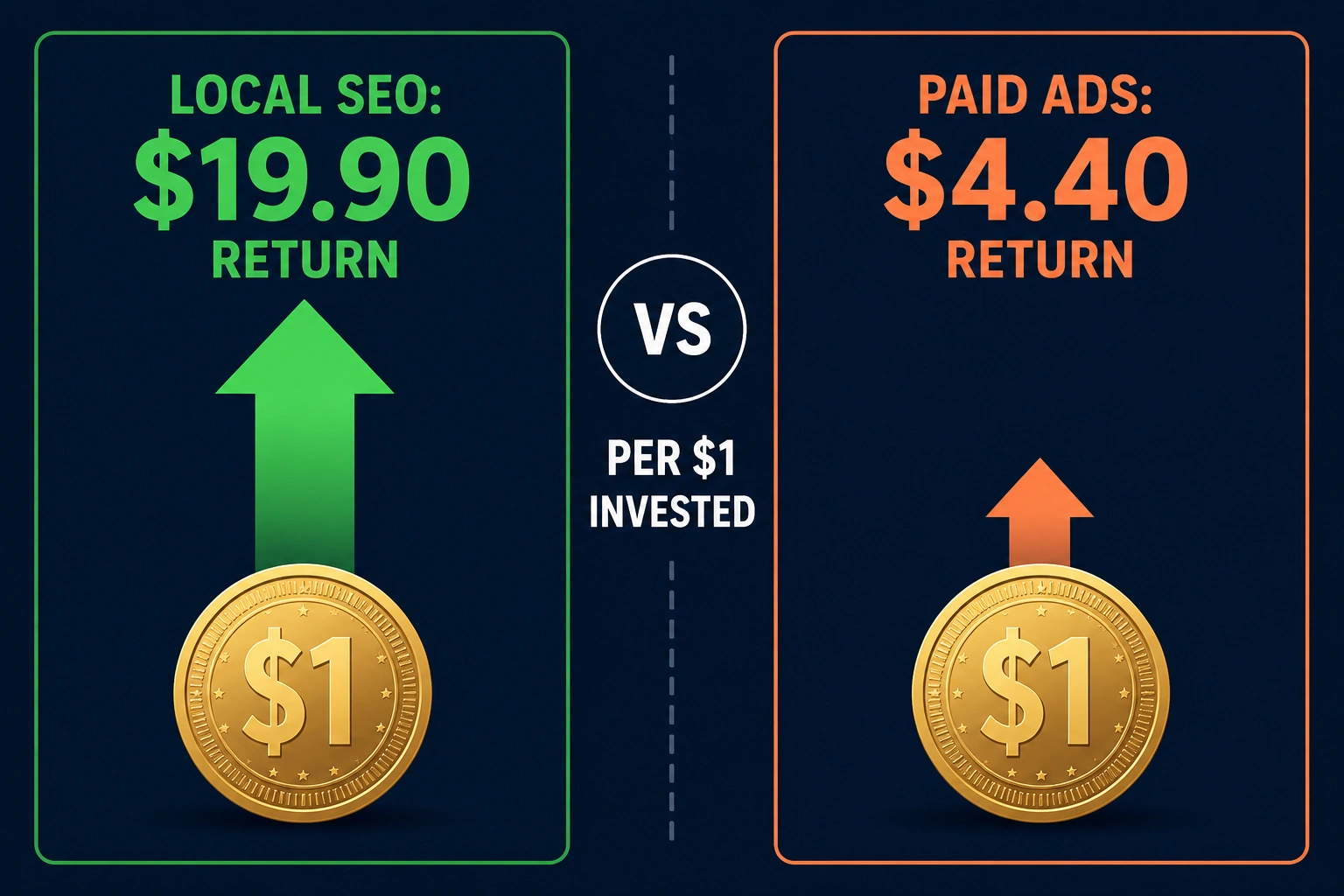
Local SEO delivers a significantly higher return on investment than paid advertising, generating $19.90 for every $1 invested compared to $4.40 from paid ads.
Step 1: Claim and Grow Your Google Business Profile
1. Set your primary category to “Plumber” to align with Google’s primary relevance signal.
- According to Local Search Ranking Factors, selecting the correct primary category is the single most critical ranking signal on your entire profile. It is more influential than your business description, your photos, or your review count.
- Secondary categories like “Drain Cleaning Service” or “Water Heater Installation Service” extend your relevance footprint into specific service queries without diluting your primary signal.
- Avoid embedding keywords into your business name. Google’s spam enforcement has grown considerably more aggressive; profiles using names that deviate from the legal business name face suspension, and reinstatement is neither fast nor guaranteed.
2. Optimize your business description and attributes.
- Write a 750-character description that leads with your core services and the specific municipalities you serve. Every character counts here: this is not a tagline, it is a relevance document.
- Attributes like “Emergency Services” and “Online Estimates” surface in filtered search results and serve as secondary differentiators when two profiles are otherwise evenly matched.
- Your Name, Address, and Phone Number (NAP) must be character-for-character identical to what appears on your website. Accuracy is key. “St.” versus “Street” is not a trivial inconsistency: it registers as a data conflict in Google’s entity resolution process.
- For contractors navigating these algorithm shifts, understanding local SEO for contractors is essential. Your Google Business Profile is your digital storefront window: if the glass is dirty or the sign is missing, people will walk right past.
3. Upload high-quality, real-world photos regularly.
- Generic stock photography is a credibility liability. Google’s algorithm and the homeowners evaluating your profile both respond to authentic images of your branded trucks, uniformed technicians, and completed installations.
- Photo recency matters. A profile that received its last upload eighteen months ago signals inactivity, regardless of how strong its other signals are.
- Profiles with complete information and frequent photo updates receive 7 times more clicks than incomplete profiles (Google / Signpost, 2026). That multiplier applies before a single homeowner reads a single review.
Step 2: Build a High-Velocity Review Acquisition System
1. Understand what review signals measure.
- Review signals account for 20% of local pack ranking influence according to an annual ranking factors survey. That is not a marginal input: it is a primary pillar.
- Google evaluates three distinct dimensions: total review volume, average star rating, and review velocity: the rate at which new reviews accumulate. A profile that earned 80 reviews two years ago and has stalled is algorithmically weaker than a profile with 40 reviews that added 10 last month.
- Plumbing businesses with more than 100 Google reviews generate 52% more phone calls from their profiles than those with fewer reviews (BrightLocal, 2026). Volume is not vanity here; it is a direct conversion driver.
2. Train your technicians to ask in person.
- The optimal moment is immediately after job completion, when customer satisfaction is at its peak, and the technician is still on-site.
- A simple, non-pressuring script works: “If you’re happy with our work today, a quick Google review helps other homeowners find us.” That is the entire ask. No follow-up required in the moment.
- Incentivize your team by offering small bonuses for reviews that mention a technician by name. Named reviews carry additional trust weight with prospective customers and reinforce your team’s accountability culture simultaneously.
- In our work with thousands of home service business owners, what we’ve seen work is a simple, repeatable process for gathering feedback.
3. Automate the follow-up sequence.
- Send an automated SMS or email within two hours of service completion containing a direct link to your Google Business Profile review form. Do not wait. Two hours is not arbitrary: it captures the window before satisfaction fades and the homeowner’s attention shifts.
- Embed a QR code on physical invoices and business cards. Mobile review submission is effortless when the path from paper to Google is a single camera scan.
- Respond to every review: positive and negative. An unanswered negative review signals to Google and to prospective customers that no one is minding the business. A measured, professional response to a complaint often converts skeptical readers more effectively than a five-star review does.
Step 3: Optimize On-Page SEO for High-Ticket Plumbing Services
Revenue-focused on-page SEO starts with a clear-eyed look at your service mix. A standard water heater replacement carries an average ticket of $1,330 to $1,586 for tank systems, and up to $3,000 for high-efficiency tankless installations, compared to a drain cleaning that might net a fraction of that. Your website’s content architecture should reflect that financial hierarchy, not flatten it. If your tankless water heater page is thinner than your drain snaking page, you are structurally deprioritizing your most profitable service in the eyes of both Google and the homeowners who find you. This is a mistake. For a detailed walkthrough of how to execute this, our guide on local SEO for plumbers covers the full on-page framework.
Optimizing your website is like setting up your physical shop floor: you place your highest-margin items right where customers can see them first. To structure your site correctly, follow proven local on-page SEO principles. When writing your title tags, focus on geographic intent. This guide on local title tags explains how to structure them. Here’s what we recommend to capture high-intent traffic.
Each high-ticket service deserves a dedicated, deep-content page with title tags, H1 headers, and meta descriptions targeting specific commercial queries: “tankless water heater installation in [City]” rather than a generic “plumbing services” umbrella. Alongside that, implement LocalBusiness schema markup (specifically the “Plumber” schema type) in JSON-LD format. Structured data does not directly boost rankings, but it sharpens Google’s understanding of your NAP, service areas, and business type, which reduces confusion in competitive markets where two or three plumbers are otherwise closely matched. To identify the specific terms worth targeting across your service pages, start with our curated list of local plumbing keywords.
“If your website treats a $150 drain snaking with the same prominence as a $3,000 tankless water heater installation, you are letting Google dictate your profit margins.”, Senior Local SEO Strategist
Step 4: Create High-Converting Service Area Landing Pages
Google’s closeness weighting is blunt: a physical address in one city creates a gravitational pull toward that city’s Map Pack and a measurable drag against adjacent markets. Proximity matters. A plumbing company headquartered in Pasadena should not expect its homepage to rank in Glendale or Arcadia without dedicated infrastructure. Service area landing pages are that infrastructure, but only when built with genuine localized content. Pages that swap a city name into a templated paragraph are doorway pages by another name, and Google’s spam filters have grown sophisticated enough to identify and suppress them. Creating high-converting service area pages requires more than just swapping city names. Each page needs neighborhood references, local landmarks, real project examples from that area, and testimonials from customers in that ZIP code. For a broader look at how to structure this across your entire site, our ultimate local SEO strategy guide covers the architectural decisions that make these pages work.
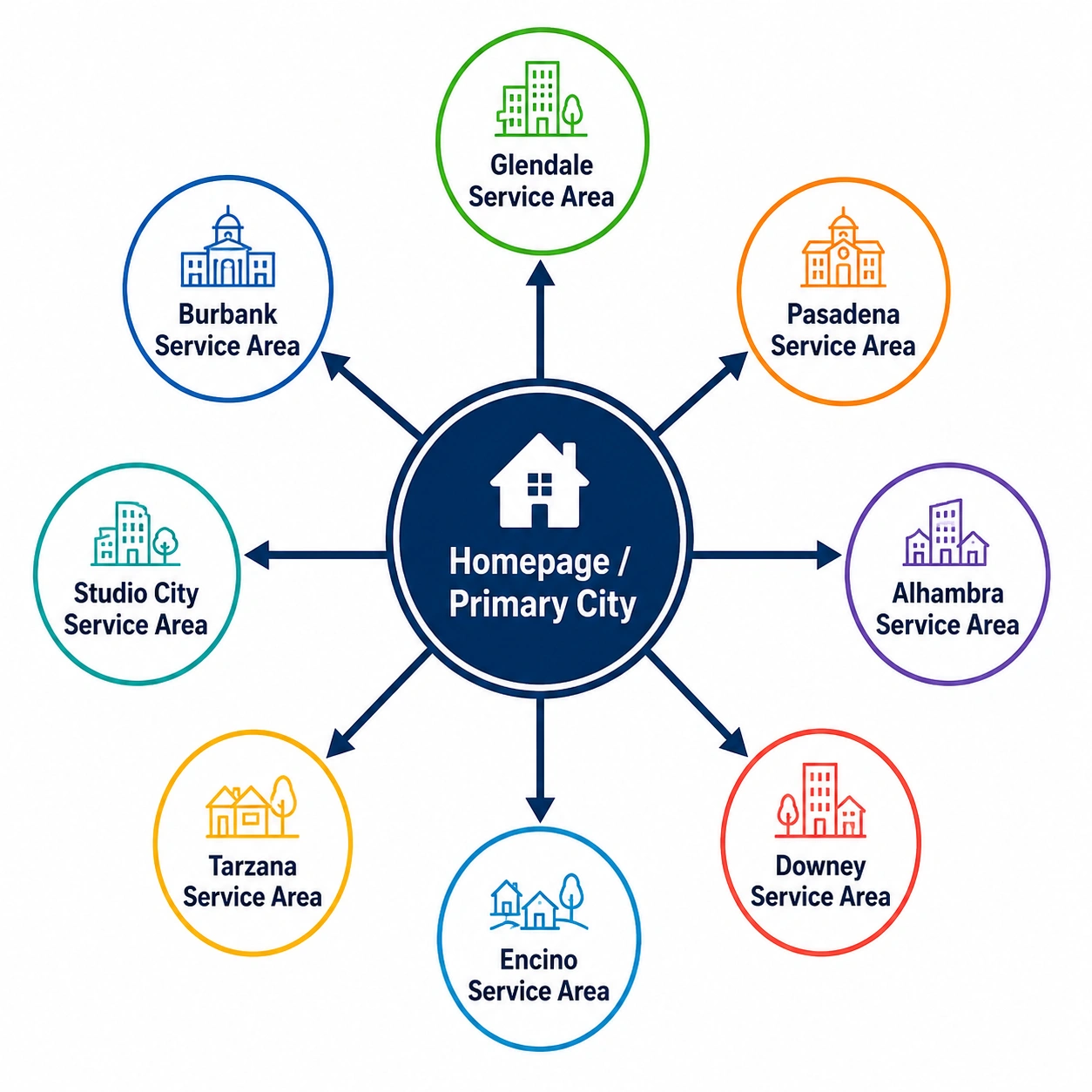
A hub-and-spoke site architecture connects a primary city homepage to multiple local service area pages, helping strengthen local SEO relevance and geographic coverage.
Want to expand your service territory?
chedule a free local visibility audit with our team, and we will map out the exact suburbs your competitors are neglecting.
Step 5: Build Local Citations and Maintain NAP Consistency
1. Audit your existing listings before building new ones.
- Conflicting business data: an old phone number on Yelp, a street address abbreviated differently on Angi, or a suite number missing from your Apple Maps listing. This erodes Google’s confidence in your entity data. That erosion is cumulative and quiet; you will not receive a notification when it starts costing you rankings.
- Tools like BrightLocal surface these discrepancies across hundreds of directories simultaneously, making the audit process manageable rather than a manual slog through individual platforms.
- Your NAP must match your Google Business Profile character-for-character. The profile is the canonical reference point. Everything else aligns to it. Consistency is vital.
2. Prioritize tier-one directories and genuinely local platforms.
- Yelp, Angi, Bing Places, Apple Maps, and the Better Business Bureau are non-negotiable starting points. These platforms carry domain authority that transfers meaningful citation weight, and they are the first places prospective customers check independently of Google.
- Hyper-local placements: your city’s Chamber of Commerce directory, neighborhood association sites, and local home services aggregators. These carry disproportionate geographic relevance signals relative to their domain authority. A citation from a local Chamber of Commerce tells Google something a generic national directory cannot.
- Quality over volume is not a platitude in citation building; it is an operational constraint. A handful of authoritative, accurate, locally relevant citations outperforms a bulk submission to 300 low-quality directories, and the latter carries a real spam risk.
Measuring Your Local SEO Success: Metrics That Matter
Many agencies hide weak performance behind impression counts and keyword position dashboards. Those numbers have their place in diagnosing specific issues, but they do not reflect whether your SEO investment is generating revenue. Focus on real leads. According to industry plumbing SEO statistics, organic searches convert far higher than paid channels when tracked down to the actual call. The metrics that matter are the ones tied to inbound contact: organic phone calls tracked through call recording, Google Business Profile direction requests (a strong proxy for purchase intent), and completed website contact forms segmented by organic traffic source. Tracking these three consistently gives you a ground-level view of whether your local search presence is converting, not just appearing. For a fuller framework on how these metrics connect to your overall digital strategy, our guide on effective local SEO strategies walks through the measurement architecture in detail.
Frequently Asked Questions About Plumber SEO
Q: How long does it take to see results from local SEO for plumbers? A: Google Business Profile optimizations can yield increased Map Pack visibility and phone calls within 30 to 90 days, particularly if your profile was previously incomplete or unclaimed. Achieving top-three placement in highly competitive metropolitan markets is a longer process, typically requiring six to twelve months of consistent optimization, citation building, and review generation. The timeline compresses when you start from a clean, well-structured foundation and extends when you are correcting years of inconsistent NAP data or a neglected profile.
Q: What is the single most important ranking factor for the Google Map Pack? A: Selecting the correct primary category is the most decisive single setting on your profile. “Plumber” must be your primary category. Secondary categories like “Drain Cleaning Service” or “Water Heater Installation Service” extend your relevance into specific service queries, but they cannot substitute for the primary signal: Google weights them differently.
Q: Do service areas listed in Google Business Profile improve rankings?
A: No. Configuring your service areas tells customers where you operate, but Google’s algorithm does not use those settings as a ranking input. To rank in adjacent cities, you need dedicated, detailed service-area pages on your website: pages that demonstrate genuine local relevance through content, not just a city name dropped into a template.
Q: Should I use a keyword-stuffed business name on my profile? A: Adding keywords like “Best Glendale Plumber” to your business name provides a ranking lift when it works, but it violates Google’s guidelines if the name does not match your legal business registration. Google’s spam enforcement has become considerably more aggressive, and profile suspensions for keyword stuffing are common. Reinstatement is slow and uncertain. The short-term ranking gain is not worth the risk of losing your entire local digital presence overnight.
Q: What are doorway pages, and will they penalize my plumbing website? A: Doorway pages are thin, city-swapped templates created to rank for multiple geographic queries without providing distinct value to users in each location. Google penalizes this pattern explicitly. Every service area page on your site must earn its existence through unique localized content: real project references, genuine customer testimonials from that area, and specific service context relevant to that community. A page that could belong to any city is a doorway page, regardless of what you call it.
Building a successful local search presence requires technical precision, consistent execution, and a deliberate focus on high-ticket service intent, keeping in mind the positive impacts we make in our local communities. It takes work. By working through this blueprint, from Google Business Profile fundamentals to service area page architecture to citation hygiene, you can shift your business away from expensive shared-lead platforms and toward a compounding organic asset that you own and control entirely. If you are also weighing cost against scope as you plan your next move, our guide on local SEO strategies for 2025 covers how to sequence these investments without overextending your marketing budget.
Ready to grow your local presence?
Contact our local SEO experts today to build your custom 2026 growth plan and keep your trucks booked weeks in advance.