As a small business, we understand the challenges of local and regional growth. We specialize in helping commercial contractors and local businesses build authority and capture high-value search traffic.
Here is what you need to know:
- Why 70 to 85% of commercial buyers complete independent digital research before contacting a single firm, and what that means for your pipeline
- How to map your content strategy to the distinct search behaviors of developers, architects, and municipal procurement officers
- The service page architecture that signals topical authority to search engines, rather than burying your capabilities in a single portfolio page
- Practical local SEO tactics that prove regional capacity to project managers, not just foot traffic
- How to prepare your firm’s digital presence for AI-driven search engines and Answer Engine Optimization (AEO)
How Can Commercial Contractors use SEO to build a Predictable Project Pipeline?
To build a predictable pipeline using SEO, optimize your website for high-intent, localized commercial keywords (e.g., “commercial general contractor [City]”, publish detailed case studies of completed projects to prove capability, and optimize your Google Business Profile (GBP) to capture local developers, architects, and property managers actively looking to hire.
Commercial construction procurement does not begin with a phone call. It begins with a search. When a developer needs a design-build partner for a $40 million mixed-use project, or a municipal procurement officer is vetting general contractors for a healthcare facility expansion, their first move is not to call a colleague: it is to audit your digital footprint. Understanding what search engine optimization is in this context is not about chasing high-volume consumer traffic. It is about positioning your firm as the safest, most qualified bidder when developers, architects, and procurement officers vet contractors online. Your website either confirms that your firm belongs in the conversation, or it quietly removes you from consideration before you ever know an RFP existed.
The data behind this shift is difficult to dismiss. Industry research indicates that 80% of commercial construction buyers initiate their own outreach to the vendor they intend to buy from, and between 70 to 85% perform independent digital research before ever contacting a firm. Word-of-mouth referrals still carry weight, but they are now the starting point for an online audit, not a substitute for one. A developer who hears your name from a trusted architect will immediately search for you. What they find in those first thirty seconds determines whether they move forward or move on.
A weak online presence does not just reduce your lead volume. It can disqualify your firm before you even know an RFP exists. The opportunity is gone.
Mapping the commercial construction buying committee
Commercial procurement is rarely a single-decision-maker process. A typical buying committee for a mid-to-large commercial project includes real estate developers, licensed architects, structural engineers, and municipal procurement officers: each conducting their own research with entirely different priorities. To help you win these projects, we use commercial construction digital marketing services as the framework for mapping these complex search journeys and satisfying these differing intents concurrently.
Developers search for evidence of financial stability and regional capacity. They need proof. They want to see completed projects of comparable scale, documented safety records, and clear signals that your firm can mobilize across their target geography. Architects approach the research differently: they look for technical compatibility, BIM integration capabilities, and demonstrated experience with design-build delivery. Municipal procurement officers focus almost entirely on regulatory compliance: safety records, licensing documentation, and verifiable experience with local building codes. Each of these stakeholders will land on different pages of your website, and each needs to find authoritative answers to their specific questions.
Early-stage search queries are often informational: searches like “commercial office build-out cost per square foot” or “what is a design-build contract” signal that a project is in the planning phase. Late-stage queries are highly transactional: “AHCA-compliant healthcare construction firms in Chicago” or “bonded commercial GC with data center experience in the Southeast.” By targeting the full spectrum of search intent, your website becomes a trusted guide rather than a static brochure. Think of search engines like a recommendation engine: the more places vouch for your business, the more trust you build. Firms that invest in this architecture consistently appear earlier in the procurement cycle, and that early positioning is often what determines who gets shortlisted.
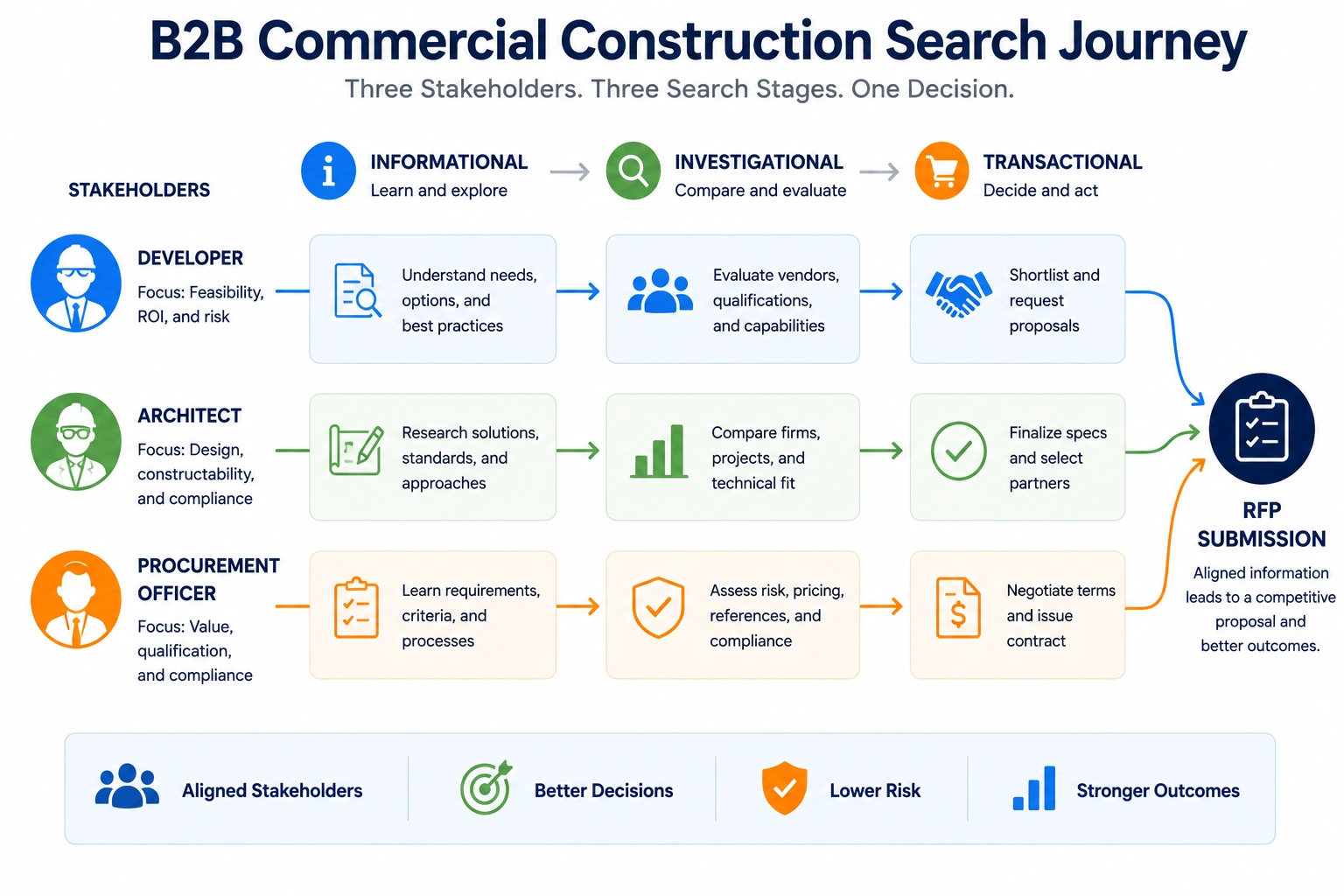
A simplified diagram illustrating how developers, architects, and procurement teams move from research to RFP submission.
Keyword strategy for high-value commercial projects
The instinct to target high-volume terms like “general contractor” or “commercial construction company” is understandable, but it misreads how commercial buyers search in practice. A developer sourcing a contractor for a cold storage distribution center is not typing “general contractor.” That is too broad. They are typing “cold storage warehouse construction contractors in Texas,” which is a highly specific query with a fraction of the monthly search volume of a generic term but carries an exponentially higher conversion value for your pipeline. The strategic shift is from chasing traffic to owning the specific vocabulary of your highest-margin project types. Here is exactly how to do it, step by step:
- Target Specialized Capabilities: Focus on niche keywords like “cleanroom construction contractors” or “cold storage warehouse builders” rather than broad terms like “general contractor.” These terms have lower competition and higher commercial intent, a combination that produces faster rankings and better-qualified leads.
- Incorporate Risk-Mitigation Terms: Optimize for terms that signal safety and compliance, such as “OSHA-compliant industrial builders” or “bonded commercial general contractors.” This speaks directly to the risk calculus of procurement officers and developers who must justify their vendor selection internally.
- Leverage Localized Commercial Intent: Map keywords to specific regional markets where your firm has active bonding capacity and mobilization power. “Commercial design-build contractors in Nashville” is a far more valuable target than any national generic term.
- Integrate Educational Content: Use informational keywords to capture early-stage planning, positioning your firm’s expertise before the bidding phase begins. This aligns with broader construction company SEO services to build long-term search authority and capture prospects before they draft their formal RFPs.
Optimizing service pages and site architecture
One of the most consistent structural problems we see on commercial contractor websites is the single “Services” page: a page that lists fifteen capabilities in bullet form and ranks for none of them. Search engines cannot establish topical authority from a list. They need more. They need depth, specificity, and a dedicated URL structure to understand what your firm truly does and where it belongs in the competitive landscape.
- Build Dedicated Service Pages: Create individual, high-depth pages (600 to 1,000 words) for every commercial specialty, such as medical facilities, retail build-outs, and industrial warehousing. These pages are not marketing copy: they are technical signals to search engines and trust-building resources for procurement officers doing due diligence.
- Develop Niche Subcategory Pages: For highly specialized sectors, build detailed pages such as high-rise construction digital marketing assets to capture enterprise-level search queries.
- Implement Clean Internal Linking: Connect your service pages to relevant project case studies to guide search engines and human users through a logical “Learn-to-Buy” pathway. This helps turn the people who already find you into the people who ultimately contact you.
- Use Structured Schema Markup: Implement
LocalBusinessandProjectschema to provide search engines with clean, machine-readable data about your services and locations. This is particularly important for AI-driven search engines, which rely on structured data to surface accurate, citation-worthy information in generated responses.
Local SEO and regional visibility for commercial GCs
Local search in commercial construction is not about driving foot traffic to an office. It is about trust. It is about proving to a developer in another city that your firm has the regional infrastructure, bonding capacity, and project history to execute complex builds in their target market without delays. That distinction matters because it changes how you approach every element of your local SEO strategy.
Optimizing your Google Business Profile is the single most critical local ranking factor. Ensure the primary category is set accurately, such as “Commercial Construction Company” or “General Contractor,” and your service area reflects the actual geography where your firm can mobilize. Beyond the profile, building a tiered ecosystem of industry-specific citations reinforces your legitimacy across the platforms that commercial buyers and search engines regularly consult. The Blue Book, ConstructConnect, and Dodge Data & Analytics are the industry infrastructure that signals to Google you are an active, credible operator in your market. Think of directory citation consistency like making sure your business shows up correctly everywhere people search: Google, Apple, Yelp, and dozens of other places people look. If your address or name is listed differently on one site than another, search engines get confused and lose trust.
Review volume and sentiment carry significant weight in local search algorithms. A firm with forty detailed reviews from past clients, developers, and subcontractors will consistently outrank a competitor with five. Gathering high-quality, authentic reviews from past commercial clients, developers, and subcontractors builds a credibility profile that procurement officers find reassuring during their vetting process. To see how local SEO integrates into a broader, cohesive marketing strategy, check out our guide on 10 ideas for marketing a construction company. Local visibility is the foundation that makes every other channel more effective, and it translates directly into being shortlisted for regional RFPs where proximity is a weighted criterion.
“In our experience working with regional builders, a flawless local search presence is the ultimate trust signal. When a developer searches for a general contractor in their target market, a highly optimized Google Business Profile backed by real client reviews immediately places you ahead of the competition.”
Excerpt from the Holloway Construction case study, demonstrating a 380% increase in organic traffic and a substantial rise in qualified RFQ submissions.
Technical performance and Core Web Vitals
Commercial contractor websites carry a structural disadvantage that most marketing guides gloss over: they are inherently image-heavy. Images slow things down. Extensive project galleries, high-resolution renderings, and before-and-after documentation are essential for demonstrating capability, but they are also the primary driver of slow load times, and slow load times are a direct ranking penalty.
The numbers here are clear: 53% of mobile visitors will abandon a website if it takes longer than three seconds to load. The AltCMO 2025 Construction SEO Report revealed that while top contractors average a desktop page speed score of 75, their mobile scores lag at a median of 56. Given that a significant portion of early-stage research now happens on mobile devices, even during site visits and project meetings, that gap represents a measurable loss of qualified traffic.
Think of your website’s load speed like the mobilization phase of a project: if you are slow to show up on day one, the client loses confidence immediately. To fix this, optimize your Largest Contentful Paint by compressing high-resolution project photos, implementing lazy-loading, and utilizing modern image formats like WebP. These are structural interventions that directly affect where your pages appear in search results and how long qualified visitors stay on them.
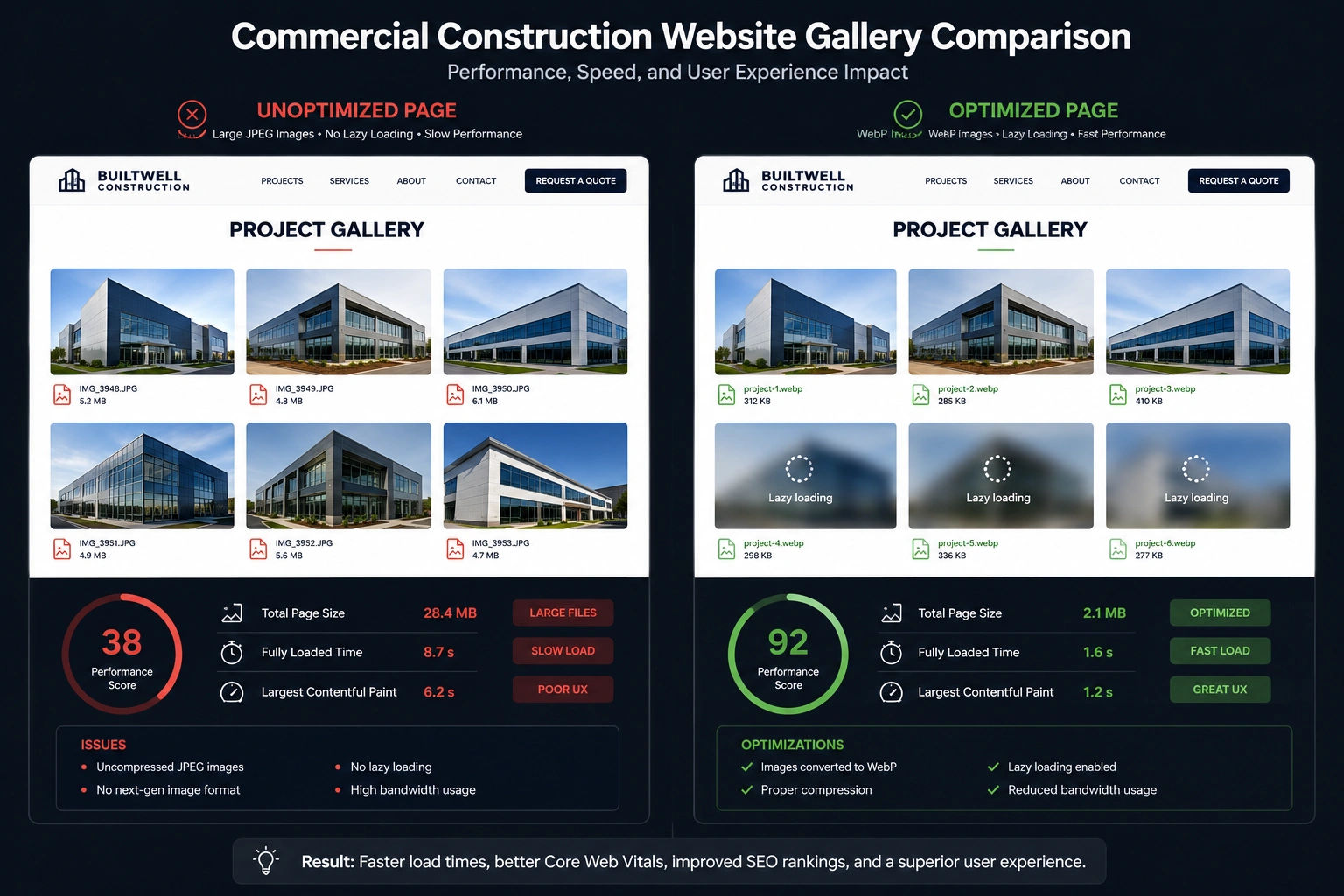
Side-by-side comparison showing how WebP images and lazy loading improve website performance for construction companies.
Schedule a free 20-minute Technical SEO Audit with our team. We will analyze your page speed, mobile performance, and keyword rankings to show you exactly where you are losing ground.
Schedule Your Free Audit
Authority building and niche link acquisition
Domain authority in commercial construction SEO is not built by accumulating generic backlinks. Quality matters more. It is built by earning citations from the specific organizations, publications, and industry bodies that your buyers already trust. A link from the Associated General Contractors of America carries a fundamentally different signal than a link from a generic business directory, both to search engines and to the procurement officers who recognize those affiliations during their vetting process. Here is what we have seen work for businesses like yours:
- Target Industry Associations: Secure backlinks from major industry bodies like the Associated General Contractors of America (AGC) or the Associated Builders and Contractors (ABC). This builds domain authority with search engines and provides visible credentialing that buyers recognize as a pre-qualification signal.
- Use material supplier directories: Partner with major material manufacturers (such as James Hardie or Boral) to get listed in their “certified installer” or “preferred partner” directories. This earns a relevant, editorially controlled backlink while positioning your firm in front of developers who use supplier networks to identify qualified contractors.
- Co-Author Case Studies: Collaborate with your subcontractors and architects to publish co-branded case studies, earning natural links from their websites. This creates the kind of multi-perspective, first-hand documentation that AI search engines prioritize when constructing authoritative summaries.
- Pursue Digital PR: Secure high-authority earned media mentions in trade publications like Engineering News-Record (ENR) or Building Design+Construction. These citations are highly prioritized by search algorithms and AI models: a feature in ENR continues to generate authority signals and referral traffic for years after publication.
Preparing for AI search and answer engine optimization
The search landscape is shifting in a way that will disproportionately affect commercial contractors who rely on traditional SEO alone. Google’s AI Overviews, Perplexity, and ChatGPT are increasingly answering B2B research queries directly on the results page, synthesizing web data to answer user queries directly. For commercial contractors, this creates both a risk and an opening. You must adapt.
The risk is straightforward: if your content is not structured in a way that AI models can parse and cite, your firm will be absent from the generated summaries that developers and procurement officers increasingly use as their first research layer. The opening is less obvious but more significant. AI models prioritize first-hand research, verified project timelines, and structured FAQ schema. To capture this “Share of Synthesis,” contractors must publish highly structured, factual, and authoritative data. Contractors who publish authoritative case studies with specific project timelines, documented cost benchmarks, and structured FAQ schema are far more likely to be cited as trusted sources within AI-generated responses, a position that carries more credibility than a traditional organic ranking because it is presented as a synthesized expert consensus.
Frequently asked questions about commercial construction SEO
These answers are based on industry benchmarks and what we have seen work for commercial builders across the country.
How long does it take to see results from commercial construction SEO?
For a new or unoptimized website, significant organic ranking improvements typically occur within three to four months, with consistent lead generation and RFQ submissions occurring between months five and eight. Approximately 74% of commercial construction firms see measurable ranking improvements within that initial three-to-four-month window. Results vary, but most clients see improvement in 3 to 6 months. SEO takes time. A sustained strategy builds a compounding asset that continues delivering qualified leads long after the initial investment, which is a fundamentally different return profile than paid search, where the pipeline stops the moment the budget does.
What is the average cost per square foot for commercial construction?
In the United States, the average commercial construction cost per square foot ranges from $240 to $870 per square foot, depending on the building type, location, and project complexity. Basic warehouses start on the lower end, while specialized facilities like data centers or healthcare buildings exceed the higher end of the spectrum. Costs vary widely. Providing these clear, authoritative benchmarks on your website is an excellent way to capture early-stage informational search queries from developers who are actively budgeting their next major projects.
How do B2B buyers choose a commercial general contractor?
Buyers evaluate contractors based on past project portfolios, financial bonding capacity, and safety records, specifically looking for an OSHA Experience Modification Rate (EMR) below 1.0 as a baseline pre-qualification criterion. They also prioritize firms with demonstrated experience in local zoning laws and building codes. Compliance is non-negotiable. Optimizing your website to display these credentials clearly, rather than burying them in a PDF prequalification packet, is vital for converting organic search traffic into qualified leads.
How does the design-build method compare to design-bid-build?
The design-build method integrates design and construction under a single contract, which reduces project delivery speed by 33% compared to traditional design-bid-build methods and significantly streamlines communication between stakeholders. This single-source responsibility minimizes administrative overhead and limits costly change orders. Efficiency wins contracts. Creating dedicated educational content around these delivery methods helps your firm rank for high-intent queries used by developers during early-stage project planning.
What is the average ROI of SEO for commercial construction companies?
Industry benchmarks show that commercial contractors achieve an average SEO ROI of 380%, while the broader construction sector averages a 681% return. This high return is driven by the massive contract values typical of commercial projects, where winning a single additional contract through organic search can cover years of digital marketing spend. When looking at specialized construction SEO services, the compounding value becomes clear. The organic cost-per-lead benchmark of $35, compared to $109 to $135 for paid search, reinforces why sustained SEO investment produces compounding returns that paid channels structurally cannot replicate.
Your website is a job site. It needs a solid foundation: technically sound architecture, clean schema, and fast load times. It needs quality materials: authoritative content, verified credentials, and documented project history. And it needs continuous maintenance, because search algorithms evolve, competitors invest, and the buyers you are trying to reach are constantly refining how they research and vet contractors online. There is no version of this where you build it once and walk away.
Small businesses are the backbone of innovation and the heartbeat of America. We are a small business ourselves, and we know that every contract you win represents jobs created, regional growth, and real progress. We are proud of the positive impacts we make by helping firms like yours grow, driving our nation forward one project at a time. We take an evidence-based approach to digital growth: no marketing fluff, just clear metrics and steady progress. We are here to stand beside you as equals, helping you build a digital pipeline that matches the strength of your physical builds.
Ready to grow your local commercial business?
Let’s build your search authority together. Contact BizIQ today to request a custom SEO forecasting and pipeline report tailored to your firm’s regional footprint and specialized capabilities.