Written by the BizIQ Editorial Team, dedicated to helping small and local businesses navigate the evolving digital marketing landscape with practical, no-hype strategies.
Key Takeaways
- Traditional SEO Foundations: Maintain your core organic rankings and capture high-intent buyers who still click through from Google Search results.
- AI-Readiness Optimization: Secure citations in ChatGPT, Perplexity, and Google AI Overviews by structuring your content as a machine-readable answer source.
- Structured Data Mastery: Feed the Google Shopping Graph with precise, granular product attributes that AI crawlers can extract and synthesize into direct recommendations.
- Local Signal Amplification: Use verified reviews and consistent local listings to dominate near-me conversational queries before a competitor does.
What is the Dual Playbook for Modern Retail Search Visibility?
The dual playbook for modern retail search visibility is to optimize your retail website for both traditional search engines and AI-powered search experiences. While Google and Bing still drive significant organic traffic through rankings, consumers are increasingly discovering products through AI assistants and AI-generated search results that prioritize authoritative, well-structured, and trustworthy content.
With AI Overviews and ChatGPT search reshaping how people find businesses, you need two things working together: a strong traditional SEO foundation and a new layer of AI-readiness. Here’s what that means for your store.
Winning the retail search game in 2026 does not require abandoning traditional SEO. Still, it does demand that you adapt your existing website content to satisfy both Google’s classic indexing algorithms and the synthesis engines powering modern AI search.
Small retail owners face a genuinely unclear landscape right now. Traditional search engine optimization and generative AI search do not operate in separate lanes; they overlap, feed each other, and occasionally contradict each other’s priorities. Yes, AI Overviews are changing how people find businesses. No, you don’t need to start from scratch. The basics still matter. Some industry voices claim that traditional SEO is obsolete, but the data does not support that conclusion. Organic search still drives the bulk of transactional traffic volume, while AI search engines like ChatGPT, Perplexity, and Google’s AI Mode are rapidly absorbing the highly qualified, conversational end of the query spectrum. The stores that stay visible in search in 2026 are the ones that learn to speak the language of both human shoppers and machine synthesizers. Those are, it turns out, more similar than they first appear.
The Behavioral Shift from Keywords to Conversational Entities
The way consumers locate products has shifted in a way that goes deeper than phrasing. A modern shopper no longer types “running shoes men” into a search bar. They ask ChatGPT, “What are the best men’s running shoes under $100 for marathon training on pavement?” That is not a stylistic change; it is a structural one. Search engines are no longer matching keywords against indexed pages; they are analyzing semantic entities and layered user intent to synthesize a single, direct recommendation. The query carries a budget, a use case, a surface type, and an implicit expectation of authority. Matching it requires more than keyword density.
To capture these conversational queries, your product pages must evolve from keyword-anchored landing pages into detailed answer repositories. This means writing in descriptive, natural language that addresses specific use cases, budget constraints, and practical pain points. A local boutique selling travel gear, for instance, gains far more traction optimizing for “lightweight overhead-compliant carry-on bags for international budget flights” than for the generic term “suitcases.” The specificity is not just good copywriting; it is the signal that tells an AI model your page is the right answer to a precise question. For a deeper look at how this content evolution plays out technically, BizIQ’s guide to content optimization for AI in 2026 walks through the structural changes worth prioritizing.
Entity-based SEO represents the underlying fundamental change here. Search engines and LLMs no longer treat your retail store as a collection of indexed URLs. They treat it as a verified real-world entity: a business with a physical address, a product category, a reputation, and a community of customers who have publicly weighed in on its quality. Entity optimization is like building your reputation in the community. Reputation matters. It is not about one conversation; it is about what everyone knows about you over time. Google’s Knowledge Graph synthesizes data from your website, your Google Business Profile, and third-party review platforms to determine whether your business is a trustworthy, capable answer to a user’s intent. That synthesis process is what entity-based optimization targets. Understanding how SEO and e-commerce work together to drive sales gives useful context for retailers building this foundation from scratch.
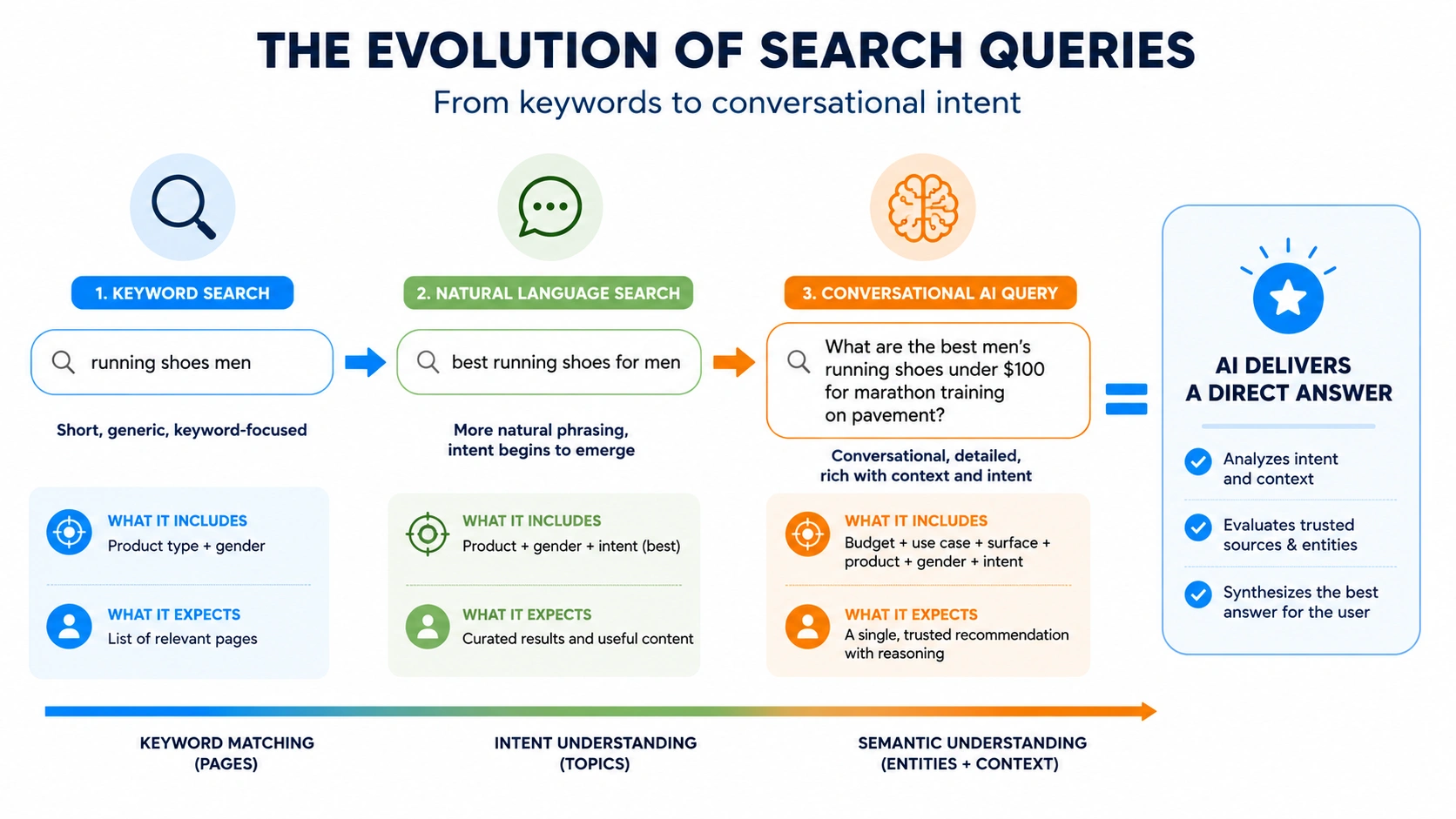
Search has evolved from simple keywords to conversational AI prompts that combine intent, context, budget, and use case.
The reality of zero-click search and the value of AI referrals
Traffic volume and traffic quality are moving in opposite directions, and that tension is the central commercial challenge of 2026 retail search. The landscape has split.
AI Overviews are like having a knowledgeable employee answer questions for walk-ins. Your job is to make sure that employee has the right information so they represent your store accurately.
Similarweb’s July 2025 study recorded a zero-click rate of 69% for news and informational queries, up from 56% in May 2024. That 13-point jump tracks almost exactly with the global rollout of Google AI Overviews. When an AI Overview is present on the search engine results page, the zero-click rate climbs further to 83%: meaning more than eight out of ten users get a sufficient answer without ever visiting a retailer’s website. For stores that built their traffic model entirely on organic click-throughs, that number warrants serious attention.
The counterweight to that concern is conversion quality. Quality beats volume. SEMrush’s June 2025 AI SEO study found that visitors arriving from AI search platforms convert at 4.4 times the rate of traditional organic search traffic. ChatGPT-referred visitors, specifically, achieve conversion rates as high as 15.9%, compared to 1.76% for standard Google organic traffic. The mechanism is straightforward: a user who asked a conversational AI to recommend a product, received a curated shortlist, and then clicked through to your store has already completed their research phase. They arrive pre-qualified, with a narrowed consideration set and a clear purchase intent. The full Semrush AI SEO study breaks down the conversion data by channel. For retailers focused on capturing these high-value referrals, BizIQ’s guide to optimizing for Google AI Overviews covers the practical steps.
Key Search Statistics for 2026
- Recent search data shows that 68% of all Google searches now end without a single click, as AI Overviews answer queries directly on the search engine results page: a structural shift that makes on-SERP visibility as important as ranking position.
- On mobile devices, the zero-click rate climbs to 77.2%, which has direct implications for local retailers whose customers are searching while in transit or near the store.
- Despite lower raw traffic volumes, referrals from AI search engines like ChatGPT convert 31% higher than traditional non-branded organic search, reflecting the pre-qualification that happens inside the AI interface.
- Visitors arriving via AI search generate up to 254% more revenue per visit because they have already narrowed their options before clicking: they are not browsing, they are buying.
Feeding the Google Shopping Graph with Structured Data
Google’s Shopping Graph is a database containing over 50 billion product listings that refreshes at a rate of 2 billion updates per hour. Data drives these systems. That scale is not accidental; it is the infrastructure that powers AI-organized shopping results, visual product carousels, and conversational product recommendations across Google’s ecosystem. If your store’s inventory is not connected to this graph through Google Merchant Center, your products are functionally invisible to AI-driven discovery, regardless of how well your website ranks in traditional search.
Structured data provides a clear, organized format that helps search engines identify your store’s information. Connecting to Merchant Center is the entry requirement. It is non-negotiable. What determines your position within AI recommendations is the quality and completeness of your structured data. Schema.org markup, implemented via JSON-LD (the format Google explicitly recommends), acts as a direct briefing document for AI crawlers. Rather than inferring your product’s attributes from unstructured page text, a crawler reading clean JSON-LD schema can extract your price, availability, GTIN, material, color, and customer rating as verified, machine-readable facts. The difference between a page with schema and one without it is the difference between a well-labeled warehouse shelf and a pile of unlabeled boxes. For a broader framework on building this technical foundation, BizIQ’s proven e-commerce SEO strategies cover the structural priorities worth addressing first.
Technical Requirements for Shopping Graph Visibility
- Google’s AI-organized shopping results draw directly from the Shopping Graph: a live database of over 50 billion product listings updating 2 billion times per hour. Your Merchant Center feed is the pipeline into that graph.
- Implement complete schema.org markup for products, reviews, price, and real-time availability. JSON-LD is the preferred implementation format and the one Google’s documentation consistently references.
- Connecting your store’s inventory to Google Merchant Center is no longer a supplementary tactic; it is the primary data conduit that Google’s AI Mode uses to build visual product carousels and conversational recommendations.
- AI models require granular specificity. Providing at least 30 structured attributes, including GTIN, MPN, material, and color, is the threshold for eligibility in conversational product recommendations. Thin data feeds get thin results.
Get a detailed analysis of your current search footprint and technical foundations.
Optimizing Product Pages for Machine Reading and Human Trust
AI assistants do not crawl the web the way traditional search bots do. They read and process content much closer to the way a knowledgeable human researcher would, and that changes what good product copy looks like. Vague marketing language does not give an LLM anything to work with. Be precise. “Made from high-quality fast-drying fabric” is an assertion without a subject. “Dries in under 30 minutes in 70% humidity” is a falsifiable claim with a specific condition and a measurable outcome. That level of precision is what an LLM needs to justify recommending your product over a competitor’s: it becomes the data point the model cites. For retailers building this kind of copy at scale, BizIQ’s guide to optimizing for ChatGPT search addresses the specific content structures that perform best in conversational AI environments.
AI models also place considerable weight on the public record of your brand’s quality: not just what your website says, but what the broader web says about you. They actively scan third-party platforms, customer reviews, and forum discussions to gauge consensus sentiment. When your on-page product details align with the positive discussions happening on external sites, the model’s confidence in citing your brand increases. That alignment is what builds citation share: the proportion of relevant AI-generated answers in which your brand appears as a recommended source. It is not purely a technical metric; it is a reputation metric that happens to be measured by machines. Trust is measurable. Forbes’ analysis of AI search and content strategy in 2026 covers this brand-trust dynamic in useful depth.
“In the AI search era, your product pages are no longer just landing pages for human visitors: they are direct pitches to machine learning models that require structured, verifiable data to recommend your brand.”
Winning the unstructured data war on third-party platforms
On-site optimization is necessary. It is not sufficient.
AI engines like Perplexity and ChatGPT synthesize answers from a wide array of unstructured sources (Reddit threads, specialized forums, independent review blogs, and editorial roundups) alongside your structured website data. A retailer with flawless schema markup but a sparse or negative off-site presence will still lose citation share to a competitor whose customers are actively discussing their products in the places AI models treat as social proof. Retailers need to actively monitor and develop their presence across these unstructured channels: encouraging genuine customer discussions, earning placements in expert roundups, and responding to community conversations in ways that reinforce brand credibility. Retrieval-augmented generation (RAG), the mechanism by which LLMs pull real-time web data to supplement their training, means that what gets written about your brand on external platforms today can directly influence whether an AI recommends you tomorrow. BizIQ’s retail digital marketing solutions connect these off-site strategies to a coherent brand-building framework.
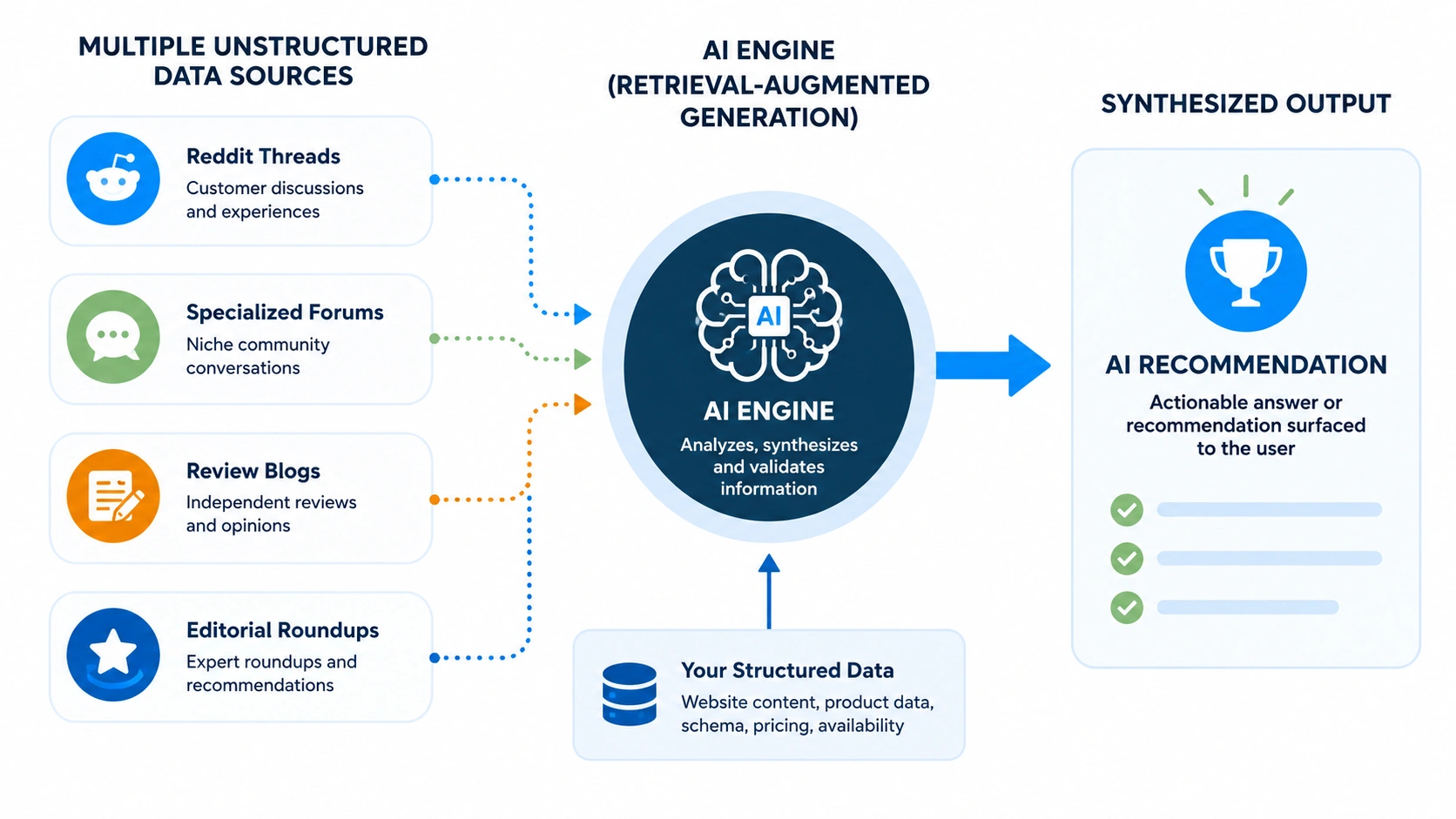
AI engines combine structured website data with discussions, reviews, forums, and editorials to generate trusted recommendations.
Navigating the transition to AI search can be demanding for busy retail owners.
Let our team of digital marketing experts build a customized strategy that drives real-time traffic and sales.
The local SEO playbook for conversational near-me queries
Conversational queries carry local intent more often than most retailers realize. Accuracy is vital. A user asking “where can I buy organic dog food near me open now” is not browsing; they are moments away from a purchase decision. AI models answering that query cross-reference your Google Business Profile, Apple Business Connect listing, and Bing Places entry to verify that your business is a real, operating physical entity before recommending it. Character-for-character NAP consistency across those platforms is not a nice-to-have; it is the verification threshold. A mismatched suite number or an outdated phone number introduces ambiguity that AI models resolve by recommending someone else. Research on entity linking and local search success from Search Engine Journal documents how this verification process plays out in practice. For a detailed breakdown of how AI handles local business data specifically, BizIQ’s Google Business Profile AI Overview guide is worth reading alongside this section.
Review signals feed directly into AI local recommendations. Displaying customer reviews with review schema integration allows AI models to extract structured sentiment and star ratings rather than parsing unstructured review text: a meaningful difference in how confidently a model can cite your store’s quality. Building local voice search relevance goes further: mentioning nearby landmarks, neighborhood names, and community partnerships in your site’s content gives AI models the geographic context they need to surface your store for hyper-local queries. Retail chains managing multiple locations face a multiplied version of this challenge, and BizIQ’s multilocation SEO strategies address the specific consistency and entity-linking requirements that multi-store operators need to get right.
Local SEO Steps for 2026 Conversational Queries
- Conversational queries frequently carry local intent: “where can I buy organic dog food near me open now” is a purchase-ready query, not a research one. Your local presence needs to be accurate enough to satisfy an AI model’s verification check.
- Ensure your operating hours, address, phone number, and in-store inventory are completely accurate and updated daily in your Google Business Profile. Stale data is a disqualifier.
- Display real customer reviews using review schema integration so AI models can extract structured sentiment and star ratings rather than inferring them from unformatted text.
- Build local voice search relevance by weaving nearby landmarks, neighborhood references, and community partnerships into your site’s content: these geographic signals help AI models match your store to hyper-local conversational queries.
Building topical authority through linked content clusters
Large Language Models favor websites that demonstrate deep, linked knowledge on a specific subject: not breadth across unrelated topics, but genuine depth within a defined domain. Rather than publishing isolated blog posts that each stand alone, retailers who build topic clusters give AI crawlers a coherent map of their expertise. Depth wins. The structure is straightforward: a deep pillar page anchors the cluster, and multiple supporting articles link back to it while addressing adjacent questions in detail. An outdoor retailer, for example, might build a pillar guide on “The Ultimate Guide to Winter Hiking” and connect it to supporting posts on “How to Choose Waterproof Boots” and “Best Layering Systems for Sub-Zero Temperatures.” Each supporting article reinforces the pillar’s authority, and the internal linking structure signals to AI crawlers that the site has established genuine topical authority: not just a passing familiarity with the subject.
This architecture also serves the semantics of how AI models index knowledge. A model trained on or retrieving from a well-clustered site can trace the logical relationships between concepts, which increases the probability that your content surfaces when a user’s query touches any node in that cluster. It is not a shortcut; building a credible topic cluster takes time and editorial discipline. But it works. For retailers competing in categories where AI recommendations are increasingly the first touchpoint, topical authority is one of the few durable competitive advantages available.
Frequently asked questions about retail SEO and AI search
Securing your store’s digital footprint requires understanding how traditional and AI search technologies interact. This knowledge is essential.
Common retail SEO and AI search queries answered
What is the difference between traditional SEO and Answer Engine Optimization (AEO)?
Traditional SEO focuses on ranking your website’s pages in search engine results for specific keywords to drive clicks. Answer Engine Optimization (AEO) focuses on structuring and optimizing your content so that AI assistants and synthesis engines, like ChatGPT, Perplexity, and Google AI Overviews, can easily extract, summarize, and cite your brand as the direct answer to conversational queries. The two approaches are not in competition; AEO is built on top of a functioning SEO foundation, not as a replacement for it.
How do I get my retail products recommended by ChatGPT Shopping?
To appear in ChatGPT Shopping recommendations, submit a clean, structured product feed to Bing Webmaster Tools and implement complete Product schema on your website. ChatGPT relies heavily on Bing’s index and structured data to extract real-time pricing, availability, and product specifications. Incomplete feeds or missing schema attributes are the most common reasons retailers are excluded from these recommendations.
Does traditional local SEO still work in 2026?
Yes, and more precisely, it is the requirement for AI search visibility. AI models cross-reference your Google Business Profile and local directory listings to verify that your business is a real, physical entity before recommending it. Without that verified foundation, AI search engines will not surface your store in response to local queries, regardless of how well-optimized your website content is.
What is the most important schema markup for a small retailer?
The two most critical schema types are LocalBusiness, which defines your physical location, operating hours, and contact details, and Product, which feeds real-time price, availability, and review sentiment directly to AI crawlers. Both use the Schema.org vocabulary and are best implemented in JSON-LD format. These two schemas alone give search engines and AI models the structured facts they need to verify and recommend your store with confidence.
How often should I update my retail website’s content to maintain AI visibility?
AI search engines weigh recency and data accuracy heavily. Auditing and refreshing your high-performing product pages, FAQs, and blog content every 3 to 6 months is a reasonable baseline, but any time pricing, specifications, or inventory levels change significantly, those updates should happen immediately. Schema markup errors introduced during site updates are a common and underdiagnosed cause of sudden drops in AI citation share.
The retail search landscape of 2026 asks something specific of store owners: not a wholesale reinvention of your digital strategy, but a disciplined layering of machine-readable structure over your existing foundation. Optimizing your product data for the Google Shopping Graph, building topical authority through interconnected content, and maintaining a flawless, verified local presence are not separate projects; they are mutually reinforcing. There is no magic solution or effortless path through this transition, and anyone who tells you otherwise is selling a shortcut that does not exist. What does exist is a clear set of priorities, and you can do this yourself, or we can help. Start today.
Here is your next step: start with your Google Business Profile. Claim it if you haven’t, verify every single field, and add new photos this week. That is your foundation. Once that is solid, you can take a few practical steps to build out your product schema and structured data feeds. Work through it methodically, and you will hold a compounding advantage over those who wait.
Contact our team today to discuss how we can help you optimize your digital footprint for maximum visibility and conversions.