
Key Takeaways:
- Basic / Template Sites: $1,500 to $3,000: Best for solo owner-operators establishing an initial online presence and claiming their Google Business Profile.
- Custom / Growth Sites: $4,000 to $8,000: Best for growing residential and commercial teams that need to dominate local search and convert high-ticket service inquiries.
- Enterprise / Multi-Location Sites: $10,000 to $20,000+: Best for large regional contractors managing complex booking integrations with platforms like ServiceTitan.
- Monthly Marketing Retainers: $1,500 to $4,500/month: Covers blended local SEO, Google Ads management, and LSA campaigns for established contractors in active growth mode.
The cost of electrician website marketing depends on your goals, competition, and service area, but successful marketing is an ongoing investment rather than a one-time expense. A comprehensive strategy that includes SEO, local SEO, website optimization, content creation, reputation management, and AI search optimization typically delivers the best long-term return by generating consistent, high-quality leads.
Word-of-mouth fills a schedule. It rarely scales one. When a homeowner’s breaker panel starts throwing sparks at 9 p.m., or a commercial facility manager needs a 400-amp service upgrade by the end of the quarter, their first move is a Google search: not a call to the neighbor who recommended you two years ago. If your website is slow, invisible in the Local 3-Pack, or built on a $29/month template that hasn’t been touched since 2021, those jobs route directly to whoever shows up first.
That’s where the budget ambiguity starts. Quotes for electrician website marketing range from $500 a month to $10,000, and most contractors can’t tell whether the difference is legitimate scope or pure margin inflation. You might find yourself asking: is this worth it for a small business like mine? Or worse, am I getting ripped off?
It isn’t always clear-cut: some of that variance is market-driven, some is service depth, and some is agencies charging premium rates for commodity work. To make smart decisions, you need to know what marketing truly costs and how do I know if it’s working.
A professional electrician website marketing cost in 2026 runs between $1,500 and $4,500 per month for most established contractors, with upfront website development requiring a separate investment of $3,000 to $8,000. Those ranges aren’t arbitrary: they reflect the real labor, tooling, and ad spend required to generate consistent, high-intent leads in competitive local markets.
To anchor your spend to something more precise than a vendor’s quote, start with the U.S. Small Business Administration benchmark: entrenched businesses should allocate 7% to 8% of gross revenue to marketing. For contractors in active growth mode or competing in dense metropolitan markets, home service specialists push that figure to 10% to 15%, because holding market share against well-funded competitors requires more than a maintenance-level budget. If you’re running $800,000 in annual revenue and spending $3,000 a year on marketing, you’re not competing; you’re hoping.
Breaking down the core components of electrician website marketing
The core channels of digital marketing for electrical businesses
Electrician website marketing functions as an orchestrated system, not a menu of optional add-ons. At its core, it integrates custom website design, local search engine optimization (SEO), pay-per-click (PPC) advertising, and Google Local Services Ads (LSAs): each channel serving a distinct role in the lead acquisition pipeline.
Local SEO is the long-game channel. It optimizes your website architecture, Google Business Profile, and local citation footprint to rank inside the Google Maps “Local 3-Pack” for searches like “panel upgrade [city]” or “emergency electrician near me.” Those positions generate clicks at zero marginal cost once earned, which is precisely why they’re contested. Paid search fills the gap while organic authority builds: Google Ads and LSAs put your business at the top of the search engine results page (SERP) immediately, with costs structured either per click or per qualified lead.
Treating these as interchangeable or sequential is a common and expensive miscalculation. It wastes your budget. The contractors who consistently secure high-ticket jobs, such as panel upgrades, EV charger installations, and commercial service contracts, run digital marketing for electrical businesses as a unified system where each channel reinforces the others, not as isolated experiments they rotate through when one stops working.
Why a multi-channel approach outperforms single-channel strategies
The PPC-vs.-SEO discourse is mostly a false choice. Agencies that push you toward one at the expense of the other are usually optimizing for their own billing structure, not your lead economics.
Sole reliance on paid ads is financially unsustainable at scale. The average Google Ads cost per click (CPC) for electrician keywords sits at $12.18 (Amra & Elma, 2026), and that figure climbs sharply in major metro markets where five or six well-funded competitors are bidding on the same terms. At $12.18 per click and a 7.5% conversion rate, you’re paying roughly $162 per lead before accounting for agency management fees. In plain terms, that is what you spend to land each new customer who calls. It gets uncomfortable fast when the leads skew toward small repair calls. Margin disappears quickly.
Organic local SEO builds compounding equity. Every service area page you rank, every citation you clean up, every Google Business Profile post you publish: these compound into a digital asset that generates exclusive leads at no incremental cost per click. The tradeoff is time: meaningful organic traction typically takes three to six months to materialize. PPC and LSAs bridge that gap, delivering immediate cash flow while your organic rankings mature. Running both in parallel is not a luxury; it is the structure that makes the math work long-term.
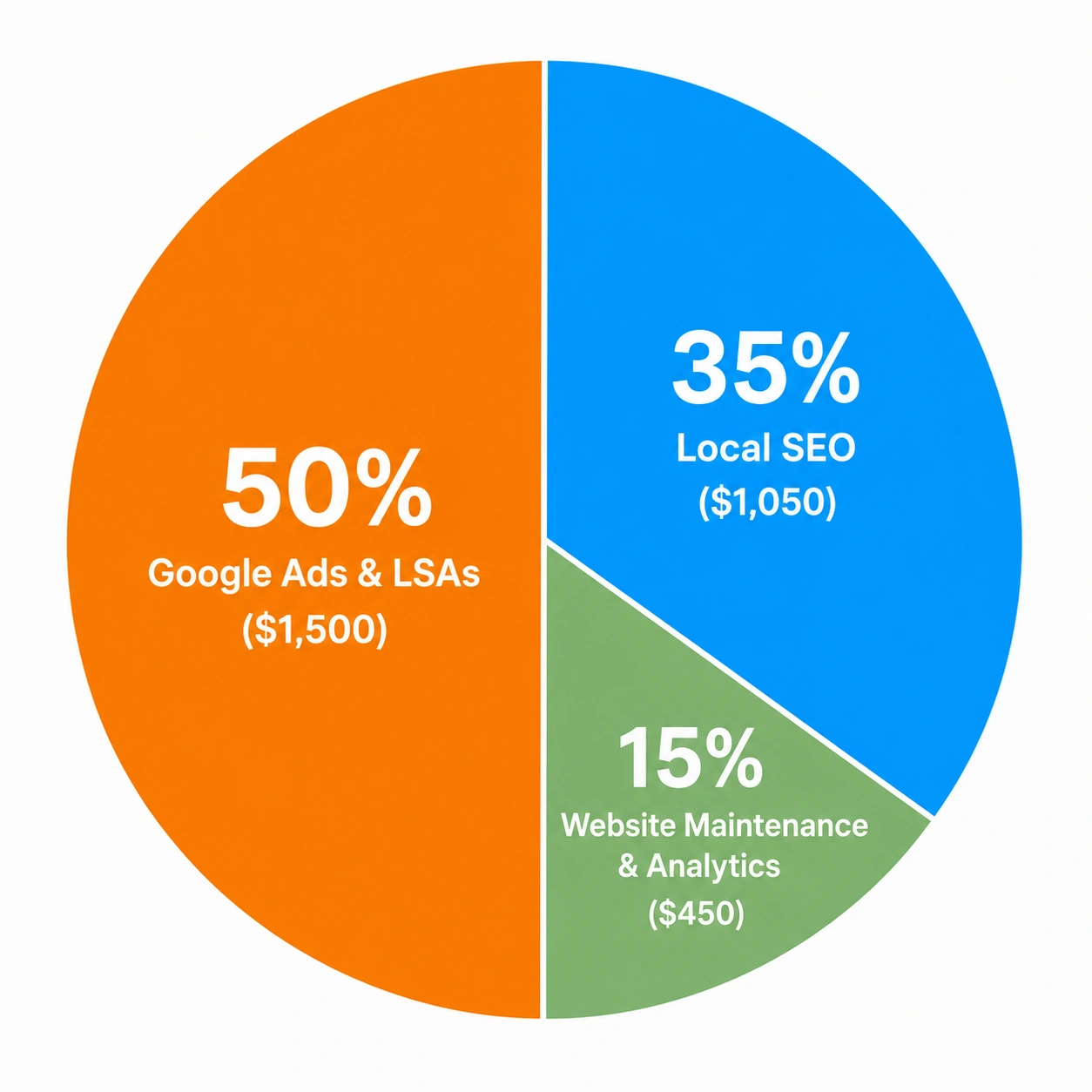
Recommended monthly electrician marketing budget allocation across Local SEO, Google Ads & LSAs, and website maintenance.
The real cost of search engine optimization and local SEO
Local SEO pricing tiers and package breakdown
SEO pricing for electricians spans a wider range than most contractors expect, and the discrepancy is mostly explained by market competitiveness and deliverable depth rather than agency prestige. Understanding the cost of SEO services before you sign a retainer agreement is the difference between a well-scoped engagement and a recurring invoice for work you can’t measure.
If you are trying to figure out what’s the minimum I need to spend or how long until I see results, the answer depends on your market. Different investment levels yield distinct results for electrical contractors.
At the entry tier, basic local SEO maintenance runs $300 to $1,000 per month: fitting for solo operators in low-competition markets where the primary goal is keeping a Google Business Profile current and maintaining existing rankings. This level of spend won’t move the needle in a crowded suburban market; it is a holding pattern, not a growth engine. It keeps you invisible.
Active local SEO retainers, the tier most established contractors truly need, run $1,200 to $3,000 per month in competitive suburban and metropolitan markets. This is where real deliverables live: ongoing keyword research, custom service page creation targeting high-value terms, local link acquisition, schema markup implementation, and systematic review generation. This tier is about making sure someone searching “emergency electrician near me” truly finds you, rather than your competitor down the road. For regional electrical contractors managing multiple service areas or branch locations, enterprise-level SEO can exceed $3,000 to $5,000+ per month, covering multi-city targeting, technical audits, and localized content clusters for each physical location.
Key deliverables of local search engine optimization services
A professional local SEO retainer should produce palpable, auditable work each month, not vague optimization activities on a PDF report. At minimum, expect Google Business Profile management, structured citation building across relevant directories, and on-page technical SEO that keeps your site aligned with current ranking signals.
Content marketing for lead generation is where the compounding value builds. Dedicated service area pages targeting “EV charger installation [city]” or “smart home wiring [neighborhood]” capture high-intent searches that generic homepage copy never reaches. These pages take time to rank, but once they do, they generate exclusive inbound leads with no additional spend. They work for you 24/7. For contractors evaluating whether their current agency is delivering real value, these local SEO pricing tips provide a useful framework for auditing scope against cost.
Local SEO Pricing Tiers: What’s Really Included:
- Basic Maintenance ($300 to $1,000/mo): Google Business Profile optimization, basic citation cleanup, and quarterly performance reporting. Appropriate for solo operators in low-competition zip codes.
- Active Local SEO Retainer ($1,200 to $3,000/mo): Ongoing keyword research, custom service page creation, local link building, schema markup implementation, and monthly review generation strategies. The standard tier for established single-truck and multi-truck operators.
- Enterprise Multi-Location SEO ($3,000 to $5,000+/mo): Advanced multi-city targeting, custom API integrations, deep technical audits, and localized content clusters for multiple physical branch locations. Necessary for regional contractors competing across several metropolitan service areas.
Pay-per-click advertising and Google Ads budgets
Ad spend vs. agency management fees
Google Ads budgets carry two discrete cost lines that vendors don’t always separate clearly in their proposals: the direct ad spend paid to Google, and the management fee paid to your agency. Conflating them is how contractors end up thinking they’re running a $2,000/month campaign when $1,200 of that is going to Google and $800 is agency margin.
Management fee structures vary. Most agencies charge either a flat fee of $500 to $1,500 per month or a percentage of active ad spend, typically 15% to 20%. The percentage model aligns incentives when your spend is high; the flat-fee model is more foreseeable for operators running tighter budgets. A detailed breakdown of the tradeoffs between these structures is worth reviewing before committing. The PPC and SEO pricing models comparison covers the mechanics of each.
On the ad spend side, a minimum of $1,200 per month is the practical floor for gathering enough conversion data to optimize a campaign meaningfully. Below that threshold, you’re not running a campaign: you’re running a sample that’s too small to draw conclusions from. You are wasting money.
Average cost per lead benchmarks for electricians
The average Google Ads cost per lead (CPL) for electricians is $93.69 (Amra & Elma, 2026), with conversion rates averaging 7.5% to 9%. That CPL is justifiable when the jobs it generates are panel upgrades, whole-home rewires, or commercial service contracts; less so when the lead volume skews toward small diagnostic calls.
Google Local Services Ads operate on a different economic model. You pay only for leads. LSAs charge per qualified lead rather than per click, with average CPLs ranging from $39 to $85 (Watson & Co. Marketing, 2026) and lead-to-booking conversion rates of 30% to 60%, significantly higher than standard PPC because the “Google Guaranteed” badge pre-qualifies the homeowner’s trust before they ever call. The tradeoff is targeting specificity: LSAs don’t offer the keyword-level control that Google Ads provides, which matters when you’re specifically trying to capture high-ticket searches for generators or commercial panel upgrades rather than general service calls.
Paid Channel Cost Summary:
- Google Ads (PPC): Recommended ad budget of $1,200+/month; average CPC of $12.18; average CPL of $93.69 (Amra & Elma, 2026).
- Google Local Services Ads (LSAs): Pay-per-lead model; average CPL of $39 to $85 (Watson & Co. Marketing, 2026); lead-to-booking conversion rates of 30% to 60%.
- Agency Management Fees: Flat fee of $500 to $1,500/month or 15% to 20% of monthly ad spend, depending on contract structure.
Ready to stop funding campaigns that generate spam calls and out-of-area inquiries?
Book a free 30-minute marketing budget consultation with our team to build a channel-specific, high-ROI plan calibrated to your real service area and job mix.
Website design and online presence management costs
Upfront design costs vs. ongoing maintenance
A specialized, high-converting electrician website runs $3,000 to $8,000 upfront, and that range reflects real differences in scope, not arbitrary pricing tiers. The full cost of a website includes line items that template-focused vendors routinely omit from their initial quotes: domain registration ($15 to $50/year), premium hosting ($30 to $100/month), SSL certificates, and the perpetual maintenance layer that keeps the site functional after launch.
Just like rewiring a commercial building, building a high-performing website requires the right materials and expertise. Cheap shortcuts fail. DIY templates seem frugal upfront, but they lack the schema markup, page speed optimization, and custom FSM integrations needed to outrank established local competitors and convert traffic into booked jobs. Integrating Field Service Management software adds another cost variable: Housecall Pro offers transparent pricing ($59 to $199/month) with relatively simple booking widget implementation, while ServiceTitan requires custom enterprise quotes and custom API setup that typically adds $1,000 to $3,000 to the upfront development cost. That’s not a hidden fee: it’s the cost of connecting your marketing front-end to an enterprise dispatch system, and it is worth it if ServiceTitan is already running your operations.
Ongoing online presence management, such as plugin updates, daily backups, uptime monitoring, and form testing, runs $100 to $300 per month. Skipping this layer is a false economy; a broken contact form or a site that goes down during a storm-surge demand spike costs more in lost leads than a year of maintenance fees.
The cost of neglecting website performance
Disregarding your website’s performance is the fastest way to erode your advertising budget from the inside. A site that loads in more than three seconds loses over half its mobile visitors before they ever see your phone number, meaning you’re paying $12.18 per click for traffic that exits before converting.
Poorly optimized electrician websites convert 1% to 3% of visitors. That is a massive waste. At that rate, a $1,200/month ad budget generating 100 clicks produces two or three leads. This isn’t just tech speak: it’s about turning more of the people who find you into paying customers. Custom, technically optimized sites achieve conversion rates of 5% to 12% (Market Minds Global, 2026): the same $1,200 in ad spend now produces five to twelve leads, cutting your effective CPL by more than half without touching the bid strategy.
“A high-converting website converts 3% to 8% of visitors into leads, whereas a poorly designed site will waste your ad spend by failing to convert traffic. Without a functional, fast-loading site, your paid traffic has nowhere to land and convert.”
How to calculate your return on marketing investment
Step-by-step formula for ROI and cost per lead
Vanity metrics, like impressions, click-through rates, and raw phone call volume, tell you your ads are running. They don’t tell you whether your marketing is lucrative. Profit is the only metric. The math that matters operates at two levels: campaign-level cost efficiency and business-level return.
At the campaign level, your Cost Per Lead (CPL) is the foundation: total marketing spend divided by total qualified leads generated. Qualified is the operative word here; counting every 30-second phone call as a lead inflates your numbers and masks the real cost of acquiring a booked job. Agencies that report raw call volume without filtering for service area, job type, and minimum ticket size are giving you a number that feels good and measures nothing useful.
Return on investment follows the standard formula: ROI = (Net Profit from Marketing − Marketing Cost) / Marketing Cost. A $4,500/month spend that generates $18,000 in net profit from new customers produces a 300% ROI: a 3:1 return. That is the floor for a sustainable campaign, not a stretch target. Reviewing common patterns in how to avoid wasting money on digital marketing is a useful audit exercise before committing to a new agency or restructuring an existing retainer.
Customer lifetime value (LTV) vs. customer acquisition cost (CAC)
Customer Acquisition Cost (CAC) is total marketing spend divided by new customers acquired during the same period. If you spend $4,500 in a month and acquire 10 new customers, your CAC is $450. Is that good or bad? That number means nothing in solitude: it only becomes meaningful when measured against what those customers are truly worth.
For residential electricians, the average first-job ticket runs $350 to $600 (Built Right Digital, 2026). That is the surface-level figure. With an annual repeat engagement rate of 35% over a three-year customer lifetime, the true LTV of a residential electrical customer rises to $922.50: a materially different number that changes how aggressively you can justify acquiring new customers. At a $450 CAC against a $922.50 LTV, your ratio is approximately 2.05:1, which is below the industry benchmark and signals that either your acquisition cost is too high or your retention and upsell activity needs attention. Drop that CAC to $300 by generating 15 customers from the same $4,500 spend, and the ratio ascends to 3.1:1: the minimum threshold for a durably profitable growth model (Profitability Partners, 2026).
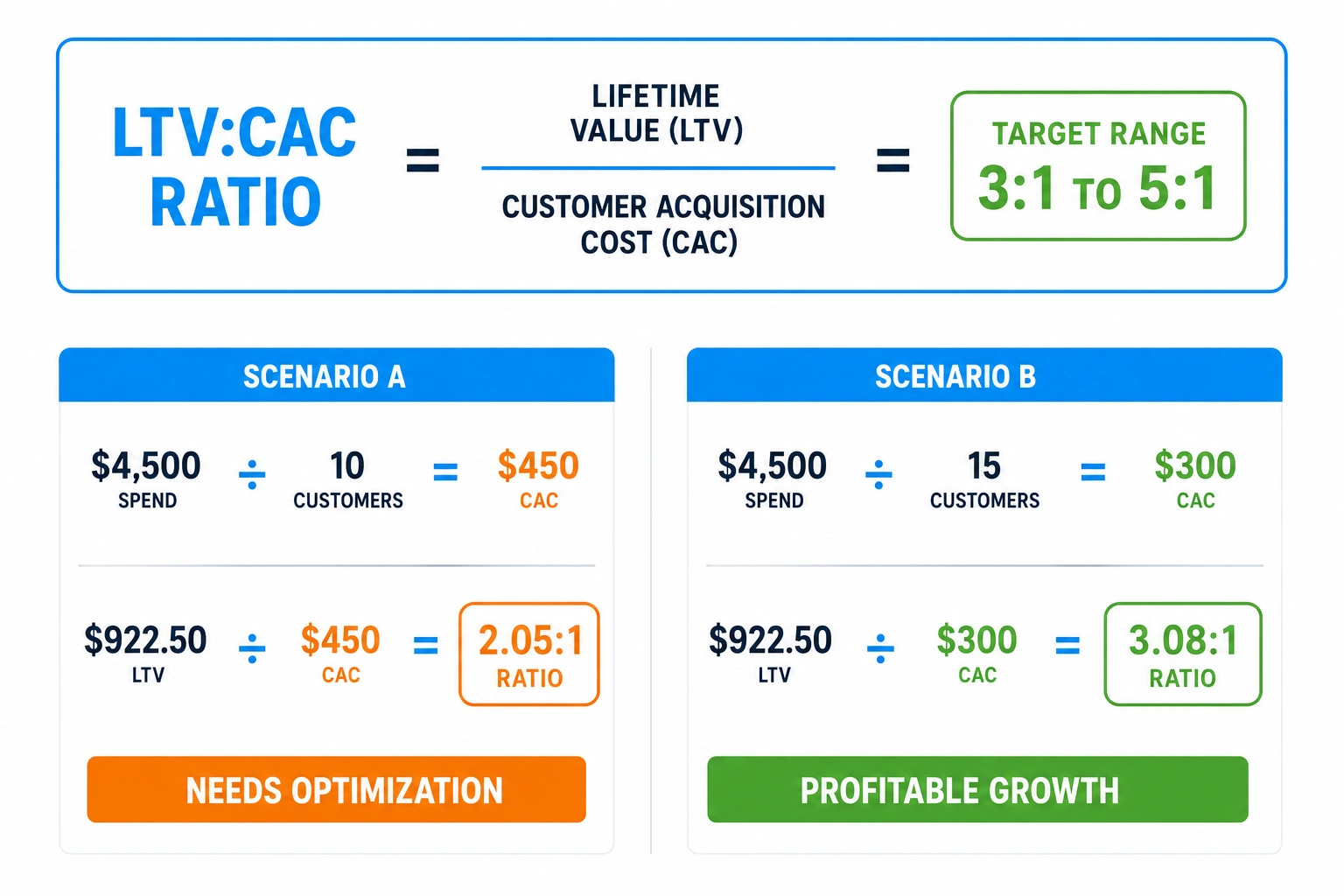
Two LTV:CAC scenarios show how acquiring more customers can lower CAC and move marketing performance into a profitable range.
Red flags: Avoiding cheap, low-quality marketing packages
Warning signs of low-cost agencies
Agencies offering full-service electrician marketing services for $300 to $500 per month are not delivering a discount: they’re delivering a different product, and usually not one that advantages your business. At that price point, the economics only work through automation: templated content, bulk link schemes, and repurposed reporting dashboards that look like activity without producing any. Google’s spam-detection algorithms have grown sophisticated enough that automated link networks don’t just fail to help; they actively damage domain authority and can trigger manual penalties that take months to recover from.
Finding an affordable marketing agency for small businesses that delivers genuine value is possible, but affordable and cheap are not synonyms. The distinction is whether the agency’s deliverables are scoped to your real competitive environment or priced to win a proposal and then coast.
One structural risk that contractors consistently underestimate: proprietary platform lock-in. This is a major trap. If the agency hosts your website on their own infrastructure and retains ownership of the domain, you don’t own your digital asset: you’re leasing it. Leaving that agency means starting from zero, losing your domain authority, your indexed pages, and every backlink your site has accumulated.
Shared lead generation traps
The shared lead model presents another significant risk for contractors. Cheap lead-gen platforms, the ones charging $15 to $30 per lead, generate that low CPL by selling the same homeowner’s contact information to four or five local contractors simultaneously. You’re not getting an exclusive lead; you’re entering a speed-and-price competition with your own neighbors before you’ve even picked up the phone. It is a race to the bottom.
That model systematically depletes margins. When every lead is a race to the bottom on price, you can’t hold rate on panel upgrades or negotiate scope on commercial work, because the homeowner already has three other quotes in their inbox. Investing in your own custom website and local SEO infrastructure guarantees that every lead your digital presence generates belongs exclusively to your business, with no competing callbacks from the same inquiry.
Warning Signs to Screen For:
- No Ownership of Assets: The agency hosts your site on a proprietary platform. If you leave, your website, domain history, and accumulated SEO equity go with them.
- Shared Lead Reselling: Your leads are simultaneously dispatched to three to five local competitors, turning every inquiry into a price auction.
- Opaque Reporting: The agency reports raw phone calls or impression counts rather than qualified service inquiries, booked jobs, and revenue attribution.
Developing your electrical contractor marketing budget
Budget allocation based on business stage
Your marketing budget must synchronize with your operational scale and growth trajectory. One size never fits all. A solo operator keeping one truck scheduled needs a fundamentally different strategy, and a different spend level, than a multi-truck enterprise targeting an entire metropolitan service area. Detailed guidance on how much to budget for marketing by business stage provides a useful calibration framework, but the core tiers break down as follows:
- Solo / Startup Electricians: $500 to $1,000/month: Focus strictly on local SEO fundamentals and Google Business Profile optimization. Paid ads at this stage often produce insufficient data volume to optimize effectively; organic presence-building is the more effective investment.
- Established Single-Truck Operators: $1,000 to $2,500/month: Active local SEO, targeted content creation, and a conservative Google Ads or LSA campaign to maintain schedule density and capture high-intent searches between organic ranking gains.
- Multi-Truck / Multi-Location Companies: $2,500 to $5,000+/month: Aggressive multi-city SEO campaigns, high-volume PPC management, and conversion rate optimization across multiple service area landing pages.
Aligning spend with growth goals
Budget decisions should be stress-tested against your real job mix. A single panel upgrade at $2,000 to $4,000 covers a solo operator’s entire monthly marketing spend. That is a fast return. A full-home rewire at $8,000 to $20,000 covers a multi-truck operator’s retainer with margin to spare. When you frame marketing spend against the ticket value of the jobs it’s designed to generate, the ROI calculus becomes considerably less nebulous.
One dimension that industry ROI calculators routinely omit: internal operational bandwidth. Scaling your marketing spend to generate 40 leads a month when your dispatch operation can only handle 20 jobs doesn’t produce growth: it produces missed calls, frustrated homeowners, and a reputation problem that no amount of ad spend can fix. Your marketing budget and your operational infrastructure need to scale in parallel; the dispatcher, the CRM licensing, the truck capacity: these are part of the true cost of growth, even if they don’t appear on the agency invoice.
Frequently asked questions about electrician marketing costs
How much should a small electrical business spend on marketing?
A startup or solo electrician should budget $500 to $1,000 per month to establish a functional online presence, prioritizing local SEO and Google Business Profile optimization before layering in paid advertising. That sequence matters: paid ads without a conversion-optimized website generate clicks that don’t book jobs. Do not skip steps.
Is Google Ads worth it for local electricians?
Yes, for capturing immediate, high-intent searches tied to high-ticket services, Google Ads delivers measurable results. The average CPC of $12.18 is significant, but a single panel upgrade or commercial service contract typically covers an entire month of ad spend. The key is ensuring your website converts that traffic at a rate that makes the CPL sustainable.
How long does it take to see results from electrician SEO?
Local SEO typically requires three to six months to generate consistent organic traffic, with competitive markets sometimes taking longer to crack. That timeline is a feature, not a flaw: the organic rankings you build during that period continue delivering exclusive leads long after the initial work is complete, at zero incremental cost per click.
What is a good cost per lead for electricians?
A healthy CPL across digital channels ranges from $25 to $100. Google LSAs tend to deliver the lowest CPLs at $39 to $85 (Watson & Co. Marketing, 2026), while competitive Google Ads campaigns in major metro markets can push CPL above $150. The more relevant benchmark is CPL relative to your average job ticket: a $100 CPL is entirely defensible if it’s generating $3,000 panel upgrade jobs.
Can I do my own website marketing to save money?
DIY platforms like Wix or Squarespace reduce upfront cost, but they don’t produce the technical infrastructure, like schema markup, page speed optimization, and custom FSM integrations, that separates a high-converting electrician website from a digital business card. Competitors running professionally built sites will consistently outrank and out-convert a template build, and the cumulative cost of lost leads over 12 months typically exceeds the price of a custom site several times over.
Investing in a conversion-focused website and a rigorous, multi-channel marketing budget is the most reliable mechanism for scaling an electrical contracting business beyond what referrals alone can sustain. Think of your marketing spend the way you think about maintaining your service fleet: skipping the oil change saves money today and costs far more in breakdowns and lost revenue later. By grounding your decisions in real-world cost benchmarks for web design, local SEO, and paid advertising, you can circumvent the cheap-package traps and build a digital infrastructure that generates high-margin jobs month after month. The contractors who dominate their local markets in 2026 aren’t the ones with the biggest ad budgets; they’re the ones who understand their numbers well enough to spend precisely and measure honestly.
Ready to power up your online presence?
Book a free consultation with our home service marketing specialists at BizIQ, and we’ll build a custom budget blueprint calibrated to your market, your service mix, and your growth targets: no generic packages, no shared leads, no guesswork.