Quick-Reference Playbook Highlights
- Core Directory Submissions: The essential general and industry-specific directories every landscaper must claim.
- The Golden Rules of NAP: How to maintain perfect Name, Address, and Phone number consistency to build search engine trust.
- Step-by-Step Optimization: A practical playbook for writing unique, keyword-rich descriptions and selecting the right categories.
- Navigating Video Verification: How to successfully pass Google’s strict verification process for service-area businesses.
- Tracking and Measuring Progress: Simple methods to monitor your local search rankings, impressions, and leads.
How do Local Citations Help Landscapers Rank Higher in Google’s Map Pack?
Local citations help landscaping businesses improve their Map Pack rankings by reinforcing the accuracy and credibility of their business information across trusted online directories. Consistent citations, combined with strong local SEO, customer reviews, and an optimized Google Business Profile, increase your chances of appearing when homeowners search for landscaping services in your area.
You have built a resilient landscape company, but neighbors searching for “lawn care near me” or “landscaping services” are finding your competitors instead. The difference isn’t the quality of your work; it’s your visibility in the Google Map Pack. Visibility drives phone calls. To achieve showing up when neighbors search, you must establish a bedrock of trust with search engines. That foundation is built on local citations, which act as your digital business cards across the web.
When Google’s algorithm decides which businesses to display in the coveted top three local spots, it doesn’t guess. It looks for consistent, verifiable proof of your business’s name, address, and phone number (NAP) across hundreds of digital touchpoints. For landscaping contractors, securing these listings is the most direct path to earning search engine trust, improving your landscaping SEO rankings, and converting local searchers who need immediate lawn care into long-term, high-value paying clients.
Why local citations dictate landscaping Map Pack rankings
The role of citations in local search algorithms
Citations account for approximately 13% of local search ranking factors, which is not a dominant slice of the algorithm, but a foundational one. Without that baseline layer of verified data, the rest of your SEO work sits on precarious ground. Search engines cross-reference directory data to confirm that your landscaping business physically exists at the claimed address; when those cross-references contradict each other, the algorithm hedges its bets and ranks you lower.
Prominence and proximity compound this. Spotless listings help search engines map your service area boundaries with enough confidence to boost your local search visibility for “near me” queries, which are the highest-converting searches a local contractor can capture. Citations don’t win you the Map Pack on their own: that requires reviews, engagement, and a well-structured website. Instead, they establish the credibility floor everything else builds on. Consistency builds trust.
The impact of the Google 3-Pack
Failing to rank in the Map Pack means missing out on nearly half of your local market’s search volume. The Google Local 3-Pack captures roughly 44% of all clicks for local service searches, which means nearly half of every prospective customer searching for a landscaper in your area never scrolls past those three listings.
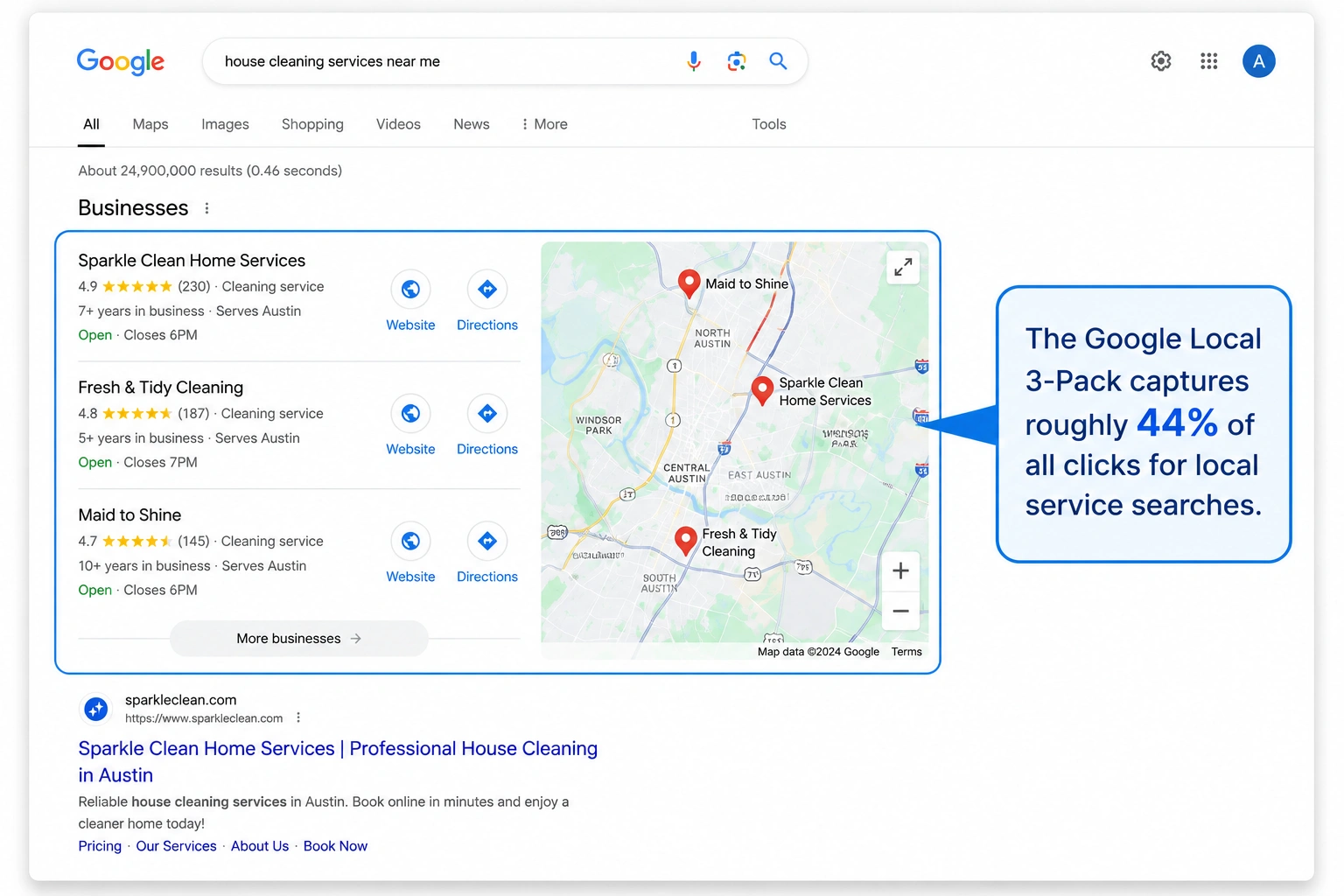
A Google Local 3-Pack mockup highlights how prominent map listings capture a significant share of clicks for local service searches.
Mobile behavior sharpens that urgency further. Approximately 88% of consumers who conduct a local search on a mobile device contact a business within 24 hours. These aren’t casual browsers: they’re homeowners with a project in mind, a budget in hand, and a phone already unlocked. They need help now. Cementing these positions improves your regional rankings and ensures your Map Pack rankings translate directly into inbound calls, not just impressions.
Visualizing the local search ecosystem
The citation network operates in tiers. Data flows downward. At the top sit Tier 1 platforms, including Google, Bing, and Apple Maps. These platforms pull and cross-reference data from Tier 2 directories like Yelp, Facebook, and Yellow Pages, as well as from major data aggregators like Data Axle and Neustar Localeze that feed hundreds of smaller local search engines. When your NAP information is consistent across those downstream sources, the Tier 1 engines receive corroborating signals from multiple autonomous databases, each one reinforcing the last.
That reinforcement loop is what builds algorithmic trust over time; or more precisely, it’s what prevents the trust erosion that comes from conflicting data. A single mismatched address variant rippling through aggregator networks can quietly sabotage months of otherwise solid SEO work.
High-authority directories for landscaping businesses
Core general platforms for baseline trust
Think of these core general platforms as putting up signposts on every major road leading to your business. Start with the basics. Before targeting niche directories, we need to make sure your business has an unblemished presence on the platforms that Google’s crawlers visit most frequently to build that initial layer of search engine trust. Among landscapers currently ranking in the Map Pack, adoption rates on these general directories are telling:
- Facebook (72% adoption rate among ranked landscapers): establishes immediate social proof and local relevance.
- Manta (70% adoption rate): a high-authority business directory that Google crawls persistently to verify small business listings.
- Yelp (67% adoption rate): drives high-intent traffic from consumers actively comparing service providers.
- Yellow Pages (67% adoption rate): a legacy platform that still carries genuine link equity and baseline trust signals.
- Mapquest (63% adoption rate): reinforces your physical location data across mapping services.
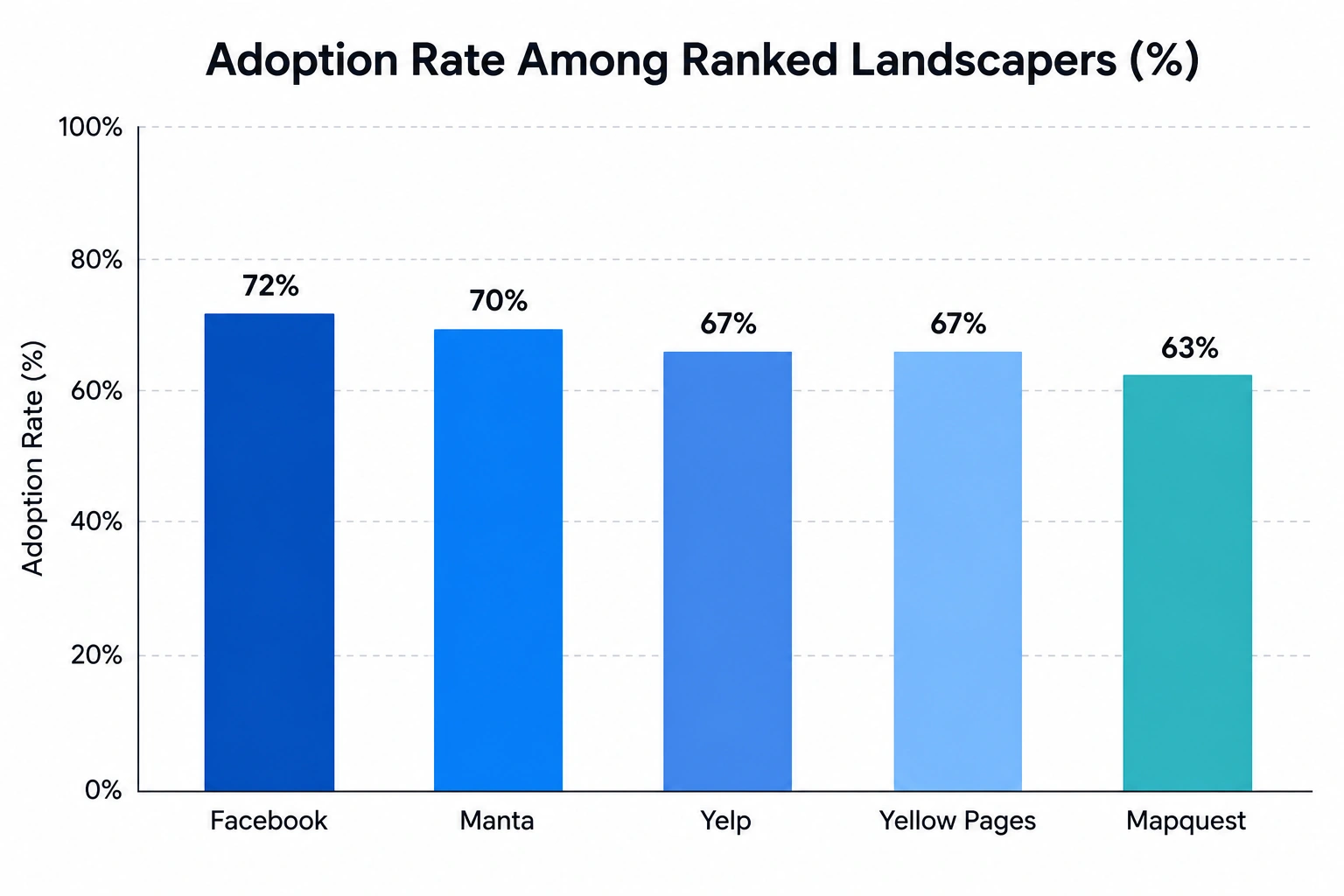
Directory adoption rates among ranked landscapers, with Facebook leading at 72%, followed by Manta, Yelp, Yellow Pages, and MapQuest.
Establishing search engine trust
Rather than chasing thousands of low-quality directories, focus your efforts on the high-authority platforms that search engines prioritize. These platforms carry outsized domain authority, which means a listing on any one of them passes meaningful link equity to your website. More consequentially, crawlers use these high-authority platforms to construct a baseline profile of your business before they ever look at niche directories. If your Facebook page says one thing and your Yelp listing says another, that baseline profile is already compromised. Consistency is key.
Consumer search behavior adds a second layer of value. Many homeowners search these directories directly, not just through Google, making them bonafide sources of high-intent referral traffic that can convert into active leads independent of your Map Pack position.
Niche and industry-specific citations for landscapers
Top home-service directories
General directories establish your credibility as a business. Niche listings build relevance. Industry-specific directories establish your credibility as a professional landscaper, and that divergence matters immensely to search engines parsing relevance signals to determine which businesses deserve top local billing.
- Houzz (DA 89): the premier platform for landscape design and outdoor living projects, sending high-relevance signals that align directly with your service category.
- HomeAdvisor (DA 85): imperative for matching with local leads and building industry-specific authority.
- Angi (DA 76): connects local contractors with homeowners who are actively ready to hire, not just browsing.
- GuildQuality (DA 51): a specialized platform for quality-minded contractors, showcasing verified customer satisfaction data.
- Landscape.com (DA 27): a narrowly targeted niche directory that signals pure industry relevance to search engines, even at a lower domain authority.
The power of industry relevance
Search engines associate these platforms directly with home services, which reinforces your business categorization in ways that general directories cannot mirror. Homeowners on these sites are actively planning projects, which drives higher conversion rates than the broader audiences on general platforms, making it a shrewd focus for your landscaping business marketing.
There’s also a competitive gap worth exploiting. BrightLocal’s research found that 11% of gardeners lack core citations. Many competitors miss this. Claiming these niche platforms doesn’t require outranking a competitor with years of SEO investment: it just requires showing up where they haven’t, giving your business an immediate edge in local search visibility.
The golden rules of NAP consistency
What is NAP consistency?
Think of NAP consistency as the digital equivalent of giving customers the right address, or making sure your business name is spelled the same way every time someone recommends you to a friend. Your business Name, Address, and Phone number must be indistinguishable across every directory, not just similar or close. Search engine crawlers don’t interpret intent; they match strings. Crawlers require exact matches. “Lawn Care LLC” and “Lawn Care” are different entities to an algorithm, even if they’re obviously the same company to a human reader.
That confusion has a direct cost. Mismatched details attenuate your local authority by splitting the trust signals that should be consolidating around a single, verified business identity. Customers feel it too; an outdated phone number or a wrong address doesn’t just fail to convert, it actively erodes confidence in your professionalism before you’ve said a word.
The cost of discrepancies
Minor variations are the most pernicious problem because they’re easy to dismiss. Using “St.” on one profile and “Street” on another, or listing your number with different formatting in different places, feels inconsequential. It isn’t. These micro-inconsistencies fragment the citation network’s ability to consolidate your authority into a single, coherent business profile.
The financial stakes are measurable. An Uberall study examining 3,000 business locations found that those with consistent, complete listings achieved an 87% increase in website clicks and a 91% increase in map views, demonstrating the direct financial impact of data accuracy. Direct customer actions, including phone calls and direction requests, followed the same upward trajectory. Keeping your business information consistent is not a housekeeping task; it’s a revenue protection strategy.
“Consistency is your currency in local SEO. A single mismatched phone number can cost you a top-3 Map Pack ranking.”, warns the BizIQ Local SEO team.
Step-by-step citation optimization playbook
Writing unique, keyword-rich descriptions
Duplicate descriptions are a wasted opportunity. Every directory profile you claim is an independently indexable page, and if you paste the same 150-word block across all of them, search engines will treat most of those pages as superfluous. Write a distinct description for each platform: same core facts, different framing and phrasing.
Within those descriptions, integrate high-intent terms naturally. Phrases like “lawn care services,” “landscape design,” and your primary service areas should appear in the first 150 characters, where both crawlers and glancing readers are most attentive. Your unique selling points, such as years in business, specific service specializations, and certifications, belong there too, not buried at the end where no one reads.
Selecting the right categories
Use “Landscaper” or “Lawn Care Service” as your primary category across all platforms. Uniformity here matters as much as it does with NAP data; category mismatches send conflicting relevance signals that weaken your topical authority. Do not mix signals.
Secondary categories expand your reach without diluting your primary signal. Relevant additions include:
- Landscape Designer
- Sprinkler System Contractor
- Tree Service
- Irrigation Contractor
- Hardscape Contractor
Ensure your category selections align with your Google Map Pack profile. When your GBP categories and your directory categories tell the same story, the algorithm has no equivocation to resolve, which makes it much easier to rank your business for highly competitive local search terms.
Don’t let broken citations hold your business back.
Schedule a Free Local SEO Audit with our team to find and fix historical NAP inconsistencies across the web.
Navigating Google’s strict video verification
Preparing for the video call
Google’s video verification process for service-area businesses is genuinely strict, and landscapers who treat it nonchalantly tend to fail it, resulting in frustrating delays and lost visibility during peak seasons. Preparation is the difference between a verified profile and a suspended one. Do not skip steps.
Before recording, gather the following:
- Physical address proof: street signs, authoritative mail, or utility bills matching your registered address.
- Branded assets: vehicles, trailers, uniforms, and tools that visually confirm you operate a legitimate business.
- Business registration documents: your business license, tax documents, or any official paperwork that verifies your legal business name.
Executing the recording
Record the entire verification in one uninterrupted, unedited take. Google’s reviewers are trained to spot cuts. For service-area businesses without a traditional storefront, the footage should show your equipment and tools loaded into a branded truck, which acts as the physical evidence that you operate in the field rather than from a fixed location.
Compliance isn’t optional here. A flagged or suspended Google Business Profile doesn’t just cost you Map Pack visibility; it can take weeks to reclaim, during which your competitors collect every call you should have received.
Tracking your local SEO progress
Key metrics to monitor
Citation building without quantification is guesswork. The metrics that matter most for local search visibility are:
Track your progress.
- Local search impressions: how often your business appears in local results and Google Maps, which establishes your baseline visibility before any ranking improvements.
- Map views and clicks: the subset of those impressions that result in a user actively engaging with your listing.
- Phone calls: tracked either through Google Business Profile insights or a dedicated call tracking number, which provide the most unambiguous signal that your local presence is generating real business activity and driving tangible revenue to your company.
Using Google Search Console and analytics
Organic traffic growth from local queries is the retrospective indicator that confirms your citation work is compounding. Track it monthly rather than weekly. Citation-driven ranking shifts move slowly, and week-over-week fluctuations can obscure a genuine upward trend. Patience is required.
Keyword rankings for terms like “landscaping SEO” and “lawn care” in your target geography give you a more granular read on progress. Pair those rankings with user behavior data: contact form submissions, quote requests, and time-on-page for service-area pages. A ranking improvement that doesn’t produce behavioral engagement usually signals a mismatch between the keyword you’re ranking for and the intent of the searcher landing on your page, meaning you are attracting the wrong audience.
Manual vs. automated citation building
The manual approach
Manual citation building costs more upfront, typically $200 to $600 as a one-time investment, but it produces listings you own outright. Each profile can be tailored with unique descriptions, project photos, and precisely selected categories. You own the profiles. For service-area businesses where the details of your profile matter more than sheer volume, that customization is consequential.
Perpetual listings are the other material advantage. Once built, they don’t revert or disappear because you stopped paying a subscription. That stability matters when you’re trying to maintain consistent NAP data across dozens of directories over a multi-year horizon, ensuring search engines never receive conflicting signals about your business location.
The automated approach
Automated tools like Yext or SEMrush compress the deployment timeline significantly, pushing listings to dozens of directories in a fraction of the time manual submission requires. The tradeoff is an ongoing subscription of $30 to $100 per month and a meaningful loss of control over profile quality. Automation has hidden costs.
The cancellation risk is the part most landscapers don’t think about until it’s too late. When a subscription expires, many of these tools revert your listings to their previous unoptimized state, or remove them entirely. That means the citation equity you spent months building can evaporate with a single missed payment. There’s a case to be made for automated tools during an aggressive initial buildout phase, but relying on them exclusively for long-term citation maintenance introduces a vulnerability that manual listings don’t carry.
Frequently asked questions about landscaping SEO
How many citations does a landscaping business need to rank?
According to BrightLocal’s data, a landscaping business should aim for 50 and 65 citations to compete vigorously in the highly competitive Google Map Pack and secure top local rankings. Top-ranking businesses average 61 citations, but volume without accuracy is a liability, not an asset. Quality beats quantity. A tightly maintained set of 55 consistent, fully optimized listings will outperform 100 haphazard ones.
Should a service-area landscaper hide their address on directory listings?
Yes, if you operate out of a residential address, hiding it on Google Business Profile and using directories that support service-area business (SAB) profiles is the optimal approach. Protect your address. Maintaining consistency across those profiles forestalls Google from flagging your account for policy violations, which is a very real risk if your physical address appears on some platforms but is hidden on others.
How long does it take for new citations to improve local rankings?
Most practitioners put the window at 2 to 6 months before citation cleanup and new listings fully influence rankings. SEO takes time. Search engine crawlers must discover, index, and verify updated listings across dozens of third-party databases, and that process doesn’t accelerate because you’re restless. The historical BrightLocal data that underpins most citation benchmarks is worth noting here: Google’s algorithm has mutated considerably, and engagement signals now carry more weight alongside citation volume than they once did.
What is the difference between landscaping and lawn care keywords?
Landscaping keywords typically target high-ticket design and installation projects like “patio installation,” “landscape lighting design,” or “retaining wall contractor.” In contrast, lawn care keywords focus on recurring maintenance services like “lawn mowing,” “fertilization,” and “weed control.” Target both audiences. Your citation descriptions should reflect both service types to capture the full gamut of local search intent, particularly if your business functions across both categories and wants to maximize its visibility.
Can I use a P.O. Box or UPS Store address for local citations?
No. Google strictly prohibits virtual offices, P.O. boxes, and UPS Store addresses for Map Pack eligibility. Use a real address. You must use a physical street address, even if you choose to hide it as a service-area business, to build legitimate local citations for small business SEO. Attempting to bypass this with a virtual address doesn’t just fail verification: it risks a permanent suspension of your Google Business Profile.
Building and maintaining accurate local citations is not a one-time marketing chore; it is the digital foundation of your landscaping business. By claiming your core listings, enforcing strict NAP consistency, and optimizing each profile with unique content, you signal to search engines that your business is trusted, active, and ready to serve local homeowners. That garnered authority is what moves you into the top three spots of the Google Map Pack, ensuring that when neighbors search for landscaping services, your phone is the one that rings.
Here’s your next step: Start with the top four general directories this week and verify that your NAP consistency is indistinguishable across all of them to build a solid foundation for your local visibility.