Key Takeaways
- PPC delivers immediate leads but maintains a flat, high cost-per-lead (CPL) averaging $183 for non-branded search.
- SEO requires upfront investment but scales to deliver a highly profitable CPL of $10 to $45 once rankings mature.
- The ultimate strategy combines both, using PPC for high-urgency emergency jobs and SEO for high-ticket, planned services.
When a homeowner faces a burst pipe at 2 AM, they click the first Google Ad they see. But when planning a $3,000 tankless water heater upgrade, they research, compare reviews, and click organic search results. For plumbing business owners, choosing between Pay-Per-Click (PPC) and Search Engine Optimization (SEO) is not about picking a favorite; it is about understanding how these channels generate leads, how much they cost, and when our marketing investments will finally cross over into pure profitability.
To scale a plumbing company in a competitive local market, treat marketing as a financial portfolio. PPC acts as our high-yield, immediate cash-flow generator, while SEO is our long-term compounding asset. Relying solely on paid ads means we are renting our leads: the moment we stop paying Google, our phone stops ringing. Conversely, investing only in SEO from day one can leave our trucks sitting idle while we wait months for organic authority to build.
The Hard Math Behind Plumbing Google Ads CPL
Understanding the Upfront Cost of Paid Search
Google Ads and Local Services Ads give a new or growing plumbing operation something SEO cannot: a presence at the top of the search engine results page on day one. That immediacy has real value, especially when we are filling a new dispatch board or entering a competitive metro market where organic rankings are months away. We are buying visibility, and for a business that needs the phone to ring this week, that trade-off is often worth it. Speed has a price.
The price of that immediacy, though, is substantial. According to Q1 2026 benchmark data from SearchLight, non-branded plumbing search campaigns average $183 per lead. That number reflects what we pay to reach a homeowner who has never heard of our brand and is searching for a plumber right now. It is the most honest measure of paid search’s true cost.
Performance Max (PMax) campaigns present a different picture on the surface, averaging $82 per lead. That lower figure is worth scrutinizing, though; PMax campaigns frequently blend branded search traffic into their reported results, which means a portion of those leads would have found us anyway. When we strip out branded queries, the cost of acquiring a genuinely new customer through PMax narrows considerably toward the non-branded benchmark.
Google Local Services Ads occupy a more defensible position in the paid ecosystem. LSAs charge an average of $57 per valid lead based on data from SearchLight, with a strong 43.9% lead-to-booked-job conversion rate: a figure that holds up well against other paid channels. Because we pay per verified lead rather than per click, budget waste from accidental clicks and low-intent browsers is largely eliminated. For plumbing businesses that want paid lead generation with tighter cost controls, LSAs are the most structurally efficient option in the current paid landscape.
The Reality of Customer Acquisition Costs (CAC)
A lead is not a booked job. That gap matters enormously when we are calculating whether paid search is profitable for our operation.
Non-branded Google Ads campaigns carry a median lead-to-customer conversion rate of 18.4%, which means roughly one in five leads becomes a paying customer. At a $183 CPL, that conversion rate produces a median cost per paying customer, our true CAC: of $333. For a business running on tight margins, that number deserves serious attention before we commit to scaling ad spend.
The offset to that $333 CAC is the median average ticket for plumbing jobs acquired via Google Ads: $1,680. At that revenue per job, the math resolves favorably. That is a solid win. A 5.54x Return on Ad Spend (ROAS) is a legitimate return, and for high-urgency, high-ticket calls, paid search earns its place in our budget. The problem is not that PPC fails to generate profitable jobs: it does. The problem is that it generates them at a fixed, non-declining cost indefinitely.
Cost-per-click rates in local plumbing markets have been climbing for several years, and that trajectory is not reversing. As more local contractors, national franchises, and lead aggregators bid on the same high-intent keywords, our CPC rises whether our campaign performance improves or not. We are competing in an auction where the floor keeps moving upward. Running PPC for plumbers is like renting a shop space in a neighborhood that gets more expensive every year: we never build equity, and the landlord sets the terms.
Understanding the mechanics of paid search is the first step toward optimizing our marketing budget. While paid ads are unmatched for speed, they offer no compounding value; we pay the same high price for the thousandth lead as we did for the first. This is why relying solely on paid search can severely limit our profit margins as our business grows.
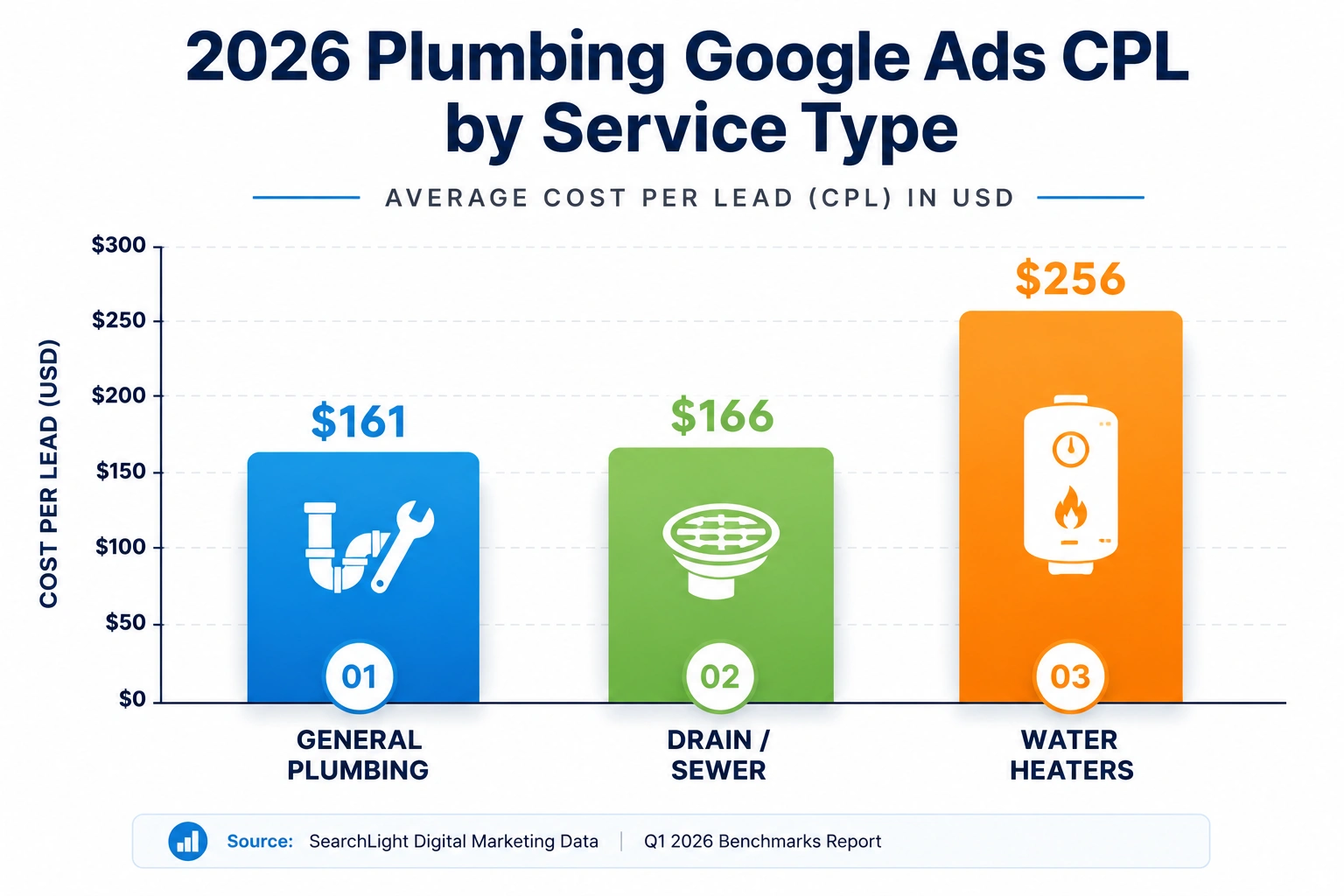
2026 Google Ads cost-per-lead benchmarks for plumbing services, highlighting CPL differences across key service categories.
The Compounding Value of Plumbing SEO
How Organic Search Builds Long-Term Equity
Earning a top organic ranking resembles earning a customer’s trust. We cannot buy it outright; we cannot shortcut the timeline, and the businesses that try to game it usually end up worse off than when they started. But when we do earn it. through consistent, quality work over months, it pays dividends that no ad campaign can replicate.
Local SEO for plumbing companies operates across three interconnected layers: our Google Business Profile (GBP), our local citation footprint, and the authority signals our website accumulates through quality content and inbound links. Optimizing our GBP with accurate service categories, regular photo updates, and a steady stream of verified reviews directly influences our map pack placement: the three-business cluster that appears above organic results for most local searches. Citation consistency across directories like Yelp, Angi, and the Better Business Bureau reinforces our geographic relevance to Google’s local algorithm. And high-quality backlinks from local news outlets, trade associations, and industry directories signal that our business is a legitimate authority in our service area.
What makes this different from paid search is the residual nature of the asset. When we pause a Google Ads campaign, lead flow stops within hours. The traffic dies instantly. When we pause an SEO retainer after 18 months of consistent work, our rankings do not evaporate overnight. The content, the links, the GBP authority, the technical site health: those assets continue generating organic traffic and inbound calls long after the active labor has concluded. That is the compounding dynamic that makes organic search fundamentally different from every paid channel. SEO is like planting an orchard: the earlier we start, the more fruit we harvest years from now.
Targeting the right plumbing keywords is where the strategic advantage lies. High-intent queries like “tankless water heater installation cost” or “whole-home repiping near me” attract homeowners who are deep in a research cycle and close to a purchase decision. These are not emergency callers: they are buyers comparing options, reading reviews, and evaluating which contractor they trust enough to invite into their home for a $3,000 to $8,000 job. Organic content that answers their questions and demonstrates our expertise converts at a higher rate than a paid ad that simply interrupts their search.
Lowering Your Blended Cost-Per-Lead Over Time
The cost curve for SEO is inverted relative to paid search. Our investment is front-loaded: we pay a monthly retainer while Google crawls, indexes, and gradually elevates our site’s authority, and the financial return accelerates over time rather than remaining flat.
Once a local plumbing SEO program reaches maturity, typically between 8 and 12 months of consistent optimization, the effective CPL drops to a range of $10 to $45. That is not a typo or a cherry-picked outlier. Data from Geek Powered Studios confirms that mature campaigns running for 12 or more months consistently outperform paid channels on a cost-per-acquisition basis, with cost per booked job landing between $25 and $100 in medium-competition markets: compared to the $333 median CAC for non-branded paid search.
The driver behind that decline is straightforward: our monthly retainer cost stays relatively constant while the volume of organic leads it generates increases. In month three, a $3,000 retainer might produce eight organic leads. In month fourteen, that same $3,000 retainer might produce sixty. That is real growth. The cost per lead has not dropped because the agency got cheaper: it has dropped because the asset we built is now working at scale.
Integrating a structured organic strategy also lowers our blended CPL across every channel. When organic rankings handle a growing share of our high-ticket planned service inquiries, our paid budget can concentrate on the emergency calls where speed genuinely justifies the premium cost.
Benefits of organic authority:
- Zero Cost-Per-Click: We pay nothing to Google when a homeowner clicks on our organic listing or map pack result.
- Higher Trust and Credibility: Many consumers actively bypass paid ads in favor of organic results, trusting Google’s natural ranking algorithms.
- Sustainable Lead Pipelines: Organic rankings provide a stable, predictable flow of leads that insulates our business from sudden PPC bid increases.
Segmenting Your Strategy by Urgency and Job Type
Capturing Emergency Calls with Paid Search
A homeowner with a backed-up sewer line at 7 PM on a Friday is not browsing our service pages or reading our blog post about drain maintenance. They are on their phone, they see the first paid ad or LSA at the top of their screen, and they call. That is the entire decision cycle. Brand recognition, content quality, and organic authority are irrelevant at that moment. Speed wins the job.
PPC and LSAs are tailored for exactly this scenario. High-urgency, same-day services: emergency drain cleaning, burst pipe repair, water heater failure: carry a search behavior pattern where speed to lead is the only variable that matters. The homeowner’s intent is fully formed before they ever type a query; our job is simply to be the first number they see. Paid campaigns targeting terms like “emergency drain cleaning near me” or “burst pipe repair [city]” capture this demand at its peak urgency.
For this segment, LSAs deserve the majority of our emergency ad allocation. The pay-per-lead model eliminates click waste, the Google Guarantee badge adds immediate credibility, and the 43.9% lead-to-booked-job conversion rate means nearly half of every dollar we spend on LSAs converts into scheduled work. That is a defensible return for a channel that requires no organic authority to perform.
Winning High-Ticket Planned Services with SEO
Tankless water heater installations, whole-home repiping, water filtration systems, and bathroom remodeling projects follow a common buyer journey: the homeowner knows they need the work done, but they spend days or weeks deciding who to hire. They read reviews. They compare service pages. They look at before-and-after photos and check whether the contractor is licensed and insured. By the time they call, they have already made a provisional decision about which company they trust.
Content is what earns that trust during the research phase. In-depth service pages that explain the installation process, address common cost questions, and include local project examples answer the exact questions these buyers are asking. Comparison guides: “tankless vs. traditional water heater: which is right for your home?”: capture informational queries and position our brand as the knowledgeable option before the buyer ever considers a competitor.
Using high-value plumbing keywords to target searchers in the research phase is where organic SEO generates its highest-margin leads. A $6,000 whole-home repiping job acquired through a $35 organic lead represents a return that no paid channel can match. Because these jobs carry the highest average tickets in our service mix, acquiring them through low-cost organic channels produces an outsized impact on our overall profitability.
Strategic channel segmentation:
- Use PPC/LSAs For: Emergency drain cleaning, water leak detection, same-day water heater repairs, and emergency sewer backups.
- Use Local SEO For: Tankless water heater upgrades, whole-home repiping, water softener installations, and bathroom remodeling services.
- Use Google Maps/GBP For: Capturing both emergency and planned local searches by maintaining a high volume of positive reviews and local proximity signals.
Want to see how our current marketing spend stacks up against industry benchmarks?
Compare your options with our detailed PPC vs. SEO comparison to discover the most cost-effective path to grow your plumbing business.
Calculating the Crossover Point Where SEO Beats PPC
The Crossover Math Explained
In the first one to three months of an SEO campaign, the effective CPL is technically infinite. We are paying a monthly retainer while Google’s crawlers assess our site, while citations propagate across directories, while content builds topical authority. No organic leads are flowing yet. That is not a flaw in the model: it is the cost of building an asset rather than renting one: but it is a reality that requires financial planning and patience.
The crossover point is the specific month where our cumulative SEO investment begins delivering leads at a lower cost than a comparable PPC budget would produce. It is not a theoretical milestone; it is a calculable number based on our retainer cost, our market’s competitive density, and the rate at which our organic lead volume scales.
Consider a concrete scenario: a $2,500 monthly SEO retainer running alongside a $2,500 monthly PPC budget. The PPC campaign delivers leads immediately at $183 each: roughly 13 to 14 leads per month, every month, with no improvement. The SEO campaign delivers nothing in month one, a handful of leads by month four, and then accelerates. By month 12, as the SEO timeline for results reaches full maturity, that same $2,500 retainer is generating organic leads at an effective CPL well under $35. The crossover has occurred, and from that point forward, every additional organic lead widens the cost advantage.
The 6-to-12-month maturation window is fixed. It reflects how search engines operate: crawl cycles, trust accumulation, link equity propagation, and no agency can compress it without resorting to tactics that create long-term penalties. Patience and consistent monthly investment are the only variables we control.
Comparing Cumulative Marketing Investments
Over 12 months, a $3,000 monthly PPC budget totals $36,000 in ad spend and yields roughly 196 leads at the $183 non-branded CPL benchmark. Those leads are real, those jobs are booked, and the ROAS is defensible. But when the campaign stops, or when a competitor outbids us on our highest-converting keywords, the lead flow stops with it. There is no residual value. The $36,000 is spent, and we start from zero.
A $3,000 monthly SEO retainer over the same 12 months also totals $36,000. The difference is what we own at the end. Our website holds accumulated domain authority. Our GBP has twelve months of review velocity and engagement signals. Our service pages rank for dozens of high-intent local queries. Our local citation profile is clean and consistent across every major directory. And by month 12, that infrastructure is generating 100 or more organic leads per month: a volume that continues even if we temporarily reduce our retainer.
That equity distinction matters beyond the CPL calculation. A plumbing business with strong organic rankings and a well-optimized GBP carries a measurably higher valuation than one that depends entirely on paid traffic. If we ever sell the business, refinance, or bring on a partner, our digital asset base is part of the conversation.
There is also a risk mitigation dimension worth acknowledging. Paid advertising platforms change their policies, adjust their algorithms, and shift their auction dynamics with little warning. A competitor with deeper pockets can temporarily price us out of our most profitable keywords. Organic equity shields us from those disruptions; it is not immune to algorithm changes, but it is far less vulnerable to competitive bidding wars.
When we calculate the true return on our marketing investment, we must look beyond the immediate cost of this month’s leads. A healthy plumbing business requires a balance of immediate cash flow and long-term equity. If we rely solely on paid search, we are building our business on rented land; a smarter approach is to reinvest a portion of our immediate PPC profits into building a permanent organic presence.
This financial transition is where many trade business owners struggle. It requires a shift in mindset from viewing marketing as a monthly expense to treating it as a compounding investment in our business.
“Plumbing businesses that run PPC and SEO simultaneously almost always outperform those running either channel in isolation. The conversion data from your paid campaigns tells you exactly which keywords to target with SEO, eliminating the guesswork and accelerating your organic ROI.” – Ed Stapleton Jr.
Navigating Local SEO Costs and Agency Tiers
Breaking Down Monthly SEO Retainers
Not every plumbing market demands the same level of investment, and the retainer tier we choose should reflect the competitive density of our specific geography: not just our comfort level with the monthly line item. Competition dictates the cost.
The starter tier, running between $600 and $1,500 per month, suits low-competition rural or small-market operations. At this level, the work centers on Google Business Profile maintenance, local citation cleanup, and foundational on-page optimization. It is not designed to dominate a metro market; it is designed to establish a clean, crawlable presence in a market where the competition is limited and the ranking thresholds are lower.
The growth tier: $1,500 to $4,000 per month: is where most single-location plumbers in competitive suburban or mid-sized metro areas should be operating. This budget funds ongoing content creation, technical SEO audits, local link acquisition, and service-area page expansion. It is the tier where the compounding CPL math starts to work in our favor within a reasonable timeline, and it is the tier where a competent agency can measurably improve our organic rankings against established local competitors.
Enterprise retainers, starting at $4,000 and scaling to $8,000 or more per month, are built for multi-location operations, regional franchises, and large contractors who need aggressive coverage across dozens of service areas. This level of investment supports extensive local landing page development, digital PR campaigns, advanced schema markup, and the kind of topical authority architecture that dominates entire metro regions rather than individual zip codes.
Matching our retainer tier to our actual business goals, rather than defaulting to the lowest available price, is a decision that deserves the same rigor we would apply to hiring a lead technician. The right PPC pricing guide and SEO retainer structure should offer full transparency on deliverables, reporting cadence, and performance benchmarks before we sign anything.
Evaluating the Quality of SEO Providers
Cheap SEO is not a bargain. Automated link spam packages priced under $500 per month have a documented track record of triggering Google manual penalties and algorithmic filters that can suppress our organic visibility for months or years. Recovering from a penalty is significantly more expensive than avoiding one, and the damage to our GBP and local rankings can linger long after the bad links are removed.
A credible plumber seo agency earns its retainer through verifiable deliverables: technical site audits that identify crawl errors and page speed issues, localized content that targets real search queries in our service area, GBP management that maintains review velocity and post frequency, and link building that sources placements from legitimate local and industry-relevant domains. Vanity metrics: keyword rankings, impressions, domain authority scores are secondary to the number that truly matters: booked jobs per month by channel.
An agency worth hiring will never promise us a specific ranking by a specific date. Rankings are an output of the work, not a deliverable the agency controls. What a trustworthy partner will provide is a clear plan: which technical issues need resolution in the first 30 days, which content assets will be built over the first quarter, which citation sources will be targeted, and what organic lead volume trajectory is realistic given our market’s competitive landscape. That clear plan is the accountability framework. If an agency cannot produce one, that is the answer we need.
Choosing the right marketing partner is just as important as choosing the right channel. A specialized plumber seo agency understands the unique search behavior of our customers and knows how to structure our website to convert local traffic into actual service calls. Investing in a high-quality, transparent retainer ensures that our digital presence is built on a solid, compliant foundation.
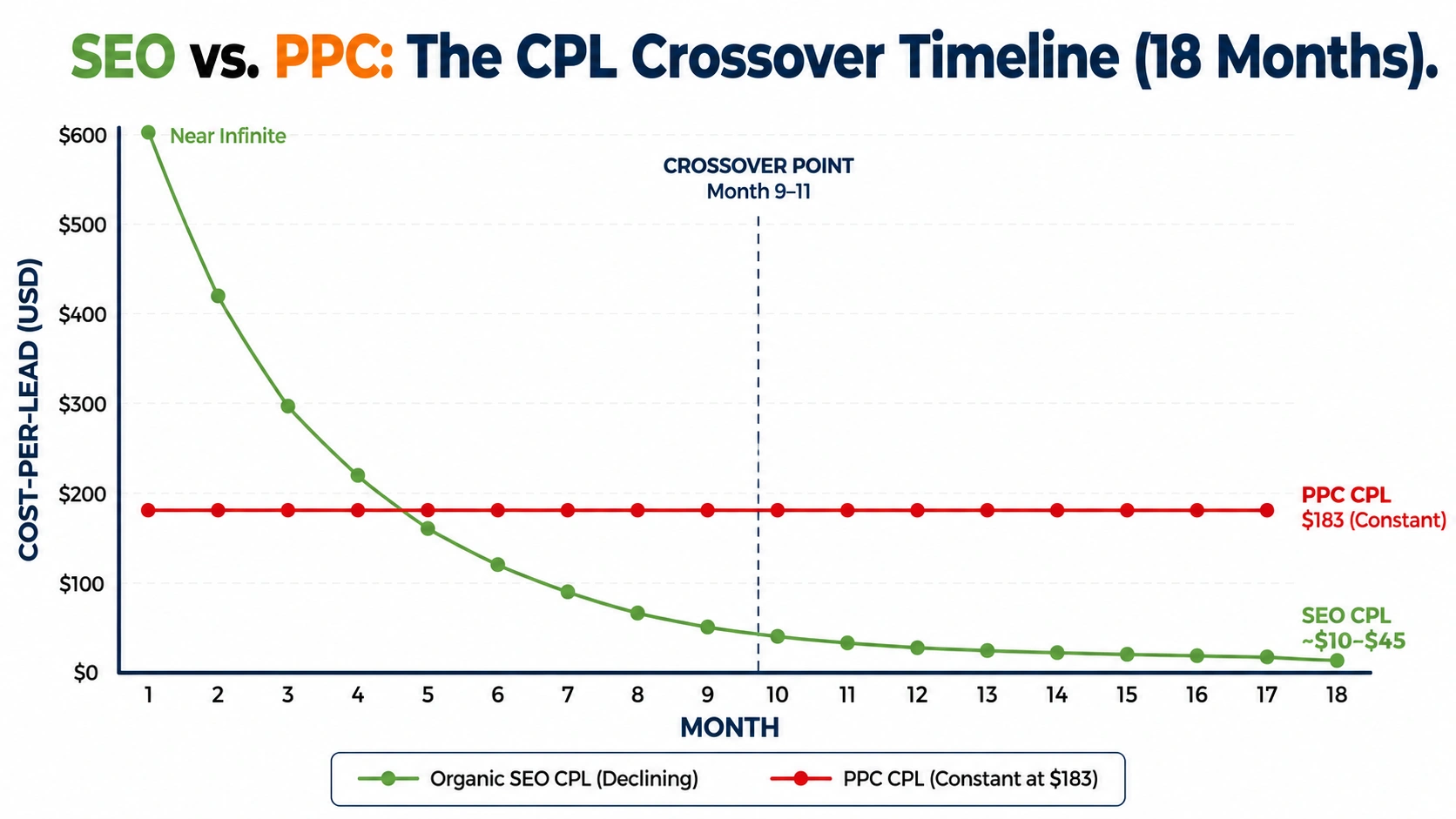
SEO starts with a high CPL but declines over time, crossing below PPC around months 9–11 and delivering lower long-term acquisition costs.
Stop renting your leads and start building a compounding business asset.
The Phased Marketing Blueprint for Plumbing Growth
Phase 1: Securing Immediate Cash Flow
New plumbing operations and established contractors entering a new service area share the same immediate problem: the dispatch board is empty and the trucks need to move. Paid search solves that problem faster than any other channel, which is why the first phase of a sound marketing build allocates the majority of budget: roughly 70%: to Google Local Services Ads and targeted PPC search campaigns.
LSAs should anchor this phase. Their pay-per-lead structure, combined with the Google Guarantee badge and the 43.9% lead-to-booked-job conversion rate, makes them the most cost-efficient immediate lead source available. Standard Google Ads campaigns fill in the coverage gaps: particularly for high-value service categories like water heater replacement and drain cleaning: where LSA inventory may be limited or where specific keyword targeting adds accuracy.
The remaining 30% of budget goes toward building the SEO foundation: claiming and fully optimizing our Google Business Profile, auditing and correcting technical site errors, and establishing our local citation footprint across the primary directories. None of this generates organic leads in month one. SEO takes time. What it does is start the clock on our organic authority timeline so that the crossover point arrives as early as possible.
Phase 2: Transitioning to Organic Equity
By month three or four, our PPC campaigns have generated enough conversion data to answer a critical question: which specific search terms are producing our most profitable booked jobs? That data is not just useful for optimizing our paid campaigns: it is the research foundation for our entire organic content strategy.
High-converting paid terms like “tankless water heater installation [city]” or “whole-home repiping cost” tell you exactly where homeowner demand is concentrated and where organic rankings would generate the highest-value leads. Building in-depth service pages and localized blog content around those terms: content that answers the questions our paid data shows buyers are asking, speeds up our organic authority in precisely the areas where it generates the most revenue.
Executing an integrated SEO and PPC strategy during this phase means we are dominating both the paid and organic sections of the SERP simultaneously for our highest-value keywords. This doubles our visibility. That dual presence compounds our click-through rate and builds brand recognition that makes our organic listings more credible to searchers who have already seen our paid ads.
As organic rankings mature and begin delivering low-cost leads on specific terms, we can gradually reduce PPC bids on those exact queries and channel that budget toward new geographic service areas or underserved keyword categories. The paid campaign funds its own replacement.
The 3-Step Growth Blueprint:
- Months 1-3 (Launch & Cash Flow): Dominate paid search with LSAs and Google Ads while establishing our local SEO foundation.
- Months 4-9 (Data Integration & Content): Use paid search data to fuel our organic content strategy, targeting high-ticket planned services.
- Months 10+ (Scale & Reinvest): Scale back high-cost PPC bids on terms where we rank #1 organically, and reinvest those savings into expanding our local service area.
Tracking the Metrics That Drive Profit
Moving Beyond Vanity Metrics
Impressions are not revenue. Clicks are not booked jobs. Keyword rankings are not customer acquisition costs. These metrics serve a purpose in a diagnostic conversation, but they do not belong in the report we use to make budget decisions.
The metrics that connect directly to our bottom line are three: booked jobs per month by channel, average ticket value per channel, and cost-per-booked-job by channel. Everything else is context. A plumbing campaign that generates 500 monthly organic impressions and zero booked jobs is a failure regardless of how the ranking report looks. A campaign that generates 40 organic impressions and 12 booked water heater installations is a success regardless of what the domain authority score says.
Comparing the lead-to-job conversion rates of different marketing channels using verified industry data is where this analysis gets genuinely useful. Non-branded paid search converts at 18.4% from lead to paying customer. LSAs convert at 43.9% from lead to booked job. Mature organic SEO: particularly for high-ticket planned services where the buyer has already done their research: can convert at rates that match or exceed LSAs when the content and GBP are optimized for conversion rather than just traffic.
Calculating our true CAC requires factoring in every cost layer: agency retainers, ad spend, call tracking software subscriptions, and the internal labor cost of whoever on our team handles lead intake and booking. Many plumbing operators undercount their true CAC by ignoring the last two categories. A $183 CPL that requires 20 minutes of sales labor per lead at $35 per hour has a real CAC closer to $195 before a single dollar of conversion overhead is counted.
Implementing Closed-Loop Lead Tracking
The gap between a marketing report and a dispatch board is where most plumbing businesses lose sight of what is working. Closing that gap requires three connected systems.
First, unique call tracking numbers assigned to each marketing channel: our website, our Google Ads campaigns, our GBP listing, and our LSA profile: so that every inbound call is tagged to its origin source before it reaches our office. Second, integration between our call tracking platform and our dispatch CRM, whether that is ServiceTitan, Housecall Pro, or a comparable field service management tool, so that every booked job carries a source attribution that traces back to the specific campaign that generated it. Third, an attribution model that follows the customer from their initial search query through to the final invoice amount, so we can calculate actual revenue per channel rather than estimated revenue based on average tickets.
This infrastructure is not complicated to build, but it demands deliberate setup. Without it, we are making budget decisions based on incomplete data: and in a market where CPCs are rising and organic competition is intensifying, incomplete data is expensive. That is a major risk.
To run a highly profitable plumbing business, we must have complete visibility into our marketing numbers. Many generalist agencies will try to distract us with reports filled with impressions and clicks, but those metrics do not pay the bills or keep our trucks moving. By tracking actual booked jobs and cost-per-booked-job by channel, we can ensure that every dollar we invest is driving real, measurable revenue.
Building a Predictable Lead Engine
Aligning Marketing Channels with Business Goals
The framing of PPC versus SEO as a binary choice distorts how successful plumbing businesses operate. The contractors who consistently outperform their local competitors are not the ones who picked the right channel: they are the ones who understood what each channel does well and deployed both accordingly.
PPC buys speed and immediate cash flow. It fills our dispatch board while our organic authority is still developing, and it captures emergency demand that organic rankings cannot serve reliably. SEO buys equity and long-term profitability. It compounds over time, drives down our blended CPL, and builds a business asset that holds value independent of our monthly ad spend. These are not conflicting objectives: they are complementary phases of the same growth trajectory.
Our specific marketing mix should reflect where our business stands: its age, its current organic authority, its local competitive density, and its near-term capacity constraints. A two-truck operation that needs to double its call volume this quarter has different priorities than a ten-truck regional contractor looking to reduce its $180,000 annual ad spend. A specialized plumbing SEO guide can help us structure our organic campaign around the specific service categories and geographic areas where our business has the greatest growth potential.
Partnering with the Right Experts
Home services marketing has enough unique characteristics, seasonal demand spikes, hyper-local competition, emergency search behavior, high-ticket planned service cycles: that generalist agency experience does not transfer cleanly. An agency that excels at e-commerce PPC or B2B content marketing will spend months learning the nuances of plumbing search behavior that a specialized partner already understands on day one.
At BizIQ, we work shoulder-to-shoulder with plumbing and HVAC contractors to manage exactly this complexity. Our team manages local SEO, Google Ads, LSA campaigns, GBP optimization, and website performance for home services businesses across competitive markets: and we build our reporting around the metrics that matter to our dispatch board, not the ones that look impressive in a slide deck. Local search algorithms shift. Paid bidding landscapes shift. Maintaining peak performance across both channels requires ongoing management, not a one-time setup.
Ultimately, building a predictable lead engine is about creating a balanced, resilient marketing portfolio. By aligning our paid and organic channels with the urgency of the job and the long-term goals of our business, we can keep our dispatch board full, our trucks moving, and our customer acquisition costs permanently low.
Frequently Asked Questions About Plumbing Lead Generation
Common Questions from Trade Business Owners
What is a realistic cost-per-lead for plumbing Google Ads in 2026?
According to recent industry benchmarks, the average non-branded plumbing CPL on Google Ads is $183. However, we can lower our blended paid search costs by utilizing Google Local Services Ads (LSAs), which average $57 per valid lead, and Performance Max (PMax) campaigns, which average $82 per lead.
How long does it take for plumbing SEO to start generating leads?
While foundational local SEO updates (like optimizing our Google Business Profile and fixing technical site errors) can show initial signals within 3 to 6 months, it typically takes 12 to 18 months of consistent optimization to build the organic authority needed to deliver a steady, low-CPL lead flow.
Should a new plumbing business start with SEO or PPC?
A new plumbing business should always lead with PPC and LSAs to secure immediate cash flow, fill the dispatch board, and keep trucks moving. However, we should simultaneously allocate a smaller, consistent portion of our budget (around 30%) to build our long-term local SEO foundation so we do not remain permanently dependent on paid ads.
What is the average ticket and ROAS for plumbing Google Ads?
The median average ticket for plumbing jobs acquired via Google Ads is $1,680. When combined with a strong sales process, this yields an average 5.54x Return on Ad Spend (ROAS), making paid search highly profitable when targeting high-value, high-intent keywords.
How much should a plumber spend on SEO per month?
Professional plumbing SEO services typically range from $1,000 to $7,500 per month depending on the size of our metropolitan market and the level of local competition. For most single-location contractors in suburban or mid-sized cities, a growth-focused retainer of $1,500 to $4,000 per month provides the necessary resources for custom content, technical optimization, and local link building.
Balancing our marketing investments between immediate paid leads and long-term organic authority is the foundation of sustainable growth. It is about balance. By understanding the hard math of CPL, segmenting our campaigns by job urgency, and tracking actual booked jobs rather than vanity clicks, we can stop guessing where our next job is coming from. Partnering with a specialized plumber SEO agency ensures that our marketing dollars are spent efficiently, building a compounding asset that drives down our cost-per-lead and keeps our dispatch board full for years to come.
Ready to scale your plumbing business with a data-driven marketing strategy?
Schedule a strategy session with BizIQ today and let us build a custom PPC and SEO blueprint for your local market.