- 188% organic traffic growth achieved within ten months of campaign launch.
- 145% increase in Google Business Profile leads, driving consistent local phone calls.
- Double the weekly roof inspection bookings without spending a dollar on paid advertising.
Most roofing contractors know the trap well. You sign up for a shared lead platform, pay $80 for a “fresh” lead, and discover that same homeowner has already been called by four of your competitors before you finish dialing. Or you lean into storm-chasing: mobilizing crews after every major weather event and scrambling for work the moment the season shifts. Both approaches produce revenue, but neither builds anything durable. The pipeline is unpredictable by design.
We look at organic search results through a different lens entirely. A well-optimized roofing website works at 2 a.m. on a Tuesday when a homeowner notices water staining on their ceiling. It captures that search, surfaces your business, and routes a qualified call to your phone, without a per-lead fee attached to it.
Paid search costs have climbed steadily across the home services vertical, with Google Ads cost-per-lead figures for roofing contractors frequently exceeding $70 in competitive markets. Organic search results, by contrast, compound over time. Each optimized page, each earned review, and each local citation correction builds on the last. We helped a roofer in Southwest Idaho who understood that distinction and committed to a structural website update rather than a temporary ad spend increase.
The blueprint for local SEO success in the roofing industry
The blueprint for local SEO success in the roofing industry resulted in 188% organic traffic growth for our partner, a regional roofing contractor in Southwest Idaho who transitioned from relying on paid leads to building a sustainable organic search presence over ten months. Results speak louder than promises.
Understanding local search engine optimization for contractors
Local search engine optimization connects ready-to-buy homeowners with contractors at the precise moment a roof fails, not a week later when a direct mail piece arrives. When someone types “roof leak repair near me” into Google, the search engine returns two distinct result types: the Local 3-Pack, which are the map listings that dominate mobile screens, and the traditional organic search results below them. Capturing a strong local search ranking for roofing services requires managing both areas, and contractors who treat them as separate campaigns leave significant lead volume on the table.
The Local 3-Pack captures the majority of immediate, high-intent clicks, particularly on mobile devices where the map listings occupy most of the visible screen before a user scrolls. Traditional organic results, meanwhile, capture homeowners earlier in their decision cycle: researching roof lifespans, comparing materials, or understanding what an insurance adjuster will look for after a storm. Both audiences convert. They search differently. They just need different content to get there. For a broader view of what we see working across the industry, explore these roofing marketing ideas that go beyond search optimization alone.
The role of organic conversion adjustments
Driving traffic is only half the equation; or more precisely, it’s the half that most contractors obsess over while neglecting the part that directly generates revenue. Organic conversion adjustments, meaning the layout and usability updates that guide a visitor from landing on a page to booking an inspection, determine whether your search marketing investment pays out or quietly bleeds budget.
Industry benchmarks place organic search conversion rates for qualified home service traffic between 3% and 7% (WebFX, 2026). A roofing site receiving 1,000 monthly organic visitors but converting at 1.2% is functionally underperforming by a factor of three or more. The Southwest Idaho campaign addressed this directly, pairing technical improvements with a conversion-focused design that prioritized simplified contact forms, click-to-call buttons, and trust signals above the fold. Contractors looking to understand the full scope of what drives these gains should review these organic SEO strategies in detail.
Search engine results pages prioritize businesses that match search intent with precision. A page titled “Roofing Services” that lists every offering in a single paragraph signals generic relevance; a dedicated page for “storm damage roof repair in Boise, ID” signals specific, localized authority. Google’s local relevance signals: proximity, prominence, and relevance, reward businesses that have done the structural work to align their content with what searchers actually need.
A high-ranking site with poor user experience is a wasted investment. Traffic alone means nothing. If a homeowner lands on a page that loads in eight seconds, buries the phone number in the footer, and offers no clear next step, they leave. That bounce signals dissatisfaction to Google and erodes the ranking you spent months building.
The most effective campaigns resolve the map-first versus organic website debate by refusing to choose. Organic content feeds the Google algorithm with local relevance signals: location-specific service pages, schema markup, and localized blog content, which in turn strengthens the business’s authority signals for map rankings. The two channels reinforce each other. Treating them as competing priorities is a resource allocation error that most contractors only recognize in hindsight.
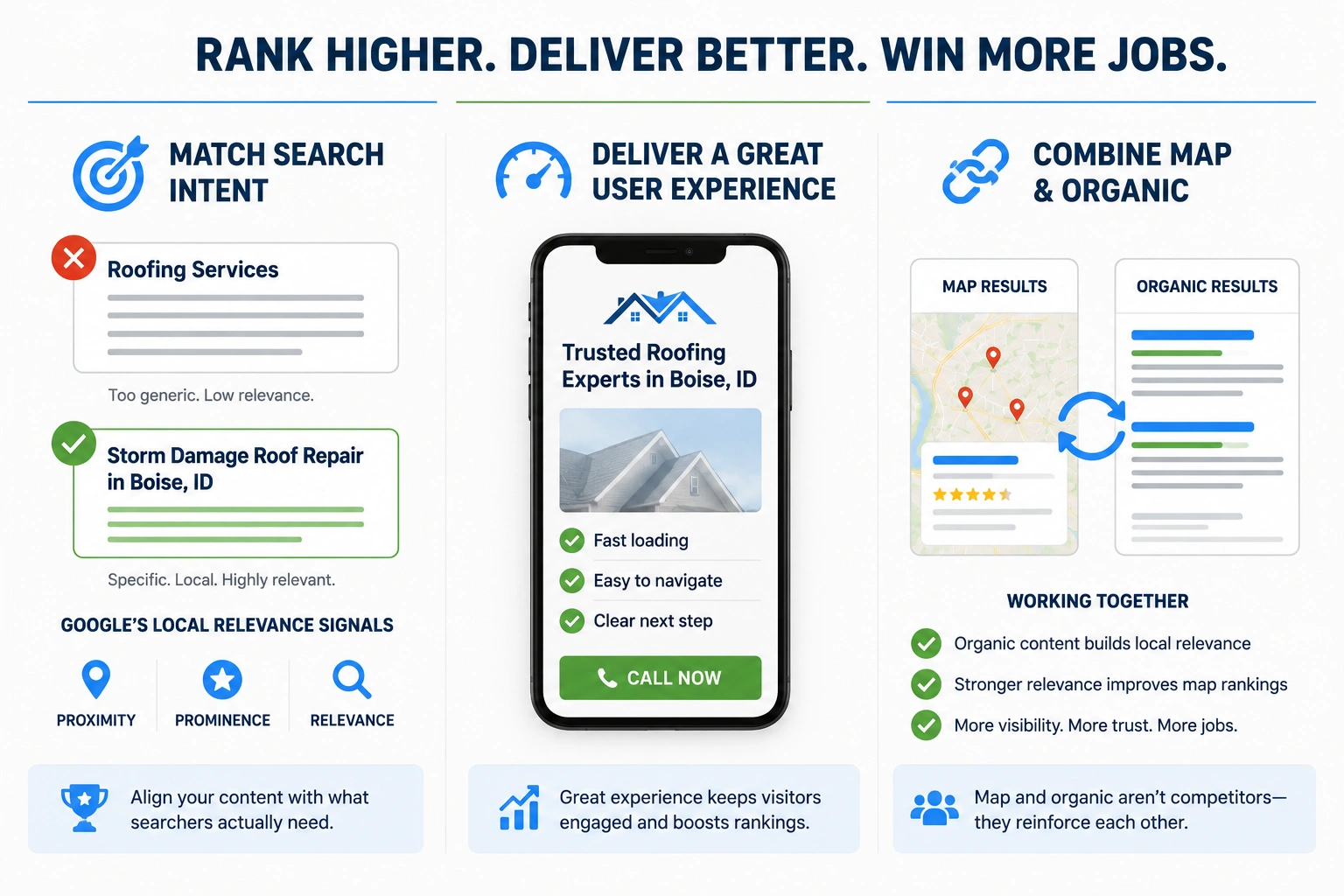
A visual overview of how search intent, website usability, and combined map and organic SEO improve local roofing visibility.
Rebuilding the website foundation for speed and search visibility
Mobile page speed optimization
Our partner, a roofer in Southwest Idaho, saw their mobile site load in 8.2 seconds before we started working together. After rebuilding the site on WordPress with compressed images, cleaned-up plugins, and proper caching, that figure dropped to 1.4 seconds, a 6.8-second improvement that immediately reduced bounce rates and signaled technical health to Google’s crawlers.
Speed isn’t a nice-to-have. Seconds cost jobs. Google’s Core Web Vitals directly influence search rankings, and mobile users abandon sites that take longer than three seconds to load at a rate exceeding 50%. For a roofing contractor whose primary audience is a homeowner standing in a wet living room searching on their phone, a slow site is a closed door.
Multi-location website architecture
Rather than consolidating all service information onto a handful of generic pages, we built 70 dedicated service area pages, with each page mapped to a specific county or city within the contractor’s operating territory. Every page carried unique, localized content: references to regional weather patterns, local permit requirements, and neighborhood-specific project examples. This approach circumvents duplicate content penalties while giving Google granular geographic signals to work with.
The architecture functions as a geographic grid, with each node reinforcing the contractor’s relevance for a specific local search query. Contractors operating across multiple counties without this structure are essentially asking Google to guess where they work. Google hates guessing. For contractors evaluating whether to build this infrastructure in-house or through a partner, BizIQ’s organic SEO services include exactly this type of multi-location page development.
Technical Optimization Steps:
- Implement a mobile-first responsive design with click-to-call buttons.
- Compress all project images and utilize modern web formats (WebP).
- Enable browser caching and clean up bloated code/plugins.
- Set up proper XML sitemaps and submit them via Google Search Console.
Optimizing Google Business Profile to dominate the local map pack
Optimizing your Google Business Profile is the fastest way to appear in local map pack results. Map listings drive immediate calls.
Strategic category and service selection
Managing the Google Business Profile for roofers is one of the most underutilized levers in local map rankings. Setting the primary category to Roofing Contractor is the baseline, but adding secondary categories like “Gutter Service,” “Waterproofing Specialist,” or “General Contractor” expands the surface area of searches where the business becomes eligible to appear. Each secondary category is an additional keyword cluster the profile can rank for without any additional content work.
The services list within your profile functions similarly. A fully populated services section, with individual entries for residential roofing, commercial roofing, roof repair, storm damage restoration, and inspection services, gives Google’s algorithm more data points to match against incoming search queries. Contractors who leave this section incomplete are voluntarily narrowing their visibility. Details matter.
Building a review generation system
Businesses occupying the top three map pack positions typically carry 200% more reviews than competitors ranked below them (Big Leap, 2024). That gap doesn’t close by asking satisfied customers to “leave us a review sometime.” Hope is not a strategy. It closes through a systematic, automated process: a review request sent via SMS or email immediately after job completion, with a direct link to the Google review form.
Responding to every review, positive and critical alike, using natural, localized language signals active business operations to Google’s algorithm. A profile with 200 reviews and zero responses reads as neglected. One with 80 reviews and consistent, direct responses reads as engaged.
GBP Optimization Checklist:
- Claim and fully verify your Google Business Profile.
- Write a detailed business description utilizing localized keywords.
- Upload high-resolution photos of actual local jobs weekly.
- Respond to every review, both positive and negative, using natural, localized language.
Ready to stop relying on expensive, shared leads that get sold to five of your competitors?
Let’s build a predictable, organic lead machine for your business.
Creating high-intent service pages and targeted local content
Keyword research and content mapping
Keyword research for a roofing campaign isn’t about finding the highest-volume terms; it’s about identifying the specific phrases homeowners in your service area type when they’re ready to spend money. Google Search Console surfaces the queries your site already ranks for, showing us the voids where competitors are capturing traffic you’re missing. Keyword research tools extend that analysis to competitor domains, revealing which localized terms are driving their lead volume.
We built dedicated service pages for residential roofing, commercial roofing, roof repair, and storm damage restoration, with each page targeting a distinct cluster of high-intent search terms. None of these pages competed with each other because each addressed a different stage of the homeowner’s decision process. Clarity prevents confusion. For contractors starting this process from scratch, this resource on roofing SEO keywords provides a practical starting inventory.
Local schema markup integration
Schema markup is the part of technical search optimization that most contractors skip because it’s invisible to users. That’s a mistake. Local business schema tells search crawlers the precise geographic boundaries of your services, your business hours, your service categories, and your contact information, all in a structured format that eliminates ambiguity. Think of it as a digital business card written in a language Google reads fluently, rather than one it has to interpret from your page copy.
When schema is implemented correctly alongside localized service pages, the combined signal is significantly stronger than either element alone. We integrated schema across all 70 service area pages, giving Google a precise map of the contractor’s operating territory.
Educational blog content serves a function that service pages can’t: it builds trust with homeowners who are still in research mode. A post explaining how to identify hail damage, what an insurance adjuster looks for during a roof claim inspection, or how long different roofing materials realistically last in high-wind environments positions the contractor as a knowledgeable resource, not just a vendor. That trust carries forward when the homeowner is ready to request an estimate.
Informational content also feeds Google’s topical authority signals. A roofing site with 40 pieces of content covering every dimension of residential and commercial roofing, including materials, weather damage, maintenance, insurance, and local building codes, ranks with more authority than a site with five service pages and nothing else. The algorithm reads breadth of coverage as a trustworthiness indicator. Authority must be earned.
Schema markup is simply a digital map that guides Google straight to your office door, translating technical details into clear geographic signals that search engines use to verify your service area.
“The improvement in our local visibility has been remarkable. Homeowners across our service areas are finding us more easily through search and Google Maps. Traffic, calls, and leads have all grown steadily since optimizing our organic SEO.”, Director of Operations, Southwest Idaho Roofing Contractor
The measurable impact of organic search optimization
Quantified lead growth and traffic metrics
The Southwest Idaho campaign’s numbers are highly revealing. The growth was substantial. Monthly leads climbed from 43 to 163 over eight months, which is a 280% increase, but the more telling figure is the organic lead trajectory: from 4 free leads per month to 68. That shift represents a structural change in how the business acquires customers, not a temporary spike driven by a promotion or a seasonal weather event.
A Raleigh-based contractor documented by LocalMighty (2024) achieved a 275% increase in organic leads through a comparable localized content and map optimization campaign. These aren’t outliers. They’re consistent with what happens when a roofing website is rebuilt around search intent rather than around what the contractor wants to say about themselves. For additional documented outcomes across industries, BizIQ’s case studies provide a range of comparable benchmarks.
Cost-per-lead reduction analysis
Our partner entered the campaign paying a high Google Ads cost-per-lead of $74. After organic rankings matured and began generating consistent inbound volume, the same monthly ad budget produced leads at $22 each, representing a 70% cost reduction without cutting spend. The organic traffic was effectively subsidizing the paid campaign by reducing the total lead volume that ads needed to cover.
We’ve seen this compounding dynamic time and again. It separates organic search visibility from paid search as a long-term strategy. Paid ad costs fluctuate with competitor bidding behavior and Google’s auction mechanics. Organic rankings, once established through consistent optimization, don’t disappear when a competitor increases their ad budget. They insulate the business from that volatility entirely. Stability matters.
The operational outcomes of that lead volume growth were concrete. The contractor hired two additional crew members and purchased a second work truck to handle the increased inspection and project demand. That’s not a marketing metric, that’s a business that scaled because its digital infrastructure finally matched its capacity to do the work.
Eliminating citation inconsistencies and building local authority
Auditing and cleaning up local citations
NAP consistency, which is the alignment of your business Name, Address, and Phone number across every directory where your business appears, is one of those foundational issues that’s easy to overlook and expensive to ignore. A contractor who changed their phone number two years ago and updated their website but left the old number on Yelp, BBB, and Angi has effectively given Google three conflicting data points about who they are. Search crawlers don’t resolve that conflict in your favor. Consistency is key.
Resolving citation inconsistencies can improve local search rankings by over 200 positions across target keywords (Big Leap, 2024). That figure sounds dramatic until you consider how many directories collect incorrect data over a business’s lifetime: address changes, phone number updates, rebranding, each one quietly undermining the local authority signals the rest of the campaign is trying to build.
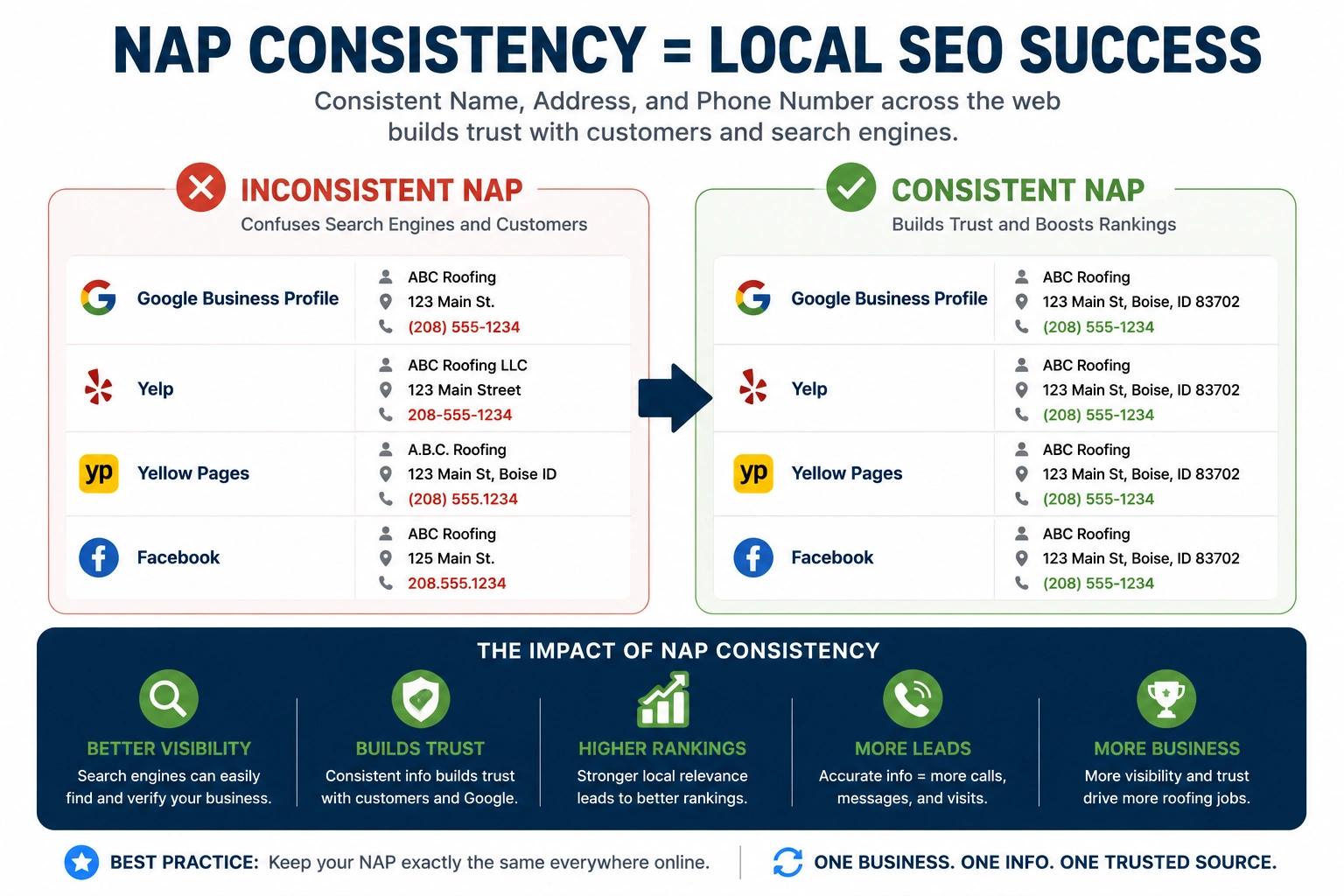
See how consistent business name, address, and phone information strengthens local SEO, rankings, and customer trust.
Local backlink acquisition
Earning local backlinks from a local chamber of commerce, a regional home improvement blog, or a community youth sports team sponsor page carries geographic relevance that a generic directory link cannot match. When a Boise-based organization links to a Boise roofing contractor’s website, that link tells Google something specific about where the business operates and who vouches for it. Volume matters less than geographic and topical precision. Quality beats quantity.
Citation Cleanup and Link Building Steps:
- Audit all existing listings using tools like Semrush to find duplicate or incorrect NAP data.
- Correct mismatched phone numbers and addresses on major directories.
- Submit your business to authoritative, localized home service directories.
- Sponsor local community events or youth sports teams to earn high-quality, local backlinks.
Shifting from broad keywords to local search intent
The danger of high-volume national keywords
Ranking for “how to repair a roof” generates web traffic. It generates almost no roofing leads. Traffic is not revenue. The homeowners searching that phrase are watching YouTube tutorials and reading DIY forums, they’re not requesting estimates. Focusing on geo-targeted keywords like “roof repair contractor in Nampa Idaho” or “emergency roof inspection Caldwell” attracts a completely different audience: people with a specific problem, a specific location, and a budget to solve it.
Contractors who build their content strategy around national search volume figures rather than local search intent end up with impressive traffic dashboards and empty inspection calendars. The fix isn’t complicated, but it requires discipline: every piece of content on the site should be evaluated against one question: does this attract a homeowner in my service area who is ready to hire someone? For a detailed look at how to build that kind of targeted digital presence, digital marketing for roofing companies covers the full strategic framework.
Aligning search intent with services
High-intent search terms like “emergency roof repair near me” or “roof replacement estimate [city name]” should map directly to localized landing pages with a quote-first UX: a prominent contact form above the fold, minimal required fields, and a clear call-to-action that removes obstacles from the conversion path. High-intent organic leads often achieve a lead-to-job close rate exceeding 50% (EstateHub, 2026), which means the quality of the traffic matters as much as the volume.
Landing pages built for this traffic should ask only for what’s necessary: name, phone number, and service type. Every additional field is a reason for a stressed homeowner to abandon the form and call the next result on the page. Keep forms short.
Aligning content with emerging AI search engines
Optimizing for generative engine optimization (GEO)
AI-driven search engines, such as ChatGPT, Gemini, and Perplexity, don’t crawl and rank pages the way traditional search engines do. They retrieve information from sources they’ve determined to be authoritative and well-structured, then compile answers. Search is changing. Generative Engine Optimization means structuring content so that these systems can extract clear, factual answers from it without ambiguity.
Answer-First layouts work here for the same reason they work in featured snippets: the answer appears before the supporting detail, making it easy for both AI systems and human readers to extract value immediately. A roofing page that opens with “Storm damage roof repair in [city] typically takes one to three days depending on the extent of the damage” is more likely to be cited by an AI engine than one that opens with three paragraphs of company history.
Securing brand mentions in AI search
The campaign secured an AI visibility score of 26 with 168 brand mentions by structuring content around Q&A formats and integrating local schema markup throughout the site. Those brand mentions represent the business appearing in AI-generated responses when homeowners ask search assistants about roofing contractors in their area, a distribution channel that didn’t exist five years ago and is growing rapidly.
AI engines analyze review sentiment alongside content structure when endorsing local service providers. A contractor with 150 Google reviews averaging 4.8 stars and a well-structured website is a credible recommendation for an AI system to surface. One with 12 reviews, a slow site, and inconsistent citations is not. Credibility matters to AI. The reputation management work and the content work are not separate campaigns; they feed the same authority signals.
Frequently asked questions about roofing SEO
Common questions from roofing contractors
Answering these questions directly on your website captures long-tail search traffic and positions your pages for featured snippets on the search engine results page: the zero-position placements that appear above all organic results and generate clicks without requiring the user to scroll.
How long does it take to see results from local SEO for roofing companies?
Most roofing contractors begin to see measurable improvements in search rankings and organic lead volume within 90 to 180 days of launching a focused local campaign. Achieving top-three map rankings and maximum lead volume typically requires six to twelve months of consistent optimization and review generation.
What is the most important ranking factor for roofing SEO?
For local map rankings, the most critical factors are your physical proximity to the searcher, the completeness and optimization of your Google Business Profile, and the volume and sentiment of your Google reviews. For organic search results, high-quality localized content and strong local backlinks are the primary ranking drivers.
Should a roofing company focus on Google Maps or organic search results?
A successful digital strategy must target both. Google Maps listings capture immediate, high-intent mobile searches from users needing urgent repairs, while organic search results capture homeowners researching larger projects, such as full roof replacements, material comparisons, or insurance claim guidance.
How do you track organic roof inspection bookings?
Implement dynamic number insertion (DNI) to trace phone calls back to organic search sessions. Additionally, set up custom event tracking in Google Analytics 4 (GA4) to monitor form submissions, click-to-call actions, and online scheduling tool completions.
What is the 25% rule for roofing?
The 25% rule states that if more than 25% of an existing roof is replaced or repaired within any one-year period, the entire roof must be brought up to current building code standards. Answering technical questions like this on your website builds substantial E-E-A-T (Experience, Expertise, Authoritativeness, Trustworthiness) with both Google and homeowners who are navigating an unfamiliar process.
The path from third-party lead dependency to owning your local search market starts with a clear-eyed audit of what you currently have. Pull up Google PageSpeed Insights and run your mobile site: if the score is below 70, that’s your first priority. Open your Google Business Profile and confirm the primary category reads “Roofing Contractor,” not something adjacent that made sense when you first set it up. Check your NAP data on Yelp, BBB, and Angi against what’s on your website. Accuracy builds trust. These aren’t exciting tasks, but they’re the foundation every other optimization sits on.
Our partner, a roofer in Southwest Idaho, didn’t double their weekly inspection bookings by discovering some obscure algorithm trick. They did it by executing a structured, multi-month campaign that addressed technical performance, local relevance signals, content depth, and conversion architecture simultaneously. The results compounded because the work compounded. Contractors who want to replicate those outcomes need a partner who understands both the technical requirements and the local market dynamics. Finding the right local SEO company is as consequential as any single optimization tactic in this playbook.
Don’t let your competitors capture all the high-value roofing leads in your city.
Contact BizIQ Today to secure your local market and start doubling your weekly roof inspection bookings.