
- Align search terms with the multi-stage B2B procurement cycle.
- Target high-intent decision-makers instead of low-value residential searchers.
- Capture multi-million dollar contracts by optimizing for specific commercial project types.
- Use authoritative industry data to build trust with enterprise developers.
B2B property developers and corporate real estate executives do not search the web like residential homeowners. When a developer assesses partners for a $50 million office build-out or a regional logistics warehouse, they bypass generic search terms. Instead, they use highly specific, procurement-aligned phrases that filter out residential builders before the first phone call happens. Winning those contracts requires a sophisticated approach to commercial construction SEO. Precision is key. By mapping your content strategy to the exact phases of the commercial procurement cycle, you position your firm as the credible authority before the formal Request for Proposal (RFP) ever lands in an inbox.
The scale of the commercial construction market makes this worth getting right. According to the US Census Bureau, total nonresidential construction spending reached a historic seasonally adjusted annual rate of $729.8 billion in early 2026. That figure isn’t background context: it represents the pool of contracts your search strategy is either capturing or missing. IBISWorld reports that the U.S. Commercial Building Construction industry alone accounts for a $315.5 billion market in 2026. Decision-makers within that sector, including corporate real estate directors, healthcare facility managers, and industrial developers, rely on search engines to pre-qualify partners, evaluate past performance, and research compliance standards long before they pick up the phone.
Decoding Search Intent: Mapping Keywords to B2B Contracts
B2B buyers do not make hasty decisions. In commercial construction, search queries function as risk-mitigation instruments: a way for executives to filter the field before committing internal resources to a formal vetting process. Understanding how that filtering works is the prerequisite for every keyword decision you make.
Search intent in this space clusters into three distinct phases, each with its own vocabulary:
- Informational Intent: The searcher is building knowledge or evaluating feasibility, for example, ‘how to vet a commercial contractor’ or ‘commercial construction cost per sq ft’.
- Commercial Investigation: The searcher is comparing delivery methods, service providers, or project approaches, such as ‘design-build vs design-bid-build for office buildout’.
- Transactional Intent: The searcher is ready to act: request a quote, submit a prequalification package, or issue an RFP, like ‘commercial general contractor in Chicago’.
Most contractors optimize exclusively for transactional terms and ignore the first two stages entirely. That’s a costly miscalculation; or more precisely, it’s a pipeline problem that masquerades as a lead volume problem. It stalls growth. The Accenture B2B Buyer Experience Report identifies the initial information search and vendor comparison phases as the highest-friction points in the B2B buying journey. In commercial construction, that friction exists because executives struggle to find transparent, verifiable data about contractor capabilities, safety records, and financial stability.
SEO is like building a foundation: invisible once done right, but everything rests on it. A contractor who publishes authoritative content at the informational and investigation stages earns trust before the competitive bidding process begins, occasionally shaping the project’s parameters well enough to sidestep open bidding altogether.
The Commercial Construction Search Funnel
| Stage | Phase | Example Keywords |
|---|---|---|
| Stage 1 | Informational: Feasibility & Budgeting | ‘commercial construction cost per sq ft’, ‘commercial building feasibility study’ |
| Stage 2 | Commercial Investigation: Vetting & Delivery Methods | ‘design-build vs design-bid-build’, ‘AIA A305 contractor qualification statement’ |
| Stage 3 | Transactional: Procurement & RFP | ‘commercial general contractor [City]’, ‘commercial building contractor near me’ |
High-Value Commercial Construction Keywords List
Search volume numbers in this space are misleading. Volume isn’t value. A term pulling 880 monthly searches can be worth more than one pulling 54,000, because the 880 searchers are procurement officers with active project budgets, not homeowners browsing renovation ideas. The keywords that matter most here are the ones that signal institutional intent, not curiosity.
Core Commercial Terms
These baseline searches are used by developers to identify established commercial builders in their target markets. They are competitive, but they are non-negotiable entry points for any firm serious about organic lead generation.
| Keyword | Monthly Searches | Est. CPC | Intent |
|---|---|---|---|
| commercial construction | 5,400 | $4.31 | Informational / Commercial |
| commercial construction companies | 2,900 | $4.93 | Commercial Investigation |
| industrial construction companies | 2,900 | $5.50 | Commercial Investigation |
| commercial construction contractor | 2,400 | $8.50 | Transactional |
| commercial construction company | 1,600 | $7.20 | Commercial Investigation |
| commercial builders | 1,300 | $6.80 | Transactional |
| commercial building contractor | 880 | $11.26 | Transactional |
| commercial general contractor | 590 | $9.50 | Transactional |
The $11.26 CPC for commercial building contractor is telling. The intent is real. Advertisers do not bid that heavily on terms that do not convert, which means the organic equivalent carries proportional contract value for firms willing to earn it through content rather than paid placement.
Niche Project and Asset Terms
Executives searching for specific asset classes use these terms to find contractors with directly relevant, proven experience. A developer sourcing a partner for a cold storage facility isn’t searching for a generic commercial builder. They are searching for someone who has built cold storage before. Specificity wins.
- tenant improvement contractor
- warehouse build-out contractor
- medical office buildout
- industrial facility contractor
- multifamily construction contractor
These terms carry lower search volumes, but the conversion rate to RFPs is substantially higher than broad commercial terms. A developer who finds your case study for a 200,000 sq ft warehouse build-out while searching warehouse build-out contractor has already self-qualified.
Vetting and Risk-Reduction Terms
These queries signal active due diligence. Trust is on the line. A decision-maker searching for ‘AIA A305 contractor qualification statement’ or ‘contractor bonding capacity’ is not browsing: they are building a shortlist. Firms that publish detailed content around these terms intercept buyers at precisely the moment they are evaluating partners.
- commercial contractor prequalification checklist
- contractor bonding capacity
- AIA A305 contractor qualification statement
- commercial contractor safety record OSHA
- commercial contractor financial capacity
B2B Partner Evaluation Phrases
These long-tail phrases are used by institutional developers seeking long-term strategic alignment rather than a one-off project vendor. Search volumes are often minimal in standard keyword tools, sometimes fewer than ten searches per month globally, but a single contract won through one of these queries can represent years of revenue.
- strategic development partner for multifamily
- preferred builder program
- builder track record review
- construction partner for developers
There is no clean way to quantify the ROI on these terms through standard analytics. But they matter. The honest answer is that you are investing in brand positioning as much as search visibility, and the attribution will always be imperfect.
Building a Winning B2B Construction Marketing Strategy
Keyword research without page architecture is just a list. The operational shift that separates high-performing construction firms from the rest is the move from generic blogging to structured keyword-to-page mapping: assigning one primary, high-intent keyword to each service, industry, and location page so that search engines can precisely match your capabilities to the queries of property developers.
A disciplined approach to structuring these pages is what moves the needle for contractors. Content marketing is like showing up to the bid on time: consistency builds reputation. If your site looks abandoned or reads like generic filler, developers will assume your job sites are run the same way.
A well-structured B2B marketing framework for commercial construction typically operates across four execution layers:
1. Keyword-to-Page Architecture Audit your existing site and assign one primary keyword to each service page, asset-class page, and geographic page. ‘Medical office buildout’ gets its own page. ‘Warehouse build-out contractor in [City]’ gets its own page. Generic service pages that try to rank for everything rank for nothing.
2. High-Value Lead Magnets Anonymous executive traffic is the most overlooked asset in commercial construction marketing. A downloadable prequalification checklist or a structured guide converts that traffic into a warm business development pipeline. Procurement officers who download your checklist have already signaled their intent: your team should be following up quickly.
3. Structured Project Case Studies Photos are not case studies. A genuine case study for a B2B audience addresses the concerns that procurement officers carry into their research: scope, schedule, budget adherence, safety incident rates, and regional permitting complexity. For example, we looked at how one commercial general contractor client in Ohio increased their qualified inbound bids by 42% within six months using this exact strategy. We lay out the exact process so you can see what works.
4. Native Conversion Points Avoid intrusive pop-ups. Interweave context-relevant CTAs within your content: a custom budget calculator embedded in an article about commercial construction costs, for instance, or a prequalification form linked from within a case study. The conversion happens because the offer is relevant, not because the pop-up was unavoidable.
When marketing a construction company at the commercial level, the instinct to chase high-volume terms is understandable but counterproductive. A firm that ranks on page one for ‘commercial building contractor in Atlanta’ with a well-structured, proof-heavy service page will consistently outperform a competitor who ranks for ‘construction company’ with a generic homepage.
Targeting Commercial General Contractor SEO
When studying commercial general contractor SEO, you need to understand what to look for in a marketing partner. You might worry that marketing agencies do not understand the construction industry, and you are right to be skeptical. Many agencies treat a commercial builder like a retail boutique, pushing generic traffic instead of real contract value. Here are the questions to ask before you hire: They must understand the commercial procurement cycle, demonstrate how another construction company increased its qualified leads, and outline their exact process for filtering out residential searchers.
Transactional terms like ‘general construction contractor near me’ and ‘remodel general contractor near me’ do pull local volume, but your landing pages must make a clear distinction between commercial capabilities and residential services. A developer evaluating your firm for a $20 million tenant improvement project who lands on a page that also advertises kitchen remodels will move on. The positioning signals do not match the procurement context. They must align.
Licensing and compliance content deserves its own dedicated real estate on your site. Real estate executives and procurement officers actively search for terms like ‘general contractor license’, ‘nc general contractor license’, ‘north carolina general contractor license’, and ‘general contractor permit’ as part of their due diligence process. Addressing these queries directly, explaining what compliance looks like in your operating markets, what your bonding capacity is, and how your firm handles permitting across different jurisdictions, builds the kind of institutional credibility that generic service pages cannot manufacture.
Content explaining ‘what does a general contractor do’ and ‘how to become a general contractor’ may seem too basic for a B2B audience, but these queries attract developers who are evaluating whether a firm understands its own scope of work. Framing these topics within a commercial compliance context, rather than a consumer education context, positions your firm as an authority rather than a tutorial site.
Here is what you can expect: we do not offer vague promises. We provide transparent pricing, clear deliverables, and a clear path to ranking for the terms that matter.
“In commercial contracting, search engine optimization is not about driving raw traffic volume; it is about positioning your firm as the low-risk, highly compliant authority for the exact project types your team excels at executing.” ; Senior B2B Construction Strategist
Demonstrating your local subcontractor network depth is equally important. Developers want evidence that you can mobilize quickly and navigate regional municipal processes without friction. Naming specific subcontractor relationships, documenting your history with local building departments, and publishing content about regional zoning nuances all contribute to the geographic authority signals that influence both search rankings and procurement decisions.
Calculating ROI on Commercial Construction SEO
Commercial construction has a multi-month, often multi-year, offline sales cycle. Calculating the return on investment for organic search in this environment requires a fundamentally different measurement architecture than what most marketing teams are used to, and many firms simply do not have it yet. If you are wondering how to calculate return on investment, the answer lies in tracking the offline loop.
Closed-loop reporting is the prerequisite. Your CRM must be configured to capture the original organic search query that initiated a prospect’s first website interaction, then carry that attribution data through every subsequent touchpoint: whitepaper download, prequalification form submission, RFP request, contract award. Without that chain, you are left attributing multi-million dollar contracts to ‘direct traffic’ because the sales cycle crossed a browser session boundary.
The keyword volume data reinforces why this investment is justified. Commercial building contractor generates only 880 monthly searches nationally, but its $11.26 CPC reflects the commercial density of that audience. A single contract won through that term can yield returns that make the entire annual SEO budget look like a rounding error. The real question isn’t whether you can afford to invest in search visibility: it’s whether you can afford to stay invisible while your competitors capture the market.
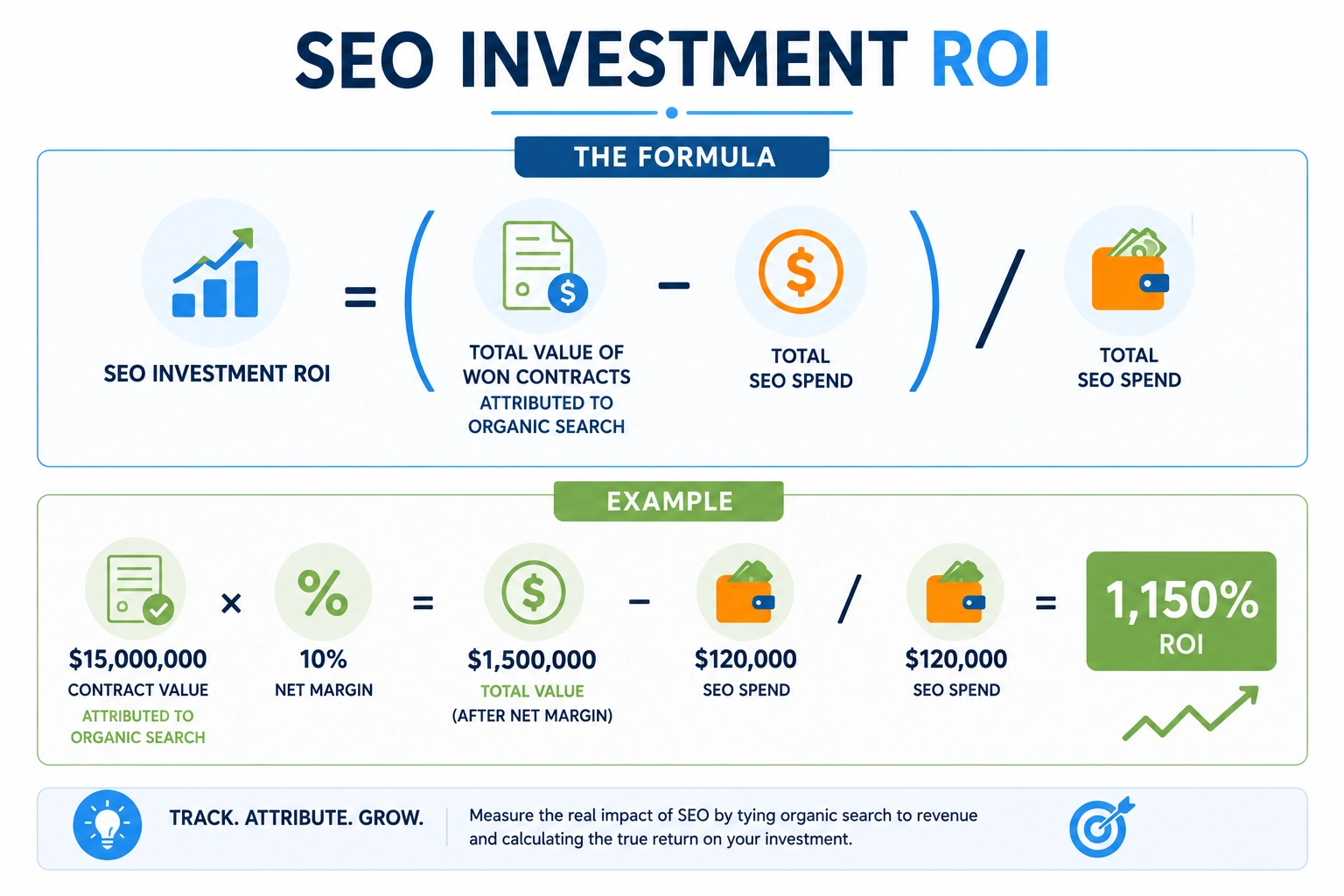
This infographic explains the SEO ROI formula with a real-world example demonstrating how organic search revenue translates into measurable return on investment.
Micro-conversions are your leading indicators. Whitepaper downloads, prequalification form submissions, and RFP document views do not close contracts on their own, but they map the trajectory of a deal weeks or months before it surfaces in your CRM as a formal opportunity. Track them with the same rigor you would apply to a late-stage pipeline metric, because in a long sales cycle, they effectively are late-stage signals. Results vary, but here’s what we typically see: early-stage touchpoints begin to climb within the first three to six months, followed by formal RFPs as search positioning solidifies.
Want to see how organic search can transform your pipeline? Get a free Commercial Construction Marketing ROI Consultation to estimate your potential return based on average contract value and close rates.
Integrating Essential NLP Entities & Search Phrases
Modern search engines do not just match keywords: they evaluate topical authority by analyzing the relational density of entities within your content. To rank competitively for commercial construction keywords, your pages need to reflect the full conceptual landscape of the topics they address, not just the primary keyword in the title tag.
Several entity clusters carry particular weight in this space. Focus on these.
Design-Build vs. Design-Bid-Build These delivery method comparisons are among the most actively researched topics by developers evaluating project execution strategies. Targeting ‘design build contractors near me’ and ‘design build vs design bid build’ requires more than a paragraph: it requires a structured, authoritative explanation that addresses the procurement implications of each model, including cost certainty, schedule risk, and owner involvement. Developers comparing these methods are often in the feasibility phase, which makes this content an early-funnel capture opportunity with long-term pipeline value.
Prefabrication and Modern Construction Methods Efficiency-focused queries around ‘what is prefabrication in construction’ and ‘prefabrication in construction industry’ are increasingly common among developers evaluating schedule compression and cost reduction strategies. Firms that publish substantive content on prefabrication signal operational sophistication to both search engines and the procurement officers who find them.
Specialized Structures Industrial developers searching for ‘steel building’ and ‘steel building kits’ represent a specific, high-value segment. These searches often originate from logistics, manufacturing, and agricultural developers with active project budgets and a preference for contractors who understand pre-engineered building systems.
Professional Standards and Certifications Mentioning ‘project management professional certifications’ within your content signals institutional capability. It is a small signal, but in aggregate with other professional entity markers, such as bonding capacity, OSHA records, and AIA compliance, it contributes to the trust architecture that procurement officers are evaluating.
For firms learning how to choose keywords for SEO in this environment, the practical implication is this: entity integration isn’t a checklist exercise. It is a byproduct of writing content that genuinely covers a topic with the depth a procurement officer would expect from a qualified partner.
Structuring for AI Overviews AI-driven search engines combine content from multiple sources to answer complex queries. A developer asking an AI assistant ‘which commercial contractors in Dallas have experience with LEED-certified cold storage?’ is triggering a synthesis process that rewards structured, direct, entity-rich content. Format your most authoritative content with clear Question-and-Answer structures, not as a gimmick, but because direct answers to specific questions are what AI models extract and surface.
Bidding Tips & Procurement Strategy
The commercial procurement process is structured, sequential, and heavily document-driven. Procurement officers who are actively drafting RFPs have already completed significant internal research: they have defined project scope, established preliminary budgets, and begun assembling a shortlist of qualified firms. By the time an RFP is published, the contractors who shaped the conversation during the feasibility phase have a measurable advantage.
Targeting the feasibility phase is where content strategy meets most directly with commercial construction project bidding tips. Developers researching ‘commercial building feasibility study’ or ‘construction contract lead generation’ are in the early stages of budgeting and scope definition. High-quality cost guides, feasibility templates, and regional permitting overviews published at this stage allow your firm to influence project parameters before the competitive bidding process begins, and occasionally to establish a preferred-vendor relationship that makes the formal RFP a formality rather than a competition.
Safety and compliance content deserves prominent placement, not a buried footnote. Put it front and center. Procurement officers are structurally risk-averse; their job is to protect the organization from contractor failures, not to find the most creative builder. Prominently featuring your OSHA safety records, bonding capacity, and insurance documentation, and making that information easy to find during an initial search, removes friction from the vetting process and signals that your firm understands what institutional buyers need to see.
Local SEO vs. National Commercial Bidding
Commercial construction is fundamentally local. A developer breaking ground on a distribution center in Charlotte isn’t searching for the largest national contractor: they are searching for a firm with established relationships in the Charlotte building department, a proven local subcontractor network, and documented experience navigating North Carolina permitting requirements. National brand recognition matters less than regional operational credibility.
A disciplined local search engine optimisation strategy for commercial contractors centers on three execution priorities:
Geographic Service Pages Dedicated pages optimized for terms like ‘commercial general contractor in [City Name]’ or ‘industrial builder in [State Name]’ are not optional: they are the primary mechanism through which regional developers find qualified local partners. Each page should address the specific municipal and regulatory context of that market, not just swap a city name into a template.
Google Business Profile Management Your Google Business Profile is your digital job site sign; it tells people you’re open for business. Keep it updated. Regularly publishing project updates, high-resolution job site photography, and verified client testimonials directly influences your visibility in the local Map Pack for high-intent searches. The firms that capture leads through local search are the ones treating their Google Business Profile as an active marketing channel rather than a directory listing.
Local Entity Signals Consistent Name, Address, and Phone (NAP) data across all directories, structured schema markup on location pages, and locally-relevant content that references specific municipalities, zoning codes, and regional subcontractor relationships all contribute to the geographic authority signals that determine local search rankings. This is where the digital marketing infrastructure your firm builds compounds over time: each local signal reinforces the others.
There is a reasonable debate about how much to invest in national informational content versus hyper-local transactional pages. The honest answer is that it depends on your business development model. Firms that compete for regional contracts across multiple markets need both. Firms that operate in a single metropolitan area should weight their investment heavily toward local authority signals and geographic service pages.
Frequently Asked Questions
What is the difference between informational and transactional intent in commercial construction SEO?
Informational intent happens when a user searches for educational resources, guides, or industry standards, for example, ‘how to write a commercial construction contract’ or ‘commercial construction cost per sq ft’. Transactional intent occurs when a user is ready to hire or request a bid, such as ‘commercial general contractor near me’. Transactional terms drive immediate leads, but informational terms allow contractors to build trust with developers during the planning stages, establishing credibility before the bidding process begins. Firms that only optimize for transactional terms are entering the conversation too late. They miss early opportunities.
How do real estate executives search for construction partners?
Real estate executives and property developers conduct highly focused, risk-mitigating searches focused on verifying a contractor’s track record, safety history, and financial capacity. Common search queries include ‘AIA A305 qualification statement’, ‘contractor bonding capacity’, and ‘commercial contractor safety record OSHA’. They rely heavily on case studies, professional networks, and prequalification checklists to build their shortlists. Proof is non-negotiable. The search behavior is less about discovery and more about verification: they often already have a candidate in mind and are using search to confirm or disqualify.
Why are listicle keywords effective for B2B construction marketing?
Listicle structures, such as ‘top commercial contractors in [city]’ or ‘essential contractor vetting criteria’, perform well because they match the comparative mindset of institutional buyers. Real estate executives must evaluate multiple options to satisfy internal procurement policies, and a well-structured listicle provides a scannable format that reduces the difficulty of that comparison process. The format also signals organizational thinking, which is itself a credibility signal for firms that can demonstrate they understand how procurement decisions get made. Structure builds trust.
What role does local SEO play in commercial contractor selection?
Local SEO is critical because commercial construction is geographically limited. Location dictates execution. Developers search for partners with local municipal experience, established regional subcontractor networks, and knowledge of area permitting laws. Optimizing through localized service pages, like ‘commercial build-out contractor in Atlanta’, and maintaining an active Google Business Profile ensures your firm surfaces when developers search for regional expertise. A national reputation without local search visibility is an invisible asset in most procurement contexts.
How do we target corporate developers who use formal RFP processes?
Corporate developers and procurement officers conduct extensive online research before issuing an RFP. They start early. Publishing detailed case studies, feasibility guides, and cost-estimation content optimized for terms like ‘commercial building feasibility study’ or ‘office build-out cost’ captures their attention during the pre-planning phase. The goal is to be the firm that shaped their thinking about what a project should look like, not just one of several names on a shortlist they assembled independently.
Aligning your digital presence with the search behavior of B2B decision-makers is the most reliable mechanism for building a reliable pipeline of high-value commercial construction leads. At BizIQ, we understand that sophisticated marketing belongs to businesses of every size, not just enterprise brands with dedicated in-house teams. We are a small business ourselves, and we have built our evidence-based approach specifically to give firms like yours the same strategic leverage that larger competitors take for granted.
Moving away from generic, high-volume keywords and toward procurement-aligned, project-specific search terms is not a minor tactical adjustment: it is a repositioning of how your firm shows up in the market. Our approach to commercial construction SEO is built around identifying the exact commercial contractor search terms that map to real contract value, then building the content architecture and local authority signals that make your firm the credible choice when developers are ready to act. Results vary because every business is different, but we focus on what moves the needle for contractors. Let’s work together to build a pipeline that supports your growth.
Ready to build a search strategy that maps directly to your target contract values?
Partner with the B2B SEO experts who understand how commercial construction procurement actually works. Let’s build a custom keyword strategy around the projects you want to win.