- Paid advertising bans on Google and Meta make traditional customer acquisition nearly impossible for cannabis brands.
- LegitScript certification is incredibly expensive, costing upwards of $4,350 in the first year alone for just three topical CBD products.
- Organic search (SEO) serves as a compounding asset that continues to drive traffic and revenue long after the initial setup.
Why is Organic Search the Single Most Reliable Growth Engine for a Cannabis Brand Compared to Traditional Digital Marketing?
For cannabis and CBD business owners, the digital marketing environment feels like a game where the rules are rigged against you. The moment you try to run a standard Google or Meta ad campaign, you are hit with immediate account suspensions and ad disapprovals. You are effectively locked out of paid ads while your non-cannabis neighbors scale their businesses with ease. It is a frustrating double standard.
This is because major advertising platforms enforce a strict dangerous product classification on cannabis, grouping legal dispensaries alongside illicit substances. While other local businesses can simply buy their way to the top of search results, cannabis brands are forced to find a more durable, reliable path to visibility. This is where a dedicated cannabis SEO strategy becomes your most valuable business asset: not a fallback option, but the primary growth engine your operation should be building around.
The financial and regulatory reality of paid ad bans
Google and Meta’s strict prohibitions
- Google Ads Policy: Google’s “Dangerous products or services: Recreational drugs” policy strictly bans cannabis flower, edibles, concentrates, and accessories (Google Ads Policy).
- Meta Ads Policy: Meta’s ad standards prohibit promoting the sale of THC, Delta-8, Delta-9, or ingestible CBD (Meta Ad Standards).
- Automated Ad Filters: Automated compliance filters frequently trigger false-positive account suspensions, making paid channels highly volatile even for fully compliant brands.
- Risk of Permanent Bans: The threat of permanent account termination forces businesses toward steady alternatives, a pattern explored in depth across industries restricted from Google Ads.
The high cost of LegitScript certification
- LegitScript Certification: LegitScript is a rigorous third-party verification program recognized by both Google and Meta (LegitScript CBD Certification).
- Narrow Exception: It permits a limited carve-out exclusively for topical, hemp-derived CBD with 0.3% THC or less (Google Ads CBD Policy).
- Upfront Costs: The fee structure is steep: $650 application fee per product, $1,000 annual monitoring fee per product, plus website certification fees of $800 (application) and $1,600 (annual) (LegitScript Pricing).
- First-Year Compliance Cost: For a small business with three topical products, first-year compliance costs reach $4,350 USD before a single ad dollar is spent, a figure that crystallizes the advertising limitations in the CBD industry.
Under Google’s “Dangerous products or services: Recreational drugs” policy, advertisers cannot promote cannabis flower, edibles, concentrates, or dispensaries in any form. Meta maintains a near-identical prohibition, banning any ads that facilitate the sale of THC, Delta-8, Delta-9, or ingestible CBD. Traditional digital marketing agencies built around paid acquisition are, structurally, the wrong tool for this industry. They waste your budget.
The only slim exception applies to topical, hemp-derived CBD products with a THC content of 0.3% or less. To utilize it, brands must obtain LegitScript certification: a nonrefundable $650 application fee per product, a $1,000 annual monitoring fee per product, and steep website audit fees layered on top. For a small business carrying just three topical products, that’s an upfront compliance burden of $4,350 USD in year one, before a single impression is purchased. Even then, Google restricts certified CBD ads to California, Colorado, and Puerto Rico. The geographic ceiling alone makes this path unworkable for most operators.
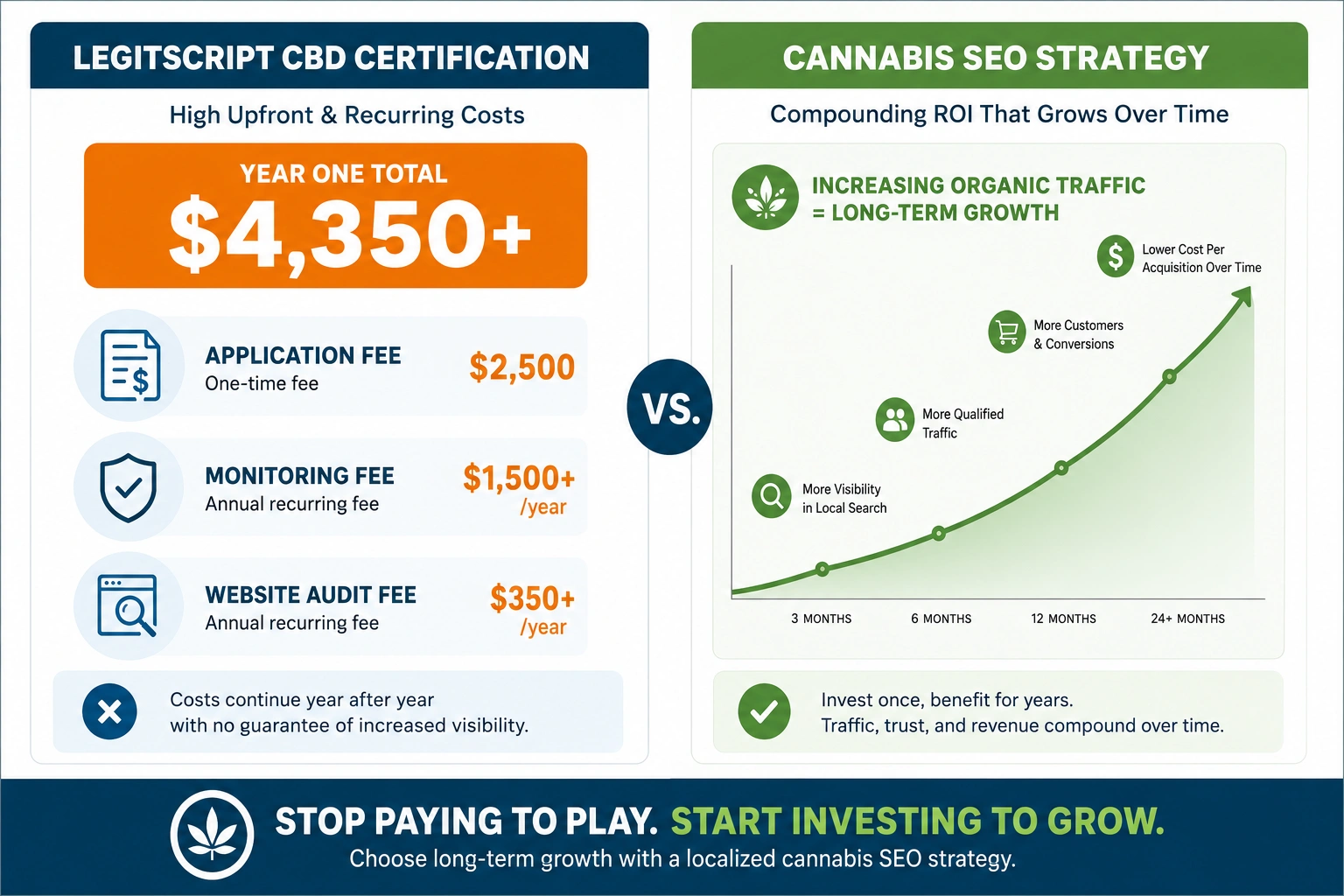
Compare the $4,350+ first-year cost of LegitScript CBD certification with the compounding long-term value of localized cannabis SEO.
The Canada cannabis advertising pilot program and its limitations
Restrictive parameters of the Canadian pilot
- Licensed Producers Only: Participation is restricted exclusively to federally licensed producers and authorized provincial or territorial government retail operators (Google Canada Cannabis Pilot).
- Search Ads Only: Approved advertisements are permitted on Google Search only, completely excluded from YouTube, Display, Shopping, and Discover.
- Strict Compliance: All advertisements must adhere to Canada’s Cannabis Act, which prohibits lifestyle associations, celebrity endorsements, and youth-directed imagery.
- Extended Timeline: Originally a temporary 20-week test launched in August 2025, Google updated its policy on January 15, 2026, extending the pilot through December 31, 2026.
- Strict Eligibility: Private, non-licensed retailers remain completely excluded from the program. Only federally licensed producers and authorized government retail operators qualify.
- Platform Limitations: Approved ads run on Google Search only. YouTube, the Google Display Network, Google Shopping, and the Google Discover Feed are all off-limits.
- Content Compliance: Canada’s Cannabis Act prohibits lifestyle associations, celebrity endorsements, unsubstantiated health claims, and any creative that could appeal to youth.
- Extended Timeline: Google updated its policy on January 15, 2026, extending the pilot through December 31, 2026, signaling cautious optimism but no structural opening for private operators.
The Canadian pilot is worth watching, but it shouldn’t be mistaken for a significant shift in the advertising landscape for most cannabis businesses. Do not count on it. A program that excludes private retailers, confines ads to a single platform, and imposes the full weight of the Cannabis Act on every creative decision is not an acquisition channel; it’s a compliance exercise for government-adjacent operators. For the overwhelming majority of dispensary owners and CBD brands, organic search remains the only scalable path forward. Do not wait for change.
The four places customers find you: organic discovery for cannabis brands
Google organic search and AI overviews
- High-Intent Traffic: Traditional organic search remains the main driver of high-intent traffic, capturing users searching for transactional, product-specific keywords below the fold.
- AI Overviews (SGE): Google’s AI-generated summaries now appear for 15% to 25% of cannabis-related search queries.
- Citation Boost: AI Overviews can suppress direct clicks, but brands cited as sources inside those summaries see a 35% boost in click-through rates.
- CTR Drop Mitigation: Structuring content for direct citation in AI summaries is no longer optional; it’s the primary defense against organic CTR erosion.
Google Business Profiles and zero-click features
- Local Search Dominance: Google Business Profiles are the lifeblood of physical dispensaries, capturing local “near me” searches at the moment of highest purchase intent.
- Local “3-Pack” Map Results: The local “3-Pack” map results capture 92% of local search clicks.
- Store Visits and Purchases: 80% of “dispensary near me” searches result in a physical store visit, and 78% of those visits lead to a purchase.
- Zero-Click Features: Featured Snippets, Knowledge Panels, and “People Also Ask” boxes require structured data and concise Q&A formatting; the mechanics are covered in detail in our guide to local SEO strategies.
- Google Organic Search: Traditional organic search captures users at the transactional end of the funnel: people searching for specific products, strains, and dispensary locations. These users are ready to buy.
- AI Overviews (SGE): Google’s AI-generated summaries appear for 15% to 25% of cannabis-related queries. Securing a direct citation inside these overviews delivers a 35% increase in click-through rate compared to standard organic listings.
- Google Business Profiles (GBP): For physical dispensaries, local search is the most vital acquisition channel. Think of it this way: your Google Business Profile is your digital storefront: it’s what people see before they even click through to your website. The local “3-Pack” map results capture 92% of local search clicks, a number that makes GBP optimization non-negotiable. You must be there.
- Zero-Click Search Features: Featured Snippets, Knowledge Panels, and “People Also Ask” boxes answer queries directly on the SERP, requiring structured data and concise question-and-answer formatting to capture.
Ready to dominate local search?
Don’t let paid ad bans hold your dispensary back. Request a free local visibility check today to uncover your visibility gaps and start building a compounding source of customer acquisition.
Why organic search compounds while paid ads terminal out
The compounding asset vs. terminal channel debate
- Terminal Nature of Paid Ads: Paid advertising is a terminal channel: the moment you stop spending, traffic drops to zero immediately.
- Compounding Nature of SEO: Cannabis SEO is a compounding asset; initial investments in technical and local optimization accumulate domain authority over time.
- Long-Term Revenue: As domain authority grows, the website ranks for increasingly competitive, high-volume terms without ongoing per-click expenditure.
- Real-World Success: A single-location dispensary achieved a 1,370% ROI over a six-month local SEO campaign, generating $922,000 in new online revenue.
- Delivery Brand Growth: A cannabis delivery brand recorded an 1,100% monthly revenue increase and 1,034% organic traffic growth within six months using advanced cannabis SEO strategies.
Digital marketing experts agree that paid advertising in restricted industries is a terminal channel. The moment you stop spending, or the moment an automated platform filter flags your account, traffic drops to zero. Conversely, organic search compounds. Every piece of content you publish is like planting a seed that keeps growing: you’re building an asset, not burning money on ads that disappear the moment you stop paying.
The data is clear on this. A single-location cannabis dispensary achieved a 1,370% return on investment over a six-month local SEO campaign, generating $922,000 in new online revenue with zero paid ad spend. A cannabis delivery brand recorded an 1,100% monthly revenue increase and 1,034% organic traffic growth within six months of implementing a localized SEO strategy. These aren’t outlier results manufactured by favorable market conditions; they reflect what happens when a business stops renting visibility and starts owning it.
“In the cannabis industry, paid advertising is a temporary lease on rented land that can be revoked at any moment. Organic search is buying the land and building an appreciating asset that your competitors cannot shut down with an automated flag.”
—Senior Digital Strategist at BizIQ
The shift from informational to transactional cannabis SEO
Prioritizing transactional intent over broad guides
- Decline of Informational Blogging: Traditional informational blogging (e.g., “What is CBD?”) is losing traction as AI Overviews answer up to 80% of these queries directly on the SERP.
- Transactional SEO Focus: Modern cannabis SEO strategy must pivot toward transactional, product-focused optimization.
- High-Intent Keywords: Local “near me” queries, product menu optimization, and structured schema markup capture ready-to-buy users, with the full tactical breakdown detailed in our CBD business SEO tips.
- Menu Platform Integration: Integrating menu platforms like Dutchie, Jane, or Weedmaps with proper crawlability is essential to capture high-intent traffic from product-specific searches.
There’s a live debate among SEO strategists about whether broad educational content still earns its place in a cannabis content calendar. With AI Overviews now answering up to 80% of informational queries directly on the search page, writing guides like “What is CBD?” or “How does THC affect the body?” is increasingly a traffic dead end. The content gets absorbed into the AI summary; the click never materializes. You lose the visitor.
The productive alternative is transactional, product-focused SEO: targeting local “near me” queries, optimizing digital menus for crawlability, and implementing structured schema markup to capture users who have already decided to buy and are simply choosing where. This isn’t a minor tactical adjustment. It’s a complete pivot of what cannabis content is actually for.
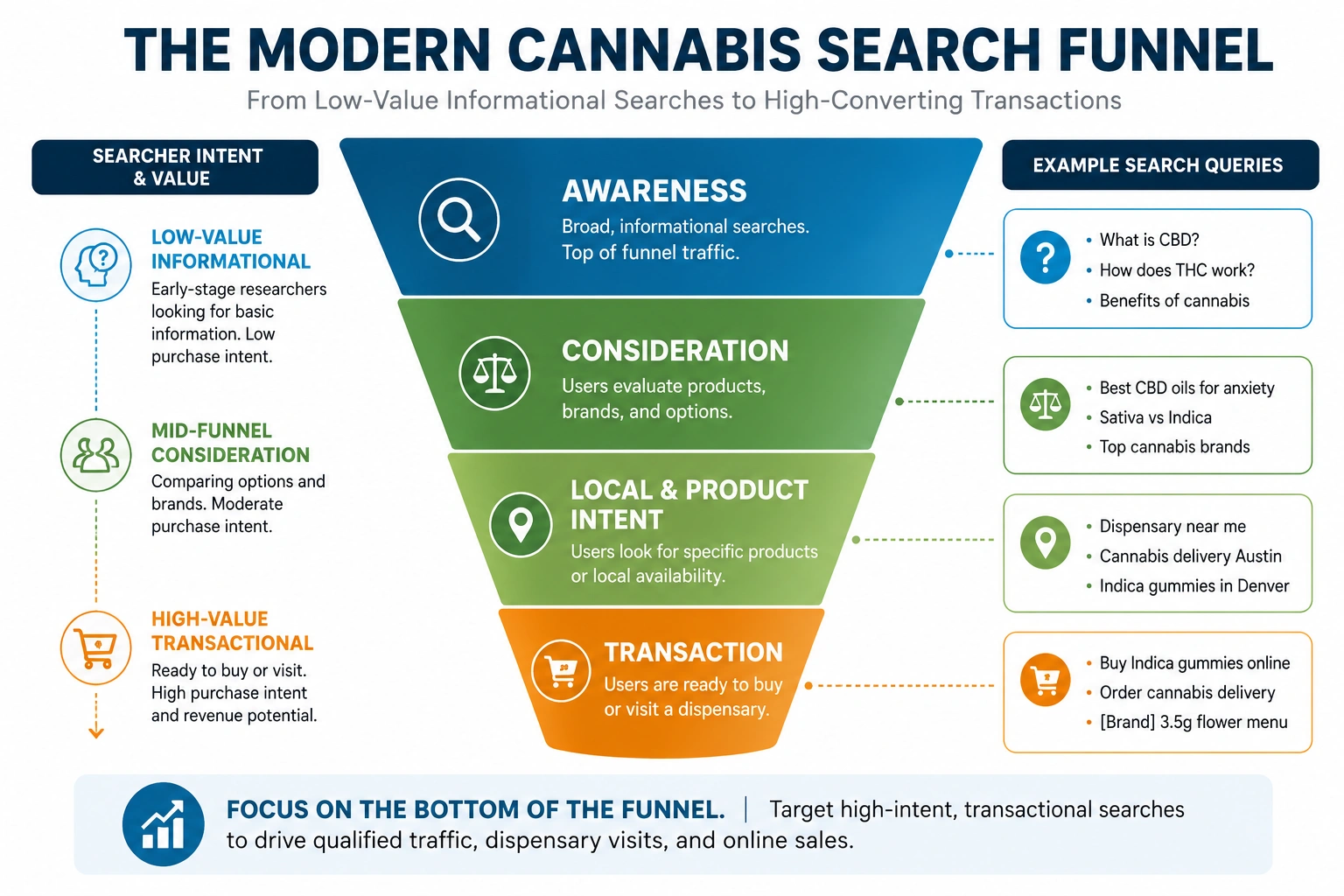
Visual breakdown of the modern cannabis search funnel, from low-value informational queries to high-converting transactional searches.
Build a sustainable growth engine.
Discover how our tailored cannabis SEO services can optimize your digital menu, clear your technical debt, and drive high-intent customers straight to your storefront
Technical infrastructure: schema markup for cannabis websites
Implementing advanced JSON-LD schema
- Machine-Readability: Schema markup translates website content into a machine-readable format for search engines and AI models, acting as the connective tissue between your content and how it gets surfaced.
- Product Schema: Essential for e-commerce menus, displaying real-time pricing, stock availability, star ratings, strain types (Sativa, Indica, Hybrid), and THC/CBD percentages directly in search results.
- LocalBusiness Schema: Crucial for dispensaries, feeding search engines verified data including geographic coordinates, physical addresses, operating hours, and state license numbers.
- FAQ Schema: Formats content into clear question-and-answer pairs, making it highly eligible for “People Also Ask” boxes and AI retrieval systems, providing a direct mechanism for bypassing regulatory restrictions in CBD SEO.
- Product Schema: Displays real-time pricing, stock availability, star ratings, strain types (Sativa, Indica, Hybrid), and THC/CBD percentages directly in search results, which is critical for menu-driven dispensary sites.
- LocalBusiness Schema: Feeds search engines verified geographic coordinates, physical addresses, operating hours, and state license numbers to establish trust and geographic authority.
- FAQ Schema: Structures content into machine-readable question-and-answer pairs, making it eligible for “People Also Ask” boxes and AI Overview citations.
Schema isn’t a nice-to-have for cannabis websites. It is essential. It’s the foundation layer that determines whether your product data surfaces in AI-generated summaries, whether your dispensary appears in the local 3-Pack with accurate hours and license information, and whether your FAQ content gets pulled into “People Also Ask” results. Most dispensary sites, even well-designed ones, are running without it, which means they’re invisible to the machine-readable layer of modern search. Getting this right is foundational work, not advanced optimization. Do not skip it.
Navigating regional and state-level local SEO saturation
Hyperlocal saturation and review velocity
- Market Discrepancies: Local SEO dynamics diverge sharply between highly saturated markets like Los Angeles and newly legalized, low-competition states.
- Saturated Market Tactics: Competitive markets demand aggressive review acquisition, local citation building, and hyper-localized content targeting neighborhood-level geography.
- Map Pack Dominance: Only 7.9% of transactional local searches trigger an AI Overview, meaning 92.1% of local commercial queries are still decided by traditional GBPs and map packs.
- Geographic Relevance: Localized landing pages and community-specific content establish the geographic relevance signals that map pack algorithms reward.
Local SEO dynamics differ greatly depending on your geographic market. Markets are not equal. In highly saturated environments like Los Angeles, dispensaries face dense competition and must sustain aggressive review velocity and local citation building just to hold map pack positions. In newly legalized states with thinner competitive fields, businesses can establish 3-Pack dominance relatively quickly by laying down basic local search signals and clean site architecture.
What makes this particularly important right now: only 7.9% of transactional local searches trigger an AI Overview. That means 92.1% of local commercial queries, the searches where someone is actively deciding where to buy, are still resolved by traditional Google Business Profiles and map packs. The AI disruption that’s reshaping informational content has barely touched local commercial intent. For dispensaries, that’s the clearest possible signal about where to concentrate optimization effort. Focus on local search.
Navigating Google’s strict ad policies
- Recreational Drugs Policy: Google’s “Recreational Drugs” policy bans cannabis containing more than 0.3% THC, covering flower, edibles, concentrates, and dispensaries without exception.
- Dispensary Restrictions: Google Ads completely bans the promotion of physical cannabis dispensaries, regardless of whether they operate online, in-store, or both.
- CBD Exceptions: The only physical retail locations permitted to run Google Ads are those selling topical, hemp-derived CBD products with LegitScript certification, restricted to California, Colorado, and Puerto Rico.
Common misconceptions and legal realities
Understanding hemp-derived vs. cannabis-derived CBD
- THC Threshold: Hemp-derived CBD contains 0.3% THC or less and is eligible for advertising carve-outs on Google and Meta under specific conditions.
- Product Restrictions: Products must be non-ingestible topicals only and certified by LegitScript to qualify for any paid advertising carve-out.
- Cannabis-Derived Prohibition: Cannabis-derived CBD typically carries higher THC concentrations and is classified alongside marijuana, making it strictly prohibited from all paid advertising channels with no pathway to exception.
Frequently asked questions about cannabis SEO and advertising
Can a cannabis dispensary run ads on Google if they do not sell products online?
No. Google Ads strictly prohibits the promotion of physical cannabis dispensaries, no matter if they offer online e-commerce or in-store shopping only. Google’s “Recreational Drugs” policy bans any business that facilitates the sale or consumption of cannabis containing more than 0.3% THC. The ban is absolute. The only physical retail locations permitted to run Google Ads are those selling topical, hemp-derived CBD products, provided they obtain LegitScript certification and target California, Colorado, or Puerto Rico.
What is the difference between hemp-derived CBD and cannabis-derived CBD under ad policies?
Ad platforms distinguish these products based on THC content and legal classification. The distinction is critical. Hemp-derived CBD contains 0.3% THC or less and is eligible for advertising exceptions on Google and Meta, provided the products are non-ingestible topicals certified by LegitScript. Cannabis-derived CBD typically carries higher THC concentrations and is classified alongside marijuana, meaning it is prohibited from all paid advertising channels with no exceptions available. The door is closed.
How does Google verify that a CBD advertiser is compliant?
Google works solely with LegitScript to vet CBD advertisers. This process is intense. To secure approval, businesses must submit their products for independent laboratory testing to verify THC content below 0.3% and confirm the absence of contaminants like heavy metals and pesticides. LegitScript also audits the advertiser’s website to ensure it contains no medical or therapeutic claims, no ingestible products, and compliant regulatory disclaimers throughout. They check everything.
Will Google and Meta open up paid ads for THC products if cannabis is federally legalized in the United States?
Federal legalization or rescheduling would likely prompt both platforms to revisit their advertising guidelines, but an immediate opening for unrestricted cannabis advertising is unlikely. Do not expect quick changes. Both Google and Meta maintain cautious stances toward vice industries; alcohol and tobacco advertising on these platforms remains heavily age-gated and geographically restricted even decades after federal legalization. Cannabis would almost certainly face the same scaffolding: mandatory age verification, geographic targeting constraints, warning label requirements, and pre-clearance certification. The timeline between federal action and platform policy change could be measured in years, not months. Prepare for a long wait.
How long does it take to see compounding results from cannabis SEO?
Paid ads stop generating traffic the moment you stop paying. It is a constant expense. Cannabis SEO operates on a different timeline: most dispensaries and CBD brands begin to see measurable improvements in local map rankings and organic search visibility within 3 to 6 months of consistent optimization. Over time, those organic assets accumulate: domain authority builds, content earns citations, and the site ranks for increasingly competitive terms without the ongoing per-click cost or the exposure to sudden account suspension. The compounding effect is real, but it requires patience and sustained execution to materialize.
Relying on advertising platforms that treat your business as a liability is an inherently shaky growth strategy. By shifting focus to organic search, you build a digital presence you own outright, one that accumulates value over time, resists automated ad bans, and intercepts customers at the exact moment they’re ready to act. Establishing this organic foundation isn’t a workaround for the restrictions; it’s the most defensible long-term position available in the cannabis market. It is your best move.
Take control of your digital visibility.
Stop fighting restricted ad platforms and start building an organic asset that grows month over month. Request your free local visibility check from BizIQ today and get a clear, practical plan to dominate your local market.