
Managing digital marketing for a multi-location brand creates specific operational challenges, and geo-targeted marketing for franchises is how those brands capture high-intent customers in every neighborhood without losing control of the message. You have to keep brand messaging consistent while reaching people in dozens of different local markets who are searching for an immediate solution, and a blanket national strategy misses many of them.
- Proximity intent: nearby searches signal strong, ready-to-act demand that geo-targeting is built to capture.
- Clean location data: consistent listings, complete profiles, and localized content improve visibility in Google Maps and neighborhood-level results.
- Radius and geo-fencing campaigns: location-based advertising reaches shoppers near your storefronts, competitors, and busy retail districts.
- Local conversion tracking: calls, direction requests, and visits show which regions earn their budget.
Do your individual locations capture nearby foot traffic through their digital presence? Geo-targeted marketing solves that problem by aligning promotion with exact geographic coordinates and customer intent. It combines paid location targeting with the fundamentals of local SEO services, so the right content reaches the right person based on where they are.
A location-based strategy also requires tight coordination between corporate and individual franchisees. You need clean data, optimized local profiles, and content that speaks to the surrounding community. This guide covers the methods that capture neighborhood-level market share, from listings and local content to radius targeting and performance tracking.
Why Location Data Drives Franchise Revenue
Customers increasingly search by proximity, adding phrases like “near me” or a neighborhood name when they want immediate help. If your franchise locations do not appear in those hyper-local results, competitors absorb the foot traffic. Search engines handle these queries by weighing device location signals along with business information, and Google states that local results are based primarily on relevance, distance, and prominence.
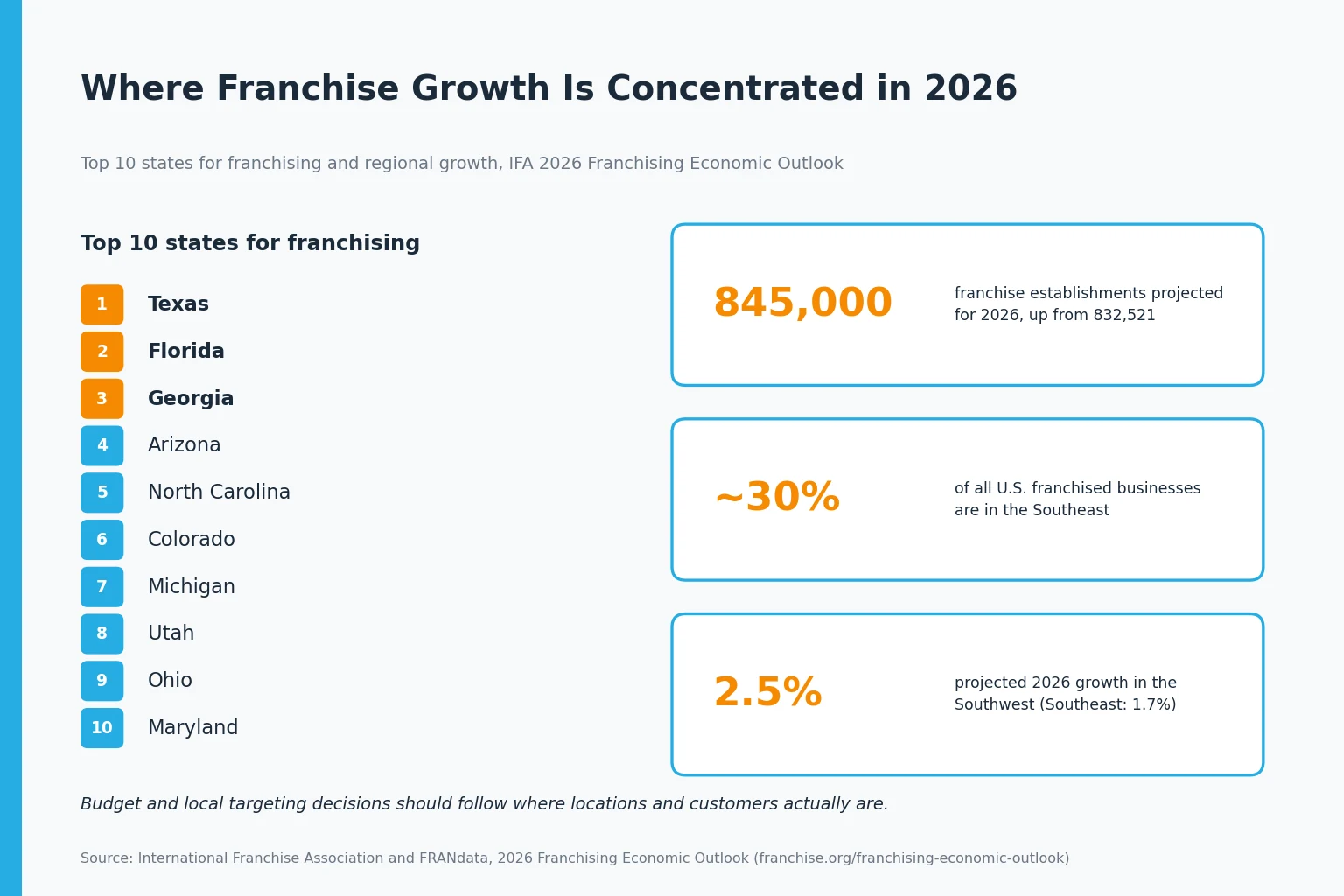
That makes geography a revenue variable, not just a targeting setting. The International Franchise Association projects U.S. franchise establishments will grow from 832,521 to 845,000 in 2026, concentrated in states such as Texas, Florida, and Georgia, with the Southeast holding nearly 30% of all franchised businesses.
Corporate marketing teams often struggle to balance broad brand awareness with neighborhood-level activation across many territories. Geo-targeting bridges that gap by delivering location-based advertising and localized offers to people near a storefront, which tends to reduce wasted spend and improve return for each franchise operator.
Building a Solid Foundation for Geo-Targeted Marketing for Franchises
Before launching spatial campaigns, a franchise needs a structurally sound local presence across every platform. Search systems rely on consistent directory data to verify that a location is legitimate, and inconsistent hours or wrong addresses damage both visibility and customer trust.
A centralized data system also prevents well-meaning franchisees from creating duplicate profiles that confuse customers. Corporate should hold administrative control over the primary data sources while local managers contribute updates, which protects the brand and still encourages authentic community engagement. Programs built around SEO for franchises start with exactly this kind of governance.
Optimizing Google Business Profiles for Local SEO for Franchises
The Business Profile is the digital storefront for every franchise location. Each one has to be claimed and verified so you control how the business appears in Google Maps. Google reports that customers are 70% more likely to visit and 50% more likely to consider purchasing from businesses with a complete profile, so hours, services, categories, and photos of that specific location all matter.
Naming deserves care. Google’s guidelines for representing your business say the name should match your real-world name as used on signage and branding, and that it should not include location information beyond that. Standardize on the consistent brand name used at every storefront instead of appending a city or keywords, which can put a profile at risk.
For help claiming and verifying every location correctly, a Google Business Profile setup and verification service reduces that risk.

Turn Your Google Business Profiles Into Local Traffic Drivers
Incomplete or inconsistent profiles can cost franchise locations valuable visibility. We help multi-location brands optimize listings, improve map pack rankings, and increase local engagement across every territory.
Localizing Content for Franchise Location Marketing
Each franchise location needs its own dedicated content on the main corporate website to capture regional search traffic. That content should describe the neighborhood, introduce local staff, and reflect real community involvement or sponsorships. Generic copy that only swaps the city name offers little value to readers or search crawlers.
Embed a Google Map for each location and add directions from major landmarks or highway exits for mobile users. Those hyper-local details show that the content serves nearby residents, and strong on-site optimization builds them into every template so quality holds up as the network grows.
How to Implement Geo-Fencing and Radius Targeting
Geo-fencing draws a virtual perimeter around a specific building, event space, or competitor location, then serves advertising to mobile devices that enter it. It works well for quick-service restaurants and retail franchises that want to reach active shoppers in the moment. Done well, it relies on thoughtful placement and not on blanketing a whole city with generic ads.
Geo-Fencing vs. Radius Targeting
The two terms overlap, so it helps to know the options. Many true geo-fencing campaigns are bought through mobile and programmatic ad networks. Google Ads offers a related capability, and its location targeting lets you reach people within a radius of at least 1 km around a location, or around a group of your business locations. It also lets you choose between “Presence,” which reaches people in or regularly in the area, and “Presence or Interest,” which also reaches people who have shown interest in it.
Google notes that a very small radius may cause ads to show intermittently or not at all, so tight perimeters should be tested before you rely on them. Whatever platform you use, location data is collected with user permission, so choose vendors that handle consent and privacy responsibly.
How to Launch Geo-Targeted Marketing for Franchises Step by Step
- Define your target perimeters. Use customer data to find where your audience spends time, then draw boundaries around complementary businesses, campuses, or competitor storefronts. Keep perimeters tight so you do not pay for impressions from drivers passing on the highway.
- Craft location-specific offers. Write creative for the people inside each perimeter with an incentive that encourages a visit to your nearest franchise, such as a limited-time offer with a clear deadline.
- Set up conversion tracking. Measure how many people saw the ad and then called, requested directions, or walked in. Physical conversion tracking is what proves the return on each localized campaign.
Capturing Local Search Market Share Through Citations and Multi-Location SEO
Citations are mentions of your franchise’s name, address, and phone number across directories and maps. They validate your physical existence to the systems that process local queries, and a strong citation profile means accurate data on platforms such as Yelp, Apple Maps, and local chamber of commerce websites.
Franchise systems often struggle with inconsistent citations after ownership changes or store relocations. One outdated address on a major aggregator can spread bad data to dozens of smaller directories. Ongoing local citation management locks corporate data in place and prevents unauthorized edits.
Local links also strengthen geographic authority. Sponsoring a youth sports team or partnering with a neighborhood charity can earn links from community websites that show your franchise takes part in the area it serves.
One warning applies to address data. Google’s guidelines state that virtual offices and mailboxes at remote locations are not eligible for a Business Profile, so every citation should use the real, staffed address of the storefront.
Tracking Geo-Targeted Marketing Performance and ROI
Measuring success at the neighborhood level across a large network means looking beyond national website traffic to regional insight. You need to understand which locations perform best in their markets, because those trends are what help corporate teams allocate budgets across territories more effectively.
Focus on actions that indicate real-world intent. BrightLocal’s 2026 Local Consumer Review Survey found that after reading positive reviews, 54% of consumers visit the business’s website, 31% visit the location, 20% contact the business, and 20% make an appointment.
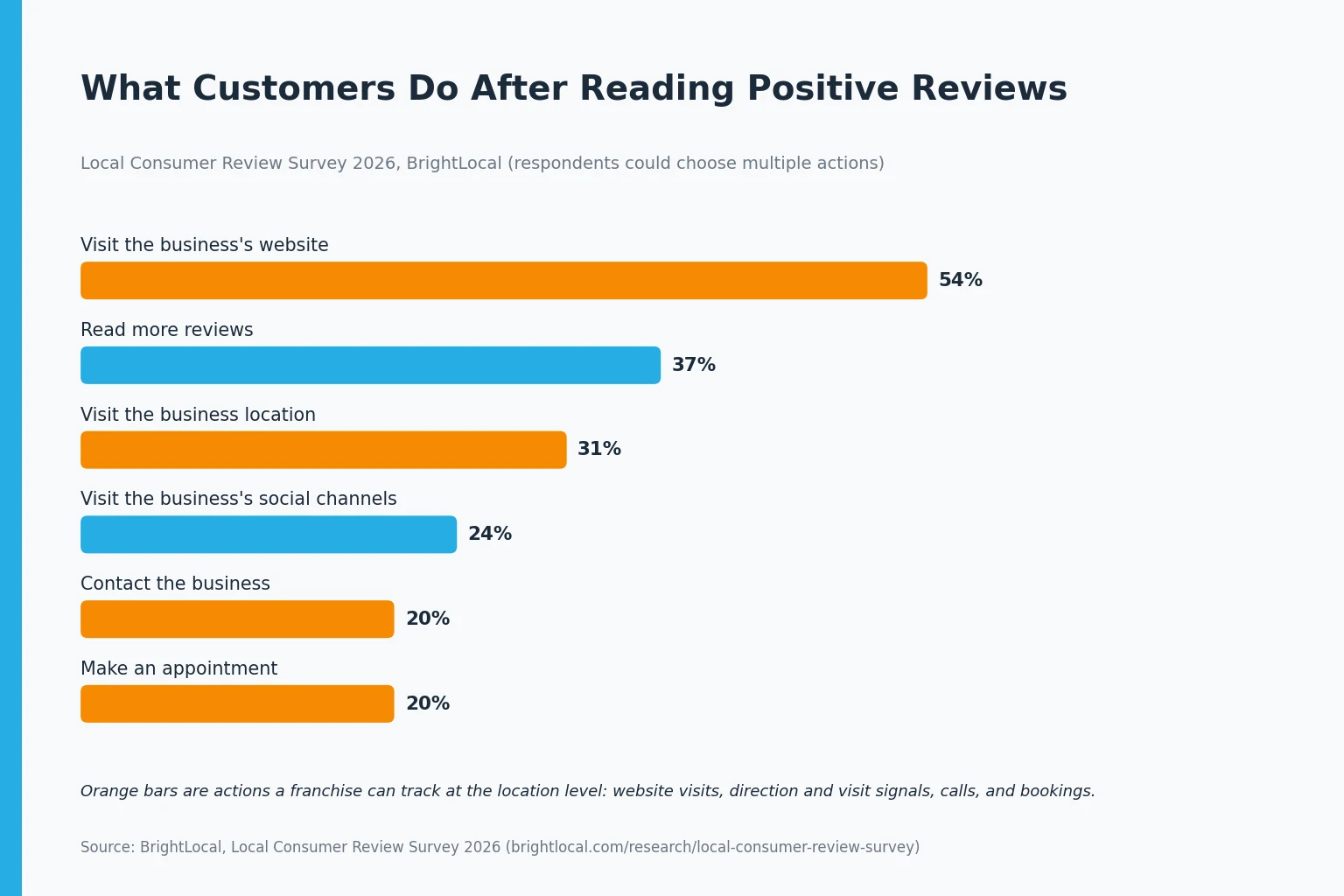
Those actions map directly to what you can measure per location: driving direction requests, tap-to-call clicks, website visits, and local form submissions. These signals carry far more weight than raw traffic counts or social impressions when you judge a campaign.
Adding UTM parameters to the website link in each Business Profile provides attribution data, separating general organic traffic from interactions with local listings and neighborhood campaigns. Reviewing that data regularly lets franchise owners refine promotions around actual local demand, and feeding it into a broader franchise marketing strategy helps corporate decide where to invest next.
A steady supply of recent reviews supports every one of these actions, which is why reputation management belongs in the same plan.
Geo-Targeted Marketing for Franchises FAQs
What is geo-targeted marketing for franchises?
It is the practice of directing advertising and local search optimization to people in specific geographic areas around each franchise location. It combines accurate listings, localized content, and paid location targeting so every storefront reaches the customers nearest to it while the brand stays consistent.
How much should a franchise spend on geo-targeted marketing?
Budgets vary with industry margins, local competition, and the revenue goals of each territory. A practical approach is to fund the foundation first, meaning listings, profiles, and local content, and then add paid location targeting where a market has strong demand. Set each region’s spend by its revenue potential, not by one network-wide percentage.
Does geo-fencing work without a dedicated mobile app?
Yes. Perimeter campaigns can run through mobile web browsers and third-party apps, because advertisers buy inventory on ad networks that use device location data with user permission. You do not need to build a proprietary app to reach nearby customers.
How long does it take to see local SEO results?
Timelines vary by market and starting point. Profile verification and listing cleanup can improve visibility within weeks, while organic local rankings typically build over several months of consistent optimization. Long-term geographic authority from localized content and local links takes sustained effort.
Can corporate teams manage all local social media accounts?
Centralizing social media protects brand identity but often reduces authentic community engagement. Most effective franchise systems provide corporate templates and let local owners post neighborhood updates, which balances a professional look with genuine local relevance.
Why do my franchise locations compete against each other in search?
Keyword cannibalization happens when locations sit close together without clearly defined digital territories. Optimizing each location around specific neighborhood names instead of broad city terms gives search systems a clear reason to show the right location for each query.
Mastering geo-targeted marketing for franchises changes how a system acquires customers in competitive regional markets. Precise location data lets you deliver the right message when customers need your services most, which reduces wasted ad spend and drives measurable foot traffic to individual storefronts.
Geographic authority comes from consistent execution across data management, profile optimization, and localized content in every territory. Treat each franchise location as its own entity with a distinct digital footprint and community presence, and the brand as a whole becomes more resilient.
Start by reviewing your local search visibility with a free SEO audit to find data inconsistencies and missing profiles. From there, standardize your citations and put conversion tracking in place.
When you want expert help, BizIQ can walk you through the next step.

Build Stronger Local Visibility for Every Franchise Location
From geo-targeted campaigns to local SEO and citation management, we help franchise brands improve neighborhood visibility and drive measurable local growth.