- Claim, verify, and structurally configure your Google Business Profile to secure a competitive position in the local 3-pack: the top three results that appear when someone searches for cleaning services near them.
- Select the correct primary and secondary business categories to align your profile with the exact search intent of homeowners looking to hire.
- Build an automated review generation system that delivers a consistent, fresh stream of customer feedback rather than relying on volume alone.
- Use Google Posts and high-quality visual content to increase engagement, signal profile activity, and lift your click-through rate from the map pack.
To optimize a Google Business Profile for a residential maid service, complete every section of your profile, choose the most relevant business categories, add high-quality photos, collect fresh customer reviews, publish regular updates, and ensure your business information is accurate and consistent across the web. A well-optimized profile improves visibility in Google Maps, local search results, and AI-powered search, helping attract more homeowners looking for cleaning services.
Getting your residential cleaning business to show up when neighbors search on Google can feel like solving an enigma with missing pieces. You know the slot exists, you know competitors are filling it, but the exact configuration that gets you there isn’t spelled out anywhere in plain language. If all of this sounds technical, you are not alone: most cleaning business owners feel the same way. The good news is that you do not need to be a tech expert to show up in the local 3-pack: the top three results that appear when someone searches for cleaning services near them.
Securing a position in this local 3-pack is the single most potent lever for scaling a residential cleaning business. Not paid ads, not social media: the map pack. Map rankings drive calls. When a homeowner in your city types “cleaning services near me” or “house cleaning near me,” the three businesses that appear above the organic results capture the overwhelming majority of clicks and phone calls. Optimizing your Google Business Profile for cleaning business operations is how we get you into that block and keep you there. Let’s begin.
Why Google Business Profile signals carry this much weight
Google Business Profile signals account for roughly 32% of local pack ranking factors: a larger share than your website’s on-page SEO or your backlink profile. This high percentage highlights how critical your profile configuration is to your local search success. It means the profile itself, configured correctly, is one of the most valuable assets your cleaning business controls directly. We do not need a developer. We do not need an ad budget. We need precision.
The traffic implications are substantial. The strategic value of Google Business Profiles becomes clearer when we look at what the map pack position delivers in practice: businesses ranking in the local 3-pack earn 126% more consumer traffic and 93% more conversion-oriented actions than those sitting outside it. The local 3-pack appears at the top of search results for 93% of queries with local intent. For a residential cleaning company, that is not a marginal advantage: it is the gulf between a phone that rings and one that doesn’t.
Google’s algorithm filters which businesses appear using three weighted variables: relevance (does your profile match what the searcher is looking for?), distance (how close is your business to the searcher?), and prominence (how well-known and trusted is your business across the web?). Proximity is the one factor we cannot manufacture; everything else we discuss here is about maximizing the other two.
Claiming and verifying your digital storefront
Before any optimization is feasible, we need to verify your business and take control of the profile. Search for your business on Google Maps. If a listing already exists, select “Claim this business.” If nothing comes up, create a Google Business Profile from scratch through the dashboard.
Verification is Google’s way of confirming you are who you say you are: think of it as getting the key to your storefront before you are allowed to hang your sign. Use your exact legal business name during setup. Do not take shortcuts. Adding keywords like “Chicago House Cleaning” when your registered name is “Bright Home Services LLC” is one of the most rapid routes to a manual suspension, and recovering from that costs us weeks of local visibility.
Navigating the video verification process
Google now requires video verification for most service-area businesses, and the process is more meticulous than it sounds. The recording must be captured in one continuous, unedited take on a mobile device: no cuts, no restarts stitched together.
The video needs to establish three distinct elements. First, your physical location: show street signs or a house number that matches your registration address. Second, your business equipment: branded cleaning supplies, a vacuum, uniforms, or a branded vehicle all suffice. Third, proof of management: log into your scheduling or business software on camera, display your business registration documents, or unlock your equipment storage area with your keys. Each element serves a specific evidentiary purpose for Google’s review team.
Video verification and document reviews typically take up to five business days to process. For full procedural details, reference Google’s Business Profile verification guidelines directly: the requirements do shift periodically, and working from a cached third-party summary can send you in the wrong direction.
One firm rule: never use a P.O. box, UPS store, or virtual office as your verification address. Google will catch it. Google’s automated filters flag these immediately, and the resulting suspension requires a formal reinstatement appeal with official business documentation.
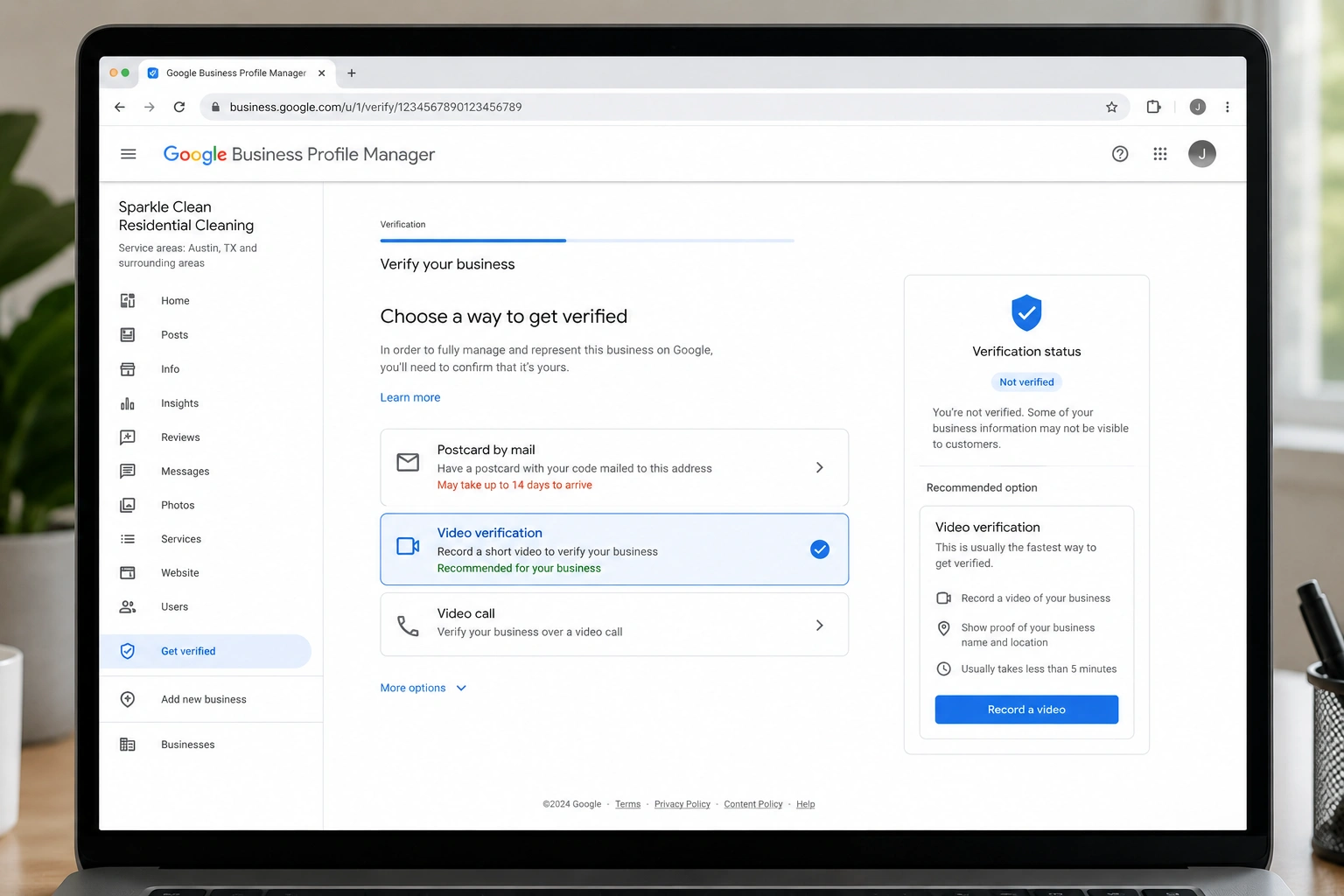
The Google Business Profile video verification process helps service-area businesses confirm ownership and activate their listing.
Optimizing your business name and core information
Think of your business name, address, and phone number like your business’s fingerprints: they must be the same every time, everywhere they appear. NAP consistency functions like a trust signal across the web. Writing “St.” on your Google Business Profile and “Street” on your Yelp listing is the kind of negligible discrepancy that quietly erodes Google’s confidence in your location data and suppresses your local 3-pack rankings over time.
Four elements to audit and lock down:
- Business Name: Your exact legal business name, nothing added. Keyword stuffing here (such as appending “City House Cleaning” to a name that does not include those words legally) is a swift suspension trigger.
- Address: For service-area businesses, this means your hidden physical address or registered business address: whichever you use must match your website and every local directory exactly.
- Phone Number: A consistent local number across all platforms. Call tracking numbers can be used, but they introduce consistency risks if not managed carefully.
- Website URL: Link directly to a dedicated landing page or booking form, not just your homepage. A high-converting destination matters more than most profile owners comprehend.
We recommend using our guide to edit your Google Business Profile to work through each field systematically. Missing or inconsistent data in any of these fields is low-hanging fruit for competitors who have theirs locked in.
Selecting the right categories and service areas
Choosing the right business category is like picking the right sign for your storefront: it tells Google exactly what you do so the right customers find you. Google authorizes one primary category, and it carries more ranking weight than every secondary category combined. For residential cleaners, that primary category is House Cleaning Service; not “Cleaning Service,” and not “Maid Service.” Those belong in secondary slots.
Recommended secondary categories:
- Maid Service: captures searches for recurring, scheduled home cleaning
- Cleaning Service: a broader catch-all that expands your local search footprint
- Carpet Cleaning Service: only if you operate dedicated equipment for it
- Window Cleaning Service: only if it’s a distinct, bookable service offering
Adding categories you do not genuinely provide is a short-term tactic with real suspension risk. Stick to your core services.
For service area configuration, hide your physical home address to comply with Google’s guidelines and define your coverage by specific cities, counties, or ZIP codes where you have staff ready to dispatch. Google’s stated guideline is that your service area should not exceed a two-hour driving radius from your business base. Spreading your coverage too thin attenuates your relevance signals in every area. Tighter, well-defined service areas typically outperform sprawling ones. Review the Google Business Profile category guidelines if you are uncertain about which categories apply to your specific service mix.
Ready to scale your residential cleaning business and automate your operations?
Your growth partner for SEO, digital marketing, and online success.
Mastering reviews and reputation management
Building a review pipeline that delivers results
Customer reviews are the lifeblood of business profile optimization for maid service success, and the mechanism that distinguishes growing cleaning businesses from stagnant ones is not the total number of reviews: it is the cadence. Industry research on local search ranking factors indicates Google increasingly weights review recency and steady velocity over historical volume. A business with 200 reviews collected over three years is not necessarily outranking one with 40 reviews collected over the last six months.
The most reliable way to build that cadence is to integrate review requests directly into your post-service workflow. Do not wait. We recommend sending a text or email within two hours of job completion: that window is when client satisfaction is highest and the experience is most vivid. Include a direct link to your Google Business Profile review section; removing friction from the process measurably increases completion rates. Make it easy. Our cleaning service case study illustrates how a structured reputation management approach translates directly into local ranking gains for a cleaning business: the results there are not theoretical.
How to handle negative reviews
Respond to every review, positive and negative, within 24 hours. Speed matters. Google treats active profile management as a prominence signal, and prospective clients read your responses as carefully as they read the reviews themselves. A professional, measured response to a critical review often does more for conversion than a string of five-star ratings with no engagement.
For negative reviews: remain professional, acknowledge the issue, and offer to resolve it offline. Keep it brief. Something like “We would like to make this right: please reach out to us directly at [phone/email]” is far more effective than a lengthy public explanation that defensive business owners often post. Keywords in your responses do not directly sway rankings, but they provide context that shapes how prospective clients interpret your service standards.
“A consistent flow of fresh, positive reviews tells Google’s algorithm that your maid service is active, reliable, and highly recommended by local homeowners.”
Maximizing Google Posts and visual content
Posting frequency and image strategy
Profiles with vibrant, high-quality imagery receive significantly more clicks and direction requests than those with deficient or outdated visuals. Before-and-after shots, team photos, and branded vehicle images function as a visual portfolio: they build immediate trust before a homeowner ever reads your description or checks your reviews.
We recommend uploading at least five to ten new photos every month. Photos build trust. Regular posting of real, unedited before-and-after photos or team pictures signals to Google that your business is active, which positively influences your prominence score. For Google Posts, publish weekly offers or seasonal promotions: “Save $50 on your first deep cleaning service” is the kind of concrete, time-bound offer that converts browsers into callers. Refer to Google’s Business Profile photo guidelines for technical specifications on image dimensions and file formats to avoid upload rejections. Keep them clean.
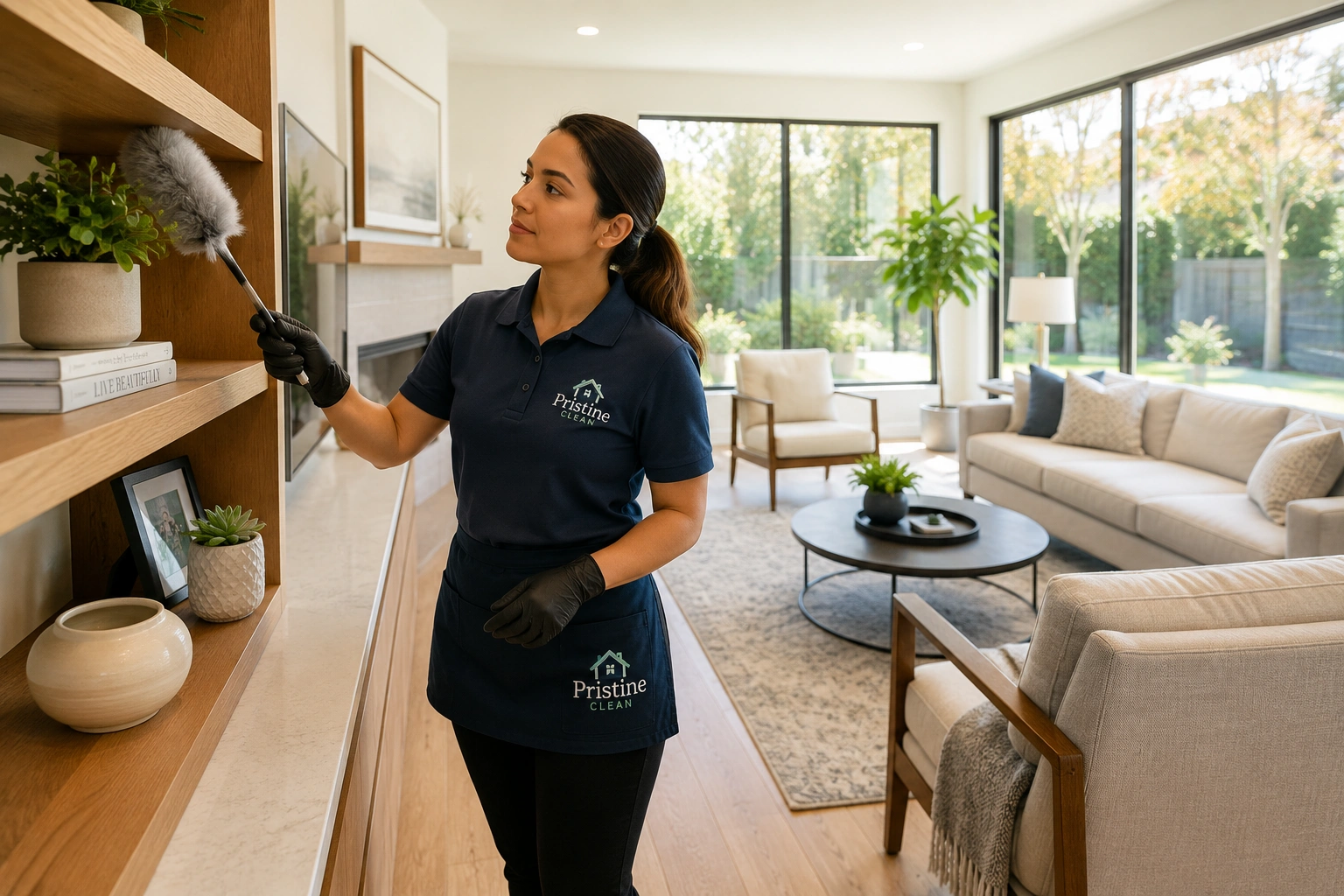
A professional cleaner carefully dusts a bright, modern living room, reflecting the quality and attention to detail homeowners expect.
Building local citations and signals
A well-optimized Google Business Profile does not operate in isolation. You need citations. Local citations, consistent mentions of your business name, address, and phone number across authoritative directories, reinforce Google’s confidence in your location data and fortify your overall local search footprint. This is one of the foundational pillars covered in our guide to local SEO strategies, and it is often the piece residential cleaning businesses overlook after getting their profile in order.
Key citation sources for residential maid services:
- Yelp: high domain authority and a trusted review platform for home services
- Nextdoor: critical for neighborhood-level residential cleaning leads; this is where homeowners actively ask for service recommendations
- Angi: highly relevant for home services and captures high-intent hiring searches
- Better Business Bureau (BBB): signals business legitimacy and trust to both Google and prospective clients
Every listing on every platform needs to reflect the same NAP data as your Google Business Profile. Accuracy is key. One mismatched phone number or abbreviated address across these sources is enough to introduce ranking friction.
Tracking performance with Google Business Profile Insights
Optimization without measurement is just guesswork with extra steps. Track your data. Google Business Profile Insights gives you direct transparency into the actions searchers take after finding your profile: and connecting those metrics to your broader Google Business Profile optimization strategy is how we identify what is working and what is quietly bleeding leads.
Three metrics deserve consistent attention: click-to-call actions, website visits, and direction requests. Each one maps to a different stage of the decision process. Watch them closely. Direction requests tell you someone is close to booking; click-to-call tells you they are ready to talk; website visits tell you they want more information before committing.
If your profile views are high but call volume is low, the gap is usually one of two things: either your reviews do not yet establish sufficient trust, or your profile details, services listed, photos, business description, are not clear enough to convert the impression into an action. That is a diagnostic, not a verdict; both are fixable with calibrated adjustments rather than a full rebuild.
Frequently asked questions
These FAQs address the adjacent queries that come up most often around local search strategy and Google Maps SEO for house cleaning services. For a broader look at industry-specific SEO, our house cleaning SEO page covers the full scope of what is involved in ranking a residential cleaning business across both organic and map pack results.
How long does it take to rank in the Google local 3-pack?
Most residential cleaning businesses see discernible improvements in local visibility within 30 to 90 days of fully optimizing their profile, though the exact timeframe depends heavily on your local competition. The timeline also hinges on the volume of reviews you generate and the consistency of your Name, Address, and Phone (NAP) data across the web. Highly competitive markets, dense urban areas with dozens of established cleaning companies, will sit toward the longer end of that range.
Can I rank in the map pack if I run my maid service from home?
Yes, you can rank in the local 3-pack as a service-area business. It is common. During setup, you should hide your physical home address and instead define the specific geographic service areas you cover, ensuring you comply with Google’s guidelines while still capturing local search traffic.
How often should I upload new photos to my Google Business Profile?
You should upload fresh photos at least once a week or bi-weekly. Regular uploads of real, unedited before-and-after photos or team pictures signal to Google that your business is active, which positively influences your prominence score.
Do keywords in my review responses help my local SEO rankings?
While keywords in your review responses do not directly boost your search rankings, they provide worthwhile context to prospective clients reading your reviews. Focus on writing natural, professional responses that highlight your commitment to customer satisfaction. Keep it natural.
What should I do if my Google Business Profile gets suspended?
If your profile is suspended, review Google’s guidelines to identify potential violations, such as keyword stuffing in your business name or using a P.O. Box as your address. Once you have corrected the issues, submit a reinstatement request with official business documentation, such as a utility bill or business license.
Auditing your profile: where to start today
Dominating the local map pack for residential cleaning searches requires a methodical approach to profile completeness, consistent review generation, and active engagement. None of those are one-time tasks: they are ongoing maintenance that compounds over time.
Your next step is a category audit. Confirm your primary category is set to “House Cleaning Service” and that your secondary categories reflect services you provide. From there, set up an automated review request sequence triggered by job completion: even a basic text message with a direct review link, sent within two hours of service, will outperform any passive approach. For cleaning businesses working with more constrained budgets, our guide on affordable local SEO strategies lays out a prioritized plan that does not require a large monthly retainer to execute.
The algorithm will keep shifting. Proximity will always carry weight you cannot fully engineer around. But profile completeness, review velocity, citation consistency, and active engagement are variables entirely within your control: and for most residential cleaning businesses, there is still significant ground to gain on all four.
Ready to start getting the business you deserve?
Get a free audit report to see where your marketing can improve.