
Multi-location marketing often feels like herding cats, especially when local branch managers create their own unapproved materials. A strong strategy keeps a branch manager from printing a pixelated flyer in a completely different font. Corporate wants strict brand control, while local operators need foot traffic and sales to survive, so the answer is a scalable system that empowers local teams without damaging the core brand.
- Balance: centralized brand control and localized execution have to work together to support regional customers.
- Central assets: shared marketing assets, clear brand guidelines, and scalable systems keep every location consistent.
- Local visibility: local SEO, optimized Business Profiles, and unique location content improve visibility for each branch.
- Trust and growth: corporate oversight with local flexibility builds customer trust, engagement, and long-term growth.
At the corporate level, marketing teams prioritize brand safety and long-term positioning. Local operators focus on monthly sales targets and immediate foot traffic. That disconnect creates friction that hurts the customer experience and wastes advertising budget across regions, and it is the core challenge that BizIQ helps multi-location brands solve.
You have to bridge national messaging and local relevance for a seamless customer journey. The answer is not one rigid plan that ignores regional differences. It is a flexible framework with strong guardrails and room for local customization, centralized control paired with decentralized execution.
Multi-Location Marketing Starts With a Centralized Command Center

A centralized command center is the single source of truth for your whole operation. Give local managers easy access to approved logos, ad copy, and campaign imagery. Without a central library, regional teams build materials from scratch with off-brand designs.
A digital asset management system solves distribution right away. Pre-approved templates speed up time to market while protecting brand integrity, and you can lock elements like logos and fonts while letting managers change local pricing or images. Corporate designers spend less time on minor edit requests, and local managers can run promotions that fit their community and season.
A monthly playbook that highlights upcoming national campaigns, with the templates to use for local tie-ins, keeps everyone in step. Franchise systems face the same challenge, and our franchise marketing resources cover it in more depth.
Defining Clear Guardrails to Maintain Brand Consistency
Empowerment needs boundaries. Document what local operators can and cannot do, including tone of voice, visual identity standards, and social media engagement rules. Make the guidelines easy for busy non-marketers to use: a dense PDF will sit unread, while a short internal wiki or video series explains the essentials.
Regular training reinforces the guardrails. Quarterly sessions for local managers can review successful local campaigns and common compliance mistakes, and positive reinforcement works far better than punishing an honest mistake.
Local SEO at Scale for Multi-Location Marketing

Search systems treat each physical location as its own entity with its own signals, so a strong national domain cannot automatically rank every store in competitive local results. Customers also check more sources than ever. In BrightLocal’s 2026 Local Consumer Review Survey, 71% of consumers used Google for local recommendations, 45% used AI tools such as ChatGPT, and 27% used Apple Maps.
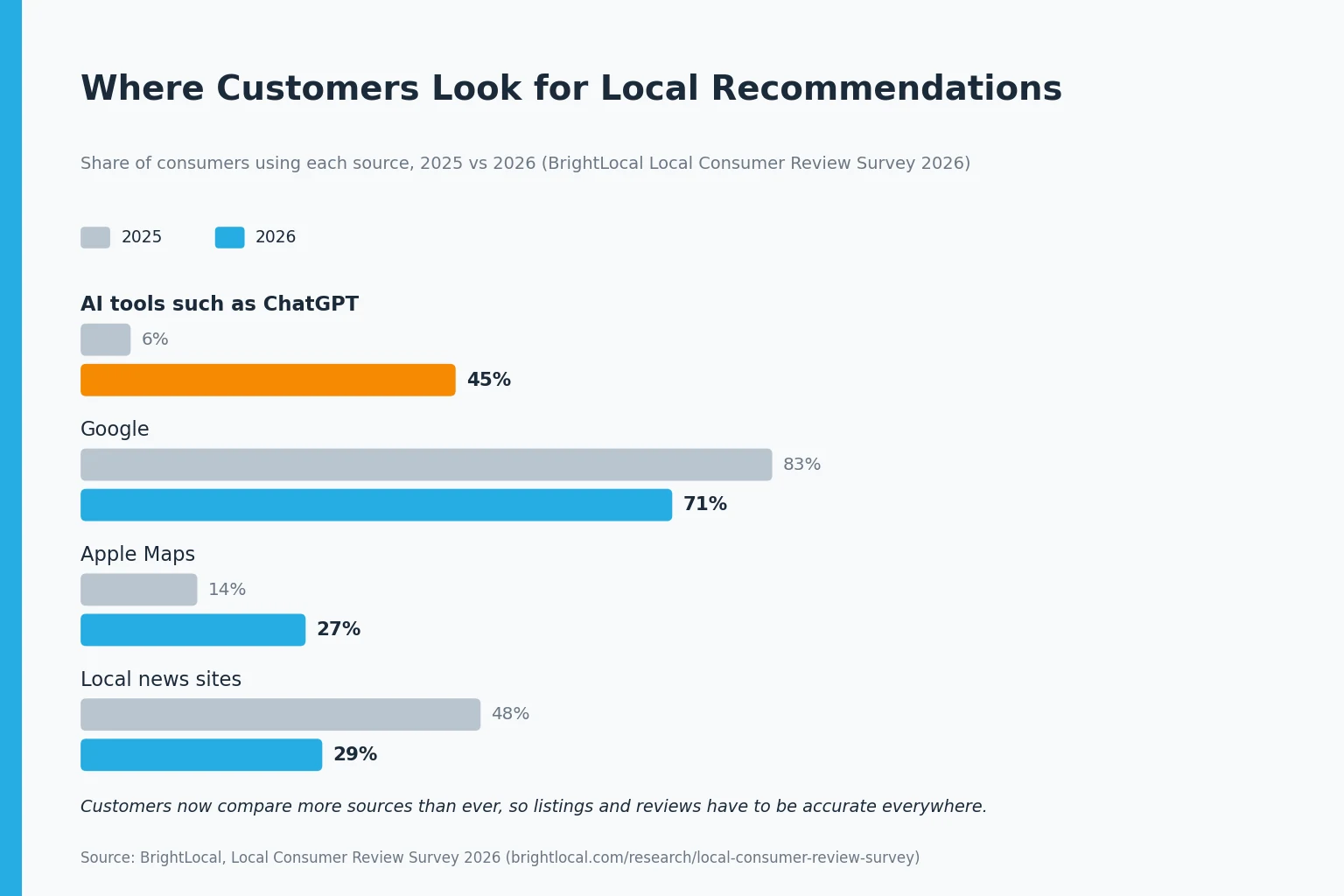
If corporate ignores local search, it loses market share to competitors who prioritize neighborhood-level visibility, and a coordinated program of local SEO services scales that work across hundreds of markets.
How to Optimize Local Search for Multi-Location Marketing
- Standardize directory data. Claim and verify listings across major aggregators, because consistent name, address, and phone data builds trust with search systems. Listing management software can automate updates across hundreds of directories, and ongoing local citation management keeps the data clean.
- Optimize every Business Profile. Treat each profile as a mini storefront for that branch, with high-quality photos uploaded regularly and prompt replies to reviews. A Google Business Profile setup and verification service gets each location set up correctly.
- Build localized content. Create dedicated content on your main website for every storefront, with directions, local staff photos, and regional service details to capture organic traffic. Strong on-site optimization builds it into every template.
Structuring Paid Advertising for Multiple Locations
Paid ads for a multi-location brand need careful budget allocation and precise geographic targeting. Avoid situations where branches bid against each other for the same search terms, because a centralized ad account structure prevents internal competition and improves total return on ad spend.
A tiered approach balances national and local needs. Dedicate part of the budget to national brand awareness that lifts every location, and use the rest for hyper-local campaigns that drive calls and store visits in specific territories. How much goes to each depends on how mature the brand is in each market, so review the split by region instead of applying one ratio everywhere.
Google Ads offers the targeting tools to make this work. Its documentation on geographic location targeting describes options you can combine to keep territories separate.
| Targeting option | What it does |
|---|---|
| Specific locations | Reaches people in chosen countries, regions, cities, or postal areas |
| Radius targeting | Reaches people within a set distance of a location, with a minimum radius of 1 km |
| Location groups | Targets a set of your business locations together |
| Presence or interest | Reaches people in the area, and also people who have shown interest in it |
Location assets can also attach each branch’s address from its Business Profile to your ads. Professional PPC management keeps each campaign focused on the right territory.
For ongoing optimization, Google Ads management reviews spend by location so budgets move toward the markets that perform.
Managing Social Media for Multiple Branches
Social media is a big hurdle for distributed brands trying to keep one voice across platforms. Customers expect fast replies to comments and messages from any branch, and leaving social entirely to local staff often leads to abandoned accounts or inappropriate posts.
A hybrid approach usually works best. Corporate handles brand messaging, national promotions, and crisis communication, and local teams add community-specific posts, behind-the-scenes photos, and event updates. A centralized scheduling tool lets corporate publish baseline content across every local account and review local posts through approval workflows before they go live. Professional social media management supports that structure.
Replies matter too. BrightLocal’s 2026 survey found that 89% of consumers expect owners to respond to reviews, and 50% are put off by templated replies, so local voice has to survive the process. A managed reputation management program helps keep replies timely and personal at scale.
Measuring Performance Across Regions
Analysis gets complicated when you operate in many markets with different demographics. A campaign that wins in New York can fall flat in Ohio because of different market maturity, so set baselines that account for regional differences in brand awareness and local competition.
Build a standard dashboard that gives corporate leaders the high-level view and lets local managers see their own data. Tracking cost per acquisition at the store level quickly shows your strongest and weakest markets, so you can shift budget from underperformers to clear winners. Adding UTM parameters to local links, including each Business Profile link, separates local search and campaign traffic from general visits.
Regular reporting calls between corporate and regional operators add context to the data, because a drop in local conversions sometimes comes from an operational issue instead of a marketing failure. A free SEO audit is a practical way to baseline local visibility by location.
Budgeting follows the data, and multi-location SEO pricing shows how budgets scale as you add markets.
Multi-Location Marketing FAQs
How do I maintain brand consistency across different locations?
Create a centralized digital asset library and clear brand guidelines, and give local managers pre-approved templates that lock core brand elements while letting them customize details like pricing or regional images.
Should each location have its own social media account?
Local accounts can perform well if you have the resources to manage them actively. A hybrid approach works best: corporate schedules baseline content, and local teams add community-specific updates with oversight.
What is the best way to handle negative reviews for a specific branch?
Reply quickly and professionally on the listing where the review appears, address the concern publicly, and then move the conversation offline with a direct contact for the local manager or corporate customer service.
How much budget should go to national versus local campaigns?
There is no single ratio. Split budget by each market’s brand awareness, competition, and need for immediate foot traffic, and review the split regularly using store-level results.
Can I use the same website content for different city locations?
It is not a good idea. Google groups very similar URLs and shows one version, so duplicated content keeps most locations out of results. Write specific content for each branch about its regional services, local team, and community involvement.
How do I stop branches from bidding against each other in paid search?
Use a centralized ad account structure with clear geographic targeting for each location, such as radius or specific-location targeting, and coordinate keywords and budgets so territories do not overlap.
Scaling a brand across dozens or hundreds of locations takes patience, discipline, and excellent communication among all stakeholders. Local operators cannot become marketing experts overnight while running a complex business, so your job is to build systems that make good marketing decisions easy and bad ones difficult.
Focus on a strong asset library, a standardized local search presence, and clear communication channels. As your footprint grows, those foundations keep your brand identity from fracturing, and a unified brand that respects local nuance will outperform a disjointed set of independent operators. Keep refining your processes with field data and feedback from frontline managers, and if you want a partner, talk with a multi-location marketing specialist about your markets.

Scale Your Brand Without Losing Local Impact
We help franchise and multi-location businesses improve local SEO, streamline marketing operations, and drive stronger results across every market you serve.