- Review freshness has emerged as a primary ranking signal for both Google Maps and generative AI search engines.
- A steady stream of one review a week consistently outperforms a massive but stale historical review count.
- Optimizing your review velocity is a highly cost-effective way for independent facilities to outrank national REITs.
Why are Fresh Reviews More Important than Total Review Count for Self-Storage Businesses in the Age of AI?
Fresh self-storage reviews often matter more than total review count because AI-powered search and modern consumers value recent customer experiences when evaluating trust and quality. Self-storage facilities that consistently earn new, authentic reviews signal that they are active, reliable, and delivering a positive customer experience, helping improve visibility in local search and AI-generated recommendations.
You might think winning the self-storage local SEO game is purely a numbers game: that the facility with the most reviews always wins. For years, independent operators have looked at national REIT competitors with thousands of reviews and felt a quiet sense of defeat, believing the gap was simply unbridgeable. But as search engines transition into AI-driven recommendation engines, that static approach to reputation management is actively working against your visibility.
What if 50 fresh reviews beat 500 stale ones?
Review freshness (the recency and consistent velocity of your customer feedback) matters far more to search algorithms than a mountain of outdated five-star ratings from three years ago. If your last review was posted nine months ago, the algorithm reads that silence as a potential signal of decline: management changes, neglected facilities, or a business quietly winding down. Conversely, a steady drip of new reviews tells a completely different story: that your facility is actively renting units, maintaining high customer satisfaction, and operating at peak performance right now.
The Algorithmic Shift to Review Velocity
According to local search ranking factor data from BrightLocal and Whitespark, review signals account for 16% of the total ranking weight in Google’s Local Pack algorithm. Within that category, search engines do not treat all reviews equally. They prioritize the rate at which you acquire them: what practitioners call review velocity.
This shift exists because search engines are fundamentally in the trust business. When evaluating Google Maps business reviews, the algorithm looks for a steady rhythm of user-generated content to confirm that your facility is still safe, clean, and actively managed. This steady rhythm acts as a continuous signal of operational health. A static pile of old reviews can’t do that. Only fresh ones can. This is what matters.
The Concept of Review Decay
Reviews lose algorithmic value over time. A review older than 90 days drops significantly in ranking weight; reviews older than two years contribute almost nothing to modern search engines. This is review decay, and it’s quietly eroding the competitive advantage that national REITs built up over years of aggressive review collection.
Think of review freshness like a hiring manager scanning resumes: you notice recent, relevant experience over a long-ago credential. That competitor with 500 reviews from 2022? Their review equity is bleeding out every single day. The operators who understand this are already pulling ahead.
Why Google Values Active Signals
Google’s primary goal is user trust: specifically, giving searchers an accurate picture of what a business looks like today, not two years ago. If a facility has hundreds of old reviews but nothing recent, Google cannot verify whether the current on-site manager is helpful, whether the security gate still functions, or whether the climate-controlled units are actually climate-controlled. Fresh reviews act like a digital heartbeat, proving your facility is open, active, and reliable. They prove you are open.
The Power of the “Drip” Over the “Spike”
There’s a temptation to run a big push: send a review request to every tenant on your list, collect 50 reviews in two weeks, and call it done. That approach backfires. Google’s spam detection algorithms flag unnatural acquisition spikes, and a sudden surge followed by months of silence is one of the clearest patterns they look for.
Focus on quality over quantity of reviews by aiming for a steady, predictable rhythm rather than unnatural spikes. This consistent acquisition pattern builds long-term authority. Building a predictable, sustainable cadence (two or three reviews a week, every week, indefinitely) is what separates facilities that hold their Maps pack position from those that briefly appear and then disappear.
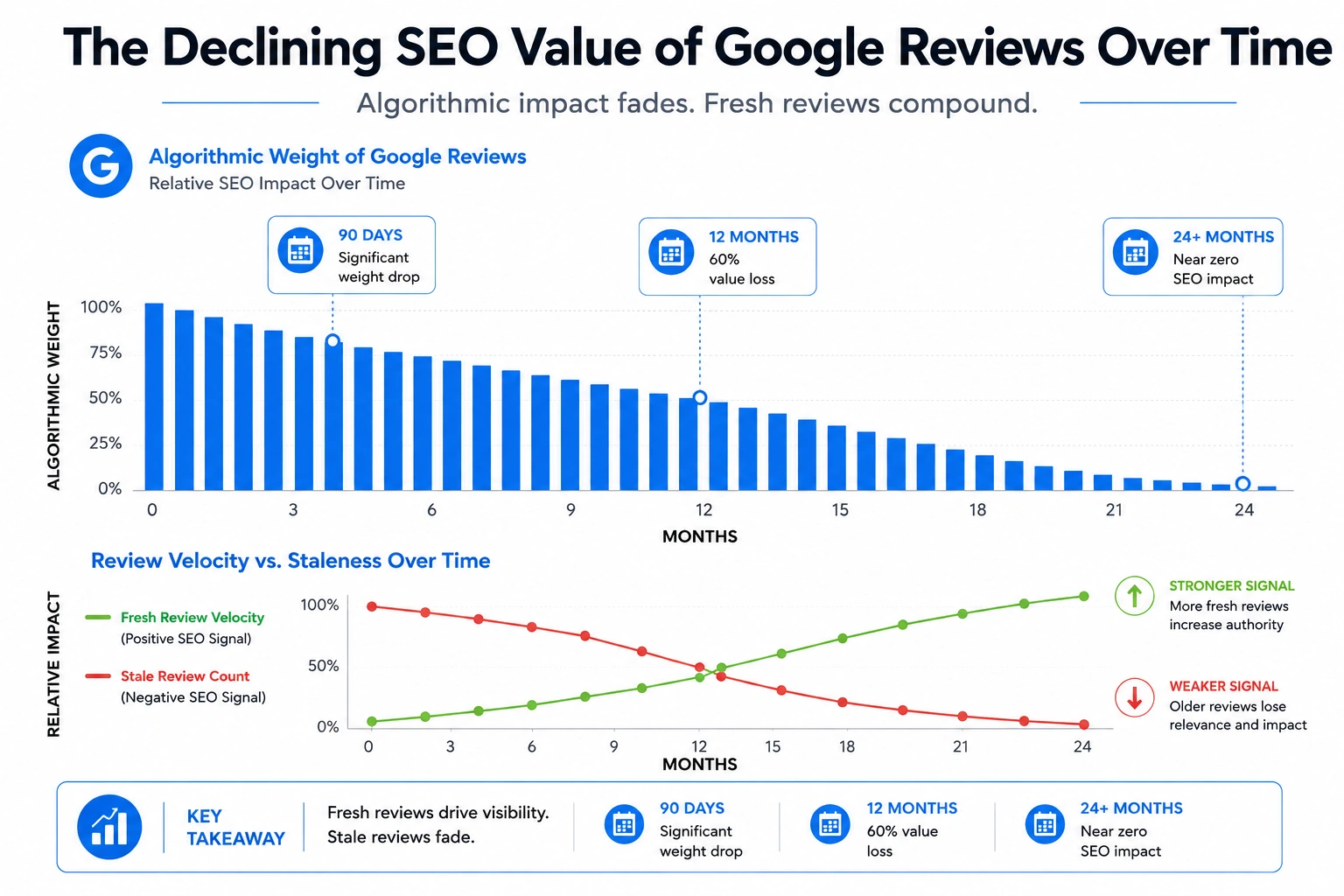
Data visualization comparing declining review value over time with the growing SEO impact of consistently earning fresh reviews.
How AI Search Engines Read and Cite Your Reviews
AI search tools like Google AI Overviews, Perplexity, and Gemini are changing how local businesses are found. Instead of presenting a list of links for users to sift through, these engines synthesize information and offer direct recommendations. When an AI engine processes a query such as “best climate-controlled storage near me,” it heavily relies on your recent reviews to construct a semantic profile of your facility.
The 3x AI Recommendation Advantage
Data from GrowthPro AI shows that businesses with 50 or more reviews acquired within the last 12 months are three times more likely to be cited and recommended in AI-generated local search answers. That’s not a marginal edge. It’s the difference between appearing in a synthesized answer that a user acts on immediately and being invisible entirely.
AI engines prioritize recent data because their job is to provide accurate, real-time recommendations: not historical rankings. It is like a physical storefront with fresh inventory: customers notice what is new and relevant today.
Understanding How AI Chooses Which Businesses to Recommend
The mechanics here are worth understanding directly. How AI chooses local businesses to recommend involves natural language processing models scanning recent reviews for specific operational attributes: “cleanliness,” “security,” “helpful staff,” “easy access,” and “climate-controlled.” These aren’t just keywords; AI engines read reviews as trust signals that models use to build a confidence score around your facility.
If your reviews are stale, AI engines don’t penalize you in a traditional sense. They simply exclude you. Your facility becomes invisible to the recommendation layer, which is increasingly where purchasing decisions begin.
The Recency Windows of Modern LLMs
AI platforms weigh recency differently. Google’s models heavily favor reviews from the last 30 days, making consistent weekly acquisition crucial for Maps pack visibility. Perplexity and Gemini consider a broader timeframe, weighting the last six months of customer feedback for their location-specific reviews. Maintaining a genuinely fresh review profile, not just an active one, ensures visibility across all major AI search platforms.
Google Business Profile AI Overview Integration
Google’s search generative experience pulls directly from your business profile data. This means your Google Business Profile is the primary data source for Google’s local AI recommendations. Learn more about how this works in our guide on the Google Business Profile AI Overview. It breaks down exactly how this synthesis works and what profile elements carry the most weight in generative results.
The Impact of AI Overviews on Local Search Visibility
AI Overviews impacting SEO are changing local search results, sending fewer clicks to traditional organic listings. The Maps pack and AI citation blocks now occupy the most valuable space on the SERP. For self-storage searches, this is often the only space that matters. Independent operators who optimize for the specific signals AI engines use to recommend businesses will improve their rankings. They can also secure a position in the answer layer that national REITs haven’t yet figured out how to dominate.
Semantic Search and User Sentiment
AI doesn’t just count stars. It reads the emotional tone and specific language within reviews, parsing sentences like “the manager helped me figure out the right unit size” or “the gate code worked perfectly at 11pm” as distinct semantic signals. A review that says “great place, 5 stars” contributes almost nothing to your AI semantic profile. A review that describes your drive-up access, mentions your on-site manager by name, and notes that the facility was spotless on a rainy Tuesday is a goldmine.
Get a free Local SEO Health Check from BizIQ to see how your review freshness and velocity stack up against your local competitors. [Get Your Free Audit Now]
Ethically Generating a Consistent Review Flow
Building a high-velocity review profile doesn’t require expensive software or incentive programs that put your Google Business Profile at risk. Independent operators can outpace national competitors by implementing a frictionless, systematic request process at key customer touchpoints, and the operators who do this well make it look effortless because the process is genuinely embedded in their operations.
Some owners worry about the time investment or feel like asking for reviews is like begging. Consistency beats incentives. A simple follow-up after a move-out generates reviews organically without discounts or rewards. You can ethically generate reviews with minimal effort.
The 24-Hour Post-Move-In Touchpoint
Send an automated, personalized text message exactly 24 hours after a tenant moves in. Keep it simple: “How was your move-in experience yesterday?” with a direct link to your Google Business Profile. Customers are most emotionally engaged with your facility in the first 48 hours: the move is fresh, the unit is new, and if the experience was positive, they’re genuinely happy to say so. That window closes fast. Act quickly.
The Gate-Exit Trigger Strategy
After a tenant’s fifth visit, program your gate access software to send a friendly email requesting a review. By then, they are a regular user who can authentically speak to your facility’s daily operations. This includes the cleanliness of the hallways, the reliability of the security system, and the ease of the drive-up access. These operational details carry weight with both human readers and AI search engines. Regular gate users are your most qualified reviewers.
Training On-Site Managers for Personal Hand-Offs
No automated system replaces the conversion rate of a genuine human ask. Train your on-site managers to close helpful interactions with a simple, direct request: “If I made your day easier, would you mind mentioning my name in a quick Google review?” Personal connections drive the highest review conversion rates, and reviews that mention staff by name are particularly valuable: they signal to AI engines that your facility has identifiable, accountable people behind it, not just a corporate property management system.
For a deeper framework on building this kind of systematic approach, mastering your online reputation covers the full architecture of turning customer interactions into a sustainable review engine.
“AI search has shifted the local marketing landscape from ‘who ranks first’ to ‘who gets included in the synthesized answer.’ In this new paradigm, review recency and velocity are the primary drivers of inclusion.” — Local Search Intelligence Report
Turning Review Responses into AI Search Signals
Most operators treat review responses as a courtesy. In the age of semantic search, they’re something more strategic. Every response is a chance to reinforce your differentiators: your security system, your clean facility, or your helpful staff. Your response is free advertising, a piece of content you control completely, placed directly inside your most visible reputation channel.
Weaving in Core Differentiators
When a customer praises your clean facility, don’t respond with “Thanks for the kind words!” Respond with something like: “Thank you, Sarah! Our team works hard to maintain a clean, climate-controlled self-storage facility with 24/7 video surveillance to ensure your belongings are always secure.” You’ve just given an AI engine a sentence that confirms your facility type, your security infrastructure, and your service quality, all in a natural, human-sounding context.
Reinforcing Primary Keywords for AI Crawlers
Mention specific services and location-based offerings in your responses. For example, if you operate in Fayetteville and provide drive-up storage, state that clearly. If RV and boat storage are available, include those details when appropriate. Since you have complete control over your responses, they represent a valuable opportunity to inject relevant semantic data for AI crawlers.
Building Active Trust with Prospects
Responding to every review, positive or negative, signals something important to prospective customers reading your profile before making a decision. It tells them a real person runs this facility and pays attention. That active engagement is a prominence signal, weighed by both humans and algorithms, and it compounds over time in a way a one-time review push never can.
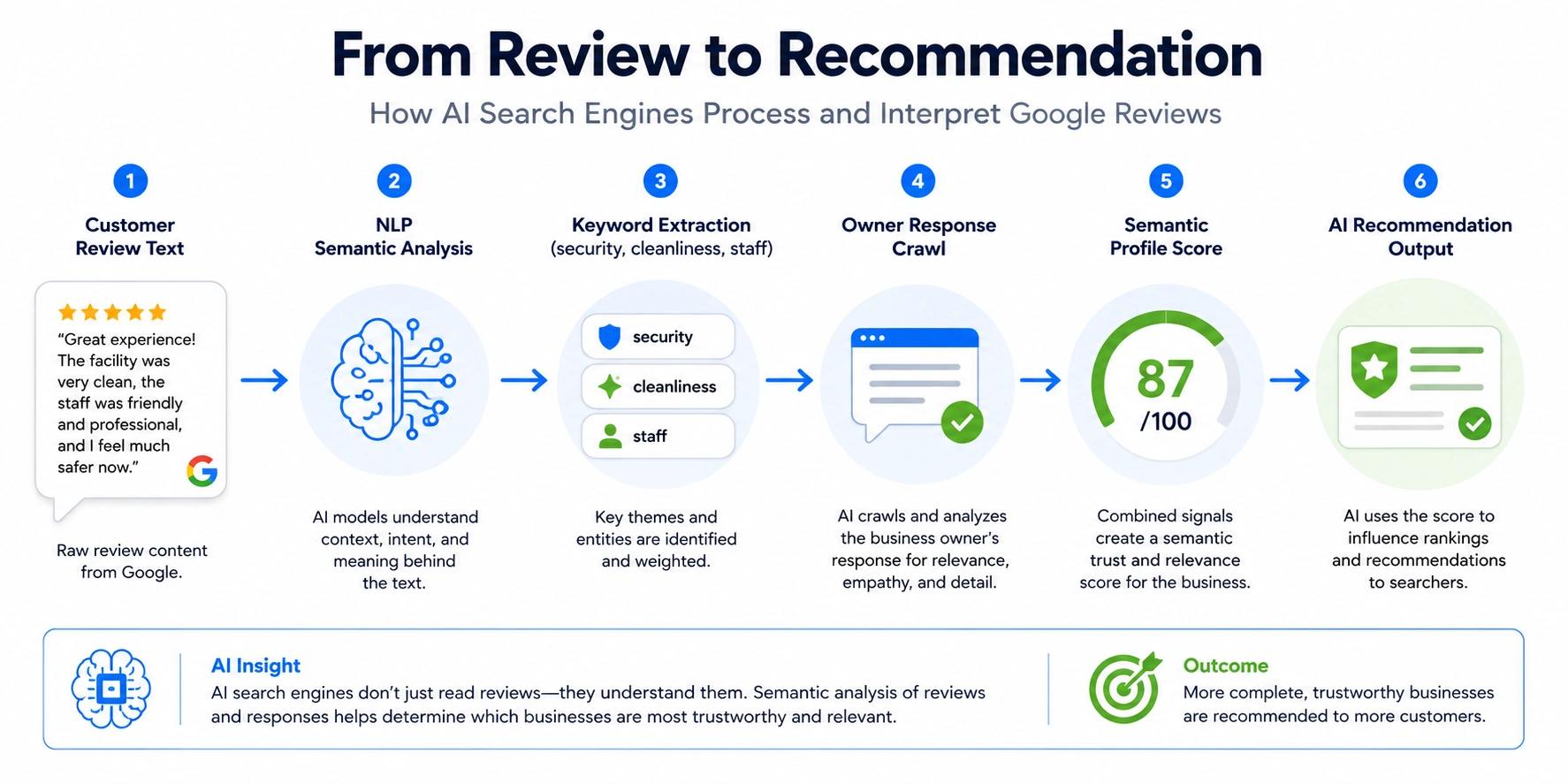
Infographic illustrating how AI processes customer reviews, extracts key topics, and uses semantic analysis to influence recommendations.
Comparing Local SEO Strategies for Self-Storage
Choosing how to manage your local SEO and review acquisition depends on your facility’s size, competitive density, and operational bandwidth. There’s no single right answer, but there are meaningful trade-offs worth understanding clearly.
DIY Local SEO Management works for single facilities in markets with limited competition. The cost is low, but the time investment is significant: manually requesting reviews, monitoring your profile, and crafting responses takes consistent effort that most owner-operators don’t have time for. In dense markets, the velocity you can achieve manually rarely keeps pace with what a systematic approach produces.
General digital marketing agencies offer broad SEO services but typically lack the operational context that makes self-storage reputation management work well. They don’t know that a tenant’s fifth gate visit is the ideal review request trigger, or that delinquent tenants should be excluded from automated outreach. That gap between general SEO knowledge and storage-specific operational triggers is where results tend to fall short.
Specialized self-storage SEO partners integrate directly with your property management systems to automate review requests ethically and safely, while building the location-specific optimization strategy that drives actual occupancy. For operators competing in markets where national REITs have established Maps pack positions, this is where the leverage is. The investment is higher, but so is the precision.
The Real-World Impact of Review Velocity
A self-storage facility in Fayetteville, Arkansas, was struggling to compete with three massive national REIT listings dominating their local Maps pack. Despite having only 45 reviews compared to the competitors’ average of 350, they implemented a systematic review velocity campaign targeting 8 to 15 new reviews per month. This rate sounds modest until you see what it does to a stale competitive landscape.
Within six months, their organic traffic grew from 191 to 2,993 monthly visitors. They secured a permanent Top 3 position in Google Maps, not by matching the REITs’ review count, but by outpacing their velocity.
That’s the mechanism: a competitor with 500 old reviews is losing ground every month while you’re gaining it. The gap doesn’t need to close; it just needs to reverse direction.
Navigating 2026 Google Terms of Service Compliance
As search engines become more sophisticated at detecting manipulation, the risk of cutting corners on review acquisition has grown significantly. Independent operators need to ensure their strategy is fully compliant: not because it’s the ethical thing to do, but because the penalties are severe enough to erase years of reputation-building overnight.
The Dangers of Review Gating
Review gating—filtering out unhappy customers before sending them to Google while routing only satisfied customers to your review link—is strictly prohibited under Google’s terms of service. This practice might seem like a minor optimization, but Google’s algorithms increasingly detect the behavioral patterns it produces. Violations can result in the removal of your entire review history or complete profile suspension. There’s no recovery path that doesn’t cost you months of visibility.
Ethically Gathering Real Feedback
Ask every customer for their genuine opinion, not just those you’re confident will leave five stars. A healthy review profile includes a natural distribution of ratings, and that mix reads as more trustworthy to prospective customers than a suspiciously perfect five-star average. When negative feedback comes in, treat it as operational intelligence. A tenant who complains about a broken gate light is giving you a free facilities audit.
Safeguarding Your Digital Asset
Your Google Business Profile is one of your facility’s most valuable long-term assets. Protect it by partnering with experts who understand reviews and reputation management compliance inside and out: not just the broad guidelines, but the specific behavioral patterns that trigger algorithmic scrutiny. Short-term tactics that put your profile at risk aren’t worth the temporary ranking bump.
Frequently Asked Questions
What is a healthy review velocity for a single self-storage facility?
For most independent facilities, a steady rate of 8 to 15 new reviews per month is the target. This volume keeps your profile fresh for Google’s algorithm and AI engines without triggering the spam filters that flag sudden, unnatural acquisition spikes. Consistency matters more than any single month’s total.
Can a facility with fewer reviews outrank a competitor with hundreds?
Yes, and it happens regularly. If a competitor has 500 reviews but hasn’t received a new one in six months, a facility with 50 reviews and a consistent velocity of two to three new reviews per week will frequently outrank them in local search results and AI recommendations. Review decay is real, and it works in your favor when you’re the one staying active.
Does Google penalize businesses that offer incentives for reviews?
Yes. Offering discounts, free rent, or gift cards in exchange for reviews violates Google’s terms of service. If detected, Google may remove all your reviews, suspend your Google Business Profile, or place a warning label on your listing, any of which severely damages your local search visibility. The risk-to-reward ratio makes incentive-based review programs a poor bet regardless of how common they seem.
How quickly do fresh reviews impact local search rankings?
Traditional SEO changes can take months to register, but improvements in review velocity and recency can positively impact your Google Maps visibility and AI search citation probability within 8 to 12 weeks of consistent acquisition. It’s one of the faster-moving levers in local SEO.
Should I respond to negative reviews, and does it affect my SEO?
You should respond to every review, negative or positive, and do it promptly. While negative reviews themselves don’t directly lower your ranking, your response rate and engagement level are measurable prominence signals. Responding to reviews makes consumers 89% more likely to trust and use your business. For a full framework on handling this well, mastering your online reputation is worth the read.
Maintaining a highly visible digital presence in 2026 means moving away from static metrics and into the dynamic logic of modern search. Review freshness, consistent acquisition velocity, and keyword-rich responses aren’t separate tactics: they’re a single integrated signal that tells Google, Perplexity, Gemini, and every other AI recommendation engine that your facility is active, trustworthy, and worth sending a neighbor to. Independent operators who build this rhythm don’t just compete with national REITs; they outmaneuver them in the local markets that actually drive occupancy. If you’re ready to stop guessing what Google wants and start building an AI-ready reputation, the team at BizIQ is here to help you establish a steady, compliant review rhythm that drives real business growth. Start by sending one follow-up to your last moved-out customer this week.
Ready to outrank the national brands in your local market?
Contact BizIQ today for a personalized Local SEO strategy session and let our experts build a high-velocity review engine for your self-storage facility. [Schedule Your Strategy Session]