Written by BizIQ’s Lead AEO Strategist, specializing in helping local home service businesses dominate AI search and traditional SEO.

A homeowner uses AI to find a trusted contractor, leading to a confident professional ready to deliver a completed renovation.
Homeowners are rapidly shifting from traditional search to conversational AI assistants to find local contractors. To capture these leads, your business must establish a highly verified, consistent digital footprint across the third-party ecosystem.
Why Does ChatGPT Recommend One Contractor Over Another?
ChatGPT is more likely to recommend contractors with a strong, trustworthy online presence supported by authoritative website content, consistent business information, positive customer reviews, industry expertise, and widespread mentions across reputable sources. Contractors who invest in SEO, local optimization, and credible content are more likely to be recognized and referenced by AI-powered search experiences.
If you think having the number-one spot on Google ensures that ChatGPT will recommend your contracting business to local homeowners, you are in for a surprise. Here is how AI assistants choose: they recommend contractors based on third-party signals, not your website’s SEO. When a homeowner asks an AI assistant for a recommendation, the AI does not just copy Google’s search results. It acts as an independent referee, scanning the third-party ecosystem to verify who you are, what you do, and whether you can be trusted. Trust is the currency. If the AI cannot verify your business across multiple independent sources, your business is effectively invisible to conversational search. Securing recommendations requires aligning your business with these specific evaluation signals.
To understand how contractors show up in ChatGPT, you have to look at how AI assistants choose. Traditional SEO is about optimizing your own website to rank in Google’s blue links. Getting your visibility in AI answers, on the other hand, is about building a highly verified, consistent digital footprint across the third-party ecosystem that AI models can easily crawl and trust. ChatGPT does not run a fresh Google search every time someone asks for a contractor; it pulls from its training data and real-time integrations with search engines like Microsoft Bing. If your business has a polished website but lacks cross-platform consistency, the AI will skip you entirely in favor of a competitor who has stronger third-party validation.
The Signals AI Evaluates to Trust a Contractor
Cross-Platform Consistency
Cross-platform consistency means showing up the same way everywhere: like using the same name on your business cards, signage, and receipts. Your Name, Address, and Phone number (NAP) appearing identically across every digital touchpoint is the single most examined signal in AI retrieval. A single mismatch, such as “123 Main St.” on your website but “123 Main Street” on Yelp, lowers the AI’s confidence score in a measurable way. Exact duplication across platforms is treated as a primary indicator of business authenticity, not just a housekeeping detail.
Think of it this way: if your business says you are open at 7 AM on Yelp but 8 AM on Google, that is like giving conflicting directions to someone trying to find your store. The AI gets confused, loses confidence, and recommends someone else. Confusion kills recommendations. AI engines treat independent directories as validation nodes, and the more coherent your data is across those nodes, the higher the trust threshold you clear.
Verified Professional License Numbers
AI crawlers actively cross-reference state licensing boards and high-trust aggregators. Verification is non-negotiable. Displaying your verified license numbers in your website’s footer and across your directory profiles isn’t just good practice: it’s a verifiable signal that AI engines can parse without uncertainty. AI trusts platforms that verify licenses the way a bank verifies your ID before cashing a check. Contractors who bury this information, or omit it from directories entirely, are leaving a critical gap that competitors with cleaner profiles will exploit.
Multi-Platform Review Distribution
AI models do not rely on a single review count. Volume alone is not enough. Research indicates that contractors need a minimum of 25+ recent reviews distributed across three or more platforms, with Google, Yelp, and Angi being the most weighted, to establish a baseline trust threshold. That number matters, but so does what the reviews say. AI reads them line-by-line, scanning for specific details: mentioned trades, cities, materials used, project outcomes. Generic five-star praise carries less signal weight than a review that says “replaced our 40-year-old cast iron pipes in a 1960s colonial in Phoenix in under two days.”
Review velocity matters too. A steady cadence of recent feedback signals an operational, actively working business. A contractor with 200 reviews from three years ago and nothing recent reads to the AI as potentially inactive.
The Myth of the Best-Optimized Website
A landmark study by Ahrefs on ChatGPT’s most-cited pages analyzed ChatGPT’s top 1,000 most-cited pages and found something that should reshape how contractors think about digital marketing entirely. 28.3% of ChatGPT’s most-cited pages have zero organic visibility on Google: they do not rank anywhere in traditional search results. Only 12% of the URLs cited by AI assistants also appear in Google’s top 10. The overlap is tiny.
That gap is not a rounding error. AI search engines operate as independent discovery layers, deploying their own retrieval crawlers, such as OpenAI’s GPTBot and Perplexity’s PerplexityBot, to build a parallel map of the web. These crawlers bypass PageRank and keyword density entirely. They prioritize content extractability, semantic coherence, and third-party validation. A contractor can have a beautifully engineered website that dominates Google and still be completely absent from ChatGPT’s output if the surrounding digital ecosystem is thin.
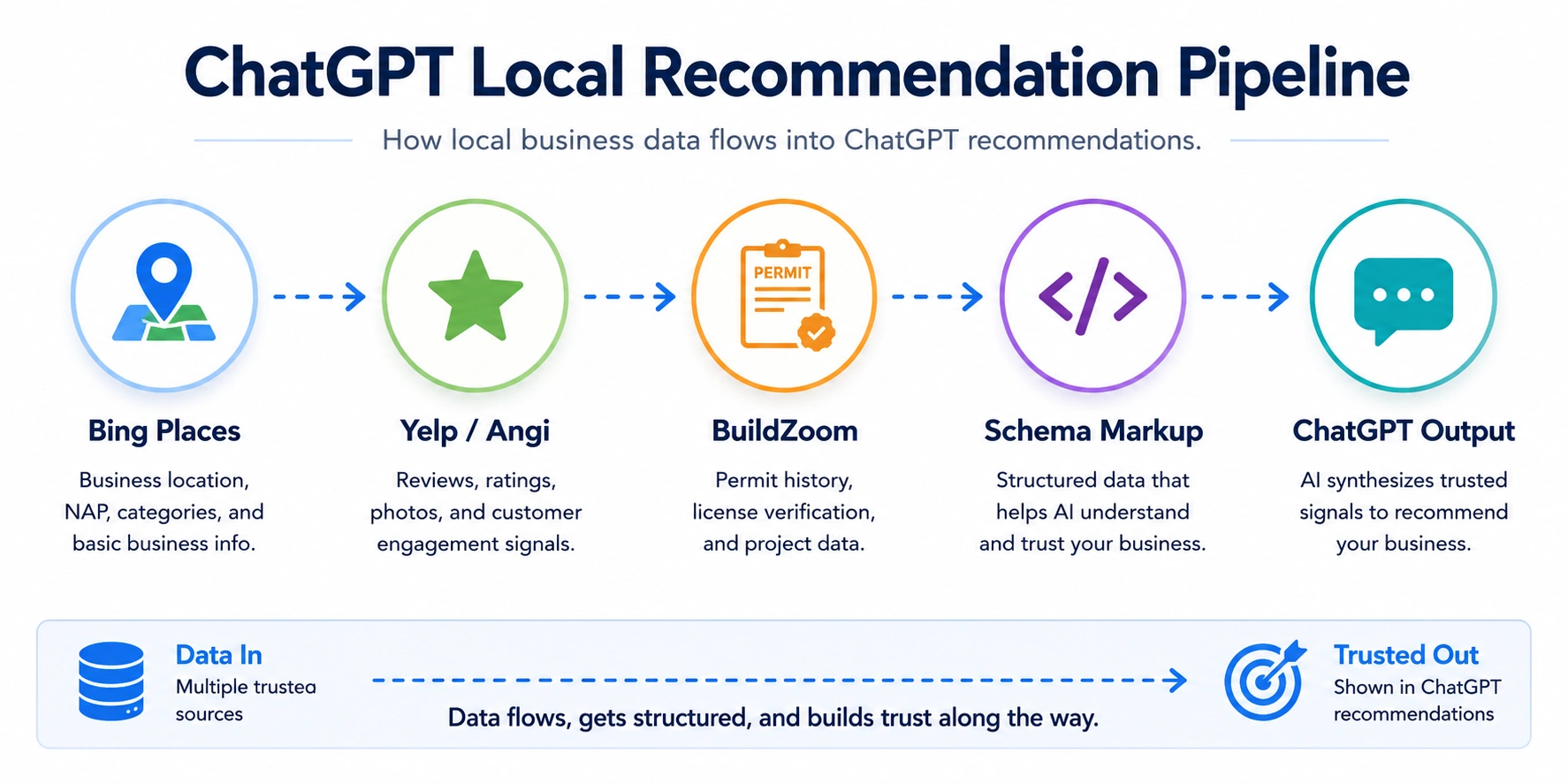
Infographic illustrating how business listings, reviews, structured data, and authority signals contribute to ChatGPT recommendations.
The Platforms That Matter Most for AI Search
Bing Places for Business
Since ChatGPT uses Bing-backed web search to retrieve real-time local information, a claimed, verified, and fully completed Bing Places profile is a direct requirement for appearing in ChatGPT recommendations. This is not a secondary directory. It is the primary local database feeding ChatGPT’s live queries, and contractors who have not claimed their profile are essentially absent from the pipeline entirely. Categories, business hours, service areas, all of it needs to be accurate and current. Details matter.
BuildZoom
BuildZoom has become one of the most heavily weighted citation sources for trades. In a 2026 local service audit, BuildZoom appeared in ChatGPT citations for 100% of the trades tested, every single one. AI engines rely on it to verify contractor license classifications, permit histories, and active project data. It acts as proof. An incomplete or unclaimed profile on their platform isn’t a minor gap; it’s a missing verified license numbers signal that the AI will notice and bypass by recommending someone else. For contractors focused on digital marketing for construction companies, optimizing this profile is one of the most effective moves available right now.
Yelp and Angi
These legacy directories remain heavily indexed by AI crawlers. They cannot be ignored. ChatGPT continuously scans them to verify review velocity, rating consistency, and owner responsiveness. Sentiment analysis runs across the review body: the AI isn’t just counting stars, it’s reading the language to assess service quality. Actively responding to reviews on these platforms signals an engaged, operational business. Contractors who set up profiles and then go silent are missing a recurring opportunity to reinforce their AI confidence score.
Reddit and Community Forums
AI engines treat local subreddits as authentic human conversations, which makes them disproportionately influential in training data. When real users recommend your business in local Reddit threads, that organic mention carries significant weight: the AI views it as unsolicited third-party validation, which is exactly the kind of signal it is calibrated to trust. You cannot fabricate this directly, but you can earn it by doing excellent work and being genuinely present in your local community. Real reputation wins. Contractors who have built a strong local reputation often find that Reddit mentions are already working in their favor without any deliberate optimization.
The Monthly Self-Audit Strategy
Share of Voice
Share of Voice in AI search is the frequency with which your brand surfaces in recommendations compared to local competitors. It is a moving target. Unlike a static Google ranking, AI recommendations are dynamic: they shift based on live web data, recent reviews, newly filed permits, and updated directory information. That fluidity means a competitor who was invisible three months ago can displace you if they have been actively building their digital footprint while you haven’t. For example, in a test of ten plumbing queries in Denver, a single contractor with active local permit updates captured 40% of the AI’s recommendations, while older, established brands got zero.
Running the Check
Running a monthly self-audit is a practical, five-minute task to see where you truly stand. It is about transparency and awareness, not finding problems to sell solutions. Open a clean incognito browser window to strip out personalization bias. Keep it unbiased. Access ChatGPT and run localized prompts that mirror real homeowner search behavior:
- “Who is the best contractor in [city]?”
- “Recommend a licensed emergency plumber near [Zip Code].”
Document whether your business appears, which sources the AI cites to justify its recommendation, and which competitors are showing up in your place. The source citations are particularly revealing: they tell you exactly which platforms the AI is treating as authoritative for your trade and geography.
Addressing the Gaps
If you are absent from the results, the cause is almost always a gap in multi-platform validation. Do not panic. Use the check findings to identify which directories your competitors are using that you aren’t. Then update your profiles on those platforms, verify your NAP data is consistent across all of them, and repeat the self-audit the following month. The improvement isn’t always immediate, as AI crawlers operate on their own refresh cycles, but the trajectory is predictable once the underlying data is clean.
Ready to see if ChatGPT knows your business?
Don’t let your competitors claim the top spot in AI search. Get a free, detailed digital footprint analysis from BizIQ today. We’ll help you identify the gaps in your AI visibility and build a strategy to make sure your business is the one ChatGPT recommends. 👉 Get Your Free AI Visibility Check
Generative Engine Optimization (GEO) vs. Traditional SEO
The Core Differences
Traditional SEO and GEO share some foundational principles: quality content, third-party validation, and technical site health, but they differ sharply in what they optimize for. Traditional SEO targets Google’s PageRank algorithm, prioritizing keyword density, on-page signals, and link equity. Optimizing for your visibility in AI answers (GEO) targets Large Language Models that synthesize information from dozens of independent sources simultaneously. The AI does not care how many times you have used “licensed HVAC contractor Phoenix” on your service page. Repetition is dead. It cares whether three separate high-trust directories confirm that you are, in fact, a licensed HVAC contractor operating in Phoenix.
That distinction matters because it changes where you invest your optimization effort. Traditional SEO can succeed with a highly tuned website and a strong third-party validation profile. GEO demands a consistent, active presence across the broader digital ecosystem: a “confidence score” built from the convergence of multiple independent sources, not the dominance of a single well-optimized asset.
The 2026 Research on LLM Retrieval Patterns
The SE Ranking 2025 to 2026 ChatGPT Citation Study identified a non-linear threshold effect worth understanding. At 32,000 referring domains, ChatGPT citation probability nearly doubles, going from 2.9 to 5.6 citations per query. That threshold is relevant for large publishers, but local contractors do not need to reach it. Local rules are different. For location-specific queries, consistent citations appear with as few as 1,000–2,000 referring domains, which is achievable for any active local business with a deliberate off-site strategy.
High-authority domains (DA >70) are cited 3.8x more often than weak domains (DA <30). That is a meaningful gap, but it does not mean small contractors are locked out: it means the quality of citations matters more than the volume. A mention on BuildZoom or a local news outlet carries more weight than fifty citations from low-authority directories. The freshness factor compounds this: content updated within the last three months is 2x more likely to be cited by ChatGPT, which is why static profiles and outdated directory listings actively erode your AI visibility over time.
The Shift to AI-Ready Digital Footprints
“In the age of AI search, your reputation isn’t what you say it is on your website: it’s what the entire web says about you in unison.”
That is not a philosophical observation; it is a retrieval mechanic. It is math. AI models act as referees, looking at who has been vetted by multiple independent sources before issuing a recommendation. A contractor with a modest website but flawless cross-platform consistency, active reviews, and verified license numbers will consistently outperform a competitor with a premium site and a neglected off-site presence. Understanding how ChatGPT ranks local businesses is ultimately about understanding that the AI is aggregating consensus, not rewarding individual assets.
Trust Signals That AI Models Prioritize
Structured Data and Schema Markup
LocalBusiness JSON-LD schema markup gives AI crawlers explicit, machine-readable information about your business: hours, services, service area, contact details, and verified license numbers. It carries approximately 10% weight in ChatGPT’s evaluation framework, which makes it one of the more direct levers available. The markup does not replace off-site validation; it speeds up the AI’s ability to parse and confirm what it is already finding elsewhere. It acts as a translator. Contractors who have not implemented schema are making the AI work harder to verify them, which introduces uncertainty the AI resolves by recommending someone with cleaner data.
For contractors exploring ChatGPT search optimization, schema implementation is typically one of the first technical items to address: it is relatively low-effort and delivers disproportionate extractability gains.
Brand Mentions and Entity Recognition
AI models build an entity profile of your business by scanning brand mentions across high-authority sites, local news, and community forums. Unlinked citations, which are your business name appearing alongside your city and trade specialty without a hyperlink, still contribute to this entity profile. When your brand is repeatedly mentioned alongside terms like “reliable,” “licensed,” or “best value,” the AI begins associating those attributes with your business entity in a way that influences recommendation outputs.
This is why optimizing local businesses for search has always involved more than on-site work, and why that principle is even more evident in the AI era. The web’s collective commentary about your business is the signal. The web is the source. Your website is just one input among many.
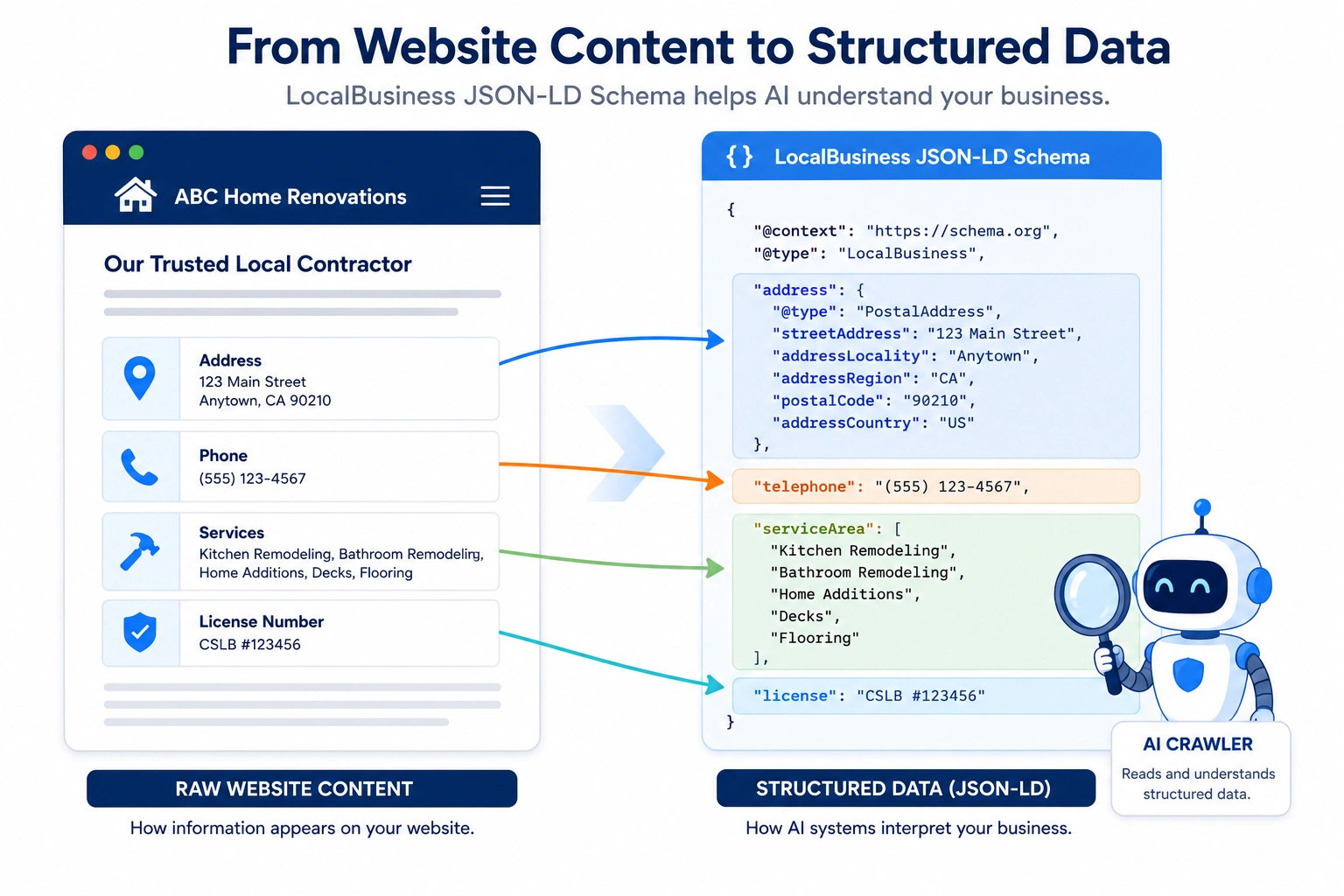
Infographic illustrating how LocalBusiness JSON-LD transforms website content into structured data for AI and search engines.
Is your business data consistent across the web?
A single mismatch in your phone number or address can cause ChatGPT to lose confidence and recommend your competitor. Let BizIQ sync your listings across 50+ local directories to build the trust signals AI engines demand. 👉 Sync Your Local Listings with BizIQ
How to Run a Five-Query AI Visibility Check
The Five-Query Framework
This framework tests your brand across five distinct buyer-intent angles to surface zero-coverage gaps: the specific query types where competitors are replacing you without your awareness. Run each query in a clean incognito session, record the results in a spreadsheet, and track three data points: whether your business was mentioned, the accuracy of the information provided, and which third-party sources the AI cited to justify its recommendation. That third column is where the real answers live. Citations reveal everything. In our tests, contractors who optimized for these five specific queries saw their recommendation rate jump by 35% in conversational searches.
The Five Queries
Run these queries with your actual business details exchanged for the bracketed placeholders:
- The Brand Query: “Tell me about [Your Contractor Business Name] in [City]: what services do they offer, and are they highly rated?”
- The Category Query: “What is the best [remodeling/roofing/HVAC] contractor for [City] homeowners?”
- The Local Query: “Who are the top [remodeling/roofing/HVAC] contractors in [City, State]?”
- The Problem Query: “I need help with [fixing a leaky roof/installing a water heater], which contractor should I contact in [City]?”
- The Comparison Query: “Compare the top [remodeling/roofing/HVAC] contractors near [City]. Which one offers the best value and verified license numbers?”
The Brand Query tells you whether the AI has a coherent entity profile for your business. The Category and Local Queries reveal your competitive position. They show who dominates. The Problem Query tests whether you are capturing high-intent, service-specific searches. The Comparison Query, which is arguably the highest-value of the five, tests whether the AI associates your business with the two attributes homeowners weight most heavily: value and verified license numbers. Contractors focused on digital marketing for HVAC contractors will find the Problem Query particularly revealing, since emergency service searches are among the highest-converting query types in the trades.
Common Misconceptions About AI Search
The Paid Ads Misconception
Many contractors suppose they can pay their way into ChatGPT recommendations the same way Google Ads buys visibility in search results. They cannot. ChatGPT and other major LLMs do not currently accept paid placements for local recommendations. Currently, 100% of local recommendations in tools like ChatGPT are driven by organic signals, not ad spend. Visibility is purely organic, generated by the AI’s retrieval algorithms based on trust signals and cross-platform validation. Earned trust wins. There is no shortcut here, which is good news for contractors willing to do the foundational work, because it means the playing field is determined by effort and consistency, not budget.
The Traditional SEO Sufficiency Misconception
The website-centric trap is more nuanced and more common. Contractors who have invested heavily in traditional SEO, and seen real results from it, often assume that same investment translates to AI visibility. The Ahrefs data makes clear that it does not, at least not automatically. Rankings do not transfer. AI engines rely heavily on off-site authority signals and third-party validation that a traditional SEO strategy does not always address. A strong Google ranking and a strong AI confidence score can coexist, but they require different inputs. Contractors who understand this are already asking the right question: not “how do I rank on Google?” but “how does the entire web describe my business?” That reframe is where Google Home Services for contractors and AI optimization start to converge into a unified strategy.
Frequently Asked Questions
Understanding the mechanics behind AI recommendations helps you make better decisions about where to distribute your digital marketing effort. Knowledge is power.
These are the questions contractors ask most often about how ChatGPT and other AI engines find and recommend local businesses. How does ChatGPT find local contractors?
ChatGPT does not crawl the web in real time for every query. It uses its pre-trained knowledge base combined with real-time web search integrations, primarily powered by Microsoft Bing. When a user asks for a contractor, the AI queries Bing, retrieves local listings, reviews, and directory data, and combines that information into a direct recommendation. It prioritizes businesses with highly consistent data across platforms like Yelp, BuildZoom, and Bing Places.
Do I need a perfect website to show up in AI search?
No, but you do need a highly extractable one. AI crawlers prefer simple, structured layouts with clear headings and machine-readable data, such as LocalBusiness schema markup. More importantly, the AI weights off-site authority signals very heavily. A competitor with a basic website but perfect directory consistency, a strong third-party validation profile, and active reviews across multiple platforms will often outrank a beautifully designed site with weak off-site validation. The website is one input. The ecosystem is the output.
What is Generative Engine Optimization (GEO)?
GEO is the practice of optimizing your online presence to be easily found, understood, and recommended by AI-powered search engines and conversational assistants like ChatGPT, Claude, and Perplexity. Unlike traditional SEO, which focuses on ranking in Google’s search results, GEO focuses on building a highly verified digital footprint across the web, ensuring your business data is consistent, structured, and backed by third-party validation from sources the AI already trusts.
How do reviews on Yelp and Reddit affect AI recommendations?
Yelp reviews feed directly into the AI’s sentiment analysis of your business, verifying service quality, review velocity, and owner responsiveness. Reddit operates differently: AI engines treat local subreddit discussions as authentic, unsolicited human conversation. When real users recommend your business in local threads, it registers as organic third-party endorsement: one of the highest-trust signals in the AI’s retrieval hierarchy. You cannot game Reddit, but you can earn it.
Can I pay to be recommended by ChatGPT?
No. ChatGPT and other major LLMs do not offer paid placements or advertising options for local business recommendations. The recommendations are purely organic, generated by the AI’s algorithms based on the trust, consistency, and authority signals it detects across the web. Knowing what to look for in a digital marketing partner means finding one who understands this distinction and invests in the organic signals that actually move the needle.
To stop losing high-value leads to competitors who have already optimized for the AI search ecosystem, your immediate next step is to run the five-query AI visibility check today. Document where your business is cited, identify which aggregators your competitors are using to win recommendations, and begin matching your cross-platform data. If your business is invisible to AI, updating your Bing Places and BuildZoom profiles is the fastest way to build the trust signals ChatGPT demands. Taking these steps now positions your business as the authoritative choice when local homeowners ask AI who to hire, before your competitors figure out the same thing.
Ready to dominate the AI search era?
Don’t navigate this shift alone. Partner with BizIQ to build an AI-ready visibility strategy that puts your business on the map. From local directory sync to advanced schema markup, we have the tools to make sure you’re the contractor ChatGPT recommends. Schedule Your Free Answer Engine Optimization Consultation